Quantcast

It by Stephen King

It by Stephen King is more than 1,000 pages and very detailed; set in Derry, Maine, (a fictional town) evil lurks beneath the city streets and in the sewers.  This novel has everything readers are looking for in a book:  family drama, coming of age story, friendship, an evil clown that is much more sinister than he looks, mysticism, a highly detailed world, and triumph.  The main characters are young kids — six boys and one girl — who are the misfits in school for one reason or another and whose families are loving for the most part, though there are a few with messed up parents.  The town is at the center of a rash of child killings and the killer is still on the loose in 1958, and their parents and the town adopt a strict curfew.  Bill, however, is the most touched by It when his brother is killed by the silver-suited clown with orange pom-pom buttons, and his family begins to pull away from one another, leaving Bill to blame himself.

“Smells of dirt and wet and long-gone vegetables would merge into one unmistakeable ineluctable smell, the smell of the monster, the apotheosis of monsters.  It was the smell of something for which he had no name:  the smell of It, crouched and lurking and ready to spring.  A creature which would eat anything but which was especially hungry for boymeat.”  (page 6)

The kids — Ben, Bill, Richie, Mike, Eddie, Stan, and Beverly — join together to form the Losers club and stand up against the town bully, Henry Bowers and his cronies on more than one occasion.  Readers are left in the dark as to how the gang gets rid of It until the very last 200 pages, but it is worth the wait as King allows his readers to get to know each character so well that they become friends.  Readers feel like they are part of the gang, and they begin imagining their worst nightmares come to life when It arises from the sewers to take another child or to taunt the Losers.  King is adept at handling seven major characters and showing readers facets of their personalities and back stories like no other author.  His prose is not flowery and is very straightforward, but he captures the emotions and thoughts of all of his characters well, making them vivid and real.

In a world where evil lurks to strike at any moment and without warning, readers are taken on a Herculean journey in which seven children believe that they are the only ones capable of stopping It from destroying more families’ lives and taking the town down.  Belief and faith play a major role in the book, and King raises a great many questions about the role they play in having power over each of us as individuals.  Some instances of faith and belief can be good and positive, but others can be utterly destructive.  Like most of us, each of the members in the Losers Club has a crisis of faith and this is when they become the most vulnerable to It.

Through a back and forth narrative between 1958 and 1985, readers unravel the mysteries of Derry, the mysterious ritual that saves the town and is performed by mere kids, and are swept up in a journey that will leave them on the edge of their seats until the very conclusion.  It by Stephen King is a fantastic read even the second time around.  One of the best King has written.

I read this is part of the Stephen King’ It Read-a-Long I co-hosted with Diary of an Eccentric.  Please visit the more in-depth discussions for Part 1, Part 2, Part 3, Part 4, and Part 5.

The Strangers on Montagu Street by Karen White

The Strangers on Montagu Street by Karen White combines historical mystery with romance, drama, and Southern hospitality, like all of the other books in the series, reuniting readers with Jack Trenholm — famous author — and Melanie Middleton — real estate agent for historic Charleston homes and resident, if reluctant, ghost whisperer.  Melanie can be whiny and she can grate on readers nerves with her penchant for denying her feelings for Jack and her rocky relationship with her parents.

However, in the latest installment, readers are introduced to a more evolved Mellie, a woman who can relate to a angsty and sarcastic teen girl who shows up unannounced and claims to be Jack’s long-lost daughter, Nola.  Melanie can’t help but see herself in Nola, and a maternal instinct she never knew she had rises to the surface.

“He looked better than the last time I’d seen him, and I wondered whether it was because he didn’t have the daily stress of dealing with a teenager to age him.  Still, there was something in his eyes that didn’t quite match his usual self-assured Jack-ness.” (Page 73 ARC)

White has carefully crafted this story, meshing the Nola storyline with that of the ghost mystery on Montagu Street.  As always, Marc Longo is back and more underhanded than ever, and even Mellie’s cousin and Jack’s sometime girlfriend, Rebecca comes and stir things up.  In addition, it looks like there is more restoration work to eat through Melanie’s budget as the foundation needs repairs, and did I mention she’s feeling her age — especially as her mother and Nola help to remind her how old she’s getting?

White’s humor is subtle at times and at others it’s quite obvious, but what is most engaging is her characterizations and how different and real each feels to the reader.  The Strangers on Montagu Street is the third book in the series, but it may not be necessary to read the other two before reading this one as the mystery stands alone, though if readers prefer to know the past struggles between Mellie and Jack it would be better to read the previous two.  White’s Tradd Street series is a cozy and perfect for holiday reading.

Of the three in the series, this is my favorite and since White has left me hanging at the outcome between Mellie and Jack’s latest entanglement, you can bet I’ll be reading the next one.

Reviews of White’s other books:

The House on Tradd Street (first book in the series)
The Girl on Legare Street (second book in the series)
On Folly Beach
The Beach Trees

Henry Tilney’s Diary by Amanda Grange

Henry Tilney’s Diary by Amanda Grange provides readers with the inner thoughts and past of Northanger Abbey‘s hero.  Like his sister Eleanor, Henry has a passion for the written word, which mirrors Austen’s homage to readers in the original novel.  Grange steeps her prose in Gothic tales of secret passages and story telling between brother and sister and between Henry Tilney and Catherine Morland.  Drawing inspiration from Mrs. Radcliff and her novels, A Sicilian Romance and The Mysteries of Udolpho.

Unlike Austen’s version, Tilney reads Gothic novels for pleasure, a pleasure he shares with his sister, and while he remains very logical in his thinking about finding a wife, he is soon swept up by the charms of Catherine.  His requirements in a wife are listed on more than one occasion with a tongue-in-cheek sense of humor.

“‘When I marry – if I marry – my wife must love to read.  I shall make it the one condition.  Her dowry is unimportant, her family is irrelevant, but she must be a lover of novels, or else no wedding can take place!'” (page 63)

Although he does say that she must love novels, he also realizes that a love of novels can go too far, and in that way Grange has paralleled the character development of Catherine in the original Northanger Abbey.  Through diary entries, readers come to know Tilney more intimately as he worries for his brother and his sister and grows increasingly concerned about his father’s seeming change of heart where money and titles are concerned.  Tilney grows from a younger son into a man of his own means and career, but he is still loyal to his family despite his budding feelings for Catherine.

Another winner from Grange that builds upon the character arcs and complex story lines left behind by Austen.  Her Tilney is a kind, gentle man with a clear vision of how his life should be, and while he remains loyal to his family, his heart guides his move.  His frank nature and his compassion bloom in Grange’s hands.  Austinites and those looking for a well-paced romance with Gothic highlights will enjoy Henry Tilney’s Diary.

I’d like to see Grange tackle a few more villains in her diary series of books!

About the Author:

Amanda Grange was born in Yorkshire and spent her teenage years reading Jane Austen and Georgette Heyer whilst also finding time to study music at Nottingham University. She has had sixteen novels published including six Jane Austen retellings, which look at events from the heroes’ points of view.

If you haven’t entered the giveaway to win you’re own copy, please check out the guest post.

The Unexpected Miss Bennet by Patrice Sarath

The Unexpected Miss Bennet by Patrice Sarath tackles the enigmatic figure of Mary Bennet, the third oldest of the Bennet sisters.  She’s the one considered unremarkable and religious in the original novel, Pride & Prejudice.  Here readers will see the struggles of Mary as she finds that she is often ignored or laughed at on almost every occasion.  She turns to sermons and music for solace, though she notes that despite the many hours she spends practicing, she is unable to improve her musical talents.

“It is a comforting belief among much of society, that a plain girl with a small fortune must have no more interest in matrimony than matrimony has in her.”  (page 1)

Sarath’s Mary has grown from the quiet girl, who was content to remain in the background.  Although she’s not sure what she wants out of life, she certainly realizes that her life is not where she wants it to be and that she wants to find a man who is her equal and to be more than her mother’s keeper or a possible governess to her sister Jane’s unborn children.  Jane and Lizzy have bigger plans for their sisters, Kitty and Mary, and plan to expose them to a greater society.  They hope that through their stay the younger sisters can find happiness, but this is Mary’s story.

Sarath has expanded upon Austen’s Mary, and readers can watch her grow into a more confident woman.  Her happiness begins to shine and it rubs off on those around her.  Rather than weave a story about Mary’s pious nature and place her in the path of a clergyman, Sarath guides Mary with deft prose to become more independent from her family and her sisters.  However, there are those moments when Mary doubts her own decisions and resolve, but so too would any woman of her societal standing who is often overlooked by men of her acquaintance as a suitable match and who is considered to be plain.

Readers favorites from Mr. Darcy and Lizzy to Lady Catherine and Anne de Bourgh round out the cast, but the colorful and rambunctious Mr. Aikens captures some of the spotlight as he shows up at inopportune moments and disrupts the decorum of Regency society with his amiable nature and constant rambling about horses.  Sarath’s characterization of Aikens helps offset the quirkiness of Mary in a way that will endear her to readers, who will see her faults as charming foibles of a well-meaning woman.

The Unexpected Miss Bennet by Patrice Sarath is less a commentary on how the wall flower blooms, but rather how as we grow into the adults we’re meant to be, we can surprise even ourselves.  Sarath has a talent for keeping the language modern, the characters vivid and evolving, and the story engaging.  Another Austenesque novel that should be read by those who love Austen and her characters.  Hopefully, Sarath has another novel planned for Kitty Bennet.

To enter the giveaway for 1 copy (US/Canada):

1.  Leave a comment about what has surprised you about your adult self when you look back on how you viewed yourself as a younger person.

2.  Spread the word on Twitter (@SavvyVerseWit), Facebook, or a blog, and leave a link for up to three more entries.

3.  Leave a comment on the guest post for another entry and let me know on this post.

Deadline Dec. 14, 2011, at 11:59PM EST.

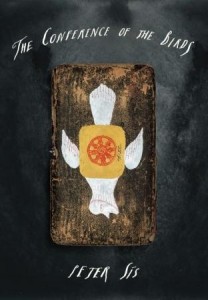
The Conference of the Birds by Peter Sis

The Conference of the Birds by Peter Sis, an acclaimed children’s author and illustrator, has taken his skills to a 12th century Sufi epic poem of the same name written by Farid ud-Din Attar, who was not only a poet but a mystic.  Often these types of poems have a hidden spiritual meaning, and Sis deftly captures the essence of Attar’s poem with illustration.

In this illustrated version of the epic poem, the pictures speak for the poet, Attar who wakes from a dream to realize he’s a hoopoe bird.  Once he transforms, he calls all of the birds of the world together to find their true king, Simorgh, by flying through the seven valleys — The Valley Of Quest, The Valley Of Love, The Valley Of Understanding, The Valley Of Detachment, The Valley Of Unity, The Valley Of Amazement, and The Valley Of Death — to reach Mountain Kaf.

In the beginning, the transformation of Attar is shown much like animated cartoons would have been created, with the flipping of each panel where each image has slight differences to create the illusion of movement.  Once the birds agree to take the journey, it is clear that it will take them through a number of valleys that will test their resolve, with each bird’s skills and weaknesses hammered by adversity and uncertainty.  Sis creates vivid birds of various colors and species.  Even if the pages of this book were not textured, readers could see the feathers and layers on these birds.

And there are many layers to these birds, their feathers, and their story.  The poem sheds light on the inner spiritual journey each of us travels, the trials that we face, and the perseverance it takes to stay on course and believe in ourselves.  For some the journey is too hard, and they turn back, but for others, it is important enough to move onward despite the risks and sorrow.  Like the poem, The Conference of the Birds by Peter Sis is multilayered, with great attention to detail from the feathers on the birds, the birds making up the larger birds, and the trees that create the mountains.  A gem of a book from an illustrator and writer who sees beyond just the words to the world it creates and the messages it brings.  Likely to be on the best of list for the year.

As an aside, I read this a couple of times carefully and with my infant daughter. She loved feeling the pages and looking at the vivid imagery, and I can tell you that keeping her attention for an entire book is difficult. This is great for kids and adults. Sis has created something of lasting beauty.

About the Author:

Born in Brno, in the former Czechoslovakia, in 1949, Peter Sís is an internationally acclaimed illustrator, author, and filmmaker. Most recently, in 2007, he published The Wall: Growing Up Behind the Iron Curtain, which was awarded the Robert F. Sibert Medal and was also named a Caldecott Honor Book. Peter Sís was named a MacArthur Fellow in 2003. He is the author of twenty children’s books and a seven-time winner of the The New York Times Book Review Best Illustrated Book of the Year.  Please check out his Web page.

Please check out this video interview from BEA:

According to the Seattle Post-Intelligencer, Sis pays homage to traditional Islamic art and its figurative representations and geometric patterns as the valleys are depicted as a series of mazes.  (Seriously, read that review, it is stunning).


If you’d like to check out the rest of the tour, please click on the TLC Book Tour icon at the right.


This is my 29th book for the Fearless Poetry Exploration Reading Challenge.


This is my 66th book for the 2011 New Authors Reading Challenge.

Her Sister’s Shadow by Katharine Britton

Her Sister’s Shadow by Katharine Britton is aptly titled given that Lilli Niles has always felt like she is living in the shadow of her “perfect” sister Bea.  Bea takes on a guardianship role when Lilli is about 15 after their father dies and their mother loses touch with reality.  Lilli resents her “perfect” sister’s hold over the family and is even more angry about how Bea lords it over her when she wins crew races and is considered perfect by her mother.  Couple all of that resentment with hormones of adolescence and you can imagine the volatility.

Told in alternating chapters between the past and the present when Lilli returns to White Head, Mass., after 30 years when her sister Bea calls and needs her, Her Sister’s Shadow vividly tells a story of healing after a significant rift between sisters.  Readers will feel the angst of a young Lilli who has just discovered boys and wants to grow up more quickly and the awkwardness of Lilli and Bea who attempt to reconnect after 30 years.

“When she was a girl, after the accident, she would go down onto the rocks, pick her way carefully along their slick surface, and shout her grief and guilt into the deep bass notes of that foghorn.  Her kitchen, all stillness in pools of white light, offered no such camouflage.”  (page 4)

Britton creates characters that are real, flawed, and seeking redemption through their actions even if they are unaware of it.  While Lilli’s relationship with Bea is strained, her relationship with Dori, her younger sister, is sweet and unbreakable.  Lilli’s relationship with Charlotte is more like a mother-daughter dynamic in which Charlotte is a caretaker and empathetic.  There is a great deal at work in these female relationships; their complexity is stunning and palpable.  Each sister is drawn realistically, causing readers to become attached to each one.  It is through this relationship with the reader, that Britton tugs tears out and causes wistful smiles to curl.

Bea’s shadow is not the only one looming over this book.  Britton has crafted a devastating novel through which readers and characters must journey to reach out of the fog and into the light.  Her Sister’s Shadow has a gorgeous setting steeped in coastal imagery that mirrors the churning ocean waves of these relationships which every so often smooth out to reflect the stars and beauty of calm.

About the Author:

Katharine Britton has a Master’s degree in Creative Writing from Dartmouth College. Her screenplay, Goodbye Don’t Mean Gone, was a Moondance Film Festival winner and a finalist in the New England Women in Film and Television contest. Katharine is a member of the League of Vermont Writers and PEN New England. She teaches writing at Colby-Sawyer College, and is an instructor at The Writer’s Center.

When not at her desk, Katharine can often be found in her Norwich garden, waging a non-toxic war against the slugs, snails, deer, woodchucks, chipmunks, moles, voles, and beetles with whom she shares her yard. Katharine’s defense consists mainly of hand-wringing, after-the-fact.

Please follow her blog and Facebook.

To Enter for 1 copy of Her Sister’s Shadow by Katharine Britton: (US/Canada only):

1.  Leave a comment about what kind of relationship you have with your sister or whether you would enjoy having a sister if you don’t have one.

2.  Follow Katharine Britton on Facebook and leave a comment for another entry telling me you did so.

3.  Facebook, Tweet, or Blog about the giveaway and leave a comment with each for up to three more entries.

Deadline Oct. 28, 2011, at 11:59PM EST


To visit the other stops on the TLC Book Tour, click on the icon at the right.


This is my 62nd book for the 2011 New Authors Reading Challenge.

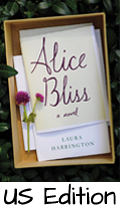
Alice Bliss by Laura Harrington

Alice Bliss by Laura Harrington is a coming of age story about a teen girl growing into adulthood at a time when her father, Matt, is sent to Iraq and her mother, Angie, is not dealing with his absence as well as Alice thinks she should.  The blissful life her family has had up until this point is turned around and twisted as Alice takes on more of her mother’s duties — making dinner, washing clothes, getting her sister’s (Ellie) lunch ready, and getting her sister to school.  She’s constantly worried about her father not returning home, about how she seems not to be anyone’s favorite, and the changes she sees in her friends, family, and Henry (her neighbor and friend).

Harrington creates a world and cast of characters that grab your heart and don’t let go.  The Bliss family story will have your tearing up right from the beginning when the father is first setting his affairs in order and explaining to Alice what she’s to do while he is at war.  Yes, he says, he is coming back, but readers know about the uncertainties of war and so does Alice, which makes his parting all the more heart-wrenching.  Alice only finds solace when running, like her mother finds solace when swimming, but they are too alike to find comfort in one another and often find themselves at odds.  Dynamic characters young and old tackle difficult questions of how to go on without a loved one, who often calmed the waters and even when that situation is expected to be temporary.

“This is the first time Alice has been allowed to walk back to their campsite from the Kelp Shed alone.  She is fourteen, barefoot, her sneakers tied together by the laces and slung across her shoulder so she can feel the soft, sandy dust of the single-track road between her toes.  Her sister fell asleep halfway through the square dance, dropping from hyperexcited to unconscious in a flash.  Her father carries Ellie draped over his shoulder, and casually, or so it seems, her mother says, ‘Come home when the dance is done.'” (page 1)

While Alice is a strong, young woman, she is also timid when it comes to her changing relationship with Henry and volatile when it comes to her relationship with her mother and sister and her schoolmates.  Alice’s life spirals out of control while she’s daydreaming and running away, but there are moments of hope when letters arrive and broken up phone calls pepper their days.  Alice is growing up before readers’ eyes.  She’s learning that her friendship with Henry is more complicated than she expects and at a time when she wants it to stay the same.  She’s flattered when a popular senior asks her to a baseball game, and she’s disenchanted with high school society when her childhood friend Steph remains distant even when it is obvious she needs someone to lean on.  Her sister Ellie tries to act more mature than her sister, and does on some occasions, but she’s still just eight and what’s important to her — a new haircut, new clothes, a nice lunch — skirts the realities of their lives without Matt.

Uncle Eddie and Gram are the rocks of the family that help hold up Angie, Alice, and Ellie — keeping them from imploding.  Harrington has created a wide cast of characters who evolve steadily throughout the novel.  Despite the third person omniscient point of view, Harrington’s narrative evokes an emotional connection between the characters and the reader.  The distance often felt with this point of view is not present here in the least.  Readers will feel the loss, the waiting, the anger, the sadness, and the confusion all at once — just as the characters do — while cheering them on to remain positive that Matt will return home.  This is a young adult novel adults will praise for its realistic portrayal of adult themes, while young adults will praise the relate-ability of its teen characters and their situations.

“Even though Mrs. Grover wears those awful sensible shoes and has gray hair that she wears in a bun, Alice thinks that maybe Mrs. Grover is still young in the ways that are important.  Like she’s not so serious all the time, and she sings and right now she’s teasing a cardinal.  Whistling in response to its call and damn if that cardinal doesn’t whistle right back.  Alice’s mother doesn’t even have a clothesline, let alone stand outside and lift her face to the sun and sing and whistle to the birds.” (page 101)

Harrington is talented at creating a world that is real — a small town where everyone knows one another and feels as though they are under a microscope at home and school — and generates an atmosphere of fear and uncertainty — in the silence of waiting.  What are those keepsakes that we hold dearest? What are those memories that we hold onto tightest? Alice and her family find these answers and more, making the novel even more suspenseful.  Alice Bliss not only tracks the evolution of Alice from child to adolescence and the bumps along the way, the novel teaches readers about heartache, compassion, and strength.

About the Author:

Laura Harrington’s award winning plays, musicals, operas, and radio plays have been widely produced in the U.S., Canada, and abroad. Harrington is a two time winner of the Massachusetts Cultural Council Award in playwriting and a two time winner of the Clauder Competition for best new play in New England for Mercy and Hallowed Ground.

“Alice Bliss”, a novel, published by Pamela Dorman Books, Penguin/ Viking, will be on sale spring 2011. She is currently writing a new novel, “A Catalogue of Birds,” as well as a song cycle with composer Elena Ruehr, and a series of choral works with composer Roger Ames. Ms. Harrington teaches playwriting at M.I.T and is a frequent guest artist at Tufts, Harvard (where she was a visiting Briggs Copeland Lecturer), Wellesley, University of Iowa, and other campuses.

Please also check out this great Q&A, an excerpt from the novel, and her blog.


This is my 59th book for the 2011 New Authors Reading Challenge.


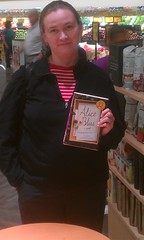
Alice blissI took part in the experiment to see where this book would end up once I read, reviewed, and released it into the world.  So, here’s a picture of me releasing it into the wilds of Maryland (Ok, its a Safeway/Starbucks Cafe).

I toyed with releasing it in a bookstore, at the library among the library sale stacks, and finally decided to release it in the Safeway near my house in their Starbucks Cafe.  It was done surreptitiously and I was incredibly self-conscious.  Nevermind that this is a book I really didn’t want to let go because I loved it so much.

I may just have to buy my own copy of this book to add to my shelves and read it again.  It was THAT GOOD!


Guest Post & Giveaway: Liza Gyllenhaal’s Move to Rural Inspiration

Today’s guest is Liza Gyllenhaal, author of So Near, and she’s going to share with us her writing space.

But first, let’s take a look at her book.  According to Amazon.com’s synopsis, “In the aftermath of a devastating loss, Cal and Jenny Horigan’s marriage is unraveling.  Both are plagued by guilt, unable to seek comfort from one another.  Burdened by remorse, they begin to lose sight of the love that once anchored them-together with their sense of right and wrong.  As the Horigans try different ways to deal with their pain, a new acquaintance seems to offer the support they desperately need-though at times they are unsure whether his guidance is leading them back to each other or further apart.”

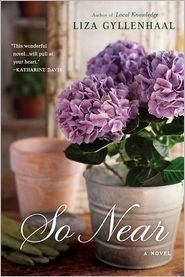
Look at that cover, those big flowers are just so eye-catching and remind me of spring and renewal.  Let’s hope the same renewal can happen for Gyllenhaal’s characters, which you can find out if you win the giveaway. 

For some reviews of So Near, please check out Life in the Thumb and 5 Minutes for Books.

Without further ado, please welcome Liza Gyllenhaal:

Where Liza works in the winter

During the years I worked in advertising in New York City, I would try to fit in an hour or two of writing every morning in my cramped apartment. I used to dream of one day having my own writing studio. If Henry James thought “summer afternoon” were the two most beautiful words in the English language, I began to feel that “writing studio” took a close second. I imagined it in the woods somewhere with a fireplace or wood-burning stove — rustic and musty and so quiet you could hear the mice scrabbling around in the walls.

Writing studio in the Berkshires

Fifteen years ago, I was able to sell my advertising agency and buy my dream — a place in the country — or, more specifically, the beautiful Berkshire Hills of Western Massachusetts. It included a small farmhouse and an old horse stable which became my “writing studio.” It still has the old iron stall feeders and leather harnesses on the walls. It remains permeated by a wonderful smell of animal and old hay. It’s where I wrote most of my first novel Local Knowledge and my just published new novel called So Near — both set in the Berkshire area.

Liza inside the studio — on the laptop

I wake up early and reread and rewrite on my laptop in the house, but in the afternoon I go out to the studio, bolt the door, and start the hard work of writing the next new word, sentence, paragraph, chapter. In the winter I have a fire going in the Jotul stove, in the summer I have all the windows open and can hear the seasonal brook and birdsong. This summer, I watched a family of wild turkeys — 17 in all — parading up and down in the old paddock. Other sightings: woodchuck, coyote, fox, and early last spring, when the trees were just greening out, a big black bear. It was a breathtaking moment when this wall of darkness lumbered right past me — so close that, if the window had been open, I could have reached out and run my hand through the bear’s ink-black fur.

Thanks so much for sharing your writing space with us, Liza.

Sounds like a place I’d love to visit just for some down time and relaxation, though I do more writing in public places where there are lots of people to watch!

About the Author:

She was raised in a small town in Pennsylvania which, at the time she was growing up, was fairly rural and very lovely—much like the area of the Berkshire Hills in Massachusetts where she now live part of the time with her husband.

She studied poetry at University of Iowa Writing Workshop before moving to New York City and began a career in publishing and advertising.  She tried to continue writing poetry, but gradually moved to romance and other genres before her first novel.

In addition to writing, she works on behalf of various non-profits in New York City and the Berkshires. She also is the past chairperson of The Academy of American Poets and currently serves on its executive committee. (– excellent news to me since I just love that organization, am a card-carrying member, and blog about it all the time — funny how small the world is sometimes).

Please follow her on Twitter and Facebook, and check out her blog.

Now for the giveaway.  I have 2 copies So Near for US/Canadian readers.

1.  To Enter, leave a comment about where you do your blogging or reading and why.

2.  Facebook, Tweet, or blog about the giveaway for additional entries. (for up to 3 other entries).

3.  Follow this blog for another 2 entries. If you already follow, let me know.

Deadline for the giveaway is Sept. 30, 2011, at 11:59PM EST.

Ten Beach Road by Wendy Wax

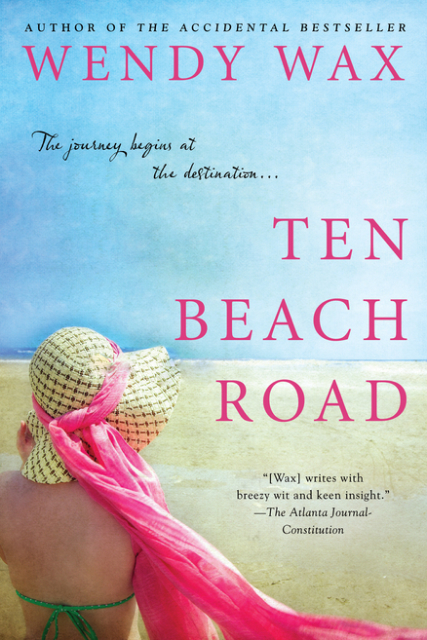
Wendy Wax has an excellent beach read with substance in Ten Beach Road for those of you looking for an end of summer winner.  Ripped from the headlines, these three women find that their only remaining asset is a rundown beach house (Bella Flora) in Florida after Malcolm Dyer — aka Bernie Madoff — stole their life savings.  Madeline’s life has been flipped upside down when she realizes her investment advising husband not only lost his clients’ money in a giant Ponzi scheme perpetrated by Dyer, but also that of his family.  Meanwhile, Avery has discovered that her father’s estate was similarly lost just as her stint as a co-host of Hammer and Nail on HGTV as her ex-husband edges her out with his elbow.  Nicole’s situation is a bit different because she had a personal connection to Dyer and her trust was more born of that loyalty than a financial desire, which makes her financial crash all the more crushing.

“‘Yes, it’s a fine old home,’ the Realtor said as if their surprise had been of joy.  ‘And as you’ll see a large portion of it has been renovated.  It just needs a little tender loving care.’

‘More like hospitalization,’ Nicole said.  ‘Or a team of paramedics.'” (page 56)

Add to the mix, a former childhood male friend, Chase, who had the perfect family life that Avery wanted and an FBI agent, Giraldi, stalking Nicole and looking for Dyer, and you’ve got a bit of mystery and sexual tension.  Wax has a down-to-earth sense of humor that livens up the playful interactions of three strangers, who soon become friends offering advice and support as they deal with family drama.  Her characters are varied and out to prove themselves to one another, their families, and everyone else, demonstrating their strengths and hiding their weaknesses as best they can.  Avery is the degreed architect portrayed on television as an airhead; Nicole is the bombshell who makes her living pairing up the rich and famous; and Madeline is the trunk of her family tree, the one that holds it all together just as the hurricane is set to rip everything apart.

“The army had spread out to attack different sections of the garden.  John Franklin sat on a camp chair that had been placed near the fountain, a smile on his face as he watched his wife command her battalion.

‘Mrs. Franklin wanted to get started before it got too hot,’ Avery said.  ‘I don’t think a single one of them is under seventy-five.  They’ll fill in with some new plantings after the house has been pressure washed and painted.’

Nicole moved down the hall to peer out the rear windows above the loggia; that was the one advantage in being last in line — she didn’t need to hold on to her spot.  Only her bladder.  ‘Good God, that woman is climbing up that tree.  I think she’s got a . . . ‘

The whir of an electric saw drifted p to them followed by the crash of a limb landing on concrete.”  (page 237)

What makes this novel more than women’s fiction is the mystery of where Malcolm Dyer is and how tragedy can either pull families apart or bring them together.  Readers searching for a summer read to close out their holiday season should seriously consider Wendy Wax’s Ten Beach Road for its tropical locale — Florida — its hot men — Chase and Giraldi — and the triumph of its female leads as they find their inner strength and pursue their dreams of redemption.

This is my 52nd book for the 2011 New Authors Reading Challenge.

Cross Currents by John Shors

Cross Currents by John Shors is set in the paradise of Ko Phi Phi in Thailand in 2004 as the lives of two families — struggling resort owners Lek and Sarai and brothers Patch and Ryan — cross paths.  In paradise anything seems possible, especially for Patch who is running from the Thai police after a stupid mistake, but even more so for Lek and Sarai’s children with so much ahead of them.

From the moment readers enter Shors’ world, readers are engrossed in the sand, the sun, the stars, and the humidity of the jungles and the resort shops that wait for tourists to arrive.  Lek and Sarai’s plight will draw empathy from readers, but what is more stunning is the strength they show on a daily basis.  It is enough to see Sarai cook, clean, massage, and devise new ways to earn income for her family, while her husband is dreaming and keeping their spirits lively.

“Lek opened his eyes, though his body remained as still as the gecko on the ceiling.  He watched it, as he often did, admiring its patience, aware of its seemingly perpetual hunger.  The creature was the length of his forefinger, and the color of mahogany.  Lek enjoyed gazing at the gecko, though he was jealous of its speed.  If a moth landed nearby, the gecko moved as if lightning filled its veins.  Yet in the absence of insects, the gecko was without motion, a silent sentinel that protected Lek’s home from airborne invaders.” (page 1)

Shors attention to detail draws a larger comparison between the characters he creates and the environment within which they live.  Patch has been helping out the Thai family, building a path, repairing bungalows, and more — almost as though he is doing penance.  In the midst of this work, Patch becomes like part of the family and he begins to feel at home, but that sense of contentment is uprooted once his brother Ryan comes to rescue him.

Cross Currents by John Shors is a devastatingly beautiful novel.  The ground beneath these characters continues to shift, placing them in harm’s way and bringing them closer.  Shors is a master at breathing life into different cultures and bringing different people together to demonstrate the power of love.  It is a novel about family, friends, and much more.  These characters are stronger for their struggles and for having known one another, and readers will not forget them.  A perfect candidate to nominate for the Indie Lit Awards literary fiction category.

Interested in other books by John Shors, check out my review of Dragon House and my interview with the author.  As with his other books, Shors will be making a donation from the sale proceeds of Cross Currents to the International Red Cross.

Believing Is Seeing by Errol Morris

Believing Is Seeing: (Observations on the Mysteries of Photography) by Errol Morris, a filmmaker, unravels the mysteries of documentary photography.  Why is Morris so skeptical about documentary photographs?  Does it relate to his deceased father and the secrecy around his role in the family or to his eye surgery as a child?  Beyond that, Morris seeks out factual evidence through testimony, history, and careful examination of light and contrast to determine the authenticity of photos and the stories behind them.

While some of the discussion and technical analysis of the Fenton photographs of the Crimean War can be a bit much for some readers, the conclusions drawn from these discussions are captivating.  Did Fenton stage the photo with the cannon balls on the road or did he not and which photo did he take first — The one with the cannon balls on the road or in the ditch?  When I first looked at the photographs, the one with the cannon balls on the road appeared to be a more powerful image, but then it appears to be staged because the balls are too evenly randomized.

“To use the familiar gestalt image of the duck-rabbit:  if we believe we see a rabbit, we see a rabbit.  If we believe we see a duck, we see a duck.  But the situation is even worse than the Gestalt psychologists imagined.  Our beliefs can completely defeat sensory evidence.”  (page 83-4)

Photographers often frame images in a way that captures the best of a scene, that’s the most aesthetically pleasing, and that provides the best lighting.  Moreover, photographers will take more than one picture of the same scene, if possible, and choose the best image to submit to magazines, etc.  They are framing the image we see regardless of whether readers realize it or not, but readers also are framing the scene and history.  Morris aptly titles this examination of photography “Believing Is Seeing” because each viewer’s beliefs, prejudices, etc., often frame their perspective when looking at a photograph.

Morris’ book is tutorial, historical, and poignant in how it examines photography, conjecture about photography and news articles, and human reactions to images.  My analytical brain was working overtime with this analysis, particularly when I got to the Abu Ghraib’s The Hooded Man.  One thing Morris clearly demonstrates is that each photo has a history or a context behind it, and without conducting appropriate research and background verifications, viewers and readers can draw the wrong conclusions.  In the discussion of The Hooded Man photo and the false identification of Ali Shalal Qaissi (called The Claw) as that man, two photos from two different perspectives are discussed, one taken by Sergeant Ivan Frederick without the flash that became iconic and one taken with a flash by Sabrina Harman.  While Qaissi is not the man in the iconic photo, Abdou Hussain Saad Falah (called Gilligan) is said to be that man, but in his testimony to the Taguba Commission he mentions a flash when his captors took his photo with the hood and blanket on.  So, is this telling us that he only remembers the flash and that maybe something happened between Frederick’s photo session and that of Harman’s, or is the flash more memorable because he was wearing a hood?

Believing Is Seeing: (Observations on the Mysteries of Photography) by Errol Morris is captivating from page one, and it will have readers, photographers, and more reassess their view of photography and history.  It raises questions about whether appropriate research was conducted, evidence collected, and correct facts appropriately used.  Like any good journalist or photographer, documents should include the facts of the moment, the event, and the context, and Morris’ book demonstrates that while many blame the 24-7 world in which we live for the slipshod journalism completed today, it has happened throughout the ages and may have less to do with technology and more to do with human nature and our desire to frame the story.  Photography is not the mystery here, it is the human mind and human behavior that is the mystery.  How are things cropped, framed, and modified to suit our purposes and why?  How can we as readers know that images and stories are modified to suit a specific purpose?  Morris suggests research, analysis, and skepticism, but also a curious mind bent on uncovering the truth.

About the Author:

Errol Morris is a world-renowned filmmaker—the Academy Award-winning director of The Fog of War and the recipient of a MacArthur genius award. His other films include Mr. Death, Fast Cheap & Out of Control, A Brief History of Time, and The Thin Blue Line.

Find out more about Errol Morris at his website, and follow him on Twitter.  Also there is this interesting interview from California Magazine.


Click the TLC Book Tours button to see the rest of the stops on the tour.


This is my 51st book for the 2011 New Authors Reading Challenge.

Virtual Poetry Circle #113

Welcome to the 113th Virtual Poetry Circle!

Remember, this is just for fun and is not meant to be stressful.

Keep in mind what Molly Peacock’s books suggested. Look at a line, a stanza, sentences, and images; describe what you like or don’t like; and offer an opinion. If you missed my review of her book, check it out here.

Also, sign up for the 2011 Fearless Poetry Reading Challenge because its simple; you only need to read 1 book of poetry. Please contribute to the growing list of 2011 Indie Lit Award Poetry Suggestions, visit the stops on the National Poetry Month Blog Tour from April.

Today’s poem is from Adam FouldsThe Broken Word (Excerpt) (It is the winner of the Costa Poetry Award):

The Broken Word (page 16-7)

4:  Facing Ngai

Mid-morning after rain.
Mountains flowing rapidly under clouds.
The valley paths a freshened red
with yellow puddles, glittering weeds.

Tom walked between the lines
of coffee for half a mile,
knocking fragments
of water onto his sleeves --
little bubble lenses
that magnified the weave
then broke, darkening in.
He walked to within earshot
and no further.

A surprisingly dull sound of ceremony,
one voice then many voices,
that recalled school chapel
although probably they were spared hymns.
Tom remembered the hymns,
the light, weakly coloured by the windows,
falling on the boys opposite,
standing, opening their mouths;
and the hymn books,
the recurrent pages greyish,
worn hollow like flagstones
with pressure of thumbs, over years,
years of terms, the books staying always
on their dark shelves in the pews.
The days he wanted to stay
all day alone in the pretty, scholarly chapel.

And then over the voices,
another sound.
Faintly, from behind the house,
Kate practising with a pistol,
its faint, dry thwacks
a fly butting against a window pane.

Let me know your thoughts, ideas, feelings, impressions. Let’s have a great discussion…pick a line, pick an image, pick a sentence.

I’ve you missed the other Virtual Poetry Circles. It’s never too late to join the discussion.