Quantcast

Night Train to Lisbon by Pascal Mercier, translated by Barbara Harshav

Night Train to Lisbon by Pascal Mercier, translated by Barbara Harshav, is about the paths we take in our lives, the regrets we carry, and the desire to connect with something or someone outside of ourselves.  Raimund Gregorius is a Swiss classical languages teacher in Bern, who has cloistered himself among his texts and his classes to the detriment of his marriage and his social life.  He’s governed by a routine existence that is abruptly changed one morning on the way to the lycée.  His love of language and learning takes him on an unexpected journey into the language and heart of Lisbon as seen through the eyes of Amadeu de Prado, a young doctor caught up in a test of his principals like none other at the time of the Salazar dictatorship.

“Gregorius took off the glasses, and covered his face with his hands.  The feverish change between dazzling brightness and threatening shadow pressing with unusual sharpness through the new glasses was a torment for the unprotected eyes.  Just now, at the hotel, after he had woken up from a light and uneasy afternoon nap, he had tried the old glasses again.  But now the dense heaviness felt disturbing, as if he had to push his face through the world with a tedious burden.”  (page 111)

Through a mix of text from Prado that Gregorius translates and the teacher’s interactions with Prado’s family and friends, a tale of hunger, deprivation, and principals emerges that will keep readers on their toes.  The parallels Mercier draws between Prado and Gregorius are uncanny, and yet, the men are so different from one another in how they choose their paths.  At the same time, both men are swept up in a hunger for more life and more connection, especially given how both their fathers had suffered and how little they knew them.  In many ways, it seems as though part of that hunger is fed by the “absence” of the father — though not their physical absence — and the expectations that absence placed on these men as they grew older.

Who could in all seriousness want to be immortal?  Who would like to live for all eternity?  How boring and stale it must be to know that what happens today, this month, this year, doesn’t matter:  endless more days, months, years will come.  Endless, literally.  If that was how it was, would anything count?”  (page 170-1)

Gregorius begins his journey in Lisbon with Prado’s book in his hands, seeking the truth of the man who wrote such inspiring words — words that spurred his desire to drop his old life and journey into a new world.  There moments when he loses himself, bumping around Lisbon and falling into the life of Prado so much so that he forgets texts that he lived and breathed in for years.  But even in returning to Bern, Gregorius is out of place; it is no longer comfortable or it does not feel like home.  Both Prado and Gregorius reach a certain precipice in their lives, and how they handle it is so similar; it is like a mirror image of the past facing the present.

Mercier explores the compartmentalization of our own lives and how we can not really know others as intimately as we can know ourselves, but even that is questioned as we can also fall into deceiving ourselves about our own abilities, emotions, and more.  Memories are fleeting and often distorted, but to uncover an unvarnished truth about the past, all sides of the story must be sough out to find the truth in the middle.  Beyond that there are questions of whether one should be sacrificed for the many or the good cause and what exactly the fear of death is about.  Night Train to Lisbon is a methodical and deep account of two men with their own convictions and perceptions about life and what it is that are challenged by the world around them.  Deeply moving, profound, philosophical and engaging.

About the Author:

Peter Bieri, better known by his pseudonym, Pascal Mercier, is a Swiss writer and philosopher.  He studied philosophy, English studies and Indian studies in both London and Heidelberg.  Mercier cycling team is a former French professional cycling team that promoted and raced on Mercier racing bikes. Together with the Peugeot cycling team, the Mercier team had a long presence in the cycling sport and in the Tour de France from 1935 until 1983.

About the Translator:

Barbara Harshav translates from French, German, and Yiddish, in addition to Hebrew. Her translations from Hebrew include works by prominent authors such as Michal Govrin, Yehudah Amihai, Meir Shalev, and Nobel Laureate S.Y. Agnon. She teaches in the Comparative Literature department at Yale University.

This is part of my own personal challenge to read more books set in or about Portugal.

This is my 27th book for the 2013 New Authors Challenge.
The Gods of Heavenly Punishment by Jennifer Cody Epstein

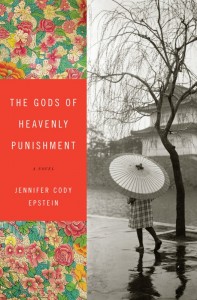
The Gods of Heavenly Punishment by Jennifer Cody Epstein chronicles Yoshi Kobayashi’s life before, during, and after WWII, with a particular emphasis on the Tokyo fire bombings that preceded the atomic bombings of Hiroshima and Nagasaki.  Billy Reynolds, whose family lives in Tokyo before the war, is a sensitive young boy who loves his new camera, and adores taking photos of Yoshi, family, friends, and more.  Cam Richards and Lacy Robertson are American college students who meet and quickly fall in love just as war is about to break out between America and Japan after Pearl Harbor, and their lives are torn apart by the war.  But ultimately, Epstein’s novel is about Yoshi and how the war tore apart a flourishing culture that once embraced American capitalism.

Not only will readers get an in-depth look at Tokyo before, during, and after the war, but they also see how war impacts not only Americans who once lived in Japan, but also those who were married to those who flew to avenge the deaths of so many in Hawaii.  Initially, readers will be duped into thinking Cam Richards and Lacy Robertson are the main protagonists — a testament to her ability to get readers to care even about secondary characters — but Yoshi is the heroine here, though there are big gaps in time that are not explored, which can leave a reader wanting more.  There is a moment near the end in particular when readers will wonder how Yoshi ends up playing piano at The American Club after the war when they last left her getting into a boat with an older man after the fire bombings, heading away from Tokyo.

“Almost by reflex Cam released the brakes and started to roll.  And then they were racing down that slippery white line, his heart pounding with the rhythmic throbbing of the twin Cyclones.  The dungaree blue of the sailors’ uniforms and the dirty gray of the ship’s island bled together as the Blonde Bombshell picked up speed.  As they passed by the signal officer (now safely flattened against the deck), Cam pulled on the yoke so hard that he felt his elbows crack, and saw the sky lunge towards him like a wet concrete wall.  They hit the ship’s edge in the after-trough of another white-topped crest, and as his plane’s nose plunged towards the water Cam’s gut plunged right along with it.”  (page 79)

Epstein is a phenomenal writer.  She captures intense moments so well, that it places the reader there with the characters.  Yoshi is a precocious young girl learning three languages thanks to her continental mother, but unfortunately, she’s held a little back by her attachment to her mother and her father’s old world conceptions of women in society.  She sees her father’s love of the new paradise, Manchuria, as a possible solution to her escape, until she learns the truth about her father’s work there.  When she heads back home, she throws herself into the national effort for the war, hoping that she can escape the disintegrating world around her in which her mother slips more and more each day.  The Gods of Heavenly Punishment by Jennifer Cody Epstein is about the outside forces that shape who we are depending on how strong we are on the inside and our ability to make our way out of the darkness into the light.

About the Author:

Jennifer Cody Epstein is the author of The Gods of Heavenly Punishment and the international bestseller The Painter from Shanghai. She has written for The Wall Street Journal, The Asian Wall Street Journal, Self, Mademoiselle and NBC, and has worked in Hong Kong, Japan and Bangkok, Thailand. Jennifer lives in Brooklyn, NY with her husband, two daughters and especially needy Springer Spaniel. To connect with Jennifer, “like” her on Facebook.

Thievery by Seth Abramson

Today marks the end of National Poetry Month, and I hope that you found some great poets and poetry collections to try this month. I’m especially pleased that we had so many participants for the Friday activities. See all of you next year for another blog tour of poetry, but I hope you’ll stick around for the rest of this year too. If you missed some of the posts this month, just click here and scroll through.

The action of the poems in Thievery by Seth Abramson, published by the University of Akron Press, occur in between the silences and the pauses of each line break and each trick phrase, highlighting the theft of what has been stolen.  From the innocence of our children to the rallying of small towns around their own even when the most horrifying things occur.  Abramson performs a sleight of hand in his poems, changing their trajectory at a moment’s notice, calling attention to the illusions that are around us everyday.

From "Chronophrenia, Part VII"

At the end of traveling
I wear the road.  Within my skin it is bad.
It's worst without --
the particulates of being nowhere entirely.
From "Chronophrenia, Part VIII," the poet asks:

Do you pay
for each silence, and if so
why start.  Can I admit this thing,
can I clothe myself
in something like it, is it time now.
Does the time come.  Does it ever.

Are we too afraid to speak up or to change the world around us and make it better, or have we just become too complacent.  This silence and complacency is a pervasive problem Abramson tackles in his poems and what the possible consequences of that silence is.  In “Only,” “If it moves/I see it coming, sometimes I do/I swear.  I have been in the places things/were coming true/that were unwanted, in places/things went/unwell, where things went and went//”  (page 37)  There is an unraveling that these poems want to bring into the light for closer examination, though it could be the unraveling of our morality or our societies — with some poems being more ambiguous than others.  Additionally, there are several poems that focus on the abuse of men at the hands of women, like in “Hometown Courage” where the man is held down by women and in “Poem for Battered Man.”

From "All You Ploughboys":

I am sure
to do something horrible.  Half the wood is
halfway there.
And half this town is half in love with itself,
but me I go all the way.

Thievery by Seth Abramson is subtle, and at times too much so, in its exploration of change throughout society and within individuals as it asks readers and others when is the time to stand up and to create change for a better world. When is the time for us to stop the thieving from others and ourselves? These are questions that should be asked and should be met with action.

About the Poet:
Seth Abramson is the author of The Suburban Ecstasies (Ghost Road Press, 2009). In 2008 he was awarded the J. Howard and Barbara M.J. Wood Prize by Poetry. A former public defender, he currently attends the Iowa Writers’ Workshop. Please check out his blog.

Please click the image below for the latest tour stop on the National Poetry Month Blog Tour!

This is my 17th book for the Dive Into Poetry Challenge 2013.

This is my 26th book for the 2013 New Authors Challenge.

Guest Poet: Seeking Limpid Balance by Tamara Woods

Today, Pen Paper Pad‘s Tamara Woods is stopping by today to share one of her poems. Please give her a warm welcome.

For National Poetry Month, I’ve been blogging (almost) everyday, writing poetry and trying to get the courage to record a video poem. Here is a poem I wrote that I may try to digitize later.

Seeking Limpid Balance

Hand shakes
Fingertips tap
one time, two times, three  
Sharp pull from e-cig
Not the same, not the same, not the

New cocktail
tenuous strains to normality
Not quite
quieting fears,
disconnected discontent
Lids hanging
eyes sensitive
one time, two times, three 

Static burns neck's nape
Oxygen has escape room through
lighta beaming from window
bouncing from wall to ceiling floor
all white. all white, all 
one time, two times, three

Lines rips down wrist
raised coils against
pale skin
Stark black tangles 
Snarls past ears
catching air with
pacing,
one time, two times, three

The world outside these walls
tasted red, 
she felt muddy,
All feelings 
passed through her leaving
residue behind.
Never truly clean.
One time, two times, three.

About the Poet:

Tamara Woods is a poet, blogger, and generally pusher of words from Honolulu by way of West Virginia. Her first collection of poetry, The Shaping of an “Angry” Black Woman will be available this summer. Find her on Twitter, Facebook and check out her mumbling on her blog, PenPaperPad.

***Please check out my review of Sarah Arvio’s collection night thoughts: 70 dream poems and notes from an analysis.***

night thoughts: 70 dream poems and notes from an analysis by Sarah Arvio

Click the image above for today’s National Poetry Month tour post!

night thoughts: 70 dream poems and notes from an analysis by Sarah Arvio is a poetry collection that defies convention in its cathartic purpose as a series of free-association dream poems with accompanying notes on those dreams from the poet at the time she was tackling some serious trauma.  It is more than a collection of poems and notes about those dreams they capture, it is a memoir written as she uncovers some deeply traumatic events in her childhood as she was on the cusp of womanhood.

“It’s easy to forget how complex and intense are the thoughts of children, and how everlasting.  I mean that the thoughts last in the mind, enacting their meanings, even when they seem to be forgotten.”  (page 132)

Arvio’s notes are essential in many ways to the understanding of her dream poems, which are often surreal and disjointed.  The notes help carve out her images and how they associate to one another and which dreams came to her in the same span of time.  She breaks down her word choices for lines in the poems, the origins of words and how their meanings are uncannily related to the trauma she experienced and subsequently forgot.  She also provides insight into the artwork that she saw and that reminded her of the trauma and how certain colors appear and reappear in her poems because of their relation to the trauma.

watermelon (page 19):

in the brightwhite kitchen a tiny pink
watermelon lies on the pink counter
or white it may be white by the fruit
is pure pink flesh I take a bite of it
then I recall a photograph of me
standing & biting the watermelon
in the newspaper that was black & white
though I know my shirt was white & pink
at the fair on something hill (named for
a fruit) where my father bought me a book
that was called something hill something that meant
flesh & then I knew it was fanny hill
the place was strawberry hill & little 
me as francesca seduced by a book

Arvio utilizes repetition of color and words in her poem to illustrate the remembering of a dream while awake, as the mind filters through the image details to carve out the truth of the events. Her poems read like dream interpretations without the conclusion, and in this way, she leaves the poems open to interpretation until the reader gets to her notes section. While these are dream poems, the images and actions will likely make some readers squirm and look away, particularly with the maiming of animals, among other things. These poems are stark and sometimes profane, much like the shame and the trauma explored in the dreams.

night thoughts: 70 dream poems and notes from an analysis by Sarah Arvio is poignant, frightening, and “super real.” Start with the notes at the end of the book, if you want background on her dream poems before you read them, or hold off and read them at the end to get a richer experience. This memoir/poetry collection is meant to disturb.

About the Poet:

Sarah Arvio is a poet who has lived in New York, Paris, Caracas, Rome and Mexico.  For many years a translator for the United Nations in New York and Switzerland, she has recently also taught poetry at Princeton.

Her poems are widely published, in such journals as The New Yorker, The New Republic, Literary Imagination, Boston Review, The Kenyon Review and Poetry Kanto and in many online reviews.

Composers have set her poems to music:  Miriama Young set “Cote d’Azur” as “Inner Voices of Blue”; Steve Burke set “Armor” for the song cycle “Skin”; and William Bolcom set “Chagrin” for the song cycle “The Hawthorn Tree.”

She’ll be at the May Gaithersburg Book Festival for “Poetry in the Afternoon” moderated by me!

This is my 16th book for the Dive Into Poetry Challenge 2013.

This is my 25th book for the 2013 New Authors Challenge.

Our Word Association Poem Revealed…

Click the above image for today’s National Poetry Month Blog Tour post!

On Friday, I asked everyone to word/phrase associate with a pre-posted line of poetry to create a poem. Here’s the result of our collective minds:

I hope you’ve had fun with these activities over the last month.

Here’s our final result:

Bent sunbeams wind the road up
we climb carefully
ladders held by none
Fear, teasing us.
Breath held in anticipation
the sense of falling while standing still

What do you think?

199th Virtual Poetry Circle

Click on the above image for today’s National Poetry Month blog post!

Welcome to the 199th Virtual Poetry Circle!

Remember, this is just for fun and is not meant to be stressful.

Keep in mind what Molly Peacock’s books suggested. Look at a line, a stanza, sentences, and images; describe what you like or don’t like; and offer an opinion. If you missed my review of her book, check it out here.

Also, sign up for the 2013 Dive Into Poetry Challenge because its simple; you only need to read 1 book of poetry. Please sign up to be a stop on the 2013 National Poetry Month Blog Tour and visit the stops on the 2012 National Poetry Month Blog Tour.

Today’s poem is from Sandra Kasturi’s Come Late to the Love of Birds:

Moon & Muchness (page 43)

My moonsicle sour-candy-pocked moon!
I have licked and loved you to a dim lustre,
the hollow-smooth swell of an orchestral bassoon,
a worthy glow that can only be mustered
by the administrations of my spectral
tongue.  Let us lap up the song-elevated
spheres! -- the phases and phrases of their kestrel
migrations, the meandering paths of crenelated
stars.  Let us tower and fall to crumbled-
cake battlements, forge to life from god-dusted bellows,
and spoon-feed the sun in all his pie-humbled
runcible wit--let us be bean-struck bedfellows.
We can swallow the universe in its entirety,
its star-speckled, moon-freckled boundless absurdity.

What do you think?

Creating a Word Association Poem….

Click the image above for today’s National Poetry Month blog post!

Over the last several weeks during National Poetry Month, I’ve been letting the creativity flow on the blog and enlisting your help in creating some unique pieces. We’ve created Fibonacci, Blackout, and Taboo poems.

On this last Friday of National Poetry Month, I’d like to do some word/phrase association with everyone to create a poem.

I’ll give you a lead off line, and then each commenter can add the first thing that comes to their mind for the next line…and it can be just one word or a whole phrase if you feel ambitious.

Let’s make this last Friday in National Poetry Month rock with an “epic” poetry creation.

Here’s the lead phrase:

Bent sunbeams wind the road up

Ready, Set, Go have fun!

Why Photographers Commit Suicide by Mary McCray

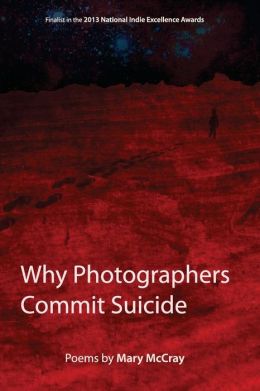
Why Photographers Commit Suicide by Mary McCray, illustrated by Emil Villavincencio and published by Termentina Books, is a collection of science fiction poetry — yes, you head that right!  These poems mesh not only the exploration of space with the modern world here on Earth, but they also harken to older themes of Manifest Destiny dating back to America’s youngest roots as a nation.  It’s a collection about the opportunities space exploration can represent, which is highly ironic given the government’s recent decision to shut down the manned shuttle program.

From "Helga Post-Orbit" (page 52)

No, it's not the sentimental, leftover space

that matters as much as the idea of Helga, open-eyed
and drifting, somewhere out of the room.
Or this mortal part of me -- lost in a raw,
everlasting free-fall of disconnected, disordered love,

knowing I'll uncover Martians, (Martians!),
the impossible mysteries of Mars,
before I'll ever know
where Helga has gone.

McCray’s poems are fantastical, opening up a solar system to the reader that delves into questions of existence and the hereafter, but also the never-ending search for more.  She explores space, Mars, and even artificial intelligence.  There are some beautiful moment of motion, like in “All of a Sudden,” where the narrator awakens:  “Last night, a woman in a hospital smock laid her fingers/on the shiny bells and, mouth over face,/blew tornadoes into the water-pale toes./Then, eyes shut and palms summoning,/my child asked me if I knew who I was./And I said, yes, I am the speed at which/particles collide.//”  For the most part, these poems draw comparisons between the society we create here on Earth and its focus on the material, and how any society on another planet would likely be more of the same.  As we seek to comfort ourselves in the unfamiliar by bringing along the unfamiliar — even to the detriment of animals brought along in the rocket.

McCray paints extraordinary pictures with her words, but the accompanying drawings from Emil Villavincencio do not add very much to the overall collection, though they are well crafted and seem to be mostly pencil renditions.  Beyond the poems about space and exploration, there are more personal poems about alienation from family members, the beauty of poetry as a reflection of space, and the amazing experience of “Sex in Zero Gravity”:  “astronaut, astronaut –/kiss me with your incomplete sentences/and your raw relativity,/run your fingers like lasers,/escape velocity through my motor heart,/the acceleration thrust/of your deep-space Cadillac cruising/my jelly-fish tremors,/touching the swirling hurricane/that is the red G-Spot of Jupiter/”  There has never been such a beautiful references to spaceships taking off and hurricanes on foreign planets in poetry to describe a sexual encounter.

Why Photographers Commit Suicide by Mary McCray is imaginative and one of the best written science fiction collections of poetry out there, and it will have readers questioning their place in the world and the need to explore more.  Like the poet points out in the title poem, we leave a bit of ourselves in the world around us, and we should be mindful of our impact.

About the Poet:

Mary McCray is the co-author of St. Lou Haiku, a collection of haiku poetry about St. Louis, Missouri, and Why Photographers Commit Suicide, poems about space exploration and new frontiers.  Visit her Website, visit her on Twitter, and on Facebook.  Also check out her bookshelf on GoodReads.


Click on the image below to check out the latest National Poetry Month Blog Tour!


This is my 24th book for the 2013 New Authors Challenge.


This is my 15th book for the Dive Into Poetry Challenge 2013.

Reflections of a Mississippi Magnolia by Patricia Neely Dorsey

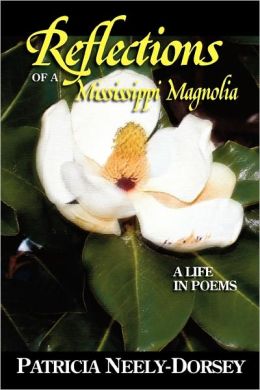
Reflections of a Mississippi Magnolia by Patricia Neely Dorsey is a very personal and reflective collection about growing up in the south and celebrating its culture.  Through rhyming poetry, Dorsey creates poems that have their own beats and rhythms that carry readers all the way through the poems.  While most of these rhymes are elementary and some seem forced, the collection is not about technique as much as it is about living and breathing the southern culture.

From "The Rules" (page 6)

Life can be much easier,
When you know what to do or not;
And you're sure to learn a lot of them,
If Southern parents you have got.
From "A Country View" (page 17)

What might you see as you go your way
On a walk through the country any spring day?
There's an old car tire without its rim,
Filled with flowers to the brim.
A bottle tree glistens in the sun,
And kids chunk rocks at it just for fun.

The poems do not hide their meaning behind complex metaphor and read more like short essays or memories. “Shelling Peas” and “Slopping Hogs” brought back images of farm life that are so vivid and filled with innocent joy and happiness. Readers will learn about the Agnews and much of the food and past times of the poet’s Southern life. Dorsey has succeeded in demonstrating a slice of life in the South.  There are some assertions about Southern life that ring very true, at least what most people typically think about Southerners, but there also are assertions in the poems that would ring true for others not raised in the South, but simply raised with a good moral compass.

Dorsey is never cryptic and clearly shows pride in her heritage, and her “Getting Personal” section of the collection is the most empowering because it is about learning to love oneself despite what others may think and say about you.  In Reflections of a Mississippi Magnolia by Patricia Neely Dorsey what you see is what you get, and that’s good enough.

***Check out the rest of the stops on the blog tour!***

About the Poet:

PND Bio


This is my 14th book for the Dive Into Poetry Challenge 2013.


This is my 23rd book for the 2013 New Authors Challenge.


Click the image below for today’s National Poetry Month blog tour post!

World Book Night 2013

What is World Book Night?

It is one night during the year where book lovers go out in their communities and talk about the books they have loved to those who do not read or seldom do. The program provides givers with the books to hand out — 20 per box — and the givers spend the day/evening out talking about the book they receive.

Who is a Giver?

Anyone who applies and is accepted. This year, my book club — Eclectic Bookworms — signed up and we were lucky enough to be selected to receive 20 paperback copies of City of Thieves by David Benioff.  I picked up the box at my local bookstore Novel Places, which due to some relocation issues could not throw a reception for us.

We divided our box over the weekend and each of us ended up with 4 books each to give away, though one of our members bowed out of the experience.  And since each of us lives in a different part of Maryland, we thought we would cover more ground.  Heck 2 of my copies went to D.C. this morning with my husband, the non-reader, who took them to the office.  I will be checking out my non-readers here in the neighborhood later in the evening to convince them to grab a copy.

My book club really enjoyed Benioff’s book and it produced a lively discussion, appealing to both men and women in the group.  I cannot wait to hear from the other members to see how their efforts fared and where they handed out their copies.  I’ll update this post with any news.

As I haven’t participated in previous years, this is an all new experience, and I’d love to get some ideas about other great places to try and hand out books.

Did you participate? Where did you hand out your copies? And which book did you receive?

Come Late to the Love of Birds by Sandra Kasturi

Come Late to the Love of Birds by Sandra Kasturi, published by Tightrope Books, is a well-crafted collection about love and freedom from the bonds of illusion.  Kasturi uses bird imagery to explore ancient fairy tales and stories from the ill-fated flight of Icarus to songs like Sing a Song of Sixpence and the blackbirds confinement in a pie.  She takes these long memorized stories and songs and turns them upside down, revealing the twists and turns that these stories could have taken in a modern world.

From "The Evolution of Birds" (page 17)

birds knew of our coming;
could sense our soft limbs millennia ahead,

could sense our drab colours and dull teeth,
our nothing lives.

They dropped their scales, made themselves small,
grew into winged things, soft and bright,

Beyond these twists and turns, Kasturi also plays with the notions in the bird kingdom and the simplicity of their lives — categorizing things into those with and without wings and nothing more. In “One Red Thought,” the red-tailed hawk and the narrator encounter one another, with the narrator questioning, “He must be/tethered to something/because why would a hawk/sit so still, why would/a hawk let me creep/close as a cat, me/” and then realizing “For him–/there are no/cameras or shoes,/there are no ornamental/gardens or lawn gnomes/or pants that need to be ironed.// There are only winged things/and non-winged things.// Only himself and the sky,/the curve of the earth/tilting how he wills it.//  There is the simplicity of the encounter, coupled with the encounter during which the narrator finally understands the reality of the hawk’s world.

From "Crucible" (page 49)

I am curled under piecrust like a blackbird, trapped.
salted and basted and oven-ready.
The kitchen clock's tick settles around me--
keeping time over what's burned or broken.

Salted, basted and oven-ready
I've become claustrophobic and butter-heavy.
Keeping time over what's burned or broken,
my fingers push and dimple the roof.

Each of these poems surprises the reader either once or repeatedly, and Kasturi’s sensitive handling of birds and human motivations alike are musical and magical. With poems rendering a clear relationship between humans and birds to those that draw hopes and dreams from birds in flight and in trees, the collection also has poems dedicated to Bradbury and Neil Armstrong. Come Late to the Love of Birds by Sandra Kasturi is wondrous and lively, full of wit and cunning, and utterly beautiful with each verse and turn of phrase.

About the Poet:

Sandra Kasturi is a writer, publisher, book reviewer and Bram Stoker Award-winning editor. She is the co-owner of the World Fantasy Award-nominated press, ChiZine Publications. She managed to snag an introduction from Neil Gaiman for her previous poetry collection, The Animal Bridegroom (Tightrope Books). She lives in Toronto with her husband, writer and publisher Brett Alexander Savory.

This is my 13th book for the Dive Into Poetry Challenge 2013.


This is my 22nd book for the 2013 New Authors Challenge.


Click the image below for today’s National Poetry Month blog tour post!