Quantcast

The Painted Girls by Cathy Marie Buchanan

The Painted Girls by Cathy Marie Buchanan is about dreams, dreams that can raise you up out of the most dire circumstances, if only you are willing to work hard and do what you must to survive.  Antoinette and Marie, by turns, are ballet girls in the Paris Opera, with Antoinette learning too late that she cannot hold her tongue or bend her stubbornness.  Imagine a time in 1880’s France when Emile Zola publishes L’Assommoir, which becomes a play about a laundress and the dire consequences of poverty and alcoholism, and when Cesare Lombroso postulates that people who are born criminals can be identified by physical characteristics of the skull.  Buchanan has taken the real-life figures of Edgar Degas, Emile Zola, and Degas’ model for the statute Little Dancer of Fourteen Years — Marie van Goethem — and intertwined their stories with criminals Emile Abadie and Pierre Gille.  Tempted by different fates, Marie and Antoinette’s stories are told in alternating chapters, providing greater insight into certain situations and events as well as the complicated relationship between sisters, particularly those struggling to survive with a drunk mother, deceased father, and younger sister weighing heavily upon them.

“But then the next minute, my mind flipped back to thinking how a smear of greasepaint might hide her sallow skin.  Back and forth I went.  How to diminish.  How to boost up.  All I knew for sure was even if old Pluque saw his way to giving her a chance, even if she clawed her way up from the dance school to the corps de ballet, she was too skinny, too vulgar in her looks, too much like me to ever move up from second set of the quadrille, the bottom of the scale.”  (Page 13 ARC)

Even as each sister raises the other up with praise and support when times are tough, there are moments of doubt — that the love is not enough and that the support is somehow hollow.  Antoinette has fallen from her place with the ballet and is scrambling for walk-on parts in the opera before she meets Emile and gets a steady role in L’Assommoir, while Marie is just embarking upon her journey in the ballet with their sister Charlotte close behind.  There is the push and pull of these sisterly relationships as they compete to be the best in ballet and to earn the most, while still supporting one another and doing the little things that keep them spirited.  However, their world is about to fall apart when Antoinette falls in love and becomes tempted by that love to throw all that she knows away on the belief that her love is real and ever-lasting.

Buchanan also demonstrates through Marie the notion that believing something to be true can make it a self-fulfilling prophecy.  Marie says at one point, “Monstrous in face, monstrous in spirit.”  She does not see herself as the beauty others see, and her self-image is a faulty foundation for her to stand on when she enters the ballet as she compares herself not only to her sister, Charlotte, whom is considered a cherub, but also to the beauty and grace of the other ballet dancers.  Meanwhile, Antoinette does not have as many concerns about her beauty, relying on her wiles to capture the attentions of Emile and hold his rapt attention.  She sees him as her escape from poverty, despite his criminal-like behavior and greater commitment to his friends.

In many ways, The Painted Girls is about the bond between sisters and about the self-fulfilling traps that many of us fall into even when the support system is there to support us.  It is about taking things for granted, about being selfish, and about not giving into temptation.  Buchanan’s storytelling is captivating, and her characters, while rooted in history, are dynamic and flawed — like the criminals spotted by their physical characteristics, Antoinette and Marie are typecast by the law, theater members, ballet instructors and the wealthy sponsors who have designs on dancers.  Buchanan’s portrait of sisters in France during this period is gritty and emotional. Readers will immediately feel the dark, dank alleys of Paris and the heel of class distinctions upon their necks, just as the van Goethem sisters do.

The first contender for the 2013 best of list.

Credit: Nigel Dickson

About the Author:

CATHY MARIE BUCHANAN is the author of The Painted Girls, a novel set in belle époque Paris and inspired by the real-life model for Degas’s Little Dancer Aged 14 (forthcoming January 2013). Her debut novel, The Day the Falls Stood Still, was a New York Times bestseller, a Barnes & Noble Recommends selection, a Barnes & Noble Best of 2009 book, an American Booksellers Association IndieNext pick and a Canada Reads Top 40 Essential Canadian Novels of the Decade. Her stories have appeared in many of Canada’s most respected literary journals, and she has received awards from both the Toronto Arts Council and the Ontario Arts Council. She holds a BSc (Honours Biochemistry) and an MBA from Western University. Born and raised in Niagara Falls, Ontario, she now resides in Toronto.

Please check out the reading guide.

Giveaway: Jane Austen’s Pride & Prejudice Turns 200

Jane Austen is best know for her novels and her close-knit family, particularly her relationship with Cassandra, who painted a famous portrait of her sister and for burning a number of her sister’s letters following her death.  Following her first novel, Sense and Sensibility, Austen turned to her second novel, Pride & Prejudice, originally titled First Impressions.  Her second novel has been one of my favorites for many years, and I think I’ve read it at least five times or at least parts of it at any given moment.  Each time I read it, I learn or discover something new, and I think that is the mark of a successful author.

January 28, 2013 is the 200th anniversary of Jane Austen’s most beloved novel, Pride & Prejudice.  Austen’s novel examines the differences between social classes, elements of marriage and morality, and comments on the societal expectations regarding the manners and education of women in different circles.  It is often considered a great love story even as Elizabeth Bennet and Mr. Fitzwilliam Darcy spar with one another and must overcome great adversity and societal impediments to find their way back to one another. 

The novel and the author have become so popular in modern society that a number of spinoffs, continuations, and re-tellings have cropped up in recent years, and there are a number of blogs dedicated to her novels and those other novels and books.  Facebook even has a page dedicated to the 200th birthday of Pride & PrejudiceCheck it out.

As part of my Jane Austen celebration, check out the giveaway below.

Quirk Books is offering one copy of The Jane Austen Handbook by Margaret C. Sullivan to one winner in the United States, Canada, or United Kingdom.

I reviewed this in February of 2011, and said that it was “a great companion for the Jane Austen fanatic and fan because it offers guidance on how young men and women navigated a complex set of social rules and even broke them at times.  As each moment in life is addressed, Sullivan also offers moments in Austen’s work where traditions are bent.”

If you want to check out my interview with Sullivan, feel free.  She offers some great insights into her love of Austen and what books she recommends for fellow Austen lovers.

Quirk Books is offering one copy of Pride & Prejudice and Zombies by Jane Austen and Seth Grahame-Smith to one winner in the United States, Canada, or United Kingdom.

In my review from 2010, I called the novel “an exercise in revision and an examination of Austen’s characters in a new light.  Many readers will disagree with Grahame-Smith’s portrayal of Lizzy as a cutthroat assassin who is quickly turned by her own emotions or strict sense of duty and honor, particularly since she often talks of dispatching her peers for slighting her family, imagines beheading her own sister Lydia simply because she prattles on, and other unmentionable actions.”

To enter for one or both of these books, leave a comment about the first time you read Jane Austen and what you enjoyed about her work or the first time you read Pride & Prejudice and why you would reread it.  If you have never read Austen before, leave a comment about what book you’d be interested in reading and why.

Deadline to enter is Jan. 11, 2013, at 11:59 PM EST.

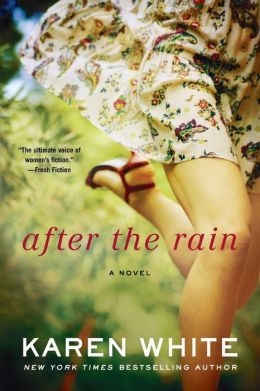
After the Rain by Karen White

After the Rain by Karen White is a republished and remastered novel that is full of twists and turns, touches lightly on the desolation of a broken family life and the darkness people can fall into as a result, and the hope that just might be around the corner.  Suzanne Paris is on a bus to Atlanta when she decides on a whim to get off in Walton, Ga., where she meets a large family and finds the home she’s been looking for all of her life.  But with the sun comes rain.  And there is a deluge of it in this book.

Suzanne has a past that is not far behind her, even as her freelance photography job takes her to many places.  She’s running from a life and for her life, and White has created a character who is both likeable and unlikeable.  She keeps secrets even from those know care for her, and her ability to trust others is very tenuous and easily broken by the wrong word or action, which White captures easily in her imagery.  From how she’s described by the muscular, hot mayor Joe Warner — who also teaches at the high school and coaches football — to how Suzanne pauses before answering questions about her past, readers will find a character who is taken in slowly by the small town and its residents but frightened of how her own past could harm them.

“Tides change.  So does the moon.  With the unfailing constancy of brittle autumn closing in on bright summer, things always changed.  If Suzanne had ever had faith in anything, it was in knowing that all things were fleeting.  And for good reason.  The highway of life was littered with the roadkill of those who didn’t know when to change lanes.”  (Page 1)

While things can be fleeting in life, there are things that are ever-lasting, and in this case, White talks about the support systems that we can have within our own families.  Whether those families are the ones we are born into or the ones we fall into or create out of friends and husbands and our own children, they are there to love and support us unconditionally.  Suzanne has a lot of lessons to learn, but the slow unraveling of her fears and her heart is endearing.  In many ways, though she’s an adult, she’s like a child being led into the life she’s always wanted.

“‘Amanda! You quit right now or I’m gonna jar your preserves!'”  (Page 5)

Photography plays a large role in the novel, and Suzanne not only takes photos of the people in Walton but also finds that she’s become a part of the town’s tapestry as she weaves parts of herself into the photos she takes.  Even more poignant, she connects with teenage Maddie when she shares with her the techniques a budding photographer needs to learn that are not necessarily taught in art classes.  After the Rain also offers readers that down-home southern feel that all of White’s novels have — from the caring strangers to the idioms that make the place its own.  There are moments when readers will want to strangle Suzanne for her decisions, and some events are easy to see coming, but the way White writes these characters and their story endears them to readers and ensures their love and struggles will never be forgotten.

Not Young, Still Restless by Jeanne Cooper, Lindsay Harrison

Not Young, Still Restless by Jeanne Cooper and Lindsay Harrison is a great memoir for the fans of The Young and the Restless soap opera and Katherine Chancellor.  She was born in 1928 to part-Cherokee parents, and was the youngest of three children.  My mother has watched the show since before I was born, and I remember the fateful episode in which Mrs. C. drove her husband off a cliff in a drunken stupor — I was one.  Yes, this show has been in my life for a very long time.

Cooper infuses her memoir with honesty, but also refuses to tell stories that are not her to tell.  She may be harsh on her ex-husband, but once you read about his antics, it’s hard not to see why she’d still not be his biggest fan.  However, she does admit that her relationship with her husband did beget her some wonderful and talented children — Corbin Bernsen, Collin, and Caren.

“I don’t care who you are, you don’t get more than one chance to betray me, and as this book should make apparent, I have a very long memory.”  (page 13)

There is some kissing and telling, but it’s not graphic, and its touching for the most part.  Cooper also offers some great insights into the soap opera business and movie/TV business.  One touching moment in the book is when she talks of her dear friend, Raymond Burr — a WWII veteran who survived the Battle of Okinawa and was awarded a Purple Heart!  She and Ray had a great friendship and there is a fun story about the time she “borrowed” his trophy just before he headed to Japan to meet with troops at an army base.

Cooper is frank in her stories and her memories — or lack there of — about events, and yes, there are moments where she doesn’t explain how she met certain famous actors and actresses, like Grace Kelly, but her open heart and charitable spirit shine through in how she cares for her family and others.  I loved the story of how she and her young daughter witnessed a car accident and stopped to help.  Her daughter was scared, but Cooper explained to her that they had to help if someone was in need.  It was their duty to do so.  We need more parents like this and more citizens who care!

Not Young, Still Restless by Jeanne Cooper and Lindsay Harrison shows that no matter your age, you are not done living yet and that there is more love, devotion, and duty to give.  Cooper’s memoir offers some great insight about the Y&R, Hollywood, and family.  Highly recommended for fans of the show and for those who are interested in learning about old Hollywood.

About the Author:

Jeanne Cooper has earned the love of soap-opera fans for her long-running role as Katherine Chancellor on CBS’s The Young and the Restless. She received back-to-back Daytime Emmy Award nominations as Outstanding Leading Actress in a Drama Series in 1989, 1990, and 1991. In 1993, she was awarded a star on the Hollywood Walk of Fame, in recognition of her many years in show business.

This is my 89th book for the New Authors Reading Challenge in 2012.


Hokey Pokey by Jerry Spinelli

Hokey Pokey by Jerry Spinelli (published in January 2013) is a modern day fable in which the maxim “Kids live in their own little worlds” comes to life.  Bicycles become wild mustangs or horses in the plains to be captured by boys who are not just boys but cowboys with rope.  Girls hate boys and boys hate girls — taunting each other with harmless names and petty pranks.  In many ways, they relate to the opposite sex no differently than they relate to their own, though rather than offer advice or imparting skills and knowledge to their gender enemies, they stand apart from them and deride them as inferior.  Spinelli’s tale takes a few chapters to develop into a full blown world, but once it does, look out.  Readers will be wandering around and playing games.

There are four basic rules in this world of Hokey Pokey:  never leave a puddle unstomped; never go to sleep until the last possible minute; never kiss a girl; and never go near the Forbidden Hut.  With a male protagonist, Jack, Spinelli obviously is gearing the book more toward male readers, but female readers who can remember their childhoods and the games they played, may still find something to hold their attention here.  Jack is flanked by his amigos, Dusty and LaJo, and his enemy, Jubilee, has just stolen his mustang — Scramjet — the most famous bike in all of the land.  Jack is pissed, he’s vengeful, he’s sad, but more than anything, he’s noticed that something has changed since he woke up in the morning.

“The world looked exactly the same as always — the places, the kids — but this time there was a slippery sense, like an uncatchable moth, that he himself was no longer part of the picture, was on the outside looking in, that the world he was seeing was no longer his.  For a scary instant he thought his end of the seesaw was going to keep on rising and catapult him clear out of Hokey Pokey.”  (page 76 ARC)

Spinelli weaves a tale of growing up and leaving childhood behind and that sense of things being the same as they always were, but different somehow.  Highly inventive and at times surreal, Spinelli’s world can be a bit topsy turvy at first, but readers will soon wonder what is wrong with Jack and where he’s going if he is leaving Hokey Pokey when there is no train.  In a world absent of adults, kids run amok, taunt each other and take out their traumatic frustrations on one another in the form of games and the dangerous click, click, click of the exploder, which renders other kids “dead.”  In a land of make-believe and where anything is possible, Jack and his friends are free to think and feel how they wish without consequence.  But even in this world, there are boundaries to how others are treated.

Hokey Pokey by Jerry Spinelli, which is my first experience with this author, is an adventure for young and old.  However, the age range is 10 and up, and readers on the younger end of that range may find the themes and some language challenging, especially as Spinelli often mashes words together or creates his own as part of Hokey Pokey’s world.

About the Author:

Jerry Spinelli is an American author of children’s novels on adolescence and early adulthood. He is best known for the novels Maniac Magee, for which he won the Newbury Medal, and Wringer.  After graduating from Gettysburg College with an English degree, Spinelli worked full time as a magazine editor.  Spinelli was born in Norristown, Pennsylvania and currently resides in Phoenixville, PA.

This is my 88th book for the New Authors Reading Challenge in 2012.

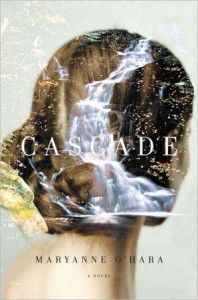
Cascade by Maryanne O’Hara

Cascade by Maryanne O’Hara is set in 1930s Massachusetts as the rest of the world is on the cusp of war with the Nazis and Boston is hoping to alleviate its water shortage by creating a new reservoir along the Cascade River.  Painter Desdemona Hart Spaulding lives in the sleepy little town of Cascade, which has been a target of lawmakers looking for water over the last decade.  Her life is nothing like she expected as her family falls on hard times, and she makes a life-altering decision to marry Asa to save her father and her home.  What she fails to realize is that some decisions are made for you by circumstance and fate in a cascade of changes that you can either fight or ride.

From the moment readers meet Dez, they know that she is conflicted about her new role as wife.  She makes her husband’s breakfast and tries to care for her father, but her mind wanders to her studio, her paints, and her canvases, making her lose track of time as she dives into the colors and scenes she creates.  Asa is hard to grasp as he seems to want to be oblivious to his wife’s struggles, but is forced to see reality when his wife makes decisions that place them both in the spotlight as the town looks for ways to save itself from drowning.

“Their once-fashionable resort town with its pleasant waters was looking more and more like the ghost valley that was invading dreams and even the pages of her sketchpad.”  (page 3)

O’Hara’s novel is not just about the cascade of decisions and twists in one’s life, but also the unexpected changes that face a country in a depression on the verge of a possible world war — at a time when sentiment against Jews is turning negative as many people lose their jobs and are thrust into poverty.  Things spiral out of control for the Spauldings and the town, but Dez is determined to follow her innate desire to pursue her art in spite of her duty to her husband and her father’s legacy as she hopes to turn public sentiment in favor of saving Cascade from the water department.  The parallels between the river and how it can shape a town and how events can shape people are deftly made in O’Hara’s lyrical prose.  She intertwines Shakespeare’s plays and famous quotations easily, tying Dez to her father’s legacy throughout the novel even when she has all but abandoned it in favor of an affair of art.

While Dez can seem immature in her clinging to Jacob, a traveling salesman, it is clear from her relationship with Asa that she’s never been in love with anything other than Shakespeare as seen through her father’s theater in Cascade and her own painting.  She is an artist that needs to feel substantial loss and pain before she can fully come into her art.  O’Hara has created a novel about the tensions between duty and desire and following one’s dream.  She has captured the struggle of artists, who unfortunately are too often misunderstood by non-artists, to achieve the time necessary to create without the guilt of failing to meet the obligations of family life and other relationships.

Through gorgeous descriptions and painting techniques, O’Hara plunges readers into the light-filled studios and landscapes of Dez, as well as into her nightmares, her guilt, and her nostalgia for things past.  Through quick brushstrokes and scraped canvases, the novel transports readers into muddied waters and into the bold color of an artist’s life.  Cascade by Maryanne O’Hara is a debut that shimmers like the rushing river over the rocks of the waterfall with its quiet power shaping Dez and what was once Cascade, Massachusetts.

***On a completely different note, I was totally in LOVE with this cover.   It was so utterly distracting with its water shapes in the profile image and how the boulders blended in as the woman’s hair.  I was enamored.***

About the Author:

Maryanne O’Hara was the longtime associate fiction editor of Ploughshares, Boston’s award-winning literary journal. Her short fiction has been published in magazines like The North American ReviewFive PointsRedbook, and many anthologies. She has received grants from the St. Botolph Foundation and the Massachusetts Cultural Council, and her story collection was a finalist for 2010′s Flannery O’Connor Award for Short Fiction. She lives on a river near Boston.

Find out more about Maryanne at her Website, her blog, and connect with her on Facebook.

This is my 83rd book for the New Authors Reading Challenge in 2012.


Life on Mars by Tracy K. Smith

Life on Mars by Tracy K. Smith, published by Graywolf Press on 30 percent post-consumer wastepaper, is a collection sliced up into four parts, and it won this year’s Pulitzer Prize in Poetry.  In the first section there are two parallels that Smith draws — the one between poet and astronomer searching for meaning in vastness and the parallels between the physical and spiritual world.  Like in “Cathedral Kitsch,” the narrator speaks of the gleam of gold in the church and wonders if God is there shining back on himself, but by the end of the poem, the narrator remarks on man’s stamp on the church and on faith.  “I feel/Man here.  The same wish/That named the planets.//Man with his shoes and tools,/His insistence to prove we exist/Just like God, in the large/And the small, the great//”

Some of the best lines come in “My God, It’s Full of Stars” where the narrator talks about God and the great unknown alongside the physical world in which she lives.  Rather than compare the two in pros and cons, the narrator takes a third path:

"Not letting up, the frenzy of being.  I want it to be
wide open, so everything floods in at once.
And scaled tight, so nothing escapes.  Not even time,
Which should curl in on itself and loop around like smoke.
So that I might be sitting now beside my father" (page 10)

There is a sense of wide-eyed, childlike wonder about the world and the unknown space and world of God. Rather than shrink from either, the narrator embraces their possibilities and revels in the possibilities.  Part two speaks for itself and pays homage to a father lost and time with him too short.  The collection then gives way to more timely matters in the news from a young woman kept as a sex slave to her father in the basement of a home he shared with his wife to the Abu Ghraib prisoners who were savagely mistreated by soldiers under too much pressure.  In the final section of the collection, Smith opens up her verse at full throttle to explore the infinite energy and being of all in the universe and the pulse of that energy as it continues to churn.

Life on Mars by Tracy K. Smith is well worth the prize it has won.  Her verse is well paced and masterful in how it draws parallels and leaves larger issues open ended for readers to think more about on their own.  She’s taken larger than life issues and honed in on them with a sharp eye, boiling them down to what really matters through personal accounts and a satiric remixing of facts from the news and more.  Definitely a collection for book clubs and to return to again and again when readers are feeling a bit enamored of the great unknowns.

About the Poet:

Tracy K. Smith was raised in Falmouth, Massachusetts. She studied at Harvard, where she joined the Dark Room Collective, a reading series for writers of color. She went on to receive her MFA from Columbia University.

This is the 24th book for my 2012 Fearless Poetry Exploration Reading Challenge.

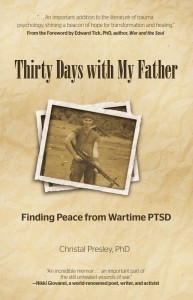
Thirty Days With My Father: Finding Peace From Wartime PTSD by Christal Presley, Ph.D.

Thirty Days With My Father:  Finding Peace From Wartime PTSD by Christal Presley, Ph.D., is the result of a 30-day project Presley undertook to get to know her father and his Vietnam War experiences after not relating for more than a decade, and she got much more than she expected.  Alternating between conversations wither her father and memories written down in her journal — the idea of her therapist — Presley relives parts of her own past just as her father does when speaking of Vietnam and what happened there.

Delmer Presley was drafted into the Vietnam War and never once thought about running off and dodging the draft, and he was a member of Americal Division, First Battalion, Sixth Infantry, referred to as the Gunfighters.  He entered the war following the Tet Offensive and came back a changed man.  While Presley’s book talks about his experiences as they were related to her during phone conversations and other encounters with her father, the memoir focuses mainly on Christal Presley’s intergenerational PTSD symptoms and childhood as it relates to those war memories.

Living in constant fear due to unpredictable behavior and other outside forces can cause heightened awareness fueled by adrenaline.  In the case of warriors and soldiers, this constant state of awareness can be hard to shake even when the unpredictability of the situation is removed and soldiers are sent home.  Consequently, the families that these soldiers return to find that their loved ones are altered, and in some cases, these situations can become very volatile and lead to unintended consequences, such as families subject to verbal abuse and more.

“‘I just didn’t consider those people human.  I never saw a Vietnamese before in my life, and I hated them.  We didn’t even call them Vietnamese back then.  Called them Charlies, dinks, and gooks.  That’s all I knew.  They taught us that.  I was trained not to see them as human.  The government can say whatever they want, but they trained us that way.  It hurt me more to see a dog or cat dead than them Vietnamese.  The government likes young boys who ain’t got no sense.  Easier to train, easier to brainwash that way.'”  (page 59 ARC)

The relationship between father and daughter always has been fragile.  The tentative nature with which Christal makes her calls to her father and feels him out before she asks each question is how readers would imagine any conversation to go given the years of silence between them, but particularly given traumatic nature of her upbringing.  Thirty Days With My Father:  Finding Peace From Wartime PTSD by Christal Presley, Ph.D., is about finding yourself amidst the chaos of family life, particularly a family life full of baggage, and about forgiveness for yourself and your family.  One of the most surprising and astonishing memoirs I’ve read in a long while.  It will have you re-evaluating your own conceptions about your childhood and how to repair relationships that have been damaged.

About the Author:

Christal Presley received her bachelor’s degree in English and her master’s degree in English Education from Virginia Tech.  She received her Ph.D in Education from Capella University. She is a former intern at Algonquin Books of Chapel Hill, and spent seven years teaching middle and high school English in Chatham and Danville, Virginia.

Her first book, Thirty Days with My Father:  Finding Peace from Wartime PTSD, will be published by Health Communications, Inc. in November 2012.

Christal grew up in Honaker, Virginia, and currently lives in Atlanta, Georgia. She is the founder of United Children of Veterans, a website that provides resources about PTSD in children of war veterans. In her spare time, you can find Christal playing with her dogs, tending to her chickens, and gardening.

***IF you would like to win a copy, leave a comment on this post about your interest by Nov. 21, 2012, at 11:59 PM EST***

This is my 80th book for the New Authors Reading Challenge in 2012.

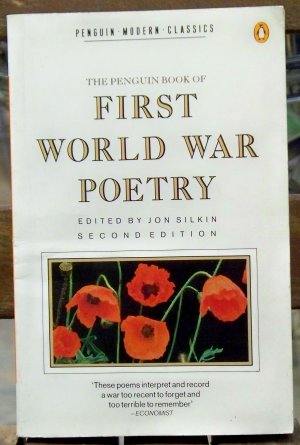
The Penguin Book of First World War Poetry (Second Edition) edited by Jon Silkin, David McDuff

The Penguin Book of First World War Poetry (Second edition) edited by Jon Silkin and David McDuff is a collection of poetry from and about the WWI.  Silkin and McDuff  increased the number of poems in translation included in the collection.  There are poems translated from German, French, Italian, Russian, and Hebrew, and Silkin was a poet himself.  As expressed in the not at the beginning, “For some, war was moral athletics; others looked forward to the experience of war as a ‘vacation from life’ — a vacation from a society disjoined by class and constrained by the rigid structures of labour.”  (page 12)

***However, I’m not one for long introductions so I skipped over it this time around and got straight to the poetry. ***

The anthology includes some of the more well known WWI poets, Thomas Hardy and Robert Graves, but also some who are not as well known.  One of the most well known WWI poems is “Anthem for Doomed Youth” by Wilfred Owen, which seeks to command a respect for the thousands who died in a cause for freedom and defense.  Steeped in religious allusions Owen makes reference to the candles lit where bodies lie and to the drawing of blinds in those same rooms as well as the prayers that often accompany the mourning process, but there also is an underlying celebration for their sacrifice as the bells are rung and anthems are sung.

Each of these poems brings with it a different perspective on war in the trenches, love, life, and loss, but above all patriotism.  Isaac Rosenberg’s “Dead Man’s Dump” (page 211) is particularly haunting:

"The wheels lurched over sprawled dead
But pained them not, though their bones crunched,
Their shut mouths made no moan.
They lie there huddled, friend and foeman,"

Meanwhile, there is a true sense of fear in Ivor Gurney’s “The Silent One,” (page 116):

"Who died on the wires, and hung there, one of two --
Who for his hours of life had clattered through
Infinite lovely chatter of Bucks accent:
Yet faced unbroken wires; stepped over, and went
A noble fool, faithful to his stripes -- and ended
But I weak, hungry, and willing only for the chance
Of line -- to fight in the line, lay down under unbroken
Wires, and saw the flashes and kept unshaken
Till the politest voice -- a finicking accent, said:
'Do you think you might crawl through there: there's a hole'
Darkness, shot at:  I smiled, as politely replied --
'I'm afraid not, Sir.' There was no hole no way to be seen
Nothing but chance of death, after tearing of clothes."

Each poet in the collection bring their own perspective to war, but there seems to be a pervading reverence to the fight these soldiers’ waged and all that they sacrificed.  There were certain translated poems in the book that didn’t resonate as well as some others, including Benjamin Peret’s “Little Song of the Maimed,” but it was good to revisit an old WWI poet, Osip Mandelstam (check out my earlier review of Stolen Air).  The Penguin Book of First World War Poetry (Second edition) edited by Jon Silkin and David McDuff offers a collection of poems that provide a wide perspective on war from the patriotism the soldiers felt to their fear and horror at the experiences they had.

About the Editors:

Jon Silkin was born in London, in a Jewish immigrant family and named after Jon Forsyte in The Forsyte Saga, and attended Wycliffe College and Dulwich College. During the Second World War, he was one of the children evacuated from London, and for a period of about six years in the 1950s, after National Service, he supported himself by manual labour and other menial jobs. He wrote a number of works on the war poetry of World War I. He was known also as editor of the literary magazine Stand, which he founded in 1952, and which he continued to edit (with a hiatus from 1957 to 1960) until his death.

David McDuff is a British translator, editor and literary critic. He attended the University of Edinburgh, where he studied Russian and German. After living for some time in the Soviet Union, Denmark, Iceland, and the United States, he eventually settled in the United Kingdom, where he worked for several years as a co-editor and reviewer on the literary magazine Stand. He then moved to London, where he began his career as a literary translator.


This review first appeared on Historical Tapestry for WWI Week.


This is my 14th book for the WWI Reading Challenge.


This is the 21st book for my 2012 Fearless Poetry Exploration Reading Challenge.

A Walk in the Park by Jill Mansell

A Walk in the Park by Jill Mansell is another engaging story about love and coming together as a family.  Lara Carson is forced to leave home at the age of 16 and returns to Bath 18 years later for her father’s funeral.  Things have changed drastically, but Evie is still the warm friend she remembers.  Lara believes she’s prepared to deal with the past, but when Flynn Erskine arrives unexpectedly her feelings nearly overcome her.  Not only does she owe the two most important people from her past an explanation, but she also has secrets she has to reveal — secrets that Flynn and Evie may not be ready for.

Mansell’s characters are always quirky, and there is no absence of that here, from Lara’s strong Aunt Nettie in Keswick to Don the jewelry shop owner in Bath.  While many of these characters are looking for love, denying that they are looking for love, or hoping to fall out of love with a cad, Mansell quietly addresses the fear that still haunts gays who have not come out of the closet, single-parenting obstacles, and how secrets can topple families.

Meanwhile, Lara is blindly making decisions that are best for her daughter, Gigi, but she refuses to look around her to see how her decisions affect herself and others.  She’s also busy trying to make love matches for her aunt and friends, at the same time she’s struggling to ignore her own passionate feelings for Flynn — her former teenage boyfriend.  Life and love is anything but a walk in the park for Lara and her friends, especially when the death of Lara’s mother raises questions about her mother’s faithfulness and about where she got the money to buy the family home.

Readers will note there are a variety of subplots, and while they are successfully concluded, there are some that felt a little rushed, which may be partially due to the multitude of characters Mansell creates.  Mansell novels are full of romance and flirty fun, but this one has some serious notes and a more mature set of story lines.  With a mother-in-law from hell and the outrageous behavior of rap star EnjaySeven, A Walk in the Park by Jill Mansell is a literary soap opera that leaps off the pages and makes readers thank their lucky stars their lives are less complicated.

About the Author:

Jill Mansell lives with her partner and children in Bristol, and writes full time. Actually that’s not true; she watches TV, eats fruit gums, admires the rugby players training in the sports field behind her house, and spends hours on the internet marvelling at how many other writers have blogs. Only when she’s completely run out of displacement activities does she write.

The School of Essential Ingredients by Erica Bauermeister

The School of Essential Ingredients by Erica Bauermeister is a novel about food and characters as original and complementary as the dinners they create during Lillian’s Monday night School of Essential Ingredients at her restaurant.  From the older couple Helen and Carl who are seasoned and aged by salted wounds and mellowing cream to the spunky and unsure experimental flavors of Chloe who strives to build her confidence in the kitchen and her relationships, Bauermeister has created a culinary masterpiece that will melt in readers’ mouths.

“The girl was a daughter of a friend and good enough with knives, but some days.  Lillian thought with a sigh, it was like trying to teach subtlety to a thunderstorm.”  (page 7)

“Some smells were sharp, an olfactory clatter of heels across a hardwood floor.  Others felt like the warmth in the air at the far end of summer.  Lillian watched as the scent of melting cheese brought children languidly from their rooms, saw how garlic made them talkative, jokes expanding into stories of their days.”  (page 17)

“The more she cooked, the more she began to view spices as carriers of the emotions and memories of the places they were originally from and all those they had traveled through over the years.  She discovered that people seemed to react to spices much as they did to other people, relaxing instinctively into some, shivering into a kind of emotional rigor mortis when encountering others.”  (page 20)

Readers will smell the food, taste it, touch it, and become inspired to create their own culinary delights at home and share them with their families and friends.  Bauermeister threads the memories and problems of each character through the movements and creations in Lillian’s cooking class, alternating points of view and providing insight into each of their lives.  The true beauty of her prose is that cooking terms are even used when cooking is not the main focus of the story, and she excels at creating a mood of melancholy or a mood of frustration or even a mood of nostalgia as each character reviews their lives and their journeys in the kitchen.

Although the stories contained in the novel are short, Bauermeister does a magnificent job of creating characters that are three-dimensional.  Like the spices and other ingredients in Lillian’s recipes, each character is an essential ingredient to the whole of the novel.  In many ways, her novel is about enjoying each moment to its fullest, even those moments of guerrilla cooking in which someone is over your shoulder adding spices or tips to make a dish better, even if those moments of advice are unwanted at the time.  Taking criticism and advice with a touch of acceptance that we all need a little help is what the recipe to life requires to make it great.  The School of Essential Ingredients will leave readers wanting more, but willing to embark on their own journeys of food and so much more.

About the Author:

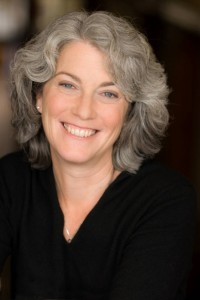
ERICA BAUERMEISTER is the author of The School of Essential Ingredients and Joy for Beginners. She lives in Seattle with her family.  Check out her Facebook page.

This is my 79th book for the New Authors Reading Challenge in 2012.

The Lost Art of Mixing by Erica Bauermeister

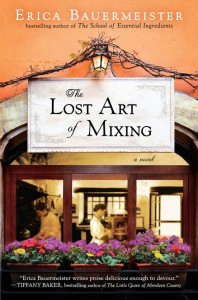
The Lost Art of Mixing by Erica Bauermeister (January 2013) picks up where her earlier novel, The School of Essential Ingredients (Check out my review tomorrow), left off — revisiting with Lillian, Chloe, Isabelle, and Tom.  Bauermeister also brings in some new characters as well as she leads readers on a journey of human interaction and family.  In many ways, recipes still play a role here as they did in the first book, though the imagery and word choices here are less about ingredients and cooking than they are about nature and the people themselves.  Isabelle plays a more integral role here than she did in the last book as a mother to grown children concerned about their new role as caregivers and to her wayward roommate, Chloe.  She’s also a motherly figure to Lillian when she finds herself in uncharted waters.

“For all the glamour of restaurants, the underlying secret of the successful ones was their ability to magically repurpose ingredients, a culinary sleight of hand that kept them financially afloat and would have made any depression-era housewife proud.”  (page 3 ARC)

Bauermeister expands on her early work and how food and emotions are closely tied to one another, looking deeper into her recipe to the ingredients and how they blend together or are mixed.  When a recipe is created, are the essential ingredients lost in one another or do they merely bring out the best elements of one another to create something luminous?  Isabelle’s memory loss highlights the mixing element further in terms of how memories are mixed in our minds with scents and seemingly innocuous objects, but the recall of those memories in those moments when scents and objects are present is all at once disconcerting, phenomenal, and joyous.

Bauermeister has created another set of deep characters with nuanced personalities and places them in unusual situations that are all at once odd and plausible, and readers will be swept up in the relationships within these pages and how the characters mingle and mesh with one another in different ways.  Whether a chance meeting when returning a lost coat or a rushed moment in the accountant’s office, lives are touched and changed.  The Lost Art of Mixing by Erica Bauermeister examines the relationships we have, the ways in which we perceive them and ourselves, and how an outside perspective can improve our interactions with those we think we know the best and are closet to, creating even deeper connections than we thought possible.

About the Author:

ERICA BAUERMEISTER is the author of The School of Essential Ingredients and Joy for Beginners. She lives in Seattle with her family. Check out her Facebook page.

Also look for a giveaway and interview in January when the book is released.