Quantcast

Do Androids Dream of Electric Sheep? by Philip K. Dick

Source: Public Library
Paperback, 244 pages
I am an Amazon Affiliate

Do Androids Dream of Electric Sheep? by Philip K. Dick, first published in 1968, was our June book club selection, and is the basis on which the classic movie Blade Runner is based.  (Previous to reading the novel, I’ve seen the movie, and recent memories of the watching the movie kept me alert for similarities in the book)  Rick Deckard is a bounty hunter, who works for little money in San Fransisco’s Police Department, and what money he does make is from bounties on the heads of escaped androids that escape Mars often by killing humans.  Society has evolved to the point at which androids are so human-like that they cannot be sniffed out except through a couple of tests administered by bounty hunters, which will puzzle the reader as to why the android would sit for such a test knowing that to fail means immediate retirement — a.k.a death.

Animals are no different, with many of the animals made extinct by the war and fallout, and residents of this desolate Earth are desperate to own an animal, even if it is an electric sheep.  As David Sedaris says in his essay “Loggerheads” in Let’s Explore Diabetes With Owls, “As with the sea turtle, part of the thrill was the feeling of being accepted … allowed you to think that you and this creature had a special relationship …”  These humans are looking for connections in any way that they can get them, either through animal ownership — such as ownership of electric animals — or through the empathy machine that connects them with other members of society through Mercerism.

“Empathy, he once had decided, must be limited to herbivores or anyhow omnivores who could depart from a meat diet.  Because, ultimately, the emphatic gift blurred the boundaries between hunter and victim, between the successful and the defeated.”  (page 51)

In Roger Zelazny’s introduction, he says, “His management of a story takes you from here to there in a God-knows-how, seemingly haphazard fashion, which, upon reflection, follows a logical line of development — but only on reflection.”  He’s correct in that the story shifts from Deckard’s story to that of J.R. Isidore, a so-called special or chickenhead who has been declared genetically unfit to emigrate to the Mars colony.  Isidore lives alone in a dilapidated apartment building filled with kipple, the detritus and radioactive dust, etc.  His condition requires readers to have a lot of patience for his ramblings, which in some cases seem like LSD trips or a schizophrenic break, but in some ways, Dick is attempting to demonstrate another aspect of loneliness and disconnect than what he’s showcased in the human-android relationship.  In addition, Dick seems to want readers to think long and hard about their faith in religion as the subject of Mercerism pervades the story as a way for humanity to connect on a deeper level through technological means.

“Here there existed no one to record his or anyone else’s degradation, and any courage or pride which might manifest itself here at the end would go unmarked: the dead stones, the dust-stricken weeds dry and dying, perceived nothing, recollected nothing, about him or themselves.”  (page 231)

Deckard is a man conflicted about his job, but only after he meets an android he finds attractive, and as with most men living on the edge and crossing over moral lines, he struggles to regain his footing and return to his real life and think little about what he’s done.  While he’s cocky about his abilities to take down androids, that bravado soon gives way to concern, doubt, and even fear.  Dick’s surreal narrative will leave readers guessing about the direction of the chase for the androids and whether Deckard will have the strength to complete his task or whether in completing that task he’ll have a complete breakdown or experience no repercussions what so ever.

Do Androids Dream of Electric Sheep? by Philip K. Dick is an exploration not of the future, but of ourselves and our never-ending search for connection with others — whether that is with an android, a spouse, a co-worker, a lover, or an animal.  In his convoluted and disconcerting narrative, the author seeks to upend the beliefs of his readers and challenge their moral boundaries.  Unfortunately, there are big gaps in the narrative and the background about the war that caused the destruction of Earth, the origins of Mercerism, and what exactly is going on Mars — are androids in control of Mars, turning humans into androids, or something else.  These are just some of the issues that are not explored fully in this cerebral exercise.

What the Book Club Thought:

Most of the book club liked the book a great deal, with two members liking it more than they expected to when they began reading it.  Dick is one of the member’s favorite authors.  In the discussion, we touched upon the jabs at capitalism throughout the text in that animals are bought and sold at high prices and the addiction of characters to the mood organ (on which they can preset their mood for the day) and the empathy machine, which allows humans to commune with one another and Mercer.  These machines seemed to leave humans dependent and in a fog, but there is also the surreal portions of the story that left many of us guessing as to whether a spider found by Isidore was real or imaginary and Rick’s sudden transformation into Mercer without the empathy machine after completing his job.

The ownership of androids (which are advertised as an incentive to move to Mars) was compared to that of owning slaves, as well as why bounty hunters were necessary to retire the androids — are they dangerous or just different?  I theorized that perhaps the incentive of owning an android was a ploy to get humans to Mars so they could be replaced with androids.  None of the other members seemed to agree.  One member also questioned from the beginning whether Rick was human or an android, though most of the members assumed he was human.  Other topics touched upon were that the androids were child-like and not as evolved as humans and hence why they sometimes acted with malice, and that perhaps given more time to live, they could develop empathy, thus making them harder to distinguish from humans.

Our July book club selection is His Majesty’s Dragon by Naomi Novik.

About the Author:

Philip K. Dick was born in Chicago in 1928 and lived most of his life in California. He briefly attended the University of California, but dropped out before completing any classes. In 1952, he began writing professionally and proceeded to write numerous novels and short-story collections. He won the Hugo Award for the best novel in 1962 for The Man in the High Castle and the John W. Campbell Memorial Award for best novel of the year in 1974 for Flow My Tears, the Policeman Said. Philip K. Dick died on March 2, 1982, in Santa Ana, California, of heart failure following a stroke.
This is my 40th book for the 2013 New Authors Challenge.

Three-Ring Rascals: The Show Must Go On! (Book 1) by Kate Klise, illustrated by M. Sarah Klise

Source:  Anna of Diary of an Eccentric gave me this ARC as the book was aimed at readers younger than The Girl, but only slightly older than my girl. (probably the longest explanation EVER!)
Paperback, 141 pages
I am an Amazon Affiliate

Three-Ring Rascals: The Show Must Go On! (Book 1) by Kate Klise, illustrated by M. Sarah Klise, is a cute book about circus life, complete with talking animals, feats that defy gravity and the laws of physics, and a scoundrel, which is due for publication in September 2013.  Sir Sidney’s Circus is a story about redemption and about being true to your friends, but it’s also about the surprising things that can happen when you’re not looking.

Sir Sidney is getting older and he’s looking for a manager when he settles on a self-proclaimed lion tamer named Barnabas Brambles, but while Sidney is away, Brambles has plans of his own — to make money for himself.  The path he takes to make more money backfires even as he strives to accomplish even more devious strategies.  Meanwhile, the animals sure miss their owner and suffer at the hands of Brambles, though they don’t exact any revenge.

Leaving the acrobats in charge of driving the train, Brambles finds that his plans are thrown out into the wind as the train gets stuck in places that will boggle his mind.  Klise is an imaginative storyteller, and readers will like the little definition explanations she includes for some of the larger words used, as well as the explanation behind the made-up words used by the mice, Bert and Gert.  The illustrations are fun and simple, and they include dialogue bubbles as the animals talk amongst themselves while Brambles makes his plans.  The text is mixed in beside and inside the illustrations, which will keep readers exploring the pages, rather than rushing over the pictures.

Three-Ring Rascals: The Show Must Go On! (Book 1) by Kate Klise, illustrated by M. Sarah Klise, is a book that will entertain younger readers, though age 10 may be a little old for the book depending on the readers’ abilities.  The book indicates it is for kids ages 7-10, but it read more like a book for ages 5-8, but younger readers may need help reading.  As a book read at bedtime for younger ages, parents could break it up in installments over several evenings.  The book is fun and only the first in the series, with certainly more antics to come, especially from Bert and Gert who are a riot.

**The Three-Ring Rascals Website offers some great insights into how the author and illustrator are like Bert and Gert, the two mice, and there are resources for teachers and fun games for kids.

About the Author and Illustrator:

Kate Klise and M. Sarah Klise have collaborated on numerous middle-grade and picture book projects. Their most recent series, 43 Old Cemetery Road, has been nominated for reading awards in nearly twenty states to date and is a Junior Library Guild selection. The pair’s novels and picture books can be found on their Website.  And to find out more about the Three-Ring Rascals, visit the Website.

This is my 39th book for the 2013 New Authors Challenge.
A Strange Place to Call Home by Marilyn Singer, illustrated by Ed Young

Source:  Purchased from Novel Books
Hardcover, 44 pages
I’m an Amazon Affiliate

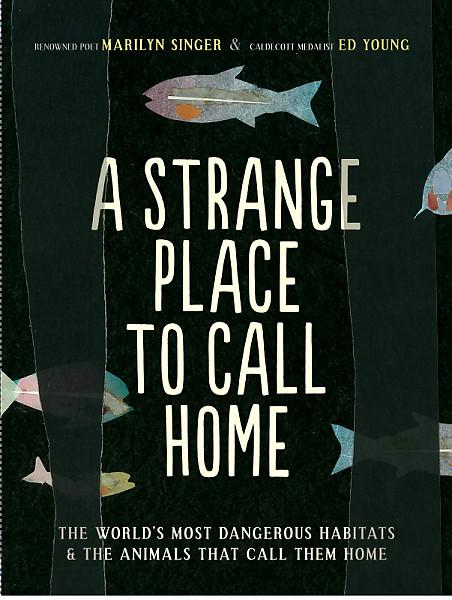
A Strange Place to Call Home by Marilyn Singer, illustrated Ed Young, is a collection of poems and illustrations about animals that live in harsh environments and have adapted to their conditions.  The poetry forms include free verse, cinquain, haiku, villanelle, sonnet, and others that give young readers a brief look at the animals in their habitats from the Humboldt penguins that live in the warmer climates of Chile and Peru to the blind cave fish that live in the dark deep.  Included in the poetry book are at times abstract looking pictures of the animals or their habitats, though the images resemble collage techniques that incorporate various mediums.  The book also includes a break down of what poems exemplify which form and end notes that give a little more information about each animal.

Dry as Dust

They can deal solo
with dryness, but give them rain
and then: toads explode.

For my little girl, who is age 2, this book was a little too old for her.  She couldn’t pay attention long enough to get through the entire book, but she loved the pages with the snow monkeys in “Think Heat.”  There are a lot more questions than answers, and kids who are older are likely to want more information about each animal and habitat.  For younger kids, there’s just enough in each poem to mirror their own wonder, including them in the wider questioning of these animals’ lives.

A Strange Place to Call Home by Marilyn Singer, illustrated Ed Young, is a little too old for my little one, but if she retains her love of animals, she’ll likely enjoy this more as she gets older.  I found the poems a little too simple, and some did not have enough information about the animals or their habitats, but the end notes did offer a bit more information.  As a jumping off point, the book will spark questions from younger readers, and it could inspire a mother- or father-child exploration of these harsh habitats and adaptable animals.  Singer offers a special thanks at the beginning of the book to several people and museums, which seems to be where she obtained some of the information for her poems.

About the Poet:

Marilyn Singer was born in the Bronx (New York City) and lived most of her early life in N. Massapequa (Long Island), NY. She attended Queens College, City University of New York, and for her junior year, Reading University, England. She holds a B.A. in English from Queens and an M.A. in Communications from New York University.  Visit her Website.

About the Illustrator:

Caldecott Medalist Ed Young is the illustrator of over eighty books for children, seventeen of which he has also written. He finds inspiration for his work in the philosophy of Chinese painting.

Young began his career as a commercial artist in advertising and found himself looking for something more expansive, expressive, and timeless. He discovered all this, and more, in children’s books.  Visit his Website.


This is my 38th book for the 2013 New Authors Challenge.


This is my 24th book for the Dive Into Poetry Challenge 2013.

The Neruda Case by Roberto Ampuero, Translated by Carolina de Robertis

Source: Riverhead Books, Penguin
Paperback, 374 pages
I am an Amazon Affiliate

The Neruda Case by Roberto Ampuero, translated by Carolina de Robertis (see my review of Perla), is set just before the dictatorship of Augusto Pinochet in Chile when Castro is in power in Cuba and Germany has been cut in half by the wall.  Cuban exile Cayetano Brulé has left Miami with his wife, Maria Paz Angela Undurraga Cox, for her home in Chile, but he continues to feel out of place as no one trusts a Cuban and he cannot find work.  Meanwhile, his wife is increasingly engaged in the reform movement in the country, while at the same time she is pulling away from her husband.  Wandering in a strange country with bad coffee, Cayetano unwittingly bumps into Pablo Neruda at a party in a library and shortly receives an offer he cannot refuse.

“The door was made of knotted wood.  It didn’t open.  He stroked the old bronze knocker, put his hands in the pockets of his fleece jacket, and told himself that all he could do now was wait.  He exhaled wafts of white breath into the overcast winter morning and thought, amused, that it looked as if he were smoking, even though, in this city, there were no more matches or cigarettes.”  (page 12)

Brulé is a man that is transformed by his business relationship with Neruda, who hires him to uncover the truth about his past that haunts him, but this relationship evolves into admiration and a personal connection that transforms Brulé into a confident detective.  Not only is the novel about finding solace, it also is about one man’s journey home.  Neruda was a complex man and legendary, and the author clearly admired the poet and held him in high regard, but the novel also demonstrates that even the most legendary of us have flaws.  It is those flaws that make us who we are, ensuring that those who love us are constantly challenged.  By the time Brulé meets Neruda, he is already a legend and Nobel laureate, and Neruda knows it and revels in his success — so much so that it becomes a crutch for any mean moment or poor decision in his life:  “I did it for my art.”

“‘Because if poetry transports us to the heavens, crime novels plunge you into life the way it really is; they dirty your hands and blacken your face the way coal stains engine stokers on trains in the south, where I was born.'”  (page 24)

“‘The casualties of our good fortune are a terrible thing, Cayetano.  But the road to personal happiness is paved with the pain of others.'”  (page 130)

Ampuero’s novel is a detective novel wrapped up in literary and historical fiction that depicts a turbulent time in Chile’s history, but also a time of idealism on the part of Neruda and President Salvador Allende.  The Neruda Case transports the reader back in time and paints a picture of idealism and its failures, but also its continued promise of hope.  Ampuero’s portrayal of Neruda is as complex as the man himself, and his detective is a man that readers will become emotionally attached to and cheer on in his mission.  One of the best, sweeping novels I’ve read this year.

**On a side note, I was pleased to find that Ampuero lived near Neruda’s home La Sebastiana as a boy and regrets that he never had the courage to knock on the poet’s door.**

About the Author:

Roberto Ampuero is an internationally bestselling, award-winning author. He has published twelve novels in Spanish, and his works have been translated around the world. The Neruda Case is his first novel published in English. Born in Chile, Ampuero is a professor of creative writing at the University of Iowa and currently serves as Chile’s ambassador to Mexico. He lives in Mexico City and Iowa City.


This is my 37th book for the 2013 New Authors Challenge.

Virgin Soul by Judy Juanita

Source: Viking
Hardcover, 306 pages
I am an Amazon Affiliate

The rhythm of Virgin Soul by Judy Juanita’s narrative is reminiscent of scat singing, but with a street-based undertone, jumping from moment to moment creating an atmosphere that resembles the turbulent nature of the 1960s.  In this way, she captures the atmosphere, especially among African-Americans in California at that time, really well.  The protagonist Geniece Hightower has always felt like an outsider since her mother died and her father skipped out, but when she heads off to college, she thinks that she’s finally found a place to fit in.  She meets some people engaged in the civil rights movement, and falls in love with Allwood, who becomes her lover and teacher.  She falls in and out of relationships, but at her heart Allwood is her first love.

Juanita breaks the book into one year of college from Freshman to Senior year, and its first-person narrative makes it read more like a memoir than fiction.  The novel bounces from moment to moment, reading more like a journal than fiction, and Geniece is tough to get a handle on as she’s pulled between the moral and conservative views of her family and the angrier, more liberal thinking of her friends.

“Uncle Boy-Boy was a dentist and Aunt Ola Ray was his wife and I was not their adored child–I was more obligation than kin, their dark-skinned orphan-in-residence.  I had gotten accepted into SF State as a freshman, but my ‘financial resources’ amounted to my seventy-two-dollar monthly Social Security check.  I wasn’t about to ask them to support me.”  (page 3)

Geniece is looking for her place in the world, and as she’s felt like an outsider in her own family, it’s easier for her to be captured by the passions of others, and eventually, she falls into the Black Panthers.  While she’s caught up in the movement, she never loses sight of getting her education, knowing from her family that it is about the only way she can break free from poverty.  As a member of the party, she learns that she is as angry as the men in the party, but she draws the line at killing.  Geniece never seems to grow out of the naive way in which she relates to the men in her life — falling into bed at a moment’s notice, even when there is very little attraction — but her relationships with her female friends are at arms length in most cases.

“Whenever Allwood insisted, I resisted, but only to a point.  I wanted to know what he knew, feel what he felt inside that righteousness.  The only way in was to surrender, and I was willing.  I had plenty of motivation and a demonstrated interest, but I needed a catalyst.  Allwood was the reason I became black.”  (page 35)

Huey Newton and Bobby Seale, the leaders of the Black Panthers, are here, along with many others from history, but they are more in the backdrop than in the foreground.  Other figures from history include Stokely Carmichael, Betty Shabazz, Eldridge Cleaver, and more.  Geniece, however, is on the sidelines and working with the community and the children and on the paper, but she has little to do with the violent protests and demonstrations.  She’s a bystander, but she isn’t.  Her involvement is focused on the rebuilding of the community, and in this way, her character matures and becomes a focal point for what was good about the Panthers.  Readers looking for an in-depth connection to these historical figures will be disappointed because the novel’s focus is Geniece and her experiences during the 1960s and the civil rights movement, which also gets caught up in the controversy of the Vietnam War and the deaths of Black soldiers on the front lines.

When the police and the FBI are watching your every move, it is naive to think that even as a mere writer or community volunteer that you wouldn’t be a target.  Unfortunately, Geniece is very naive in terms of precarious situation as a party member — a perception that she has to face head on later in the book.  Moreover, it seems as those she simply falls into a socialist movement, and gets herself deeper involved without thinking about the consequences.  Where the novel failed is at the end where too many things are left unresolved and hanging, and Geniece’s character is only partially evolved beyond her first introduction.  The relationships between the main character and the male party members are vague at times or seemingly non-existent until they fall into bed.

Virgin Soul by Judy Juanita is not for every reader; it is definitely frank about the 1960s movements, the violence, the drug use, the rampant sexual activity without commitment, and the paranoia that many in the African-American community felt.  However, Juanita has a firm grasp of her setting and time period, making it easy for readers to transport themselves back in time and to feel the tension and paranoia that these activists felt as they strived for change.  Another aspect that comes to life is the color differences and prejudice within the Black community itself, particularly in how darker skin men and women were treated compared to those with lighter brown skin.  Overall, a turbulent novel that reads more like a series of memories.

About the Author:

Judy Juanita’s poetry and fiction have been published widely, and her plays have been produced in the Bay Area and New York City. She has taught writing at Laney College in Oakland since 1993. This is her first novel. She lives in Oakland.  Check out this Interview from Publisher’s Weekly.

This is my 36th book for the 2013 New Authors Challenge.

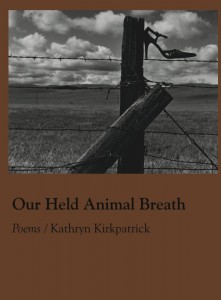
Our Held Animal Breath by Kathryn Kirkpatrick

Source: Wordtech Communications and TLC Book Tours
Paperback, 96 pages
I am an Amazon Affiliate

Our Held Animal Breath by Kathryn Kirkpatrick is a slim volume of poetry that is broken into three sections.  Although there is a deep sense of anger and hurt over current events and the rape of the world by humanity, many of these poems also have a personal side to them — deep personal losses of friends and family.  At times, the narrator is baffled at how some things come to be, like in “Millennium” where the narrator is left with an altar in a room flooded with light.  “How did I come by this altar,/these windows of stained glass?/When I meet the fox again,/I set her free./The meadow she finds/is neither desert nor glacier.”  (page 11)

Kirkpatrick wonders about the connections between humans and nature, particularly animals.  She postulates in “At the Turkey Farm” whether we absorb the loneliness and longing of turkeys when we eat them during holidays, but at the same time she talks about their only solace as being able to stand in the fading light in their own poop.  At the heart of the poem, the narrator is exploring the existence of these animals as walking corpses and ghosts haunting the farms but not really living.  In a way the poem itself is haunting, forcing readers to contemplate these farms where animals are bred to be something other than themselves, serving mostly as food.

Strange Meeting (page 22-3)

Is this how an animal feels
on the other side of a human eye?

I was a woman speaking
to men I didn’t know.

Large and strong, they
knew about power
in ways I may never

I sat framed and assessed
no threat a square jaw decided
negligible bent knuckles said

I looked back through my animal
eye, saw

the slit throat of the cow
in the leather shoe

the poisons deep in the soil
where the cotton grew

the felled trees
of the papers stacked

the mountains leveled
in the electric hum of light and heat
where we sat.

I saw clearly
all they had done and would do
to make a world we’d be losing fast.

I saw why it was lost.
And I saw how we would lose it.

In some poems, Kirkpatrick weaves in the teachings of Buddhism, but in some instances, those teachings cannot stop the suffering. “After Zazen” explores the many forms of suffering facing humanity, including accidental swallowing of stones to cause near suffocation and death and the invasion of one country into another. Raising questions about suffering on many fronts, the narrators are searching for ways to end it or at least ease the pain. Meditation may not be the best solution or it could be. Beyond these moments of suffering, the narrator blur the lines between animal and human to find the similarities of feelings and behaviors, but to also outline the loyalties that have been forgotten, like that of a dog and master. Perhaps that loyalty should be expanded to include other aspects of nature.

Our Held Animal Breath by Kathryn Kirkpatrick offers a wide range of poems for discussion in book clubs, focused on the impact of human activity on the environment and the changes that are possible if we just think outside the box.  What are the ways that we can brainstorm to feed ourselves and continue to live and grow without harming other animals and nature.  While the brown of the cover is a bit off-putting; the shoe seems out of place on the wire fence, though that may be on purpose given the sometimes out of place nature of our own existence in the world.

About the Poet:

Raised in the nomadic subculture of the U.S. military, Kathryn Kirkpatrick was born in Columbia, South Carolina, and grew up in the Phillipines, Germany, Texas and the Carolinas.  Today she lives with her husband, Will, and their two shelties in the Blue Ridge Mountains of North Carolina, and she currently holds a dual appointment at Appalachian State University as a Professor in the English Department and the Sustainable Development Program. She has a Ph.D. in Interdisciplinary Studies from Emory University, where she received an Academy of American Poets poetry prize.

Giveaway:  1 copy of Our Held Animal Breath

Want to win a copy of her book?  Leave a comment below with an email

I’ll contact the randomly drawn winner, who must be age 18 or older and live in US or Canada as the publisher is sponsoring the giveaway.  Deadline to enter is June 17, 2013 at 11:59 PM EST

This is my 23rd book for the Dive Into Poetry Challenge 2013.


This is my 35th book for the 2013 New Authors Challenge.

Regulated for Murder by Suzanne Adair

Source: Author provided review copy
Paperback, 230 pages
I am an Amazon Affiliate

Red coat soldier and criminal investigator Michael Stoddard has landed himself in a pickle in the first American Revolutionary War Thriller installment, Regulated for Murder by Suzanne Adair.  Stoddard must dress in plain clothes before making his way to Hillsborough, N.C., to deliver a vital dispatch to Cornwallis, and he must not let on that he is a British soldier.  He’s less than pleased by his new assignment as he was attempting to close in on Bowater, who is accused of defrauding two men.  Stoddard assumes the name of Compton after stumbling upon a murder scene in a town not loyal to the British and being surrounded by lawmen and residents who are very suspicious of strangers.  Quickly, he’s rescued from certain jail time by his “cousin,” Kate, just as he is recruited by the town’s German sheriff Schmidt to find the killer of a local man.  What transpires is a criminal investigation wrought with danger at nearly every turn, which set during another time period might be perceived as a little too much.  However, given the American revolutionary time period in question when loyalties were tested and retested, Adair handles the investigation and interactions with a town full of former Regulators and those who opposed them carefully.

“Electric readiness charged Michael’s muscles.  He sprang into the house and pivoted to avoid Schmidt’s paw swipe.  The German kicked the door shut, leaving his lackeys outside.  Michael’s forearm deflected the second swipe, followed it with a slash from his dagger that snagged Schmidt’s sleeve.  Then his heel caught on an upturned rug.  Schmidt advanced into his stumble, batted the dagger from his hand.  It clattered to the foyer floor out of reach.” (page 69)

Adair provides enough backstory for readers to follow along with Stoddard and understand his background, though it is clear that more is haunting this man.  Adair fleshes out Stoddard’s conflicted character, providing readers with glimpses of his struggles with his moral conscience, but she also depicts him as a highly logical man.  It was interesting to see that this are was plagued by corruption even before the American Revolution and that the townspeople sought to root it out themselves, which calls to mind the driving force behind the American fight for freedom from British rule.  However, Adair also touches upon the tension people felt after getting to know some of the soldiers that occupied their towns, getting to know them as people made it harder to see them as enemies.

Regulated for Murder by Suzanne Adair is a solid mystery set in the period of the American Revolution that will keep readers entertained and learning about our nation’s past.  The author even provides historical notes about what parts of the novel are based in fact and which are fiction.  While the book started off a little slowly, it quickly picked up pace once Stoddard entered the town of Hillsborough.  There were some moments that seemed a little too coincidental, but they were intended to be so given the circumstances of the murder investigation, but the appearance of Stoddard’s nemesis seemed a bit forced, though it was still enjoyable to see the moral dilemma it presented to the main character.

About the Author:

Award-winning novelist Suzanne Adair is a Florida native who lives in a two hundred-year-old city at the edge of the North Carolina Piedmont, named for an English explorer who was beheaded. Her suspense and thrillers transport readers to the Southern theater of the Revolutionary War, where she brings historic towns, battles, and people to life. She fuels her creativity with Revolutionary War reenacting and visits to historic sites. When she’s not writing, she enjoys cooking, dancing, hiking, and spending time with her family.  Visit her on Facebook, Twitter, and blog.

This is my 1st book for the American Revolution Reading Challenge 2013


This is my 34th book for the 2013 New Authors Challenge.

The Last Van Gogh by Alyson Richman

Book Source:  Library
Paperback: 308 pages
I am an Amazon Affiliate:

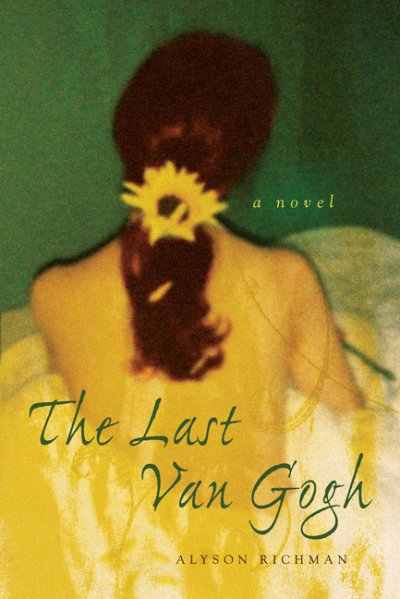
The Last Van Gogh by Alyson Richman, which was our May book club selection (unfortunately, I missed this meeting due to obligations at the 2013 Gaithersburg Book Festival), is based on true events in near the end of Vincent Van Gogh’s life in Auvers, France, in the 1890s.  Told from the point of view of Marguerite Gachet, a story unfolds not so much about Van Gogh but about the cloistered life of a young woman trapped inside her own family home by not only an overbearing and controlling father, but also family secrets.  More than that, it is a tribute to an artist and the tension between that art and the desire to have a normal life, as well as the struggle between family obligation and one’s own desires.

“For a home that had so many colors and vibrant paintings on its walls, there were still so many shades of gray between us.”  (page 182)

Richman does really well in using painting techniques and colors to describe the scenes in Auvers, and it is almost as if the reader has stepped inside one of Van Gogh’s paintings and is walking around among the village’s people.  Another surprising element is that the chapter headings, which often appear in some translated works, are less in-your-face about each chapter’s contents.  The headings also add to the atmosphere of the novel, reinforcing the painting and French aspects of the novel.

“I had gone out to do my errands, as I always did in the early afternoon.  It was a warm, radiant day in May.  The sky was cornflower blue, the sun the color of crushed marigolds.  I have to confess that I walked a little slower that day when I passed by the station.  I knew approximately which train he would be arriving on.  So I walked with smaller steps than usual, carrying my basket of eggs and my loaves of bread.”  (page 1)

From the moment readers meet Marguerite, they can see her rebellious nature, even though her daily tasks showcase her obedience to her father at every turn.  When the secrets begin to unravel, she finds herself less torn between duty and desire and more willing to follow her own mind and heart, even if it means getting caught.  Her father is the most irritating and self-absorbed character as he seeks to ingratiate himself into the artistic community by claiming his tinctures are actual cures.  And the son, Paul, is just as bad as he attempts to please his father at every turn and garner his favor.  The only way he can gain that favor is through Marguerite’s downfall, which she brings about on her own during her fateful meeting with Van Gogh.

The Last Van Gogh by Alyson Richman is a rich story in character, setting, and nuance.  Van Gogh’s perceptive nature as an artist shines through in his painting of Dr. Gachet as an aging man with sallow features, but it also shines through in his paintings of Marguerite at the piano and in the garden.  A love story in painting that comes alive with each brush stroke, only to be mired by the rain streaked canvases touched by tinctures that are misused and the controlling desires of a man torn between propriety and his obsession with art.

About the Author:

Alyson Richman is the author of “The Mask Carver’s Son,” “The Rhythm of Memory (formerly published as Swedish Tango),” The Last Van Gogh,” and the national best-seller, “The Lost Wife.” She loves to travel, cook, ride her yellow bicycle, and do ballet. She currently lives in New York with her husband and two children.

This is my 33rd book for the 2013 New Authors Challenge.

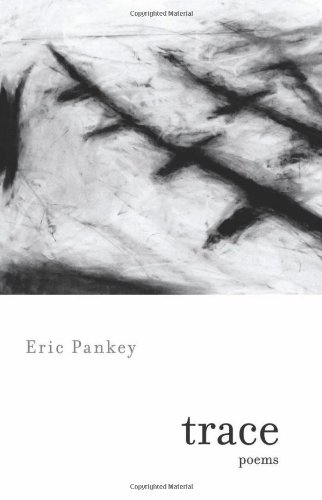
Trace by Eric Pankey

Book Source: Purchased at Novel Places
Paperback, 68 pgs
I am an Affiliate of Amazon.com

Trace by Eric Pankey, published by Milkweed Editions on 100 percent post-consumer waste paper, is a melancholy collection of poems that explores faith and the vacillation between believing and not.  Combining science and philosophy with observations of nature, Pankey examines the impact of life upon life, memory, and the other.  “If all matter is constant, what can one add to creation?”, the narrator of “A Line Made While Walking” asks.  What are these lines that we draw between our past and present, God and ourselves, and even between one another — are they not just arbitrary demarcations.  Like in “Out-of-the-Body,” the narrator watches the river otter and wonders if the animal is at play or working and whether even such distinctions enter into his thoughts while he’s busily breaking up the ice.  And if the otter does not make these distinctions, why do we, especially when we lie awake at night.  If only we could watch ourselves from outside of ourselves, what would we see?

Pankey’s preoccupation with death and its ultimate push to think about faith in something greater than ourselves permeates each and every poem in the collection, though some more intensely than others.  “All of winter, like a suppressed yawn, wells up inside me” is just one line from “Cogitatio Mortis” or I think of death (a rough Latin-to-English translation).  Death is never far from us or our thoughts, especially in today’s media hyped up world in which news from across the globe reaches us in seconds and wars continue to break out across the world.

Edge of Things

I wait at the twilit edge of things,
A dry spell spilling over into drought,

The slippages of shadow silting in,
The interchange of dusk to duskier,
The half-dark turning half-again as dark.

There:  night enough to call it a good night.

I wait for the resurrection, but wake to morning:
Mist lifting off the river.
Ladders in the orchard trees although the picking's done.

There are moments of hope in the collection, as Pankey’s poems discuss the death of the body, but not the soul. In “The Place of Skulls,” the narrator talks about the millstones and the hauling down of the bodies, but that the tree continues living and bearing fruit. Whether this is a poem about reincarnation, the absorption of the soul into the tree, or the mere image of saplings that have grown up and bear their own fruit after the sire has passed on does not matter because there is hope that life never just stops.  Faith is at the edges of these poems and underneath them, but on the surface, there is death, loss, and memories of all that has passed, even if those memories are faded and carry different emotional context than they did in the moment of creating them.

Trace by Eric Pankey is a collection focused on faith and passing on and what one wishes to leave behind, compared to what is actually left behind.  It is about the struggle to continue to get up every day and face it head on, even if death is closer than ever.

About the Poet:

Eric Pankey is the author of nine collections of poetry. TRACE, published by Milkweed Editions this year is the most recent. Two new collections, DISMANTLING THE ANGEL, and CROW-WORK are forthcoming. He is the Heritage Chair in Writing at George Mason University.

He’ll be at the May Gaithersburg Book Festival for “Poetry in the Afternoon” moderated by me!


This is my 21st book for the Dive Into Poetry Challenge 2013.


This is my 32nd book for the 2013 New Authors Challenge.

The Klipfish Code by Mary Casanova

The Klipfish Code by Mary Casanova is a young adult novel set during World War II when Norway was occupied by the Nazis for five years.  Rather than acquiesce to all of the Nazis demands and become indoctrinated, many of them showed their solidarity in small ways, including wearing paperclips on their clothes and not speaking to those in the community who turned into Nazi informers.

Marit is a young girl of ten when the first bombs fall on Norway, which has become a pawn in the war as the Germans seek to control the ports and the British seek to do the same.  Her parents are eager to join the Resistance and help the British as best they can — her father’s knowledge of bridges and roads and her mother’s ability to speak English — but it forces them to break up the family and send their children to Godøy Island to live with their grandfather Bestefar and their aunt Ingeborg.  While Marit and her brother Lars have spent summers there, Marit does not get along well with her grandfather who she finds favors her brother.

“She couldn’t believe he was actually speaking to her.  She didn’t know if he wanted an answer or not, but she gathered her courage.  ‘But Bestefar, if no one fights back, the Germans will be here forever!'” (page 41)

Casanova’s story is based in fact, which can be found in the notes at the back of the book, and her characters are believable as young children caught in a war they do not understand.  Marit struggles with her morals as she’s forced by her peers to not speak to her friend Olaf in school because his parents turned in a Norwegian to the Nazis.  While Marit is brave at the beginning of the occupation, she falters as any young child would in the face of oppression and danger, and she must come to terms with her own convictions and if they are worth the price she and her family might pay.

Unlike other suspenseful young adult novels in which children are the main protagonists and the most important actors in the plot, Casanova has stuck to the real world dynamics of the world in which children do not know everything and are not the main actors.  Marit demonstrates fear as she strives to deliver the klipfish code and when she encounters the Germans up close.  The Klipfish Code by Mary Casanova is a realistic account of Norway’s struggles during the Nazi occupation without being too graphic about the violence that came with that regime.

About the Author:

Mary Casanova is an award-winning children’s author of novels and picture books. Many of her books stem from her life on the Minnesota-Canadian border; yet some of her stories have taken her as far away as France, Norway, and Belize for research. Whatever the setting for her books, Casanova writes stories that matter–and stories that kids can’t put down.

Her book awards include: American Library Association “Notable,” Aesop Accolades by the American Folklore Society, Parents’ Choice “Gold” Award, Booklist Editor Choice, and two Minnesota Book Awards. Her books frequently land on state children’s choice book master lists across the country. “The greatest reward for me,” Casanova states, “is when a young reader tells me she or he loves one of my books. For me, it’s all about communicating writer-to-reader through a character and story.”

This is my 31st book for the 2013 New Authors Challenge.

The Fact of the Matter by Sally Keith

The Fact of the Matter by Sally Keith, published by Milkweed Editions on 100 percent post-consumer waste paper and who will be at the 2013 Gaithersburg Book Festival) allows nature to run rampant through the poems, lifting up the reader and at the same time opening the door to reality.  While we strive to compartmentalize our lives to the before, during, and after of pivotal moments, the reality is that these moments are not separate and cannot be separated.  This analytical approach to our very journeys runs contrary to the emotional and experiential ways in which we live.  The struggle between the logical part of the brain and the emotional part can be seen in every poem, but it is particularly pronounced in the poems “Providence,” “Knot,” and “Crane.”

Keith’s use of nature elements, especially wind, provide readers with not only emotional cues to the state of things, but also paints vivid landscapes that evoke emotional responses.  In each poem, there is a longing for the past and what was, but it is not so overwhelming that the present moment nor the emotional memory of the past is lost.  While facts play a key role in grounding some of these poems, behind the scenes Keith weaves a narrative that haunts each poem with a depth of emotion and progression toward the realization of one’s own mortality and its nearness at all times.  “What is Nothing But a Picture,” is a prime example of this technique as the narrator paints a mural of seascapes and battles in the past, while examining the past, present, and end.  Like with many artists, there is a restless to the narrative, and this restlessness becomes overwhelming by the end of the poem when “The dogs’ hot breath hits in gusts./Clouds thicken.  Clouds splice/down far-off mountainsides no one sees./The surface of the ocean is heavy./The surface is a ruin that breathes./”  (pages 27-42)

For Example (page 52)

The pale undersides of sycamore leaves, knocking
at seed pods hanging in brown bunches

so that they helicopter down.
Slag heap, mad slack, taut song:

Which morning am I making up now?
Somewhere wild animals are seeking cool hollows

in which to lay themselves down.
A wall of cotton disperses in the wind.

Keith references the great battles and losses of Achilles and Hector on more than one occasion, and it would seem that these references point to a kinship between these heroes and the people of today, although the losses may not achieve the same legendary magnitude.  The Fact of the Matter by Sally Keith explores not only the facts of matter, but also the emotional ties that bind us and the art that is born out of those experiences, which can never truly capture those moments in the same way that they were lived — a kind of existential examination of grief and mortality.

About the Poet:

Sally Keith is the author of two previous collections of poetry: Design, winner of the 2000 Colorado Prize for Poetry, and Dwelling Song, winner of the University of Georgia’s Contemporary Poetry Series competition. Her poems have appeared in Colorado Review, A Public Space, Gulf Coast, New England Review, and elsewhere. Keith teaches at George Mason University and lives in Washington, DC.

This is my 20th book for the Dive Into Poetry Challenge 2013.


This is my 30th book for the 2013 New Authors Challenge.


She’ll be at the May Gaithersburg Book Festival for “Poetry in the Afternoon” moderated by me!

The Collected Poems of Marcel Proust edited by Harold Augenbraum

The Collected Poems of Marcel Proust edited by Harold Augenbraum includes not only the original French alongside the English translations of the poems, but also detailed notes on the various references and historical context for each of the poems at the end of the collection. As an interesting addition, there are a few of the original drawings that Proust sent along with the poems in his correspondence.  Proust is generally known for his prose, and most people don’t know that he wrote poems.  (While I’ve read some of his poems before, I have not read his prose.  I’m a bit out of the norm.)  “The poems were composed from when Proust was seventeen to when he was fifty,” says the introduction on page xvi.  That’s a long period of time, and there are a great many poems.  How many of these poems were written down in one moment or revised is unclear, but some of these poems clearly were further along in the process.

Proust’s poems range from witty to plainspoken and sarcastic.  Some of his poems about love border on the edge of passion and hatred, and there are moments in certain poems that may remind readers of the great Romantic poet Percy Bysshe Shelley.  Proust’s poems celebrate not only art, but also music, language, and friendship — even those relationships that sour.  Many of these poems were untitled.

Poem 9 (page 27)

Madame, it's possible that I have forgotten
Your divine and birdlike profile,
That I have pushed past my own madness
Like one jumping through a hoop,
But always still your eyes will shine
Like bright chandeliers on the ceiling of my mind.

His poems are playful and cutting at the same time, and his grasp of language and all its capabilities is astounding. Readers will wonder about the subjects that are not clearly named, but at the same imagine their own obsession or loved one in their stead. Even without knowing the subject of poem 9, the reader can gather that the woman once held an esteemed place in the poet’s heart, but has now fallen into disgrace in his eyes. And yet, even though the love affair has gone downhill, she still is remembered fondly but will remain in the past.

From the traditional forms of sonnet to the less-than-traditional prose-like poetry in the collection, readers will get a sense of Proust’s evolution as a writer and his experiences as he saw them. The Collected Poems of Marcel Proust edited by Harold Augenbraum has a lot to offer readers, and while it is not necessary to read the French, those who can will have a richer experience.

About the Poet/Author:

Valentin Louis Georges Eugène Marcel Proust was a French novelist, critic, and essayist best known for his monumental novel In Search of Lost Time. It was published in seven parts between 1913 and 1927.

This is my 18th book for the Dive Into Poetry Challenge 2013.


This is my 29th book for the 2013 New Authors Challenge.