Quantcast

Controlled Hallucinations by John Sibley Williams

Source: John Sibley Williams
Paperback, 78 pages
I am an Amazon Affiliate

Controlled Hallucinations by John Sibley Williams is a debut collection that breaks down the barriers between reality and fantasy in ways that will remind readers of Salvador Dalí and the surrealists one moment and a spiraling, broken hearted romantic, the next.  These poems are equally raw in emotion and imagery, like in “XXXIX” (page 49), “The knives I display in this poem/cannot even cut an overripe fruit.//When I thrash them wildly/to hold them to your throat, or mine,/when I threaten an old enemy/with a few unsharpened words/”  Violence only appears in some of these poems, but it is never gruesome or overly graphic.  One main technique used throughout the collection resembles slipstream combining the familiar with the unfamiliar.

XII (page 22)

I would like to crochet a mitten
for my future child,
       to warm another's hands
       with the work of my own.

I would like to build a house for someone,
       anyone,
       a stranger,
       from foundation to wafting chimney,
and then smile at the pain
of pressing on the bruises
left from making.

But all I have is a song to lean on,
       an eager voice,
       a white cane
       related to me as stone is to moss,
and I am hoping
this simple attempt at light will suffice.

Unlike unbidden hallucinations, these poems carefully unravel in slow movements to serve as a reminder to the reader that their own lives can and have spiraled until they were pulled back.  Even as movement speeds up in some poems, there is always a moment where that movement stops, providing a perspective for the reader to examine.  Williams’ poems have the aim of making the untranslatable translatable, and the poems draw parallels between each poem’s narrator and the reader’s world.  “IX” (Page 19) seems to partially showcase the need for control in love, but how equally painful trying to keep control can be: “The paper cut on my palm/runs parallel to my love line./They taper off at the same spot,/under my thumb//” evoking the image that control can smother love.

 From "XLV" (page 55)

Let's be moths together
circling the bright eye,
circling and trying to enter,
then retreating as far as darkness allows.

There’s a constant struggle in these poems from the choices made and the choices that could have been made.  Controlled Hallucinations by John Sibley Williams peels back the skin to reveal what’s underneath, but then veils it with sheer fabric to obscure its harshness.  Some of these poems can be puzzling, requiring a couple of reads, while others seem contrived or unfinished.  Overall, the collection is engaging and accessible for more patient readers.

About the Poet:

John Sibley Williams is an award-winning writer of fiction and poetry. He works as Book Marketing Manager of Inkwater Press, as well as a freelance literary agent, and lives in Portland, Oregon. John is the author of Controlled Hallucinations (forthcoming 2013 by FutureCycle Press), as well as seven chapbooks. John is the winner of the 2011 HEART Poetry Award, and finalist for the Pushcart, Rumi, and The Pinch Poetry Prizes. He has served as Acquisitions Manager of Ooligan Press and publicist for various presses and authors, and holds an MFA in Creative Writing and MA in Book Publishing.
This is my 64th book for the 2013 New Authors Challenge.


This is my 27th book for the Dive Into Poetry Challenge 2013.

Solving the World’s Problems by Robert Lee Brewer

I use Grammarly’s plagiarism checker because it works! Have you tried it?

Source: Purchased
Paperback, 92 pages
I am an Amazon Affiliate

Solving the World’s Problems by Robert Lee Brewer is the debut collection of a poet who has spurred inspiration virtually for many years as part of the Writer’s Digest team, and as a debut, it oozes deconstruction, construction, and reflection in each poem’s white spaces in ways that are thought-provoking and eye-opening.  There are love poems, break-up poems, and get back together poems, but the overwhelming theme seems to be that love is the great connector of us all — no matter how successful the relationships ultimately are — and the poet seems to postulate that love can “solve the world’s problems.”  While some of these poems have a pessimistic hint in them, they are balanced with a certain amount of light.

From "Matters of Great Importance" (page xv-xvi)

poets consider which chair
                is going to inspire them
                                  to write the poem

that inspires other people
                  to build chairs and
                                    drive trucks and write poems

Within each poem there is an expansion, an expanse left open for the reader to explore and think about on their own.  While these poems cover well-worn territory at times, each line break and word choice makes them crisp, inspiring the reader to look at the subject anew.  In “worried about ourselves,” the narrator talks of how the moon was once something godly and now is just a chunk of rock floating in space, but toward the latter half of the poem, the new perception is turned on the reader, examining the never-ending analysis of ourselves to the point we begin to believe our own perceptions about reality are true, even when they are not.  Some of the best lines are the simplest, like in “I think the world is a pin cushion” (page 48):

there's a space between everyday matters
that makes someone feel every day matters

But there are more serious moments, moments in which social issues are addressed, such as global warming in “one day we looked for the snow” (page 49) and living in a fast-paced modern world where appearances matter and wars are inevitable — “why I never mention the traffic report” (page 52).  But more interestingly, there is an exploration of the modern world and the perceived increase in connection between humans, but the reality is that we seek these outlets to distance ourselves from one another — walking out the door has never been easier when face-to-face takes a back seat.

Solving the World’s Problems by Robert Lee Brewer is a chance to find ourselves reflected in ourselves and the world around us.  From “the noises that scare us” (page 30):

to uncover and hope no shots are fired
we're not here to find something new        we want
reminded of who we were when the birds

first spoke  our wings dissolve as we age   and

About the Author:

Robert Lee Brewer is Senior Content Editor for the Writer’s Digest Writing Community. He edits books, manages websites, creates electronic newsletters, crafts blog posts, writes magazine articles, participates in online education, and speaks nationally on writing and publishing topics. As a poet, Robert was named Poet Laureate of the Blogosphere in 2010, has been a featured reader at several poetry events around the country, and is the author of Solving the World’s Problems (Press 53). Follow him on Twitter @robertleebrewer.

This is my 63rd book for the 2013 New Authors Challenge.


This is my 26th book for the Dive Into Poetry Challenge 2013.

Pat the Beastie and Love the Beastie by Henrik Drescher

Source: Purchased
Board Book, 11 pages
I am an Amazon Affiliate

Pat the Beastie: A Pull-and-Poke Book by Henrik Drescher is perfect for parents with pre-school-age children just learning about the joys of books and reading.  Paul and Judy have a pet named Beastie, and young readers learn alongside these pint-sized protagonists that it’s not very nice to pull Beastie’s hair or poke his eyes.  There are consequences after these children torment Beastie, and my little one calls this the “boogie nose” book.  Each page is full of interactive fun and colorful pages that pop.  She’s had so much fun with this book, she reads it on the potty and wants it read on the couch before bed, at bedtime, and anytime she feels like it really.  The moral of this little story is to be kind to your pets, but the book is just good old fashioned fun for kids.

Source: Purchased
Board Book, 11 pages
I am an Amazon Affiliate

Love the Beastie: A Spin-and-Play Book by Henrik Drescher is the second of the books, but the first my little one picked out at a bookstore — and she chose it over a monkey puppet, which is rare for her.  Paul and Judy have been forgiven by Beastie and learned a lesson since the last book.  In this one, the siblings take Beastie on some adventures and play games with him.  The book pays homage to the power of forgiveness and the love that owners (especially kids) can share with pets.  The colors are vibrant in this book, and yes there are some funny bits, but the kids are not as nasty, which is a good way for parents to teach the same lessons to their own kids.

About the Author:

Henrik Drescher was born in Copenhagen and immigrated to the United States in 1967. He began a career in illustration as a young man and has been traveling throughout the United States, Mexico, Europe and China, creating massive journals of notes and drawings wherever he went.  Check out his Website.

This is my 62nd book for the 2013 New Authors Challenge.

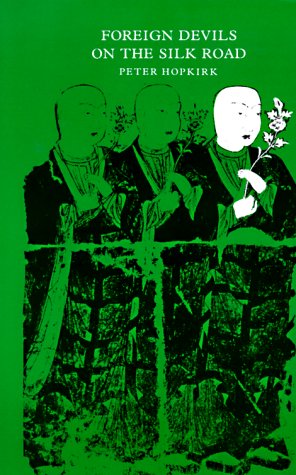
Foreign Devils on the Silk Road by Peter Hopkirk

Source: Purchased at Novel Books
Paperback, 241 pages
I am an Amazon Affiliate

Foreign Devils on the Silk Road by Peter Hopkirk, which was my book club’s September selection, is the kind of nonfiction that could be engaging with a different kind of narrative.  The author seeks to cover the archaeological digs and finds of six men over the first quarter of the century — Sven Hedin of Sweden, Sir Aurel Stein of Britain, Albert von Le Coq of Germany, Paul Pelliot of France, and Langdon Warner of the United States, though there is a little bit about Count Otani of Japan.  There is little about Otani, and as such could have been omitted as the records are considered secret by the government.  There also is little about Pelliot and Warner, which really leaves the author with the three main archaeologists — whom the Chinese view as thieves given the art and manuscripts the men stole.  The harsh conditions of the Silk Road through the Taklamakan Desert left many expeditions decimated, animals dead, and others sickened.

“On one stretch they found the route marked by wooden posts placed there to prevent travelers from straying away from the caravan trail at night or during a sandstorm as so many unfortunates had done over the centuries.”  (page 76)

There is a complete chapter of China’s past going as far back as 221 bc and before the birth of Christ, and a second chapter that focuses on the elements of the map, going across every road and aspect of a map that could easily be looked at on its own.  These pages would have been better served with details of the expeditions of the individual men, which the author clearly obtains from personal accounts of the men.  Hopkirk does quote from some of these accounts throughout the book, but readers may soon find that reading the first accounts of these expeditions would be more detailed and engaging than the recounting of them by Hopkirk.

The narrative is dry for more than 60 pages, leaving readers wanting more from the author.  It seems odd that the book would be so light on details of how the archaeologists obtained the frescoes and manuscripts they found until more than halfway through the book.  Rather than make rubbings of the artifacts or careful drawings — cameras were more than likely cost prohibitive at this time, not to mention huge — these archaeologists used knives and saws to cut away the wall drawings in pieces.  These actions are very disheartening and seem to be motivated by personal glory or scholastic gain.  Foreign Devils on the Silk Road by Peter Hopkirk could have been so much more, but the narrative was lacking, and readers would be better served finding the accounts from the archaeologists and their peers — though one caution would be to watch out for political spin as a number of countries were competing for these treasures at the time.

**Unfortunately, with other obligations on the table, I missed the September discussion of this book.***

About the Author:

Peter Hopkirk is a British journalist and author who has written six books about the British Empire, Russia and Central Asia.

This is my 61st book for the 2013 New Authors Challenge.

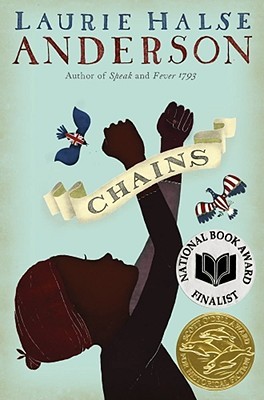
Chains by Laurie Halse Anderson

Source: Public Library
Hardcover, 316 pages
I am an Amazon Affiliate

Chains by Laurie Halse Anderson is the first in a series of books set during the American Revolution, and Isabel is a young slave who must care for herself and her sister, Ruth, after the death of their mother and their owner.  She quickly finds that the things she had been promised by their owner do not come to pass, and she must prepare herself for new and more harsh owners, the Locktons.  In her new household in New York, where the Locktons have settled from England, she finds that her chores are many and grueling, but that her sister has garnered the special attention of Mrs. Lockton, who dresses her as a doll and requires her to be silent at all times.  New York also is where she meets Curzon, a young black boy working on the side of the rebels, for whom he hopes she will provide intelligence from the Lockton household.

“The bees swarmed again behind my eyes, making the scene grow dim and distant.  The sun was nearing the horizon, casting long shadows across the wharf.  I was a ghost tied to the ground, not a living soul.”  (page 182)

Isabel soon learns that both the British and American rebels are willing to use slaves as they see fit and promise them freedom they have no intention of granting.  Anderson’s young adult novel deftly balances the cruelty of slavery with the sensibilities of young adults, ensuring that the abuse and cruelty is never more than young readers can handle. However, there are some instances that do become graphic, but it is essential to demonstrate the fates that faced a number of slaves, especially those who attempted or even thought about escaping their masters.  Moreover, she easily demonstrates the excess and perfidy of the war and its opposing sides, as the British throw balls in honor of the queen at the same time the rebels are struggling to feed themselves.

“And then, the final triumph.  She used a tiny brush to paint a thin line of glue above each eye.  Madam opened an envelope and shook out two gray strips of mouse fur, each cut into an arch.  Leaning toward the mirror, she glued the mouse fur onto her own eyebrows, making them bushy and thick as the fashion required.”  (page 207)

Chains by Laurie Halse Anderson is the first in a series, and it ends with a wide open ending in many ways, but at least some of the issues are resolved.  Anderson brings to life not only the issue of slavery, but also of the opposing sides in the revolution and the confusion it brought with it on the battlefield and in the cities not immediately touched by the war.  The confusing reports, the captured cities, the changing of power, all of it comes to life.

About the Author:

Laurie Halse Anderson is the New York Times-bestselling author who writes for kids of all ages. Known for tackling tough subjects with humor and sensitivity, her work has earned numerous American Library Association and state awards. Two of her books, Speak and Chains, were National Book Award finalists. Chains also made the Carnegie Medal Shortlist in the United Kingdom.

Laurie was the proud recipient of the 2009 Margaret A. Edwards Award given by YALSA division of the American Library Association for her “significant and lasting contribution to young adult literature…”. She was also honored with the ALAN Award from the National Council of Teachers of English and the St. Katharine Drexel Award from the Catholic Librarian Association.

This is my 4th book for the American Revolution Reading Challenge 2013


This is my 60th book for the 2013 New Authors Challenge.

Black Aperture by Matt Rasmussen

Source: Academy of American Poets, part of the membership benefits, with no expectation of review
Paperback, 64 pages
I am an Amazon Affiliate

Black Aperture by Matt Rasmussen, 2012 winner of the Walt Whitman Award from the Academy of American Poets and recently added to the National Book Award 2013 long list, could not be more aptly named.  The light passing through this dark hole is that of the narrator’s brother when he commits suicide, forever changing his family and yet changing nothing in the wider world.  There is a balance Rasmussen tries to strike here between the irrevocable change the family, and in particular the brother, feel and the lack of change outside of their microcosm, even in nature where the hunters and sportsman arbitrarily continue to shoot clay pigeons or deer.

From After Suicide (page 4-5)

I wanted to put my finger
into the hole

feel the smooth channel
he escaped through

stop the milk
so he could swallow it

There is a deep sadness in these poems, but also a sense of confusion and desire to understand, even when understanding is beyond our capacity because we are not those who have taken their lives.  We have different experiences and different perspectives, and while we have the capacity for empathy, that is oftentimes not the same — or enough.  The narrator of the poems even acknowledges this when he says in “Elegy in X Parts,” “There is no refuge//from yourself.” (page 36)  It is because we are trapped with ourselves that suicide may seem like the only solution, especially if we are unable to see solutions outside of ourselves.

Rasmussen has some stark images, haunting pictures of death and lifelessness.  There is an emptiness in those vivid moments, which the poet captures with so few brushstrokes.  As the past slips further away, people and moments fade, but their impressions are still felt — as personified by “Monet as a Verb” (page 19).  And although a tragic loss can be scarring, scars fade and heal.  Black Aperture by Matt Rasmussen examines the light that leaves our lives in a flash, often unexpectedly and without reason, and how we sometimes grieve for long periods of time afterward and in some cases, even want to follow our loved ones through the same dark hole to find peace, understanding and closure.

About the Poet:

Matt Rasmussen’s poetry has been published in Gulf Coast, Cimarron Review, H_NGM_N, Water~Stone Review, New York Quarterly, Paper Darts, and at Poets.org. He’s received awards, grants, and residencies from The Bush Foundation, The McKnight Foundation, The Minnesota State Arts Board, Jerome Foundation, Intermedia Arts, The Anderson Center in Red Wing, MN, and The Corporation of Yaddo. He is a 2014 Pushcart Prize winner, a former Peace Corps Volunteer, and teaches at Gustavus Adolphus College. His first book of poems, Black Aperture, won the 2012 Walt Whitman Award and was published in 2013 by LSU Press.

This is my 25th book for the Dive Into Poetry Challenge 2013.


This is my 59th book for the 2013 New Authors Challenge.

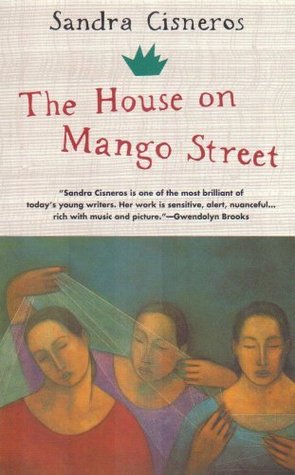
The House on Mango Street by Sandra Cisneros

Source: Purchased at Public Library Book Sale
Paperback, 110 pages
I am an Amazon Affiliate

The House on Mango Street by Sandra Cisneros is a coming-of-age story about Esperanza Cordero in a Latino neighborhood on Mango Street in Chicago.  She doesn’t remember much of the time before Mango Street, and it is clear that things were both good and bad there.  Neighbors she knew were hit by their husbands, while others had given up on their dreams simply because they got married.  In many ways these stories are woven together and are lyrical enough that they could be an epic poem about growing up as an immigrant in America.

Each short vignette tells a story from Esperanza’s point of view, revealing the harsh realities of growing up in an area other people are afraid to step foot in.

“All brown all around, we are safe.  But watch us drive into a neighborhood of another color and our knees go shakity-shake and our car windows get rolled up tight and our eyes look straight.”  (page 28)

Esperanza is growing up and learning how to become a woman, running in the city streets in heels an old lady hands her and her friends.  At the same time, she’s struggling to hold onto her childhood, while she’s admiring the older girls in the neighborhood wearing make-up and nylons.  She’s naive about relationships between girls and boys and she finds herself in situations where she can be taken advantage of, thanks to those she trusts.  But she also comforts her father when he cries.

“They don’t walk like ordinary dogs, but leap and somersault like an apostrophe and comma.” (page 71)

Cisneros paints a bleak picture as seen through Esperanza’s eyes, but at the same time she allows her character to feel something beyond the confines of her neighborhood.  She does not want to be that woman who merely looks at the possibilities and wallows in sadness and regret.  The House on Mango Street by Sandra Cisneros pays homage to these struggling women in a cadence, and she ensures readers not only glimpse a life that may be unfamiliar but that still contains a sliver of hope.

About the Author:

Sandra Cisneros was born in Chicago in 1954. Internationally acclaimed for her poetry and fiction, she has been the recipient of numerous awards, including the Lannan Literary Award and the American Book Award, and of fellowships from the National Endowment for the Arts and the MacArthur Foundation. Cisneros is the author of two novels The House on Mango Street and Caramelo; a collection of short stories, Woman Hollering Creek; two books of poetry, My Wicked Ways and Loose Woman; and a children’s book, Hairs/Pelitos. She is the founder of the Macondo Foundation, an association of writers united to serve underserved communities (www.macondofoundation.org), and is Writer in Residence at Our Lady of the Lake University, San Antonio.

This is my 58th book for the 2013 New Authors Challenge.

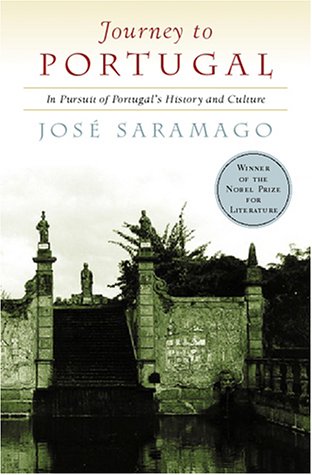
Journey to Portugal: In Pursuit of Portugal’s History and Culture by José Saramago, translated by Amanda Hopkinson and Nick Caistor

Source: Public Library
Hardcover, 464 pages
I am an Amazon Affiliate

Journey to Portugal: In Pursuit of Portugal’s History and Culture by José Saramago, translated by Amanda Hopkinson and Nick Caistor from Portuguese, is a travelogue, but not in a traditional sense of naming specific destinations, their locations, and offering impressions in a straightforward manner.  Readers looking for a travel guide would be best served looking for another book about Portugal.  Saramago refers to himself as the traveler, which can be wearisome throughout 400 pages of text, and many of the visits he makes throughout the country are to either museums or religious locations/buildings, which is odd given his atheism and tenuous relationship with the Catholic church after writing The Gospel According to Jesus Christ.  Moreover, this travelogue is as close to being a memoir as it can be given Saramago’s reflections, daydreams, and observances about the more modern Portugal around him.  (He exiled himself, a Communist, to the Spanish island of Lanzarote following The Carnation Revolution in 1974 where he remained until his death in 2010.)  However, he does say that he wishes these religious relics and pieces to be preserved as works made by human hands.

“The traveller thanks him, and sets off in the direction indicated.  There the palheiros survive, huge barracks made of wooden slats blackened by the wind and the sea, a few already stripped beams exposed to the gaze.  A few are still inhabited, others have lost their roofs to the wind.  It won’t be long before nothing will remain beyond a photographic record.” (page 146)

In many ways, Saramago is reflecting on the life he’s led, the perceptions he’s had and still has, and how as time moves on the ornaments of those memories and perceptions are stripped bare, leaving only the barest outline of the past — until the emotions and personal connections are lost and all that is left is a photo out of context.  “During the lengthy voyage that took nearly six months, the conviction was born in me that in every place I passed through there was a piece of old Portugal bidding farewell to the traveller I was, an ancient Portugal which was beginning, finally, while still doubting whether it wanted to or not, to move towards the twentieth century,” he says. (page xii)  He reconciles the past with the present, as seen through a melancholy perspective, and like the villages and people the traveller approaches slowly, he passes through one town to another, gets lost, and meditates on what he encounters.

Saramago reflects on stonework quite a bit and its ability to stand the test of time, and through his ruminations, readers are likely to see his struggle with the endurance or inability of workers and tributes to stand the test of time — there are some shrines and other edifices he finds hold stories that are no longer accessible.  Journey to Portugal: In Pursuit of Portugal’s History and Culture by José Saramago, translated by Amanda Hopkinson and Nick Caistor, may suffer from poor translation, but there are moments of great reflection and insight that shouldn’t be missed, even if they are mired in melancholia and dark moods, by patient readers.

About the Author:

José de Sousa Saramago is a Nobel-laureate Portuguese novelist, playwright and journalist. He was a member of the Portuguese Communist Party.  His works, some of which can be seen as allegories, commonly present subversive perspectives on historic events, emphasizing the human factor rather than the officially sanctioned story. Saramago was awarded the Nobel Prize for literature in 1998. He founded the National Front for the Defense of Culture (Lisbon, 1992) with among others Freitas-Magalhaes. He lived on Lanzarote in the Canary Islands, Spain, where he died in June 2010.

This is my 57th book for the 2013 New Authors Challenge.

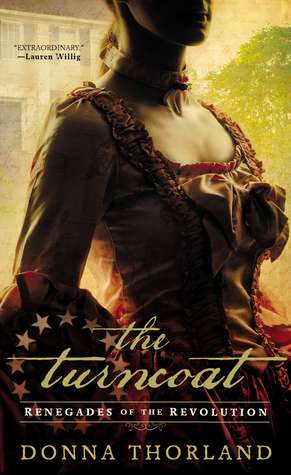
The Turncoat: Renegades of the Revolution by Donna Thorland

Source: Borrowed from Diary of an Eccentric
Paperback, 432 pages
I am an Amazon Affiliate

The Turncoat: Renegades of the Revolution by Donna Thorland is a steamy novel of espionage, spies, and cover-ups. Quaker daughter Kate Grey is swept up in a plot against the British by Mrs. Ferrars, who is tasked with watching over her while her father rides off with supplies for The Continental Army.  Riding away from the only home she’s known, she’s forced to hear and see the darker side of war as it comes to her neighbor’s farm.  From that moment of helplessness on, she’s made up her mind to fight against the British who have plundered her home and its women.  She establishes herself in Philadelphia as an heiress, with the help of Ferrars, and embarks on a journey she never expects would lead her back to the British officer, Peter Tremayne, whom Ferrars duped at the Grey farm.

“Only the barest sliver of light entered beneath the batten door, which was reinforced on both sides with iron plates.  He took care not to look directly at it; in this blackness it would blind him like the sun.  He stood soaking up the darkness, breathing in the chemical smells of old powder and fresh mold, and reining in the panic that threatened to overwhelm him.  It was like being underground, being buried.  The unseen vault must be at least three stories above him, and the emptiness held all the childhood terrors of the night, and the decidedly adult terror that came with the knowledge of all the ways a man might die in such a place.”  (page 207)

Secrets twist in on themselves as Kate becomes engaged to one of the most terrifying British soldiers campaigning with General Howe from Philadelphia.  Although Kate flourishes in her new role as beautiful spy, turning heads, she is ill prepared for the emotional attachment she feels for her mark and still has for the man she never expected to see again, Peter Tremayne.  The emotions that she keeps hidden driver her actions more than she realizes, and at times, they are what breaks down her facade, makes her stumble, and leaves her lying in traps set by more emotionally detached foes.

Thorland weaves fact with fiction seamlessly in this historical novel about the American Revolution, and readers will see the strategy and battle scenes play out with gruesome consequences.  She captivates her readers through the building of strong and flawed characters whose lives are not only torn apart by war, but also the loyalty they feel to their families and countries even as they see hope in the enemy.  Trust and loyalty are tested over and over again, but Kate is committed to her duty and risks everything she wants, especially with Peter, to save General Washington and the Rebel cause.  The Turncoat: Renegades of the Revolution by Donna Thorland is gripping and offers a more exciting look at the American Revolution from both the Rebel and Crown’s point of views.


About the Author:

Graduating from Yale with a degree in Classics and Art History, Donna Thorland managed architecture and interpretation at the Peabody Essex Museum in Salem for several years. She then earned an MFA in film production from the USC School of Cinematic Arts. She has been a Disney/ABC Television Writing Fellow and a WGA Writer’s Access Project Honoree, and has written for the TV shows Cupid and Tron: Uprising. The director of several award-winning short films, her most recent project aired on WNET Channel 13. Her fiction has appeared in Alfred Hitchcock’s Mystery Magazine. Donna is married with one cat and splits her time between Salem and Los Angeles.

This is my 56th book for the 2013 New Authors Challenge.


This is my 3rd book for the American Revolution Reading Challenge 2013

Origins (The Vampire Diaries: Stefan’s Diaries Vol. 1) by L.J. Smith, Kevin Williamson, Julie Plec

Source: Purchased from Borders ages ago
Paperback, 237 pages
I am an Amazon Affiliate

Origins (The Vampire Diaries: Stefan’s Diaries Vol. 1) by L.J. Smith, Kevin Williamson, Julie Plec is the first in the diaries series stemming from L.J. Smith’s original novels.  Stefan Salvatore is the younger of two brothers, and he’s the one that does as his father asks and rarely speaks out against him.  Damon, who is away during the Civil War, is the outspoken rebel.  Told from Stefan’s point of view, readers will get a sense of the tug between duty and desire, but as the second son and most responsible, his sense of duty often sways his choices.  When his father pushes him to pay his attentions to a local beauty from a powerful family, he does so, but it is clear that the match is one of convenience, not love.

“There was no mystery or intrigue in Mystic Falls.  Everyone knew everyone else.  If Rosalyn and I were to get married, our children would be dancing with Daisy’s children.  They would have the same conversations, the same jokes, the same fights.  And the cycle would continue for eternity.”  (Page 39)

In fact, a stranger in town, Katherine Pierce, has turned his head, and he cannot get her out of his mind.  A tug of war between his desires and his duty ensues, but other than Katherine’s beauty and mystery, you know little of her and why Stefan wants to be with her.  Is it mere animal lust, has she taken over his mind to make him feel that way?  These are questions that are left unanswered, but the infatuation he has with her leads to jealousy when his brother Damon returns from General Groom’s camp and spends a great deal of time with her.  She continues to be a mysterious figure even at the end of the novel, but as there are others in the series, she must be that way for a reason.

Although some of the chapters are written in diary form, the story is in prose, with Stefan’s inner thoughts sprinkled throughout as diary entries.  Despite wishing Stefan were more like Damon, unfettered, he sticks to his duties until the dam breaks for him emotionally.  He has little choice but to follow his desires when his duty has failed him.  The juxtaposition between the human and vampire Stefan is hinted at here, especially as he continues to compare himself to his brother and to find the life under his father’s thumb stifling.  Origins (The Vampire Diaries: Stefan’s Diaries Vol. 1) by L.J. Smith, Kevin Williamson, Julie Plec is a solid first book that introduces the town of Mystic Falls, the threat that faces the townsfolk as the Civil War brews outside their doors, and the unseen dangers that lie amongst them in wait.

About the Author:

L.J. SMITH has written over two dozen books for young adults, including The Vampire Diaries, now a hit TV show. She has also written the bestselling Night World series and The Forbidden Game, as well as the #1 New York Times bestselling Dark Visions. She loves to walk the trails and beaches in Point Reyes, California, daydreaming about her latest book. She also loves to hear from readers ([email protected]) and hopes they will visit her continually updated website, where information, new stories, and contests can be found.

This is my 55th book for the 2013 New Authors Challenge.

The Real Jane Austen by Paula Byrne

Source: Harper and Public Library
Hardcover, 361 pages
I am an Amazon Affiliate

The Real Jane Austen: A Life in Small Things by Paula Byrne (which I began reading as a review copy, but opted for a finished borrowed copy to finish because the photos and images were inserted after the ARCs were distributed) is expressive, carefully crafted, and incisive in how it sketches out the true Jane Austen.  In this non-linear biography, Byrne debunks a few of the myths around Austen, particularly about her alleged romantic encounters and her homebody persona.  Through careful analysis of her novels, characters, the correspondence she had with her family and others, and other tidbits from other documents at the time, Byrne demonstrates the careful and perfectionist nature that was Jane Austen, particularly as a novelist.  With that perfectionism also came a penchant for telling her family members exactly what she thought, knowing that they would not take her criticism lightly, especially if they were writing their own stories or poems.  But she also was critical of their life choices and worried about childbirth and the consequences of marriage, especially as a means of stifling a woman’s voice.

“Strikingly, Jane Austen’s heroines are rarely described as beautiful and accomplished.  Even Emma Woodhouse is ‘handsome’ rather than ‘beautiful.’  Physical descriptions of her heroines are rare.  Austen shows instead how they grow into loveliness or possess a particular fine feature, such as sparkling eyes.”  (page 82)

In addition to the importance of family — such as sisterly bonds — Austen seems to have drawn her characters and many of the situations in her novels from real life, things she herself may have experienced on her “expeditions” or to her family members.  Another parallel: the mysterious ways in which her heroines are described — with none being detailed as beautiful or their features particularly outlined to give readers an impression of the whole — and the mystery surrounding her surviving portrait, which may not be her, but a sketch drawn by her sister is most likely her, but she is turned away and her features are unknown.  Byrne also points out there is evidence to suggest that like modern-day Janeites, Austen thought of her characters as real people as well, and often scribbled out afterlives for characters from some of her contemporaries after reading those novels.

“The acknowledgement of the incompleteness of human disclosure [in Emma] strikes at the very heart of Jane Austen’s creative vision.”  (page 255)

Byrne uses her knowledge of the Regency period to better grasp Austen’s daily routines and jaunts, noting that the “turnpike system” was introduced during her lifetime and that while her mother may have suffered from travel sickness, Austen did not.  The author of so many great “domestic” novels traveled a fair share, including to the seaside, which became integral parts of her later novels.  And through her distant relations, her connections to royalty and those engaged in the plantation and slave ownership trade were not as far flung as one would expect for an impoverished woman.  These relationships and sources enabled her to maintain as close to truthfulness in her novels as she could without experiencing things first hand.

The Real Jane Austen: A Life in Small Things by Paula Byrne is a must have for those who have read Jane Austen’s novels and wish to get a better handle on the author and her influences, and while some of those influences may be small in comparison to the wars abroad during her lifetime, they shaped her writing and her expectations in countless ways.  There are moments in which the biographer takes some liberal turns in determining Austen’s character and motivations, and in some cases they may seem plausible, while in others they do not.  But with an absence of facts, thanks to Cassandra Austen’s burning of her sister’s letters, biographers are left with gaps in time that are hard to fill.  From whether Chatsworth or Stoneleigh Abbey is the model for Pemberley in Pride & Prejudice to how an unnamed lady came to be published first by a military publisher, Byrne handles each aspect of Austen’s life with care and consideration, but she never shies away from the more mischievous side of Austen, either.  For those looking for lost secrets, this is not the book for you, and many of us will have to be contented with what we do know about Austen and forget about what moments are lost to us forever.

About the Author:

Paula was born in Birkenhead in 1967, the third daughter in a large working-class Catholic family. She studied English and Theology at the college that is now Chichester University and then taught English and Drama at Wirral Grammar School for Boys and Wirral Metropolitan College. She then completed her MA and PhD in English Literature at the University of Liverpool. She is now a full-time writer, living with her husband, the Shakespeare scholar Jonathan Bate, and their three young children (Tom, Ellie and Harry) in an old farmhouse in a South Warwickshire village near Stratford-upon-Avon.

Paula is represented by The Wylie Agency. She is an Executive Trustee of the Shakespeare Birthplace Trust and a Royal Literary Fund Fellow at the University of Warwick.

Paula is the author of the top ten bestseller Perdita: The Life of Mary Robinson (HarperCollins UK, Random House USA).  Check out her Website and join her on Twitter.

This is my 54th book for the 2013 New Authors Challenge.

His Majesty’s Dragon by Naomi Novik, narrated by Simon Vance

Source: Public Library
Audiobook, 9 CDs
I am an Amazon Affiliate

Our August book club selection, His Majesty’s Dragon (Temeraire book 1) by Naomi Novik, narrated by Simon Vance, meshes the Napoleonic wars with dragons.  The novel opens with the capture of a French frigate run by a crew unwilling to give up its prize, a near hatching dragon egg, to the British HMS Reliant and Capt. Will Laurence.  While the prize is a great find, the hatchling will be very dangerous should it emerge while they are at sea where there are no mates, trainers, or food available. The situation forces the captain to have the men without families draw straws to determine who would become responsible for the dragon and its egg while aboard.

Handlers of dragons are considered second-class citizens, causing severe disappointment among families and generating a great separateness between handlers and their families.  Generally, children as young as seven are taken away from home for training.  While the young John Carver, who is afraid of heights, is selected to be the dragon’s handler, the dragon has other ideas.  When the dragon speaks, the men are astonished as they expected there to be a trick to getting them to speak.  Once named, Temeraire becomes the focus of the Reliant and its crew, and its relationship to Laurence takes an unexpected turn.

Vance’s voices are easily discernible as different characters and he excels at expressing the character’s fears and awe as he speaks their dialogue, but Novik tends to rely a great deal on adverbs to demonstrate fear or anxiousness and in some cases at the beginning the narration seems to contradict itself — either the dragon egg is an unusual find or a well-known item captured in the surgeon’s books about different dragons or there is a three hour trip to London from Madeira or a three hour trip from London to Scotland, but it is unlikely that both would take that long by transport or dragon.  There is a great deal of explanation through the characters about what they know and don’t know about the dragons, which can get tiresome as the descriptions become longer than necessary.

However, the growing relationship between Temeraire and Laurence is endearing.  And the conflicts between handlers about the care for the dragons and Laurence’s expectations about the training build up the tension as Napoleon continues to mount his forces.  While the first half of the book seems to be setting up the world for the dragons and can drag on a bit, the second half picks up speed with the battles and fighting.  The audio, as narrated by Vance, enables readers to become more closely engaged in the relationship between Temeraire and his handler, as they learn how to fly formations in training for battle and as they get to know one another.  There are a number of endearing scenes in which the handler and the dragon curl up together, with the handler reading to the dragon about mathematics, naval history, and more.

His Majesty’s Dragon (Temeraire book 1) by Naomi Novik satisfactorily meshes history with dragons, but the strength of the novel is in the relationships built between the dragons and their handlers.  These relationships are caring and strengthen with the passage of time, so much so that handlers often plan their futures around them.


This is my 53rd book for the 2013 New Authors Challenge.


About the Author:

An avid reader of fantasy literature since age six, when she first made her way through The Lord of the Rings, Naomi Novik is also a history buff with a particular interest in the Napoleonic era and a fondness for the work of Patrick O’Brian and Jane Austen. She studied English literature at Brown University, and did graduate work in computer science at Columbia University before leaving to participate in the design and development of the computer game Neverwinter Nights: Shadow of Undrentide. Over the course of a brief winter sojourn spent working on the game in Edmonton, Canada (accompanied by a truly alarming coat that now lives brooding in the depths of her closet), she realized she preferred writing to programming, and on returning to New York, decided to try her hand at novels.  Naomi lives in New York City with her husband and six computers.

What the book club thought:

It seemed as though most of the members enjoyed the book, and one member said that the historical facts about the Napoleonic wars were accurate for the most part.  Some expressed an inability or slight difficulty in determining the size of the dragons or transports used to move the dragons.  One member, who led the group, pointed out that the illustrator in the back of the book got some of the details wrong in the section that explains the differences between the dragons and their features.  One member said that she was not really excited to read the book because she doesn’t usually read fantasy books, but the author made it seem plausible that dragons would fit into our world.  She also indicated that she wanted one of her own dragons to curl up with and read to, and she would like to read the other eight books in the series.  Another member said that if Napoleon really did have dragons the world might have been more in trouble than it was at the time.  One male member had not finished the book, but said that he would continue reading.  Overall, is seems like the club enjoyed this foray into fantasy novels.