Quantcast

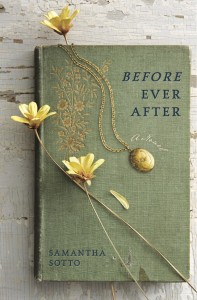
Before Ever After by Samantha Sotto

“Eggs and engagements.  Though slightly odd, they were a harmless pairing on most days, even with a greasy pile of bacon on the side.  But today was not like most days, because in less than an hour, they would make Shelley Gallus a twenty-six-year-old widow” (page 3 of ARC)

Before Ever After by Samantha Sotto is a debut novel that seemingly asks readers to suspend disbelief as Shelley Gallus discovers that her deceased husband, Max, may not have died three years ago and that he may in fact not ever age.  Oh, and he has a grandson, Paolo, from Italy who is now about 30 years old.  However, Sotto weaves her story with such beautiful prose that readers are immediately captivated and drawn into Shelley’s grief and her shock.  There is no conscious need to suspend disbelief, and readers will not even notice that they are doing it.

“Shelley’s ability to go through the motions wasn’t surprising considering that she had been schooled by the best. Her mom had never quite gotten over the death of her own husband, and Shelley grew up watching her paint on the brightest smile with a berry shade of Revlon lipstick. There had been days when her happiness had seemed so real, so genuine, that Shelley had almost believed it.” (Page 7 of ARC)

Death can leave a terrible emptiness in someone, especially when the person who dies is so ingrained and integral to their lives.  Sotto’s novel is more than a look a grief or the secrets spouses keep from one another; it is a journey through history that takes Shelley and Paolo through several countries and sheds light on Max’s past.  The narration shifts from present to immediate past (about five years ago when Max and Shelley first meet) to the distant past as Max recounts history in France, Austria, Slovenia, and other places.

In a way, Sotto’s prose is like traveling back in time, and while the main characters of Shelley, Max, and Paolo do not figure in those historical tales, readers never forget them or get confused.  The transitions between each time frame are seamless and almost fairytale like.  Shelley blossoms in this story from a young woman running away from the death of her parents (one literal and one figurative) only to assume a lifeless existence in London in advertising.  Her one shining moment is taking a trip through Europe on a whim — where of course she meets Max who teachers her to overcome her fears and take a leap of faith.

Before Ever After by Samantha Sotto bends time, and readers will stand on the precipice of each tale holding their breath as more of Max is revealed.  Tortured souls, romance, travel, mystery, and more are wrapped in between these pages.  Sotto has a good grasp of time and its hold on us, how we think about the past, hover over it with a magnifying glass, and torture ourselves with our longings and past errors.  A strong debut from a compelling mind that captures readers’ imaginations from page one.  A treasure to unearth in the waning days of summer that very well could be one of the best reads of the year.

About the Author:

SAMANTHA SOTTO fell in love with Europe’s cobbled streets and damp castles when she moved to the Netherlands as a teenager. Since then, she has spent nights huddled next to her backpack on a beach in Greece, honeymooned in Paris, and attended business meetings in Dusseldorf in the pleasant company of a corporate credit card. Before Ever After was inspired by her experiences living, studying, and traveling in Europe. Samantha lives in the Philippines with her family. This is her first novel.

For more info on Samantha and Before Ever After, check out her website, her blog, her Facebook page, and Twitter.


For the other stops on the blog tour, check out the TLC Book Tours site.


This is my 44th book for the 2011 New Authors Reading Challenge.
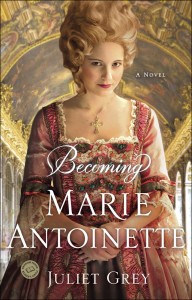
Guest Post & Giveaway: Researching Becoming Marie Antoinette by Juliet Grey

Becoming Marie Antoinette by Juliet Grey was released earlier this month by Ballantine Books, a division of Random House.  The novel has been on a blog tour through TLC Book Tours this month, so check out some great reviews.  I’ll be reviewing this later in the fall, but I have a treat for my readers today.  Juliet Grey has graciously offered to write about her research process for her novel and what made her fall in love with Marie Antoinette.

Without further ado, please welcome Juliet Grey.

I fell in love with Marie Antoinette (and Louis) while I was researching their marriage for a work of nonfiction; and the more I read about them (at least a dozen biographies by scholars who often present conflicting opinions not only of events but of personalities), the more it became apparent that the monarchs have truly been misrepresented and misinterpreted by historians. They say history is written by the winners, and Marie Antoinette and Louis were the two greatest victims of the French Revolution.

What sparked BECOMING MARIE ANTOINETTE specifically is how little has been told about her childhood years and the incredible makeover she had to endure at the hands of a small army of experts before she was judged acceptable marriage material, while the clock was ticking and a vitally strategic international alliance hung in the balance. The preadolescent Marie Antoinette was worked over by a hairdresser who reconfigured her hairline so that her forehead would not appear to prominent; a dentist who realigned her teeth with orthodontia, a pair of actors who became her dialect coaches for her pronunciation of French; a notable dancing master who taught her the “Versailles Glide,” the walk that was unique to the women of the Bourbon court; and a gentle cleric who came to tutor her in academics. My novel also shows just how much the young Austrian archduchess Maria Antonia was a political pawn, moved about the European chessboard by her mother, the formidable Hapsburg empress Maria Theresa, and King Louis XV of France.

Most of the events depicted in BECOMING MARIE ANTOINETTE and in the next two novels in the trilogy are based on the historical record. I may be one of the few novelists to include a fairly extensive bibliography at the back of her book (which only begins to reflect the scope of my research), but I wanted readers to know that I did my homework, and then some. At times I felt like a literary anthropologist. For example, I went so far as to hunt down the names and backgrounds of the actual figures who aided in Marie Antoinette’s physical metamorphosis, transforming her hairline, her teeth, her gait, and her speech—and then her mind—into a package that the French sovereign Louis XV would deem acceptable dauphine material. In some cases, even the dialogue in the novels (and in particular the correspondence I used in the novels) reflect the actual words that were spoken or written. We are fortunate in that the Eighteenth Century was an age of great letter writers and memoirists. Nearly everyone kept a journal back then.

All that said, although we know that certain things happened historically, as a novelist I have the freedom to imagine what was really going on in the room at the time and in the characters’ heads. We don’t always know how a given thing occurred, just that it did. I have a golden rule of historical fiction writing, which is: that if an incident could have happened, then it’s fair game to include it in a novel. For my own taste, I prefer not to wildly re-imagine historical events in my books. For one thing, fans of historical fiction (and I’m one as well) tend to be well versed in the history of their favorite time period and they get pulled out of the narrative when an author includes a scene that strains credulity or plays too loosey-goosey with the historical record. I’m also a professional actress and part of my training is to be able to get under a character’s skin and inside their head to imagine how they think and feel and what prompts them to act as they do and say the things they say. This sort of emotional analysis stands me in good stead as an author because it’s another way of digging into the psyche of a historical personage to reach a perspective from that taken by scholars and biographers.

I have had a lot of fun letting some of the actual historical figures speak for themselves. Die-hard Marie Antoinette aficionados may recognize some of the quotes, not just from her, but in the mouths of other characters in the books. And in the second novel in the trilogy, DAYS OF SPLENDOR, DAYS OF SORROW, which will be published in 2012, readers will meet some real doozies—the colorful and scandalous players involved in the notorious Affair of the Diamond Necklace. Nearly all of them published their own self-serving memoirs and the records of their trial testimony is extant as well, so there has been a wealth of ore for a novelist to mine.

And something that we just get a glimmer of in BECOMING MARIE ANTOINETTE will glow hotter and brighter as the trilogy progresses—the controversial relationship between the queen and the Swedish mercenary, Count Axel von Fersen. For decades scholars have debated whether their romantic friendship ever became something more; between the scholar’s sleuthing and the artist’s imagining herself inside their heads, hearts, and minds, I believe I have discovered the answer.

Thanks, Juliet, for sharing your love of Marie Antoinette and your research.

To win a copy of Grey’s Becoming Marie Antoinette, you must be a U.S. resident or have a U.S. resident who can accept the package for you.

1. Leave a comment about why you are interested in grey’s book.

2. Spread the word about the giveaway and leave a link to your blog post, Facebook, or Twitter announcement.

3. Follow the blog and let me know for a third entry.

Deadline is Aug. 24, 2011, at 11:59 PM EST.

Ideal Cities by Erika Meitner

Ideal Cities by Erika Meitner, whom I interviewed in 2009, was published in 2010 by Harper Perennial as part of the National Poetry Series selected by Paul Guest. The collection is broken down into two sections: Rental Towns and Ideal Cities.  Rental towns appears to be at first glance about the transient nature of apartment or rental living, but on a deeper level its about the transient nature of our lives and how quickly we all want to grow up and become adults.  There zipping through memories and moments reminds us that our childhood moves too quickly and so innocence is gone before we realize it.  “The windows on the soon-to-be luxury/condos across the way say things/to the darkness I can’t hear.  Sometimes/they’re blocked by the train masticating/its way across town.  Now and then//” (from Vinyl-Sided Epiphany, page 5-6)

Each poem is ripe with stunning imagery, like in “January Towns” (page 38-9),  “. . . Sometimes the light/above the clouds winks out a full-size replica/of our lives.  We are crystals of frozen water;//”  Not only is life transient in nature as we move from one moment to the next, but it is also frozen in time for us to review at anytime in our memories.  A bit of us, as we were is frozen, captured.  We seek to capture those moments not only in our minds, but in photos and videos, and in some moments we see ourselves in the past and wonder who those people are.  From “Poem With/out a Face” (page 16-7), “Desire is serendipity,/is pity, is blind,is danger,is not/obligation, is poking the most/alien thing with a stick to see/if it stirs and clings, the way/”  Some memories are clearer than others, which is true even of those moments in our lives that we thought we’d remember forever through a clear, clean lens, only to find the lens is murky and obscured.

In the second section, “Ideal Cities,” Meitner’s poems are not about a utopia in the true sense of the word, like a world without crime, etc., but they are about the communities that reside in each city, with their diversity, quirkiness, and pain.  There are a great deal of images in these poems that pay homage to the sounds of cities, from construction equipment to the silence of social networking.  This section is smaller than the first, but tackles tougher subjects like the Holocaust, though both sections glance at pregnancy and birth.  From “Elegy With Construction Sounds, Water, Fish” (page 75-7), “There is music, and there is music./There is water from a plastic pitcher/hitting slate pavers, silenced by skin./There are valleys with houses tucked/into them and something trilling/”  From birth to death and city to the suburbs, Meitner’s focus is on the journey that life takes, even its most devastating parts.

Meitner’s poetry has a quickness that illustrates the transient nature of the modern world, and her poems beg the question of whether modernity is ideal or whether suburbia is ideal.  Readers will examine each of these poems and discover that the answer to that question lies within themselves.  The poet endorses neither one nor the other, but she does examine the old world versus the new world.  Ideal Cities by Erika Meitner is an enigmatic collection with moments on clarity and stunning imagery that highlights the transient nature of the modern world whether you live in the city or in suburbia.

Also check out the poem from this collection that was under discussion in the 109th Virtual Poetry Circle.

© Photo by Steve Trost, 2009

About the Poet:

Erika Meitner was born and raised in Queens and Long Island, New York. She attended Dartmouth College (for an A.B. in Creative Writing in 1996), Hebrew University on a Reynolds Scholarship, and the University of Virginia, where she received her M.F.A. in 2001 as a Henry Hoyns Fellow. Meitner is a first-generation American: her father is from Haifa, Israel; her mother was born in Stuttgart, Germany, which is where her maternal grandparents settled after surviving Auschwitz, Ravensbruck, and Mauthausen concentration camps

She is currently an Assistant Professor of English at Virginia Tech, where she teaches in the MFA program, and is also simultaneously completing her doctorate in Religious Studies at the University of Virginia, where she was the Morgenstern Fellow in Jewish Studies.


This is my 21st book for the Fearless Poetry Exploration Reading Challenge.


This is my 43rd book for the 2011 New Authors Reading Challenge.

Mailbox Monday #139

Mailbox Mondays (click the icon to check out the new blog) has gone on tour since Marcia at A Girl and Her Books, formerly The Printed Page passed the torch.  This month our host is Life in the Thumb.  Kristi of The Story Siren continues to sponsor her In My Mailboxmeme.  Both of these memes allow bloggers to share what books they receive in the mail or through other means over the past week.

Just be warned that these posts can increase your TBR piles and wish lists.

Here’s what I received this week:

1.  Alice Bliss by Laura Harrington from the author for review and her BookCrossing.com experiment.

2.  The Lost Wife by Alyson Richman from Penguin for review.

3. Horoscopes for the Dead by Billy Collins, which I purchased for myself after I read it from the library.

4. Bloody Valentine by Melissa De La Cruz, which I purchased from Borders.

5. The Boat by Nam Le, which Anna bought for my birthday gift.

What did you receive this week?

R.I.P. Charlee (10/8/1997 – 8/13/2011)

Too Long a Trail

This is all I can muster since losing my dog, Charlee. He was my best friend, and my cuddle bug for a long, long time. There are very few photo albums in my house that don’t have a picture of Charlee in them, and I still have his family tree/ and the collar he wore when Anna and I got him at the pet store.

I will miss his little Ewok, teddy bear puppy face, his love grunts, and his wet kisses. Most of all I’ll miss his happy smile, and yes, he smiled…all the time…mostly with his tongue hanging out.

He was always there to greet me at the door and never ever got mad at me when I vented about anything. Most of all he would sit by my side or on my lap when I cried at a sad movie or lost love or lost family members. He would watch dog shows with me on television. He was full of energy, bouncing around, peeing on shoes in greeting, and getting his head stuck in a fish box.

Dog in a Box

He may have done all those things: eaten glass, chocolate, and tin foil . . . lets not forget the half of a corn cob from the trash. But he was always happy and content just to be loved, hugged, and kissed. He love the snow and would catch snowballs in his mouth and eat them and catch frisbees in the summer. He may have been a purebred, but he was no priss. We went hiking and he’s even taken a dip or two in a pool or pond. Anna (here’s her post) and I even took him to Boston Public Garden where he chased the geese into the pond and they preceded to follow him around the lake as we walked.

I won’t go into his many illnesses, but I will tell you this, he’s not suffering anymore and that’s all I can ask for, even if my daughter won’t remember him or how he welcomed her into the family by sitting outside her nursery door guarding her that first week she was home.

Charlee Atop Canyon Overlook...Pooped

110th Virtual Poetry Circle

Welcome to the 110th Virtual Poetry Circle!

Remember, this is just for fun and is not meant to be stressful.

Keep in mind what Molly Peacock’s books suggested. Look at a line, a stanza, sentences, and images; describe what you like or don’t like; and offer an opinion. If you missed my review of her book, check it out here.

Also, sign up for the 2011 Fearless Poetry Reading Challenge because its simple; you only need to read 1 book of poetry. Please contribute to the growing list of 2011 Indie Lit Award Poetry Suggestions, visit the stops on the National Poetry Month Blog Tour from April.

In the honor of our new U.S. Poet Laureate, Philip Levine, today’s poem is one of his:

On 52nd Street

Down sat Bud, raised his hands,
the Deuces silenced, the lights
lowered, and breath gathered
for the coming storm. Then nothing,
not a single note. Outside starlight
from heaven fell unseen, a quarter-
moon, promised, was no show,
ditto the rain. Late August of '50,
NYC, the long summer of abundance
and our new war. In the mirror behind
the bar, the spirits—imitating you—
stared at themselves. At the bar
the tenor player up from Philly, shut
his eyes and whispered to no one,
"Same thing last night." Everyone
been coming all week long
to hear this. The big brown bass
sighed and slumped against
the piano, the cymbals held
their dry cheeks and stopped
chicking and chucking. You went
back to drinking and ignored
the unignorable. When the door
swung open it was Pettiford
in work clothes, midnight suit,
starched shirt, narrow black tie,
spit shined shoes, as ready
as he'd ever be. Eyebrows
raised, the Irish bartender
shook his head, so Pettiford eased
himself down at an empty table,
closed up his Herald Tribune,
and shook his head. Did the TV
come on, did the jukebox bring us
Dinah Washington, did the stars
keep their appointments, did the moon
show, quartered or full, sprinkling
its soft light down? The night's
still there, just where it was, just
where it'll always be without
its music. You're still there too
holding your breath. Bud walked out.

Let me know your thoughts, ideas, feelings, impressions. Let’s have a great discussion…pick a line, pick an image, pick a sentence.

I’ve you missed the other Virtual Poetry Circles. It’s never too late to join the discussion.

Review of Quirk’s The Baby Owner’s Books

Normally, I don’t review three books in one post, but I’m making an exception for this set of baby-related books.  When the publicist at Quirk found out my husband and I were having our first child, they kindly sent us some reference guides on caring for her.

The Baby Owner’s Manual by Louis Borgenicht, MD, and Joe Borgenicht, D.A.D., can be used as a reference guide by all new parents and probably some who already have children.  The main approach of the book is similar to how a manual would talk about your new stereo or other consumer product by first describing its parts and functions and then discussing care and maintenance.  There are tips on how to perfectly swaddle the baby and how to deal with emergency situations.  Included also is a section on what accessories are not included, such as bottles and diapers, and a caution that some “models” may vary.  New parents don’t have a ton of time to read this book cover-to-cover, but it is easily dipped into for advice, particularly if they encounter a particular problem at feeding or bed time.

Readers will enjoy the instructional tone, but also the witty nature of the concept of baby as product, which eliminates the need for hard-to-understand medical jargon and other instructional nonsense that leave parents confused or bored.  Most of these tips are practical and easy to employ without incurring great expense, which is fantastic since most things related to babies are expensive and time-consuming.

The companion The Baby Owner’s Maintenance Log wasn’t as useful given that new mothers and fathers are merely scrambling around trying to find time to sleep, let alone write down each feeding and bowel movement.  Inside, there are spaces to record name, birth weight, eye color, bowel movements, feeding times and ounces, and of course developmental feats like rolling over.  To be honest, readers will not likely have time to write all of these moments down, though doctors will expect you to know roughly how many ounces the baby is eating, how frequently, and how long s/he sleeps.  It would be a blessing to have all of that information written down in one place, but from a practical standpoint, it is unlikely to happen unless the parents are super-organized and write down the details in the moment.

Finally, The Baby Owner’s Games and Activities Book by Lynn Rosen and Joe Borgenight offers a wide variety of activities to do with a baby and is grouped by specific age ranges to ensure proper development.  Again, this reference guide offers a fun and non-clinical look at development.  Surprisingly, I found myself doing some of the activities outside our daughter’s age range, but she seemed to just go with the flow and gobble up the knowledge.  The age ranges are not hard and fast rules/categories.

Babies tend to learn by modeling after activities done by their parents.  If you make a funny face, they will try it to — emulating you.  If you clap, they will try to clap.  Its fun to watch babies grow and adapt to new activities, even at ages younger than those outlined in this book.  There are probably activities that new parents will not have thought of or done that are included in this book, like having their child smell different flowers, etc.  These are merely exercises in development, but also in having fun with baby!

Overall, Quirk has an excellent set of baby manual books to help new parents that won’t be overly prescriptive or boring.  They will teach new parents and babies alike, but also be fun and enjoyable.  The only one in the set that seems least useful is the log book, but that’s just due to time constraints.  It could come in handy for parents who have nanny’s or babysitters and want to know what their baby did when they were at work or having date night.

This is my 40th-42nd book for the 2011 New Authors Reading Challenge.
The Snow Whale by John Minichillo

The Snow Whale by John Minichillo, which is published by local Maryland publisher Atticus Books, is a satire of Moby Dick by Herman Melville to a certain extent.  The debut novel centers on the life-changing decision of John Jacobs, a zombified office worker selling desk doodles to corporations via telephone, to find out his ancestry through a cheek-swab DNA test.  The results come back and find him more than one-third Eskimo/Inuit, and its enough for John to quit his job, take a vacation from his marriage, and head to Alaska to claim his birthright and go whale hunting.

“And why couldn’t a mild-mannered desk doodle salesman like Mike be the recipient of the Genghis Khan gene?” (page 9 of ARC)

His wife, Jessica, is equally in a rut, but still enjoys her job as a ballroom dance instructor.  She wishes that her marriage was more passionate and spontaneous, but the spontaneity she gets from John is not exactly what she’s looking for.  However, she agrees that he should go to Alaska given the passionate gleam in his eyes.  While some of the actions John takes are irrational and a bit nutty, readers will enjoy the shear witty prose and dialogue that accompanies the surreal situations presented.

“Q continued to walk with half steps, arms folded.
‘Stop shivering,’ Jacobs said.
‘I’m fucking freezing.’
‘Act Eskimo.’
‘What does that even mean?’
‘This is the thaw.  This should be warm for you.'”  (page 88 of ARC)

John is on a journey to find himself and to shake up the mundane, but in the midst of his journey he comes to realize that his life was already full before he left for Alaska.  Meanwhile, the chief of the Inuit tribe, Akmaaq, is looking for an end to his suffering as the leader being slowly shunned and cast aside following a dreadful whale hunt the year before.  He is like Ahab more than John because he is seeking to meet the white whale — his fate and death.  Although Akmaaq is native, like Queequeg in the original Melville novel, Akmaaq is neither a cannibal nor seeking adventure in the wide world beyond his isolated tribe, but he has established a friendship with John to ensure his safety — at least partially — and is aware that death awaits.  Ishmael is John, here in Minichillo’s novel, because he is seeking adventure and change — he is on the journey.

The Snow Whale by John Minichillo is an excellent debut novel that will likely be on the best of 2011 list.  It incorporates classic literature, though knowledge of Melville’s novel is not necessary to enjoy the wit and captivating story Minichillo creates.  John is a quirky character that readers will sympathize with, and his journey may be a bit surreal, but probably mirrors some of the fantasies readers have had about escaping their boring lives behind a cubicle wall.  Book clubs would find a great deal to discuss from the modernization of tribal people to the misconceptions “white” people have about different cultures and peoples, and themselves.

About the Author:

John Minichillo lives in Nashville with his wife and son.  This is his first novel.  Please do check out the interview with John at Atticus Books.  Here’s a sneak peak of the book.


This is my 39th book for the 2011 New Authors Reading Challenge.


This is a stop on The Literary Road Trip since this book is published by Maryland house Atticus Books.

Interview With Poet David Mason

Poet Dave Mason

This week an interview with Poet David Mason posted on 32 Poems, and he was a pleasure to interview because he’s one of the only poets I can remember interviewing that is involved in writing operas and other librettos for plays. 

Please check out a part of the interview below, and give him a warm welcome.

How would you introduce yourself to a crowded room eager to hang on your every word? Are you just a poet, what else should people know about you?

I would recite a poem by someone else. Mother Goose, for example. Then I would recite another poem by someone else. Auden or MacNeice or Dickinson, perhaps. I might ask the audience to repeat a poem after me, to join in the recitation. I wouldn’t say much of anything about myself unless I was asked in a question and answer session.

Poetry is often considered elitist or inaccessible by mainstream readers. Do poets have an obligation to dispel that myth and how do you think it could be accomplished?

Poets don’t have any obligation to do anything. Nor do readers. It’s a free country. I like a certain level of access in a poem, but I also love a whiff of mystery, a sense that the inexpressible has been cracked open or exposed to me in some way. I wouldn’t want to dispel any myths. Myths are there to cast a spell, not to be dispelled.

Please describe your writing space and how it would differ from your ideal writing space.

I’ve never had any trouble writing anywhere I’ve been in the world. I did until recently have a lovely office that used to be an artist’s studio, with north light and brick floors–a beautiful room. Now I live in a tiny cabin, 380 square feet in the shadow of Pike’s Peak, and it serves just as well. People who need the perfect space in which to write are sissies. Your brain is where you write. It’s portable.

What current projects are you working on and would you like to share some details with the readers? The most exciting work involves my collaboration with composer Lori Laitman. Our first opera, The Scarlet Letter, will have its professional premiere at Opera Colorado in Denver in 2013. My libretto will be published as a book in 2012. Our oratorio, Vedem, premiered in Seattle last year and is now out on CD from Naxos. And we’re at work on an opera based on my verse novel, Ludlow. Also, I seem to be writing a lot of love poetry lately. The dam has burst.

Check out a sample of his poetry:

SEA SALT

Light dazzles from the grass
over the carnal dune.
This too shall come to pass,
but will it happen soon?
A kite nods to its string.
A cloud is happening

above the tripping waves,
joined by another cloud.
They are a crowd that moves.
The sky becomes a shroud
cut by a blade of sun.
There’s nothing to be done.

The soul, if there’s a soul
moves out to what it loves,
whatever makes it whole.
The sea stands still and moves,
denoting nothing new,
deliberating now.

The days are made of hours,
hours of instances,
and none of them are ours.
The sand blows through the fences.
Light darkens on the grass.
This too shall come to pass.

–first published in The Times Literary Supplement

Thanks, David, for answering my questions.  For the rest of the interview, visit 32 Poems.

About the Poet:

David Mason’s books include The Country I Remember, Arrivals and the verse novel, Ludlow. His book of essays, The Poetry of Life and the Life of Poetry, appeared in 2000, and a second volume of essays has appeared from the University of Michigan Press. Author of a libretto for Lori Laitman’s opera of The Scarlet Letter, Mason won the Thatcher Hoffman Smith Creativity in Motion Prize for the development of a new libretto. He teachers at The Colorado College and serves as Poet Laureate of Colorado.

Focus Features Giveaway: One Day by David Nicholls

Boy, have I got a prize pack for you!  One Day by David Nicholls (check out the reader’s guide) is hitting the theaters this month on August 19 through Focus Features, which if you may recall brought the stunning Pride & Prejudice with Matthew MacFayden as Mr. Darcy to life.  But I digress.

Here’s the synopsis:

Twenty years…two people. Directed by Lone Scherfig (director of “An Education,” Academy Award-nominated for Best Picture), the motion picture “One Day” is adapted for the screen by David Nicholls from his beloved bestselling novel One Day. After one day together – July 15th, 1988, their college graduation – Emma Morley (Academy Award nominee Anne Hathaway) and Dexter Mayhew (Jim Sturgess of “Across the Universe”) begin a friendship that will last a lifetime. She is a working-class girl of principle and ambition who dreams of making the world a better place.

He is a wealthy charmer who dreams that the world will be his playground. For the next two decades, key moments of their relationship are experienced over several July 15ths in their lives. Together and apart, we see Dex and Em through their friendship and fights, hopes and missed opportunities, laughter and tears. Somewhere along their journey, these two people realize that what they are searching and hoping for has been there for them all along. As the true meaning of that one day back in 1988 is revealed, they come to terms with the nature of love and life itself.

The movie stars the phenomenal Anne Hathaway, along with  Jim Sturgess, Patricia Clarkson, Ken Stott, Romola Garai, and Rafe Spall .  If you love romantic dramas, this is for you.

Check out this video:

The prize pack for 2 U.S. winners includes:

  • *Autographed* copies of the book (movie tie-in edition, paperback, signed by David Nicholls)
  • Clear cosmetic case
  • Necklace
  • Moleskin Journal

Prizing values: $30.95 per pack

Giveaway provided by Focus Features

About the Author:

David Nicholls was born in Eastleigh, Hampshire, David Nicholls attended Toynbee Comprehensive School and Barton Peveril Sixth Form College prior to studying English Literature and Drama at the University of Bristol. Having graduated, and keen to pursue a career as an actor, he applied for and won a scholarship to study at the American Musical and Dramatic Academy in New York. Following his studies there, he returned to London in 1991. There he worked in a number of bars and restaurants before finally earning an Equity card. He worked sporadically as an actor for the next eight years, appearing in plays at the Battersea Arts Centre, the Finborough, West Yorkshire Playhouse, and Birmingham Rep. In between jobs he worked as a bookseller at Waterstones, Notting Hill.

Mr. Nicholls is currently working on his fourth novel, as well as a feature film adaptation of Charles Dickens’ Great Expectations.

To Enter the giveaway:

1. Leave a comment about what romantic drama you’ve recently either read or watched in movie form that you enjoyed or tell me what about romantic dramas makes you swoon?

2. For a second entry, become a follower of my blog or let me know if you are already.

3. For a third entry, “Like” the One Day Facebook page, and let me know.

4. For a fourth entry, enter the Good Reads One Day Sweepstakes and let me know you did.

5. Finally, for a fifth entry, Spread the word about the giveaway on Twitter, Facebook, or your own blog and let me know (leave a link).

Deadline is Aug. 16, 2011, at 11:59 PM EST.

Mailbox Monday #138

Mailbox Mondays (click the icon to check out the new blog) has gone on tour since Marcia at A Girl and Her Books, formerly The Printed Page passed the torch.  This month our host is Life in the Thumb.  Kristi of The Story Siren continues to sponsor her In My Mailbox meme.  Both of these memes allow bloggers to share what books they receive in the mail or through other means over the past week.

Just be warned that these posts can increase your TBR piles and wish lists.

Here’s what I received this week:

1.  When She Woke by Hillary Jordan from Algonquin Books for review in October.

2. The McCloud Home for Wayward Girls by Wendy Del Sol, which I received from Berkley for review.

3. The Taste of Salt by Martha Southgate from Algonquin for review.

4. Maman's Homesick Pie by Donia Bijan from unrequested from Algonquin.

What did you receive this week?

109th Virtual Poetry Circle

Welcome to the 109th Virtual Poetry Circle!

Remember, this is just for fun and is not meant to be stressful.

Keep in mind what Molly Peacock’s books suggested. Look at a line, a stanza, sentences, and images; describe what you like or don’t like; and offer an opinion. If you missed my review of her book, check it out here.

Also, sign up for the 2011 Fearless Poetry Reading Challenge because its simple; you only need to read 1 book of poetry. Please contribute to the growing list of 2011 Indie Lit Award Poetry Suggestions, visit the stops on the National Poetry Month Blog Tour from April.

Today’s poem is from Erika Meitner‘s (I interviewed her in 2009) Ideal Cities:

O Edinburgh (page 18)

it was night & we were always drunk
    or it was day (gray day) & I'd buy
              boxes of clementines on my way
    from school & keep them outside
my window on the sill so they'd stay
    cool -- O Edinburgh, where we'd
              mash ourselves together on that shelf
    of bed after you lined up shoes
to toss, one by one, at the heater
    on the wall -- open coils that glowed
              orange for 15-minute increments
    like a toaster, & when you'd hit
the button your shoes would thud
    like large fish tails slapping the sides
              of a boat & we rose with the wind's
    current, its November brogue, &
O Edinburgh, it spoke in tongues,
    flapped doors open & shut, howled
              until I couldn't remember exactly
    what happened in the dark except
that we curled ourselves up into
    the smallest specks until I wept
              over a horoscope & someone else's
    tattoo & I never loved you because
I was a wall of a city I had never been to

Let me know your thoughts, ideas, feelings, impressions. Let’s have a great discussion…pick a line, pick an image, pick a sentence.

I’ve you missed the other Virtual Poetry Circles. It’s never too late to join the discussion.