Quantcast

An Interview With Poet Rachel Zucker

Poet Rachel Zucker

This week at the Poetry Blog of 32 Poems Magazine my interview with poet Rachel Zucker was posted. She’s a contributor to the magazine and was a delight to interview.  I really enjoyed her comment about no one really being “just a poet.”

First, let me tantalize you with a bit from the interview, and then you can go on over and check the rest out for yourself.

Without further ado, here’s the interview.

How would you introduce yourself to a crowded room eager to hang on your every word? Are you just a poet, what else should people know about you?

Is anyone “just a poet”? I don’t know anyone like that. I’m also a professor and teach at NYU. I’m also a doula (labor support assistant). I’m studying to become a Childbirth Educator (so I can teach birthing classes to pregnant couples). I’m a mother of three sons. I’m a devoted wife to my husband, Josh Goren. I’m always starting new projects and hobbies. For example, I just started a blog, where I post one sentence descriptions every day. I also write prose. Is there a room where a crowd hangs on my every word? I guess, maybe a room full of students who are there for extra credit . . .

Do you have any obsessions that you would like to share?

I have many obsessions. I wish I had more time to watch television. I really love television but don’t watch at all now. I want to watch the new Game of Thrones mini series. My husband has read me all the books — thousands of pages — we have 200 pages left in the last book.

Most writers will read inspirational/how-to manuals, take workshops, or belong to writing groups. Did you subscribe to any of these aids and if so which did you find most helpful? Please feel free to name any “writing” books you enjoyed most (i.e. Bird by Bird by Anne Lamott).

I recently posted a list of books that was most useful to me on 32 poems blog. None of these are writing manuals but all of them functioned as how-tos. I started a writing group many years ago — a peer group — and the group stayed together (with members coming and going) for almost 10 years. It was tremendously helpful to have that group, post MFA. I met Arielle Greenberg that way! And worked with these great writers. I stopped wanting the group because I was mostly writing prose. Now I miss it. But I have my correspondence with my dear poet friends: Arielle, DA Powell, Laurel Snyder, Sarah Manguso, Sarah Vap, Wayne Koestenbaum, David Trinidad, Matthew Zapruder–just to name a few who have given me invaluable feedback on my work and supported me in my writing.

I think I read a lot of books that are really thinly veiled “how to” live books and these help me write. I read memoirs and parenting books and cook books.

Do you have any favorite foods or foods that you find keep you inspired? What are the ways in which you pump yourself up to keep writing and overcome writer’s block?

I really love coffee but have had to stop drinking it all together. I have really debilitating insomnia and the caffeine makes it worse. I feel really sorry for myself about giving up coffee. I’m sitting here mentally smelling it and just feeling sad.

Check out some of her poetry or prose.  Here’s a poem I found on Poets.org from her:

Hey Allen Ginsberg Where Have You Gone and What Would You Think of My Drugs?
by Rachel Zucker
A mouse went to see his mother. When his car broke down he bought a bike.
When the bike wore out he bought skates. When the skates wore down he ran.
He ran until his sneakers wore through. Then he walked. He walked and
walked, almost walked his feet through so he bought new ones. His mother was
happy to see him and said, “what nice new feet you have on.”
—paraphrase of a story in Mouse Tails by Arnold Lobel

hey, listen, a bad thing happened to
my friend's marriage, can't tell you
only can tell my own story which
so far isn't so bad:

"Dad" and I stay married.  so far.
so good.  so so.

But it felt undoable. This lucky life
every day, every day. every. day.

(all the poetry books the goddamn same
until one guys gets up and stuns the audience)

Then, Joe Wenderoth, not by a long shot
sober says, I promised my wife I wouldn't fuck
anyone, to no one in particular and reads a poem
about how Jesus has no penis.

Meanwhile, the psychiatrist, attractive in a fatherly
way, says libido question mark.

And your libido?
like a father, but not like mine, or my sons'—

"fix it."

My friend's almost written
a good novel by which I mean finished
which means I'd like to light myself
on fire, on fire
with envy, this isn't "desire"
not what the Dr. meant
by libido?
                        I hope—

not, it's just chemical:
            jealousy. boredom. lethargy.

Books with prominent seraphs: their feet feet feet I am
marching to the same be—

other

than the neuronic slave I thought anxiety made me
do it, made me get up and carry forth, sally
the children to school the poems dragged
by little hands on their little seraphs
to the page my marriage sustained, remaining
energy: project #1, project #2, broken
fixtures, summer plans, demand met, request
granted, bunny noodles with and without cheesy
at the same time, and the night time I insomnia
these hours penning invisible letters—

            till it stopped.

doc said: it's a syndrome.        you've got it,
                                      classic.

it's chemical,
mental

circuitry we've got a fix for this
classic, I'm saying I can

make it better.

Everything was the same, then,
but better.

At night I slept.
In the morning got up.

Kids to school, husband still a fool-
hardy spirit makes
me pick a monday morning fight, snipe! I'll pay for that
later I'm still a pain in the
elbow from writing prose those shift+hold+letter,
I'm still me less sleepy, crazy, I suppose
less crazy-jealous just
ha-ha now at Jesus' no penis his
amazed at the other poet's kickass
friend's novel I dream instead about
the government makes me put stickers
on my driver's license of family members
who are Jews, and mine all are.  Can they get us
all? I escape with a beautiful light-haired man,
blue-eyed day trader, gentile. 

gentle, gentle, mind encased in its blood-brain barrier from the harsh skull sleep, sleep and sleepy wake and want to sleep and sleep a steep dosage— 

            "—chemical?"

in my dreams now every man's mine, no-
problem, perhaps my mind's a little plastic,
malleable, not so fatal now 

the dose is engineered like that new genetic watercress
to turn from green to red when planted over buried
mines, nitrogen dioxide makes for early autumn
red marks the spot where I must
watch my step, up one half-step-dose specific—

            The psychiatrist's lived in NY so long
            he's of ambiguous religious—
            everyone's Jewish sometimes—
            writes: "up the dosage."

now, when I'm late I just shrug it's my new improved style missed the train? I tug the two boys single file the platform a safe aisle between disasters, blithely I step, step, step-lively carefully, wisely. I sing silly ditties play I spy something pretty grey-brown-metal-filthy for a little city fun. Just one way to enjoy life's trials, mile after mile, lucky to have such dependable feet. you see, the rodents don't frighten I'm calm as can be expected to recover left to my one devivces I was twice as fast getting everywhere but where did that get me but there, that inevitable location more waiting, the rats there scurry, scurry, a furry till the next train comes

"up the dosage."

Brown a first-cut brisket in hot Dutch oven
after dusting with paprika.  Remove.  Sauté
thickly sliced onions and add wine. (Sweet
is better, lasts forever, never need a new bottle).
Put the meat on onions, cover with tomato-sauce-
onion-soup-mix mixture, cover. Back in a low
oven many hours.

The house smells like meat.
My hair smells like meat. 

I'm a light unto the nation.

I'm trying
to get out of Egypt.
This year,
I'll  be better.

Joseph makes sense of the big man's dreams, is saved,
saves his brothers those jealous boys who sold him
sold them all as slaves. Seven years of plenty.  Seven
years of famine.  He insomnias the nights counting up
grains, storing, planning, for what? They say throw
the small boys in the river (and mothers do so). Smite
the sons (and fathers do it.) God says take off your shoes,
this holy ground this pitiful, incombustible bush.

Is God chemical?
Enzymatic of our great need to chaos?

We're unforgivable.
People of the salted
cheeks.  Slap, turn, slap.

To be chosen
is to be
unforgiving/ unforgiv-
en, always chosen:
be better.

The Zuckers are a long line of obsessives. 

This served them well in war time saw it
coming in time that unseeable thing they
hoarded they ferried, schemed, paced, got the hell
out figured out at night, insomnia, how to visa—

now, if it happens again, I won't be
ready

I'm "better."

The husband, a country club Jew from Denver, American
intelligentsia will have to carry me out and he's no big
man and I'm not a small girl how fast

can the doctor switch the refugee gene back on?

How fast can I get worse?  Smart again and worse?

Better to be alive than better.  

            "...listen:" says the doctor, "sleeping isn't death.
            All children unlearn this fear you got confused
            thought thinking was the same as spinning—"
            Writes: "up the dosage."
            don't think.  this refugee thing part
            of a syndrome fear of medication of being better...

Truth is, the anti-obsessional medicine works
wonders and drags me through life's course...

About this time of year but years ago the priests spread
rumors of blood libel. Jews huddled in basements accused
of using Christian babes' blood to make unleavened bread.

signs and wonders.
Christ rises.

Blood and body and babes.
Basements and briskets
and bread of afflictions.

I am calm now with my pounds of meat
made and frozen, my party schedule, my pills
of liberation, my gentile dream-boy, American
passport, my grey haired-psychiatrist, my blue-
eyed son, my brown-eyed son, my poems on their
pretty little fleet-feet, my big shot friends, olive-skinned
husband, my right elbow on fire: fire inside deep in the nerve
from too much carrying and word-mongering, smithery, bearing
and tensing choosing to be better to live this real life this better orbit this Jack

Kerouac never loved you like you wanted.
Blake.
Buddha.
Only Jesus and that's his shtick,
he loves

everyone: smile! that's it,
for the camera, blood pressure
normal, better, you're a poster child
for signs and wonders what a little chemistry
does for the brain, blood, thought, hey,

did you know that Pharaoh actually wanted
to let them go?  those multitude Jews
but God hardened Pharaoh's heart against them [Jews]
to prove his prowess show his signs, wonders, outstretched
hand, until the dosage was a perfect ten and then
some, sea closing up around those little chariots
the men and horses while women on the far shore shook
their tambourines.  And then what?  Forty years to get the smell
of slavery off them. 

Because of this. Bloody Nile. My story one of
the lucky.  Escape hatch even from my own
obsess—

            I am here because of this.
Because of what my ancestors did for me to tell this
story of the outstretched hand what it did for me this
marked door and behind this red-marked door, around
a corner a blue-eyed boy waits to love me up with his
leavened bread, his slim body, professional detachment,
medical advancements, forgive me my father's mother's
father was the last in a long line of Rabbis—again! with this? This
rhapsody of affliction and escape, the mind bobbing along
in its watery safe. Be like everyone. Else. Indistinguishable but
better than the other nations but that's what got us into this, Allen,
no one writes these long-ass poems anymore.  Now we're
better, all better.  All Christian.  Kind.

Please check out the rest of the interview on 32 Poems Blog.

A Weekend With Mr. Darcy by Victoria Connelly

A Weekend With Mr. Darcy by Victoria Connelly is a summer read for Austenites and those who want to have fun.  Set in modern day England, Dr. Katherine Roberts works too hard as a professor at St. Bridget’s College in Oxford and sees her role as lecturer at the Jane Austen Conference as a way for her to get away and relax.  She befriends regency romance author Lorna Warwick through letters and hopes that the conference will put a face to the name she’s begun to call friend.  Meanwhile, Robyn is stuck in a relationship with Jace (Jason Collins) and is too worried about his feelings to express her own or to end their relationship.  She decides that she’s not going to think about her life while at the Austen conference, but just enjoy herself before dealing with her fading relationship with her childhood friend.

“She thought of the secret bookshelves in her study at home and ho they groaned deliciously under the weight of Miss Warwick’s work.  How her colleagues would frown and fret at such horrors as popular fiction!  How quickly would she be marched from her Oxford office and escorted from St. Bridget’s College if they knew of her wicked passion?”  (page 2 of ARC)

Women and their passion for Jane Austen’s characters seems never-ending, but does this passion for Austen sometimes prevent these women from living their own lives?  And does it ensure that the men in their lives will never measure up to Mr. Darcy or Captain Wentworth?  Connelly has created a cast of characters that have flaws and find themselves in situations they never expected.  Dr. Roberts is a strong woman with a passion for sexy Regency romances, but her own love life is a disaster until she finds herself in situation much like Captain Wentworth, while Robyn is trapped by obligation in a life much like Edward Ferrars.  It is an interesting correlation between Austen’s characters and Connelly’s female leads, as it demonstrates a new perspective on how these situations would be handled.

Connelly also creates a cast of characters that are fun and outrageous from Dame Pamela to Higgins the butler.  And of course, what Austen spinoff doesn’t have its own Lady Catherine de Bourgh — in this case, it’s Mrs. Soames.  A Weekend With Mr. Darcy by Victoria Connelly is a great romp in the English countryside with some gal pals and hot men that will make you giggle, squirm, and sit on the edge of your seat.  A quick summer read that will have readers wondering if an Austen-filled weekend should be their next vacation.

About the Author:

Victoria Connelly grew up in Norfolk before attending Worcester University where she studied English Literature. After graduating, she worked her way through a number of jobs before becoming a teacher in North Yorkshire.  In 2000, she got married in a medieval castle in the Yorkshire Dales and moved to London.  She is currently working on a trilogy about Jane Austen addicts.  The first, A Weekend with Mr Darcy, was published in the UK by Avon, HarperCollins, and will be published in the US by Sourcebooks in July 2011.   The second in the trilogy, The Perfect Hero, was published in the UK in April 2011.  She lives in London with her artist husband, a springer spaniel and four ex-battery hens.


This is my 34th book for the 2011 New Authors Reading Challenge.

Guest Post: My Craziest Austen-Related Adventure by Victoria Connelly

Has anyone else noticed that Sourcebooks has some of the best Austen-related fiction on the market?  I have.  Victoria Connelly’s work, however, is new to me, and since she writes Darcy-related fiction, I figured it was time to give her novel a try.

Today, I’ve got a treat for you as Victoria regales us with her craziest Austen-related adventure and includes a photo for us to share.  Without further ado, let me turn it over to her.

My Craziest Austen-Related Adventure

When I started writing my Austen addicts trilogy, I soon discovered the wonderful website of ‘Pride and Prejudice Tours’. Run by the amazing Helen Porter, these bespoke holidays take you to the locations used in the film adaptations of Austen’s novels. As a fan of the films, this sounded like a dream come true especially as many of the houses used are privately owned and impossible to find.

I quickly got in touch and started a long conversation with Helen – telling her about my books and swapping stories about our favourite locations and we soon discovered we had a dream in common – of owning a Georgian manor house deep in the heart of the English countryside.

One of the most perfect houses I have ever seen is the house that was used as Barton Cottage in Emma Thompson’s 1995 adaptation of Sense and Sensibility. I love the scene where Elinor and Marianne Dashwood arrive at the cottage and both stare at it in wide-eyed horror because they have just left the grand stately home of Norland Park, and Barton Cottage must look like a shack in comparison. This scene always makes me laugh because, to me, Barton Cottage in this film is my idea of perfection and the thought of actually staying there seemed too good to be true.

Without further delay, I booked myself a weekend there with ‘Pride and Prejudice Tours’!

The coach picked me up from Bath where I joined the tour group. They were a lovely bunch mainly from America and Canada, and they were all women bar one solitary man. Leaving Bath, the coach headed south through Somerset and on in to Devon where the roads became so narrow that we almost got stuck at one point!

I’ll never forget my first glimpse of the cottage. Tucked away on a private estate of rolling hills ending in the sea, the three-story stone house rose up from a sloping garden, looking out over a secluded estuary. It was May and cow parsley filled the garden in a lacy froth. There were bluebells in the field beside the cottage and red campion in the wood – all of which appeared in the little bunch of flowers which Willoughby gives to Marianne in the film.

I got up early on my first morning there and walked down the little lane which Willoughby, Edward Ferrars and Colonel Brandon all the ride along in the film. Of course, it was impossible not to think about handsome heroes on horseback whilst staying at the cottage but, alas, none had made an appearance whilst I was there.

What made the weekend really special for me was meeting the other Austen fans. I think I can safely say that Jane Austen fans are amongst the nicest people in the world and I loved talking to them about their favourite scenes from the books, their favourite heroes and heroines and what it is that makes Jane Austen so special. They all helped to inspire my writing and, although I hated the thought of leaving Barton Cottage, I was excited about getting back home to write my trilogy.

I knew I wanted to use Barton Cottage as a setting for one of my Jane Austen novels and I’m delighted to say that it has a starring role in the third book in the trilogy, Mr Darcy Forever. So, if you can’t visit the house yourself, you can read about my heroine’s adventures there!

Thanks, Victoria, for sharing your adventure with us. Stay tuned for my review of A Weekend with Mr. Darcy tomorrow.

Mailbox Monday #136 and Library Loot #6

Mailbox Mondays (click the icon to check out the new blog) has gone on tour since Marcia at A Girl and Her Books, formerly The Printed Page passed the torch.  This month our host is A Sea of Books.  Kristi of The Story Siren continues to sponsor her In My Mailboxmeme.  Both of these memes allow bloggers to share what books they receive in the mail or through other means over the past week.

Just be warned that these posts can increase your TBR piles and wish lists.

Here’s what I received this week:

1.  To the Moon and Back by Jill Mansell for review in September from Sourcebooks.

2.  Out of Breath by Blair Richmond for review in October.

3.  Mr. Darcy's Undoing by Abigail Reynolds from Sourcebooks for review in October.

4.  Mr. Darcy's Bite by Mary Lydon Simonsen from Sourcebooks for review in October.

5. Becoming Marie Antoinette by Juliet Grey from Random House for review in the fall.

Library Loot:

Library Loot is a weekly event co-hosted by Claire and Marg that encourages bloggers to share the books they’ve checked out from the library. If you’d like to participate, just write up your post-feel free to steal the button-and link it using the Mr. Linky any time during the week. And of course check out what other participants are getting from their libraries!

1.  Now You See Her by James Patterson and Michael Ledwidge

2.  Sugar in My Bowl by Erica Jong

What did you receive this week?

107th Virtual Poetry Circle

Welcome to the 107th Virtual Poetry Circle!

Remember, this is just for fun and is not meant to be stressful.

Keep in mind what Molly Peacock’s books suggested. Look at a line, a stanza, sentences, and images; describe what you like or don’t like; and offer an opinion. If you missed my review of her book, check it out here.

Also, sign up for the 2011 Fearless Poetry Reading Challenge because its simple; you only need to read 1 book of poetry.  Please contribute to the growing list of 2011 Indie Lit Award Poetry Suggestions, visit the stops on the National Poetry Month Blog Tour from April.

Today’s poem is from Carl Phillips:

Porcelain

As when a long forgetfulness lifts suddenly, and what
we'd forgotten—as we look at it squarely, then again
refuse to look—is our own
                                            inconsequence, yes, it was
mostly like that, sex as both an act of defacement and—
as if the two were the same thing—votive offering,
insofar as the leaves
                                     also were a kind of offering, or could
at least be said to be, as they kept falling the way leaves
do: volitionless, from different heights, and in the one direction.

Let me know your thoughts, ideas, feelings, impressions. Let’s have a great discussion…pick a line, pick an image, pick a sentence.

I’ve you missed the other Virtual Poetry Circles. It’s never too late to join the discussion.

Curses and Wishes by Carl Adamshick

Curses and Wishes by Carl Adamshick uses an economy of words to address the harrowing moments of life and the happier moments.  His images are unique and playful, but his subjects are sometimes dark and eerie, like the barren tree with its barely there spinal column of vertebrae on the cover.  From “Even Though” (page 1-3), “I felt the deep bruise of a sentence/and wanted to eat/at the banquet of silence.”  Which are the curses and which are the wishes is left up to the reader, but some poems are clearly laments for those dying in the Holocaust (like the poem “The book of Nelly Sachs“) or lost by other means.

Adamshick clings to the moment, a snatch of time and draws out the undercurrent of meaning, creating a story from the unknown.  Unlike, Whitman, who used nature in his poems to extrapolate wider philosophical realities of transcendentalism, Adamshick’s poems combine industrial elements from street lights to chessboard pieces and cameras to evoke emotion and recognition in the reader, creating an Aha moment.  “The corner utility pole/holds a cone of light/to its mouth// and is screaming/at the pavement.// We are almost here/”  (page 38 from “Almost”)  However, like Whitman, there is a sense of moving beyond, gaining insight into humanity and stretching ourselves further.

Junkyard (page 7)

I never visit my younger self.
Any change I elicit
would be just that: change.
Something different in a world
of differences. A shifting
from memory to dream. Snow
falling in a barrel of rusted
engine parts becoming a day
of lightning and old fallen oak:
one life or another, mine or yours.
This is the last outpost before
things become what they are.
I was eleven when an older self,
the lord of my childhood, appeared
above the chair in my room
splendid and silent like a planet
rotating, spinning in its ellipses,
but, also, unmoving by the headboard
and the one pillow full of feathers.

There is a quiet power in these poems and this slim volume, which leave readers waiting to devour more from Adamshick.  Many of the poems are about change and what it means to be changed and keep moving onward and upward.  However, “Junkyard” raises another question about change — is change always beneficial and new or is it just a reincarnation of something that came before?  Can we really transcend the present and these bodies we inhabit?  Curses and Wishes by Carl Adamshick is a clear winner and would be an excellent candidate for the Indie Lit Awards.  Another one for the Best of List of 2011.

Copyright Jessie Sue Hibbs

About the Poet:

Born in Toledo, Ohio, Carl Adamshick grew up primarily in Harvard, Illinois.

Adamshick currently lives in Portland, Oregon, with his partner of many years, Jessie Sue Hibbs.

Curses and Wishes by Carl Adamshick won the Walt Whitman Award from the Academy of American Poets and was published by independent press Louisiana State University Press.  It is Adamshick’s first poetry collection; please check out this Oregonian article about his win.  (I received this book as a member of the Academy of American Poets, but not for review.)


This is my 33rd book for the 2011 New Authors Reading Challenge.


This is my 18th book for the Fearless Poetry Exploration Reading Challenge.

Where She Went by Gayle Forman

“But the end, when it finally came, was quiet.” (page 109)

Where She Went by Gayle Forman is the follow-up to If I Stay (my review — please do not read this review of Where She Went until you’ve read the first in the series because this will contain spoilers), and it is told from Adam’s point of view several years after the end of the previous book.  His band Shooting Star has hit it big, he’s got an A-list actress girlfriend, and all the money he could want, but what he doesn’t have is what he wants most of all.

Closure is a word that is thrown around a lot, but as humans we often want to know the reasons why things happen, and when we are not given a reason — even one we think is bollix — it incenses us.  In some ways we become obsessive about it.  Forman has a firm grasp of this obsession and its ties to passionate love, and the intensity of these feelings come to the fore when Adam is in New York and attends a concert at Carnegie Hall.

“I slide into my seat and close my eyes, remembering the last time I went to a cello concert somewhere this fancy.  Five years ago, on our first date.  Just as I did that night, I feel this mad rush of anticipation, even though I know that unlike that night, tonight I won’t kiss her.  Or touch her.”  (page 38)

In addition to the flashbacks of Adam’s rise to fame, Forman sprinkles in lyrics, which act like stanzas from poems, at the beginning of certain chapters, providing a certain lens or frame of mind for the characters.  Readers will enjoy seeing the more creative fruits of Adam’s labors because it provides an insiders view into his evolution into the “guy” he’s become.  Forman also does well showing the realities of the music industry and how many musicians just become commodities, losing themselves and their artistry.

Told from Adam’s point of view and using a similar style of flashbacks,  Forman again builds the tension between Mia and Adam from the beginning of their relationship and its end.  A young love unfinished, a journey taken alone by both characters, and so much left unsaid between them — a situation ripe for awkwardness, tenderness, and more.  Where She Went is an excellent follow up that not only fleshes out these characters, making them your friends so that you cheer them on and hope they find peace.  Both are quick, engaging reads, but are far from fluff, dealing with tough topics like death and redemption.

This is my 16th book for the 2011 Wish I’d Read That ChallengeI’ve wanted to read this book since reading Jill’s dual review in June.

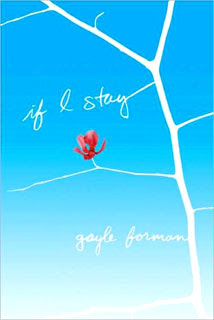
If I Stay by Gayle Forman

If I Stay by Gayle Forman is a young adult fiction novel about a teenage musical prodigy and her family.  She’s got a boyfriend with a band that is just taking off, and she’s under pressure to gain admission to Julliard playing the cello.  Tragedy strikes and changes everything, shaking up her world.

Forman’s prose is engaging from the first page, but the tragedy that befalls Mia is a predictable plot device that forces this blossoming 17-year-old to reassess her life.  Her music transports her to a safe place and even though she is not as confident as she thinks she must be to perform it, it is as much a part of her as her family and her boyfriend.  The strength of this novel is Mia’s character, her introspection, her trepidation at experiencing new things, and her ability to overcome embarrassment and fear.

“And I didn’t know how to rock-talk at all.  It was a language I should’ve understood, being both a musician and Dad’s daughter, but I didn’t.  It was like how Mandarin speakers can sort of understand Cantonese but not really, even though non-Chinese people assume all Chinese can communicate with one another, even though Mandarin and Cantonese are actually different.”  (page 47)

Mia often feels on the outside of her family, which has deep rock-and-roll ties in the community, and from her boyfriend, who is a lead guitarist in a up-and-coming rock band, and sometimes even from her own classical music because she has not done many of the things that other classical music prodigies have done with local quartets, etc.  However, Mia continues to plug along, beating back her insecurities and striving for the life she wants.  Forman has a firm grasp of a teenager’s life — the peer pressures they face, the insecurities that haunt each decision they make, and the passions in which they lose themselves.

Forman builds tension by shifting from Mia’s present into her past, careful not to rush through each moment and unfurling revelations as Mia sees them in each fragment of time.  Readers will be moved by Mia’s story and her struggle to find her true self amid high school pressures and more.  But If I Stay by Gayle Forman is more than a coming of age story, it’s about the ties that bind us to one another and how we keep those ties alive and relevant.

This is my 15th book for the 2011 Wish I’d Read That ChallengeI’ve wanted to read this book since reading Jill’s dual review in June.


This is my 32nd book for the 2011 New Authors Reading Challenge.


The Secret Lives of the Four Wives by Lola Shoneyin

Lola Shoneyin’s The Secret Lives of the Four Wives is set in modern-day Nigeria where men are supreme and wives are meant to breed children — an obsession of Baba Segi and the reason he has four wives.  However, his newest wife, Bolanle, is the youngest and most educated of the four — Iya Segi, Iya Tope, Iya Femi, and Bolanle — and her entry into the household generates jealousy and change.

Baba Segi’s only concerns are being catered to by his wives and procreation, and when Bolanle fails to produce an heir after much “pounding” (his words), he seeks counsel from his male friends and the “Teacher,” who advises him to bring her to the hospital.  It is then that the jealousy of the women becomes more concentrated on Bolanle, as they struggle to protect a family secret.

“Even a child would have worked out why my father was extolling qualities that had previously vexed him; I was compensation for the failed crops.  I was just like the tubers of cassava in the basket.  Maybe something even less, something strange — a tuber with eyes, a nose, arms and two legs.  Without fanfare or elaborate farewells, I packed my bags.  I didn’t weep for my mother or my father, or even my siblings.  It was the weeds I didn’t get the chance to uproot that year that bothered me.”  (page 91)

Shoneyin adopts what many might consider a very masculine prose that creates a crass view of sex in a polygamist household and a not-so-favorable perspective of Baba Segi, the husband.  Even when the narrative shifts to Bolanle’s first-person point of view, the language is harsh, making it difficult for readers to discern the speaker with each shift.  However, these shifts gradually become easier to discern, and each perspective adds a new layer to the narrative and deepens the complexity within the Segi family.

Readers may want more background and detail of Nigeria and its customs or at least its a more vibrant picture of its places and culture.  Shoneyin generates a harsh world that is not only Nigeria, but could be any country at any time in which polygamy is the norm and women are seen as second-class citizens.  What is absent here is a clear sense of place and time — a setting that could have made the story more vivid and memorable.

The Secret Lives of the Four Wives may have been long-listed for the Orange Prize, but the characters and story are reminiscent of other oppressed women under similar circumstances.  However, what makes this novel unique is the four wives and their perspectives on why they became wives of Baba Segi — what circumstances led them to that choice and why they continue to stay.  Each has a compelling story to tell, and while Baba Segi is not a sympathetic character, he does provide his wives with an oasis from their pasts and with the confidence to rule their own lives.  Overall, readers will get a glimpse into another world and of what it means to be one of many wives.


About the Author:

Lola Shoneyin lives in Abuja, Nigeria, where she teaches English and drama at an international school. She is married, with four children and three dogs.  Please visit her Website and her blog.


Please check out the other stops on the TLC Book Tour by clicking the icon.


This is my 31st book for the 2011 New Authors Reading Challenge.

Mailbox Monday #135

Mailbox Mondays (click the icon to check out the new blog) has gone on tour since Marcia at A Girl and Her Books, formerly The Printed Page passed the torch.  This month our host is A Sea of Books.  Kristi of The Story Siren continues to sponsor her In My Mailbox meme.  Both of these memes allow bloggers to share what books they receive in the mail or through other means over the past week.

Just be warned that these posts can increase your TBR piles and wish lists.

Here’s what I received this week:

1.  The Taker by Alma Katsu a win from TheBookTrib

2.  One Day by David Nicholls for review in Sept., but stay tuned for a giveaway in August.

3.  Kindle by Amazon, which I won from the Summer of Gomez event from Graham Parke

What did you receive this week?

Weekly Geeks 2011-02

I’m not sure how many weeks it has been since my last Weekly Geeks posting, but I thought this week’s topic was interesting.

“What book/novel would you suggest for someone like me, someone interested in learning about your state, city and/or country? What book do you think is perfect for presenting the history and culture of your place of residence in the most perfect and interesting way?”

I haven’t lived in Maryland that long compared to all the time I spent growing up in Massachusetts, but I think I can offer up at least one book that represents some of Maryland’s history and culture during a tumultuous time in our nation’s history.

I’d recommend Jarrettsville by Cornelia Nixon, which takes place just after the U.S. Civil War ends and the south has lost.  Remember Maryland is south of the Mason-Dixon line, which served as a demarcation between the North and South and thus the ideological differences about the legality of slavery.  Jarrettsville is just below that line in Maryland and is a perfect setting for a novel, especially since some of its residents held similar beliefs to their northern brethren that slavery was wrong.  I reviewed this book as part of the War Through the Generations U.S. Civil War reading challenge this year and really enjoyed it, especialy after learning that the story was based upon the life of Nixon’s distant relative, Martha Jane Cairnes.

What’s compelling about this story is that Nixon takes a tragic and personal event and weaves a story that illustrates the continued tensions between the North and South even after the end of the Civil War and the power of love to change someone’s long-held and deeply rooted perceptions about the world.  However, it also demonstrates how insecurity can breed deception and suspicion and tear apart love and family.  Slavery was not just a political issue or a business issue, but a family issue that even led to some men fighting one another on the battlefield and in the home.

What book would you recommend about your state?

106th Virtual Poetry Circle

Welcome to the 106th Virtual Poetry Circle!

Remember, this is just for fun and is not meant to be stressful.

Keep in mind what Molly Peacock’s books suggested. Look at a line, a stanza, sentences, and images; describe what you like or don’t like; and offer an opinion. If you missed my review of her book, check it out here.

Also, sign up for the 2011 Fearless Poetry Reading Challenge because its simple; you only need to read 1 book of poetry.  Please contribute to the growing list of 2011 Indie Lit Award Poetry Suggestions, visit the stops on the National Poetry Month Blog Tour from April.

Today’s poem is from Amy Lowell:

Spring Day [Bath]

The day is fresh-washed and fair, and there is a smell of tulips and narcissus in the air.

The sunshine pours in at the bath-room window and bores through the water in the bath-tub in lathes and planes of greenish-white. It cleaves the water into flaws like a jewel, and cracks it to bright light.

Little spots of sunshine lie on the surface of the water and dance, dance, and their reflections wobble deliciously over the ceiling; a stir of my finger sets them whirring, reeling. I move a foot and the planes of light in the water jar. I lie back and laugh, and let the green-white water, the sun-flawed beryl water, flow over me. The day is almost too bright to bear, the green water covers me from the too bright day. I will lie here awhile and play with the water and the sun spots. The sky is blue and high. A crow flaps by the window, and there is a whiff of tulips and narcissus in the air.

Let me know your thoughts, ideas, feelings, impressions. Let’s have a great discussion…pick a line, pick an image, pick a sentence.

I’ve you missed the other Virtual Poetry Circles. It’s never too late to join the discussion.