Quantcast

We the Animals by Justin Torres

We the Animals by Justin Torres is raw, abrasive, and rough because its characters are “animals” reverting to their baser selves in fear or confusion.  The novel reads like a short story collection, throwing readers into brief moments throughout the lives of three boys growing up in Brooklyn with a Puerto Rican father and a white mother.  Manny, Joel, and the third boy who narrates the story, creates an unconventional coming-of-age story.

“It wasn’t just the cooing words, but the damp of her voice, the tinge of her pain — it was the warm closeness of her bruises — that sparked me.”  (page 17)

These boys are wild and crazy, and their dysfunctional family life has taken them on a roller coaster ride of emotions from anger as their father beats them to deep sorrow when their mother comes home from her job to find their father has left.  These boys run free in the neighborhood, have no manners, and are struggling to find their place in the world.  Are they boys that need the protection of their mother or are they men who can take on their father and be free?  Torres shows episodes in which both of these things are true, but these boys are clearly in between, at an age where things can be magical but reality is too stark to ignore.

Torres’ writing is instinctive and brutal at times, giving this novel an autobiographical feel.  The novel is told from the viewpoint of the youngest boy reminiscing and much of it seems nostalgic, even for the not-so-normal parts of his life — where he sees the good in it and possibly relationships he misses having.  However, even though the novel is told from the point of view of the youngest brother, readers may find themselves disconnected from the characters because the scenes are so clipped and blaze by with quick, bright images that shock them — at least until the end.  At little more than 100 pages, We the Animals takes readers on a quick journey through a rough childhood of poor, mixed-race boys in Brooklyn who have to deal with more than there share of depravity and sadness.

I want to thank Ti at Book Chatter for her review that got me interested in Torres’ work.

About the Author:

JUSTIN TORRES was raised in upstate New York. His work has appeared in Granta, Tin House, and Glimmer Train. A graduate of the Iowa Writers’ Workshop, he was the recipient of a Rolón Fellowship in Literature from United States Artists and is a Wallace Stegner Fellow at Stanford. Among many other things, he has worked as a farmhand, a dog walker, a creative writing teacher, and a bookseller.
This is my 67th book for the 2011 New Authors Reading Challenge.

This is my 18th book for the 2011 Wish I’d Read That Challenge.
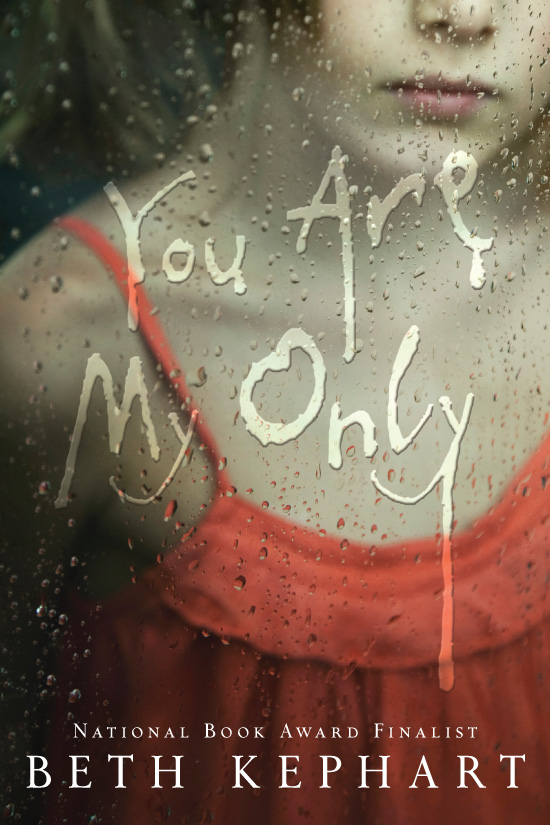
You Are My Only by Beth Kephart

You Are My Only by Beth Kephart tackles the tough topic of child abduction from two perspectives — that of the young victim, Sophie, and that of a mother, Emmy, whose child is stolen.  In this powerful, yet quiet novel, Kephart explores how one unexpected event can devastate entire worlds.

While the topic is ripped from the headlines, there is no sensationalism here.  Through carefully selected words in her poetic prose, Kephart builds tension and suspense, like the quiet vibration growing louder on the railroad tracks as the train approaches.  It also provides a quiet space — like the air between the branches of a tall tree — for readers to contemplate what each voice is saying, what each voice is struggling to address, what pain is closed inside of them and just clawing to get out.

“My feet are two pale fish inside the tight ponds of my Keds.  I leave the street for the train station.  I leave the station and cross onto the tracks, slick-backed and shiny as snail glisten.  The black gauze of the clouds flap at the moon, and from the tracks I can see into the backs of people’s houses, the private places where the lamps have not gone off.  It’s like looking through snow globes, worlds behind glass.”  (page 21)

Kephart’s prose is very lyrical and imagistic, and readers need to pay careful attention to her lines.  For instance, the above passage perfectly demonstrates Emmy’s frame of mind after losing her child.  She is lost, drowning, unmoored.  She has become separate from those who have “normal” lives because that’s what she believed she had with her child and husband, no matter how imperfect the marriage.

Emmy and Sophie have strong voices, both with stories to tell, and having one without the other here would have left too much unsaid.  Kephart is a masterful storyteller, building characters from the inside out, ensuring readers receive well-rounded men and women with strengths and weaknesses.  But there is always a mystical element to her novels, something in the background that is left unexplained.  She trusts the reader to uncover the truth of these relationships she’s building and the mysteries of what motivates them to keep moving forward even when things are at their most dark and uncertain.

“But my voice skids away, rides the slippery tracks.  Far away, at the bend in the rails, the night is lamped.  It is yellow and growing brighter, and now I understand:  the train has big yellow eyes.  Lovely ocher liquid eyes.  They put the shimmer down on the tracks and splatter the dark.”  (Page 22)

Beyond the main story, there are Helen and Cloris a devoted couple of aunts to a young boy, Joey, who is as normal as can be to Sophie.  Like Joey who supports Sophie, quirky Arlen and fantastical Autumn support Emmy in ways that are unexpected.  Although Emmy’s scenes, which are told from her point of view, limit readers’ knowledge of how she becomes institutionalized, it is not how she got there that is important to the story.  What is important is what happens there and how it transforms her.  Some of the hospital scenes are reminiscent of One Flew Over the Cuckoo’s Nest — minus the booze, floozies,and Nurse Ratched — in that she is there against her will and wants to escape, but for a while she merely is.  The relationship Emmy builds with Autumn helps her repair her broken psyche, and in this way, Kephart’s hospital is the antithesis of what happens in One Flew Over the Cuckoo’s Nest.

You Are My Only is an emotional powerhouse drawing redemption out of the shattered pieces of lives rendered asunder by a single event.  Through faith and love these characters can begin the heal, rebuild, and flourish.  What more could readers ask for?  Stunning, precious, and captivating from beginning to end.

About the Author:

Beth Kephart is the author of 10 books, including the National Book Award finalist A Slant of Sun; the Book Sense pick Ghosts in the Garden; the autobiography of Philadelphia’s Schuylkill River, Flow; the acclaimed business fable Zenobia; and the critically acclaimed novels for young adults, Undercover and House of Dance. A third YA novel, Nothing but Ghosts, is due out in June 2009. And a fourth young adult novel, The Heart Is Not a Size, will be released in March 2010. “The Longest Distance,” a short story, appears in the May 2009 HarperTeen anthology, No Such Thing as the Real World.

Kephart is a winner of the Pennsylvania Council on the Arts fiction grant, a National Endowment for the Arts grant, a Leeway grant, a Pew Fellowships in the Arts grant, and the Speakeasy Poetry Prize, among other honors. Kephart’s essays are frequently anthologized, she has judged numerous competitions, and she has taught workshops at many institutions, to all ages. Kephart teaches the advanced nonfiction workshop at the University of Pennsylvania. You can visit her blog.  Also check out this chat.

My other Beth Kephart reviews:

Please come back this afternoon for my interview with Beth Kephart about You Are My Only and for a giveaway.

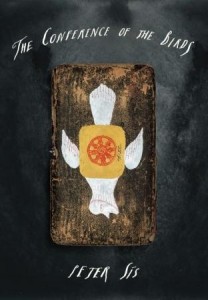
The Conference of the Birds by Peter Sis

The Conference of the Birds by Peter Sis, an acclaimed children’s author and illustrator, has taken his skills to a 12th century Sufi epic poem of the same name written by Farid ud-Din Attar, who was not only a poet but a mystic.  Often these types of poems have a hidden spiritual meaning, and Sis deftly captures the essence of Attar’s poem with illustration.

In this illustrated version of the epic poem, the pictures speak for the poet, Attar who wakes from a dream to realize he’s a hoopoe bird.  Once he transforms, he calls all of the birds of the world together to find their true king, Simorgh, by flying through the seven valleys — The Valley Of Quest, The Valley Of Love, The Valley Of Understanding, The Valley Of Detachment, The Valley Of Unity, The Valley Of Amazement, and The Valley Of Death — to reach Mountain Kaf.

In the beginning, the transformation of Attar is shown much like animated cartoons would have been created, with the flipping of each panel where each image has slight differences to create the illusion of movement.  Once the birds agree to take the journey, it is clear that it will take them through a number of valleys that will test their resolve, with each bird’s skills and weaknesses hammered by adversity and uncertainty.  Sis creates vivid birds of various colors and species.  Even if the pages of this book were not textured, readers could see the feathers and layers on these birds.

And there are many layers to these birds, their feathers, and their story.  The poem sheds light on the inner spiritual journey each of us travels, the trials that we face, and the perseverance it takes to stay on course and believe in ourselves.  For some the journey is too hard, and they turn back, but for others, it is important enough to move onward despite the risks and sorrow.  Like the poem, The Conference of the Birds by Peter Sis is multilayered, with great attention to detail from the feathers on the birds, the birds making up the larger birds, and the trees that create the mountains.  A gem of a book from an illustrator and writer who sees beyond just the words to the world it creates and the messages it brings.  Likely to be on the best of list for the year.

As an aside, I read this a couple of times carefully and with my infant daughter. She loved feeling the pages and looking at the vivid imagery, and I can tell you that keeping her attention for an entire book is difficult. This is great for kids and adults. Sis has created something of lasting beauty.

About the Author:

Born in Brno, in the former Czechoslovakia, in 1949, Peter Sís is an internationally acclaimed illustrator, author, and filmmaker. Most recently, in 2007, he published The Wall: Growing Up Behind the Iron Curtain, which was awarded the Robert F. Sibert Medal and was also named a Caldecott Honor Book. Peter Sís was named a MacArthur Fellow in 2003. He is the author of twenty children’s books and a seven-time winner of the The New York Times Book Review Best Illustrated Book of the Year.  Please check out his Web page.

Please check out this video interview from BEA:

According to the Seattle Post-Intelligencer, Sis pays homage to traditional Islamic art and its figurative representations and geometric patterns as the valleys are depicted as a series of mazes.  (Seriously, read that review, it is stunning).


If you’d like to check out the rest of the tour, please click on the TLC Book Tour icon at the right.


This is my 29th book for the Fearless Poetry Exploration Reading Challenge.


This is my 66th book for the 2011 New Authors Reading Challenge.

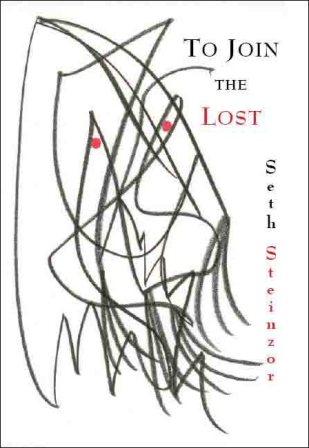
To Join the Lost by Seth Steinzor

To Join the Lost by Seth Steinzor is a modernization of Dante’s Inferno, and the irony that Dante takes a lawyer with him on his next visit should not be lost on readers.  Seth infuses his epic poem with modern tools and vices from bulldozers to politics.  Traveling the same path as Dante into the depths of Hell’s nine circles, Seth sees those trapped in between and those who have sinned in a multitude of ways.

With each canto there is a flavor of “famous” sinners, but also references to the poet’s own sins and regrets.  Where the epic poem is strongest is where Steinzor references his own troubles, his own lack of faith, his own indecision, and his own failures. “loading racks and shoving them along a/track of stainless steel into a/box of stainless steel — lower the lever,/close the gate — punch the big red/button, wait — shuddering, hissing — raise/the gate, releasing white clouds –/reach in, extract a rack of formerly filthy,/now gleaming and steaming glasses, or shiny,/clunky porcelain, or scratched-up aluminum/knives, forks, and spoons so hot//” (page 18 of Canto II)

Yes, the poem references some events, many the most horrific in nature (i.e. the Holocaust), and yes, this may seem trite and unnecessary, but these are the moments that most of humanity knows either first hand or through study.  These historic instances of unmitigated evil correlate to the references Dante makes from his historical knowledge, such as the reign of Julius Caesar and family wars that existed during that time.  However, Dante relies heavily on mythology and religious text to craft each of his cantos, though there are references to his own love, Beatrice, within the poem.  This is how Steinzor’s and Dante’s poems are similar.

Unlike Dante who uses mythology and Catholicism to make his points, Steinzor relies more heavily on Buddhism.  “. . .  That flat little pebble’s the/world of your daily awareness.  The pond is/everything else.”  (page 43, Canto VI)  The line break after “is” signifies a Buddhist precept of being in the here and now without thought to the past or the future — to be in the moment.  Many parts of this epic poem are enjoyable, but are bogged down in parts by movement through the circles with Dante and similar pungent smells.  However, Steinzor’s verses shine beneath the mire with vivid imagery in stunning ways occasionally.  “crowd of moving parts that, overlapping,/layer almost to opacity,/the eye drawn in, each figure a mottled window/into unimaginable//dimension, an almost empty pane.”  (page 23 of Canto III) or “Then, suddenly, he dived down smack/upon the landfill — a belly-flop! I sat/on his back, and he body-surfed across/the writhing mass.  We regained our feet near an/idling ‘dozer.” (page 44 of Canto VI)

To Join the Lost by Seth Steinzor modernizes Dante’s Inferno in a way that is personal for the poet and tackles some of histories most evil moments and most controversial politically.  Some readers will not enjoy the comments about a former president or other topics touched upon in this epic poem, but the gems in this epic are the more personal aspects of the piece.

***Stay Tuned tomorrow for my Interview with Seth Steinzor.***

About the Author:

Seth Steinzor has been writing poetry nonstop since his teens. To Join the Lost is his first book.  Visit his Website.  Here’s a preview of one Canto.


Please check out the other stops on the tour by clicking the TLC Book Tours image at the left.


This is my 28th book for the Fearless Poetry Exploration Reading Challenge.


This is my 65th book for the 2011 New Authors Reading Challenge.

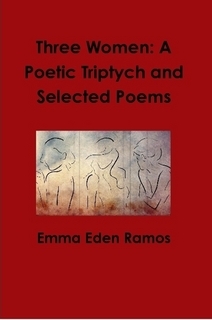
Three Women: A Poetic Triptych and Selected Poems by Emma Eden Ramos

Three Women: A Poetic Triptych and Selected Poems by Emma Eden Ramos, published by Heavy Hands Ink this year (it is eligible for the Indie Lit Awards), is primarily a series of poems about British-American psychotherapist Annette, her daughter Julia, and a Croatian immigrant, Milena.  Ramos uses the idea of the Triptych beautifully here, in which the poems about or told from Julia and Milena’s points of view are hinged on the poems told from Annette’s point of view.  Moreover, the poems from Julia and Milena’s points of view are used to flesh out the larger story of Annette and her grief, establishing not only the entrapment of “troubles” or suicidal feelings felt by the victims, but also the sense of enormous loss and emptiness felt by the surviving family members.  The message is the goal, and it is not bogged down by overly “pretty” or gruesome language.

From Fold One: Introductions in “Annette” (page 5), “I am a beautiful woman, perhaps the most beautiful/I’ve seen/But the exterior, she perjures herself like an unruly/teen.”  The first line of comparison is drawn when the poet takes the reader from this image of a beautiful woman whose exterior is deceiving to her daughter’s introduction, a young woman as troubled as her dead brother and her mother.  The line is further drawn to include Milena, who now feels out of place in her adopted home, America, since her father passed into a world of rest.  This unrest establishes the foundation upon which Ramos builds the Triptych or the links between these women.

On the surface, it is easy to see the connections between a mother grieving for her lost son and Milena grieving for her lost father.  Julia, it appears, is on the outside looking in because she does not believe her mother “sees” her through the grief, which gives her permission to be suicidal.  The connection Julia sees between her mother and her deceased brother are more than she can reconcile, especially when she too lost someone she loved.  It is not until the final panel is revealed — Fold Three: Connections — that the whole picture is revealed.  There is a melding here of these women, a verbal acknowledgment that they are the same.  However, what separates them is how they tackle the aftermath of suicide.

The other selected poems in the work are not as strong, unfortunately, but Emma Eden Ramos’ conversational style is maintained in the final poems.  Moreover, the stories in the final poems are so different that the collection would have been better served by further introspection by the three main women in the beginning set.  Two of the final poems are focused on body image and religion, but one of the poems maintains the examination of suicide, though in a more cryptic, less direct way.

Three Women: A Poetic Triptych and Selected Poems is a unique chapbook from a young poet, Emma Eden Ramos, that demonstrates a personable style that can reach out to readers and draw them into the story.

Please check out one of the best poems in the collection at the Virtual Poetry Circle.

About the Poet:

Emma Eden Ramos is a twenty-four year old writer from New York City. She has had short stories published in literary journals such as BlazeVOX Journal, The Legendary, The Citron Review, Down in the Dirt Magazine, Stories for children Magazine, and The StoryTeller Tymes.

Her poetry has appeared in Calliope Nerve, Ink Sweat & Tears, and Children, Churches and Daddies Magazine. Emma’s novelette, Where the Children Play, was published in the Spring 2010 issue of BlazeVOX Journal. Three Women: A Poetic Triptych and Selected Poems is Emma’s first collection of poems. At present, Emma is writing a middle-grade novelette. She will be a student at Brooklyn College in the spring. Connect with her on GoodReads.

This is my 27th book for the Fearless Poetry Exploration Reading Challenge.


This is my 64th book for the 2011 New Authors Reading Challenge.

Jane Austen Made Me Do It Edited by Laurel Ann Nattress

Laurel Ann Nattress, the woman behind Austenprose.com, is now the editor of Jane Austen Made Me Do It, a collection of Jane Austen-inspired short stories (check out the tour).  Authors not considered Austenites per se, like Frank Delaney writes with Diane Meier and Adriana Trigiani join those known for their Austen spinoffs, like Amanda Grange, Jane Odiwe, Alexandra Potter, and more.  The collection even includes the winner of the Jane Austen Made Me Do It short story contest — Brenna Aubrey’s “The Love Letter.”  But some Austen retelling favorites like Abigail Reynolds, Mary Simonsen, and Eucharista Ward are notably absent.  However, this only begs the question as to whether there will be another anthology in the future as the Austen subgenre continues to grow.

It is only fitting that the collection begins with the woman who started my journey onward into the world of Jane Austen and subsequent retellings and inspired novels, Syrie James with “Jane Austen’s Nightmare.”  The short story personifies every writer’s nightmare — that the characters will not like how they have been drawn and will seek justice.  From characters perceived as too perfect to those with a great number of flaws, Austen meets them all in her nightmare set in Bath, a city she despises.  Kicking off the collection here is a great introduction to all of Austen’s novels and characters and to her own fears and character as we know her to have been, possibly.

“Austen’s rise to fame has been steady since her nephew James Edward Austen-Leigh’s biography, A Memoir of Jane Austen, introduced ‘dear Aunt Jane’ to broader readership in 1869, but recently, two elements have been her strongest catalyst:  the Internet and a wet shirt.”  (page xii)

There are stories for five of her six novels, and Mansfield Park, though mentioned in passing or referred to slightly, is the one left out as an inspiration for a complete story.  Each author tackles a different novel and/or theme from the ridiculousness of ghost stories in “A Night at Northanger” by Lauren Willig to the trials of living with one’s in-laws, like in “Nothing Less Than Fairy-Land” by Monica Fairview.  Clever renderings of finding love in the most unlikely places in Beth Patillo’s “When Only a Darcy Will Do” are joined by modernized stories of renewed love and patience.  These stories are perfect for those looking for more Austen and for those who are unsure whether they would like Austen retellings/continuations.

There are outstanding stories and those that are not quite as good, but let’s be clear, if you love all-things Austen, you want this collection and there are no stories here that you will want to miss.  Writing Austenesque stories requires a certain level of imagination, while at the same time a certain commitment to her characters as she has created them.  Each of these writers does just that.  Jane Austen Made Me Do It has enough clever wit and modern sensibility for any reader, and would suit those looking for prime examples of how a short story can capture the heart.

About the Editor:

A life-long acolyte of Jane Austen, Laurel Ann Nattress is the author/editor of Austenprose.com a blog devoted to the oeuvre of her favorite author and the many books and movies that she has inspired. She is a life member of the Jane Austen Society of North America, a regular contributor to the PBS blog Remotely Connected and the Jane Austen Centre online magazine. An expatriate of southern California, Laurel Ann lives in a country cottage near Snohomish, Washington. Visit Laurel Ann at her blogs Austenprose.com and JaneAustenMadeMeDoIt.com, on Twitter as @Austenprose, and on Facebook as Laurel Ann Nattress.

My Soul to Take by Tananarive Due

My Soul to Take by Tananarive Due is the fourth book in her immortals series and is set in the year 2016 when governments are striving to keep terrorists at bay and plagues secret to reduce the threat of panic.  Glow, a type of blood that is warm to the touch, is being touted as the solution to the pandemic and disease problem, but the United States has banned the drug for its terrorist ties and unknown origins.

Fana, an immortal, and her father, Dawit, hope to help the human race by offering the healing powers of their blood, but they are stopped at every turn by a rival faction of immortals who oppose the sharing of blood with mortals, led by Michel.  Complicating the situation even further is Fana’s attraction to mortal Johnny Wright and her betrothal to Michel.  Due has crafted a unique world in which these characters struggle not only for the life and death of humanity, but with greater questions of acceptance and compassion.  She even sprinkles her novel with technology gadgets that could be in our very near future, which is a nice touch.

“Fana was grateful that Mom had raised her with mortals in her family, closest to her heart.  Her cousin, aunt, and best friend were all mortals, so she hadn’t grown up with the feelings of superiority shared by her Life Brothers, and even her father.  She tried not to feel it, anyway.  Fana always began her meditations by asking for humility so she would not lose herself.” (page 64)

While readers will enjoy the intricate details throughout the novel about the Immortals and their way of life, something is missing — it is hard to connect with the characters without having read the previous books in the series.  Complicating matters is the emergence of Phoenix, a former music star, and her family, who are dealing with the deaths of a fraternal grandmother and maternal father that haunt them.  As quickly as readers become involved in her story, they are quickly shifted away from it and immersed in the immortal world.  When readers are returned to Phoenix’s story, they may feel like they have to flip back to recall what has happened to her.  This format does a disservice to the character — whose story line does intersect with Fana’s early on — and makes it difficult to reconnect with the character and her story and how it connects to the Immortals story line.

Due has a talent for creating other worlds, environments where immortals are gods, but have secreted themselves and their innovations away below the ground.  There are some that want to save humanity, and others that see humanity as ants to be squashed.  Through a great deal of biblical allusion, she creates an allegory for the Book of RevelationsMy Soul to Take is a slowly, unwinding battle of wills, but mortals refuse to sit on the sidelines and watch.  A pleasurable read that could be enhanced by reading the previous books in the series.

About the Author:

Tananarive Due (pronounced tah-nah-nah-REEVE doo) is the American Book Award-winning author of nine books, ranging from supernatural thrillers to a mystery to a civil rights memoir.

She has a B.S. in journalism from Northwestern University and an M.A. in English literature from the University of Leeds, England, where she specialized in Nigerian literature as a Rotary Foundation Scholar. Due currently teaches creative writing in the MFA program at Antioch University Los Angeles. Due has also taught at the Hurston-Wright Foundation’s Writers’ Week, the Clarion Science Fiction and Fantasy Writers’ Workshop, and the summer Imagination conference at Cleveland State University. She is a former feature writer and columnist for The Miami Herald.

Due lives in Southern California with her husband, Steven Barnes; their son, Jason; and her stepdaughter, Nicki.

This is my 63rd book for the 2011 New Authors Reading Challenge.

Mr. Darcy’s Undoing by Abigail Reynolds

Mr. Darcy’s Undoing by Abigail Reynolds is the latest in her “What If?” series of Pride & Prejudice variations that seeks to uncover how far Darcy will go to woo Lizzy if after his disastrous proposal she accepts one from another man.  Darcy has made his arrogant speech about loving Lizzy against his better judgment and has proposed they get married, and she has refused by the time this book opens.

Lizzy has a dilemma before her; she had hoped to marry for love, but with her sister Jane’s hopes of marrying Mr. Bingley dashed and her continued depression about losing him, Lizzy realizes that she no longer has the luxury to marry for love and must find a suitable man with means to save her family from ruin upon the death of her father.  She takes the responsibility on when a family friend Mr. Covington begins to show interest in her.  After accepting his proposal and resigning herself to a marriage based on necessity and fondness, which she hopes will grow into love, Mr. Darcy arrives on the scene with Mr. Bingley and things get more complicated as she realizes her true feelings for Darcy.

“He inquired after her family as Darcy looked on sardonically, wondering what Elizabeth could possibly see in this dull fellow.  It grated on his nerves every time Covington called her by her name or allowed an admiring look to rest upon her.  Nevertheless, he gave no thought to leaving; as vividly unpleasant as this might be, nothing would induce him to leave Elizabeth alone with Covington while he had a choice in the matter.  There was a certain ironic humour, he reflected, in finding himself as her chaperone.” (page 68-9 ARC)

Told from both Lizzy and Darcy’s point of view, readers get a well-rounded glimpse at the feelings and frustrations they feel about their situation, especially after Lydia runs off with Wickham.  What’s new here is that Lizzy is deflated and more vulnerable, but she remains strong at her core in her convictions.  Scandal has hammered her family’s reputation and she realizes that she is at the center of it and believes that everyone would be best off without her.  Darcy must not only convince her of his love, but that she has not permanently injured her family’s reputation and that she is not a pariah who can destroy his reputation.

“The two men eyed one another for a moment, then Darcy said in a more normal voice, ‘Do you still object to Georgiana’s presence here? I would like her to have the opportunity to get to know Elizabeth.’

‘Good God, Darcy, are you actually asking my opinion? There is a first time for everything!'”  (page 176 ARC)

Reynolds introduces Mr. Covington, Mrs. Covington, and makes sure that fan favorites, like Mr. Bennet and Colonel Fitzwilliam, are as bright as Lizzy and Darcy.  Each character is vivid and dynamic.  However, Lady Catherine, Mr. Collins, and Charlotte Lucas do not make appearances, but are talked about in passing.  Reynolds is a master at throwing Lizzy and Darcy into new situations that threaten to keep them apart, but the overarching theme is always that love conquers all.  Austen would be proud that Reynolds has taken her characters, helped them evolve into better versions of themselves, and taken them on new journeys.

Mr. Darcy’s Undoing by Abigail Reynolds is infused with bawdy conversation, conflict, societal disapprobation, and classic characters with modern sensibilities.  Darcy and Lizzy are no longer pinned down by Regency norms, but are pioneers of modernity and unbridled love and passion.  Reynolds is masterful in her homage to Austen and her wit, while catering to readers’ desire for romance and strong protagonists.  Likely to be one of the first Austen spinoffs to make the end of year “Best of” list.

Her Sister’s Shadow by Katharine Britton

Her Sister’s Shadow by Katharine Britton is aptly titled given that Lilli Niles has always felt like she is living in the shadow of her “perfect” sister Bea.  Bea takes on a guardianship role when Lilli is about 15 after their father dies and their mother loses touch with reality.  Lilli resents her “perfect” sister’s hold over the family and is even more angry about how Bea lords it over her when she wins crew races and is considered perfect by her mother.  Couple all of that resentment with hormones of adolescence and you can imagine the volatility.

Told in alternating chapters between the past and the present when Lilli returns to White Head, Mass., after 30 years when her sister Bea calls and needs her, Her Sister’s Shadow vividly tells a story of healing after a significant rift between sisters.  Readers will feel the angst of a young Lilli who has just discovered boys and wants to grow up more quickly and the awkwardness of Lilli and Bea who attempt to reconnect after 30 years.

“When she was a girl, after the accident, she would go down onto the rocks, pick her way carefully along their slick surface, and shout her grief and guilt into the deep bass notes of that foghorn.  Her kitchen, all stillness in pools of white light, offered no such camouflage.”  (page 4)

Britton creates characters that are real, flawed, and seeking redemption through their actions even if they are unaware of it.  While Lilli’s relationship with Bea is strained, her relationship with Dori, her younger sister, is sweet and unbreakable.  Lilli’s relationship with Charlotte is more like a mother-daughter dynamic in which Charlotte is a caretaker and empathetic.  There is a great deal at work in these female relationships; their complexity is stunning and palpable.  Each sister is drawn realistically, causing readers to become attached to each one.  It is through this relationship with the reader, that Britton tugs tears out and causes wistful smiles to curl.

Bea’s shadow is not the only one looming over this book.  Britton has crafted a devastating novel through which readers and characters must journey to reach out of the fog and into the light.  Her Sister’s Shadow has a gorgeous setting steeped in coastal imagery that mirrors the churning ocean waves of these relationships which every so often smooth out to reflect the stars and beauty of calm.

About the Author:

Katharine Britton has a Master’s degree in Creative Writing from Dartmouth College. Her screenplay, Goodbye Don’t Mean Gone, was a Moondance Film Festival winner and a finalist in the New England Women in Film and Television contest. Katharine is a member of the League of Vermont Writers and PEN New England. She teaches writing at Colby-Sawyer College, and is an instructor at The Writer’s Center.

When not at her desk, Katharine can often be found in her Norwich garden, waging a non-toxic war against the slugs, snails, deer, woodchucks, chipmunks, moles, voles, and beetles with whom she shares her yard. Katharine’s defense consists mainly of hand-wringing, after-the-fact.

Please follow her blog and Facebook.

To Enter for 1 copy of Her Sister’s Shadow by Katharine Britton: (US/Canada only):

1.  Leave a comment about what kind of relationship you have with your sister or whether you would enjoy having a sister if you don’t have one.

2.  Follow Katharine Britton on Facebook and leave a comment for another entry telling me you did so.

3.  Facebook, Tweet, or Blog about the giveaway and leave a comment with each for up to three more entries.

Deadline Oct. 28, 2011, at 11:59PM EST


To visit the other stops on the TLC Book Tour, click on the icon at the right.


This is my 62nd book for the 2011 New Authors Reading Challenge.

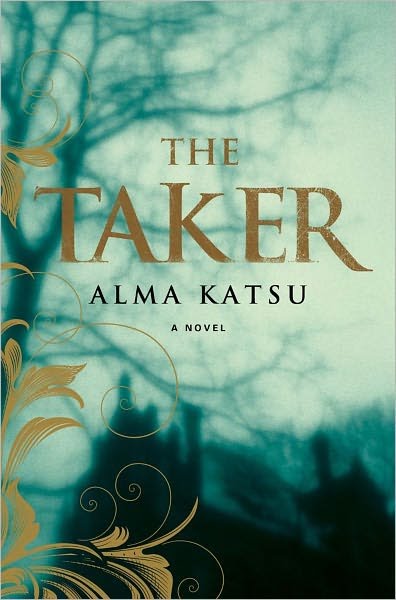
The Taker by Alma Katsu

Alma Katsu’s The Taker has received a number of rave reviews and some unfavorable reviews, and it was recently listed in BookList’s Top 10 Debut books.

Lanore, “Lanny,” shows up in her northern Maine hometown covered in blood, and the police say that she has confessed to killing a man and leaving him in the frozen woods.  ER doctor, Luke Findley, becomes the recipient of a Gothic fairy tale that is more dark and sinister than full of fairy dust, unless that fairy is an evil alchemist and sodomite.

“The stranger had appeared suddenly, at the edge of the gathering that evening.  The first thing Adair noticed about him was that he was very old, practically a shrunken corpse leaning on his walking stick, and as he got closer, he looked older still.  His skin was papery and wrinkled, and dotted with age spots.  His eyes were coated with a milky film but nevertheless had a strange sharpness to them.  He had a thick head of snow white hair, so long that it trailed down his back in a plait.  But most notable were his clothes, which were of Romanian cut and made of costly fabrics.  Whoever he was, he was wealthy and, even though an old man, had no fear of stepping into a gypsy camp alone at night.”  (page 162)

The Taker is a story within a story, within a story, spanning from the dark ages through the present day, and Lanny claims to be immortal, but do not be mistaken into thinking she’s a vampire or werewolf.  She is neither.  Her unrequited love for the town pretty boy, Jonathan St. Andrew, is the main crux of the story and how it brings about her downfall that leads to her life as an immortal.  Katsu spoke recently at Novel Places about the book and revealed that the story of Pinocchio is the backbone of her novel, which is clear in how the desire to grow up and become a woman with her own life separate from her family propels Lanny to be easily led astray.  However, that is where the similarity ends.  Katsu’s novel is ripe with sodomy, rape, kidnapping, murder, and more, which is why it would be a perfectly dark book to read this season as Halloween approaches and is what would once have been considered horror (rather than the popular category of paranormal, which has a “lighter” tone to it).

Lanny tells her story to Luke in the present day, but a more effective approach would have been to have her merely tell her story to the reader.  As many know story framing or using one character as a plot device for another character to tell his/her story is bothersome if the character/plot device is not well developed.  While Luke does have a back story here, it fails to round out the character enough, leaving him flat and boring compared to the characters of Lanny and Adair.  Even Jonathan is little more than a caricature of the pretty boy of the town’s founders, and it would have served to have more of him and Lanny’s interactions in the book at the beginning of their “romance” to demonstrate their affection for one another.  However, being told from Lanny’s point of view, it is incredibly difficult to demonstrate Jonathan’s perspective on their relationship and oftentimes he comes off as a callous womanizer who is incapable of love.

With that said, however, Katsu is adept at time shifts within the story that keep the pace of the novel moving quickly.  Moreover, she creates a deeply atmospheric novel where readers are combing through the mist to grasp the truth of Lanny’s story and to unravel the mystery of her immortality.  Some have said this is a romance; it is not.  Most will debate who is “The Taker,” but there is certainly more than one, and it will depend on your personal perspective as to which you believe is the taker.  They all are takers in their own way — taking what love and affirmation they can, taking the loyalty of others by forcing their hands, and taking pleasure in the act of taking.  Readers who shun violence in books, particularly against women should steer clear.  Katsu’s The Taker is dark and decadent; an excellent debut novel for those looking to tantalize their darker senses with interminable consequences.

Stay tuned for the next two books in this series; I know I will be waiting on the edge of my seat. I’m always on the lookout for horror books, as I’ve grown tired of EMO vamps and werewolves.

For a chance to win my gently used ARC (which has a signed bookplate), please visit this post about Alma Katsu’s reading near me.  If you’re looking for another bonus entry, leave a comment on this review.

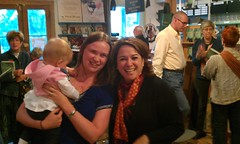
Alma Katsu (right) Me & Wiggles

About the Author:

Alma Katsu is a 30-year DC veteran who lives in two worlds: on one hand, she’s a novelist and author of The Taker (Simon & Schuster/Gallery Books). On the other hand, she was a senior intelligence analyst for CIA and NSA, and former expert in multilateral affairs.  Watch the book trailer or this one.


This is a stop on The Literary Road Trip since Katsu has worked in Washington, D.C., and now resides in Virginia.


This is my 61st book for the 2011 New Authors Reading Challenge.

Out of Breath by Blair Richmond

Out of Breath by Blair Richmond is a young adult novel that will have readers quickly turning the pages to find out what secrets Kat Jones is hiding and why the town of Lithia where she ends up seems so ethereal and mysterious.  Kat arrives in Lithia, where she was born, after running from something that happened in Texas, and everyone in the town is incredibly friendly and welcoming.

Richmond’s sparse narration, plus the focus on running races, ramps up the suspense as Kat’s secretive nature enables her to blend in and adopt a new life.  However, this new life quickly becomes more than she can handle, enticing her to strap on her running shoes and get out of town fast.  She’s a young woman who’s budding college life is cut short, and she turns to the only activity — running — that gives her solace to escape.  A vegan in a town of tree huggers and other like-minded nature and running enthusiasts, Kat is at home and relatively at peace.  However, the rivalry between Roman and Alex and their secrets threaten to disturb the tenuous life she’s starting to build.

“Since I was eight years old I’ve been a runner.  Not a jogger.  A runner.  I was always the fastest girl I knew, and, during junior high, was faster than any boy I knew.  I ran cross-country in high school and I won state during my junior year.  A scholarship to a major college seemed all but inevitable until my dad backed the car up over my left foot the summer before my senior year.  It’s funny how quickly dreams can be crushed.  Just as easily as my left foot.”  (page 3)

Like many other young adult novels on the market, Out of Breath has a touch of the paranormal — vampires and ghosts — but there is an unexpected twist here.  Vampires are actually dangerous, and certain vampires have quirky eating habits.  The ghosts play more of a role in the latter pages, and likely even more of a role in the other two planned books for the trilogy.  Yes, this is the first in a series — a series that focuses on nature, saving the environment, and vegan/vegetarianism.  Although the vegan/environmental angle can be heavy handed at times when Roman and Kat converse, it serves a purpose for the plot and can be overlooked by readers that may feel as though Kat is preaching to them.

Out of Breath by Blair Richmond is an eerie novel that takes a look at the consequences of our actions and how we cannot right the wrongs of the past, but only  strive to change our futures.  Readers will enjoy the mix of paranormal, young adult coming of age story, romance, and suspense mixed with a theme of environmental conservation and appreciation.  Even better is that unlike other trilogies, Richmond’s novel does not leave the reader with a major cliffhanger, but provides a modicum of resolution and leaves the reader with a stronger version of Kat.  An intriguing mix of themes and characters that creates a mystical world in the forest anchored in the reality of today’s environmental concerns.

About the Author:

Blair Richmond is the pen name of a writer living in the Northwest, where OUT OF BREATH is set. She is currently working on THE GHOST RUNNER, the second book in the trilogy featuring Kat and the mysterious town of Lithia.

Ashland Creek Press is hosting a Halloween virtual book launch party with an author Q&A, book giveaways, and more.  Mark your calendars


This is my 60th book for the 2011 New Authors Reading Challenge.

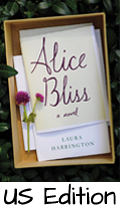
Alice Bliss by Laura Harrington

Alice Bliss by Laura Harrington is a coming of age story about a teen girl growing into adulthood at a time when her father, Matt, is sent to Iraq and her mother, Angie, is not dealing with his absence as well as Alice thinks she should.  The blissful life her family has had up until this point is turned around and twisted as Alice takes on more of her mother’s duties — making dinner, washing clothes, getting her sister’s (Ellie) lunch ready, and getting her sister to school.  She’s constantly worried about her father not returning home, about how she seems not to be anyone’s favorite, and the changes she sees in her friends, family, and Henry (her neighbor and friend).

Harrington creates a world and cast of characters that grab your heart and don’t let go.  The Bliss family story will have your tearing up right from the beginning when the father is first setting his affairs in order and explaining to Alice what she’s to do while he is at war.  Yes, he says, he is coming back, but readers know about the uncertainties of war and so does Alice, which makes his parting all the more heart-wrenching.  Alice only finds solace when running, like her mother finds solace when swimming, but they are too alike to find comfort in one another and often find themselves at odds.  Dynamic characters young and old tackle difficult questions of how to go on without a loved one, who often calmed the waters and even when that situation is expected to be temporary.

“This is the first time Alice has been allowed to walk back to their campsite from the Kelp Shed alone.  She is fourteen, barefoot, her sneakers tied together by the laces and slung across her shoulder so she can feel the soft, sandy dust of the single-track road between her toes.  Her sister fell asleep halfway through the square dance, dropping from hyperexcited to unconscious in a flash.  Her father carries Ellie draped over his shoulder, and casually, or so it seems, her mother says, ‘Come home when the dance is done.'” (page 1)

While Alice is a strong, young woman, she is also timid when it comes to her changing relationship with Henry and volatile when it comes to her relationship with her mother and sister and her schoolmates.  Alice’s life spirals out of control while she’s daydreaming and running away, but there are moments of hope when letters arrive and broken up phone calls pepper their days.  Alice is growing up before readers’ eyes.  She’s learning that her friendship with Henry is more complicated than she expects and at a time when she wants it to stay the same.  She’s flattered when a popular senior asks her to a baseball game, and she’s disenchanted with high school society when her childhood friend Steph remains distant even when it is obvious she needs someone to lean on.  Her sister Ellie tries to act more mature than her sister, and does on some occasions, but she’s still just eight and what’s important to her — a new haircut, new clothes, a nice lunch — skirts the realities of their lives without Matt.

Uncle Eddie and Gram are the rocks of the family that help hold up Angie, Alice, and Ellie — keeping them from imploding.  Harrington has created a wide cast of characters who evolve steadily throughout the novel.  Despite the third person omniscient point of view, Harrington’s narrative evokes an emotional connection between the characters and the reader.  The distance often felt with this point of view is not present here in the least.  Readers will feel the loss, the waiting, the anger, the sadness, and the confusion all at once — just as the characters do — while cheering them on to remain positive that Matt will return home.  This is a young adult novel adults will praise for its realistic portrayal of adult themes, while young adults will praise the relate-ability of its teen characters and their situations.

“Even though Mrs. Grover wears those awful sensible shoes and has gray hair that she wears in a bun, Alice thinks that maybe Mrs. Grover is still young in the ways that are important.  Like she’s not so serious all the time, and she sings and right now she’s teasing a cardinal.  Whistling in response to its call and damn if that cardinal doesn’t whistle right back.  Alice’s mother doesn’t even have a clothesline, let alone stand outside and lift her face to the sun and sing and whistle to the birds.” (page 101)

Harrington is talented at creating a world that is real — a small town where everyone knows one another and feels as though they are under a microscope at home and school — and generates an atmosphere of fear and uncertainty — in the silence of waiting.  What are those keepsakes that we hold dearest? What are those memories that we hold onto tightest? Alice and her family find these answers and more, making the novel even more suspenseful.  Alice Bliss not only tracks the evolution of Alice from child to adolescence and the bumps along the way, the novel teaches readers about heartache, compassion, and strength.

About the Author:

Laura Harrington’s award winning plays, musicals, operas, and radio plays have been widely produced in the U.S., Canada, and abroad. Harrington is a two time winner of the Massachusetts Cultural Council Award in playwriting and a two time winner of the Clauder Competition for best new play in New England for Mercy and Hallowed Ground.

“Alice Bliss”, a novel, published by Pamela Dorman Books, Penguin/ Viking, will be on sale spring 2011. She is currently writing a new novel, “A Catalogue of Birds,” as well as a song cycle with composer Elena Ruehr, and a series of choral works with composer Roger Ames. Ms. Harrington teaches playwriting at M.I.T and is a frequent guest artist at Tufts, Harvard (where she was a visiting Briggs Copeland Lecturer), Wellesley, University of Iowa, and other campuses.

Please also check out this great Q&A, an excerpt from the novel, and her blog.


This is my 59th book for the 2011 New Authors Reading Challenge.


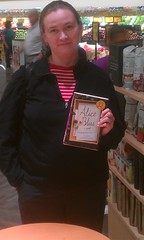
Alice blissI took part in the experiment to see where this book would end up once I read, reviewed, and released it into the world.  So, here’s a picture of me releasing it into the wilds of Maryland (Ok, its a Safeway/Starbucks Cafe).

I toyed with releasing it in a bookstore, at the library among the library sale stacks, and finally decided to release it in the Safeway near my house in their Starbucks Cafe.  It was done surreptitiously and I was incredibly self-conscious.  Nevermind that this is a book I really didn’t want to let go because I loved it so much.

I may just have to buy my own copy of this book to add to my shelves and read it again.  It was THAT GOOD!