Quantcast

Flesh by Khanh Ha

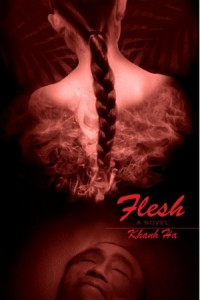
Flesh by Khanh Ha is dark and dreamlike.  Tai’s coming of age story is fraught with trauma and hardship, but he maintains his determination and remains grounded despite the beheading of his father at the hands of his granduncle in Northern Vietnam.  Ha has woven a dark love story within Tai’s trip through adolescence that takes him to Hanoi and other places as he searches for the man who turned in his bandit father to the authorities.  Part dark adventure, Tai is thrown into the world of Vietnam’s opium dens and indentured servitude as his mother barters him away to pay for a safe, final resting place for his father and younger brother.

“He could not tell which one was my father’s as he passed under the banyan tree.  Those were the same heads he saw in the rattan baskets, but now they had no eyes, only black sockets with grubs crawling in them.  He spotted a hole bored under each jaw, and a rod was pierced through it to the top of the skull and into a limb.  The heads looked out in different directions, and in the early morning light they bore a pinched look neither of hurt nor sorrow.”  (page 18)

Each chapter reads like a short story, a memory recalled by Tai about his journey and the impact is at once immediate and lasting.  Readers are piggybacking on Tai’s shoulders as he runs through the jungles of Tonkin and the streets of Hanoi as the dark, mysterious Frenchman chases him and he bumps into Xiaoli, a young Chinese girl working in an opium den.  Ha’s prose is poetic as it paints the scene in which you can smell the opium, see and hear the brown of Tai’s village and the busy streets of Hanoi, and feel the delirium of smallpox or his pulse quicken as he begins to fall in love.

“The bank was steep.  I was a salamander, half naked, creeping on the clay soil, seizing knotty vines that bulged across the incline.  The dark odor of sundered organics.  Lying flat on the ridge of the bank, I felt unusually warm, and then a suffocating heat hazed my eyes.”  (page 42)

Tai’s journey is through darkness and fear, and Ha raises questions of nurture vs. nature — whether we are only who we are because of who our parents were or the circumstances in which we were raised.  From the atmosphere to the myths and legends, Ha generates a novel that will capture readers from the beginning, but there are times when the dialogue is a bit trite and wooden.  However, as there is little dialogue per se and that dialogue is often between characters that know little of the other’s language, it can be forgiven.

Flesh by Khanh Ha is a stunning debut novel that showcases the writer’s ability to become a young male narrator whose view of the world has been tainted by his life circumstances and tragedy, but who has the wherewithal to overcome and become a better man.  Through a number of twists and turns, Tai must come to terms with the loss of his father, his obligations as the remaining male member of his family to care for his mother, and the secrets that his culture and family hide.
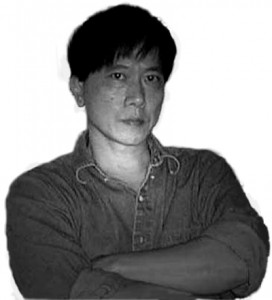
 

About the Author:

Khanh Ha was born in Hue, the former capital of Vietnam. During his teen years he began writing short stories which won him several awards in the Vietnamese adolescent magazines. He graduated from Ohio University with a bachelor’s degree in Journalism. Flesh is his first novel. He is at work on a new novel.

Visit the author at his website.


Click for Tour Stops

This is my 46th book for the 2012 New Authors Challenge.
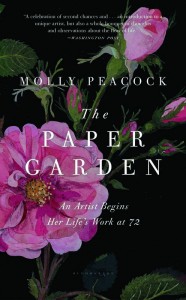
The Paper Garden by Molly Peacock

Poet Molly Peacock’s The Paper Garden is not only a collage and biography of a woman, Mary Delany, who began a career as an artist late in life, but it also is partially a memoir of Peacock’s own life and the nuggets of wisdom she’s gained from her obsession with this floral artist and her collages or flower mosaicks.  Delany is a woman who began working with scissors and paper long before she gained recognition for her art, starting as a young girl in school.  While one of her classmates recognized her talent, life got in the way as Delany was plucked from her home and moved to her aunts and back again as English politics became tumultuous and her family backed the Pretender.

“A few of the papers she used — all of the papers in the eighteenth century were handmade — in fact were wallpapers, but mostly she painted large sheets of rag paper with watercolor, let them dry, then cut from them the hundreds of pieces she needed to reproduce — well, to re-evoke might be a better word — the flower she was portraying.  There is no reproduced hue that matches the thrill of color in nature, yet Mrs. D. went after the original kick of natural color, and she did it like a painter.”  (page 7-8 ARC)

Through all of the upheaval, Delany kept to her crafts and her music, once inspired by a meeting with Handel.  Peacock’s prose is intimate and conversational as she speaks of Delany like a beloved friend and peer.  She speaks of her journey to learn about Delany’s life and craft like a careful historian citing her sources and engaging in reverence for her subject.  Through her delicate prose, the beauty of Delany and her work emerge gradually, like the petals of a bud opening slowly as the sun rises.

Peacock does a fantastic job comparing individual mosaicks to events in Delany’s life in England and Ireland even though many of the pieces were created long after the death of her second husband and her younger sister, Anne.  She was an early mixed media artist who used wallpapers, paints, dried leaves, and other materials to create her portraits of flowers, breathing new life into even the most simple flower.

The Paper Garden by Molly Peacock is a quiet read chock full of details about Mary Delany’s craft, her family, and her inspiration, but it also is full of advice, beautiful images of Delany’s work, and tidbits about Peacock’s motivations in her own poetry and life.  Readers will dip into this book, think and wonder about Delany’s craft, but also ruminate on what this journey she embarked upon taught her and ourselves.  In almost a meditative way, the biography pulls the reader in and pushes them out to ensure the depth of the art and its meaning is thought about on a deeper level.

***Some of my favorite quotes from the book that can apply to writing***

“Great technique means that you have to abandon perfectionism.  Perfectionism either stops you cold or slows you down too much.  Yet, paradoxically, it’s proficiency that allows a person to make any art at all; you must have technical skill to accomplish anything, but you also must have passion, which, in an odd way, is technique forgotten.”  (page 28 ARC)

“Not to know is also sometimes the position of the poet, who depends on close observation to magnify a subject, hoping to discover an animating spirit.  There’s romance in that forensic impulse . . .” (page 34 ARC)

About the Author:

Molly Peacock is the award-winning author of five volumes of poetry, including The Second Blush. Her poems have appeared in the New Yorker, the Paris Review, and the Times Literary Supplement. Among her other works are How to Read a Poem . . .  and Start a Poetry Circle and a memoir, Paradise, Piece by Piece. Peacock is currently the poetry editor of the Literary Review of Canada and the general series editor of The Best Canadian Poetry in English. A transplanted New Yorker, she lives in Toronto.

Visit Molly Peacock’s Website.

Click for Tour Stops

This is my 4th book for the 2012 Ireland Reading Challenge.

The Cottage at Glass Beach by Heather Barbieri

The Cottage at Glass Beach by Heather Barbieri is about mothers and daughters and sisters and their tension and love filled relationships.  Nora Cunningham returns to Burke’s Island to get away from her scandalous political life in Boston with Malcolm and clear her head in upper Maine. Irish-American immigrant ancestors infuse her memories, memories she barely remembers from her younger childhood of her mother, Maeve, and their life together on the island before her mother’s disappearance. Nora reconnects with her aunt Maire as she begins to find her self — the person she is without Malcolm and the person she’s been deep inside.

“Her mother laughs.  Her voice is as sparkling as light on water.  The folds of her skirt cling to her legs.  She’d dived in fully clothed.  She isn’t like the other mothers with their rules and careful ways.”  (Page 1 ARC)

Nora’s daughters, Annie and Ella — ages seven and twelve — are like Maire and her sister Maeve used to be — one always cautious and one who lives in the moment.  Barbieri’s weaves in Irish folklore about selkies, seals that shed their skin to become humans on land.  These seals play a protective role in the story as they are always just off shore, watching carefully.  Soon, a man, Owen Kavanagh, washes up on shore near Nora’s cottage in the middle of a rainstorm.  But he’s not the only mysterious male on the island; there’s also a young boy named Ronan who befriends Annie.

“Indeed, a shiny head bobbed in the eddies that curled toward the shore, indigo depths between.  The creature met Nora’s gaze directly, its dark eyes wide and oddly human, before the children’s laughter drew its attention once more.”  (Page 18 ARC)

In many ways Ella and Annie act older than they are, but readers will see the toll that potential divorce can have on kids as their father makes a surprise visit to the island.  The island’s oasis atmosphere can be easily disturbed by outsiders, even if the inhabitants are eager to remain in between the past and the future like Nora.  However, how the characters react to those disturbances is a sign of strength and the support of their ancestors.  Barbieri blurs the lines between folklore and reality well here, and readers will be swept up in a cadence of storytelling that is reminiscent of Irish stories.

The Cottage at Glass Beach by Heather Barbieri is an oasis and a safe harbor in which Nora comes to reassess her life and decide how to move on after being deeply hurt by the one man she thought she could trust.  But she also must take into account the feelings and needs of her daughters, which is tough when harboring so much anguish.  A perfect summer read about mother-daughter bonds, bonds between sisters, and redemption.

Check out my review of The Lace Makers of Glenmara.

About the Author:

The author of two previous novels, The Lace Makers of Glenmara, and Snow in July, Heather Barbieri has won international prizes for her short fiction. She lives in Seattle with her family.  Please visit here on her Website and Facebook.


This is my 3rd book for the 2012 Ireland Reading Challenge.


Perla by Carolina De Robertis

Perla by Carolina De Robertis (giveaway following the review) is captivating and intoxicating in its setting, mystery, and the psychological unraveling of the main protagonist, Perla.  She’s growing into a young woman, but her cloistered existence threatens to explode until she begins to release herself in books and in her relationship with Gabriel.

The past haunts everything around her, though she does not know it at first.  She is proud of her family and her father’s naval career and her mother’s quirky penchant for picking up new hobbies and discarding them.  But her pride is suddenly shaken when she learns of the Disappeared, Argentinians who were silently taken from their workplaces and homes in the 1970s and 1980s by the government for allegedly being subversives.  In school she writes a short story that wins a prize and is published in the newspaper, but her story has other unintended consequences.  It opens up hidden fissures in her family, and forces her to rebel and question the father she’s loved with blind devotion.

“He was uninvited moisture.  He had leaked into this house.  I had every reason to find his presence an affront, to be enraged at his invasion, or at least to eject him in calm tones.  Certainly he made me feel combustible, unsafe in my own skin.  But though I didn’t know why, though the feeling shocked me, I did not want him to leave.”  (page 28)

The fluidity with which De Robertis tells the tale is much like the Dali painting, “The Persistence of Memory,” hung in Perla’s childhood home, weaving in and out of reality and shaping a psyche that is struggling with secrets that are too devastating to hold inside.  Perla is a novel about identity and how it is created or comes into being and whether it is alive within us before we are even born.  In accordance with this look at identity, the novel examines the harsh treatment society places on new generations for the transgressions of the past.  Struggling with the truth of her father’s job and how it may have contributed to the disappearance of many Argentinians is enough for Perla to deal with as a young adult, but she also must confront the sneer and the unspoken disgust in the eyes of her classmates and friends when her father’s occupation is revealed.

Retreating into herself and her books, Perla finds a way to cope and becomes strong in a way that even she is unaware of, and when she meets Gabriel, her strength is tested once again.  Can she love her father and still love this man who writes articles condemning the actions of former military and government leaders who now have immunity?  Can she reconcile the two worlds of her life into one and live with herself?  And how can she explain her love for her father amidst the knowledge of what his actions before she was born did to the country and to other families?

De Robertis takes readers on a psychological journey through Perla’s mind as she processes the revelations of her family life and the nation she was born into.  Legacy plays an important role and it is clear that Perla must uncover what that legacy should be as she grows into a woman and leads her own life.  The prose is so enchanting and intoxicating, hours of reading fly by as streets in Buenos Aires become crowded with footfall percussion beats and musical laughter countered with the closed off rooms of Perla’s childhood home and the dark, swirling violet waves of her aunt’s painting.  Water also is a significant image throughout the book as it gives life and sustains it in the womb and in the soil, but it also connects everyone and everything in the story, running underground and supplying the sustenance to the tale.

“Flowers lurked at every turn.  You could not rest your gaze without encountering a geranium, two geraniums, hundreds of geraniums, and you could not walk without the feeling that geraniums were following you close at heel, bright mobs of them, crowding the air at your back.  You could not help feeling vastly outnumbered.” (page 90)

In a few sections when Perla’s mother has taken up gardening as a hobby and begins overpopulating the house with geraniums, it is clear that these flowers are like the bodies of the disappeared blossoming despite the cover up and lurking around every corner, haunting those that took part.  These bodies even when the blossoms fade from lack of care, continue to haunt the house and its inhabitants, prodding Perla’s family to look about them, to question, to uncover the truth beneath the well-manicured soil.

Perla by Carolina De Robertis melds the supernatural with reality in a way that it becomes a testament to all of the disappeared and the children of the disappeared who were restored and not.  It is an examination of an ugly part of Argentinian history in which women, children, and men were taken from their families and homes without warning, tortured, and released from planes above the Atlantic Ocean — erased from existence.  De Robertis does not dwell on the horrors of those times, but on the consequences of those actions and the reverberations felt for generations following the political upheaval that caused them.  She does so with aplomb and breath-taking imagery that transports readers to a South American nation ripe with beauty and dark secrets to explore what it means to have an identity and to be an individual in spite of what your family may have done in the past.  One last note, get the tissues ready!  Another for the 2012 best of list.

Author Carolina De Robertis

About the Author:

Carolina De Robertis is the author of Perla and The Invisible Mountain, which was an international bestseller translated into fifteen languages, the recipient of Italy’s Rhegium Julii Prize, and a Best Book of 2009 according to the San Francisco Chronicle, O, The Oprah Magazine, and BookList. Her writings and literary translations have appeared in Zoetrope: Allstory, Granta, The Virginia Quarterly Review, and elsewhere. She is the translator of Alejandro Zambra’s Bonsai, which was just made into a film, and Roberto Ampuero’s internationally bestselling The Neruda Case, which will be published for the first time in English in July 2012. De Robertis has been awarded a 2012 fellowship from the National Endowment for the Arts.

De Robertis grew up in a Uruguayan family that immigrated to England, Switzerland, and California. Prior to completing her first book, she worked in women’s rights organizations for ten years, on issues ranging from rape to immigration. She lives in Oakland, California, where she is currently elbow-deep in writing her third novel, which explores migration, sexual frontiers, and the tango’s Old Guard in early twentieth century South America.  Connect with her on Facebook, Twitter, and through her Website.

tlc tour host

This is my 37th book for the 2012 New Authors Challenge.



To enter for 1 copy of Perla by Carolina De Robertis (US/Canada), leave a comment about what you’d like to learn about the disappeared of Argentina.

Deadline is May 17, 2012, at 11:59PM EST

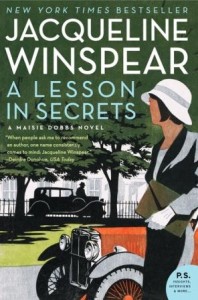
A Lesson in Secrets by Jacqueline Winspear

A Lesson in Secrets by Jacqueline Winspear is the eighth book in the Maisie Dobbs series of cozy mysteries, but can be read as a stand-alone novel.  Set between the end of WWI and the beginnings of WWII, Dobbs is called upon by the British Special Branch to be their eyes and ears inside the College of St. Francis about events that would cause concern to the Crown.  Once installed as a junior lecturer of philosophy, a murder occurs that sets events in motion and tangles Dobbs in yet another mystery.

Dobbs runs her own private investigation agency in London, but she’s called away to a college in Cambridge on special assignment, leaving the office in the capable and reliable hands of Billy Beale.  Beyond the murder mystery and the search for anything that threatens national security, Dobbs is concerned about her father and her friend Sandra, who has just lost her husband in a freak accident.

“She wound down the window and gave a hand signal to indicate that she was pulling over to the side of the road, thus allowing an Austin Seven behind to pass, followed by the motor car that had been shadowing her for at least half an hour.  As soon as they passed, she turned back onto the road again and began to drive as close to the vehicle in front as safety would allow.” (page 3)

Winspear crafts an intricate novel of mystery that resonates with the reader as Dobbs is a strong woman making her way in a man’s world just after the war has ended and women are struggling to maintain their new found freedom.  Dobbs is a strong woman, though scarred, who is intelligent and observant.  Interestingly, Winspear demonstrates how idle gossip can provide just the nugget of information investigators need to close in on a killer.  While Dobbs is kept in the dark about the knowledge held by government officials, she manages to uncover their secrets and those of other government officials who view her as an inconsequential lecturer.

Although there are three or more stories going on at once, Maisie is always central and she juggles so many tasks with ease — almost like she is superhuman.  Pacifism, the treatment of conscientious objectors, and whether someone’s heritage plays a role in their loyalties are just some of the issues addressed in this novel.  A Lesson in Secrets by Jacqueline Winspear raises questions of how much should we idolize our mentors — after all they are just human — and whether we should vilify those that do not see the world in quite the same way that we do.  Moreover, she tackles the power of the written word and its impact on political parties, soldiers, and average citizens, plus how words can inflame already volatile situations.

About the Author:

Jacqueline Winspear was born and raised in the county of Kent, England. Following higher education at the University of London’s Institute of Education, Jacqueline worked in academic publishing, in higher education, and in marketing communications in the UK.

She emigrated to the United States in 1990, and while working in business and as a personal / professional coach, Jacqueline embarked upon a life-long dream to be a writer.  Find out more about Jacqueline at her website, www.jacquelinewinspear.com, and find her on Facebook.

This is my 19th book for the 2012 New Authors Challenge.


This is my 8th book for the WWI Reading Challenge.

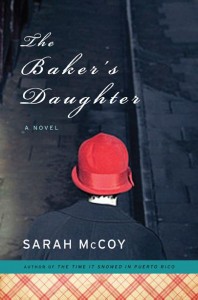
The Baker’s Daughter by Sarah McCoy

The Baker’s Daughter by Sarah McCoy is a novel told in a number of different points of view and spans several time periods, including the final year of World War II.  Two strong female protagonists, each haunted by the past and each past is tied to war in one way or another.

Elsie Schmidt is a German immigrant to El Paso, Texas, who spent the last year of WWII in her father’s bakery working and shying away from the decisions that came with living in Nazi Germany.  Unlike her sister, Hazel, who was in the Lebensborn program and praised for her work to help the Fatherland, Elsie sees herself as more of an outsider, lacking in the standard skills expected of a Good German.

“While Hazel thrived and grew more popular, Elsie felt oppressed and stifled by the uniforms and strict codes of conduct.  So at the tender age of eleven, she begged Mutti to work in the bakery.” (Page 16)

Reba Adams is also an El Paso transplant, but she’s a journalist looking for her latest feel-good piece for the magazine she works for, but she gets more than she bargained for when she meets Elsie.  Meanwhile, she’s hiding from her past and the ghosts of her dead Vietnam veteran father and failing to fully commit to the life she’s created in Texas with her fiance Riki, a border patrol officer.

“Everyone on campus knew her from the photograph in the Daily Cavalier: her lips bulging on the mouth guard; fuzzy, dark hair matted beneath the headgear; gloves up and ready.  They thought she was an anomaly coming from the Adams family.”  (Page 33)

The two different main perspectives in two different time periods is deftly handled by McCoy and each of her characters are strong and stubborn, but neither is lacking in dynamism or flaws.  Also unique to the novel is how well McCoy weaves in the elements of baking and pastry into her description; it is seamless and will make readers’ mouths water and have them itching to try the recipes in the back of the book.  Touching on family loyalty, mother-daughter bonds, father-daughter bonds, relationships of all kinds, plus the search for love and forgiveness, McCoy reaches deep inside the dough to knead the bonds of these women to help them grow outward and inward, allowing them to absorb more love and connections.  The recipe for a successful novel is two parts dynamic characters, one part intriguing plot and story lines, and one part clever writing style, and The Baker’s Daughter provides all the nourishment you’ll need.

Click for Tour Stops

About the Author:

SARAH McCOY is author of the novel, The Time It Snowed in Puerto Rico. She has taught English writing at Old Dominion University and at the University of Texas at El Paso. The daughter of an Army officer, her family was stationed in Germany during her childhood. She calls Virginia home but presently lives with her husband and dog, Gilbert, in El Paso, Texas. The Baker’s Daughter is her second novel. She is currently working on her next.

Website | Blog | Facebook | Twitter

This is my 16th book for the 2012 New Authors Challenge.

Reading with Sarah McCoy, Author of The Baker’s Daughter, at Novel Places

The Baker’s Daughter by Sarah McCoy was published in January 2012 and already has received a number of praising reviews and even one blogger, Anna of Diary of an Eccentric, says that the book will be on her best of 2012 list.  With all of this praise, I’m looking forward to my TLC Book Tour stop in March, but I also wanted to see the author in person.  Who is this woman who has generated so much buzz in the blogosphere with her sophomore book?  (Her first book for those interested was The Time it Snowed in Puerto Rico)  Lucky for me, Novel Places in Clarksburg, Md., was hosting a reading with this author and I could make it with some finagling by me to have the hubby watch “Wiggles.”

I’ve loved the few readings I’ve been to at Novel Places because the store is cozy and the readings are intimate — more like a conversation with a book club and author than a formal reading.  People arrived early to get copies of the book and chat with the author before 7 p.m., and I just sat and listened.  What I learned from the event was that most authors have the same type of personality in that they love listening to their characters in their heads and garnering inspiration from the people and things around them.

The Baker’s Daughter is actually inspired by a German woman whom Sarah met at a farmer’s market once and who told her how she married an American soldier at the end of WWII before coming to the United States.  That was all that was said, and while Sarah has not seen the woman since, it was enough to send her off on a journey of history, relationships, and more, which is all housed in her second book.  Although she says that she will never hand the woman a copy of the book and tell her that she was the inspiration, I think the woman would be happy to know that she touched the author in that way.

Author Sarah McCoy at Novel Places

I love that Sarah brought the red hat from the cover and although she’s too young to be in the Red Hat Society, she agreed to become a Pink Lady.  She was asked about her writing and revision process, which she says is long with journaling about her characters at the start, rather than plot outlines, and about 10-12 rounds of revisions once the first draft is written. Her research process is narrowed by the characters she is inspired to write about, limiting research to a particular year in a particular region or city in Germany for example for The Baker’s Daughter.  She says that otherwise, she would just research too much, get overwhelmed or after 10 years still not have written a book.

Her younger brother also was in attendance and was apparently not only chauffeuring her around to each event while she’s in the area, but also taking photos.  It was obvious from the way she interacted and talked about him and her family that they are all close.  It’s wonderful to see those family connections in person, especially given that her novel touches upon family connections and interactions during some difficult periods in history.

Answering Questions at Novel Places

She talked about her MFA program and her teaching stints in Texas where she now lives with her husband, though she is a former Virginia resident (her parents still live in Fairfax County).  Overall, it was an engaging and conversational event.  She’s affable, delightful, and vivacious, and obviously very outgoing; I think I was in awe of her — too in awe to actually ask any questions, though there were many buzzing in my head.  Perhaps, I’ll get the chance to interview her once I’ve had the chance to read the book and review it here for the blog tour.

Hopefully, I didn’t miss much in the conversation, but that sickness is going around and I think it has finally reached me because my head was feeling awfully foggy.  I’m lucky I remembered my book and Anna’s for Sarah to sign and to talk to her about how much Anna loved the book — by the way, she remembered Anna from that blue cat tattoo icon she uses. . .how cute is that?!

Thanks to Patrick for hosting another AWESOME event!


Additionally, this is a stop on The Literary Road Trip since Sarah McCoy is a former resident of the area and her family still lives here.
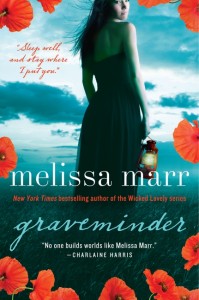
Graveminder by Melissa Marr

Graveminder by Melissa Marr is creepy and mysterious.  Claysville is a town in which its residents are protected, and there is a peculiar bond between the undertakers and the graveminders.  Not sure what a graveminder is? Readers quickly get an inkling of what they do and how they take care of the dead in the town.  Supernatural beings — both good and bad — are afoot in Claysville, and those that leave the town who were born there are often drawn back by an unnatural force.

“Absently, Rebekkah ran her fingertips over the wood of the desk.  Maylene had refused to let any one refinish it, arguing that the pattern of the scratches and wear marks from years of use made it uniquely hers.  Years leave stories written on every surface, she’d said.  The room, Maylene’s bedroom, was filled with stories.”  (page 112)

Rebekkah Barrow is called back home when her grandmother, Maylene, is murdered, and her on-again, off-again love Byron is there by her side as she buries the only family she has left.  Although Rebekkah is not a blood relative, she’s got a bigger job to do now that she’s returned, and Byron has to help her.  Blood relatives are beside themselves with jealousy, like Cissy, or are indifferent to the situation, like Liz.  And the town is full of people who know a lot more than they are willing to speak about aloud.

Marr has an excellent sense of how to create atmosphere; her novel reads like those dark movies where the fog machines are making everything misty and the characters are left bumbling around in the dark, trying to hold onto some sense of normalcy.  Byron and Rebekkah are surrounded by their pasts with one another and their histories with those in the town, but they must set their troubles aside for the good of the town.  Marr is clearly using an allusion to the Faust and his deal with the devil, but in Graveminder, the town has made a pact with the dead.  The body count gets larger and larger as the Undertaker and his Graveminder learn their craft, but the question is, will the pact be broken or will they find themselves broken by the pact that gave them no choice about who they were to become?

Graveminder by Melissa Marr has an interesting set of characters, though Cissy is a bit too much of a caricature and a little too outrageous in her outbursts.  Readers would almost prefer her to be less but more sinister.  Quick paced, and action packed, but the drama between Byron and Rebekkah could have been more subtle.  Readers searching for a book to curl up with and looking for a bit of paranoia with their late night reading should consider a Graveminder for a companion in the wee hours of the morning.

About the Author:

Melissa Marr grew up believing in faeries, ghosts, and various other creatures. After teaching college literature for a decade, she applied her fascination with folklore to writing. Wicked Lovely was her first novel. Currently, Marr lives in the Washington, D.C., area, writes full-time, and still believes in faeries and ghosts.  Check her out on Twitter, the Web, Facebook, and “like” Graveminder.


To see the other stops on the TLC Book Tour, click the TLC Tour Button.


This is my 7th book for the 2012 New Authors Challenge.


Additionally, this is a stop on The Literary Road Trip since Melissa Marr is a Washington, D.C., resident and author.

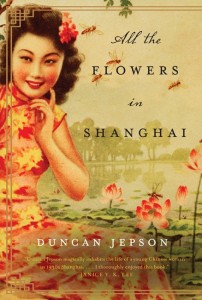
All the Flowers in Shanghai by Duncan Jepson

All the Flowers in Shanghai by Duncan Jepson is set in 1930s Shanghai and is told by Xiao Feng as she writes down her past, beginning with the courting of her beautiful sister who has been spoiled by her parents.  Her mother’s ambitions lie with her sister, and Feng is on the sidelines watching her sister be paraded in front of other families with prominence in society and wonders where their ambitions will lead.  The prose is easy to read and captures attentions easily with its bright colors and very descriptive settings, but in many ways, the characters initially seem cliched with the older sister demonstrating her importance over her younger sister and treating her poorly and the younger sister simply accepting the treatment.  However, this is a story about Feng and her relationship with her grandfather as much as it is about the ambitions and corruption of a family and its members when disappointment strikes.

“I hope that what I have written in these rough pages of cloth will show you how we were so bound to tradition and history that we could not see what was so obvious and that though I have always loved you, I never understood that love is nothing unless it is expressed.”  (page 2 ARC)

Feng is very naive about the world around her and the traditions that families use to live their lives, but some of the fault for that lies with her parents and her grandfather who sheltered her from the obligations of women in Chinese society.  Her parents focused all of their attentions on her sister and her grandfather kept her in the dark about the realities of life and treated her more like a boy who would have any number of opportunities.  Jepson’s story is like many others about Chinese families with a naive young girl thrust into a married life she does not want and does not know how to navigate.  Feng is transformed into First Wife, and as such, she learns to command staff and even her husband as she holds the family’s fate of having a male heir in her hands.

Readers will see a desperate woman who wants to control her own fate by any means necessary, and unfortunately ends up transforming herself into a corrupt woman with little joy and many regrets.  Jepson’s characters are more like caricatures, with the overbearing father-in-law and mother-in-law, the pliable husband with no backbone, and the servant maid who does as her mistress tells her regardless of the consequences.  Jepson loses some of the pizazz of his writing once the bustling city streets and beautiful gardens fade into the background of the secluded Sang house; readers feel cramped inside the large home’s walls, much like Feng does.  In this way, Jepson has created a very specific atmosphere and controlled environment for his characters to navigate.

All the Flowers in Shanghai by Duncan Jepson is an engrossing tale that has been told a number of times, but his story will keep readers turning the pages.  There will be times when they will shout at Feng to grow up and stop being so naive, but at other times they will shake their heads as she makes regretful choices and begins to care about the most superficial things in life, abandoning the girl she once was.  Its a quick read, but there is a lack of depth in characters and the story seems like one that has been told several times.  However, it is entertaining and enjoyable giving readers a glimpse of a changing China.

About the Author:

Duncan Jepson is the award-winning director and producer of five feature films. He has also produced documentaries for Discovery Channel Asia and National Geographic Channel. He was the editor of the Asia-based fashion magazine West East and is a founder and managing editor of the Asia Literary Review. A lawyer by profession, he lives in Hong Kong.

Check out the other stops on the TLC Book Tour by clicking the tour host icon.

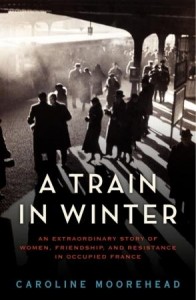
A Train in Winter by Caroline Moorehead

A Train in Winter by Caroline Moorehead strives to shed light on the occupation of France by Germany during World War II and the rise of the French Resistance, particularly the role of women within the resistance.  Of the 230 women who were arrested and sent to Auschwitz in Poland, less than 50 survived, and seven were alive when Moorehead began researching and writing this account of their story.  Impeccably well researched, the book takes readers behind the scenes of the French Resistance, and in many ways the level of detail presented can be overwhelming, especially for those not well acquainted with the ins and outs of the time period.  However, this iteration of facts, times, places, and events serves to demonstrate just how confusing a time the German occupation of France was for those who lived it and sought to overcome it.

“In a rising mood of hostility and mockery, they went around repeating their favourite jokes.  ‘Collaborate with the Germans?’ went one.  ‘Think of Voltaire . . . A true Aryan must be blond like Hitler, slender like Goring, tall like Goebbels, young like Petain, and honest like Laval.’  Another started with the question:  ‘Do you know what happened?’ At 9.20, a Jew killed a German soldier, opened his breast and ate his heart!  Impossible!  For three reasons:  Germans have no hearts.  Jews don’t eat pork.  And at 9.20 everyone is listening to the BBC.'” (page 34 ARC)

Clearly, Moorehead’s forte is in biography and she is deft at handling facts and ensuring that they are well explained in accordance with interrelated events and moments in time, but the text is often dry and tough to remain engaged in.  However, even among these facts, there are pockets of emotion where mothers decide to ship their children to foster families or relatives outside Paris so that they can continue working with the Resistance without endangering the lives of their children.  Still others opt to include their children in the fight to restore a free France.  Moorehead fills in some of the history and familial background in for certain women, but in a way, this litany of facts detracts from the ability of the reader to connect more emotionally to these women.

“Half a litre of black coffee in the morning watery soup at midday, 300 grams of bread — if they were lucky — with either a scrape of margarine, a bit of sausage, cheese or jam at night, was not enough to stop the women’s bodies shrinking and feeding on themselves, the fat disappearing first and then the muscles.  The food never varied.”  (page 203 ARC)

It is not until part two that some readers will become truly engaged in the story as the women are tortured and learn to cope with their sparse surroundings at Auschwitz.  The bravery and solidarity of these women is phenomenal.  Unless readers are willing to wade through the political ins and outs of the early French Resistance and occupation of France and the French police’s collaboration with German occupiers, they may not make it to the more engaging and heart wrenching parts of the story.  Moorehead has chosen to tell a true story and to ensure that those who were present have their say in how that story is told, but it may have served better for the story to focus on just a few of the women from the beginning, allowing them to be the face of the others’ struggles.

A Train in Winter by Caroline Moorehead is a tale of survival that needs to be told and remembered.  As one of the women from the resistance said after having survived cancer longer than expected, “Surviving is something that she is very good at.”  (page 6 ARC)


To visit the other stops on the TLC Book Tour, click the icon on the left.


About the Author:

The author of numerous biographies and works of history, including Gellhorn and Human Cargo, Caroline Moorehead has also written for The Telegraph, The Times, and The Independent. The cofounder of a legal advice center for asylum seekers from Africa, she divides her time between England and Italy.


This is my 74th book for the 2011 New Authors Reading Challenge.

Camp Nine by Vivienne Schiffer

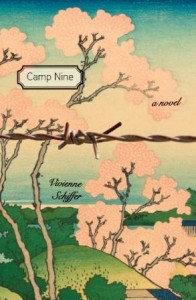
Camp Nine by Vivienne Schiffer is told from the point of view of Cecilia “Chess” Morton as she looks back on her time in Desha County, Arkansas, during the late 1940s when Camp Nine was erected near her childhood home.  As a child, she grew up without a father, but she had a mother who doted on her, though she often butts heads with Chess’ grandfather, who owned half, if not more, of the town, Rook.  Her grandfather controlled much of Chess’ land inheritance and sold a good portion of land, which he deemed useless, to the government for Camp Nine, which he was told would hold German prisoners of war captured during WWII, which was in full swing at the time the story takes place.

Chess is a curious child, but often her inquisitiveness gets shut down by the adults around her who dismiss her desire to know about her family, particularly the feud between her mother and Mr. Ryfle, who tends the grandfather’s land and often makes empty promises about helping Chess’ mother plant her land.  There is a great deal of mystery in the early stages of the novel, including her mother’s past in California and why Camp Nine is being used to house Japanese Americans.  Chess also laments the unspoken code of behavior expected of Blacks, like Ruby Jean who helped raise Chess’ mother.

“‘That river over there is the mightiest river in the world.  It wouldn’t do for there to be just any dirt around here.  The dirt here must have its own strong personality.  It won’t back down to the river.  It won’t back down to men.  You have to understand it and work with it.  Not against it.'”  (Page 121)

Schiffer crafts a narrative that stands apart from other accounts of WWII as it seeks to inject emotion into a situation that many Americans were removed from by hundreds of miles or more.  WWII was fought on distant shores, but its effects were devastating to Americans who soon became objects of suspicion.  However, this story is not just about the internment of Japanese Americans, but of the impact their internment had on the small towns in which their camps were built — kicking up racism and exacerbating classism.  In many ways, Schiffer has developed the setting into an additional character given that its bisected into two halves by the railroad tracks, with the enemy on one side and the townspeople on the other.

Chess’ mother is more progressive than other residents of Rook, but her ideas and actions have farther reaching consequences than she expects.  Schiffer’s characters are engaging and real, and set against the backdrop of this tumultuous time, a young girl is growing into adulthood and realizing that the world is vastly more complicated than she expected.  Camp Nine is captivating and raises questions about perception:  What we think of ourselves when faced with family secrets?  How we’d react in the face of injustice?

I’d consider this similar to Tallgrass by Sandra Dallas.

About the Author:

Vivienne Schiffer grew up in the Arkansas Delta town of Rohwer, site of the Rohwer Relocation Center, on which Camp Nine is based. She is an attorney and has practiced law for twenty-eight years in Houston, where she lives with her husband Paul and their family. Schiffer is currently at work on her second novel.

To visit the other stops on the TLC Book Tour, please click the icon at the right.

This is my 68th book for the 2011 New Authors Reading Challenge.

The Conference of the Birds by Peter Sis

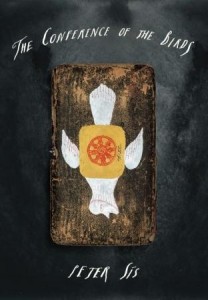
The Conference of the Birds by Peter Sis, an acclaimed children’s author and illustrator, has taken his skills to a 12th century Sufi epic poem of the same name written by Farid ud-Din Attar, who was not only a poet but a mystic.  Often these types of poems have a hidden spiritual meaning, and Sis deftly captures the essence of Attar’s poem with illustration.

In this illustrated version of the epic poem, the pictures speak for the poet, Attar who wakes from a dream to realize he’s a hoopoe bird.  Once he transforms, he calls all of the birds of the world together to find their true king, Simorgh, by flying through the seven valleys — The Valley Of Quest, The Valley Of Love, The Valley Of Understanding, The Valley Of Detachment, The Valley Of Unity, The Valley Of Amazement, and The Valley Of Death — to reach Mountain Kaf.

In the beginning, the transformation of Attar is shown much like animated cartoons would have been created, with the flipping of each panel where each image has slight differences to create the illusion of movement.  Once the birds agree to take the journey, it is clear that it will take them through a number of valleys that will test their resolve, with each bird’s skills and weaknesses hammered by adversity and uncertainty.  Sis creates vivid birds of various colors and species.  Even if the pages of this book were not textured, readers could see the feathers and layers on these birds.

And there are many layers to these birds, their feathers, and their story.  The poem sheds light on the inner spiritual journey each of us travels, the trials that we face, and the perseverance it takes to stay on course and believe in ourselves.  For some the journey is too hard, and they turn back, but for others, it is important enough to move onward despite the risks and sorrow.  Like the poem, The Conference of the Birds by Peter Sis is multilayered, with great attention to detail from the feathers on the birds, the birds making up the larger birds, and the trees that create the mountains.  A gem of a book from an illustrator and writer who sees beyond just the words to the world it creates and the messages it brings.  Likely to be on the best of list for the year.

As an aside, I read this a couple of times carefully and with my infant daughter. She loved feeling the pages and looking at the vivid imagery, and I can tell you that keeping her attention for an entire book is difficult. This is great for kids and adults. Sis has created something of lasting beauty.

About the Author:

Born in Brno, in the former Czechoslovakia, in 1949, Peter Sís is an internationally acclaimed illustrator, author, and filmmaker. Most recently, in 2007, he published The Wall: Growing Up Behind the Iron Curtain, which was awarded the Robert F. Sibert Medal and was also named a Caldecott Honor Book. Peter Sís was named a MacArthur Fellow in 2003. He is the author of twenty children’s books and a seven-time winner of the The New York Times Book Review Best Illustrated Book of the Year.  Please check out his Web page.

Please check out this video interview from BEA:

According to the Seattle Post-Intelligencer, Sis pays homage to traditional Islamic art and its figurative representations and geometric patterns as the valleys are depicted as a series of mazes.  (Seriously, read that review, it is stunning).


If you’d like to check out the rest of the tour, please click on the TLC Book Tour icon at the right.


This is my 29th book for the Fearless Poetry Exploration Reading Challenge.


This is my 66th book for the 2011 New Authors Reading Challenge.