Quantcast

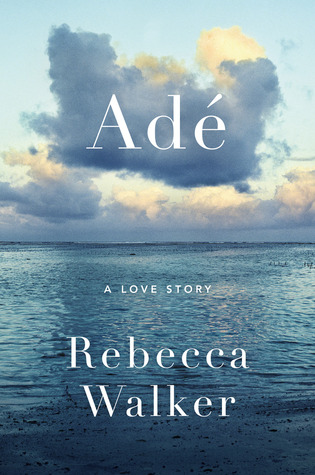
Adé: A Love Story by Rebecca Walker

Source: TLC Book Tours and New Harvest
Hardcover, 128 pages
I am an Amazon Affiliate

Adé: A Love Story by Rebecca Walker reads like a memoir, but it is fiction.  A young, American woman who has felt unmoored since her parents’ divorce, even at an Ivy League school until she falls into the web of Miriam, a free-spirited twenty-something whose eager to lose herself in the passions of others, particularly by having sex with men.  At the end of the school year, she and Miriam decide to see the “real” Africa and Middle East, traveling first to Egypt and slowly moving into more southern territories.  While Walker’s novella is considered a love story, it is far from overtly romantic, and it is more a search for identity, an identity that is strong and unwavering.  This nineteen-year-old, who later becomes known as Farida, is searching, always searching and consciously taking note of her place in the world.

“I was nineteen years old to Miriam’s twenty-one.  I felt raw and unfinished, where she seemed complete and self-assured.  I was a child of divorce and felt like I came from a thousand places — each one holding a little piece of me, and I drifted among them with no way to gather them up.  Miriam was from just one place, Miami, and more specifically, the moneyed enclave of Coconut Grove.” (page 4)

As they are touring Egypt, both young women are searching for something more authentic in their experience, rather than the tourist traps of Cairo and Giza, where Walker’s prose refers to tourists as flies around a plate of food.  Just from these early moments and descriptions, the reader can garner a sense that Farida is still searching for a home, a place where she not only feels worthy but safe and loved.  These tourist traps are not what she has come for her, with her “copper-colored” skin and “brown eyes the shape of almonds.”  As the narrative shifts away from Farida and Miriam’s experiences and becomes more focused on Farida’s alone, the reader gets a sense that something has shifted in the narrative — something more serious has come.

Even after she meets Adé, a Swahili Muslim from the Kenyan island of Lamu, Farida has succumbed to the feeling of belonging in these nations’ she’s visited, with their small villages and welcoming people.  Their romance is slow, and yet fast.  They begin with meetings at night after he works and walks throughout the town, then things heat up even faster after she reveals her passion for him.  Although this relationship blooms quickly and breaks her away from the past she’s known in America, her sensibilities have never strayed too far outside those democratic principles, and it is those principles that sets her apart in a world she’s come to think of as her own. Adé: A Love Story by Rebecca Walker is not a traditional story of love between a man and a woman, but of finding the love that can lift you up, complete you, and make you stronger even in the most adverse circumstances — and there are plenty of those here as the Persian Gulf War begins in the background.
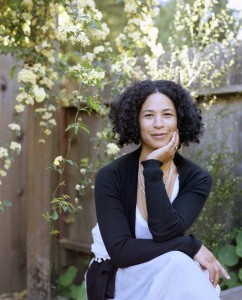
About the Author:

Rebecca Walker is the author of the best-selling memoirs Black, White and Jewish and Baby Love, and editor of the anthology Black Cool. She is also the editor of the anthologies To Be Real, What Makes a Man, and One Big Happy Family. Her writing has appeared in Bookforum,  Newsweek, Glamour, Marie Claire, The Washington Post, Vibe, and Interview, among many other publications, and she blogs regularly for The Root. For more information, please visit her Website and follow her on Twitter.


ENTER to win 1 copy of Rebecca Walker’s Adé: A Love Story by leaving a comment below by Nov. 18, 2013, at 11:59 p.m.
This is my 77th book for the 2013 New Authors Challenge.

Sense & Sensibiliy by Joanna Trollope

Source: TLC Book Tours and Harper
Hardcover, 368 pages
I am an Amazon Affiliate

Sense & Sensibility by Joanna Trollope is the first of the books in Harper’s Austen Project in which six bestselling contemporary authors use Jane Austen’s famous novels as a basis for their own modern versions.  With so many modern day versions, spin-offs, and continuations of Austen’s classic books, the expectations for the project are likely high, but this first rendition is a mixed bag.  While sticking very close to the original plots, Trollope’s main contribution to the original is an exaggeration of the characters — Elinor has too much sense (even more than Austen’s version) and Marianne is overly dramatic at every turn — and the introduction of modern technology, like Twitter, YouTube, iPods, and Facebook.  Although the exaggerated characters could be considered parody in a way, in some scenes they come off as merely annoying.

“It had been made plain to Sir John, from a young age, that the luxury of making choices in life simply did not exist without money.  Money was not an evil.” (page 42 ARC)

The social conventions of Austen’s time continue to play a role here, with characters motivated to find matches with money because without them, they will be destitute.  But in this modern society, it is hard to see that women would have just this option open to them, unless they are as shallow as Lucy Steele.  In fact, Elinor takes a job, at least part time until she completes her degree, but most everyone else seems content to sponge off their richer relatives, without much gratitude — though with relatives like these, it would be hard to muster gratitude.  Trollope clearly understands the foils that Marianne and Elinor play in the novel, and her exaggerations of their character in a modern society of social media may seem a bit much, but for young women constantly surrounded by their faults and mistakes, it might be believable.  Elinor, here, seems to represent a need in society for privacy, a greater need than society seems willing to allow unless people completely withdraw from society.  She’s strong, but at the same time, she’s vulnerable, as she pines for Edward.

Trollope has done a superb job with the youngest sister, Margaret, a young girl struggling with her emotions after her father’s death, being pushed out of the only home she’s ever known (Norland), and moving to a new school without her friends.  Bill Brandon is still reserved and quietly watching in the background, still considered boring by Marianne, and still caring, but there is a dynamic Trollope adds that will have readers cheering for something that was not in the original.  Meanwhile, John “Wills” Willoughby is even more dastardly in Trollope’s novel, yet he is still partially redeemable if you can buy that marrying for money is still a motivator in society, which it might still be among the more wealthy families.  Sense & Sensibility by Joanna Trollope is more focused on the excess in modern society as seen through her take on Marianne, Margaret, Elinor and the other characters, which can be extrapolated from their reactions to events and relationships.  Although readers would expect a more cohesive melding of the modern world with Austen, Trollope has created a new commentary on society that applies more easily to the modern world’s emphasis on excess and self-promotion.

About the Author:

Joanna Trollope is the #1 bestselling author of eighteen novels, including The Soldier’s Wife, Daughters-in-Law, Friday Nights, The Other Family, Marrying the Mistress, and The Rector’s Wife. Her works have been translated into more than twenty-five languages and several have been adapted for television. She was appointed to the Order of the British Empire in 1996 for her services to literature, and served as the Chair of Judges for the Orange Prize for Fiction 2012. She lives in London and Gloucestershire.  Find out more about Joanna on her website.  Photo credit: Barker Evans.

This is my 74th book for the 2013 New Authors Challenge.

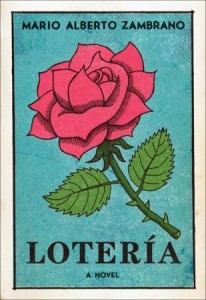
Lotería by Mario Alberto Zambrano

Source: TLC Book Tours and Harper
Hardcover, 288 pages
I am an Amazon Affiliate

Lotería by Mario Alberto Zambrano is an imaginative coming-of-age story for eleven-year-old Luz Castillo that uses the cards from a Mexican game that resembles American bingo.  Each card can be covered in the game once the riddle is called and the players know what card it is based on the riddle, and each card is placed in a tablas in any order or in a standard order.  Like the game, Luz unwinds her memories just before a tragic event lands her in a center and her father arrested.  As she turns the cards over, a memory is triggered, and she writes it down in her journal at the behest of her auntie Tencha.  Like any child traumatized by a startling event, Luz’s memories do not follow any kind of straightforward timeline, but they do reveal a great deal about her family’s immigration, ties to Mexico, and adjustment in America.

“And because quiero can mean either want or love, I asked if it meant “I want you” or “I love you.”  Come here, because I love you,or, come here, because I want you? If you were saying to someone, come to me, then the person you loved wasn’t there, and if you had to tell someone to come to you then maybe he didn’t love you.  And to want someone to come to you is like an order.  If you have to order someone to come to you, how much love is in that anyway?”  (page 13 ARC)

Like the journal entries, Luz’s family life is complex and multilayered with her older sister, Estrella, having been born in Mexico and knowing to smoothly speak Spanish, while Luz is a natural born American who is self-conscious about speaking Spanish aloud even though she knows what those around her say.  While there are moments in this novel when Luz has more adult thoughts, the experiences she has at home with her parents always fighting and her cousins taking advantage of her youth when she visits in Mexico, it is clear that she is mature beyond her years and has given a great deal of thought to her life experiences.

Peppering the story with Spanish words, the meaning of which can be mostly gleaned from the context of the story, Zambrano has crafted a puzzle that will spur readers to keep reading and take the journey with Luz as she uncovers the memories she’s tried to forget about her family.  While Luz has grown up in a typically male-oriented household, it is clear that America has had an influence on the family as her mother takes a job outside the home and never cowers behind her skirts when her husband is out of control with drink.  Despite the hardships, Luz has faced, she still remains optimistic and open to the possibilities of a better life, as she speaks to God in her journal entries about her past and her own confusion and feelings.

Lotería by Mario Alberto Zambrano is well-crafted, stunning, and highly recommended.  It brings to light the horrors of familial dysfunction, abuse, and general family discord through the eyes of a mature child, who strives to cope with it all in the best way possible.  Not only does it highlight the transition of a family from life in Mexico to one in America — with its opportunities and disappointments — but it also examines the dichotomy of family relationships that produce both love and hate.  Zambrano is an author to watch for.

About the Author:

Mario Alberto Zambrano was a Riggio Honors Fellow at the New School and recently completed his MFA at the Iowa Writers’ Workshop as an Iowa Arts Fellow. He is a recipient of the John C. Schupes Fellowship for Excellence in Fiction. Lotería is his first novel.

Find out more about Mario at his Website and connect with him on Facebook.

This is my 46th book for the 2013 New Authors Challenge.

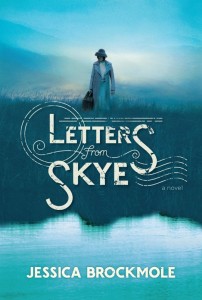
Letters From Skye by Jessica Brockmole

Source: TLC Book Tours and Random House
Hardcover, 304 pages
I am an Amazon Affiliate

Letters from Skye by Jessica Brockmole, an epistolary novel that straddles two World Wars, is about falling in love, finding your soul mate, and poetry.  Elspeth Dunn, a Scottish poet on the Isle of Skye, lives a rather cloistered life on her island but one of her books makes its way across the Atlantic to a young man in Illinois, David Graham, who writes her a fan letter.  Over the course of several years beginning when WWI breaks out in Europe, Elspeth and David begin a correspondence that takes on a life of its own.

“It’s the war talking.  I know; I’ve seen it.  They head off, invincible, feeling as if the future is a golden pool before them, ready to dive into.  And then something happens — a bomb, a sprained wrist, a bullet that whizzes by too close for comfort — and suddenly they are grabbing for whatever they can hold on to.  That golden pool, it swirls around them, and they worry they might drown if they’re not careful.  They hold tight and make whatever promise comes to mind.  You can’t believe anything said in wartime.  Emotions are as fleeting as a quiet night.”  (page 33 ARC)

While David is in America struggling through college and hoping to subvert his father’s plans for medical school, Elspeth is busy writing poetry and becoming even more entrenched in the lines her muse is offering.  Her relationship with her brother Finlay is the closest she has, but war does change things.  The more her muse speaks, the more she’s pulled away from the life she’s always known and the more she is challenged to face her fears — including her fear of water.

Through Elspeth and David’s correspondence the wider impact of war is experienced, complete with the tension of the home front as wives and families wait for their loved ones.  But at the same time, the lives of women are broadening as they are able to enter into jobs once thought of as men’s work.  The feminist leanings of Elspeth are clearly front and center in some of her correspondence with David, but it never deters him in his pursuit of her.  The moral high ground has no place in this romantic jaunt across Scotland, London, and France as a young woman and man succumb to their emotional connection on the page.

Letters from Skye by Jessica Brockmole weaves Elspeth and David’s story with that of Margaret, Elspeth’s daughter, and her search for the past.  Margaret has never met her father, and her mother remains close-lipped about her past and her daughter’s father.  But when WWII begins to break out, all of the old transgressions and emotional upheaval of Elspeth’s past resurfaces, threatening to leave her unmoored once again.  But Margaret’s life is far from pristine when it comes to the tentacles of war as her fiance flies for the RAF.  Brockmole’s letters are frank, honest, and engaging as these relationships unfold and enfold, creating a family history that will be hard to forget.  And yes, there is a poem included!

About the Author:

Jessica Brockmole spent several years living in Scotland, where she knew too well the challenges in maintaining relationships from a distance. She plotted her first novel on a long drive from the Isle of Skye to Edinburgh. She now lives in Indiana with her husband and two children.

To learn more about Jessica and her work, visit her Website.

To WIN a copy of this book, leave a comment by July 19, 2013, at 11:59 PM EST; You must be a U.S. resident 18 years and older.

This is my 44th book for the 2013 New Authors Challenge.

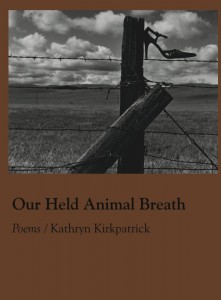
Our Held Animal Breath by Kathryn Kirkpatrick

Source: Wordtech Communications and TLC Book Tours
Paperback, 96 pages
I am an Amazon Affiliate

Our Held Animal Breath by Kathryn Kirkpatrick is a slim volume of poetry that is broken into three sections.  Although there is a deep sense of anger and hurt over current events and the rape of the world by humanity, many of these poems also have a personal side to them — deep personal losses of friends and family.  At times, the narrator is baffled at how some things come to be, like in “Millennium” where the narrator is left with an altar in a room flooded with light.  “How did I come by this altar,/these windows of stained glass?/When I meet the fox again,/I set her free./The meadow she finds/is neither desert nor glacier.”  (page 11)

Kirkpatrick wonders about the connections between humans and nature, particularly animals.  She postulates in “At the Turkey Farm” whether we absorb the loneliness and longing of turkeys when we eat them during holidays, but at the same time she talks about their only solace as being able to stand in the fading light in their own poop.  At the heart of the poem, the narrator is exploring the existence of these animals as walking corpses and ghosts haunting the farms but not really living.  In a way the poem itself is haunting, forcing readers to contemplate these farms where animals are bred to be something other than themselves, serving mostly as food.

Strange Meeting (page 22-3)

Is this how an animal feels
on the other side of a human eye?

I was a woman speaking
to men I didn’t know.

Large and strong, they
knew about power
in ways I may never

I sat framed and assessed
no threat a square jaw decided
negligible bent knuckles said

I looked back through my animal
eye, saw

the slit throat of the cow
in the leather shoe

the poisons deep in the soil
where the cotton grew

the felled trees
of the papers stacked

the mountains leveled
in the electric hum of light and heat
where we sat.

I saw clearly
all they had done and would do
to make a world we’d be losing fast.

I saw why it was lost.
And I saw how we would lose it.

In some poems, Kirkpatrick weaves in the teachings of Buddhism, but in some instances, those teachings cannot stop the suffering. “After Zazen” explores the many forms of suffering facing humanity, including accidental swallowing of stones to cause near suffocation and death and the invasion of one country into another. Raising questions about suffering on many fronts, the narrators are searching for ways to end it or at least ease the pain. Meditation may not be the best solution or it could be. Beyond these moments of suffering, the narrator blur the lines between animal and human to find the similarities of feelings and behaviors, but to also outline the loyalties that have been forgotten, like that of a dog and master. Perhaps that loyalty should be expanded to include other aspects of nature.

Our Held Animal Breath by Kathryn Kirkpatrick offers a wide range of poems for discussion in book clubs, focused on the impact of human activity on the environment and the changes that are possible if we just think outside the box.  What are the ways that we can brainstorm to feed ourselves and continue to live and grow without harming other animals and nature.  While the brown of the cover is a bit off-putting; the shoe seems out of place on the wire fence, though that may be on purpose given the sometimes out of place nature of our own existence in the world.

About the Poet:

Raised in the nomadic subculture of the U.S. military, Kathryn Kirkpatrick was born in Columbia, South Carolina, and grew up in the Phillipines, Germany, Texas and the Carolinas.  Today she lives with her husband, Will, and their two shelties in the Blue Ridge Mountains of North Carolina, and she currently holds a dual appointment at Appalachian State University as a Professor in the English Department and the Sustainable Development Program. She has a Ph.D. in Interdisciplinary Studies from Emory University, where she received an Academy of American Poets poetry prize.

Giveaway:  1 copy of Our Held Animal Breath

Want to win a copy of her book?  Leave a comment below with an email

I’ll contact the randomly drawn winner, who must be age 18 or older and live in US or Canada as the publisher is sponsoring the giveaway.  Deadline to enter is June 17, 2013 at 11:59 PM EST

This is my 23rd book for the Dive Into Poetry Challenge 2013.


This is my 35th book for the 2013 New Authors Challenge.

Maya’s Notebook by Isabel Allende

Book Source: HarperCollins and TLC Book Tours
Hardcover: 400 pgs
I am an Affiliate of Amazon.com

Maya’s Notebook by Isabel Allende is written in a notebook form without chapter breakdowns and is not a linear narrative.  Maya Vidal is a very troubled youth when tragedy strikes her very unconventional family of her pilot father who is rarely home, her grandparents Nidia and Popo, her absent mother Marta Otter, and the family friend Mike O’Kelly.  The novel is a departure from Allende’s typical historical fiction novels, but do not expect history to be absent from this coming-of-age novel — the takeover of Chile by Pinochet is present in the background, hanging over the Vidal family like a hazy cloud.  From her nose ring and tattoos to her goth clothes, Maya and her vampire friends set out on a path of self-destruction as a way to rebel against their family lives that they claim are very distasteful and harmful.  However, unlike Debbie and Sarah, Maya’s life is far from abusive and emotionally vacant, though it has changed significantly.

“I love some of the island’s customs, like truco, but there are others that bug me.  If a chucao, a tiny loudmouthed bird, chirps to the left of me, it’s bad luck, so I should take off a piece of clothing and put it back on inside out before going any farther; if I’m walking at night, I’m supposed to carry a clean knife and salt, because if I cross paths with a black dog with one ear lopped off, that’s a brujo, and in order to get away I have to trace a cross in the air with the knife and scatter salt.”  (Page 47 ARC)

Allende is a novelist that handles details with aplomb, weaving them in the disjointed narrative at just the right time, leading readers on an emotional journey that evokes not only frustration at Maya’s behavior, but also one of sympathy and sadness for the losses she feels.  She needs to hit rock bottom in order to climb up and rebuild her life, even though she falls off a high cliff into the abyss of drug dealers, mafia criminals, and the sex trade.  Allende does not sugarcoat anything that Maya experiences in her rehab stints or her escapes and drop off the map inside Las Vegas.  Unwittingly or willfully blind, Maya stumbles into a crime ring that is bigger than she ever thought it could be and it puts her life and the lives of her loved ones in danger as she never could have imagined. However, the end game with the conspiracy feels a bit contrived.

Maya’s past is never far behind, even as her life spirals out of control, chirping behind her ear at every turn.  Running is the only way she knows how to deal with her emotions, and its the way her family has dealt with the harsh struggles of their lives since the time of Pinochet. The ties that bind this family are stronger than ever, even as dynamics change between them and secrets of the past are uncovered. Love is the strongest tie, but fear also can be a great motivator as the walls close in. Maya’s Notebook by Isabel Allende is a modern marvel that will make a lasting impression on readers as a headstrong girl becomes unmoored and is forced to not only confront her own demons but the ghosts of the past.

About the Author:

Born in Peru and raised in Chile, Isabel Allende is the author of many bestselling novels, including, most recently, Island Beneath the SeaInes of My Soul, Zorro, Portrait in Sepia, and Daughter of Fortune. She has also written a collection of stories; three memoirs, The Sum of Our Days, My Invented Country, and Paula; and a trilogy of young adult novels. Her books have been translated into more than 27 languages and have become bestsellers across four continents. In 2004 she was inducted into the American Academy of Arts and Letters. Allende lives in California.  Find out more about Allende, her books, and her foundation at www.isabelallende.com, and connect with her on Facebook.

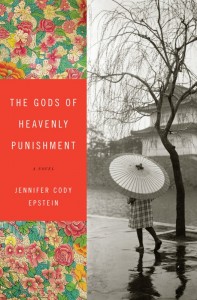
The Gods of Heavenly Punishment by Jennifer Cody Epstein

The Gods of Heavenly Punishment by Jennifer Cody Epstein chronicles Yoshi Kobayashi’s life before, during, and after WWII, with a particular emphasis on the Tokyo fire bombings that preceded the atomic bombings of Hiroshima and Nagasaki.  Billy Reynolds, whose family lives in Tokyo before the war, is a sensitive young boy who loves his new camera, and adores taking photos of Yoshi, family, friends, and more.  Cam Richards and Lacy Robertson are American college students who meet and quickly fall in love just as war is about to break out between America and Japan after Pearl Harbor, and their lives are torn apart by the war.  But ultimately, Epstein’s novel is about Yoshi and how the war tore apart a flourishing culture that once embraced American capitalism.

Not only will readers get an in-depth look at Tokyo before, during, and after the war, but they also see how war impacts not only Americans who once lived in Japan, but also those who were married to those who flew to avenge the deaths of so many in Hawaii.  Initially, readers will be duped into thinking Cam Richards and Lacy Robertson are the main protagonists — a testament to her ability to get readers to care even about secondary characters — but Yoshi is the heroine here, though there are big gaps in time that are not explored, which can leave a reader wanting more.  There is a moment near the end in particular when readers will wonder how Yoshi ends up playing piano at The American Club after the war when they last left her getting into a boat with an older man after the fire bombings, heading away from Tokyo.

“Almost by reflex Cam released the brakes and started to roll.  And then they were racing down that slippery white line, his heart pounding with the rhythmic throbbing of the twin Cyclones.  The dungaree blue of the sailors’ uniforms and the dirty gray of the ship’s island bled together as the Blonde Bombshell picked up speed.  As they passed by the signal officer (now safely flattened against the deck), Cam pulled on the yoke so hard that he felt his elbows crack, and saw the sky lunge towards him like a wet concrete wall.  They hit the ship’s edge in the after-trough of another white-topped crest, and as his plane’s nose plunged towards the water Cam’s gut plunged right along with it.”  (page 79)

Epstein is a phenomenal writer.  She captures intense moments so well, that it places the reader there with the characters.  Yoshi is a precocious young girl learning three languages thanks to her continental mother, but unfortunately, she’s held a little back by her attachment to her mother and her father’s old world conceptions of women in society.  She sees her father’s love of the new paradise, Manchuria, as a possible solution to her escape, until she learns the truth about her father’s work there.  When she heads back home, she throws herself into the national effort for the war, hoping that she can escape the disintegrating world around her in which her mother slips more and more each day.  The Gods of Heavenly Punishment by Jennifer Cody Epstein is about the outside forces that shape who we are depending on how strong we are on the inside and our ability to make our way out of the darkness into the light.

About the Author:

Jennifer Cody Epstein is the author of The Gods of Heavenly Punishment and the international bestseller The Painter from Shanghai. She has written for The Wall Street Journal, The Asian Wall Street Journal, Self, Mademoiselle and NBC, and has worked in Hong Kong, Japan and Bangkok, Thailand. Jennifer lives in Brooklyn, NY with her husband, two daughters and especially needy Springer Spaniel. To connect with Jennifer, “like” her on Facebook.

Pain, Parties, Work: Sylvia Plath in New York, Summer 1953 by Elizabeth Winder

Pain, Parties, Work: Sylvia Plath in New York, Summer 1953 by Elizabeth Winder is atmospheric and an indulgent retrospective of the lives of Mademoiselle‘s summer guest editors, who were hand picked from a bunch of college essays and pieces submitted by college women.  The magazine was not only known for its fashion and celebrities, but also for the writing it published from heavyweights like Dylan Thomas and Truman Capote.  Additionally, the magazine published its college issue.  “Sunday at the Mintons” by Sylvia Plath, a short story, earned her a guest editorship at the magazine, a summer that became the basis of her novel, The Bell Jar.  Winder bases her “loose” biography on interviews with those summer guest editors and others who had contact with Plath that summer, which are backed up by letters and journal entries from Plath herself as much as possible — though there is the pitfall that some memories may be nostalgic or missing certain truths about that time as memories fade.

From the moment she sets forth in New York, readers are introduced to a different Sylvia Plath from the moody and dark one they have come to know. This younger version of the writer is full of whimsy, loves fashion, and is eager to please.  Her Northeast upbringing probably instilled in her a deep sense of courteousness and decorum, but there were also inherent eccentricities already present in her character, especially during one luncheon in which she gobbles up all of the caviar appetizer without sharing.  A commune of young women was built at the Barbizon Hotel that summer, as many of the young women wanted careers and still to raise families in a period of history before the pill was available and before career women were considered part of the norm.

“A white enameled bowl bloomed out of one wall–useful for washing out white cotton gloves.  (Within days there would be little damp gloves hanging in each room like tiny white flags.)” (page 5 ARC)

While Winder provides a great many anecdotes about Sylvia from her fellow guest editors and roommates, there seems to be a disconnect between the Sylvia these women saw and the Sylvia that was.  At the outset, Winder tells the reader she wants to paint a different portrait of Sylvia Plath than the iconic one we all know of the suicidal poet.  And while she succeeds in showing a “good girl” that was Plath in her 20s, she also demonstrates how as a young woman free from the constraints of her own society, she was given more freedom to pursue men and other experiences, to which she might not otherwise have been exposed.  And like many young women — and even men — still finding their place in the world and how to accomplish their goals, they often suffer from the “grass is always greener” problem when the reality of their ideal opportunity is not as wonderful as it has seemed from afar.

There were some among the guest editors in 1953 who were given menial tasks and envied Plath’s work with Cyrilly Abels doing rejections and editorial work, but Plath languished in the role and her talents for graphics were cast aside in favor of her fiction-writing talents.  In many ways, those who believed in her talent had begun to stifle it.  While she may have looked the part of a professional interviewer and editor, Plath was chained to a makeshift desk that anchored down her spirit, while many of the other girls were enjoying their time as editors — meeting Plath’s hero writers and attending dinners and events.  It seems that this separation isolated her from the other guest editors, even though on the outside she was conversing with them and enjoying their company as well as the company of many strange men throughout New York.

It is too easy to suggest that Pain, Parties, Work: Sylvia Plath in New York, Summer 1953 by Elizabeth Winder aims to undo the iconic woman that is Sylvia Plath, but it does provide a wider view of her whole person.  Not just the mother, burdened artist, and ex-wife of Ted Hughes, but the spirited poet who was stifled by a dream job that she saw as a launching point who succumbed to her tendency to depression upon her return home after a series of unrelated rejections flooded in after that summer.  Plath was a woman plagued by her own dichotomies, who was unable to break free from the labels of society without the guilt that accompanied those actions, but she also was talented and burned brighter than many other women of her age.  What Winder succeeds in doing is providing an excellent look into 1950s New York and the pressures these young women faced as progressive ideals began to emerge.

About the Author:

Elizabeth Winder is also the author of a poetry collection. Her work has appeared in the Chicago Review, the Antioch Review, American Letters, and other publications. She is a graduate of the College of William and Mary and earned an MFA in creative writing from George Mason University.

This is my 20th book for the 2013 New Authors Challenge.


Please click the image below for today’s National Poetry Month Tour Post!

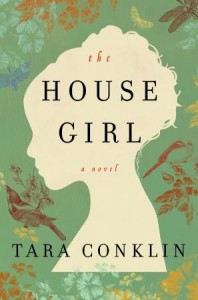
The House Girl by Tara Conklin

The House Girl by Tara Conklin is told mainly from two female points of view — Lina Sparrow and Josephine Bell — one is a white lawyer in New York City at a corporate law firm and the other is a slave/house girl in the southern Lynnhurst, Virginia.  Lina has lived with her artistic father most of her life as her artistic mother’s life was cut short.  Her story is compelling as she’s chosen the analytical and detached life of a lawyer over that of the emotional and less practical life of an artist.  Josephine, an equally if not more compelling story, is a slave on a tobacco farm caring for her dying mistress, who tries to sketch and paint in her upstairs studio.

“Mister hit Josephine with the palm of his hand across her left cheek and it was then she knew she would run.  She heard the whistle of the blow, felt the sting of skin against skin, her head spun and she was looking back over her right shoulder, down to the fields where the few men Mister had left were working the tobacco.”  (page 3 ARC)

Lina is a first-year associate at her law firm, and she works a mad number of hours as she tries to impress her boss and mentor, Dan, but at the same time, she seems to be beating her head against a wall.  There are some tenuous connections drawn between these two stories, the oppressive nature of working for a law firm and slavery, which may or may not be a fair comparison.  The narrative shifts from Josephine to Lina and between the past and present, and once Lina becomes involved with a slavery reparations case, she is wrapped up in innocuous research while all of her other cases are re-assigned.  She’s struggling with her role on the case, but also with the revelations about her mother and her father that have set her world askew.

“She couldn’t bear the thought of sharing.  This was where her mother had once slept, cooked, painted, breathed, and Lina’s memories of her seemed tethered to the physical space.  The way a wall curved away, a washboard of light thrown by the sun against the bare floor, the sharp clap of a kitchen drawer slamming shut — all these evoked flashes of her mother and early childhood that seemed cast in butter, soft and dreamy, lovely, rich.”  (page 21 ARC)

In the latter part of the novel, Lina comes across a biography of an abolitionist as she’s researching the life of Josephine Bell, but this section is overly long and could have been slimmed down a bit as Lina learns about the abolitionist’s connection to the Underground Railroad.  The strength of the novel is in Josephine’s story and her struggles with the Bell family, with her only release — the snatches of time she has to sketch and paint when her mistress is laid up in bed or asleep.  The mysterious life of Josephine is revealed in quick chapters, but early on these chapters are too focused on her desire to run and whether she should run.

In many ways, Lina’s story detracts from the whole, pulling readers into the present and into a case that seems more fantasy than reality.  However, Lina’s story with her father and mother — and the art world — is strong and could have been explored in a separate novel.  The artistic connection, more than the slavery reparations case, would have been a better angle for these stories, connecting the artists to one another through their craft and inspiration or something of that nature.

The House Girl by Tara Conklin showcases not only Conklin’s grasp of the Antebellum South, but also art and its craft.  The strongest parts of Lina’s story are those in her father’s art studio and in the galleries as the paintings are described and the ties between Josephine Bell and Lu Anne Bell are revealed.  Once the novel picks up speed, its tough to put down, and Conklin easily portrays the culture and atmosphere of the southern farm and the fear slaves felt daily.

About the Author:

Tara Conklin has worked as a litigator in the New York and London offices of a major corporate law firm but now devotes her time to writing fiction. She received a BA in history from Yale University, a JD from New York University School of Law, and a Master of Law and Diplomacy from the Fletcher School (Tufts University). Tara Conklin’s short fiction has appeared in the Bristol Prize Anthology and Pangea: An Anthology of Stories from Around the Globe. Born in St. Croix, she grew up in Massachusetts and now lives with her family in Seattle, Washington.  Check her out on Facebook and Twitter.  Also here’s a podcast about Conklin’s inspiration for the novel.  Photo credit Mary Grace Long.

tlc tour host

This is my 10th book for the 2013 New Authors Challenge.

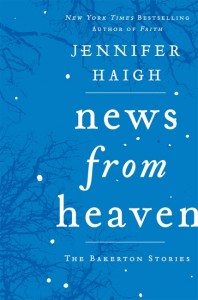
News From Heaven by Jennifer Haigh

News From Heaven by Jennifer Haigh is a collection of interconnected short stories about Bakerton, Pa., and while the characters in these stories all have roots in that former coal-mining town, the town itself is a character — matter of fact, it is the character — that holds these stories together.  Haigh has created a heartbreaking and hopeful story about the death and rebirth of a town and its people.  As the founding members, the Bakers, brought glory and industry to the town that ensured its prosperity, they also have a hand in its decline.

From WWI to the 1970s and 1990s, Haigh chronicles the rise and fall of a town tied closely to its founding family and the coal beneath its hills.  By the end, readers will be as connected to Bakerton as they are to their own hometowns and families.  From the coal hacked out of the mines to the black lungs carried by its resident miners, there is a deep sense of place and the people who inhabit it are as flawed and as memorable as the school teachers, mechanics, small business owners, and others of memory.

“The town lay before them in a deep valley, settled there like sediment:  the main street with its one traffic light, the rows of company houses, narrow and square — some brick-cased now, or disguised with porches and aluminum siding, but at this distance you could see how alike they all were.”  (page 166, “The Bottom of Things”)

Beautifully, each story builds upon the foundation of the last from the high flying days of the coal boom and the nepotism it wrought in the town to the ultimate crashing down of the town around the ears of the residents who relied too heavily on the Bakers to carry them through.  There are glimpses of how war can build up a town, while at the same time tear down its people, and there are other moments where the destruction of war is keenly felt at home when a soldier returns.  Haigh’s collection runs the emotional gamut, but the most striking passage comes in the final story, “Desiderata,” referencing the prose poem by Max Ehrmann.  She infuses the final story with a deep sadness of grief and the devastation of a secret revealed, but returns to the hopeful tone of rebirth and beginning anew amidst this unwanted baggage and knowledge.

In many ways, this collection depicts a slice of American history, with particular attention paid to how immigrant groups interacted with one another and to each other even in a new country.  Even as war is far away, many of the prejudices bred abroad continued in their new homes, and these interactions continued to reflect in future generations.  News From Heaven by Jennifer Haigh has a blasé title, but given the final moments of the collection and the reference to the prose poem, it is reflective of Haigh’s focus on faith.

About the Author:

Jennifer Haigh is the author of the New York Times bestseller Baker Towers, winner of the 2006 PEN/L. L. Winship Award for outstanding book by a New England author; Mrs. Kimble, which won the PEN/Hemingway Award for debut fiction and was a finalist for the Book Sense Book of the Year; and The Condition.

Her fiction has appeared in Granta, Ploughshares, Good Housekeeping, and elsewhere. She lives in the Boston area.

Find out more about Jennifer at her Website and connect with her on Facebook.  Also check out her Book Club Girl discussion.

This is my 7th book for the 2013 New Authors Challenge.

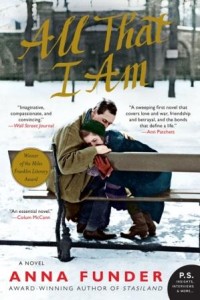
All That I Am by Anna Funder

All That I Am by Anna Funder is an unusual pre-WWII novel that takes into account not only the after effects of WWI, but also the politics that flooded Germany before the war.  Funder has crafted a psychological novel in some ways, but the characters who are most interesting and mysterious — Hans and Dora — also are the most distant.  Perhaps they are more interesting and mysterious because they are seen through the eyes of those who knew and loved them best — Ruth and Ernst Toller — which begs the question of whether we — ourselves — would be more interesting to others if seen through our closest connections.  Ruth, Ernst, Hans, and Dora, along with others, are forced to flee Germany for London after Hitler comes to power.  Funder admits that many of the elements of her novel are taken from history and from her friend Ruth’s actual life, but this novel is not just about the history and intrigue of German ex-pats seeking information from inside the regime about their friends and to warn other countries about Hitler’s expectations for war.

“Last week they loaded me into the MRI machine, horizontal in one of those verdammten gowns that do not close at the back: designed to remind one of the fragility of human dignity, to ensure obedience to instruction, and as a guarantee against last-minute flight.”  (page 7)

Ruth and Dora are cousins, and Ruth is easily swept up into the passion of the Socialist party Dora belongs to because she’s already fallen in love with the words of a young man, Hans.  Even at the beginning, there is a tension between Hans and Dora, and while Ruth first mistakes it for a lover’s intimacy, it is clear to the reader that the tension is born of jealousy and competition.  The beginnings of the movement hold close to their ideals for peace and workers’ rights — even equal rights for women — but those ideals are tested time and again.  These ideals are burdened and even broken, as seen through the eyes of the individuals tested.  Funder’s unraveling of the story in two perspectives — Toller and Ruth — can be frustrating, as Toller and Ruth tell their stories from different points in time, which calls into question whose memory is more reliable.  Both are looking to the past before WWII and their early days in exile, and Funder leaves enough clues along the way for readers to pick up on the essence of the outcome.

“From what Bev has told me, an addict can lose ten years of their life in a quest for exactly this:  the constant present tense.  Afterwards, those who do not die wake to a world that has moved on without them:  it is as if nothing happened to the fiend in those years, they did not age or grow and they must now pick up –”  (Page 201)

Whether the drug is an opiate, morphine, or memory, these activists, these friends, these compatriots become blind to the realities of their exile.  Rather than remember their past glories with fondness, Hans, in particular, and Toller become absorbed in the images of themselves — those they created or were created of them.  Funder is calling into question the image we have of ourselves and those that others have of us — are those perceptions mirrors of themselves or are they a bit distorted when compared.

All That I Am by Anna Funder sheds light on the lives of German ex-pats before WWII, and the secretive life some of them led as they tried to help those they left behind in Germany.  But at it’s heart, the novel is about how politics and ambitions can distort friendships or not matter at all.  It’s also about the enduring love for those we know and love, even those that are unworthy of that devotion and those who also offer more of themselves to the world and others than they do to themselves.  A novel of memory, love, devotion, and self-sacrifice worth reading.

About the Author:

Anna Funder’s international bestseller, Stasiland, won the Samuel Johnson Prize for nonfiction. Her debut novel, All That I Am, has won many prizes, including the prestigious Miles Franklin Literary Award. Anna Funder lives in Brooklyn, New York, with her husband and children.

Visit Anna at her Website and connect with her on Facebook.

This is my 5th book for the 2013 New Authors Challenge.

The Tell by Hester Kaplan

The Tell by Hester Kaplan unfolds like a stop-motion movie, one frame at a time, and in that movie there are flashes of the past.  Owen Brewer’s attention is easily swayed from one subject and one moment to another, breathing in both the past and present of his life, while at the same time observing the behaviors and ticks of others.  His marriage to Mira Thrasher is modern and telling, especially in how they introduce themselves to the new neighbor and former actor Wilton Deere.  Their marriage does not seem to be on solid ground, just from the way Owen watches the interaction of his wife and Wilton and thinks about reclaiming her in the most instinctual way.  Owen is tough to take and analyzes a great many things much more than other people would, while Mira is more a take-it-as-is girl and enjoys the moments, while not watching for the sky to fall.  Meanwhile, Wilton is trying to reconnect with his daughter, but in the process clings to this married couple next door because he longs to be loved and hated.

“Owen leaned into the sink and gulped water, leady and lethal, from the tap. Then some movement of white, gone before he could fully detect or confirm it, drew his eye past the unfurling pleasure of the lilacs to the empty house next door. Its windows were violet mirrors. In the year since the place had been on the market, Owen had sometimes used the house to animate wisps of his imagination they way people used empty battlefields. Where they saw the fuming charge across the hard-packed earth, the clash, the fallen in the grass, the victorious mob shaded by incoming clouds, he pictured his future children on the oak stairs, bodies passing in front of doorways, and the motion of family life he hoped to have here in this house, someday, with Mira.” (page 3 ARC)

Kaplan’s novel is psychologically complex.  Mira is an artist, struggling to keep her studio open and helping give direction to the elderly, young, and even homeless.  At the same time, she is hardly home when she is with Owen, and most nights, she’s off at the casino with Wilton, though she claims she does not have a gambling problem.  Kaplan explores the breakdown of trust between a husband and wife, the rebuilding of faith between an estranged daughter and father, and the power of addiction and obsession.  Each person has a “tell” — which in gambling is a change in a player’s behavior or demeanor that can give clues to other players about the truth of their hand — and in this case, Owen is trying to discern Mira’s tell, while navigating a new and untested friendship with a man he presumes is trying to get a little closer to his wife.  With Wilton, the task of determining the tell is more difficult as Owen cannot determine if he is telling the truth, acting, or a combination of both, though Owen in many cases errs on the side of Wilton telling lies.

“It was like standing still while a very fast train blew by you and lifted your hair.  What remained was what had been forgotten or abandoned:  a towel in the bushes, a single sneaker, a cat, a brightly colored plastic ring still drifting on the pond.”  (Page 100 ARC)

Kaplan’s novel unfolds with careful precision as she delves deeper into the spiraling vortex of Owen’s marriage with Mira, and his obsession with her family’s hording and her secret trips to the casino.  Each is scared to be alone, but not scared enough to stop their behavior from ruining everything.  Kaplan’s The Tell is dark and woeful, her characters are swimming in a dark pool and clinging to any hope they see, no matter how fleeting or false it may be.

About the Author:

Hester Kaplan is the author of The Edge of Marriage, which won the Flannery O’Connor Award for Short Fiction, and Kinship Theory, a novel. Her short stories have been included in The Best American Short Stories series. She teaches in Lesley University’s MFA Program in Creative Writing and lives in Rhode Island.

Find out more about Hester at her website. You can also follow her on Facebook and Pinterest.

tlc tour host This is my 2nd book for the 2013 New Authors Challenge.