Quantcast

Poetry for Young People: African American Poetry edited by Arnold Rampersad and Marcellus Blount, illustrated by Karen Barbour

Source: Sterling Children’s Books
Hardcover, 48 pages
I am an Amazon Affiliate

Poetry for Young People: African American Poetry edited by Arnold Rampersad and Marcellus Blount, illustrated by Karen Barbour for ages 8+, includes poems from those well-known and those who may be new to readers, teachers, and parents alike.  Maya Angelou, Langston Hughes, Nikki Giovanni, and Lucille Clifton are just some of the poets you would expect in this collection, but also there is Elizabeth Alexander, Alice Walker, and others who are either known for other literary works or are not as well recognized by the public for their poetic accomplishments.  The editors include explanations of the poets’ lives, the poems, and vocabulary that may be unfamiliar.  The illustrations are very reminiscent of modern art with a bit of a mosaic quality.

From “We Wear the Mask” by Paul Laurence Dunbar (page 12)

We wear the mask that grins and lies,
It hides our cheeks and shades our eyes,–
This debt we pay to human guile;
With torn and bleeding hearts we smile,
And mouth with myriad subtleties,

Why should the world be over-wise,
In counting all our tears and sighs?
Nay, let them only see us, while
We wear the mask.

In the introduction, the editors raise a good point about African-American poets and their sense of duty to balance not only their freedom to write about any subject, but also their internal obligation to write about the subject of race.  Two poets — Philis Wheatley and George Moses Horton — were given the freedom to learn to read and write as slaves and to publish or compile their own poetry collections, a “privilege” that was not lost on them.

For those early poets paving the way for other African-American poets, a new struggle began for them — writing in dialect and Standard English — and these poets soon began to feel as though their own work in dialect was a comic view of black American life, which was not at all how they wanted it portrayed.  This introduction is rich in information about these early poets and could be used to bridge conversations about poetry and history with young students and readers either in the classroom or at home.  Whether these poets explicitly talk about race or not, they are about freedom and some show an unvarnished look at our own shared history.

Poetry for Young People: African American Poetry edited by Arnold Rampersad and Marcellus Blount, illustrated by Karen Barbour, will generate discussion among teachers and students, parents and children, of all ages.  In addition to the historical and biographical information, the editors also offer some detail about poetic form, including haiku, which could be useful to generate classroom exercises among students or just for fun as a family activity.

Book 6 for the Dive Into Poetry Reading Challenge 2014.


Click below for today’s stop on the 2014 National Poetry Month: Reach for the Horizon blog tour:
Haiku

This month, The New York Times put out a call for Haiku about the city. With a deadline on April 5, 2014, I had little time to waste. I haven’t written haiku in a long while, but I do love the little form.

The criteria for the NYC haiku was:

Your haiku must relate to one of six categories relating to New York City. Those topics are:

Island
Strangers

Solitude
Commute
6 a.m.
Kindness

You don’t have to include the word, just let the topic inspire you, and relate it to your experience of New York City.

For those who may have forgotten the rules of writing a haiku, here’s a quick 101 guide:

• Only three lines.
• First line must be five syllables.
• Second line must be seven syllables.
• The third line must be five syllables.
• Punctuation and capitalization are up to you.
• It doesn’t have to rhyme.
• It must be original.

The did leave out the part that Haiku generally has something to do with nature or the seasons, but I won’t hold that against them.

Here is what I came up with, but I only submitted three:

Amtrak thumps rails north
anxious heart, loud silence here.
clammy hand held down.

St. Paul camouflaged
in Spring’s green, shadowed by steel
fulcrum: past, future

Central oasis
spring fever fields full out
below Essex, free

“Imagine,” he said.
blooms, friends — city wonderland
diverse harmony.

Maze of rat tunnels
rumbles on rails, sardines tight.
Jump inside, smiling.

What would your haiku be about NYC or your own location?

This is part of the 2014 National Poetry Month: Reach for the Horizon Blog Tour, click the button for more poetry:

248th Virtual Poetry Circle

Welcome to the 248th Virtual Poetry Circle!

Remember, this is just for fun and is not meant to be stressful.

Keep in mind what Molly Peacock’s book suggested.

Look at a line, a stanza, sentences, and images; describe what you like or don’t like; and offer an opinion. If you missed my review of her book, check it out here.

Also, sign up for the 2014 Dive Into Poetry Reading Challenge because there are several levels of participation for your comfort level.

Visit today’s stop on the 2014 National Poetry Month Blog Tour: Reach for the Horizon

Today’s poem is from New European Poets edited by Wayne Miller and Kevin Prufer:

The Barren Woman by O. Nimigean from Romania (page 82)

the barren woman imagines she's giving birth
she twists in the sheets and heaves herself about
she sprawls spraddling her legs against the wall
she thrusts and convulses
runs rivers of sweat
and calls me by name
she even gives birth to me
only she feels how the unseen crown of my head
bursts out through her sex unreceptive to seed
only she hears me gasp and squall
she gnaws my umbilical cord of shadow
and she fondles my head and body
with eager hands

the barren woman licks her faceless whelp
her skinless heartless cub
only she strokes me and knows me
and suckles me on her nut-like pap
I nurse without a sound
and then let slip the delicate nipple and fall asleep
baring my gums and teeth of mist

   translated from the Romanian by Adam J. Sorkin and Radu Andriescu

What do you think?

This is part of the 2014 National Poetry Month: Reach for the Horizon Blog Tour, click the button for more poetry:

Guest Post: An Introduction to Poetry Friday by Tabatha Yeatts

National Poetry Month is a big month for the Poetry Friday crowd. What is Poetry Friday? I turned to Poetry Friday regulars to help me explain.

WHAT IS POETRY FRIDAY?

In an article for the Poetry Foundation, Susan Thomsen explains Poetry Friday this way: “Readers, writers, teachers, parents, librarians, homeschoolers, illustrators, and editors share favorite poems for children and adults, link to cool poetry sites, describe readings they’ve been to, and recommend great books about poetry.”

If you think you might be interested but need a little enticement, let me tell you about the variety of things Poetry Friday has to offer:

FOR WRITERS:

It’s where we meet to learn, to teach, to hold each other up on this challenging, not-always-graceful journey to a poem. –April Halprin Wayland

Thanks to this group, I have written all sorts of poems I never could have imagined before. Lots of inspiration! –Irene Latham

I didn’t write poetry for over twenty years, and PF helped me find my voice again. –Renée LaTulippe

There are “friends” out there that I’ve never met, friends who share my enthusiasm for a good poem or who ask interesting questions about writing, art, life, whatever. I don’t care if their friendship comes to me online – that’s fine. Writing can be isolating – and I’m comfortable with my friends arriving via different modes of delivery. I like the connective tissue that gets formed no matter how we meet. –Julie Larios

FOR TEACHERS:

One of the greatest gifts I have received is a community that honors each other. We are full of kindness and acceptance and there isn’t enough of that in the world. Some of us are teachers facing the daily challenges of Common Core and state testing and closed minds. I feel safe in this place we call Poetry Friday. I also feel celebrated. When I post about my students’ work, you always praise me and compliment their work. I can’t tell you what that does to fuel me. I have finally found a group of people as nuts about poetry as I am. –Margaret Simon

It’s where I met ‘my people’ to exchange original poems, poems from mentors and share student poetry. –Jone Rush MacCulloch

One thing I can add since I feel I’m one of the newest Poetry Friday people is how welcoming the community has been to me. I love poetry, and…I was thrilled to find company who were both passionate and knowledgeable. –Linda Baie

I love PF because it allows me share poems I love, find new poems to express my thoughts and feelings, and discover new poets through our PF community. And, I love that the format allows me to write and incorporate visual elements and music. –Tara Smith

FOR READERS/ PEOPLE WHO ARE INTERESTED IN BEING PART OF A POETIC COMMUNITY:

If you are human with a pulse and a heart, there is a poem for you. Poetry Friday might help you find that poem or inspire you to write your own. 🙂 –Jama Rattigan

I’d also say that the fun of Poetry Friday for me is really in that sense of community – there are others who want to celebrate poetry, and thanks to the web, we can find each other and connect. The weekly tradition – the ritual, almost – helps me think of poetry even when I don’t blog on a Friday, and that’s nice, too. –Greg Pincus

When I first began reading the posts and participating, I had a good base knowledge of children’s poetry and a true interest. But in the last year, I have learned so much more and my interest has grown tremendously! I’ve also “met” so many wonderful, intelligent, talented writers that I am now thrilled to call friends. It is truly a special community! –Becky Shillington

Don’t be afraid to jump right in! It’s such a welcoming, supportive community. I haven’t encountered a warmer or more passionate group of poetry-lovers anywhere on the web or otherwise. It’s the highlight of my blogging week. –Irene Latham

As I’m getting back into posting and visiting at least SOME of the many wonderful posters each week, it feels like coming home… Thank you, all of you, for *being* Poetry Friday! –Laura Purdie Salas

For someone new, I say, “Welcome!” If you like poetry – even a little – join us. If you are afraid of poetry, join us. If you love poetry, join us. –Amy Ludwig VanDerwater

WHAT’S THE DEAL WITH COMMENTING?

When I started posting on Poetry Friday a few years ago, I learned it takes a little while to attract regular commenters, and it’s worth the effort to get to know this generous community. Leaving a heartfelt sentence or two in response to other blog posts is a great way to get and stay involved. –Robyn Hood Black

I comment from the heart – whatever my response may be. I love reading comments to discover other thoughts, interpretations, reactions – these are so much fun, for they make you look at the poem in a completely different way. –Tara Smith

Comment on what strikes you, and if you do not have a blog, consider beginning one for your own poetry findings and explorations. –Amy Ludwig VanDerwater

WHAT ARE POETRY FRIDAY POSTS LIKE?

There’s a huge range of what you can do. You can share a poem, a song, a poetry book. You can put as much or as little effort into it as you can spare. Here’s a small selection so you can see a bit of the variety. Also, feel free to make the rounds of this week’s round-up!

Joy begins a poem and invites commenters to add to it

Laura at Author Amok wraps up a month of color poems

Colette discusses students memorizing Invictus

Charles (Father Goose) shares an illustrated original poem

A tea party with poems at Jama’s

A vacation and poetry from Dori

Heidi shares a poem from a non-poetry-centered magazine

Matt talks about revising poems

An original poem by Steven with background info

Ruth talks about Poetry Fridayers at the International Reading Convention
Favorite poems for fictional characters at my blog

HOW DID IT START?

Poetry Friday began in 2006 as the brainchild of Kelly Herold. Blogs who win the longevity award for being a part of Poetry Friday from the start include Check It Out, GottaBook, MotherReader, Poetry for Children, A Wrung Sponge, and A Year of Reading.

WHO CAN DO ROUND-UPS?

Anyone who is willing to gather the links in some way, shape or form. Read more about it at A Year of Reading.

Poetry for Young People: Robert Frost edited by Gary D. Schmidt, illustrated by Henri Sorensen

Source: Sterling Children’s Books
Hardcover, 48 pages
I am an Amazon Affiliate

Poetry for Young People: Robert Frost edited by Gary D. Schmidt, illustrated by Henri Sorensen, is intended for younger readers (ages 8+) and the illustrations serve to maintain their interest, allowing them to visualize the topics Frost has set forth in his verse.  These illustrations in this book take on a water-color feel, and are reminiscent of Frost’s own love of nature and its mysteries.  The introduction serves as a starting point for teachers or parents, which read in its entirety out loud could be boring for younger listeners.  It would be best to choose a few facts to introduce young readers to the poet and his life.

From “A Patch of Old Snow” (page 34)

There’s a patch of old snow in a corner,
That I should have guessed
Was a blow-away paper the rain
Had brought to rest.

It is speckled with grime as if
Small print overspread it,
The news of a day I’ve forgotten–
If I ever read it.

Frost’s poems are broken into seasonal categories — Spring, Autumn, Winter, and Summer — but there are more poems in the Summer and Autumn sections.  The index at the back of the book makes it easier for you to find particular poems.  However, what is truly helpful are the blurbs that will help direct teachers, parents, and young readers to the specifics of Frost’s poems.  For instance, before reading “An Encounter,” the editor calls attention to the “barkless specter” in the poem, forcing readers to focus on that image and what clues Frost lays forth in the poem as to the specter’s true identity.

Poetry for Young People: Robert Frost edited by Gary D. Schmidt, illustrated by Henri Sorensen, does include poems from Frost that have older and more elevated language than younger readers would be used to, but exposing these readers to more challenging language and poems can enable them to broaden their vocabulary.  My daughter may be too young to read these on her own, but she often listens while doing other things when I read these aloud, and she loves flipping through the pictures and asking me what the images are.

About the Poet:

Robert L. Frost was an American poet. His work was initially published in England before it was published in America. He is highly regarded for his realistic depictions of rural life and his command of American colloquial speech.


About the Editor:

Gary D. Schmidt is an American children’s writer of nonfiction books and young adult novels, including two Newbery Honor books. He lives on a farm in Alto, Michigan,with his wife and six children, where he splits wood, plants gardens, writes, feeds the wild cats that drop by and wishes that sometimes the sea breeze came that far inland. He is a Professor of English at Calvin College.

Book 5 for the Dive Into Poetry Reading Challenge 2014.

This is part of the 2014 National Poetry Month: Reach for the Horizon Blog Tour, click the button for more poetry:

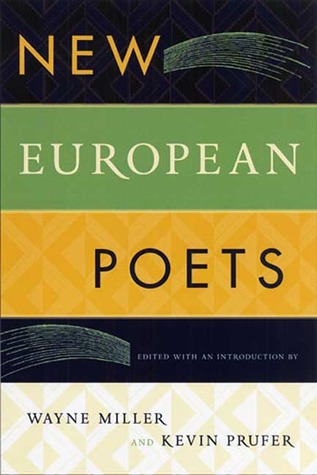
New European Poets edited by Wayne Miller and Kevin Prufer

Welcome to the 2nd day of the National Poetry Month Blog Tour!

I thought that as so much of National Poetry Month seems to focus on classic poets or contemporary U.S. poets, I would review an anthology of contemporary European poets and their poetry. I hope you’ll click the button below to visit with Laura at Book Snob as well.

Source: Public Library
Paperback,
I am an Amazon Affiliate

New European Poets edited and introduced by Wayne Miller and Kevin Prufer is an anthology of European poetry since 1970.  Each poet selected was translated and each poem has the language from which it was translated and the name of the translator below.  Unfortunately, this anthology does not include the poem in its original language, which some readers would prefer as it gives a visual comparison between the texts.  However, the collection does include the short biographies of the poets included, the translators — to which the anthology is dedicated — and the editors, which provides a great reference for finding more of these authors’ works.

Reading through the poems in this collection is like traveling the undulating and varying landscapes of Europe, with climbs through the mountains, sitting in lounges by the seaside, and hunting in the dark forests.  Many of these poems mirror those that are found in American contemporary poetry, but then there are others that are distinctly European in subject matter and style.  In the introduction, the authors talk about the dialogue between poets in American and those in Europe — how poetry informed each style on either side of the Atlantic.  However, that dialogue has mostly stopped, and the authors strive to rekindle that dialogue with this anthology, a real possibility as more reader-poets pick up this volume and begin leafing through it.

From Spain's Luis Garcia Montero's "Poetry"

"Poetry is useless, it serves only
to behead a king
or seduce a young woman." (page 13)

In fact, this collection serves to disprove this early statement in the poetry anthology. Poetry is more than political protest and seduction — it is a connection of the human spirit and an observation of the human condition.  Ranging from the irreverent in “Kiss My Corpse” by Gür Genç of Cyprus to the heartbreaking emptiness of “The Barren Woman” by O. Nimigean of Romania, these poems share a range of emotions that are universal but in a style that is fresh and inviting.

Each poem leaves the reader — more so an American reader — with a sense of understanding and awe and a new way of thinking not only about emotion, life, and living, but also of poetry itself.  New European Poets edited and introduced by Wayne Miller and Kevin Prufer is a collection that should be savored and returned to again and again over time.  Spend a day in one country or two, but visit them often and with an observant eye.

Book 4 for the Dive Into Poetry Reading Challenge 2014.


14th book for 2014 New Author Challenge.


5th book for 2014 European Reading Challenge; these poems are from a number of different countries, but since the ones that most resonated with me were from Hungary, that’s the country I’m choosing for this one.

This is part of the 2014 National Poetry Month: Reach for the Horizon Blog Tour, click the button for more poetry:

Guest Post: Why I Love Poetry by Beth Hoffman

The number one reason why poetry has become a valuable part of my life is simple: it helps me be a better writer. I’m a novelist, and by reminding me to hone extraneous words from my sentences, poetry is my most respected and formidable teacher. Whenever I feel uninspired or stale or lazy, I’ll turn to poetry for inspiration and guidance. Sometimes that inspiration comes in the form of a slap in the face. A friendly slap, but a slap just the same.

Poetry wakes me up.

No other literary genre has the power to evoke imagery and emotions in so few words. And ditto for urging the reader to slow down and ponder those things that, at first blush, seem imponderable.

Be it with a touch as light as morning’s breath, or the shattering blow of a hammer, poetry speaks to the deepest, most vulnerable parts of ourselves, if only we can slow down enough to listen. And think.

This short video clip from the film DEAD POETS SOCIETY sums it up far better than I … What will your verse be?

This is part of the 2014 National Poetry Month: Reach for the Horizon Blog Tour, click the button for more poetry:

National Poetry Month Tour Schedule & Linky

Welcome to the 2014 National Poetry Month: Reach for the Horizon Blog Tour!

I do have a couple open dates still, but this is the schedule for April 2014 as it stands, with our first post on Savvy Verse & Wit and Rhapsody in Books!

April 1: Beth Hoffman and Rhapsody in Books
April 2: Book Snob
April 3: Bermudaonion
April 4: Tabatha Yeatts
April 5: Rhapsody in Books and Still Unfinished
April 6: Rhapsody in Books
April 7: The Bluestocking Society
April 8: the bookworm
April 9:  Lost in Books
April 10: Come, Sit By The Hearth
April 11:  Book Dilettante
April 12:  Rhapsody in Books
April 13: I’d Rather Be at the Beach
April 14:  Sophisticated Dorkiness
April 15:  Reader Buzz
April 16:  Everything Distils Into Reading
April 17: Necromancy Never Pays
April 18: Peeking Between the Pages
April 19:  Rhapsody in Books
April 20:  Rhapsody in Books
April 21:  Burning the Bridges
April 22:  Erica Goss
April 23:  Diary of an Eccentric
April 24:  Sweta Srivastava Vikram
April 25: Melissa Firman
April 26: Beth Kephart
April 27:  I’d Rather Be at the Beach and Emma Eden Ramos
April 28:  Regular Rumination
April 29:  Mary McCray
April 30:  Tabatha Yeatts

For those participating this year, please leave your post link below:

2014 National Poetry Month Blog Tour Sign-Ups

Welcome to the sign-ups for the 2014 National Poetry Month: Reach for Horizon Blog Tour!

I would love to have any bloggers, poets, authors, and readers sign up to review books, talk about poets, write poetry, share their inspirations, and celebrate the love of poetry this April.

Please let me know in the parentheses — Your Name (date) — which date you would prefer, and I’ll set aside that date for you. 

If you know what topic/poet you want to cover, leave that in the comments as well.

Here are the remaining open dates (as of March 25):

April 21, April 22, April 25, April 26, April 28, April 29

Let’s fill up all 30 days!

Dewey’s 24-Hour Read-a-Thon

Today is the beginning of Dewey’s 24-hour Read-a-Thon.  Although I have other plans today, I will be reading off and on with everyone and cheering people on when I can.

Introduction

1) What fine part of the world are you reading from today?

USA, Washington, D.C.

2) Which book in your stack are you most looking forward to?

Finishing up Camelot’s Court by Robert Dallek, and if I finish it I will consider it a successful read-a-thon.

3) Which snack are you most looking forward to?

Grapes…and coffee…I love Dunkin Donuts French Vanilla!

4) Tell us a little something about yourself!

I loved my Keeshond like he was a child, but with a little toddler running around, I realize caring for a dog was much easier.

5) If you participated in the last read-a-thon, what’s one thing you’ll do different today?

I like to keep my participation laid back; that’s what I’ve learned over the years.  To just have fun!

Blackout Poem Challenge:

THE Chilean poet Pablo Neruda, known for his love poems and leftist ideals, died 40 years ago this September. One would hope he’d be at rest by now. But on Monday, as classical musicians played a Neruda work set to music by Vicente Bianchi, his remains were exhumed to determine whether he died from poison — instead of prostate cancer, the conventional account.

In recent years, other icons of the Hispanic world have suffered the same fate. In 2011, Salvador Allende, Chile’s democratically elected president-elect who was deposed by a military junta in 1973, was disinterred to verify that he’d fatally shot himself. (The finding — yes — is still disputed.) The late Venezuelan president Hugo Chávez ordered in 2010 that the tomb of his idol, Simón Bolívar, be opened to test his theory that the liberator died of poisoning, not tuberculosis. (The theory remains unproved.)

And in 2008, a Spanish judge authorized the unearthing of a mass grave in the southern town of Alfácar to see whether Federico García Lorca, the poet and dramatist who was assassinated by Fascists in 1936, at the outset of the Civil War, was buried there. (The results were inconclusive.)

There is something gothic, but also cathartic, about summoning artists like Neruda, and his close friend García Lorca, back into the realm of the living, making us wonder if death is really the end. A Chilean judge’s decision, in February, to allow an investigation into Neruda’s death, which led to this week’s exhumation, looks like an act of expiation.

Neruda used his pen to denote, to denounce, to decry. He was 69 when the junta took power. By then he had been an embassy attaché, a senator and an ambassador. In 1969, he initially ran for president as a Communist, but later backed Allende’s candidacy. However, passion for political change was only one side of his persona. The other was that of a bon vivant. Many people enjoy life plentifully, but few have been so eloquent about it. The Dionysian sensuality of Neruda’s odes is contagious, joyful and erotic. And also destructive: Neruda’s marriage to Matilde Urrutia, his third wife and the inspiration for “The Captain’s Verses” and “One Hundred Love Sonnets,” unraveled after she learned he was having an affair with her niece.

Neruda died in a clinic in Santiago on Sept. 23, 1973 — 12 days after the American-backed coup that overthrew Allende and brought Gen. Augusto Pinochet to power. Many Chileans have long been skeptical of the official cause of death. In 2011, Neruda’s former driver said the poet told him, on the eve of his death, that he’d been given a harmful injection by a doctor. Conspiracy theorists note that Neruda died in the same hospital where Eduardo Frei Montalva, a politician who had supported the junta before switching sides, died in 1982. A judge ruled in 2009 that Frei had been poisoned.

Could Neruda have suffered a similar fate? Allende had died on Sept. 11, 1973, and another opponent of the junta, the folk singer Víctor Jara, was assassinated on Sept. 16. Finishing off Neruda could have been the junta’s coup de grâce.

Exhuming icons is one way to deal with guilt. Elsewhere in Latin America, the past’s phantoms are resurfacing: in Guatemala, where the former dictator Efraín Ríos Montt is on trial for genocide; in Argentina, whose cities are dotted with memorials to those who were “disappeared” during the “dirty war”; and in Mexico, where a once-pliant media have challenged the former president Felipe Calderón’s handling of the war against drug cartels.

But Neruda holds a special place in this grim look backward. Gabriel García Márquez, the Colombian writer and a fellow Nobel laureate, has called him “the most important poet of the 20th century — in any language.”

Neruda left thousands of poems, a handful of which are of such inspired beauty as to justify the very existence of the Spanish language. Adolescents routinely give his “Twenty Love Poems and a Song of Despair” to their sweethearts. His ideological verses have been read aloud, often from memory, in one revolution after another, from the fall of the Berlin Wall to the embers of the Arab Spring. Some of Neruda’s poems — “I Ask for Silence,” “Walking Around,” “Ode to the Artichoke” — have been rendered into English repeatedly, each version another effort to make him current and vital to a new generation.

What we’ve read so far:

32 pages

32 pages

26 pages

Which hour was most daunting for you?

The 15th hour was brutal for me, that’s when I decided to take a nap. A big mistake because I slept through the rest of readathon.

Could you list a few high-interest books that you think could keep a Reader engaged for next year?

I think kids books with games in them are so fun and peek-a-boo flaps. They are quick reads for when there are distracting little children around or you just need a quick read.

How many books did you read?

We only read 3 whole books, but I did read about 50 more pages of Camelot’s Court.

What were the names of the books you read?

See above the images.

Which book did you enjoy most?

The little one and I really like the Halloween Forest.

Which did you enjoy least?

None really.

How likely are you to participate in the Read-a-thon again? What role would you be likely to take next time?

I think if I have as little time as I did this time, I’ll be a cheerleader instead.

I hope everyone had a great read-a-thon!

Hooray! An Event of Successful Fiction and Memoir

IMG_2731Yesterday, we headed down to Alexandria, Va., to attend an event at Hooray for Books with Beth Kephart, whose writing cannot be praised enough, and Debbie Levy, who is as charming in person as I expected.  It has been many years since I’ve been there, but I’ve always loved the waterfront, the Torpedo Factory, and many other things about the shops and restaurants there.  While I did notice some changes, including the movement of Hannelore’s where I got my wedding dress to a side street off of King Street, much of the atmosphere remains the same.  What did we do after the event? We went to our favorite pub, Murphy’s, though after the nauseated morning I had, I did not dare have the Guinness I would have love to have.  And then we took Wiggles around to check out the sights she has never seen.  (pictured here is my favorite tree down by the water).

Due to construction on the lovely George Washington Parkway, I was late to the event and I hate being late!  I abhor it.  My husband kindly dropped me off as he sought parking.  I walked in and was told there were still seats, which was good, though I would have stood for this one.  And stupidly, I became too absorbed in the conversation to take too many photos.  There was talk about memoir and its differences from fiction and autobiography, and how there is still a need for imagination in memoir, but not in making up facts.  We all know those memoirists that have been caught bending or blatantly making up facts — they are not Beth Kephart or Debbie Levy (below Beth on the left and Debbie on the far right).

IMG_2715

There were books galore to be had at the bookstore, and when my husband finally arrived with Wiggles, they sat for a few minutes while the audience — and myself — were engaged in a writing exercise about what friends from our school days would remember about us and what we’d like them to remember — thanks to Debbie Levy.  Earlier we had engaged in a different writing exercise about a first person account of an object, which Beth Kephart dreamt up.  I did share the poem, I will share here at the behest of Beth and Debbie, though I feel it is unfinished.

Ghost in a Book

She was a bean pole
awkward
books hanging from her nose,
from her hands,
in her bag.
Looking down, but
always -- inwardly -- out
to a horizon
beyond four walls,
small town, gossip.
Ready to spring --
jump forward, move
and leave us
wondering if she was here.

I’ve honestly written more poetry than fiction and essay and have never written memoir or nonfiction. It was good to stretch my writing in these exercises, and it was fun to see what others came up with. Some of them were funny and sarcastic, while others were serious. This was a great event for more than one reason — writing exercises, readings, questions and answers — but most of all the genuine awe and support the writers showed for one another, culminating in each buying books from the other’s stacks and signing books to their friends and loved ones. I loved how they bounced questions off of one another and how they interacted. It was like watching two colleagues who have known one another longer than I suspect Beth and Debbie have.

I’ll leave you with my favorite photo from yesterday — thanks to my husband who took the photo — of three lovely ladies.

IMG_2716

2013 Gaithersburg Book Festival

Tomorrow between 10 a.m. and 6 p.m., the fourth annual Gaithersburg Book Festival will offer authors, poets, and activities for kids.

Among the authors I’m looking forward to are these:

And those poets on the Poetry in the Afternoon Panel, I’m moderating are:

I hope that if you are in the area, you’ll stop by the panel or at least see some great authors.  This is always a great family event and shares the love of books.