Quantcast

Guest Post: The Magic of Poetry by Sweta Srivastava Vikram

Sweta Srivastava Vikram is a poet and novelist, and dare I say an activist?! Her poetry books have been reviewed on Savvy Verse & Wit, and she’s even visited for a Q&A and a guest post about creativity in the past. I’ve known her for what seems like forever, and after meeting her in person more than once and chatting with her on social media and email, I can say that we are kindred spirits, poets, and friends.  Check out my reviews of No Ocean Here, Because All Is Not Lost, Beyond the Scent of Sorrow, and Kaleidoscope: An Asian Journey of Colors.  Here are her interview and previous creativity guest post.

Today, she’s going to share the magic of poetry for National Poetry Month!

J.D. Salinger once said, “Poets are always taking the weather so personally. They’re always sticking their emotions in things that have no emotions.” He’s probably right.

In the first week of April, I got caught in the rain three days in a row. I love the rains and call myself a pluviophile (aside from urban dictionary, is pluviophile even officially considered a word?) While the lover of rain inside me was happy to wash away the unmentionables in the downpour, it wasn’t that simple. The wind mutilated my umbrella. The cold seeped inside my bones. My body collapsed with the onslaught.

For two weeks, I was on bed rest, fighting 103F fever and sinusitis. I had no taste in my mouth. To top it all, the strong antibiotics reacted and I had to be put on a counter dosage. Life came to an un-poetic standstill.

The only thing that soothed me at this time was a stray star that I would spot outside my bedroom window every night. I live in New York City—this was definitely an unusual and poetic occurrence. True to J.D. Salinger’s words, I started to attach a meaning to this mystical happening and wondered about the pleasant surprise.

Right about this time, my sister-in-law (husband’s sister) who lives in Singapore told me that our five and a half-year-old niece, Noyonika, had written a poem in school. It was about a star.

How To Catch A Star (By Noyonika)

I will sit on a broom
And fly to the moon
And catch my star

It is very dark when I fly to the moon
I am scared, it is so dark!

But I am brave and I carry on
To catch my star
Then I see something
Yippee, Yippee!

It’s my star!
It’s golden, pink and purple
It’s beautiful, it’s colossal
And it glows in the dark!

I reach my hand out
And catch my star
And I tell the broom:
‘Take me back to my room.”

Was that Noyonika’s star that I saw outside my window? Yes, you could say my fever-induced delirium made me imagine that. Or was it pure poetry? My niece, thousands of miles away, and I bonding over a remote incandescent body in the sky via the path of verses. The way I look at it, poetry paves way for imagination with a touch of human connection. With all due respect, in this sometimes cold, unpredictable, and impersonal world, attaching emotions in oddest of places is what keeps us sane, Mr. Salinger.

Thanks, Sweta, for sharing the magic of poetry with us and the world.

About the Poet:sweta

Sweta Srivastava Vikram, featured by Asian Fusion as “One of the most influential Asians of our time,” is an award-winning writer, Amazon bestselling author, novelist, poet, essayist, columnist, and educator. She is the author of five chapbooks of poetry, two collaborative collections of poetry, a novel, and a nonfiction book. Her work has also appeared in several publications across three continents. Sweta has won three Pushcart Prize nominations, an International Poetry Award, Best of the Net Nomination, Nomination for Asian American Members’ Choice Awards 2011, and writing fellowships. A graduate of Columbia University, she lives in New York City with her husband and teaches creative writing and gives talks on gender studies while managing a career in digital marketing. You can follow her on Twitter or Facebook.

Walking Home: A Poet’s Journey by Simon Armitage

Source: Liveright, W.W. Norton
Paperback, 285 pages
I am an Amazon Affiliate

Walking Home: A Poet’s Journey by Simon Armitage is part memoir and part travelogue, and the path he chooses to walk — while contrary to what is outlined in the guidebooks for the Pennine Way in England and part of Scotland — is literally a walk home for him.  He begins in Kirk Yethom, Scotland, and ends more or less in Edale, England, which is in the Peak District.  As a poet, readers may expect a deeper analysis of the journey or the travails he experiences, but as Armitage is nearly constantly accompanied by strangers, friends, fellow poets, and even his family, he has little time to contemplate more than the scant passerby or the physical obstacles in his path.  Much of the travelogue is focused on Armitage re-orienting himself by map or landscape or simply following someone who has offered to guide him over a particular leg of the 267 miles.  The first poem included in the book doesn’t come until he has pass nearly a third of the way through the trail — whether that is when inspiration hit him to write a poem during the journey or whether it was written afterward about that section of the trail is unclear.

“Prose fills a space, like a liquid poured in from the top, but poetry occupies it, arrays itself in formation, sets up camp and refuses to budge.  It is a dissenting and willful art form, and most of its practitioners are signed-up members of the awkward squad.” (page 5)

Armitage has help in coordinating his journey, which includes readings held at the end of each leg either in an inn, a home, a bar, or other venues, and he passes a sock about the room for collections, which he uses to fund his continued journey along the way.  He says that he sets out on the journey to get “out there,” rather than write about far-off places from his desk chair.  In a way, he sees it as a way to “clear his head.”  The path does not seem to clear his head so much as clutter it with more concerns and worries about himself and the physical health of others.

There is a point early on in which he gains a “regular” pace of walking and he feels as though he’s reached his stride, but he’s clearly not reached the most arduous parts of the journey.  Those parts of the journey clearly weigh on his psyche, as does his part of the journey when he is lost in the mist.  He nearly loses his sense of identity, but he continues onward.  Perhaps this is the crux of the prose, that poets lose themselves in the journey and that loss of self can be frightening unless the poet can plod forward.

Walking Home: A Poet’s Journey by Simon Armitage is a journey at the arm of a poet who does not find himself all that interesting and cannot seem to understand the reason why anyone would volunteer to go on the journey with him or even come to listen to him read his poems.  The one interesting moment in the memoir where he talks of spare rooms as the keepers of “family lore” and “memory vaults,” is grossly under-explored, as he seems to want to keep out of the private moments of the people who open their homes to him.  While the landscape is varied and the hardships he faces could be a cautionary tale against these kinds of treks, the journey does not live up to reader’s expectations about what a poet would write about, experience, or explore.

About the Poet:

Simon Armitage was born in 1963 in the village of Marsden and lives in West Yorkshire. He is a graduate of Portsmouth University, where he studied Geography. As a post-graduate student at Manchester University his MA thesis concerned the effects of television violence on young offenders. Until 1994 he worked as Probation Officer in Greater Manchester.

His first full-length collection of poems, Zoom!, was published in 1989 by Bloodaxe Books. Further collections are Xanadu (1992, Bloodaxe Books), Kid (1992, Faber & Faber), Book of Matches (1993, Faber & Faber), The Dead Sea Poems (1995, Faber & Faber), Moon Country (with Glyn Maxwell, 1996, Faber & Faber), CloudCuckooLand (1997 Faber and Faber), Killing Time (1999 Faber & Faber), Selected Poems (2001, Faber & Faber), Travelling Songs (2002, Faber & Faber), The Universal Home Doctor (2002, Faber & Faber), Tyrannosaurus Rex Versus the Corduroy Kid (2006, Faber & Faber, Knopf 2008), and Seeing Stars (2010, Faber & Faber, Knopf 2011).

Armitage’s 2012 nonfiction book Walking Home, an account of his troubadour journey along the Pennine Way, was a Sunday Times best-seller for over a month and is shortlisted for the 2012 Portico Prize.

Book 12 for the Dive Into Poetry Reading Challenge 2014.


6th book for 2014 European Reading Challenge; this memoir/travelogue takes place in England and Scotland.


18th book for 2014 New Author Challenge.


For today’s 2014 National Poetry Month: Reach for the Horizon tour stop, click the image below:

Guest Post: A Driven Poet by Erica Goss

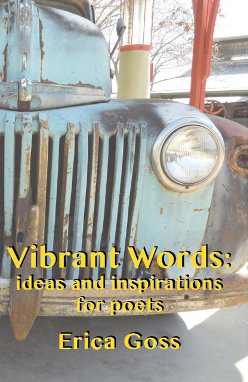
Erica Goss is the Poet Laureate of Los Gatos, CA, and the host of Word to Word, a show about poetry. She is the author of Wild Place (Finishing Line Press 2012) and Vibrant Words: Ideas and Inspirations for Poets (PushPen Press 2014). Her poems, reviews, and articles appear widely, both on-line and in print. She won the 2011 Many Mountains Moving Poetry Contest and was nominated for the Pushcart Prize in 2010 and 2013. Please visit her at Website.

We’ve been following her 12 Moons project with Atticus Books for some time and we’ve seen Snow Moon, Wolf Moon, Worm Moon, and Planters Moon.  Check out all 12 Moons.

Today’s she’s here to talk about her latest poetry project, Vibrant Words: Ideas and Inspirations for Poets. Please give her a warm welcome.

When my book, Vibrant Words: Ideas and Inspirations for Poets came out in late March, I decided that in order to promote it, I would attend events within a two-hour drive of my home in Los Gatos, California. I’ve already put plenty of miles on my Honda Fit, traveling to book-signings and poetry readings all over the San Francisco Bay Area. I’ve driven two hundred miles in one day to read for twenty minutes, but that’s not even close to California Poet Laureate Juan Felipe Herrera. He once drove from Fresno to San Jose, a round trip of three hundred miles, to read two poems at a book release party.

In spite of my general annoyance at the amount of time I must drive, I get some of my best ideas while driving. This is not always a good thing. Once on a drive between San Jose and Sacramento (about one hundred and twenty miles) an entire poem came to me, fully formed. Not in a place where I could pull over and write, I chanted the poem to myself over and over for the next half-hour while trying to concentrate on driving the speed limit. I even imagined what I would tell the officer, should I get pulled over: “I’ll show you my driver’s license as soon as I write this poem down.”

More often, as I enter my long-distance driving trance, bits of conversation, things I’ve read, and phrases from songs I’m listening to on the radio come and go in my thoughts. Part of my brain has to stay alert to drive safely, but the other part can roam, examining signs and counting the number of red cars vs. blue cars. I like finishing the terse sentences I read on highway signs: “Expect delays” becomes “Yes, I always expect delays” and “Gas Food Lodging” is kind of hilarious on its own. “Bump” is one of my favorite signs; our roads are plenty bumpy, but it takes a really spectacular bump to warrant a sign.

Traffic often grinds to a halt (like the sign says, “expect delays.”) I’ll pull out my Moleskine notebook and make a few notes: “sleep bone,” “I carry a purse and talk to strangers,” “recipe for lasagna,” “if marriage was a cookbook,” and “crows are so American” are all from recent traffic stops.

Since the release of Vibrant Words, I’ve driven from the Pacific Ocean to the Central Valley, and I’m just starting out. I hope to bring my book to places farther and farther from home, but if it gets too far, I think I’ll fly. Plus, I need new tires.

Erica is truly a driven poet. Thanks so much for sharing your travels and your inspiration with us.

Save

Response Poetry

Response poetry is often one of the easiest kinds of poetry to write for poets who are starting out because it often relies on the text of another poet.

Writers just starting out in poetry will often imitate the style of another poet until they can find their own, and some even write poems outwardly replying to another poets work, like Sir Walter Raleigh’s response to Christopher Marlowe’s “The Passionate Shepherd to His Love.” Other options include building off a primary metaphor that the poem works from, stealing the first line of the poem, using a passage as an epigraph, turning prose into verse, or writing the opposite of the poem.

For further information about these techniques, go here.

Today, I’m going to give you a poem, and my response, and I’d love to see what your response poems would be in the comments either to the original poem or to my response.

The Young Man's Song by W.B. Yeats

I whispered, "I am too young,"  
And then, "I am old enough";   
Wherefore I threw a penny   
To find out if I might love.   
"Go and love, go and love, young man,
If the lady be young and fair,"   
Ah, penny, brown penny, brown penny,   
I am looped in the loops of her hair.   
   
Oh, love is the crooked thing,   
There is nobody wise enough
To find out all that is in it,   
For he would be thinking of love   
Till the stars had run away,   
And the shadows eaten the moon.   
Ah, penny, brown penny, brown penny,
One cannot begin it too soon.

Here’s my response poem:

A Young Woman's Lament

I spied him at the fountain
caressing a brown penny as he stared
a long time into the flowing water.
Dark curls tumbling to his neck,
a suit crisp and bright.

The dark copper revealing its shine
reflecting the sun's rays.
I smile at the thought, until
Whispering to himself,
he seems to argue, flailing his arms.

I scratched my head,
"He's cute, but clearly crazy," I said.
The fear crept along my skin
He turned to stare right at me.  With a splash,
he squared his shoulders, sauntered toward my dry mouth.

For today’s 2014 National Poetry Month: Reach for the Horizon tour stop, click the image below:

250th Virtual Poetry Circle

Welcome to the 250th Virtual Poetry Circle!

Remember, this is just for fun and is not meant to be stressful.

Keep in mind what Molly Peacock’s book suggested.

Look at a line, a stanza, sentences, and images; describe what you like or don’t like; and offer an opinion. If you missed my review of her book, check it out here.

Also, sign up for the 2014 Dive Into Poetry Reading Challenge because there are several levels of participation for your comfort level.

Click for today’s stop on the 2014 National Poetry Month Blog Tour: Reach for the Horizon

Today’s poem is from New European Poets edited by Wayne Miller and Kevin Prufer:

First Steps by Stefan Hertmans of Belgium (page 302)

He ran into the street without a glance
and I, beginning to be like him more and more,
thought he could make it to the door.

But he turns around, cars racing
along the prom. Now he’s almost there
I’ll never get to him in time.

Just so my father, all his life,
could dream of my hand, as small
and quick, able to slip between bars
into the depths of rock and water.

Life rushes in a blink.
Then I grab him—he unafraid,
His eyes wide open and so calm—

I with that fatal smash
That will never leave
My life and body.

      -translated from the Flemish by Gregory Ball

What do you think?

This is part of the 2014 National Poetry Month: Reach for the Horizon Blog Tour, click the button for more poetry:

The Late Parade by Adam Fitzgerald

Source: Liveright, W.W. Norton
Hardcover, 112 pages
I am an Amazon Affiliate

The Late Parade by Adam Fitzgerald strikes a confusing pose upon first glance with its oftentimes odd image pairings and obscured references, but at its heart, there is a deep melancholy and longing in these poems.  There are moments that slip through the reader’s fingers as they slip through the narrator’s fingers, leaving both with a sense of loss.  We’ve come late to the parade and are sad for it.

From "Mid-Harbor" (page 66)

"All such gestures may be inventions of nostalgia,
ways of edging a tea-saucer future forward,
poised perilously on a gilded table's brink.

We glance at ourselves with plaster cables strung
over cheeks, snoozing the forest's alarm, turning
to a charmed gouache with oblivious sentiment."

Fitzgerald deftly melds pop culture with classic reading, cuing it up with a fantastic and unbelievable world of clouds, “buttered air,” and “dental waters.”  Like the poem “Two Worlds at Once” suggests, Fitzgerald is asking the reader to straddle reality and fantasy to enjoy the happiness of moments in love even if they have already passed us by or never came about in the first place — it is their existence and possibility that are the most poignant.

Filled with lush imagery that confuses and contradicts, readers minds will become full, at times overtaxed, but poems that force readers to expand their minds and contemplate every chosen word are those that engage us the most.  The Late Parade by Adam Fitzgerald is a debut collection not soon forgotten.

17th book for 2014 New Author Challenge.


Book 11 for the Dive Into Poetry Reading Challenge 2014.

For today’s 2014 National Poetry Month: Reach for the Horizon tour stop, click the image below:

Nefertiti in the Flak Tower by Clive James

Source: Liveright
Hardcover, 96 pages
I am an Amazon Affiliate

Nefertiti in the Flak Tower by Clive James is a collection of rhyming and metered poems that relies heavily on history, particularly that of WWII, to make connections about the resiliency of human kind in the face of horrifying adversity.  The title poem, Nefertiti in the Flak Tower, does use the history of the Nefertiti bust as a German treasure that was moved and protected in a Flak Tower during WWII, towers that were built to protect cities like Berlin from air raids with guns and shelter citizens.  Beyond the historically based poems, there are poems about the life of a writer and his friends and how even these glamorous lives of signing books can become mundane, but there are those moments that make even the most thankless jobs worthwhile.

From "Grief Has Its Time" (page 81)

"Free of such burdens, I pursue my course
Supposing myself blessed with the light touch,
A blithesome ease my principal resource.
Sometimes on stage I even say as much,

Or did, till one night in the signing queue
An ancient lady touched my wrist and said
I'd made her smile the way he used to do
When hearts were won by how a young man read

Aloud, and decent girls were led astray
By sweet speech. "Can you put his name with mine?
Before the war, before he went away,
We used to read together." Last in line

She had all my attention, so I wrote"

James comes across as both romantic and removed.  The rhyming poems can linger in the mind when the emotion is clear and connects with the reader, but there are other occasions when the rhymes seem forced and throw off the rhythm of the poem, creating a disconnect between the reader and the subject.  Nefertiti in the Flak Tower by Clive James is a mix of some really great poems that will leave a lasting impression and those that fall a little flat on first and second reading.

Book 10 for the Dive Into Poetry Reading Challenge 2014.


16th book for 2014 New Author Challenge.


For today’s 2014 National Poetry Month: Reach for the Horizon tour stop, click the image below:

Any Anxious Body by Chrissy Kolaya

Source: the poet, Chrissy Kolaya
Paperback, 96 pages
I am an Amazon Affiliate

Any Anxious Body by Chrissy Kolaya does not have the most eye-catching cover, but what’s inside will knock your socks off!  Beginning with what readers may see as someone who lived through the Great Depression when saving everything counted toward survival, Kolaya uses early memories and events overheard to not only connect generation to generation, but to weave a thread through each struggle and moment of unease and concern that each moment is fleeting.  Humans are in a perpetually anxious state, sometimes without knowing it, because our lives are finite and each moment has a beginning and end — often ending before we’re ready to deal with it.

From “Fired” (page 17)

His friend —
the one married just out of high school,
runs his eyes over you,
smoothing the skin over your bones.

Kolaya — using notes from a great grandmother who no longer can verbally communicate and a letter from her daughter — has a visceral sense of not only the human body and its reactions to touch, but also the emotional connections between family and lovers. Her verses are fresh and evoke a response from her readers immediately. While there is a sense of contemplation about life events and family connections, the poems also never forget to remind readers that too much thinking can prevent life from happening.

From “Polarity” (page 15)

She wants to talk about how it will work
and I think:
I will move toward you in a moment or two,
and you should do the same.

Any Anxious Body by Chrissy Kolaya has created a reflective collection of poems, a collection that requires the reader to listen to the voices, to the moments, to the memories, but more importantly to open themselves up to the experience.  Each poem’s voice changes perspective, providing readers with the fullest view of living as possible, and sometimes those perspectives can leave you squirming.

About the Author:

Chrissy Kolaya is a poet and fiction writer. Her short fiction has been included in the anthologies New Sudden Fiction (Norton) and Fiction on a Stick (Milkweed Editions). Her poems and fiction have appeared in a number of literary journals.

She has received a Norman Mailer Writers Colony summer scholarship, an Anderson Center for Interdisciplinary Studies fellowship, a Loft Mentor Series Award in Poetry, and grants from the Minnesota State Arts Board, the Lake Region Arts Council, and the University of Minnesota. She teaches writing at the University of Minnesota Morris. Check out her blog and her Facebook page.

15th book for 2014 New Author Challenge.


Book 9 for the Dive Into Poetry Reading Challenge 2014.


For today’s 2014 National Poetry Month: Reach for the Horizon tour stop, click the image below:

Book Spine Poetry

I’ve always loved exercises that have people thinking outside their comfort zones.  For National Poetry Month, I would love to see what everyone can create out of book spines to make their own poem.

Take some books (doesn’t have to be just poetry), place them in an order that makes sense to you, and you’ll have your poem.

Here’s what I came up with:

bookspine

Walking Home
The Odyssey
To Join the Lost
Any Anxious Body
Chasing Utopia
Flies
Rubber Side Down

I hope you’ll all join me and share your own book spine poem.


For today’s 2014 National Poetry Month: Reach for the Horizon tour stop, click the image below:

249th Virtual Poetry Circle

Welcome to the 249th Virtual Poetry Circle!

Remember, this is just for fun and is not meant to be stressful.

Keep in mind what Molly Peacock’s book suggested.

Look at a line, a stanza, sentences, and images; describe what you like or don’t like; and offer an opinion. If you missed my review of her book, check it out here.

Also, sign up for the 2014 Dive Into Poetry Reading Challenge because there are several levels of participation for your comfort level.

Click for today’s stop on the 2014 National Poetry Month Blog Tour: Reach for the Horizon

Today’s poem is from New European Poets edited by Wayne Miller and Kevin Prufer:

Between Yesterday and Your Mouth by Rosa Alice Branco of Portugal (page 4)

I will spend the night with those days.
With the smile you left in the sheets.
I still burn with the remains of your name
and see with your eyes the things that you touched.
I am here between the bread and table, in the glass
you lift to your mouth. In the mouth that holds me.
And I don't know what I am between yesterday and what will come.
Yesterday I was the river at evening, the gaze that caressed the light.
My son writes on pebbles on the beach and I invent
steps for deciphering them. They all roll far away.
That's how the sea is. I am learning with the waves
to melt away to foam. There is always a seagull
that cries out when I come near, there is always a wing
between the sky and my floor. But nothing belongs to me,
not even the words with which I cement the hours.
Perhaps love is just a small difference in time zones
or a linguistic accord that only exists
deep in the flesh. But here where I am not
what grounds me is the certainty that you exist.

   translated from the Portuguese by Alexis Levitin

What do you think?

This is part of the 2014 National Poetry Month: Reach for the Horizon Blog Tour, click the button for more poetry:

Ode to Childhood: Poetry to Celebrate the Child edited by Samuel Carr

Source: Sterling Children’s Books
Hardcover, 96 pages
I am an Amazon Affiliate

Ode to Childhood: Poetry to Celebrate the Child by Samuel Carr is a collection of poems from a variety of poets about children, parenthood, and their own childhoods, and no collection about children would be complete without William Blake, who has four poems included.  Blake is a poet that spoke about the innocence of childhood in a great many poems, which can be found in his Songs of Innocence and Songs of Experience.  His childlike lines and voice evoke the childlike quality readers will immediately reference in their own experiences, but his poems also speak of a duality in childhood between desire and the more enlightened search for knowledge.  He demonstrates that children learn from the reactions and action of others in “Infant Sorrow,” learning that smiles get reactions that wailing did not.

Longfellow image

Reprinted with permission from Ode to Childhood © 2014 Batsford, distributed by Sterling Publishing Co., Inc. Photography by TFL from the London Transport Museum collection.

While each poem in the collection is about children or childhood, they are by turns nostalgic for a childhood lost, a celebration of innocence and play, and a homage to the joys that children bring to parents, others, and themselves.  Many of these poems are from classic poets and could be harder to comprehend upon first reading because of the difference in modern language, but the gist of the poems can be easily discerned from the overall atmosphere in the poems.

From “The Schoolboy” by William Blake (page 76)

I love to rise in a summer morn
When the birds sing on every tree;
The distant huntsman winds his horn,
And the sky-lark sings with me.
O! what sweet company.

But to go to school in a summer morn,
O! it drives all joy away;
Under a cruel eye outworn,
The little ones spend the day
In sighing and dismay.

The rhymes and rhythms of these poems could be read aloud almost like lullabies, but there are deeper meanings and stories that are told.  Coupled with the vibrant drawings that pop when readers turn the page, nostalgia for a by-gone era can take over —  remember scampering through those hills, playing follow-the-leader, or just chasing other kids around.  Ode to Childhood: Poetry to Celebrate the Child by Samuel Carr is not just a celebration of childhood or innocence, but a celebration of life.

IF YOU WOULD LIKE TO WIN ODE TO CHILDHOOD edited by Samuel Carr, tell me a childhood memory in the comments. You must have a U.S. mailing address to enter. Giveaway ends April 15, 2014, at 11:59 PM EST

Book 8 for the Dive Into Poetry Reading Challenge 2014.


For today’s 2014 National Poetry Month: Reach for the Horizon tour stop, click the image below:

Poetry for Young People: Langston Hughes edited by David Roessel and Arnold Rampersad, illustrated by Benny Andrews

Source: Sterling Children’s Books
Hardcover, 48 pages
I am an Amazon Affiliate

Poetry for Young People: Langston Hughes edited by David Roessel and Arnold Rampersad, illustrated by Benny Andrews for ages 8+, is a collection of poems that won the Coretta Scott King Illustrator Award in 2007.  Hughes’ poems grew from a love of Whitman and a desire to express the joys of Black culture through verse and in an unapologetic way — and many of his poems are steeped in the urban experience from New York’s Harlem to Washington, D.C.  where is poem “Big Buddy” has become an anthem for the Split This Rock Poetry Festival.

Hughes’ introduction is long, and well it should be given his influence and his numerous works, but there is enough in here to conduct an entire lesson about American culture in the 1920s and beyond.  Like in the other books of this series, there are accompanying illustrations and explanations of what the poet thought or where the inspiration came from, and more importantly, dialects, unusual terms, and geographic locations are explained in the footnotes at the bottom of the page.

From “I, Too” (page 22)

I, too, sing America.

I am the darker brother.
They send me to eat in the kitchen
When company comes,
But I laugh,
And eat well,
And grow strong.

The beauty of Hughes’ poems is the ways in which he illustrates not only the beauty of his people, but that of America with his people in it.  Infusing poems with a musicality of jazz or blues evokes an even greater emotional response when read aloud.  Poetry for Young People: Langston Hughes edited by David Roessel and Arnold Rampersad, illustrated by Benny Andrews, is poignant, fun, and full of history.  Poems that are less about the darker side of life and more about the joys that we find within it.

Also in the series:


IF YOU WOULD LIKE TO WIN POETRY FOR YOUNG PEOPLE PRIZE PACK, name a favorite poet or poem in the comments. You must have a U.S. mailing address to enter. Giveaway ends April 15, 2014, at 11:59 PM EST

Book 7 for the Dive Into Poetry Reading Challenge 2014.


For today’s 2014 National Poetry Month: Reach for the Horizon tour stop, click the image below: