Quantcast

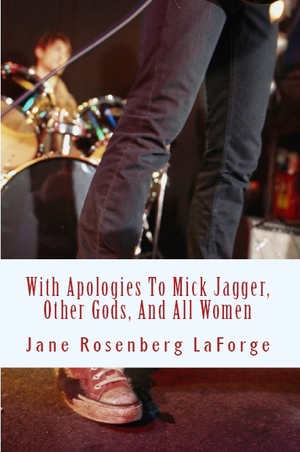
With Apologies to Mick Jagger, Other Gods, and All Women by Jane Rosenberg LaForge

With Apologies to Mick Jagger, Other Gods, and All Women by Jane Rosenberg LaForge takes a look at not only what it means to be young and full of dreams, aspirations, and confidence, but also the flip side of that — what it means to be older and confined by societal, professional, and personal constraints.  Her verse is topsy turvey with its own underground beat that shimmies out the fine-tuned truth that whether or not we are rock gods or ordinary people we are the same in how we are shaped and how we shape the world around us.  From hiding our wrinkles and our broken dreams to wearing them proudly, LaForge has crafted an unapologetic anthem about living, not merely surviving the world around us.

From "Prodigy":

It is youth that keeps you pale and concerned
about the smaller buzzing parts, the soil
and the pine cones there, and the grace
between fists and teacups.  You are a foil,
a reminiscence, a sobering glance forward
because nothing can be repeated, metric by 
metric; speaking the dream always changes it
irreparably, as if it weren't worth mentioning.
From "Apollo at 21st and 8th":

record we shed each day,
the accumulation of our pasts
that we deposit upon wood and 
polish, in the shafts and patterns
of directed sunlight.  Could gods
begin in dust and spit not as we have,

The collection is divided into two parts, and the first section, despite the title of the Mick Jagger poem, are hardly apologetic. From the crass way that age takes over the face to the abandonment of religion and faith in favor of the present and those rock stars before us on the television, LaForge chooses terse language clipped in the right places to give readers enough pause to encourage serious contemplation about aging and worship of the present. In “Runyon Canyon,” her narrator says, “It is not the soul that grows/in your bone, but a whistle;/as if a palpable friction between/lip and reed; a green-sweet taste/like hesitation and sympathy;” These images blend together to create a sound that hums.

In the second half of the collection, the poems are more personal, delving into the sorrowful images of disease and how the body can be ravaged even when the patient is in denial or at least trying to pretend they are not ill. LaForge takes a frank look at the grotesque found in the most beautiful relationships, including being sisters.  With Apologies to Mick Jagger, Other Gods, and All Women by Jane Rosenberg LaForge strikes a pose and has an opinion without apology, and don’t expect one.  The statements are bold and without explanation.  They just are.

About the Poet:

Jane Rosenberg LaForge’s poetry, fiction, critical and personal essays have appeared in numerous publications, including Poetry Quarterly, Wilderness House Literary Review, Ottawa Arts Review, Boston Literary Magazine, THRUSH, Ne’er-Do-Well Literary Magazine, and The Western Journal of Black Studies.


This is the 23rd book for my 2012 Fearless Poetry Exploration Reading Challenge.


This is my 82nd book for the New Authors Reading Challenge in 2012.

Thankfully Reading Weekend 2012

I’ve unofficially participated in Thankfully Reading Weekend, finishing Keys to the Repository by Melissa de la Cruz, beginning and finishing The Ghost Runner by Blair Richmond, and starting the book club pick Ripper by Stefan Petrucha and Misguided Angel by Melissa de la Cruz.

Challenge #1 was what is the perfect book recipe or reading recipe:

My favorite place to read is on the couch, generally lying down but propped up on pillows and with a glass of something ice cold (usually water) or something piping hot (like coffee or hot cocoa) — the beverage often depends on the weather.  The blanket can be fluffy, fuzzy, or just plain warm as long as the legs are covered.  As for a book…generally the writing has to be easy to follow, absorbing, and about things I enjoy reading about, which can either mean poetry, the environment, vampires, Ireland, Boston, or those struggling to find their identities or home.  I love internal struggles most of all, so books where the character is having an internal struggle are the most appealing.

Challenge #2 was about the book we’re most thankful for, and I have to say that its Thrall by Natasha Trethewey because it made me think about race and father-daughter relationships in a new way.  I loved that she used paintings and other artwork to illustrate her points, but that she also drew on the more personal aspects of father-daughter relationships.  And when you hear her read in person, you can just feel the emotion of these poems.  It has inspired me to find more books that move me in that way and to write poetry that will carry a more emotional rather than theoretical weight.

For Challenge #3, we were asked about our family reading traditions or memories about books; here’s what I shared:

Our family didn’t read much, but my nana read to us all the time and she let me loose in the library at a very young age, and I would beg my mother to take us many days of the week to reload my shelves. The love of reading is something I hope to pass onto my daughter, who already knows the word “read” and says it every time she picks up a book from the shelf and hands it to me. And when I’m working or busy with dinner, you’ll often catch her in a sea of books on the floor saying the few words she remembers from the books — reading to herself or her stuffed animals. Too cute. And it makes me proud.

I hope to at least get partially through a third book before the end of the weekend, so wish me luck.  I also cheer on everyone who is participating or not even participating, but reading.

Thrall by Natasha Trethewey

Thrall by Natasha Trethewey examines the lines between father and daughter and the African-American experience through a set of personal and analytical poems focused on race and culture.  In “Miracle of the Black Leg,” Trethewey examines the juxtaposition of white and black men in paintings and other artwork in which the leg of one man is taken and attached to the thigh of another man.  There are similarities in pain stricken faces in some images, paralleling their similar situations, but there are also clear disparities in how each man is treated, even if the leg is taken from a newly deceased person.  The imagery she chooses in this poem is particularly haunting, especially when taken in the historical context of how the images are presented throughout the years — with the black donor swept to the side and only the black leg as a representation of the whole.

"See how the story changes:  in one painting
     the Ethiop is merely a body, featureless in a coffin,
so black he has no face.  In another, the patient --
     at the top of the frame -- seems to writhe in pain,
the black leg grafted to his thigh.  Below him
     a mirror of suffering:  the blackamoor --" (page 11)
". . . The black man, on the floor,
holds his stump.  Above him, the doctor restrains
    the patient's arm as if to prevent him touching
the dark amendment of flesh.  How not to see it -- 
    the men bound one to the other, symbiotic --
one man rendered expendable, the other worthy
    of this sacrifice?  In version after version, even
when the Ethiopian isn't there, the leg is a stand-in,
    a black modifier against the white body," (page 12)

The title of the collection tells readers all they need to know about the topics covered, including the moral, mental, and physical slavery or servitude as well as the complete emotional absorption that can happen in relationships. As Trethewey examines works of art through a lens of racial demarcation, she also looks at daughters’ relationships with their fathers, which can sometimes be congenial and at other times turbulent. In “Knowledge,” she is looking at the dissection of a woman and the men who stand around her as the cut is made into her flesh, and Trethewey’s narrator concludes that her father was not just one type of man, but each of the men in the room — all at once contemplative, scientific, and artistic, even though at times she felt he were just one of those men.

It is easy to see why Thrall by Natasha Trethewey could captivate a packed audience at the Library of Congress when she was inducted as the newest U.S. Poet Laureate, and hearing a poet read their own work can be the best gift.  While her reading can enthrall you and bring you near tears, her careful word selection in each poem will ensure that you reflect on the meaning of each line in each verse before you even think about the overarching themes of separation and connection as well as their juxtaposition.  A collection that will be on the best of list for sure.

Check out the recap of the U.S. Poet Laureate Event.

This is the 22nd book for my 2012 Fearless Poetry Exploration Reading Challenge.

King Solomon’s Ring by Konrad Z. Lorenz

King Solomon’s Ring by Konrad Lorenz, an Austrian ethologist, is not your typical science book in that it is written with a less-scientific audience in mind.  Complete with minimal illustrations from Lorenz, the book does not read like a scientific experiment that can be precisely duplicated, but more like a series of observations and anecdotes from a man who invited the wild into his home.  Unlike King Solomon, Lorenz claims not to need a magic ring to learn the language of animals and to communicate with them.  While there are discussions of domesticated and wild dogs, among other animals, Lorenz mainly focuses on the behaviors of the water shrew, his aquarium fish, and the Jackdaw.

While considered a premier examination of animal behavior and discussing in detail the phenomenon of imprinting, on some occasions he appears to anthropomorphize these animals, making them seem more human than they are, particularly when discussing their mating rituals.  Lorenz also is very descriptive of the animals and their interactions with one another and with the humans who lived in the home and surrounding neighborhood.  These descriptions, while interesting to a scientist, may border on tedium for others.

“The whole charm of childhood still lingers, for me, in such a fishing net.”  (page 12)

“I intend to develop further this mixed breed, now that it has happily survived the war, and to continue with my plan to evolve a dog of ideal character.”  (page 142)

He raises some interesting questions about the parallels between certain species and humans in that some species, like humans, share their experiential knowledge of dangers and enemies with their young, rather than their young having an instinctual knowledge of what animals are their natural enemies.  Lorenz also discuss language and how body language is a lost art among humans, but is alive and well among animals, like yawning and smiling in humans to signify an emotion.

His wife must have had enormous levels of patience, though the bit about leaving their own child in a cage while the animals roamed free in the house and outside was hopefully a joke.  King Solomon’s Ring by Konrad Lorenz is light on scientific method and heavy on observation, but at times the descriptions get bogged down with too much detail even for a general audience.  For those who have studied imprinting and other aspects of animal behavior before, the book could seem very repetitive and far from engaging.  Additionally, there are moments where he pats himself on the back or the backs of his friends who achieve some interesting feats with animals, which can seem a bit self-serving.

About the Author:

Konrad Z. Lorenz ForMemRS was an Austrian zoologist, ethologist, and ornithologist. He shared the 1973 Nobel Prize with Nikolaas Tinbergen and Karl von Frisch.


This is my 81st book for the New Authors Reading Challenge in 2012.


What Book Club Thought:

This book, which was our November pick, really wowed one member of the book club, who said he learned a great deal from Lorenz and his theories about animals in his care, while most of us seemed to think that we’d learned all of the things he talked about in the book already through other sources — most likely in school or the animal channel.  The rest of us either thought it was an OK book or didn’t like it very much at all.  Our youngest member said that there should have been more about Penguins, though Lorenz lived in a place where Jackdaws were the most prevalent bird it seemed.  Two members found the chapter about dog ancestry and behavior the most interesting, particularly about the relationship to masters and one another in a pack versus the dog that prefers to be alone.

One heated discussion was about whether animals are intelligent or not, with one member playing devil’s advocate and insisting that animals act on pure instinct and are not problem-solving beings with intelligence.  In one scenario, the member suggested the lion would simply die in the arctic and be unable to problem-solve their way out of the situation or find food, but it was argued that there are different levels of intelligence in the animal kingdom and that some things can be learned by animals and other things cannot.  Additionally, there was a discussion about adaptability versus intelligence as well as the teaching of danger to young animals by their parents, much like humans teach their own children about dangers.

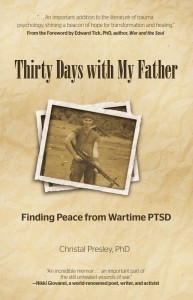
Thirty Days With My Father: Finding Peace From Wartime PTSD by Christal Presley, Ph.D.

Thirty Days With My Father:  Finding Peace From Wartime PTSD by Christal Presley, Ph.D., is the result of a 30-day project Presley undertook to get to know her father and his Vietnam War experiences after not relating for more than a decade, and she got much more than she expected.  Alternating between conversations wither her father and memories written down in her journal — the idea of her therapist — Presley relives parts of her own past just as her father does when speaking of Vietnam and what happened there.

Delmer Presley was drafted into the Vietnam War and never once thought about running off and dodging the draft, and he was a member of Americal Division, First Battalion, Sixth Infantry, referred to as the Gunfighters.  He entered the war following the Tet Offensive and came back a changed man.  While Presley’s book talks about his experiences as they were related to her during phone conversations and other encounters with her father, the memoir focuses mainly on Christal Presley’s intergenerational PTSD symptoms and childhood as it relates to those war memories.

Living in constant fear due to unpredictable behavior and other outside forces can cause heightened awareness fueled by adrenaline.  In the case of warriors and soldiers, this constant state of awareness can be hard to shake even when the unpredictability of the situation is removed and soldiers are sent home.  Consequently, the families that these soldiers return to find that their loved ones are altered, and in some cases, these situations can become very volatile and lead to unintended consequences, such as families subject to verbal abuse and more.

“‘I just didn’t consider those people human.  I never saw a Vietnamese before in my life, and I hated them.  We didn’t even call them Vietnamese back then.  Called them Charlies, dinks, and gooks.  That’s all I knew.  They taught us that.  I was trained not to see them as human.  The government can say whatever they want, but they trained us that way.  It hurt me more to see a dog or cat dead than them Vietnamese.  The government likes young boys who ain’t got no sense.  Easier to train, easier to brainwash that way.'”  (page 59 ARC)

The relationship between father and daughter always has been fragile.  The tentative nature with which Christal makes her calls to her father and feels him out before she asks each question is how readers would imagine any conversation to go given the years of silence between them, but particularly given traumatic nature of her upbringing.  Thirty Days With My Father:  Finding Peace From Wartime PTSD by Christal Presley, Ph.D., is about finding yourself amidst the chaos of family life, particularly a family life full of baggage, and about forgiveness for yourself and your family.  One of the most surprising and astonishing memoirs I’ve read in a long while.  It will have you re-evaluating your own conceptions about your childhood and how to repair relationships that have been damaged.

About the Author:

Christal Presley received her bachelor’s degree in English and her master’s degree in English Education from Virginia Tech.  She received her Ph.D in Education from Capella University. She is a former intern at Algonquin Books of Chapel Hill, and spent seven years teaching middle and high school English in Chatham and Danville, Virginia.

Her first book, Thirty Days with My Father:  Finding Peace from Wartime PTSD, will be published by Health Communications, Inc. in November 2012.

Christal grew up in Honaker, Virginia, and currently lives in Atlanta, Georgia. She is the founder of United Children of Veterans, a website that provides resources about PTSD in children of war veterans. In her spare time, you can find Christal playing with her dogs, tending to her chickens, and gardening.

***IF you would like to win a copy, leave a comment on this post about your interest by Nov. 21, 2012, at 11:59 PM EST***

This is my 80th book for the New Authors Reading Challenge in 2012.

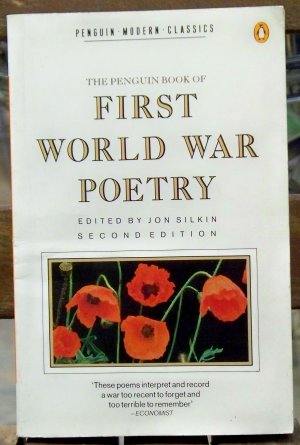
The Penguin Book of First World War Poetry (Second Edition) edited by Jon Silkin, David McDuff

The Penguin Book of First World War Poetry (Second edition) edited by Jon Silkin and David McDuff is a collection of poetry from and about the WWI.  Silkin and McDuff  increased the number of poems in translation included in the collection.  There are poems translated from German, French, Italian, Russian, and Hebrew, and Silkin was a poet himself.  As expressed in the not at the beginning, “For some, war was moral athletics; others looked forward to the experience of war as a ‘vacation from life’ — a vacation from a society disjoined by class and constrained by the rigid structures of labour.”  (page 12)

***However, I’m not one for long introductions so I skipped over it this time around and got straight to the poetry. ***

The anthology includes some of the more well known WWI poets, Thomas Hardy and Robert Graves, but also some who are not as well known.  One of the most well known WWI poems is “Anthem for Doomed Youth” by Wilfred Owen, which seeks to command a respect for the thousands who died in a cause for freedom and defense.  Steeped in religious allusions Owen makes reference to the candles lit where bodies lie and to the drawing of blinds in those same rooms as well as the prayers that often accompany the mourning process, but there also is an underlying celebration for their sacrifice as the bells are rung and anthems are sung.

Each of these poems brings with it a different perspective on war in the trenches, love, life, and loss, but above all patriotism.  Isaac Rosenberg’s “Dead Man’s Dump” (page 211) is particularly haunting:

"The wheels lurched over sprawled dead
But pained them not, though their bones crunched,
Their shut mouths made no moan.
They lie there huddled, friend and foeman,"

Meanwhile, there is a true sense of fear in Ivor Gurney’s “The Silent One,” (page 116):

"Who died on the wires, and hung there, one of two --
Who for his hours of life had clattered through
Infinite lovely chatter of Bucks accent:
Yet faced unbroken wires; stepped over, and went
A noble fool, faithful to his stripes -- and ended
But I weak, hungry, and willing only for the chance
Of line -- to fight in the line, lay down under unbroken
Wires, and saw the flashes and kept unshaken
Till the politest voice -- a finicking accent, said:
'Do you think you might crawl through there: there's a hole'
Darkness, shot at:  I smiled, as politely replied --
'I'm afraid not, Sir.' There was no hole no way to be seen
Nothing but chance of death, after tearing of clothes."

Each poet in the collection bring their own perspective to war, but there seems to be a pervading reverence to the fight these soldiers’ waged and all that they sacrificed.  There were certain translated poems in the book that didn’t resonate as well as some others, including Benjamin Peret’s “Little Song of the Maimed,” but it was good to revisit an old WWI poet, Osip Mandelstam (check out my earlier review of Stolen Air).  The Penguin Book of First World War Poetry (Second edition) edited by Jon Silkin and David McDuff offers a collection of poems that provide a wide perspective on war from the patriotism the soldiers felt to their fear and horror at the experiences they had.

About the Editors:

Jon Silkin was born in London, in a Jewish immigrant family and named after Jon Forsyte in The Forsyte Saga, and attended Wycliffe College and Dulwich College. During the Second World War, he was one of the children evacuated from London, and for a period of about six years in the 1950s, after National Service, he supported himself by manual labour and other menial jobs. He wrote a number of works on the war poetry of World War I. He was known also as editor of the literary magazine Stand, which he founded in 1952, and which he continued to edit (with a hiatus from 1957 to 1960) until his death.

David McDuff is a British translator, editor and literary critic. He attended the University of Edinburgh, where he studied Russian and German. After living for some time in the Soviet Union, Denmark, Iceland, and the United States, he eventually settled in the United Kingdom, where he worked for several years as a co-editor and reviewer on the literary magazine Stand. He then moved to London, where he began his career as a literary translator.


This review first appeared on Historical Tapestry for WWI Week.


This is my 14th book for the WWI Reading Challenge.


This is the 21st book for my 2012 Fearless Poetry Exploration Reading Challenge.

The School of Essential Ingredients by Erica Bauermeister

The School of Essential Ingredients by Erica Bauermeister is a novel about food and characters as original and complementary as the dinners they create during Lillian’s Monday night School of Essential Ingredients at her restaurant.  From the older couple Helen and Carl who are seasoned and aged by salted wounds and mellowing cream to the spunky and unsure experimental flavors of Chloe who strives to build her confidence in the kitchen and her relationships, Bauermeister has created a culinary masterpiece that will melt in readers’ mouths.

“The girl was a daughter of a friend and good enough with knives, but some days.  Lillian thought with a sigh, it was like trying to teach subtlety to a thunderstorm.”  (page 7)

“Some smells were sharp, an olfactory clatter of heels across a hardwood floor.  Others felt like the warmth in the air at the far end of summer.  Lillian watched as the scent of melting cheese brought children languidly from their rooms, saw how garlic made them talkative, jokes expanding into stories of their days.”  (page 17)

“The more she cooked, the more she began to view spices as carriers of the emotions and memories of the places they were originally from and all those they had traveled through over the years.  She discovered that people seemed to react to spices much as they did to other people, relaxing instinctively into some, shivering into a kind of emotional rigor mortis when encountering others.”  (page 20)

Readers will smell the food, taste it, touch it, and become inspired to create their own culinary delights at home and share them with their families and friends.  Bauermeister threads the memories and problems of each character through the movements and creations in Lillian’s cooking class, alternating points of view and providing insight into each of their lives.  The true beauty of her prose is that cooking terms are even used when cooking is not the main focus of the story, and she excels at creating a mood of melancholy or a mood of frustration or even a mood of nostalgia as each character reviews their lives and their journeys in the kitchen.

Although the stories contained in the novel are short, Bauermeister does a magnificent job of creating characters that are three-dimensional.  Like the spices and other ingredients in Lillian’s recipes, each character is an essential ingredient to the whole of the novel.  In many ways, her novel is about enjoying each moment to its fullest, even those moments of guerrilla cooking in which someone is over your shoulder adding spices or tips to make a dish better, even if those moments of advice are unwanted at the time.  Taking criticism and advice with a touch of acceptance that we all need a little help is what the recipe to life requires to make it great.  The School of Essential Ingredients will leave readers wanting more, but willing to embark on their own journeys of food and so much more.

About the Author:

ERICA BAUERMEISTER is the author of The School of Essential Ingredients and Joy for Beginners. She lives in Seattle with her family.  Check out her Facebook page.

This is my 79th book for the New Authors Reading Challenge in 2012.

Judging a Book by Its Lover by Lauren Leto

Judging a Book by Its Lover by Lauren Leto is a guide to the mind of readers everywhere, and it offers some great tips on how to fake it for readers who may not have read some contemporary or classic authors that everyone else has been.  Leto is like many of us in that she says, “Considering yourself a serious reader doesn’t mean you can’t read light books.  Loving to read means you sometimes like to turn your head off.  Reading is not about being able to recite passages from Camus by memory.  Loving young adult novels well past adolescence isn’t a sign of stunted maturity or intelligence.  The most important thing about reading is not the level of sophistication of the books on your shelf.  There is no prerequisite reading regimen for being a bookworm” (page 8).  To that end, she discloses that she’s likely to be found with the latest Janet Evanovich in her hand when she has to fly anywhere.

The initial confessions read like that of any bookworm, with the boxes and boxes of books moved from apartment to apartment and from makeshift bookshelf to re-purposed material made into a bookshelf — in her case, a couple of old ladders (page 13).  Leto even offers a funny little bit about changing the readers’ mascot from a worm to a cat, but one of the most ironic reasons in the book is because cats hold grudges (page 63) — like many do against James Frey from A Million Little Pieces, who offers a witty quote about Leto’s book on the cover.

Through a series of chapters of advice on how to fake having read a particular book, using vague statements and comparisons to popular movies and other writers you may have read, Leto has created an unapologetic homage to reading as entertainment, education, enjoyment, escapism, and understanding.  She even includes a chapter on rules for the book club, which means talking about book club with others not in your club or about the books you are reading in the club as well as how best to end a disagreement over something that happens in one of the books read by the group.  Her observations on members of a book club and their roles from the leader to the quiet (usually girl) member are in line with many readers’ experiences, including those who might even fit those character types in one group or another.

Some of the best aspects of this book are the snarky comments about authors and readers of certain authors, like those who adore Chuck Palahniuk are boys who cannot read and those who love Chuck Klosterman are boys who don’t read.  Leto’s comments about the “Literati,” a chapter with an alternate title of “Why Ernest Hemingway Once Told John Updike Literary New York Is a Bottle Full of Tapeworms Trying to Feed on Each Other,” is hilarious and a warning for those would-be writers out there.  Judging a Book by Its Lover by Lauren Leto is not really about judging anyone, but it is about having fun with books and reading, making connections even with strangers, and finding happiness in a bent page — to paraphrase her (page 245).

About the Author:

Lauren Leto dropped out of law school to start the popular humor blog “Texts from Last Night.” She co-authored the book Texts from Last Night: All the Texts No One Remembers Sending. She lives in Brooklyn.

This is my 78th book for the New Authors Reading Challenge in 2012.

The Help by Kathryn Stockett

The Help by Kathryn Stockett, which was my book club’s October selection, has been celebrated and made into a movie already.  Aibileen, Minny, and Skeeter share the narration for the 1960s segregated Jackson, Mississippi, as the lines blur between the races and to social classes.  While Skeeter’s social class is not as pure as it seems, the Black maids are struggling to make ends meet and hold their tongues even as others are engaged in sit-ins at the local Woolworth’s and marches.  Stockett carefully illustrates the social and color lines in the South, while also paying careful attention to the harsh realities of Black maids in white households.  This is not just a story about Black maids, but also about where stigma comes from, how it is perpetuated, and how it can be overcome.

“And I know there are plenty of other ‘colored’ things I could do besides telling my stories or going to Shirley Boon’s meetings — the mass meetings in town, the marches in Birmingham, the voting rallies upstate.  But truth is, I don’t care that much about voting.  I don’t care about eating at a counter with white people.  What I care about is, if in ten years, a white lady will call my girls dirty and accuse them of stealing the silver.”  (page 256)

Stockett has created a novel that gets readers thinking about their own environment and what they tolerate on a daily basis, even though they do not agree with certain things that happen or continue to be spoken in anger or prejudice toward others.  Like she notes in her “Too Little, Too Late” essay at the back of the paperback, no one in her white family who had a Black maid even thought about asking the maid what it was like to be Black in the deep south.  How many things that go on daily do we disagree with and dislike, but allow to happen without so much as a criticism or objection?

On one hand, readers are introduced to the Black maids and the prejudice they put up with from their white employers, and on the other hand, Stockett introduces Skeeter, a young woman returned from college to find that she is vastly different from her childhood friends, Hilly and Elizabeth.  While the parallel is lightly drawn and clearly not the same kind of prejudice on both sides, it does raise the question about what it means to create groups within a larger society to the exclusion of others.  Both avenues lead to great isolation and emotional pain, but the consequences of speaking out against that oppression are potentially more violent and devastating for the maids than for Skeeter.

The Help by Kathryn Stockett provides a balanced look at the love and disdain in the relationship between white women and families and Black maids, but it also tends to play it safer than one would expect given the volatile time period being discussed.  Yes, there are occasions of devastating tragedy, spousal abuse, and hints of other violent behavior, but truly the focus is less on the consequences of speaking out and more on the ties that bind each group to one another.  Stockett has chosen to show the complex relationships between these women given the societal constructs that constrain their actions and behaviors, even if they would wish it not so.

About the Author:

Kathryn Stockett was born and raised in Jackson, Mississippi. After graduating from the University of Alabama with a degree in English and Creative Writing, she moved to New York City where she worked in magazine publishing and marketing for nine years. She currently lives in Atlanta with her family. The Help is her first novel.


This is my 77th book for the New Authors Reading Challenge in 2012.


What the Eclectic Bookworms Thought (Beware of Spoilers):

Overall, we all enjoyed The Help and determined that it accurately portrayed the South, particularly the conflicted emotions of the Black maids and the children they raised.  It also demonstrated the poor logic that many white families used to determine what Blacks were good enough to do for them, but not good enough to share with.  For instance, Blacks cannot use the same bathrooms as whites because they are diseased, but at the same time, those maids can cook their families’ food and raise their children.

The group seemed split about which character they liked best, with some of us in favor of Minny, while others liked Skeeter and Aibileen best.  One of our female members said that Aibileen’s voice was the most balanced, and that’s why she liked her best, while our youngest member said that she enjoyed Skeeter best because she was an aspiring writer.  Personally, Minny’s kick ass attitude and yet vulnerability when it came to her husband and children made her both frightening and endearing — as well as a little bit vulnerable.

The club also discussed whether we would go as far as Minny to get revenge on Hilly, with only a few of saying that we would and a couple of us indicating we would have gone further.  At one point the discussion of slavery came up and whether the maids would have considered themselves still slaves or something more than that, but we all seemed to be on the fence about that question.  A discussion of other cultures’ use of slavery and how slaves could earn their way out was also mentioned, though none of us had any concrete sources on hand to discuss that too much in depth.

Other topics touched upon during the discussion include the friendship dynamics in Hilly’s group and how most of the women were subservient to Hilly and her approval, while others like Skeeter seemed to see that cow-towing to Hilly was wrong as well as how Minny and her family seemed to get by more easily than Aibileen who was on her own without any children.  We all enjoyed the book, though some of us would have preferred less about Stuart and Skeeter’s relationship and that other sections were trimmed down.  I personally enjoyed the additional insight into Skeeter and Stuart’s relationship after having watched the movie and found that part lacking in the film.

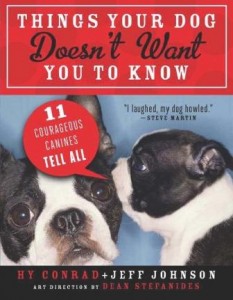
Things Your Dog Doesn’t Want You to Know by Hy Conrad and Jeff Johnson

Things Your Dog Doesn’t Want You to Know by Hy Conrad and Jeff Johnson is a humorous collection of stories from 11 dogs who bare all.  Not only do they divulge secrets about why those “pee” walks take so long, but they also enlighten dog walkers on the order that dogs should be taken out and why.  There are hijinks from dogs eating shoes and eating even mores hoes when owners lock them in the shoe closet, and there are dogs giving parenting advice to owners about their own puppies.

Sarge was one of the funniest given that he was a narcotics dog and became addicted to the pot that the police had him sniffing out.  He goes through several different jobs from junkyard dog to service dog.  He has trouble holding down a job.  Axelrod is another funny little dog who has a thing for herbs and incense given that there are herbal soaps in the bathroom, he thinks the herb garden outside is the perfect place to go potty since his owners seem to like the scent.

Conrad and Johnson have a firm grasp of the dog mindset and their seemingly erratic behavior from chasing cars to herding kids throughout the house.  A book you can dip into in the waiting room for entertainment, follow only one dog’s story from beginning to end, or read cover to cover.  Things Your Dog Doesn’t Want You to Know by Hy Conrad and Jeff Johnson is fun for dog owners, kids, those who love dogs, and anyone in between looking for a good chuckle.

About the Authors:

Best known for his work in mysteries, Hy Conrad was one of the original writers for the groundbreaking series, Monk, working on the show for all eight seasons, the final two as Co-Executive Producer. In a related project, Hy was Executive Producer and head writer of Little Monk, a series of short films featuring Adrian Monk as a ten-year-old.  His latest TV work was as writer and Consulting Producer for White Collar.

Hy is also the author of hundreds of short stories and ten books of short whodunits, which have been sold around the world in fourteen languages.  Hy’s first mystery novel series, Abel Adventures, will debut in 2012 with the publication of Rally ‘Round the Corpse.  And his first full-length comedy/mystery play, Home Exchange, premiered at the Waterfront Playhouse in May 2012.  He lives in Key West and Vermont with his partner and two miniature schnauzers.

Jeff Johnson spent most of his working life in advertising agencies, currently as General Manager of Cramer-Krasselt in New York City.  He is the author of The Hourglass Solution:  A Boomer’s Guide to the Rest of Your Life and co-authors (with Paula Forman) a national online advice column called Short Answers, which also appears in newspapers all along the east coast (from Massachusetts to Florida).  Jeff lives in Vermont and Key West and is on the Board of Directors of the Waterfront Playhouse and the Florida Keys SPCA.

This is my 76th book for the New Authors Reading Challenge in 2012.

Out of True by Amy Durant

Out of True by Amy Durant, blogger at Lucy’s Football, has a poignant dedication in the front:  “To everyone who doesn’t quite fit:  You do.  You will. Keep going.  You’re almost there.”  And in many ways, this dedication sets the tone for the collection.  There are a number of poems in the collection that talk about love and loss, but there also are those poems heavily focused on things and people that are just out of reach as the narrator continues to strive for the ultimate goal.

Durant has a frank style that not only clearly defines the poetic story, but also draws parallels from ancient myths and literature.  In “SYZYGY,” in which the moon and sun fall in love but are separated by the horizon, but Durant allows the celestial bodies to not only communicate through the tides and other messages.  The lines are written in the pattern of notes between married couples asking for the dishes to be washed and errands to be run.  But there is an undercurrent of disappointment as the narrator postulates that the sun will not rise and the evening will not bring the moon — the promises made that cannot be kept, like those between busy married couples and others that are forgotten or intentionally made knowing that they cannot be kept.

From "What We Build What We Destroy" (Page 20-21)

I like to build a fire; 
the ritual of it.  Placing the
small sticks, twisting the
paper, tenting the larger
logs.  The flames
licking around the edges,
teasing, like a schoolgirl
skipping along the edge
of a playground;

then the bite, the moment
the fish takes the bait, the
roaring upward, the rush,
the suck of air.  All eyes on
the dance of the flames.
I made this.  This thing that
can destroy:  I made this.

Readers will find her interplay of imagery fun, and perseverance becomes a strong message throughout the collection no matter if the narrator must let go of a past love or strive for a goal.  The cover ties the collection together with the stairway upward, signifying the struggle and the journey all at once with the light near the top of the stairs and the darkness below.  In many ways, this image demonstrates how each of us has a darkness in our lives that we journey away from, but at the same time that it can be present in the most enveloping way.  Particularly with the purposeful forgetting of high school memories in “Oubliette,” in which the narrator cannot catch up with those people she has forgotten even though the scars of what happened back then remain and are ever-present.  There is a truth in the forgetting that the narrator shares, illustration that the scars make up who she is even though she has forgotten the details of the faces of the perpetrators, which in itself may be a fallacy or a willful denial.

Out of True by Amy Durant is an emotional and insightful look at life’s travails and the decision to persevere and journey onward.  Durant’s debut poetry collection has a unique voice that highlights the harsh realities of life and love, but also the beauty of struggle and how it makes us not only who we become, but more than what we are.  Letting go is a must in this life, but also there must be a semblance of acceptance in order for humans to enjoy their lives, find joy, and evolve.

***Stay tuned tomorrow for an Amy Durant reading and giveaway***

About the Poet:

Amy Durant is a writer living in the Capital District of New York. She blogs frequently at her own site, Lucy’s Football, about far less serious things than this, and is lucky enough to write for Insatiable Booksluts about all things bookish. She is the artistic director for one of the many wonderful community theaters in her area and lives with a very cuddly but very spatially-impaired Siamese cat. Her book, Out of True, was published by Luna Station Press in August 2012.
This is the 20th book for my 2012 Fearless Poetry Exploration Reading Challenge.


This is my 75th book for the New Authors Reading Challenge in 2012.


From the Land of the Moon by Milena Agus, translated by Ann Goldstein

From the Land of the Moon by Milena Agus, translated from the Italian by Ann Goldstein, is the story of a young unnamed woman’s grandmother just at the end of WWII in Italy after the 1943 American bombing of Cagliari.  Despite the namelessness of the main characters, there are named secondary characters in the slim novel that provide it depth and the main characters some roots.  The granddaughter is telling the story of her grandmother after her death, reminiscing about the growth and change in family.

The life of this family has seem good times and bad times, with some members experiencing greater hardships than others.  The grandmother in particular has a number of suitors that fail to come back after several weeks due to rumors about her sanity.  Her own family keeps her at arms length and often hidden from public view unless necessary.  She’s the black sheep of the family, though from what we learn about her she has normal urges of a young woman and a desire for freedom.  More than that, she’s got a creative mind and a penchant for writing.

“One day my great-grandmother waited for her in the courtyard with the whip, made of ox sinew, and began to hit her until even her head was bleeding and she had a high fever.”  (Page 14)

After a number of miscarriages and failed pregnancies, the grandmother has little recourse but to take action and find away to rid herself of at least one health problem.  On a trip to take care of her kidney stones in the healing waters, the grandmother meets a young man, known only as the Veteran.  In many ways, they are the same, but they also have different tragedies to overcome.  He was a concentration camp survivor after being captured during the war, while she is an escapee from her family.  Like the many times destroyed home on Via Manno, families are built and rebuilt as the darkness is torn out of the house and light once again filters in through its large windows with new hope.

From the Land of the Moon by Milena Agus, translated from the Italian by Ann Goldstein, is about family and how it can be ripped apart and held together by secrets.  But it also is about dreams and love, and the sacrifices we must make to live into the future.  In many ways, its about the perseverance of our ancestors and how they can shape us in the future, even without our knowledge.

About the Author:

Milena Agus was a finalist for the Strega and Campiello prizes, and was awarded the prestigious Zerilli-Marimò prize for Mal di petra (From the Land of the Moon). It is her first novel. Agus lives in Cagliari, Sardinia.

About the Translator:

Ann Goldstein is an editor at The New Yorker. For Europa Editions, she has translated three novels by Elena Ferrante—The Days of Abandonment, Troubling Love, The Lost Daughter—Clash of Civilizations Over an Elevator in Piazza Vittorio, The Chill by Romano Bilenchi, The Father and the Stranger by Giancarlo de Cataldo, and The Worst Intentions by Alessandro Piperno. Her translation of Linda Ferri’s Cecilia is forthcoming in May 2010. She received a PEN Renato Poggioli Translation Award and was a visiting scholar at the American Academy in Rome. She is currently editing the complete works of Primo Levi, for which she received a Guggenheim Translation fellowship. She lives in New York.

This is my 74th book for the New Authors Reading Challenge in 2012.