Quantcast

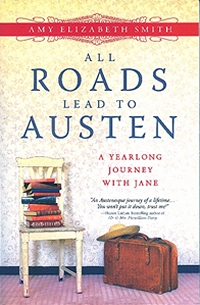
All Roads Lead to Austen by Amy Elizabeth Smith

All Roads Lead to Austen by Amy Elizabeth Smith is the memoir of one college professor’s journey through Latin America discussing Jane Austen’s books with book clubs and having a misadventure of her own that changes her life.  Her enthusiasm for the trip is infectious.

“Was I nervous about spending a year away from family and friends, trying to function in a foreign language I had a tenuous grip on while convincing several dozen people in six different countries to join me for book groups? Hell, yeah.  Was I excited about the trip anyway? Hell, yeah.” (page xiii ARC)

She decides to discover if Jane Austen’s Sense & Sensibility, Pride & Prejudice, and Emma can carry the same sway with Latin and South Americans that it does with Americans and Europeans.  She visits not only Mexico and Guatemala, but also Ecuador, Chile, Argentina, and Paraguay, and she finds that underneath all the stereotypes and prejudices, each of has a base need for family, acceptance, love, and support.  Smith’s memoir highlights not only her insecurities about committed relationships and her conscious efforts to avoid stereotyping or relying on her assumptions of various cultures when meeting new people, but also her quirkiness at making each temporary apartment or hotel feel more like a home by decorating it with statues, blankets, and other items.  She’s also like many readers, a book collector and completely helpless when it comes to saying no to books in a bookstore.  Her over-packed luggage and rising airport fees are a testament to her journey to South American and Latin American bookstores, especially as she seeks recommendations who compare to Jane Austen from the local residents.  All the while, she’s learning Spanish and immersing herself in the language at every turn.

“One of the fun features of Spanish that English lacks is the capacity to create nouns that express behaviors out of other nouns or verbs.  So a dog is un perro, and behaving like a dog to somebody (see how many words that takes?) is una perrada.  Behaving like un burro (donkey) translates into una burrada and un cochino (a pig), una cochinada.”  (page 21 ARC)

There are moments when she falls ill and cannot recall the names of the book group members, which readers may find a bit disrespectful given the time these men and women gave her for the book group discussions.  What would really have added to the memoir would have been better descriptions of the places she went or saw or perhaps the inclusion of pictures from some of these locations.  However, these are minor quibbles given the societal and social insights the memoir provides as a bungling American travels through unfamiliar countries.  More than a discussion of Jane Austen and her books, All Roads Lead to Austen by Amy Elizabeth Smith is an examination of one woman’s journey through other worlds and learning how to go with the flow and find her own happiness in a world that moves blindingly.

About the Author:

Amy Elizabeth Smith, originally from Pennsylvania, teaches writing and literature at the University of the Pacific in Stockton, California. Her memoir, All Roads Lead to Austen: A Yearlong Journey with Jane (Sourcebooks, June 1, 2012) recounts her year spent learning Spanish and holding Austen reading groups in Guatemala, Mexico, Ecuador, Chile, Paraguay, and Argentina.

This is my 48th book for the New Authors Reading Challenge 2012.

Wonderstruck by Brian Selznick

Wonderstruck by Brian Selznick is a quick read even at 600+ pages, and is a middle grade novel that pairs words and images to tell a heartfelt story of family, discovery, and understanding.  Ben, who has one good ear, has lost his mother in a car accident in 1977 Minnesota and is thrust into his aunt’s home with his cousin Robby, who isn’t too keen on sharing his room.  Ben by all accounts is a curious and shy boy, whom his mother showered with love and attention, encouraging him to scavenge for mementos along the way, which he kept in his museum box.  The loss of his mother weighs heavily on him, and upon discovering his other cousin, Janet, in his mother’s room, he decides to remain behind and feel closer to her.

Meanwhile, Rose’s story is told in drawings set in New Jersey and New York City.  The narration shifts from the present (1977) and Ben’s story to Rose’s story in 1927.  Their stories parallel one another at various points after Ben makes the fateful decision to run away to find the father he has never known.  Wolves, nature, and the Big Apple loom large in both stories as Ben and Rose make their way into the unknown.

Selznick’s prose has an easy flow between the illustrations and the text, and given that both stories are told in separate mediums, it is easy for younger readers to keep them straight. Most readers will note the parallels in the two stories and likely will uncover the final destination long before the last page is turned. The illustrations are detailed in some cases, but there are moments where the illustrations seem to be just filler pages to increase the suspense associated with Ben’s story of self-discovery. Rose’s story could have been told in fewer pages and more sparsely spaced throughout the book and the connections would still have been present.

“The curator then must decide exactly how the objects will be displayed.  In a way, anyone who collects things in the privacy of his own home is a curator.  Simply choosing how to display your things, deciding what pictures to hang where, and in which order your books belong, places you in the same category as a museum curator.” (page 98-9)

Additionally, readers may find that they wanted more about the teasing Ben endures as a boy with only one good ear and who does not know sign language, as well as more about Rose’s story as a young deaf girl in the late 1920s who is sheltered a little too much by her parents.  However, Selznick doesn’t always need a pencil to paint a picture of readers, especially when he can do it so well with words.

“Jamie came and sat next to him as the sky filled with shooting stars.  The projector rotated, the view changed, and the boys found themselves inside a meteor, hurtling across the sky.  They flew to the moon and bounced between craters.  One by one, the planets drifted into view, and soon they were out beyond the solar system, gazing down on the universe like ancient gods.  Ben thought of the glow-in-the-dark stars in his room, and the Big Dipper, and the quote about the stars, and his mom.  The glowing lights above him spun and swirled, tracing endless patterns against the perfect dome of the ceiling like a million electric fireflies making constellations in the dark.”  (page 406)

Wonderstruck by Brian Selznick definitely will appeal to younger readers and illustrators, but it should not be discounted as a fluffy YA novel.  There is a deeper message about finding one’s place outside your own family, about discovering new places and wonders, and about finding the courage to take chances.

What the Book Club Thought (beware of spoilers):

Wonderstruck was the selection of our youngest member, The Girl from Diary of an Eccentric. She prepared discussion questions ahead of time to see what everyone thought of the entire book, the way the two stories were told, and whether anything surprised us. We also discussed what each of us would put in our own museum boxes, and answers ranged from coin collections and shells to Red Sox and Patriots stuff to pictures, stuffed animals, and other sentimental items.

We had an interesting discussion about the “Captain Obvious” nature of some of the prose (The Girl’s words, not ours), and about whether who Rose was or how the stories came together surprised any of us. Most of us were not surprised to find out who Rose was, but I was surprised to learn who Walter was. Many of us agreed that Rose’s ability to cut up a book for the deaf and create a paper replica of NYC was fantastic, and I particularly liked how one of the buildings she made had the picture of the mouth on it from the book. One of the male members liked elements of the story individually, but not how they came together as a whole. Overall, it seemed like most of us enjoyed the book, though two members were absent from the discussion this time around.

Next month is my selection, When She Woke by Hillary Jordan, and one of our members has already finished it and is itching for discussion.

About the Author:

Brian Selznick is the illustrator of “Frindle” by Andrew Clements, “Riding Freedom” and “Amelia and Eleanor Go For A Ride,” both by Pam Munoz Ryan; as well as his own book “The Houdini Box,” winner of the 1993 Texas Bluebonnet Award. Mr. Selznick lives in Brooklyn, New York.


This is my 47th book for the New Authors Reading Challenge 2012.

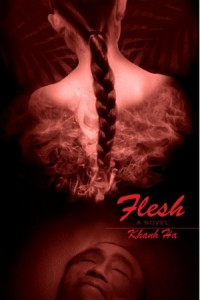
Flesh by Khanh Ha

Flesh by Khanh Ha is dark and dreamlike.  Tai’s coming of age story is fraught with trauma and hardship, but he maintains his determination and remains grounded despite the beheading of his father at the hands of his granduncle in Northern Vietnam.  Ha has woven a dark love story within Tai’s trip through adolescence that takes him to Hanoi and other places as he searches for the man who turned in his bandit father to the authorities.  Part dark adventure, Tai is thrown into the world of Vietnam’s opium dens and indentured servitude as his mother barters him away to pay for a safe, final resting place for his father and younger brother.

“He could not tell which one was my father’s as he passed under the banyan tree.  Those were the same heads he saw in the rattan baskets, but now they had no eyes, only black sockets with grubs crawling in them.  He spotted a hole bored under each jaw, and a rod was pierced through it to the top of the skull and into a limb.  The heads looked out in different directions, and in the early morning light they bore a pinched look neither of hurt nor sorrow.”  (page 18)

Each chapter reads like a short story, a memory recalled by Tai about his journey and the impact is at once immediate and lasting.  Readers are piggybacking on Tai’s shoulders as he runs through the jungles of Tonkin and the streets of Hanoi as the dark, mysterious Frenchman chases him and he bumps into Xiaoli, a young Chinese girl working in an opium den.  Ha’s prose is poetic as it paints the scene in which you can smell the opium, see and hear the brown of Tai’s village and the busy streets of Hanoi, and feel the delirium of smallpox or his pulse quicken as he begins to fall in love.

“The bank was steep.  I was a salamander, half naked, creeping on the clay soil, seizing knotty vines that bulged across the incline.  The dark odor of sundered organics.  Lying flat on the ridge of the bank, I felt unusually warm, and then a suffocating heat hazed my eyes.”  (page 42)

Tai’s journey is through darkness and fear, and Ha raises questions of nurture vs. nature — whether we are only who we are because of who our parents were or the circumstances in which we were raised.  From the atmosphere to the myths and legends, Ha generates a novel that will capture readers from the beginning, but there are times when the dialogue is a bit trite and wooden.  However, as there is little dialogue per se and that dialogue is often between characters that know little of the other’s language, it can be forgiven.

Flesh by Khanh Ha is a stunning debut novel that showcases the writer’s ability to become a young male narrator whose view of the world has been tainted by his life circumstances and tragedy, but who has the wherewithal to overcome and become a better man.  Through a number of twists and turns, Tai must come to terms with the loss of his father, his obligations as the remaining male member of his family to care for his mother, and the secrets that his culture and family hide.


About the Author:

Khanh Ha was born in Hue, the former capital of Vietnam. During his teen years he began writing short stories which won him several awards in the Vietnamese adolescent magazines. He graduated from Ohio University with a bachelor’s degree in Journalism. Flesh is his first novel. He is at work on a new novel.

Visit the author at his website.


Click for Tour Stops

This is my 46th book for the 2012 New Authors Challenge.

Guardians of the Gate by Vincent N. Parrillo

Guardians of the Gate by Vincent N. Parrillo is a historical fiction novel about Ellis Island between 1893 and 1902 as immigration to the United States increases, particularly from Italy and other non-northern European nations, and sentiment in America turns against immigrants.  Dr. Matt Stafford and his wife have moved to New York City and are living the high life with a very busy social calendar as he works at Presbyterian Hospital.  After losing a child in a miscarriage, their relationship fractures and each seeks satisfaction in life through different means — Peg through social activities and Matt through his job as a surgeon and ultimately as a doctor at Ellis Island.  Stafford is a likeable doctor and clearly cares about his patients and learning different languages and cultures, but his morals become more flexible when his wife’s ailment takes a turn for the worse and he spends more time with a lovely nurse at Ellis Island — a relationship that starts too quickly given the set up of the nurse’s character as aloof and consummately professional, even shying away from small talk with co-workers.

Meanwhile, nearly half of the book is spent with Ellis Island’s lead administrator Dr. Joseph Senner, whose heavy handed management style rubs personnel the wrong way, but endears him to his kindred German immigrants.  Senner expresses his concerns about the operations at Ellis Island openly and sets about making changes.  Senner is aloof to his workers and his German accent remains thick, even after 13 years in America.  Parrillo’s adherence to the use of “v” rather than “w” and other typical German-American accented English words continue to pull the reader out of the story and could have been phased out early on after the cadence had been well established.  Given the aloof nature of Senner’s character from his employees, the relationship in the latter half of the book between him and Dr. Stafford is surprising.

“The impact of this grand hall was striking.  The hall was virtually the full size of the building itself.  Its vastness was enhanced by the cathedral ceiling and the light — even on this overcast day — that filtered through the tall, eave-high windows.  A wide-planked pine floor, resembling a sailing ship’s deck so familiar to the arriving ocean voyagers, set off the woodwork.  The place even seemed to have the scent of a ship.  Ten parallel aisles, framed by railings, marked where the immigrants began the screening process.  Potted plants, American flags, and red, white, and blue bunting festooned the hall.”  (Page 5)

However, Parrillo is clearly a student of Ellis Island history as details about the island, the immigrants, the inspection procedures, and even the buildings themselves pour into the dialogue between Senner, who is a new administrator, and his assistant Ed McSweeney.  The facts and figures, plus the inclusion of photographs from the real Ellis Island provide this historical fiction novel with a unique style, mimicking a piece of nonfiction.  There are good and bad workers on Ellis Island, but the story is less about them and the immigrants than it is about Stafford and his troubled love life.

While Parrillo does include fictionalized accounts of immigrants coming to Ellis Island and their histories, the prose merely tells and does not show the emotion of these characters, as it does when the immigration officials interact.  While the plot and Dr. Stafford anchor the story and keep the pages turning, readers may want greater depth from Parrillo’s characters who at times are wooden in their actions and conversation.  With that said, the historical details of the bureaucracy related to Ellis Island, the corruption of immigration officials, and the procedures that had to be put in place to accommodate an influx of immigrants is interesting.  Through carefully selected details, Parrillo ensures that Ellis Island comes to life, nearly becoming a larger-than-life character of the book and stealing the show from Dr. Stafford and others.

Guardians of the Gate by Vincent N. Parrillo is a satisfying look at Ellis Island’s struggles in the beginning of the 1900s as immigrants began flooding America’s shores.  Parrillo is adept at blending in historic details and data into his prose, bringing to life the historic buildings and struggles of those entering the country and those helping them enter.  Those interested in Ellis Island’s history (complete with photos) and immigration will enjoy the historic parts of the novel.

About the Author:

VINCENT N. PARRILLO is a professor of sociology at William Paterson University of New Jersey. An internationally recognized expert on immigration, he is the executive producer, writer, and narrator of the award-winning PBS television documentary, Ellis Island: Gateway to America (1991). He currently lives in northern New Jersey.

This is my 45th book for the 2012 New Authors Challenge.

Haunted (6:1 Series, Volume 1) by Janel Gradowski

Haunted (6:1 Series, Volume 1) by Janel Gradowski is part of her six stories with one theme series and was the first she published as an ebook after much success in publishing her flash fiction in literary journals.  This collection is a quick read and can be read in about a day.  There is a surprising breadth of characters and situations representing the theme from a woman haunted by her jilted lover to a ghost unaware of his present state.

There are six stories in the collection: “Sequestered,” “New Friends,” “Retirement,” “Grandma’s Treasures,” “Uncleansed,” and “Strangers.”  Each cast of characters is haunted in one way or another whether by the past, the supernatural, or their deeds.  Among some favorites in the collection are “Sequestered,” “Strangers,” “Grandma’s Treasures,” and “Uncleansed” that have very dynamic characters in normal situations that turn a bit abnormal.  However, “New Friends” reminded me of other stories involving ghost children causing mischief in houses and mothers who don’t believe their children at first and think that their kids are exhibiting signs of trauma.  Readers may want a new twist in this kind of story, but the characters of Wendy and her daughter Mia are playful and have a charming relationship that makes them endearing.

In “Sequestered,” Stacie is jilted by her fiance and escapes to the woods to forget.  Haunted by a unrequited love and a future that can never be, she gets more than she bargains for.  The ending will knock the socks off readers, and there are some great descriptions in this short story.

“Naked trees contorted like tortured skeletons in the frigid, autumn wind.”

“Wisps of fog rose from the lake’s glassy water, materializing like an army of ghosts.”

Even in “Retirement,” Gradowski has a way of painting the scene so that readers are captured by the moment and emotionally charged.  “Autumn thunderstorms are always more vicious than their summer counterparts, like they are enraged by the cold air.”  She generates the heartache of Cecily as a palpable being that reaches beyond the page, haunting not only the character created, but also the reader.

Readers can identify with the oddities of family members from the crazy grandmother to the strange behavior of parents after a tragic event and the rituals they rely upon to keep their sanity.  “Grandma’s Treasures” and “Uncleansed” explore these relationships and their odd rituals in a unique way and each story uncovers family secrets that the protagonists Lindsey and Eva, respectively, never expected.

Haunted (6:1 Series, Volume 1) by Janel Gradowski is an excellent debut from a talented flash fiction and short story writer.  Short story is a difficult form to generate connections between readers and characters, but Gradowski achieves this easily through her word choices and narrative flow.  Haunting prose, unique characters, and surprising twists will keep readers coming back for more.

About the Author:

Janel Gradowski grew up, and still lives, in the mitten of Michigan. She is a wife and mother whose writing companion is a crazy Golden Retriever named Cooper. In the past she has worked many jobs. Renting apartments, scorekeeping for a stock car racetrack and selling newspaper classified advertisements are some of the experiences that continue to provide inspiration for her stories. Now she writes short fiction and is also a beadwork designer and teacher.

Her work has appeared in many publications, both online and in print. The 6:1 Series features themed collections of her stories. Each volume will have six stories, a mix of flash and short fiction, that are based on the title’s theme.  Visit her blog, Janel’s Jumble.

***And yes, for those keeping track, this is the second item I’ve read on my Kindle.

This is my 44th book for the 2012 New Authors Challenge.

Archie’s War: My Scrapbook of the First World War 1914-1918 by Marcia Williams

Archie’s War: My Scrapbook of the First World War 1914-1918 by Marcia Williams is the story of ten-year-old Archie Albright, who receives a scrapbook from his uncle Colin.  Archie is a boy living in East London, England, who’s in love with drawing and comics, and he’s a got a best friend named Tom and a dog named Georgie.  In the book he explains a little bit about his family, particularly his 16-year-old sister’s interest in voting.  Once talk about Austria declaring war on Serbia begins, Archie’s house becomes divided with his grandmother and father in favor of Britain entering the war, and his sister against the war and eager for peace to remain.  Once Germany invades Britain’s ally Belgium, Britain has little choice but to enter the war.  Archie’s scrapbook includes a nice break down of which countries were allied with Germany and which were allied with Britain, and it includes copies of news articles reminiscent of the time period.  Plus, there is a running body count, which is something that young boys would likely keep track of.

Unlike other scrapbooks that merely use memorabilia and newspaper articles, etc. to depict the time period and the events in the story, Williams has incorporated comics as a young boy would draw them, complete with images of his family in hilarious poses, slapping and biting of siblings, and other typical family events of the time period.  Even in spite of Archie’s jokes and comics, it is clear that the war has him rattled as adults talk about German residents as if they could be spies.  He even pees out the window of his room rather than go to the outside bathroom to avoid a German attack, though when his grandmother finds out about his antics, he’s scolded and yet resolved to continue peeing out the window rather than go outside.

There are other more serious moments, like when Archie’s father goes off to war with his Uncle Derek and his mother and older brother begin working outside the home.  Nurse Edith Cavell‘s story is depicted in comic form as well, with Archie saluting her bravery.

Archie’s War: My Scrapbook of the First World War 1914-1918 by Marcia Williams is a fun way to introduce WWI to kids and provides parents an interactive tool to teach history to children in a way that will not bore them.  The colorful drawings are things that children can easily relate to, and the newspaper clippings provide the book a nuanced historical accuracy.  Williams does well including letters and mementos as well as stories that accurately depict the times of rationing, women heading to work outside the home, soldiers dying or returning shell shocked, and more.  Archie’s world changes before his eyes, and he can do little else but roll with the punches and record his family’s history.

About the Author and Illustrator:

Marcia Williams is famous for her retellings of classic stories. From Shakespeare and Dickens to the Canterbury Tales and Greek Myths, her humorous comic-strip illustration is hugely popular all over the globe. She lives in London.  Visit her fun Website.

This is my 11th book for the WWI Reading Challenge.


This is my 43rd book for the 2012 New Authors Challenge.

The Wonder of It All by Elizabeth P. Glixman

The Wonder of It All by Elizabeth P. Glixman is a very small volume of poetry, but has a large sense of humor that will at times have readers giggling to themselves about the absurdity of it all.  Many of the poems are very much in the here and now of the moment.  The collection can fit in your pocket and can be taken out on the subway ride in between stops.

One of the best in the collection is “The Man from TSA — Unrequited Love Did Not Stop Glenn Close,” in which the narrator opts not for the scanning machine, but the gloved hand of a TSA agent and falls in love — or is it obsession?  Pop culture references infuse these poems, grounding readers in their own lives to draw parallels, but oftentimes the situations are too surreal for readers to connect with.  In a way, this may be the point that Glixman is trying to get to — that life is a series of absurd moments that we categorize to make sense of them and their meaning.

Other poems, like “Avalanche Worry,” have a tongue-in-cheek humor to them, telling readers to always have a cell phone, a year’s supply of groceries on hand, and other supplies so they are prepared.  But many of these poems are narrations of moments, offering vignettes, but little else.  While these characters and stories are fun and humorous, they lack the poetic nuance many readers are looking for in terms of images and larger connections to the human condition.  However, there are gems in this collection that poke fun at pop culture and its pervasiveness, including “The Wonder of It All” in which Minnie Mouse is transformed into a flirtatious girl, like Brittany Spears.

The Wonder of It All by Elizabeth P. Glixman is a mixed bag of poems, but entertaining in fits and starts.  There are some poems that could have ended sooner and more powerfully, but there are others that are deftly crafted.

This is the 17th book for my 2012 Fearless Poetry Exploration Reading Challenge.


This is my 42nd book for the 2012 New Authors Challenge.

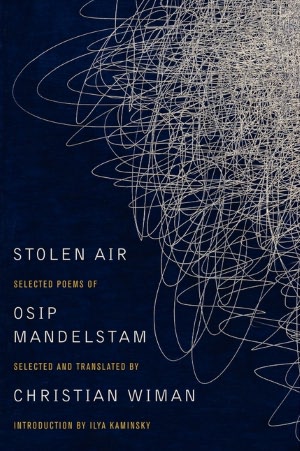
Stolen Air by Osip Mandelstam, translated by Christian Wiman

Stolen Air by Osip Mandelstam, translated by Christian Wiman is a selection of poems from Mandelstam’s entire career translated from his non-native Russian into English.  The introduction is rather long, but with good reason as it strives to capture a poet that was always evolving and striving to breath new life into the Russian language and to provide a voice to those seen as outsiders of the government.  Living through WWI and a Russian revolution, Mandelstam — a Poland born Jew who moved to Russia with his parents — became an exile and later died in a Siberian transit camp in 1938 after being arrested.

“From the inarticulate comes the new harmony.  The lyric poet wakes up the language:  the speech is revealed to us in a new unexpected syntax, in music, in ways of organizing the silences in the mouth.”  (Page XIX)

Mandelstam and Wiman approach poetry in much the same way, according to the introduction — not through word-for-word translation, but through the silences and the music of the lines.  The collection is broken into three sections beginning with his early poems between 1910 and 1925 and ending with the poems written between 1934 and 1937.  Mandelstam’s work is very musical and generally uses a great deal of rhyme and alliteration, but the ways in which these poems are translated, they are neither cutesy nor predictable.

Interrogation (page 21)

Official paper, officious jowls, unswallowable smells
Of vomit, vodka, cells, bowels,
And all these red-tape tapeworms gorging on reports.

Choir, stars, your highest, your holiest silences...
But first, sign here on the dotted line
That they may grant you permission to shine.

The poems are song-like, but ripe with derision for Stalin’s totalitarianism and the control over freedom, which provided many with the guise of free expression that was received at a high price. Mandelstam speaks of a life choreographed by others and punishments that are deeply harsh when spontaneity strikes. His words are like hammers on the chains attached to boulders in prisons of old, making sure the lack of freedom is felt most acutely. From the “legislated” freedoms to the starvation and lack of heat, it is all present in Mandelstam’s roving poetry. He moved from city to city, presumably fleeing the government, and this movement is in poems like “Night Piece” and “Prayer” but it also is in the other poems through their quick imagistic movements from one moment to the next — the narrator always in motion.

Stolen Air by Osip Mandelstam, translated by Christian Wiman is not only about the absence of freedom, but finding that freedom within that totalitarian regime — grabbing onto it, stealing the air to breathe creatively. The narrator has learned to grab onto that stolen air and run with it, traipsing through beauty and finding the music everywhere, even in the darkness.  The translation does not read as such with very few moments where the verse stumbles, and this is the best tribute to a poet — a translator who hears the same music even across time.  Well done and highly recommended.

About the Poet (from Poets.org):

Born in January, 1891, in Warsaw, Poland, Osip Emilievich Mandelstam was raised in the imperial capital of St. Petersburg, Russia. His father was a prominent leather merchant and his mother a teacher of music. Mandelstam attended the renowned Tenishev School and later studied at the Sorbonne, the University of Heidelberg, and the University of St. Petersburg, though he left off his studies to pursue writing. He published his first collection, Kamen, or Stone (1913), when Russian Symbolism was the dominant persuasion.

The Bolsheviks had begun to exert an ever increasing amount of control over Russian artists, and Mandelstam, though he had initially supported the Revolution, was absolutely unwilling to yield to the political doctrine of a regime that had executed Gumilev in 1921. The poet published three more books in 1928—Poems, a collection of criticism entitled On Poetry, and The Egyptian Stamp, a book of prose—as the state closed in on him. Mandelstam spent his later years in exile, serving sentences for counter-revolutionary activities in various work camps, until his death on December 27, 1938, in the Gulag Archipelago.

About the Translator:

Christian Wiman was born and raised in West Texas. He is the editor of Poetry and the author of three collections of poems, Every Riven Thing, Hard Night, and The Long Home, and one collection of prose, Ambition and Survival: Becoming a Poet.

This is the 16th book for my 2012 Fearless Poetry Exploration Reading Challenge.


This is my 41st book for the 2012 New Authors Challenge.


This is my 10th book for the WWI Reading Challenge.

Darkroom by Joshua Graham

Darkroom by Joshua Graham is mind-blowing, fast-paced, secretive, and conspiratorial.  Conspiracy theorists, anti-government advocates, and the generally suspicious of all things military and political must read Graham’s book.  Mixing in elements of reality with those of fiction, Graham aptly captures the disillusionment with the Bush Administration just before the election of President Barack Obama and the fervor behind a movement for change that got our current president elected.

However, in this case, the candidate for change is independent, former Vietnam War military star Richard Colson.  He exudes confidence and decisiveness, even in the face of his wife’s health misfortunes and the continuous emergence of his past that must be addressed.  Cover-ups, suspicious natural and accidental deaths among members of the Vietnam War’s Echo Company, disappearing college students, and other events pepper the narrative, but Graham has written a story that is ultimately about faith in ourselves, our beliefs, and the uncharted.

Peter Carrick, a photojournalist from the war and friend of Colson’s, is a distant father, despite his daughter Xandra’s attempts to win his approval through cello recitals and her career as a photojournalist.  The death of Grace, Xandra’s mother, brings the story full circle as Peter and his daughter fly to Binh Son, Vietnam to scatter her ashes as she’s requested, but what the trip brings forth is ugly, horrifying, and disconcerting.  Soon Xandra is caught up in a case she has no physical connection to, and is guided only by the mysterious visions she sees in the darkroom when she develops her photographs.

“To my surprise, when we pass the wall of trees, the ground is level and clear.  Charred black, the skeletal frames of several farmhouses shudder, as though one strong gust could blow them away like dandelion spores.  The rest are simply dirt pads where other homes once stood.”  (page 16 ARC)

Alternating from the Vietnam War where Peter Carrick meets his wife Grace and falls in love to the present where his daughter is caught in an investigation that turns into a hunt for her as she becomes a fugitive, Graham has created not only a dynamic protagonist in Xandra who must overcome her incessant need to please her father and gain his approval, but he’s created secondary characters like her father, Colson, Agent Kyle Matthews, and others who are just as complex.  Book clubs would have a ton of topics to discuss from faith to whether not telling someone something or a lie by omission is still lying.  Further, readers will likely discuss the variety of conspiracy theories that have persisted throughout politics, including the true perpetrators of the JFK and MLK assassinations.

Darkroom by Joshua Graham is more than compelling, it’s engrossing with its alternating points of view in different chapters enabling the story of the Vietnam War to be filtered through the eyes of characters in the present and the conspiracy to unravel at a far more breakneck pace toward the end.  Graham is not afraid of unhappy endings nor afraid of making the tough choices to kill off integral characters, but have faith because all is not as it seems.

About the Author:

Joshua Graham is the award winning author of the #1 Amazon and Barnes & Noble legal thriller Beyond Justice. His latest book, Darkroom, won a First Prize award in the Forward National Literature award and was an award-winner in the USA Book News “Bests Books 2011” awards. Connect with Josh at his Website, Facebook, and on Twitter.

Also, check out this month’s guest post about the power of photography.

This is my 40th book for the 2012 New Authors Challenge.

Check the other tour stops

City of Thieves by David Benioff

City of Thieves by David Benioff, which was the May book club selection, is set during WWII on the Western front of the war between 1942 and 1945, though mostly during the nearly 900 day siege of Leningrad, which was cut off from supplies of food and more.  Lev and Kolya are thrown together by circumstance when Lev is arrested as a looter when a dead German is found in his neighborhood and he’s discovered taking items off the body and is sent to the Crosses.  Kolya a Red Army deserter is thrown in the Crosses where he meets Lev.  The dynamic between these characters is full of initial paranoia, which morphs into irritation and finally camaraderie.  Kolya loves to chat about anything and everything, but he’s particularly boastful about his sexual exploits and his experience with just about everything related to war.  He’s pompous but in a comical way, and he reminds me of those wise jesters in the king’s court who uses humor to slice to the root of truth, even at times when it could be fatal.  Lev is a young boy who often portrays himself as an older young man or younger as it is convenient to the situation.

“There was something oddly comforting in Kolya’s consistency, his willingness to make the same jokes — if you could call them jokes — over and over again.  He was like a cheerful senile grandfather who sat at the dinner table with beet soup splattered on his collar, telling once more the story of his encounter with the emperor, though everyone in his family could recite it now from memory.” (page 161)

The beginning almost sets it up as a framed story in which the author or someone with the same name as the author hears the story from his grandfather, the knife fighter.  It’s not a far stretch to imagine the beginning chapter sets the story up to read similar to a memoir of David’s grandfather, Lev Beniov.  However, the frame is never closed literally by the end of the story, which is good in this case because it provides the story with a greater emotional impact.

“Wick lamps lit the small apartment and out long shadows crept across the walls, across the frayed rugs on the floor, the brass samovar in the corner, and a white sheet hanging on the far side of the room — partitioning off the sleeping area, I assumed.  When the giant closed the door, the sheet billowed like a woman’s dress in the wind.  In the moment before it settled down I saw what lay behind it — not a bed, no furniture at all, just slabs of white meat hanging from hooks, suspended from a heating pipe by heavy chains, with a canvas drop cloth on the floor to collect the drippings.”  (page 59)

Lev and Kolya embark on a journey to find eggs — yes, that is a chicken in the far snowy distance on the cover — to save their own hides, a deal offered by a powerful Soviet colonel.  They mean cannibals, partisans, and of course Germans bent on killing them.  While there is darkness, mystery, and suspense, there also is a quaint feeling to the setting and the interactions between Lev and his new friend.  The absurdity of their situation is never lost on them, and it attempts to mirror the absurdity of war.  Despite the danger they find themselves in, they often joke and rag on one another as if they are playing baseball in the streets of Leningrad.

City of Thieves is a well written coming-of-age story at a time when the world was at war, but in spite of the danger, Lev and Kolya form an unbreakable bond.  It’s easy to see their tentative interactions blossom into true friendship, a bond that keeps them alive and watching each other’s backs throughout the novel.  While in the midst of German attacks, in the rural farmhouses appropriated by Germans as whorehouses, and even in a remote hunting cabin, the journey they are on is not only one in search of eggs, but in search of the faith and strength they need to survive.  Another for the best of list.

Here’s what Book Club thought (Caution may contain spoilers):

We actually had a rather long discussion about this book from the prologue and the interjection of the author in the prologue as the grandson of one of the main characters to what the eggs symbolized.  One of the members thought that the eggs symbolized the absurdity of war, while another thought it was the fragility of human life.  As for the prologue, most said that they had forgotten about it, while two others (including myself) thought it was the author’s ego leading him to place himself in the story.  Although it’s an interesting device, it also seems to make the story appear true when it is not — given that in interviews the author has said he was never able to ask his grandparents about their time in Germany during WWII before they died.  And the prologue is not the only instance of the author interjecting his family subtly into the novel — i.e. Lev Beniov is one of the main characters, a close last name to David Benioff.

There also was quite a lot of discussion about the “Courtyard of the Hound,” which was talked about as a great work of Russian literature by Kolya and whether it was a great work of literature, could be a great work of literature, or was merely a boring story about a shut in who finally leaves his apartment because of a dead dog.

Other elements we discussed is the lack of care with human life by the generals on both sides of the war — whether the Russian colonel sending Kolya and Lev on an absurd journey to find eggs when all Russians are starving or the callous way in which the Germans used Russian women as sexual play things.  One member also highlighted the seeming lack of outrage regarding the cannibals compared to the outrage displayed against the women who were being used as whores by the Germans and acquiesced so that they could survive — why was one form of survival better than another or at least more acceptable.  Another interesting point was made about the cinematic feel of the latter half of the book where there were dramatic scenes lumped together one after another from the dogs used to carry bombs under tanks to the German whorehouse and the showdown with the German elite assassins.  It seemed to be very packed in and gave the reader little time to breath or be deeply impacted by the events at hand, which I did notice that this half of the book read more like a screenplay (haphazard of the author’s screenwriting occupation perhaps?).

Also, please read Diary of an Eccentric‘s review.

About the Author:

David Benioff worked as a nightclub bouncer in San Francisco, a radio DJ in Wyoming and an English teacher/wrestling coach in Brooklyn before selling his first novel, The 25th Hour, in 2000.

He later wrote the screenplay for Spike Lee’s adaptation of Hour starring Edward Norton and Phillip Seymour Hoffman. In 2005, Viking Press published Benioff’s collection of short stories, When the Nines Roll Over.

Benioff’s screenwriting credits include Troy (2004), directed by Wolfgang Petersen, and Stay (2005), directed by Marc Forster, and The Kite Runner (2007). Jim Sheridan produced Benioff’s screenplay Brothers, and Hugh Jackman reprised his role as the clawed mutant in Benioff’s Wolverine. Viking published his most recent novel, City of Thieves, in May 2008.

Benioff is married to actress Amanda Peet; the couple has one daughter, Frances Pen. Also check out his interviews.  And another interview.

This is my 39th book for the 2012 New Authors Challenge.

The Opposite of Me by Sarah Pekkanen

The Opposite of Me by Sarah Pekkanen is about an empty shell of a woman whose career is her life and nothing else matters, other than being smarter than her twin sister, Alex, who looks nothing like her and is a beautiful model.  Lindsey is in line for a vice president position at her advertising agency in New York City when she’s outmaneuvered by a competing colleague who is not afraid to use her sexuality to get what she wants.  Cheryl’s down-and-dirty tricks shatter Lindsey’s hopes, leaving her twisting in the wind and rudderless after the announcement that Cheryl is the new VP.

“He kept hold of my hands as he rubbed his thumbs along my palms.  Doug made Bill Clinton look like a nun wearing a chastity belt at a Victorian tea party.”  (page 67)

While this may sound like the crux of the novel, it isn’t.  Lindsey is tough to like from the first pages with her obsessive nature and her workaholic personality.  It’s almost like she’s forgotten how to be a human being and interact with people beyond work projects and business dealings.  Although she knows the ins and outs of her job and refuses to play dirty, she also lacks the social skills to really connect with her co-workers and fails to have friends outside of work.  Her only friend is her colleague Matt, who she jokes with about Cheryl and other work-related things.  Once forced to start over, she heads back to Washington, D.C., and rethinks more than her advertising job.

“I put on my new black bra and matching panties, then slipped into my Rock & Republic jeans and black turtleneck.  The turtleneck looked simple and classic from the front, which made the flash of bare skin in the back all the more unexpected.  And my jeans hadn’t gotten any looser since yesterday.  I squatted and squeezed and shimmied my way into them, working up a light sweat.  On the bright side, if I wore them often enough, I wouldn’t ever have to go to the gym.  (On the not-so-bright side, I might be developing multiple personalities.  But hey, at least one of my personalities would be skinny!)” (page 174)

Pekkanen has created a dynamic that any reader with siblings can relate to, a deep-seated jealousy of what the other sibling seems to have.  Whether it’s Lindsey’s jealousy of her sister Alex’s beauty or the nuanced envy of her sister Alex for what Lindsey has, Pekkanen has created a set of characters with stories interwoven in a way that keeps readers in a state of anticipation.  What’s even more ironic is the job Lindsey lands once back home living with her parents and how much in common she has with the desperate people she meets.

In many ways, the title of the book is ironic because her sister is no more different from Lindsey than the clients she meets.  Each searches for the human connection that’s missing from their lives, whether that means connecting with their soul mate or connecting with their sister.  Lindsey’s clients help teach her to seek out what’s been missing from her life.

The Opposite of Me by Sarah Pekkanen is fun and serious, with a deeper message about finding confidence in yourself and your skills so that you can grab everything that life has to offer, even if it isn’t exactly what you planned. To answer Lindsey’s question about how you know which life is the right one for you: You Feel It. And Sarah Pekkanen has definitely chosen the “write” life.

About the Author:

Sarah Pekkanen is the internationally-bestselling author of the novels The Opposite of Me and Skipping a Beat and the upcoming These Girls, as well as the linked short stories available for ereaders titled “All Is Bright” and “Love, Accidentally.” For more information please visit her Website, Facebook, and Twitter.


This is my 38th book for the 2012 New Authors Challenge.

Perla by Carolina De Robertis

Perla by Carolina De Robertis (giveaway following the review) is captivating and intoxicating in its setting, mystery, and the psychological unraveling of the main protagonist, Perla.  She’s growing into a young woman, but her cloistered existence threatens to explode until she begins to release herself in books and in her relationship with Gabriel.

The past haunts everything around her, though she does not know it at first.  She is proud of her family and her father’s naval career and her mother’s quirky penchant for picking up new hobbies and discarding them.  But her pride is suddenly shaken when she learns of the Disappeared, Argentinians who were silently taken from their workplaces and homes in the 1970s and 1980s by the government for allegedly being subversives.  In school she writes a short story that wins a prize and is published in the newspaper, but her story has other unintended consequences.  It opens up hidden fissures in her family, and forces her to rebel and question the father she’s loved with blind devotion.

“He was uninvited moisture.  He had leaked into this house.  I had every reason to find his presence an affront, to be enraged at his invasion, or at least to eject him in calm tones.  Certainly he made me feel combustible, unsafe in my own skin.  But though I didn’t know why, though the feeling shocked me, I did not want him to leave.”  (page 28)

The fluidity with which De Robertis tells the tale is much like the Dali painting, “The Persistence of Memory,” hung in Perla’s childhood home, weaving in and out of reality and shaping a psyche that is struggling with secrets that are too devastating to hold inside.  Perla is a novel about identity and how it is created or comes into being and whether it is alive within us before we are even born.  In accordance with this look at identity, the novel examines the harsh treatment society places on new generations for the transgressions of the past.  Struggling with the truth of her father’s job and how it may have contributed to the disappearance of many Argentinians is enough for Perla to deal with as a young adult, but she also must confront the sneer and the unspoken disgust in the eyes of her classmates and friends when her father’s occupation is revealed.

Retreating into herself and her books, Perla finds a way to cope and becomes strong in a way that even she is unaware of, and when she meets Gabriel, her strength is tested once again.  Can she love her father and still love this man who writes articles condemning the actions of former military and government leaders who now have immunity?  Can she reconcile the two worlds of her life into one and live with herself?  And how can she explain her love for her father amidst the knowledge of what his actions before she was born did to the country and to other families?

De Robertis takes readers on a psychological journey through Perla’s mind as she processes the revelations of her family life and the nation she was born into.  Legacy plays an important role and it is clear that Perla must uncover what that legacy should be as she grows into a woman and leads her own life.  The prose is so enchanting and intoxicating, hours of reading fly by as streets in Buenos Aires become crowded with footfall percussion beats and musical laughter countered with the closed off rooms of Perla’s childhood home and the dark, swirling violet waves of her aunt’s painting.  Water also is a significant image throughout the book as it gives life and sustains it in the womb and in the soil, but it also connects everyone and everything in the story, running underground and supplying the sustenance to the tale.

“Flowers lurked at every turn.  You could not rest your gaze without encountering a geranium, two geraniums, hundreds of geraniums, and you could not walk without the feeling that geraniums were following you close at heel, bright mobs of them, crowding the air at your back.  You could not help feeling vastly outnumbered.” (page 90)

In a few sections when Perla’s mother has taken up gardening as a hobby and begins overpopulating the house with geraniums, it is clear that these flowers are like the bodies of the disappeared blossoming despite the cover up and lurking around every corner, haunting those that took part.  These bodies even when the blossoms fade from lack of care, continue to haunt the house and its inhabitants, prodding Perla’s family to look about them, to question, to uncover the truth beneath the well-manicured soil.

Perla by Carolina De Robertis melds the supernatural with reality in a way that it becomes a testament to all of the disappeared and the children of the disappeared who were restored and not.  It is an examination of an ugly part of Argentinian history in which women, children, and men were taken from their families and homes without warning, tortured, and released from planes above the Atlantic Ocean — erased from existence.  De Robertis does not dwell on the horrors of those times, but on the consequences of those actions and the reverberations felt for generations following the political upheaval that caused them.  She does so with aplomb and breath-taking imagery that transports readers to a South American nation ripe with beauty and dark secrets to explore what it means to have an identity and to be an individual in spite of what your family may have done in the past.  One last note, get the tissues ready!  Another for the 2012 best of list.

Author Carolina De Robertis

About the Author:

Carolina De Robertis is the author of Perla and The Invisible Mountain, which was an international bestseller translated into fifteen languages, the recipient of Italy’s Rhegium Julii Prize, and a Best Book of 2009 according to the San Francisco Chronicle, O, The Oprah Magazine, and BookList. Her writings and literary translations have appeared in Zoetrope: Allstory, Granta, The Virginia Quarterly Review, and elsewhere. She is the translator of Alejandro Zambra’s Bonsai, which was just made into a film, and Roberto Ampuero’s internationally bestselling The Neruda Case, which will be published for the first time in English in July 2012. De Robertis has been awarded a 2012 fellowship from the National Endowment for the Arts.

De Robertis grew up in a Uruguayan family that immigrated to England, Switzerland, and California. Prior to completing her first book, she worked in women’s rights organizations for ten years, on issues ranging from rape to immigration. She lives in Oakland, California, where she is currently elbow-deep in writing her third novel, which explores migration, sexual frontiers, and the tango’s Old Guard in early twentieth century South America.  Connect with her on Facebook, Twitter, and through her Website.

tlc tour host

This is my 37th book for the 2012 New Authors Challenge.


To enter for 1 copy of Perla by Carolina De Robertis (US/Canada), leave a comment about what you’d like to learn about the disappeared of Argentina.

Deadline is May 17, 2012, at 11:59PM EST