Quantcast

When the Cypress Whispers by Yvette Manessis Corporon

Source: TLC Book Tours and HarperCollins
Hardcover, 368 pages
I am an Amazon Affiliate

When the Cypress Whispers by Yvette Manessis Corporon melds the island tranquility of Greece’s Erikousa with the Greek Gods and Goddesses and whispering of the Cypress, creating a modern-day mythology.  Daphne is a modern woman, her heart heavy with the loss of her first husband and her struggles as a single mother rising to the top in New York City’s restaurant scene.  She comes back to her island home to have a traditional Greek wedding, despite her fiance Stephen’s misgivings about constrained traditions, and to reconnect with her Yia-yia (grandmother).

“In hushed, reverent tones, Yia-yia insisted that the cypresses had their own secret language that traveled between the trees on the gentle morning breeze and quieted down again as the afternoon stillness set in.”  (page 4-5 ARC)

The juxtaposition between Daphne’s American life of being always on the go and struggling to make time even for her daughter is clear once she returns to the island.  It is not that as a child life was so much more care-free (though it was), but life on the island is slower and more connected to family and tradition than it is in the business world and career-focused life Daphne was building for herself.  Evie, her daughter, was named for her great-grandmother, but she’s never met her or been to the island until now.  Corporon’s focus on Daphne brings together the family story as it shifts between her childhood, her time in America, and the present time with the wedding planning.  Tensions are increased as a mysterious man, Yianni, begins making assumptions about her and seems too close to her grandmother.  A WWII mystery is revealed and Daphne sees the error of her judgments and realizes that she may have more in common with this mystery man than she first expected.

When the Cypress Whispers by Yvette Manessis Corporon has it all — well-drawn characters, mythology and tradition, love and loss, and the power of family.  An emotional, heartfelt novel about the traditions and cultures that make us who we are and the dangers of committing halfway or only looking at the surface.

Photo credit Dia Dipasupil

About the Author:

Yvette Manessis Corporon is an Emmy Award-winning writer, producer, and author. She is currently a senior producer with the syndicated entertainment news show Extra. In addition to her Emmy Award, Yvette has received a Silurian Award for Excellence in Journalism, and the New York City Comptroller and City Council’s Award for Greek Heritage and Culture. She is married to award-winning photojournalist David Corporon. They have two children and live in New York.

Find out more about Yvette at her website, follow her on Twitter, and connect with her on Facebook.


7th book for 2014 European Reading Challenge; It is set in Greece.


20th book for 2014 New Author Challenge.


12th book for 2014 Historical Fiction Reading Challenge.


9th book (WWII) for the 2014 War Challenge With a Twist.


The Eight Stages of Translation by Robert Bly

Source: Purchased
Paperback, 107 pages
I am an Amazon Affiliate

The Eight Stages of Translation by Robert Bly is a slim how-to manual for amateur translators or those just beginning to dip their toes into poetry translation.  He breaks down the process into eight stages, which he illustrates using a René Maria Rilke poem, XXI.  He translates the poem in several drafts from the German into American English.  The eight stages he talks about and provides examples for through his drafts are:

  1. Setting down the literal translation
  2. Get a handle on the concepts and beliefs presented in the original poem; abandon the poem if the translator does not feel a connection with them.
  3. Rewrite the literal translation to ensure the meanings of the poem are not lost.
  4. Translate the latest draft into spoken English, using phrases that have been heard in natural conversation.
  5. Examine the translation in terms of tone to ensure that it carries over from the original (whether happy, sad, etc.)
  6. Listen to the original for sound and carry those same sounds over to the translation, such as the use of open vowel sounds.
  7. Speak with a native speaker to go over the translation to ensure meanings and tone are maintained.
  8. The final stage is completing the translation with all of the advice given and paying close attention to the original poem’s rhythm and rhymes (which are often less about end rhymes than internal rhymes).

The thought process through which Bly guides the reader through translation can be easily understood in the example given and the drafts presented, but even for those with no interest in translating poems themselves, the book includes some breathtaking translations done by Bly himself.  Although I am not fluent in any language, other than English, reading translations is always a peek inside another culture and world.  These translations are no different.  Bly has taken great care with them, and it shows.  Read The Eight Stages of Translation by Robert Bly not for the how-to, but for the poetry.

About the Poet:

Robert Bly is an American poet, author, activist and leader of the mythopoetic men’s movement. His most commercially successful book to date was Iron John: A Book About Men (1990),[1] a key text of the mythopoetic men’s movement, which spent 62 weeks on the The New York Times Best Seller list.[2] He won the 1968 National Book Award for Poetry for his book The Light Around the Body.


Book 13 for the Dive Into Poetry Reading Challenge 2014.


19th book for 2014 New Author Challenge.


For today’s 2014 National Poetry Month: Reach for the Horizon tour stop, click the image below:

Mailbox Monday #268

Mailbox Monday, created by Marcia at To Be Continued, formerly The Printed Page, has gone through a few incarnations from a permanent home with Marcia to a tour of other blogs.

Now, it has its own permanent home at its own blog.

To check out what everyone has received over the last week, visit the blog and check out the links.  Leave yours too.

Also, each week, Leslie, Vicki, and I will share the Books that Caught Our Eye from everyone’s weekly links.

Here’s what I received:

1. The Vintner’s Daughter by Kristen Harnisch from Caitlin Hamilton Summie Marketing for review in August!

Loire Valley, 1895. When seventeen-year-old Sara Thibault’s father is killed in a mudslide, her mother sells their vineyard to a rival family, whose eldest son marries Sara’s sister, Lydia. But a violent tragedy compels Sara and her sister to flee to New York, forcing Sara to put aside her dream to follow in her father’s footsteps as a master winemaker.

Meanwhile, Philippe Lemieux has arrived in California with the ambition of owning the largest vineyard in Napa by 1900. When he receives word of his brother’s death in France, he resolves to bring the killer to justice. Sara has travelled to California in hopes of making her own way in the winemaking world. When she encounters Philippe in a Napa vineyard, they are instantly drawn to one another, but Sara knows he is the one man who could return her family’s vineyard to her, or send her straight to the guillotine.

2.  Goodnight Songs by Margaret Wise Brown for review from Sterling Books.

From Margaret Wise Brown, author of the beloved Goodnight Moon, comes a previously unpublished collection of charming lullabies, gorgeously illustrated by 12 award-winning artists. The roster of celebrated names includes Carin Berger, whose The Little Yellow Leaf was a New York Times Best Illustrated Children’s Book; Eric Puybaret, who brought the bestselling Puff, the Magic Dragon to life on the page; Coretta Scott King Honor Award winner Sean Qualls; and Caldecott Honor medalist Melissa Sweet. An accompanying CD, with lilting songs beautifully composed and sung by Emily Gary and Tom Proutt, makes this the perfect gift to wish children a sweet goodnight.

3.  Grand Central: Original Stories of Postwar Love and Reunion with an introduction by Kristin Hannah for review in July.

On any particular day, thousands upon thousands of people pass through New York City’s Grand Central Terminal, through the whispering gallery, beneath the ceiling of stars, and past the information booth and its beckoning four-faced clock, to whatever destination is calling them. It is a place where people come to say hello and good-bye. And each person has a story to tell.

Now, ten bestselling authors inspired by this iconic landmark have created their own stories, set just after the end of World War II, in a time of hope, uncertainty, change, and renewal.

What did you receive?

For today’s 2014 National Poetry Month: Reach for the Horizon tour stop, click the image below:

Emma Eden Ramos Interviews Poet Brooke Elise Axtell

Emma Eden Ramos is a poet, middle-grade, and young adult novelist, and I’ve featured her a few times on the blog.  We’re Internet buddies who have a “poking” war from time to time, and we talk poetry and books all the time.  Check out my reviews of Still, At Your Door, The Realm of the Lost, and Three Women: A Poetic Triptych and Selected Poems.  Check out the interviews, and her guest interview.

BRK2Emma will be interviewing poet Brooke Elise Axtell, and we’ll share one of her poems.  Please give them a warm welcome.

be careful with a woman like me 
by Brooke Elise Axtell

be careful with a woman like me
who lives like a drunkard 
for the grey honey of the sea
who sends her singing voice to distant coves
like a hurricane trapped in a green bottle just to see 
if shrouds can be ripped & the dead raised.

be careful with a woman like me
who sharpens her heart like an ivory dagger
& howls her monsoon music to the moon
who wraps her secrets in silver cloths
to hide beneath deck & makes no promises
who is a cloud no hammer can nail to the bed
who will keep you restless & well fed on blackberries.

be careful with a woman like me
who dances in with a brass band
then slips away like a line in the sand
when the slightest wind moves.
it is not that i can't be true.
it is not that you are a red lacquered door
to open & quickly pass through.

but what appears to be 
a delicate locket hanging
from a gold chain at my neck
holds a private tempest & the shipwreck
of every storm-torn night my skin eats.

be careful of a woman like me.
i am true the way rain is true.
i am pure & vanishing. 
when the thirst of brittle leaves is quenched
when the land is a screaming emerald
it is clear. i am no longer here.

i am as restless as a sloop at bay, 
swaying with the seducing wave & her dark granite gaze.

i secretly flunked the school of manners
though i held my spoon at such a graceful angle.
i disguised my dissent behind the careful lifting 
of the teacup & memorized the map of their make believe.

i breathed heavy in the bed of my enemy
so i could overturn the twist of the sordid fist. 
i oiled the gears of my mind like a pleasing machine.
you should be careful with a woman like me.

all the while i trained in guerilla warfare 
chewed rabbit stew, sank my teeth 
into the neck of a god who does not topple 
at the earthquake of the shrine.

i crossed seven purple mountains on my knees.
i sucked on stones until they turned to bread.
i gave my heart to a hungry harlot to eat for breakfast

& you will find only the grey honey of the sea 
rocking, rocking 
in a woman like me.

Emma: The ability to write isn’t always all inclusive. Someone who composes beautiful prose may find that they’re completely hopeless when it comes to writing verse. You, however, are an award winning poet and short story writer. What, for you, is the link that makes both mediums accessible?

Brooke: I start with an initial instinct, a visceral energy that inevitably gives way to a particular form. When I begin writing I know that there is an underlying architecture that will reveal itself, but the line between verse and story in not absolute. Hybrid forms fascinate me. The intersection of text, song, performance and story yields such a rich alchemy. Lately, I’ve been intrigued by journalism as a site of beautiful protest.When you watch the boundaries between genres breed and dissolve, you begin to feel that every form is open to you.

Emma: You are also a very well-established singer/songwriter. You’ve worked with artists such as Terry Bozzio (of Missing Persons and Frank Zappa), Charlie Sexton (guitarist for Bob Dylan), Mitch Watkins (guitarist for Leonard Cohen), and a number of other great musicians. How do you find the collaborative process?

Brooke: It is an incredible honor to collaborate with such powerful musicians. I grew up dancing with a professional ballet company, so I approach the songwriting process as both a poet and a dancer. Music connects language and movement in a way that is completely transformative for me.

Emma: Which do you prefer, collaborating with other artists on a project or creating on your own?

Brooke: I appreciate both modalities. I crave solitude and connection. I am most alive as an artist when I create space for each side of the process. Collaboration challenges me to expand and grow. Solitude renews me and helps me reconnect with my courage. In a media-saturated climate I am vulnerable to distraction. I need to set aside moments to honor the interior life as well as cultivate authentic community.

Emma: Some time back, you won first place in the Young Texas Writer’s Awards for your short story “Maya’s Mirror.” Have you been writing since you were a young girl?

Brooke: Yes. As soon as I could write I started inventing stories about aliens, ghosts and unknown planets. I also wrote mystical poems about nature with themes of isolation. In retrospect, I see that I was working with creative codes to process the trauma I experienced.

Emma: Are there a few poets, fiction writers or lyricists who have deeply influenced you?

Brooke: I am nourished by many sources. As far as poets, I am reading the work of Akilah Oliver, Alice Notley, Bhanu Kapil and countless others. As far as songwriting, I am drawn to the work of Tori Amos, Bjork, Ani Di Franco, PJ Harvey, Billy Holiday and Sarah Vaughan. Fierce, imaginative women who tap into multiple states of consciousness. I am also grateful for the rich legacy of feminist writer/activists such as Audre Lorde and Adrienne Rich.

Emma: What would you say is your greatest inspiration?

Brooke: Mending the aftershocks of violence, honoring the body, healing ruptures through creative alchemy, a fierce hunger for social justice, my love of women, blues and jazz.

Emma: Do you have any advice for aspiring writers?

Brooke: Set aside time to write consistently. It has to become your way of life. This is a core decision, a sacred space you create, a ritual. You write because it is who you are and silence feels like a form of erasure.

I keep a hand-written journal to collect all the fragments: streams of consciousness, postcards of films, research, drawings, poetry. Recently, I found a gorgeous photograph of an anatomical heart and taped it inside. It is important to have private places as a writer, where there is no pressure to perform.

Immerse yourself in writers who speak to you. Join some form of creative community with writers who are more experienced than you. Ultimately, trust the value of you own voice, honor your instincts and stay open to wise counsel.

If you do not connect to someone else’s work they may not be an ideal mentor for you. Teachers and professors can be helpful, but take a look at their body of work before you invest too much in their critiques.

Going to open mics and public readings is a powerful way to come into your voice. For my poetry collections, I engage with performance as part of the editing process. I listen to what resonates and what feels like excess. It brings me back to the original energy of a piece.

Keep writing and refining your process. You deserve to be heard.

Thanks to both Emma and Brooke for this great interview today, as we wind down the April National Poetry Month celebration.

Description from GoodReads:

Brooke Axtell’s mesmerizing poetry explores the thirst for solace in desolate spaces. It is a thirst for cleansing, healing and rejuvenation. In her third collection of poems, she plunges the body of pain, the “remembering body,” into the renewing element of water. With fierce elegance, she reveals the core thirst of life: to experience all as sacred. Her gift of striking imagery and stunning, musical language has the power to haunt and heal. She transmutes pain into incantation. This is the alchemy of the artist.Just as Kore of Greek myth was forced into the underworld and initiated into a cycle of ascension, Axtell investigates a realm of ruin and rises to share a new vision of life. Her poems confront the ravages of violence with the relentless hope of the creative process. She explores the archetype of the wild woman, the sacred marriage of the soul, the cost of injustice, the modern sex industry, the Divine Feminine and the gift of intimacy that honors the emergence of the true untamed nature. Here is the map of one woman’s spiritual journey. You will find solace in these waters, “the healing waterfall behind the ancient wall.”

For today’s 2014 National Poetry Month: Reach for the Horizon tour stop, click the image below:

Guest Poet: Beth Kephart

National Poetry Month is the perfect month for an author like Beth Kephart to launch her next book.  Her poetic prose reads like poetry, with each carefully selected word pregnant with meaning.  Readers of Kephart know that her writing is deep and meaningful, and that they must read her words with reverence.  This month, Beth Kephart and Chronicle Books launched Going Over, a young adult novel about 1983 Berlin and two families separated by the Berlin Wall, about taking risks, about love, and about inner strength.  Feel free to check out my review.

Today, Beth Kephart has come to celebrate National Poetry Month with us, and she’s going to share with us a never before seen or published poem about writing.

Portrait Gallery

My mind off its leash, I wander
The streets at night, after a storm.
Riffling scenes from ambered windows,
Incidents you could name paintings by:
Old Man in Plaid
Cat on Sill
Woman Loosening Auburn Braids
Boy Lit Blue by Fluorescence
And somewhere a catastrophe with a trash can
And a dog dragging its chain,
A guzzle in the drains,
While overhead the squirrels humiliate themselves
Among greasy limbs and leaves.  Save me
From my thoughts, I think.
Keep me innocent as a thief in the dark
Part of these washed-up streets.
Where it’s only the deer and the squirrels
And me, a dog dragging its chain.
You’re a little whacky, he’d said,
And I might have been exuberant
With the praise, might have stressed,
Myself to myself, that in the game
Of being me, I’d won, but who
Are we to measure our sanity by,
And who walks the streets in the dark
After a storm, looking for life
Through the lit-up glass
Of other people’s stories?

I want to thank Beth for sharing this poem with everyone this month, and I’d love to hear from you about what you think about the poem and what it means to you?

251st Virtual Poetry Circle

Welcome to the 251st Virtual Poetry Circle!

Remember, this is just for fun and is not meant to be stressful.

Keep in mind what Molly Peacock’s book suggested.

Look at a line, a stanza, sentences, and images; describe what you like or don’t like; and offer an opinion. If you missed my review of her book, check it out here.

Also, sign up for the 2014 Dive Into Poetry Reading Challenge because there are several levels of participation for your comfort level.

Here’s today’s stop on the 2014 National Poetry Month Blog Tour: Reach for the Horizon

Today’s poem is from New European Poets edited by Wayne Miller and Kevin Prufer:

Walls by Lindita Arapi of Albania (page 126)

And if a wall, long and thick,
A high wall
Should rise in front of you . . . 
What would you do?

I would close my eyes, I would crouch
And rest my cheek against it,
I would find peace in its cool serenity.

And if this wall were death . . .

   -translated from the Albanian by Robert Elsie

What do you think?

This is part of the 2014 National Poetry Month: Reach for the Horizon Blog Tour, click the button for more poetry:

Guest Post: The Magic of Poetry by Sweta Srivastava Vikram

Sweta Srivastava Vikram is a poet and novelist, and dare I say an activist?! Her poetry books have been reviewed on Savvy Verse & Wit, and she’s even visited for a Q&A and a guest post about creativity in the past. I’ve known her for what seems like forever, and after meeting her in person more than once and chatting with her on social media and email, I can say that we are kindred spirits, poets, and friends.  Check out my reviews of No Ocean Here, Because All Is Not Lost, Beyond the Scent of Sorrow, and Kaleidoscope: An Asian Journey of Colors.  Here are her interview and previous creativity guest post.

Today, she’s going to share the magic of poetry for National Poetry Month!

J.D. Salinger once said, “Poets are always taking the weather so personally. They’re always sticking their emotions in things that have no emotions.” He’s probably right.

In the first week of April, I got caught in the rain three days in a row. I love the rains and call myself a pluviophile (aside from urban dictionary, is pluviophile even officially considered a word?) While the lover of rain inside me was happy to wash away the unmentionables in the downpour, it wasn’t that simple. The wind mutilated my umbrella. The cold seeped inside my bones. My body collapsed with the onslaught.

For two weeks, I was on bed rest, fighting 103F fever and sinusitis. I had no taste in my mouth. To top it all, the strong antibiotics reacted and I had to be put on a counter dosage. Life came to an un-poetic standstill.

The only thing that soothed me at this time was a stray star that I would spot outside my bedroom window every night. I live in New York City—this was definitely an unusual and poetic occurrence. True to J.D. Salinger’s words, I started to attach a meaning to this mystical happening and wondered about the pleasant surprise.

Right about this time, my sister-in-law (husband’s sister) who lives in Singapore told me that our five and a half-year-old niece, Noyonika, had written a poem in school. It was about a star.

How To Catch A Star (By Noyonika)

I will sit on a broom
And fly to the moon
And catch my star

It is very dark when I fly to the moon
I am scared, it is so dark!

But I am brave and I carry on
To catch my star
Then I see something
Yippee, Yippee!

It’s my star!
It’s golden, pink and purple
It’s beautiful, it’s colossal
And it glows in the dark!

I reach my hand out
And catch my star
And I tell the broom:
‘Take me back to my room.”

Was that Noyonika’s star that I saw outside my window? Yes, you could say my fever-induced delirium made me imagine that. Or was it pure poetry? My niece, thousands of miles away, and I bonding over a remote incandescent body in the sky via the path of verses. The way I look at it, poetry paves way for imagination with a touch of human connection. With all due respect, in this sometimes cold, unpredictable, and impersonal world, attaching emotions in oddest of places is what keeps us sane, Mr. Salinger.

Thanks, Sweta, for sharing the magic of poetry with us and the world.

About the Poet:sweta

Sweta Srivastava Vikram, featured by Asian Fusion as “One of the most influential Asians of our time,” is an award-winning writer, Amazon bestselling author, novelist, poet, essayist, columnist, and educator. She is the author of five chapbooks of poetry, two collaborative collections of poetry, a novel, and a nonfiction book. Her work has also appeared in several publications across three continents. Sweta has won three Pushcart Prize nominations, an International Poetry Award, Best of the Net Nomination, Nomination for Asian American Members’ Choice Awards 2011, and writing fellowships. A graduate of Columbia University, she lives in New York City with her husband and teaches creative writing and gives talks on gender studies while managing a career in digital marketing. You can follow her on Twitter or Facebook.

Walking Home: A Poet’s Journey by Simon Armitage

Source: Liveright, W.W. Norton
Paperback, 285 pages
I am an Amazon Affiliate

Walking Home: A Poet’s Journey by Simon Armitage is part memoir and part travelogue, and the path he chooses to walk — while contrary to what is outlined in the guidebooks for the Pennine Way in England and part of Scotland — is literally a walk home for him.  He begins in Kirk Yethom, Scotland, and ends more or less in Edale, England, which is in the Peak District.  As a poet, readers may expect a deeper analysis of the journey or the travails he experiences, but as Armitage is nearly constantly accompanied by strangers, friends, fellow poets, and even his family, he has little time to contemplate more than the scant passerby or the physical obstacles in his path.  Much of the travelogue is focused on Armitage re-orienting himself by map or landscape or simply following someone who has offered to guide him over a particular leg of the 267 miles.  The first poem included in the book doesn’t come until he has pass nearly a third of the way through the trail — whether that is when inspiration hit him to write a poem during the journey or whether it was written afterward about that section of the trail is unclear.

“Prose fills a space, like a liquid poured in from the top, but poetry occupies it, arrays itself in formation, sets up camp and refuses to budge.  It is a dissenting and willful art form, and most of its practitioners are signed-up members of the awkward squad.” (page 5)

Armitage has help in coordinating his journey, which includes readings held at the end of each leg either in an inn, a home, a bar, or other venues, and he passes a sock about the room for collections, which he uses to fund his continued journey along the way.  He says that he sets out on the journey to get “out there,” rather than write about far-off places from his desk chair.  In a way, he sees it as a way to “clear his head.”  The path does not seem to clear his head so much as clutter it with more concerns and worries about himself and the physical health of others.

There is a point early on in which he gains a “regular” pace of walking and he feels as though he’s reached his stride, but he’s clearly not reached the most arduous parts of the journey.  Those parts of the journey clearly weigh on his psyche, as does his part of the journey when he is lost in the mist.  He nearly loses his sense of identity, but he continues onward.  Perhaps this is the crux of the prose, that poets lose themselves in the journey and that loss of self can be frightening unless the poet can plod forward.

Walking Home: A Poet’s Journey by Simon Armitage is a journey at the arm of a poet who does not find himself all that interesting and cannot seem to understand the reason why anyone would volunteer to go on the journey with him or even come to listen to him read his poems.  The one interesting moment in the memoir where he talks of spare rooms as the keepers of “family lore” and “memory vaults,” is grossly under-explored, as he seems to want to keep out of the private moments of the people who open their homes to him.  While the landscape is varied and the hardships he faces could be a cautionary tale against these kinds of treks, the journey does not live up to reader’s expectations about what a poet would write about, experience, or explore.

About the Poet:

Simon Armitage was born in 1963 in the village of Marsden and lives in West Yorkshire. He is a graduate of Portsmouth University, where he studied Geography. As a post-graduate student at Manchester University his MA thesis concerned the effects of television violence on young offenders. Until 1994 he worked as Probation Officer in Greater Manchester.

His first full-length collection of poems, Zoom!, was published in 1989 by Bloodaxe Books. Further collections are Xanadu (1992, Bloodaxe Books), Kid (1992, Faber & Faber), Book of Matches (1993, Faber & Faber), The Dead Sea Poems (1995, Faber & Faber), Moon Country (with Glyn Maxwell, 1996, Faber & Faber), CloudCuckooLand (1997 Faber and Faber), Killing Time (1999 Faber & Faber), Selected Poems (2001, Faber & Faber), Travelling Songs (2002, Faber & Faber), The Universal Home Doctor (2002, Faber & Faber), Tyrannosaurus Rex Versus the Corduroy Kid (2006, Faber & Faber, Knopf 2008), and Seeing Stars (2010, Faber & Faber, Knopf 2011).

Armitage’s 2012 nonfiction book Walking Home, an account of his troubadour journey along the Pennine Way, was a Sunday Times best-seller for over a month and is shortlisted for the 2012 Portico Prize.

Book 12 for the Dive Into Poetry Reading Challenge 2014.


6th book for 2014 European Reading Challenge; this memoir/travelogue takes place in England and Scotland.


18th book for 2014 New Author Challenge.


For today’s 2014 National Poetry Month: Reach for the Horizon tour stop, click the image below:

Guest Post: A Driven Poet by Erica Goss

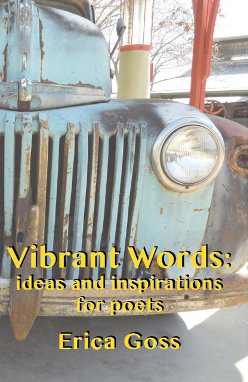
Erica Goss is the Poet Laureate of Los Gatos, CA, and the host of Word to Word, a show about poetry. She is the author of Wild Place (Finishing Line Press 2012) and Vibrant Words: Ideas and Inspirations for Poets (PushPen Press 2014). Her poems, reviews, and articles appear widely, both on-line and in print. She won the 2011 Many Mountains Moving Poetry Contest and was nominated for the Pushcart Prize in 2010 and 2013. Please visit her at Website.

We’ve been following her 12 Moons project with Atticus Books for some time and we’ve seen Snow Moon, Wolf Moon, Worm Moon, and Planters Moon.  Check out all 12 Moons.

Today’s she’s here to talk about her latest poetry project, Vibrant Words: Ideas and Inspirations for Poets. Please give her a warm welcome.

When my book, Vibrant Words: Ideas and Inspirations for Poets came out in late March, I decided that in order to promote it, I would attend events within a two-hour drive of my home in Los Gatos, California. I’ve already put plenty of miles on my Honda Fit, traveling to book-signings and poetry readings all over the San Francisco Bay Area. I’ve driven two hundred miles in one day to read for twenty minutes, but that’s not even close to California Poet Laureate Juan Felipe Herrera. He once drove from Fresno to San Jose, a round trip of three hundred miles, to read two poems at a book release party.

In spite of my general annoyance at the amount of time I must drive, I get some of my best ideas while driving. This is not always a good thing. Once on a drive between San Jose and Sacramento (about one hundred and twenty miles) an entire poem came to me, fully formed. Not in a place where I could pull over and write, I chanted the poem to myself over and over for the next half-hour while trying to concentrate on driving the speed limit. I even imagined what I would tell the officer, should I get pulled over: “I’ll show you my driver’s license as soon as I write this poem down.”

More often, as I enter my long-distance driving trance, bits of conversation, things I’ve read, and phrases from songs I’m listening to on the radio come and go in my thoughts. Part of my brain has to stay alert to drive safely, but the other part can roam, examining signs and counting the number of red cars vs. blue cars. I like finishing the terse sentences I read on highway signs: “Expect delays” becomes “Yes, I always expect delays” and “Gas Food Lodging” is kind of hilarious on its own. “Bump” is one of my favorite signs; our roads are plenty bumpy, but it takes a really spectacular bump to warrant a sign.

Traffic often grinds to a halt (like the sign says, “expect delays.”) I’ll pull out my Moleskine notebook and make a few notes: “sleep bone,” “I carry a purse and talk to strangers,” “recipe for lasagna,” “if marriage was a cookbook,” and “crows are so American” are all from recent traffic stops.

Since the release of Vibrant Words, I’ve driven from the Pacific Ocean to the Central Valley, and I’m just starting out. I hope to bring my book to places farther and farther from home, but if it gets too far, I think I’ll fly. Plus, I need new tires.

Erica is truly a driven poet. Thanks so much for sharing your travels and your inspiration with us.

Save

Mailbox Monday #267

Mailbox Monday, created by Marcia at To Be Continued, formerly The Printed Page, has gone through a few incarnations from a permanent home with Marcia to a tour of other blogs.

Now, it has its own permanent home at its own blog.

To check out what everyone has received over the last week, visit the blog and check out the links.  Leave yours too.

Also, each week, Leslie, Vicki, and I will share the Books that Caught Our Eye from everyone’s weekly links.

Here’s what I received:

1.  The Transcriptionist by Amy Rowland, unexpectedly from Algonquin.

A stunning novel told with the same gravity as Nicole Krauss s History of Love. This powerful debut follows a woman who sets out to challenge the absurdity of the world around her. Lena, the transcriptionist, sits alone in a room far away from the hum of the newsroom that is the heart of the Record, the New York City newspaper for which she works. For years, she has been the ever-present link for reporters calling in stories from around the world. Turning spoken words to print, Lena is the vein that connects the organs of the paper. She is loyal, she is unquestioning, yet technology is dictating that her days there are numbered. When she reads a shocking piece in the paper about a Jane Doe mauled to death by a lion, she recognizes the woman in the picture. They had met on a bus just a few days before. Obsessed with understanding what caused the woman to deliberately climb into the lion’s den, Lena begins a campaign for truth that will destroy the Record’s complacency and shake the venerable institution to its very foundation.

What did you receive?

For today’s 2014 National Poetry Month: Reach for the Horizon tour stop, click the image below:

Response Poetry

Response poetry is often one of the easiest kinds of poetry to write for poets who are starting out because it often relies on the text of another poet.

Writers just starting out in poetry will often imitate the style of another poet until they can find their own, and some even write poems outwardly replying to another poets work, like Sir Walter Raleigh’s response to Christopher Marlowe’s “The Passionate Shepherd to His Love.” Other options include building off a primary metaphor that the poem works from, stealing the first line of the poem, using a passage as an epigraph, turning prose into verse, or writing the opposite of the poem.

For further information about these techniques, go here.

Today, I’m going to give you a poem, and my response, and I’d love to see what your response poems would be in the comments either to the original poem or to my response.

The Young Man's Song by W.B. Yeats

I whispered, "I am too young,"  
And then, "I am old enough";   
Wherefore I threw a penny   
To find out if I might love.   
"Go and love, go and love, young man,
If the lady be young and fair,"   
Ah, penny, brown penny, brown penny,   
I am looped in the loops of her hair.   
   
Oh, love is the crooked thing,   
There is nobody wise enough
To find out all that is in it,   
For he would be thinking of love   
Till the stars had run away,   
And the shadows eaten the moon.   
Ah, penny, brown penny, brown penny,
One cannot begin it too soon.

Here’s my response poem:

A Young Woman's Lament

I spied him at the fountain
caressing a brown penny as he stared
a long time into the flowing water.
Dark curls tumbling to his neck,
a suit crisp and bright.

The dark copper revealing its shine
reflecting the sun's rays.
I smile at the thought, until
Whispering to himself,
he seems to argue, flailing his arms.

I scratched my head,
"He's cute, but clearly crazy," I said.
The fear crept along my skin
He turned to stare right at me.  With a splash,
he squared his shoulders, sauntered toward my dry mouth.

For today’s 2014 National Poetry Month: Reach for the Horizon tour stop, click the image below:

250th Virtual Poetry Circle

Welcome to the 250th Virtual Poetry Circle!

Remember, this is just for fun and is not meant to be stressful.

Keep in mind what Molly Peacock’s book suggested.

Look at a line, a stanza, sentences, and images; describe what you like or don’t like; and offer an opinion. If you missed my review of her book, check it out here.

Also, sign up for the 2014 Dive Into Poetry Reading Challenge because there are several levels of participation for your comfort level.

Click for today’s stop on the 2014 National Poetry Month Blog Tour: Reach for the Horizon

Today’s poem is from New European Poets edited by Wayne Miller and Kevin Prufer:

First Steps by Stefan Hertmans of Belgium (page 302)

He ran into the street without a glance
and I, beginning to be like him more and more,
thought he could make it to the door.

But he turns around, cars racing
along the prom. Now he’s almost there
I’ll never get to him in time.

Just so my father, all his life,
could dream of my hand, as small
and quick, able to slip between bars
into the depths of rock and water.

Life rushes in a blink.
Then I grab him—he unafraid,
His eyes wide open and so calm—

I with that fatal smash
That will never leave
My life and body.

      -translated from the Flemish by Gregory Ball

What do you think?

This is part of the 2014 National Poetry Month: Reach for the Horizon Blog Tour, click the button for more poetry: