
Thanksgiving is a time for families to come together and share their gratitude.
Literature and Poetry Reviews, Home of the Virtual Poetry Circle
Thanksgiving is a time for families to come together and share their gratitude.
 Source: Publisher
Paperback, 108 pgs.
I am an Amazon Affiliate
Sway by Tricia Johnson is best read a few poems at a time, dipping in and out of nature’s changes and seasons. Johnson’s poems are primarily focused on nature and the narrator is caught up in all the beauty. She’s distracted by it, enthralled by it, and in awe of it – as it should be. In “Nestle,” readers are invited to meet the narrator “in the tall grass/We will settle in its hidden places/Nestled with mother earth” (pg. 12)
Readers will feel like they have fallen into the natural world, where the sun and moon enchant the walk. The narrator is asking us to stop with her, take a breath, and observe … be in the moment. Each season is give its due and Johnson knows how to describe each well, making readers feel like they are there. I don’t think that these poems necessarily depict only Pennsylvania, but they could be in other backyards. Reading the poems in succession can get a bit monotonous. But there are those moments where you fall right into the poem.
Walk (pg. 31)

...
The smell of fall
Warm air out
The chill felt through fabric
Move to sweat along the back of a scarf wrapped neck
Wink (pg. 34)

One red leaf on my maple tree
Winked out as I walked by
I said hello, introduced myself
Thanked its crimson glow
A nod toward change
A season swooping in
The center glimpse of rose
Wrapped in the nature of green
My favorite poem in the collection has to be “Pumpkin Latte” where deer are the night raiders cannibalizing her pumpkin decorations. It reminds me of the family of deer in my own yard and how they will nibble anything they can. Fruits and vegetables are their favorites, of course.
Sway by Tricia Johnson calls to us, guides us to an appreciation of nature. She’s providing us with paintings and an atmosphere where we can just be and breathe.
RATING: Tercet
Other Reviews:
About the Poet:
Tricia Johnson is a poet wishing to share her work with others, by using the written word to embrace one another’s humanity. She is a retired teacher. She lives in the beautiful hills of Pennsylvania with her husband and two sons. Published work includes the poem “Living with Lupus” which appeared in Still You Poems of Illness & Healing, Wolf Ridge Press 2020.
 Source: Purchased
Audible, 9+ hrs.
I am an Amazon Affiliate
Accomplished by Amanda Quain, narrated by Deva Marie Gregory, focuses on high school-age Georgiana Darcy who is struggling to find herself after Wickham entangles her in his drug-dealing scheme at her private school.She is a bit dramatic, probably too many regency romance shows for her.
Gregory is an excellent narrator for this young adult’s redemption story. She provides different voices for Georgie, Fitz, Avery, Wickham, and others.
Georgie is crumbling under the pressure of the Darcy name and its expectations. She’s unsure of who she is and unable to rectify her reputation at the private school where everyone hates her for taking away their best trombone player and drug dealer, Wickham. Even though she had nothing to do with the drug dealing and her room was all Wickham needed, her brother is severely disappointed and ramps up his helicopter parenting.
Georgie, on the other hand, is eager to get out from under the glare of her classmates, Wickham’s threats, and her brother’s oppressive supervision. Her lavish family lifestyle is something she wants to get past but even those around her see her like her ancestors and even her brother — untouchable, able to throw money at problems, and so many other privileged trappings.
Accomplished by Amanda Quain, narrated by Deva Marie Gregory, is a charming story of a young woman looking for herself as forces outside of herself try to force her to be someone she isn’t. She’s artistic, musical, and creative, and clearly not the business/medical mold of the Darcy legacy. While Georgie is a bit obsessive and full of anxiety, which can get tiresome, her gradual evolution in this story is delightful, even when she stands up to her brother, not quite in the most rational or tactful way. Quain is a talented writer, and I look forward to others in this series.
RATING: Quatrain
 Mailbox Monday has become a tradition in the blogging world, and many of us thank Marcia of The Printed Page for creating it.
It now has its own blog where book bloggers can link up their own mailbox posts and share which books they bought or which they received for review from publishers, authors, and more.
Thank you to Velvet for stepping in when Mailbox Monday needed another host.
Emma, Martha, and I also will share our picks from everyone’s links in the new feature Books that Caught Our Eye. We hope you’ll join us.
Here’s what I received:
 Above Ground by Clint Smith for the Gaithersburg Book Festival.
Clint Smith’s vibrant and compelling new collection traverses the vast emotional terrain of fatherhood, and explores how becoming a parent has recalibrated his sense of the world. There are poems that interrogate the ways our lives are shaped by both personal lineages and historical institutions. There are poems that revel in the wonder of discovering the world anew through the eyes of your children, as they discover it for the first time. There are poems that meditate on what it means to raise a family in a world filled with constant social and political tumult. Above Ground wrestles with how we hold wonder and despair in the same hands, how we carry intimate moments of joy and a collective sense of mourning in the same body. Smith’s lyrical, narrative poems bring the reader on a journey not only through the early years of his children’s lives, but through the changing world in which they are growing up—through the changing world of which we are all a part.
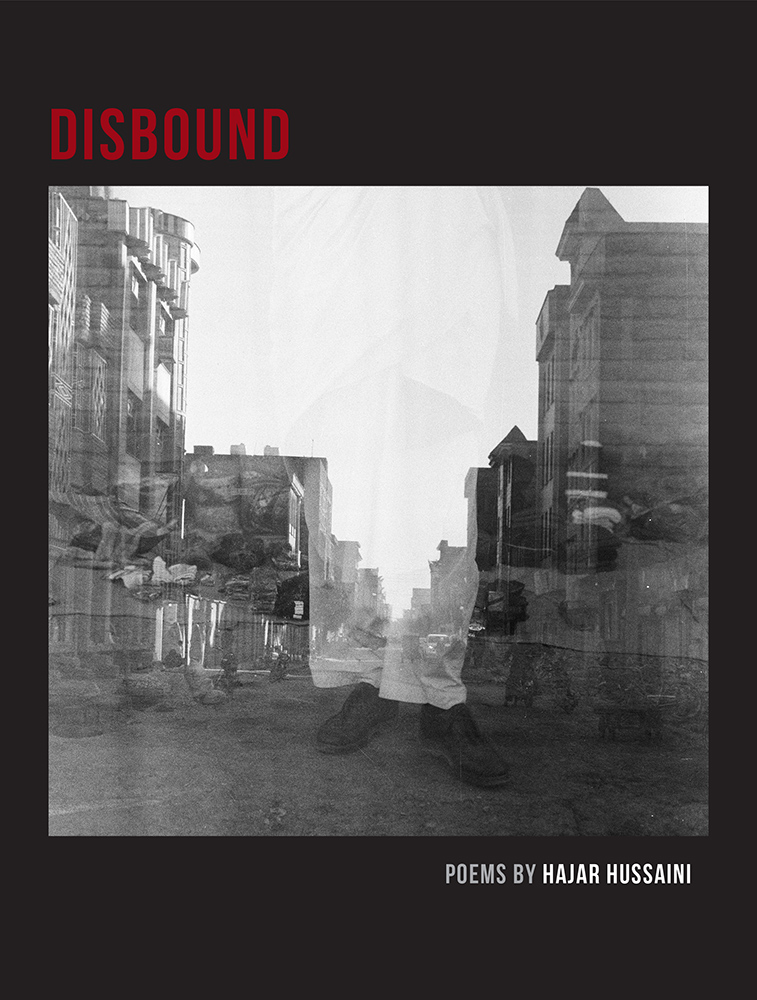 Disbound by Hajar Hussaini for Gaithersburg Book Festival.
Hajar Hussaini’s poems in Disbound scrutinize the social, political, and historical traces inherited from one’s language. The traces she finds—the flow of international commodities implied in a plosive consonant, an image of the world’s nations convening to reject the full stop—retrieve a personal history between countries (Afghanistan and the United States) and languages (Persian and English) that has been constantly disrupted and distorted by war, governments, and media. Hussaini sees the subjectivity emerging out of these traces as mirroring the governments to whom she has been subject, blurring the line between her identity and her legal identification. The poems of Disbound seek beauty and understanding in sadness and confusion, and find the chance for love in displacement, even as the space for reconciliation in politics and thought seems to get narrower.
 Sound Fury by Mark Levine for Gaithersburg Book Festival.
 The Pause and the Breath by Kwame Sound Daniels for Gaithersburg Book Festival.
This book is an answer to the American Sonnet. Through the structure of the sonnet, the pause and the breath explores the boundlessness that is the experience of xir black transness. Though laden with imagery, each sonnet remains a narrative that develops into an overarching narrative of wholeness. In this book, Kwame Sound Daniels urges the reader to pause and breathe through facets of personal identity.
 Kisses at the Espresso Bar by Anita Nahal for Gaithersburg Book Festival.
Kisses at the expresso bar showcases the prolific poetic style of Anita Nahal as a true virtuoso of the English language. She performs word magic in each ekphrastic prose poem, transforming the visual into the verbal, creating caramelized associations that stick to one’s soul. Her sense and sensibility echo the famous quote from Antoine de Saint-Exupery’s The Little Prince that “only the heart can see rightly; what is essential is invisible to the eye.”—Dr. Gerrit Dielissen, Professor of Sociology, Utrecht University, the Netherlands“All dressed and out. High heels tick-ticking between hide, membrane, cloth. Barely touching, just hinting. So were the shades and lights, and the froths in the cups and the cakes, and the sugars and the creams. Swirling like sips in the dips of the lips and the hips. Seemingly in an animated conversation….” (From the poem, “Kisses at the espresso bar”)
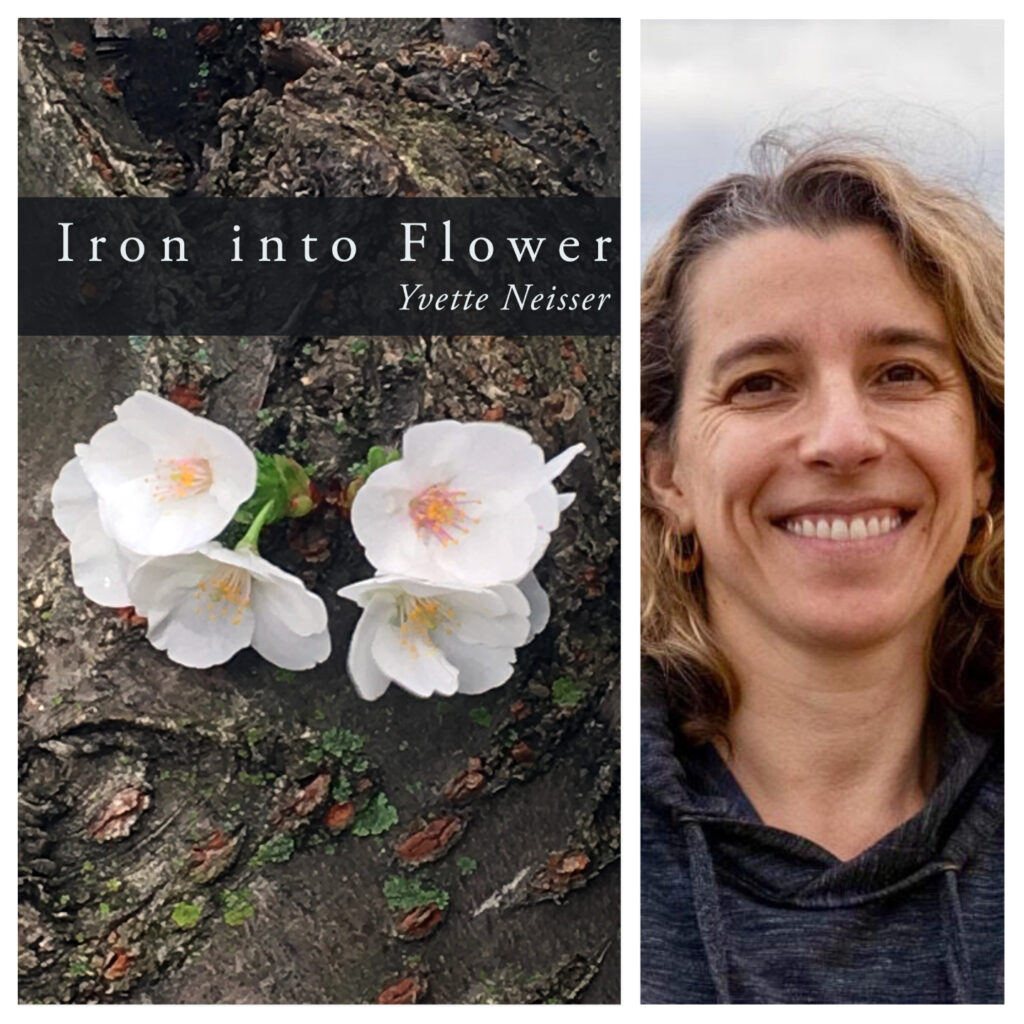 Iron Into Flower by Yvette Neisser for Gaithersburg Book Festival.
“You must change your life, / say the rabbis of old” begins a poem from Iron into Flower, Yvette Neisser’s second collection. Like those rabbis, Neisser’s deceptively simple poems pose age-old questions about memory, identity, love, faith, and morality. And when calamity strikes-a death, an auto accident, a divorce-the poems’ speaker, also named “Yvette Neisser,” does indeed change her life, reclaiming her body, her identity, even her name. Timeless rituals-the sun’s arc, the passing of the seasons, the quiet pleasures of making tea and flipping tortillas-help reassure even the most troubled souls who haunt these poems. Neisser writes, “Bless us all, the whole imperfect lot of us.” And she means it: these are poems of healing and grace.-Katherine E. Young, author of Woman Drinking Absinthe, Poet Laureate Emerita, Arlington, VA
Iron into Flower doesn’t pull any punches as we readers are drawn into a landscape of loss: Auschwitz, Gaza, the body, first loves, and even depression’s loss of color, as ‘orange and red cascade/ and crumble into brown, / then earth, / then bareness.’ In these moving and rhythmic texts where Neisser’s children’s faces are ‘all that matter, ‘ the poet finds beauty and strength in her yearning to ‘learn the shape of faith.’-Nancy Naomi Carlson, Author of An Infusion of Violets
I relished this dual-journey of a book, where mother traverses the Deep South in the mid-sixties on her way to Mexico. But also landscapes of memory-a hike with father, where “the years have etched rings around my life”-in poem after poem the arresting passage of time; or a kind of lifespan within a single poem, from “the pull of oars up the quiet river…to “the closing of eyelids.” But we also encounter work that doesn’t flinch in the face of harrowing histories-pieces that “shine a mirror inside [our]selves / examine [our] flaws.” In short, the stuff of art-this gorgeous arc that doesn’t shy from “digging deep.”-Francisco Aragón, author of After Rubén, Director of Letras Latinas

 Accomplished by Amanda Quain, purchased from Audible.
It is a truth universally acknowledged that Georgiana Darcy should have been expelled after The Incident with Wickham Foster last year—at least if you ask any of her Pemberley Academy classmates. She may have escaped expulsion because of her family name, but she didn’t escape the disappointment of her big brother Fitz, the scorn of the entire school, or, it turns out, Wickham’s influence.
But she’s back for her junior year, and she needs to prove to everyone—Fitz, Wickham, her former friends, and maybe even herself—that she’s more than just an embarrassment to the family name. How hard can it be to become the Perfect Darcy? All she has to do is:
- Rebuild her reputation with the marching band (even if it kills her)
- Forget about Wickham and his lies (no matter how tempting they still are), and
- Distract Fitz Darcy—helicopter-sibling extraordinaire—by getting him to fall in love with his classmate, Lizzie Bennet (this one might be difficult…)
Sure, it’s a complicated plan, but so is being a Darcy. With the help of her fellow bandmate, Avery, matchmaking ideas lifted straight from her favorite fanfics, and a whole lot of pancakes, Georgie is going to see every one of her plans through. But when the weight of being the Perfect Darcy comes crashing down, Georgie will have to find her own way before she loses everything permanently—including the one guy who sees her for who she really is.
What did you receive?
 Source: Purchased
Paperback, 72 pgs.
I am an Amazon Affiliate
Fixed Star by Suzanne Frischkorn is an amalgam of found poetry and structure poems mirroring the culture and identity that many of us have over time. We find that there are fixed points in our culture and identity and that there also are found parts of those segments of ourselves that we incorporate willingly. There’s a deep restlessness in each of these poems as they deftly move from one to the next, when reading in succession, and it is a skill to be admired.
Frischkorn’s opening poem, “Cuban Polymita,” begins the collection with: “Birth cleaved me in half” If that line alone doesn’t give you a sense of restlessness, the rest of the collection certainly will. It is from this instant of birth in which the narrator begins to move away from her origins: “A lace dress. A first language./All myths once we move north./” (“II”, pg. 2) In these earlier poems, the narrator is looking for the truth in those myths, unraveling the mystery of her heritage. But the narrator is keenly aware that to unravel these hidden pasts is also likely to reveal “what is tarnished,” and to question is it worth the risk?
Once I Dove Into the Caribbean Sea (pg. 36)
Isla de Cozumel, ’93Cuba, its tide strove to draw me towards you and failed. I departed with a smooth shell and wisps of surrogate sky. How cool marble caressed my bare soles, how heat plied my skin bronze. Not until I slide the silver bracelets from my wrist will the strains of your shore ebb.
Frischkorn’s Fixed Star is an attempt to excavate the movement from past to present to pinpoint the evolution, to understand something that was lost. In that adventure toward discovery, a restlessness propels each of these poems forward and back into the past again, signaling the push and the pull of who and what has birthed us to who and what we become.
RATING: Cinquain
Other Reviews:
 About the Poet:
Suzanne Frischkorn is the author of Fixed Star (JackLeg Press, September 2022) as well as the books, Girl on a Bridge, and Lit Windowpane (both from Main Street Rag Press), and the chapbooks American Flamingo, Spring Tide, Red Paper Flower, Exhale, and The Tactile Sense.
She is the recipient of The Writer’s Center Emerging Writers Fellowship for her book Lit Windowpane, the Aldrich Poetry Award for her chapbook Spring Tide, selected by Mary Oliver, and an Individual Artist Fellowship from the Connecticut Commission on Culture & Tourism.
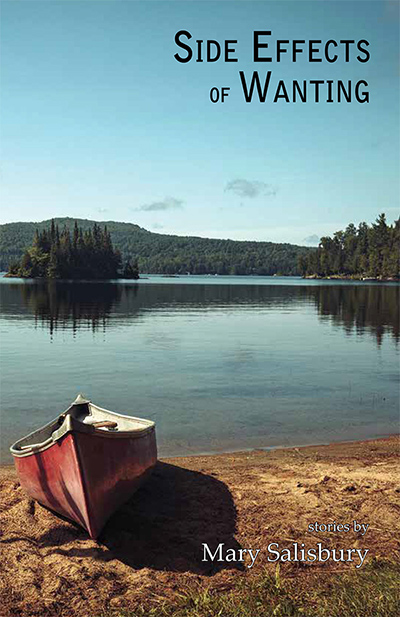 Today’s guest is Mary Salisbury, who has a new book out from Main Street Rag. Let’s learn about Side Effects of Wanting:
Side Effects, Mary Salisbury’s impressive debut collection, introduces a writer whose voice compels and enchants, its quiet and subtle vibrancy pitch perfect, story after story, and intensified by the quietness that surrounds each. Stories of love, longing, and loss, and behind each the writer’s charitable heart, and an observing eye that misses nothing. ~Jack Driscoll, author of The Goat Fish and the Lover’s Knot
Compelling and remarkably honest, Side Effects of Wanting investigates the sharper edges of our unique emotional landscapes in a series of exciting, accessible stories that explore both the strengths and frailties of the human condition in its varied aspects—personal identity, grief, fractured relationships, the ghosts of the past, transformation, and slowly mending hearts. Weaving together small-town stories filled with secrets, hardships, and that ever-present ache of almost becoming the person you want to be, Mary Salisbury tenderly renders heartbreaking narratives in which characters reach out to be loved, to be understood, and to finally feel safe. ~John Sibley Williams, author of As One Fire Consumes Another
Mary Salisbury’s stories are infused with the precision of a poet and the wisdom of a deep thinker, amounting to some of the best stories I’ve read about milestone matters of the heart, everyday regrets with life-altering outcomes, and the painful nuances of long-haul love. Side Effects of Wanting not only invites us in, it lets us laugh and cry while we watch on the edge of our seats as lovers, siblings, parents, and co-workers face private, universally relatable conundrums head-on. ~Katey Schultz, author of Still Come Home
Thank you, Mary, for stopping by today to share your thoughts on the creative process.
Daydreaming is part of writing to me. When I was young I climbed trees on our elm-lined street in Flint, Michigan, and hid so I could daydream in peace. My secret dream was to be a songwriter or a back-up singer.
Music was what captivated me, the music of the mid-60’s—Motown was the thing. In my Catholic school it was all plaid skirts and white shirts and daydreaming was not considered a prerequisite to good writing or to singing. But I knew in my heart that it was.
I read the poetry of Emily Dickinson and Robert Frost. I found the poetry of William Carlos Williams, and more, as I grew into my teens. I began to write poetry of my own, and I continued to write poems and stories as I got older and raised children and worked as a registered nurse.
No, I did not become a back-up singer, but I’d still like to be one. My love of music and my love of reading allowed me to enter the world of other worlds and I kept writing so that I could be there, in those other worlds.
As an adult I worked and lived in a small town in Southern Oregon and absorbed the life and natural world around me. I witnessed the act of quiet heroes—people who got out of bed every day and did what was necessary, despite their troubles. These are the people who populate my stories.
I wrote in the car, waiting for my children’s soccer, baseball, or basketball practice to end. I wrote in the library, or early in the morning before the day began. That’s the thing about writing—you only need a notebook and a pen.
I had my first book of short stories published two days before I turned seventy. Writing has sustained me through loss and love. If you love writing, if you need to write, keep writing, and always keep reading. They go together like lyrics and melody.
About the Author:
Mary Salisbury’s short fiction has been published in Cutthroat’s Truth to Power, The Whitefish Review, Cutthroat: A Journal of the Arts, and Flash Fiction Magazine. Salisbury’s essay on writing was featured in Fiction Southeast. Two of Salisbury’s chapbooks, Come What May, and Scarlet Rain Boots, were published by Finishing Line Press, and her poetry has appeared in Calyx. Salisbury is an Oregon Literary Arts Fellowship recipient and a graduate of Pacific University’s MFA in writing program.
Mailbox Monday has become a tradition in the blogging world, and many of us thank Marcia of The Printed Page for creating it.
It now has its own blog where book bloggers can link up their own mailbox posts and share which books they bought or which they received for review from publishers, authors, and more.
Thank you to Velvet for stepping in when Mailbox Monday needed another host.
Emma, Martha, and I also will share our picks from everyone’s links in the new feature Books that Caught Our Eye. We hope you’ll join us.
Here’s What I Received:

 Our Ancestors Did Not Breathe This Air by Afeefah Khazi-Syed, Aleena Shabbir, Ayse Angela Guvenilir, Maisha Munawwara Prome, Mariam Eman Dogar, and Marwa Abdullhai for Gaithersburg Book Festival consideration.
Our Ancestors Did Not Breathe This Air brings fresh voices of poignancy and a much-needed representation in modern poetry. From the scents of a bustling street market in India to the warmth of stories rooted in Venezuela to snippets of college days shared at MIT, the poetry in this book features an ache for grounds no longer walked upon. With a range of distinct styles and voices, the poets’ nuanced self-expression amounts to a piece that is both a prayer and a rebellion. Their words, introspective and reminiscing, witty and thoughtful, are an ode to that which makes them who they are and where they come from. Simultaneously, their voices are a rejection of dangerous stigmas, cultural taboos, and oppressive systems. In both verse and image, Our Ancestors Did Not Breathe This Air is a bold and unfiltered collection recounting moments, tears, and dreams that have been generations in the making. The poems in this collection are accompanied by full-color illustrations and photographs.

 Harbinger by Shelley Puhak for Gaithersburg Book Festival consideration.
From “Portrait of the artist, gaslit” to “Portrait of the artist’s ancestors” to “Portrait of the artist reading a newspaper,” the poems in Harbinger reflect the many facets of the artistic self as well as the myriad influences and experiences that contribute to that identity.
“Portrait of the artist as a young man” has long been the default position, but these poems carve out a different vantage point. Seen through the lens of motherhood, of working as a waitress, of watching election results come in, or of simply sitting in a waiting room, making art – and making an artist – is a process wherein historical events collide with lived experience, both deeply personal but also unfailingly political. When we make art, for what (and to whom) are we accountable? And what does art-making demand of us, especially as apocalypse looms?
With its surprising insights, Harbinger, the latest book from acclaimed poet Shelley Puhak, shows us the reality of the constantly evolving and unstable self, a portrait of the artist as fragmentary, impressionable, and always in flux.

 Some Days the Bird by Heather Bourbeau and Anne Casey for Gaithersburg Book Festival consideration.
Throughout 2021, as COVID and climate change battled for supremacy in the hearts and minds of the world, American poet Heather Bourbeau and Irish-Australian poet Anne Casey engaged in a poetry conversation back and forth across the globe, alternating each week, to create 52 poems over 52 weeks. With poems anchored in their gardens, they buoyed each other through lockdowns and exile from family, through devastating floods, fires, wild winds and superstorms. Some Days The Bird, a collection of internationally recognized and award-winning poems, is the result of their weekly communiqués from different hemispheres (and opposing seasons) in verse.
 Origami Selected Poems of Manuel Ulacia, translated poems of Manuel Ulacia by Indran Amirthanayagam for Gaithersburg Book Festival consideration.
Manuel Ulacia (1953–2001) was born in Mexico City, grandson of Manuel Altolaguirre and Concha Mendez, members of Spain’s “Generation of ‘27.” Altolaguirre and Mendez became refugees of the Spanish Civil War, residing first in Cuba and then in Mexico. Manuel gained recognition for his own poetry early, studying architecture as an undergrad, and then a Master’s and PHD in Hispanic literature at Yale, specializing in Luis Cernuda. He then returned to Mexico where he taught at the Universidad Nacional Autonoma de Mexico, became a confidant and protégé of Octavio Paz at Vuelta, and engaged in political action on behalf of persecuted writers as president of PEN’s Mexico chapter. Books include Origami para un día de lluvia (Origami for a Rainy Day) (1990), one of the great long poems of the Spanish language, and El plato azul (1999), another brilliant long poem. Other books inclue La materia como ofrenda (Matter as Offering) (1980), El río y la piedra (The River and the Rock) (1989), Arabian Knights and Scottish Mornings (unpublished until it was included in Poesia, published posthumously by Fondo de Cultural Economica). Manuel also wrote a definitive critical study of Octavio Paz, El árbol milenario: Un recorrido por la obra de Octavio Paz (The Thousand-Year- Old Tree. A Voyage Through the Work of Octavio Paz) (1999). Manuel died, at the height of his powers, at age 48, beyond the Buenavista beach, 30 kilometers from Ixtapa-Zihuatanejo, pulled out to sea by a riptide.
What did you receive?

Today is the day we honor those who sacrifice so much when entering military service. While we may not agree with every war, military action, etc., please remember that our military goes where the government tells them to go and they serve with honor and many with compassion.
Our veterans often come home battered and mentally affected by the battles and war zones they find themselves in. Many are forever changed. They are no longer who the were.
Consider donating your time, your money, or your skills to the following charities that help veterans impacted by their work for our nation:
I’m not endorsing any of these organizations, so please do your own research, but I wanted to share some of the organizations that are doing good work for our veterans, too many of whom are left on the sidelines of domestic life because of how war impacts them mentally or physically.
Mailbox Monday has become a tradition in the blogging world, and many of us thank Marcia of The Printed Page for creating it.
It now has its own blog where book bloggers can link up their own mailbox posts and share which books they bought or which they received for review from publishers, authors, and more.
Thank you to Velvet for stepping in when Mailbox Monday needed another host.
Emma, Martha, and I also will share our picks from everyone’s links in the new feature Books that Caught Our Eye. We hope you’ll join us.
Here’s What I Received:

 Brave Like Mom by Monica Acker, illustrated by Paran Kim, for review from Media Masters Publicity.
 Call Me Spes by Sara Cahill Marron for Gaithersburg Book Festival consideration.
An operating system falls for its user. It waits, a journey not unlike Dante’s Inferno, from factory to glass face. Strangers, friends, lovers, predators, kin, all translated through the operating system’s code. Each voice, a whole character the system struggles to make sense of, held by a human hand. This device logs your locations even when you don’t ask. Undeniably, these actions lack all conditions, a form of loving.
Call Me Spes lays bare these overheard voices— tenderly, voyeuristically, a perpetual ride-along. The device deepens its relationship with its user, learning and updating with the solitary goal of closeness. Pressed against a page, these poems are siren songs marching through Inferno to the promised Heaven we scroll to attain, some kind of progress.
 Common Grace by Aaron Caycedo-Kimura for Gaithersburg Book Festival consideration.
In 65 lyric poems organized into a triptych, Common Grace offers an important new lens into Asian American life, art, and love.
Part 1, “Soul Sauce,” describes the poet’s life as a practicing visual artist, taking us from an early encounter with an inkwell at Roseland Elementary in 1969 to his professional outdoor easel perched on Long Island Sound.
Part 2, ‘Ubasute,” is named after the mythical Japanese practice wherein “a grown son lifts / his aged mother on his back, / delivers her to a mountain, / leaves her to die.” This concept frames a wrenching portrayal of his parents’ decline and death, reaching back to his father’s time in the American internment camps of WWII and his mother’s memories of the firebombing of Tokyo. It also anchors the 2 outer parts in the racial trauma and joys passed down from his parents.
Part 3, “Gutter Trees,” gives us affecting love poems to his wife and the creative lives they’ve built together.
Ranging in scope from private moments to the sweep of familial heritage, Caycedo-Kimura’s poems are artful, subtle, but never quiet.
 Death Throes of the Broken Clockwork Universe by Wayne David Hubbard for Gaithersburg Book Festival consideration.
In his debut poetry collection, Death Throes of the Broken Clockwork Universe, Wayne David Hubbard illustrates journeys through physical space and abstract worlds of emotion.
Combining choreological precision with playfulness, readers enter the mind’s eye of a poet standing along the shoreline of powerful forces that shape all lives: time, place, and love.
Written over a ten-year period, the collection calls to mind the poetry of Lorine Niedecker, Rae Armantrout, Larry Eigner, and Carl Phillips. Importantly, these poems resist thick, impenetrable themes, instead celebrating ordinal wonders of life that are hidden in open view. This spare book offers strong, memorable imagery and questions that will delight thoughtful readers.
What did you receive?
 Source: Media Masters Publicity
Hardcover, 32 pgs.
I am an Amazon Affiliate
Brave Like Mom by Monica Acker, illustrated by Paran Kim, is a story of two young girls whose mom is battling cancer and her girls see her as strong and brave. They want to be like her and not shed tears. But these girls are strong when they strive to climb walls, ride horses, and so much more. But their mom reminds them that it is ok to be scared and to cry.
Acker does a good job of showing how mom is brave for her girls, but also how neighbors, their dad, and others help her every day. What the girls see is the actions of their mother, not the helping hands. The illustrations are simple and colorful.
What I wanted was less telling and more showing of this relationship between the kids and the mother and the family in general. Brave Like Mom by Monica Acker, illustrated by Paran Kim, does have a great story with advice for young children of parents struggling with illness.
RATING: Tercet
About the Author:
Monica Acker is a writer and educator. She holds a BA in creative arts and a MAT degree in childhood education. Monica is a member of SCBWI, 12×12, and Children’s Book Insider. She lives in Reading, Massachusetts, with her family.
 Source: Purchased
Paperback, 37 pgs.
I am an Amazon Affiliate
Why We Never Visited the Elms by Marianne Szlyk are poems that explore what could have been to what is now. Each poem is a journey, a microcosm of the larger journey the collection takes the reader on. The journey begins with the narrator and her mother and why they never visited Our Lady of the Elms, where her mother went to college. She reminisces about the stories she heard and how the college was nestled into a neighborhood. There’s almost a romanticism in these stories, but Szlyk reminds us that not all is rosy in that past, just like it isn’t in the present. “Every Friday the cafeteria would serve/slices of greasy hamburg pizza/that Mom would have pretended to eat//had we stopped by her old school.//” (pg. 3-4)
Just as in “Fishing,” the narrator says, “The surface hides mud, weeds, a murder victim./No one fishes now …” (pg. 5) We look back on our own histories with fondness, even if there is darkness in those old streets and rivers. We can look at those places now with a distance, glossing over a darkness and lifting out the good parts. Szlyk has a knack for exploring the what ifs and that what weres and the what ares. Time slips easily in these poems, and readers can slip behind the curtains to explore places in different times to see change and what stays the same.
Why We Never Visited the Elms by Marianne Szlyk is a time slip. Readers will love the optimism Szlyk imbues her poems with, reminding us that we should focus on the light we have and not the darkest parts of our lives.
RATING: Quatrain
Other Reviews:
About the Poet:
Marianne Szlyk’s most recent book is Poetry en Plein Air (Pony One Dog Press, 2020). Her poems have appeared in Verse-Virtual, the Red Eft Poetry Review, the Trouvaille Review, and other journals/websites. Some poems have been translated into Polish, Italian, and Cherokee. She lives in the D.C. area with the wry poet and flash fiction writer Ethan Goffman and their elderly cat.
Mailbox Monday has become a tradition in the blogging world, and many of us thank Marcia of The Printed Page for creating it.
It now has its own blog where book bloggers can link up their own mailbox posts and share which books they bought or which they received for review from publishers, authors, and more.
Thank you to Velvet for stepping in when Mailbox Monday needed another host.
Emma, Martha, and I also will share our picks from everyone’s links in the new feature Books that Caught Our Eye. We hope you’ll join us.
Here’s What I Received:
 Fixed Star by Suzanne Frischkorn, which I purchased.
The opening poem, “Cuban Polymita,” from which the title Fixed Star arises, serves as the scaffolding device for Frischkorn’s manuscript. Like the beautiful painted snails it references, the book, too, is a series of spirals: mainly, a pair of sonnet coronas whose recursive lines twine through the manuscript, both framing and bracing it. Navigating splits in language, geography, government, culture, and family-Frischkorn guides us through poems that are, contrapuntally, both luxuriant and lean. Swirling through this compact, honed manuscript is a series of citations (Shakespeare, John Cage, Muriel Rukeyser, John Keats, Normando Hernández González), and geographies (Cuba, Spain, Florida, Pennsylvania) that create transit across decades and differing terrains. Constellated with Latin jazz, jasper, sea glass, bougainvillea, contradanza, and coral reefs, Fixed Star is a brilliant treatise on violence, division, loss, longing, and the search for song. ―Simone Muench

 Country of Glass by Sarah Katz, which I purchased.

 Taste: A Book of Small Bites by Jehanne Dubrow, which I purchased.
What did you receive?



