Quantcast

Twilight: The Graphic Novel Volume 2 by Stephenie Meyer and Young Kim

Twilight: The Graphic Novel Volume 2 by Stephenie Meyer and Young Kim is the second (my review of Volume 1) in the series providing Meyer’s fans with even more Edward and Bella, but in visual form.  Kim’s images are sharp and well shaded, but there are only a few splashes of color, mostly red.  The story line is basically the same, with Bella and Edward running from James and Victoria.

There is a bit more back story of Carlisle and James here, and some of the scenes are modified to adapt it for the graphic novel and speed up the action.  Kim is a deft talent with her shading and life-like images.  She takes the story to a new visual level, making her characters almost 3-D with their depth.  Twilight fans who cannot get enough of this saga will love to add these books to their collections, and others might simply enjoy the art in these volumes, especially how the clothes move with the vampires and humans so realistic that readers would wish to feel the fabric.

There are odd moments in the novel where “conversation bubbles” are empty except for an ellipses, which may be unnecessary, given the depth of Kim’s talent to create believable facial expressions.  Meyer is surely capitalizing on her saga’s fame, and she’s looking to her character notes and sketches to offer her readers more than just the same story.  Is there enough in these graphic novels to satisfy the less-than-die-hard fan?  Maybe.  What is the real gem in Twilight: The Graphic Novel Volume 2 is Kim’s talent as an artist.
A Wreath of Down and Drops of Blood by Allen Braden

A Wreath of Down and Drops of Blood by Allen Braden is a slim collection of poems, published as part of the Virginia Quarterly Review Poetry Series, and is steeped in bird imagery and rural life.  His images are at once beautiful and raw, bringing with it the full force of nature’s unbridled beauty and fearsome nature.  Even the most beautiful images take on an aggressive persona, like the catalpa petals in “Remembering Precious Landscape, but with an Elegy in Mind” (page 9) that become “splayed.”

On the flip side, nature’s sexuality emerges as the narrator recounts love and precious moments between lovers.  In “Flight Theory” (Page 4-7), “How many nights did I try/to retrace the complexities/of starlings with my hands over her skin?/”  For this poem alone, the collection is worth buying.  The imagery is most vivid and charged here, creating a world that readers can get lost in.

Moments of rural life and childhood memories also grace these pages as the narrator of each poem takes the environment and personifies it with emotion.  The connection to a father, but the distance of that connection will make readers wonder how well they really know/knew their parents.  Also the dichotomy of love is present, with its passionate supportive nature and its violent passion that can render relationships asunder, leaving only pain and hate.

Braden has crafted variations of the sonnet in this collection, but readers who do not revel in form poetry may not notice the variation.  However, these varied sonnets continue the poet’s careful attention to detail to bring out the brute nature of humanity and to affirm our place in the natural world through carefully balanced language.  A Wreath of Down and Drops of Blood offers readers a look at humankind in its basest moments, highlighting those emotions we often feel when we are alone but never speak of in the presence of others, even those who love us best.

About the Poet:

Allen Braden is the recipient of a creative writing fellowship from the National Endowment for the Arts and a residency from the Poetry Center and the School of the Art Institute of Chicago. His poems have appeared in such publications as the Georgia Review, Prairie Schooner, Shenandoah, Virginia Quarterly Review, and Witness.


This is my 69th book for the 2011 New Authors Reading Challenge.


This is my 30th book for the Fearless Poetry Exploration Reading Challenge.

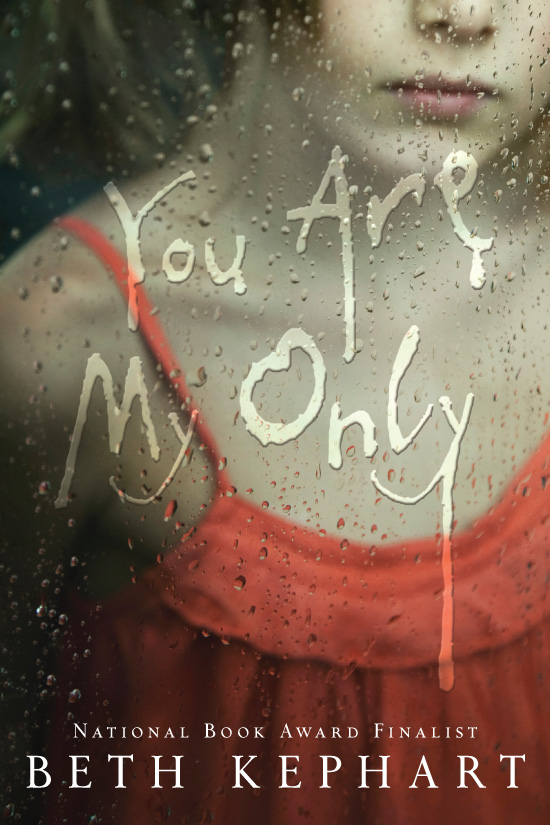
You Are My Only by Beth Kephart

You Are My Only by Beth Kephart tackles the tough topic of child abduction from two perspectives — that of the young victim, Sophie, and that of a mother, Emmy, whose child is stolen.  In this powerful, yet quiet novel, Kephart explores how one unexpected event can devastate entire worlds.

While the topic is ripped from the headlines, there is no sensationalism here.  Through carefully selected words in her poetic prose, Kephart builds tension and suspense, like the quiet vibration growing louder on the railroad tracks as the train approaches.  It also provides a quiet space — like the air between the branches of a tall tree — for readers to contemplate what each voice is saying, what each voice is struggling to address, what pain is closed inside of them and just clawing to get out.

“My feet are two pale fish inside the tight ponds of my Keds.  I leave the street for the train station.  I leave the station and cross onto the tracks, slick-backed and shiny as snail glisten.  The black gauze of the clouds flap at the moon, and from the tracks I can see into the backs of people’s houses, the private places where the lamps have not gone off.  It’s like looking through snow globes, worlds behind glass.”  (page 21)

Kephart’s prose is very lyrical and imagistic, and readers need to pay careful attention to her lines.  For instance, the above passage perfectly demonstrates Emmy’s frame of mind after losing her child.  She is lost, drowning, unmoored.  She has become separate from those who have “normal” lives because that’s what she believed she had with her child and husband, no matter how imperfect the marriage.

Emmy and Sophie have strong voices, both with stories to tell, and having one without the other here would have left too much unsaid.  Kephart is a masterful storyteller, building characters from the inside out, ensuring readers receive well-rounded men and women with strengths and weaknesses.  But there is always a mystical element to her novels, something in the background that is left unexplained.  She trusts the reader to uncover the truth of these relationships she’s building and the mysteries of what motivates them to keep moving forward even when things are at their most dark and uncertain.

“But my voice skids away, rides the slippery tracks.  Far away, at the bend in the rails, the night is lamped.  It is yellow and growing brighter, and now I understand:  the train has big yellow eyes.  Lovely ocher liquid eyes.  They put the shimmer down on the tracks and splatter the dark.”  (Page 22)

Beyond the main story, there are Helen and Cloris a devoted couple of aunts to a young boy, Joey, who is as normal as can be to Sophie.  Like Joey who supports Sophie, quirky Arlen and fantastical Autumn support Emmy in ways that are unexpected.  Although Emmy’s scenes, which are told from her point of view, limit readers’ knowledge of how she becomes institutionalized, it is not how she got there that is important to the story.  What is important is what happens there and how it transforms her.  Some of the hospital scenes are reminiscent of One Flew Over the Cuckoo’s Nest — minus the booze, floozies,and Nurse Ratched — in that she is there against her will and wants to escape, but for a while she merely is.  The relationship Emmy builds with Autumn helps her repair her broken psyche, and in this way, Kephart’s hospital is the antithesis of what happens in One Flew Over the Cuckoo’s Nest.

You Are My Only is an emotional powerhouse drawing redemption out of the shattered pieces of lives rendered asunder by a single event.  Through faith and love these characters can begin the heal, rebuild, and flourish.  What more could readers ask for?  Stunning, precious, and captivating from beginning to end.

About the Author:

Beth Kephart is the author of 10 books, including the National Book Award finalist A Slant of Sun; the Book Sense pick Ghosts in the Garden; the autobiography of Philadelphia’s Schuylkill River, Flow; the acclaimed business fable Zenobia; and the critically acclaimed novels for young adults, Undercover and House of Dance. A third YA novel, Nothing but Ghosts, is due out in June 2009. And a fourth young adult novel, The Heart Is Not a Size, will be released in March 2010. “The Longest Distance,” a short story, appears in the May 2009 HarperTeen anthology, No Such Thing as the Real World.

Kephart is a winner of the Pennsylvania Council on the Arts fiction grant, a National Endowment for the Arts grant, a Leeway grant, a Pew Fellowships in the Arts grant, and the Speakeasy Poetry Prize, among other honors. Kephart’s essays are frequently anthologized, she has judged numerous competitions, and she has taught workshops at many institutions, to all ages. Kephart teaches the advanced nonfiction workshop at the University of Pennsylvania. You can visit her blog.  Also check out this chat.

My other Beth Kephart reviews:

Please come back this afternoon for my interview with Beth Kephart about You Are My Only and for a giveaway.

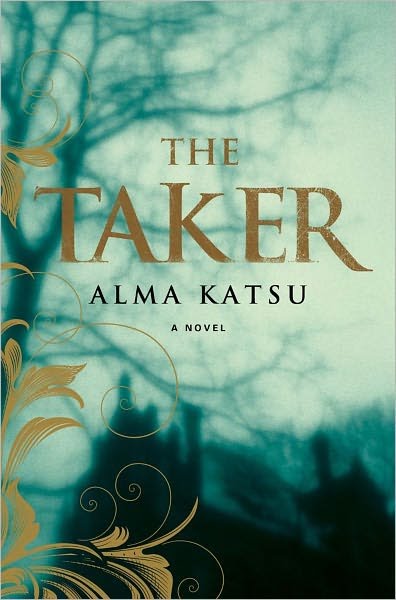
The Taker by Alma Katsu

Alma Katsu’s The Taker has received a number of rave reviews and some unfavorable reviews, and it was recently listed in BookList’s Top 10 Debut books.

Lanore, “Lanny,” shows up in her northern Maine hometown covered in blood, and the police say that she has confessed to killing a man and leaving him in the frozen woods.  ER doctor, Luke Findley, becomes the recipient of a Gothic fairy tale that is more dark and sinister than full of fairy dust, unless that fairy is an evil alchemist and sodomite.

“The stranger had appeared suddenly, at the edge of the gathering that evening.  The first thing Adair noticed about him was that he was very old, practically a shrunken corpse leaning on his walking stick, and as he got closer, he looked older still.  His skin was papery and wrinkled, and dotted with age spots.  His eyes were coated with a milky film but nevertheless had a strange sharpness to them.  He had a thick head of snow white hair, so long that it trailed down his back in a plait.  But most notable were his clothes, which were of Romanian cut and made of costly fabrics.  Whoever he was, he was wealthy and, even though an old man, had no fear of stepping into a gypsy camp alone at night.”  (page 162)

The Taker is a story within a story, within a story, spanning from the dark ages through the present day, and Lanny claims to be immortal, but do not be mistaken into thinking she’s a vampire or werewolf.  She is neither.  Her unrequited love for the town pretty boy, Jonathan St. Andrew, is the main crux of the story and how it brings about her downfall that leads to her life as an immortal.  Katsu spoke recently at Novel Places about the book and revealed that the story of Pinocchio is the backbone of her novel, which is clear in how the desire to grow up and become a woman with her own life separate from her family propels Lanny to be easily led astray.  However, that is where the similarity ends.  Katsu’s novel is ripe with sodomy, rape, kidnapping, murder, and more, which is why it would be a perfectly dark book to read this season as Halloween approaches and is what would once have been considered horror (rather than the popular category of paranormal, which has a “lighter” tone to it).

Lanny tells her story to Luke in the present day, but a more effective approach would have been to have her merely tell her story to the reader.  As many know story framing or using one character as a plot device for another character to tell his/her story is bothersome if the character/plot device is not well developed.  While Luke does have a back story here, it fails to round out the character enough, leaving him flat and boring compared to the characters of Lanny and Adair.  Even Jonathan is little more than a caricature of the pretty boy of the town’s founders, and it would have served to have more of him and Lanny’s interactions in the book at the beginning of their “romance” to demonstrate their affection for one another.  However, being told from Lanny’s point of view, it is incredibly difficult to demonstrate Jonathan’s perspective on their relationship and oftentimes he comes off as a callous womanizer who is incapable of love.

With that said, however, Katsu is adept at time shifts within the story that keep the pace of the novel moving quickly.  Moreover, she creates a deeply atmospheric novel where readers are combing through the mist to grasp the truth of Lanny’s story and to unravel the mystery of her immortality.  Some have said this is a romance; it is not.  Most will debate who is “The Taker,” but there is certainly more than one, and it will depend on your personal perspective as to which you believe is the taker.  They all are takers in their own way — taking what love and affirmation they can, taking the loyalty of others by forcing their hands, and taking pleasure in the act of taking.  Readers who shun violence in books, particularly against women should steer clear.  Katsu’s The Taker is dark and decadent; an excellent debut novel for those looking to tantalize their darker senses with interminable consequences.

Stay tuned for the next two books in this series; I know I will be waiting on the edge of my seat. I’m always on the lookout for horror books, as I’ve grown tired of EMO vamps and werewolves.

For a chance to win my gently used ARC (which has a signed bookplate), please visit this post about Alma Katsu’s reading near me.  If you’re looking for another bonus entry, leave a comment on this review.

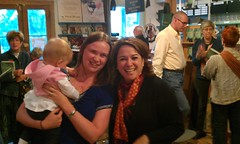
Alma Katsu (right) Me & Wiggles

About the Author:

Alma Katsu is a 30-year DC veteran who lives in two worlds: on one hand, she’s a novelist and author of The Taker (Simon & Schuster/Gallery Books). On the other hand, she was a senior intelligence analyst for CIA and NSA, and former expert in multilateral affairs.  Watch the book trailer or this one.


This is a stop on The Literary Road Trip since Katsu has worked in Washington, D.C., and now resides in Virginia.


This is my 61st book for the 2011 New Authors Reading Challenge.

The Chameleon Couch by Yusef Komunyakaa

The Chameleon Couch by Yusef Komunyakaa — broken into three sections — challenges the mind and the internal rhythm of our souls.  It challenges our preconceptions about everything from music to what it means to be an African American.  In the form of aubades and odes, Komunyakaa evokes song throughout the collection, which have readers very focused on how the rhythms of the poems impact them beyond the words spoken.  The poet is striving to reach not only the logical mind here, but something deeper, ethereal, like a soul.

There are allusions in this volume that are religious, musical, and mythological, but these do not detract from the poems’ power.  “Kindness” (page 28), is one of the most dense poems in the collection, filled with a number of allusions including the consumption of salt as a sign of friendship.  However, even if not all the references are clear at first glance, it is clear that kindness is often recognized even in the bleakest of moments and in the darkest of places even if someone has been a “stranger” to it.

There are a range of emotions and thoughts in this collection, the narrator of these poems changes like the lizard, adapting to the moment and blending into the environment he finds himself in. The cover is reminiscent of the dark jungle of our lives as we try to navigate our way sometimes in the shadows for the silence of observation, but oftentimes to hide from the actions and decisions we have made or are frightened of making.  Meanwhile, other decisions seem inevitable and natural.

Excerpt from:  Conceived in a Time of War (page 37)

Because your mother & father kissed
beneath a hail of Roman candles,
you crawled out of one thousand
tiny deaths, stubborn as aster
in stony clay.  A goddess of dawn
scooted under a zing of barbed wire
to witness your birth. . . .

Komunyakaa’s poems have a musicality equivalent to Jazz.  “Jazz has space, and space equals freedom, a place where the wheels of imagination can turn and a certain kind of meditation can take place.  It offers a meditational opportunity,” he once said.  His poems are just like this, providing moments of pause, allowing readers to interact with the lines and images.  “How many ghosts followed us/into the basement to Muniak’s bepop gig/to hear the saxophone argue with the piano?/” from “Aubade at Hotel Copernicus” (page 33-4).

Komunyakaa is paying homage to all forms of the human spirit — good or bad — in The Chameleon Couch, but the poems are never indifferent. In “A Translation of Silk” (page 17), “One can shove his face against silk/& breathe in centuries of perfume/on the edge of a war-torn morning/where men fell so hard for iron/they could taste it. Now, today,/a breeze disturbs a leafy pagoda/printed on slow cloth. A creek/begins to move. His brain trails,/lagging behind his fingers to learn/suggestion is more than radiance/” Some poems are about the legacy we leave behind, the anger about historical events like the Holocaust, and the quieter moments each of us shares with our lover or family. Another extraordinary candidate for the 2011 Indie Lit Awards and the “best of” list.

Also please check out the poem from this collection that I featured in the 117th Virtual Poetry Circle.

About the Poet:

Yusef Komunyakaa is an American poet who currently teaches at New York University and is a member of the Fellowship of Southern Writers. Komunyakaa is a recipient of the 1994 Kingsley Tufts Poetry Award, for Neon Vernaculaand the 1994 Pulitzer Prize for Poetry. He also received the Ruth Lilly Poetry Prize. Komunyakaa received the 2007 Louisiana Writer Award for his enduring contribution to the poetry world.

His subject matter ranges from the black general experience through rural Southern life before the Civil Rights time period and his experience as a soldier during the Vietnam War.

This is my 26th book for the Fearless Poetry Exploration Reading Challenge.

Around Germantown (MD) Then & Now by Margaret Coleman

Around Germantown (MD) Then & Now by Margaret Coleman takes a look at what Germantown was like before 1980 and what it was like after the Maryland-Nation Capital Park and Planning Commission adopted the area.  Coming from Massachusetts where many of the towns are older than the actual state and older than the United States, I had no idea that towns/cities were actually planned out ahead of time.  I really thought that they just came about when people started settling into an area and the businesses just cropped up naturally to service those people.  Silly, me.

Germantown, Md., is made up of six villages and the heart of the city has been moved a couple of times as populations and transit projects changed.  My husband and I looked at this book together and I told him we must have been destined to move here, since some of the founding families have the same last name as those of the town we grew up in.  The town also was settled by German farmers in addition to the English farmers already here.

We really enjoyed the photos of places that were and what they came to be, though it saddened us that so many of the original historic structures in the town had burned (on purpose or accidentally) and were not restored and of those that were restored were moved to other locations.  Unfortunately, progress seems to be the mainstay of this town as historic homes have been replaced by gas stations and other signs of commerce.  The tone of the book doesn’t seem as maudlin as I do about it, however.

Around Germantown (MD) Then & Now by Margaret Coleman is an interesting peak into the history of this town, its people, and its growth over the years.  I’d recommend it to locals interested in the area they have moved to or to those who have lived here but know little of its history.  I’ve always enjoyed these types of books even if I don’t live in the areas discussed.  The inclusion of photos of places then and now rounds out the story.

This is my 55th book for the 2011 New Authors Reading Challenge.

She by Saul Williams

She by Saul Williams is a collection of interconnected musical poems coupled with a collection of images from Marcia Jones that tells a story about a woman and their journey together.  On his Website, he says, “This book chronicles my thoughts and feelings as a young man working through an early relationship with an amazing visual artist as we embark on adulthood and parenthood in the same breath.”

Each of Williams’ poems has a unique rhythm to it, and should be read aloud for effect.  Each is as expressive as you would expect Williams to be in real life, becoming an extension of himself and his digital, visual, and audio art.  Unlike other collections, Williams’ She is a story beginning to end with a prologue and epilogue and prose poetry.  The nameless She is integral to the journey, a connection to the past and the future, illustrated through short lines and “out loud” cadence that screams to be read aloud.

While readers could dip in and out of the collection and experience it in small chunks, it is best to read it cover to cover to grasp its full impact. Tackling issues of separatism, aging, and opposing desires, Williams pinpoints the harshest of realities and deals them a deft blow when he demonstrates the commonalities between us all. Because these poems do not have titles, the clear intent is to create a continuous narrative in which “calamity makes cousins of us all” (page 22) and “we live.” (page xi)

Nature imagery and personification can make the issues more vivid, “there is a gathering in the forest. the leaves have refused to change. they say that they are tired of things never remaining the same, of dying to be reborn, of winter’s dry withered hand.” (page 7) But lest the images become to heavy, there are moments of whimsy as well.

I have seen the truth
many times
but for the first time
she saw me

I wore suspenders
for the judgment
in my pants

(page 13)

As the relationship goes down hill, readers will not a dramatic change in the poems as the narrator struggles to let go for the sake of love. “I am a canvas/painted over/whether it be by your hand/or mine own.” (page 113) The images included in the book are unusual and appear to mix mediums, and often resemble pages from a scrapbook that a mother would keep of her children. In a way these pages resemble Williams’ play on words as he picks them apart and alters their definitions to explain the moment he is in.

Reading She alone in a room is not enough. It should be read aloud, shared with others, and most who pick up a copy will do just that. Seeing Saul Williams read it would make it even better, but its up to you to find out where he’s reading or performing next. There is not enough that can be said about this collection, except go read it!

Some reason Saul reminds me of Don Cheadle in this photo.

About the Poet:

Saul Williams is an American poet, writer, actor and musician known for his blend of poetry and alternative hip hop and for his leading role in the 1998 independent film Slam.

From Wikipedia about Williams and Marcia Jones’ relationship:

Williams and artist Marcia Jones began their relationship in 1995 as collaborative artists on the Brooklyn performance art and spoken word circuit. Their daughter, Saturn, was born in 1996. His collection of poems S/HE is a series of reflections on the demise of the relationship. Marcia Jones, a visual artist and art professor, created the cover artwork for The Seventh Octave, images through-out S/HE in response to Williams, and set designed his 2001 album Amethyst Rock Star.

This is my 24th book for the Fearless Poetry Exploration Reading Challenge.


This is my 54th book for the 2011 New Authors Reading Challenge.

Buoyancy and Other Myths by Richard Peabody

Buoyancy and Other Myths by Richard Peabody is a slim collection that gets at the heart of family drama broken into three parts:  Shooting Myself in the Foot, Kissing Games, and Between Funerals.  The narrator in these poems ages and matures from a young boy eager to help his father but afraid of falling short to an older man similarly worried about falling short, but more accepting of reality.

Unlike the young man in “Family Secrets” who is shaking sense into his brother, the man in the latter poems, like “Orbits,” comes to the realization that the past cannot be hidden and regrets do nothing but hold you back.  You must roll with the punches.  What is striking in some of these poems is the calmness of the narrator, even as violent thoughts or actions are being displayed.  For instance, in “Family Secrets” (page 11) — which is a powerful way to start a collection — “Music isn’t enough tonight./Scratching, clawing, eyes like stones./If I erase him I will expand./His sins wiped clean. Nowhere/for him to leer from. No perch/or receptacle that can hold that/particular weight. He gives up./”  Is his brother still living and he wishes that he didn’t have to remember him or is it what happened to his brother that he does not wish to remember and it would be easier to erase him entirely?

Nearing the end of the collection, it seems as though this narrator has found peace or at least outwardly demonstrates contentment, or is it resignation?  In “I Live Behind a Bakery” (page 55-6), “Only most days/it’s easier/to just read a book/with that smell/all around me/and think buttery thoughts.//”  Peabody has a lot of cutesy ideas that he plays with in his poetry, like living behind a bakery or dating vampires, but these images are metaphors for other things like the contentment that you find in the simple things of life or even in the relationships you have.  However, there is an undercurrent in these poems urging readers to move beyond contentment, leap into more dangerous and possibly fulfilling territory.

Guitar Player (page 36)

Fingers know secrets
that eyes can’t understand.

While not all the poems are memorable or strong, there are a few gems within the collection’s pages that are worth reading more than once. Some are simply powerful in a few lines. Buoyancy and Other Myths by Richard Peabody explores the nature of relationships and how they propel us to greater things to seek out new directions and yes, to grow.

About the Poet:

Richard Peabody, a prolific poet, fiction writer and editor, is an experienced teacher and important activist in the Washington , D.C., community of letters. Peabody is the editor of Gargoyle Magazine (founded in 1976), and has published a novella, two books of short stories, six books of poems, plus an e-book, and edited (or co-edited) nineteen anthologies including: “Mondo Barbie,” “Conversations with Gore Vidal,” “A Different Beat: Writings by Women of the Beat Generation,” and “Kiss the Sky: Fiction and Poetry Starring Jimi Hendrix.” Peabody teaches fiction writing for the Johns Hopkins Advanced Studies Program.

This is my 23rd book for the Fearless Poetry Exploration Reading Challenge.


This is my 53rd book for the 2011 New Authors Reading Challenge.


This is a stop on The Literary Road Trip since Richard Peabody is a local Washington, D.C., area poet.

Twilight: The Graphic Novel, Volume 1 by Stephenie Meyer and Young Kim

Twilight: The Graphic Novel, Volume 1 is adapted from Stephenie Meyer’s best seller and the art is done by Young Kim.  Purchased as a gift, I grew curious about the art work inside since I’ve already read the series of books.  Meyer is a storyteller, but this graphic novel rendition of her story breathes new life into the supernatural love story with its crisp imagery and the stark contrasts generated by its black and white shading and sparse use of color.

Given that I normally don’t review graphic novels, I was more impressed here with the illustrations.  Kim is a stunning talent and demonstrates a clear ability to render lifelike faces to humans, vampires, and werewolves alike.  Don’t expect the images of Kristen Stewart or Robert Pattinson here.  Kim has imagined Bella and Edward in her own way and has pared down Meyer’s text significantly, allowing the pictures to carry the story.

I found the graphic novel adaptation mildly enjoyable for its images, but the text was minimal at best and much is left to the reader’s imagination.  Moreover, I noticed that some liberties were taken with Meyer’s story, much like what you would expect a movie screen writer to do, so it is clearly an adaptation not a reiteration.  Twilight: The Graphic Novel, Volume 1 by Stephenie Meyer and Young Kim is an interesting collaboration to round out any Twilight lover’s collection.

Here, Bullet by Brian Turner

Here, Bullet by Brian Turner, who served in the U.S. army for seven years after receiving his MFA and was a team leader for one year in Iraq with the 3rd Stryker Brigade Combat Team, won the 2005 Beatrice Hawley Award and was printed by Alice James Books — a nonprofit cooperative poetry press.  (The title poem, Here, Bullet,” was recently profiled in the Virtual Poetry Circle.)  The collection is broken down into four sections, and each section is preceded by a quote relevant to it, with some even quoting the Qur’an.  Turner is adept at illustrating the violence of war, but also the humanity that accompanies it.  From the startling nature of rockets going off over head to the silence of bullets as they enter the body, he provides a keen eye into how those instruments of war impact both sides of the battle equally psychologically, physically, and spiritually.

Soldiers who craft wartime poetry have generally either fallen into the category of using graphic violence to shock and awe the reader or using quieter imagery to bring about reader understanding about psychological impacts of battle.  There also are those that have political poems that are heavy on criticism or propaganda, but those would fall less into the wartime poetry category.  Turner combines both violence and peace in his imagery, but in a unique way that has violence silently creeping into the lines and shocking readers.  For instance, in “Eulogy” (page 20), readers may hardly notice the suicide of Private Miller because he takes “brass and fire into his mouth,” but once the birds fly up off the water by the sound, it is clear the brass and fire are from a gun.  While outright, violent images can be eye-opening for readers, the quiet power in some of Turner’s lines are that much more lasting.

From “Katyusha Rockets” (page 32), “Rockets often fall/in the night sky of the skull, down long avenues/of the brain’s myelin sheathing, over synapses/and the rough structures of thought, they fall/into the hippocampus, into the seat of memory–/where lovers and strangers and old friends/entertain themselves, unaware of the dangers/headed their way, or that I will need to search/among them.”  These poems not only pay tribute to soldiers on all sides, but the civilians, the heroes, and a soldier’s fears and his regrets.  Some poems are infused with deep sadness, while others are steeped in great pride.

Here, Bullet by Brian Turner and the title poem are a testament to war and all of its trappings.  Readers will enjoy the quiet power these poems hold and the deft hand with which Turner paints the humanity of both sides in war.  The collection also contains moments of observation that will have readers thinking about war in the greater context of our own “supposed” morality as espoused by the Bible and the Qur’an, noting in “Dreams From the Malaria Pills (Turner)” (page 46), “He knows the Qur’an and the Bible/have washed page by page to the shore,/their bindings stripped loose, their ink/blurred into the sea.//”

About the Poet:

Brian Turner is a soldier-poet who is the author of two poetry collections, Phantom Noise (2010) and Here, Bullet (2005) which won the 2005 Beatrice Hawley Award, the New York Times “Editor’s Choice” selection, the 2006 Pen Center USA “Best in the West” award, and the 2007 Poets Prize, among others. Turner served seven years in the US Army, to include one year as an infantry team leader in Iraq with the 3rd Stryker Brigade Combat Team, 2nd Infantry Division. Prior to that, he was deployed to Bosnia-Herzegovina in 1999-2000 with the 10th Mountain Division. Turner’s poetry has been published in Poetry Daily, The Georgia Review, and other journals, and in the Voices in Wartime Anthology published in conjunction with the feature-length documentary film of the same name.


This is my 48th book for the 2011 New Authors Reading Challenge.


This is my 22nd book for the Fearless Poetry Exploration Reading Challenge.

Enemy Women by Paulette Jiles

Enemy Women by Paulette Jiles is set during the U.S. Civil War in Missouri, which is torn apart by Union ties and Confederate rebel robberies and mischief.  Adair Colley’s father is taken by Union militia on suspicion of helping rebels, and the union soldiers have ripped through their home and taken many of their belongings.  Following the capture of her father, she and her sisters walk to inquire about their father’s imprisonment and to possibly barter for his freedom.  However, along the journey, Adair’s tactless mouth gets her in trouble and she is imprisoned in St. Louis and her sisters flee to relatives.  The novel is about the civil war peripherally and directly and how it impacts Adair and her life.

“There will be trouble in Missouri until the Secesh are subjugated and made to know that they are not only powerless, but that any attempts to make trouble here will bring upon them certain destruction and this . . . must not be confined to soldiers and fighting men, but must be extended to non-combatant men and women.” (Page 1 from beginning correspondence)

Jiles peppers the beginning of each chapter with “authentic” correspondence and dispatches from union and confederates alike, as well as from ordinary people.  On some occasions, these passages speak directly or indirectly to the action in the chapters they precede, but on others they do nothing more than offer additional background to the war and its terror.  They do provide a certain authenticity to a novel that is more fanciful in nature as Adair seems younger than her 18 years.  She sees the world as a young girl who believes that justice always prevails, and despite the challenges she faces, she seems unable to let go of her naivete.  She often is surprised by how people act and react, which she finds extremely disappointing.  Unfortunately, not much changes with Adair’s character throughout the book.  At times, she can be cunning and quick to make decisions that are beneficial, but at other times, she’s fumbling around and unable to be courageous.

“Do you not want out of here? He said.  He seized up the papers.  You think perhaps you care for me.  Would you care for me if you were not here? And dependent on my good will?” (page 126)

Jiles does have her moments where she demonstrates the changes in Missouri from farmland and traditional ways of life to a more industrialized and modern society.  Questions also are raised about whether Adair would have fallen in love with a union soldier had the war not taken place and they were not thrown together.  Readers may enjoy the plight of Adair, but they also may grow frustrated with her lack of growth and the plodding nature of the prose throughout the book.  War scenes only occur once or twice in the book, and while most of the book is about Adair and her journey, there are a couple of chapters thrown in that focus only on Major Neumann after he is sent to the war front from the St. Louis prison where Adair is held.

Enemy Women by Paulette Jiles illustrates the transitions Missouri and its people endured as a result of the war and its aftermath, and the harsh conditions the war brought to union and confederate alike is well depicted.  However, dialects and uneducated speech are not done well, and there are no quotation marks at all.  Moreover, the characterizations falter in several points in the book, and there are some convenient plot devices used to get Adair where she needs to go and to save her from discovery.  The ending left a great number of unanswered questions given the cryptic prose used by Jiles in the final moments of Adair’s story.  While Enemy Women by Paulette Jiles didn’t work most of the time, readers interested in the social impact of the U.S. Civil War might enjoy the story.

Please do check out the discussion for the read-a-long on War Through the Generations if you’ve read the book.


This is my 47th book for the 2011 New Authors Reading Challenge.


This is my 2nd book for the U.S. Civil War Reading Challenge 2011.



Ideal Cities by Erika Meitner

Ideal Cities by Erika Meitner, whom I interviewed in 2009, was published in 2010 by Harper Perennial as part of the National Poetry Series selected by Paul Guest. The collection is broken down into two sections: Rental Towns and Ideal Cities.  Rental towns appears to be at first glance about the transient nature of apartment or rental living, but on a deeper level its about the transient nature of our lives and how quickly we all want to grow up and become adults.  There zipping through memories and moments reminds us that our childhood moves too quickly and so innocence is gone before we realize it.  “The windows on the soon-to-be luxury/condos across the way say things/to the darkness I can’t hear.  Sometimes/they’re blocked by the train masticating/its way across town.  Now and then//” (from Vinyl-Sided Epiphany, page 5-6)

Each poem is ripe with stunning imagery, like in “January Towns” (page 38-9),  “. . . Sometimes the light/above the clouds winks out a full-size replica/of our lives.  We are crystals of frozen water;//”  Not only is life transient in nature as we move from one moment to the next, but it is also frozen in time for us to review at anytime in our memories.  A bit of us, as we were is frozen, captured.  We seek to capture those moments not only in our minds, but in photos and videos, and in some moments we see ourselves in the past and wonder who those people are.  From “Poem With/out a Face” (page 16-7), “Desire is serendipity,/is pity, is blind,is danger,is not/obligation, is poking the most/alien thing with a stick to see/if it stirs and clings, the way/”  Some memories are clearer than others, which is true even of those moments in our lives that we thought we’d remember forever through a clear, clean lens, only to find the lens is murky and obscured.

In the second section, “Ideal Cities,” Meitner’s poems are not about a utopia in the true sense of the word, like a world without crime, etc., but they are about the communities that reside in each city, with their diversity, quirkiness, and pain.  There are a great deal of images in these poems that pay homage to the sounds of cities, from construction equipment to the silence of social networking.  This section is smaller than the first, but tackles tougher subjects like the Holocaust, though both sections glance at pregnancy and birth.  From “Elegy With Construction Sounds, Water, Fish” (page 75-7), “There is music, and there is music./There is water from a plastic pitcher/hitting slate pavers, silenced by skin./There are valleys with houses tucked/into them and something trilling/”  From birth to death and city to the suburbs, Meitner’s focus is on the journey that life takes, even its most devastating parts.

Meitner’s poetry has a quickness that illustrates the transient nature of the modern world, and her poems beg the question of whether modernity is ideal or whether suburbia is ideal.  Readers will examine each of these poems and discover that the answer to that question lies within themselves.  The poet endorses neither one nor the other, but she does examine the old world versus the new world.  Ideal Cities by Erika Meitner is an enigmatic collection with moments on clarity and stunning imagery that highlights the transient nature of the modern world whether you live in the city or in suburbia.

Also check out the poem from this collection that was under discussion in the 109th Virtual Poetry Circle.

© Photo by Steve Trost, 2009

About the Poet:

Erika Meitner was born and raised in Queens and Long Island, New York. She attended Dartmouth College (for an A.B. in Creative Writing in 1996), Hebrew University on a Reynolds Scholarship, and the University of Virginia, where she received her M.F.A. in 2001 as a Henry Hoyns Fellow. Meitner is a first-generation American: her father is from Haifa, Israel; her mother was born in Stuttgart, Germany, which is where her maternal grandparents settled after surviving Auschwitz, Ravensbruck, and Mauthausen concentration camps

She is currently an Assistant Professor of English at Virginia Tech, where she teaches in the MFA program, and is also simultaneously completing her doctorate in Religious Studies at the University of Virginia, where she was the Morgenstern Fellow in Jewish Studies.


This is my 21st book for the Fearless Poetry Exploration Reading Challenge.


This is my 43rd book for the 2011 New Authors Reading Challenge.