Quantcast

Fallen Angels by Walter Dean Myers

Fallen Angels by Walter Dean Myers is a young adult novel for ages 9-12 or ages 12 and older depending upon maturity.  It touches upon the role and racism encountered by young African-American draftees and volunteers in the Vietnam War.  The coming-of-age novel was banned by certain school districts for its use of profanity, violence, sexual language, and vulgarity, and continually challenged by parents and teachers for the last decade.  Myers pulls no punches in this young adult novel, painting a picture of war as teens drafted in the 1960s would have experienced it and been impacted by it.

Harlem, New York’s Richie Perry volunteers to join the army at age 17 after he realizes its the best option to provide for his alcoholic mother and younger brother and that college is a dream that is too far out of reach since his father abandoned them.  He joins Alpha Company once in Vietnam and meets a cast of characters from a soldier who preaches faith to Peewee who acts as tough as he does on the Chicago streets and sees racism in every comment.

“Hot.  Muggy.  Bright, Muggy.  That was the airport at Tan Son Nhut.  We deplaned, followed Lieutenant Wilson across the field into an area in front of some Quonset huts, and started forming ranks.  It took a while.  The sergeant with the clipboard came along and tried to encourage us as best he could.

‘You faggots can’t even line up straight, how you gonna fight?’ he shouted.” (page 7)

Perry thinks a lot about what to write to his mother and his brother, Kenny, and he details every moment of his time in Vietnam as if he’s keeping a journal.  His relationship with Peewee continues to grow even though their outlooks on getting back to the World differ and their reactions to tragic events are opposite.  Death touches these men in many ways, but mostly they try to forget despite the visions that flit in front of their minds out in the field as they fight the Viet Cong.

“‘How about people in the hamlet?’ Brew asked.

‘We got to show them that we can be peaceful if they peaceful with us, or we can mess them up,’ Sergeant Simpson said.

‘Pacify them to death!’ Peewee said.”  (page 120)

Fallen Angels tackles very adult themes, but from the point of view of young teenagers thrown into a war they do not understand, are unable to describe to their loved ones, and have a hard time dealing with on a day-to-day basis.  How do you define courage? Can killing the enemy and seeing fellow soldiers die be forgotten and should they?  From the spider holes used by the Viet Cong in their guerrilla warfare against the Americans to the miscommunications and changed orders for each unit, Fallen Angels provides an inside look at this confusing war, and sheds light on how inexperienced soldiers react when facing death and superiors they do not understand.  Walter Dean Myers tackles not only morality, but also racism, courage, forgiveness, and finding oneself amidst terrifying circumstances.  The anniversary edition includes information about the author and some book club discussion questions with answers from the author.

About the Author:

Walter Dean Myers is a writer of children’s and young adult literature. Walter Dean Myers was born in West Virginia in 1937 but spent most of his childhood and young adult life in Harlem. He was raised by foster parents and remembers a happy but tumultuous life while going through his own teen years. Suffering with a speech impediment, he cultivated a habit of writing poetry and short stories and acquired an early love of reading.

This is my 53rd book for the 2010 New Authors Reading Challenge.


This is my 10th book for the 2010 Vietnam War Reading Challenge.

Playing Basketball With the Viet Cong by Kevin Bowen

Kevin Bowen‘s Playing Basketball With the Viet Cong is his first collection of poems and they focus on his memories of the Vietnam War.  Although there are moments of brutality and horrifying images, many of these poems intend to infuse the enemy with humanity — whether that enemy is a U.S. soldier or a member of the Viet Cong.  In a way these poems diverge from other war veterans’ writings in that rather than attempt to sort through mere emotional trauma, Bowen seeks to draw parallels between two nations that were once at war with one another and highlight their similarities in a way that will generate peace and forgiveness.

From “Willie, Dancing” (page 27):

When we moved south
we found comfort
nights at base in new dug bunkers,
the womb hum of generators,
artillery thud and mortars
marking time.  And whiskey,

Bowen’s lines are sparse, but use each word to its fullest potential to provide a sensory overload, much like the one he may have experienced in Vietnam himself.  Readers will hear the bombs hit the ground and feel the anxiety of the soldiers as each poem unfolds.  How did these soldiers ever “feel at home” in the jungles surrounded by the enemy?  Did they live in constant fear as the adrenaline pumped through their veins?

Poetry often tries to convey more than the lines state on the surface.  Bowen often blurs the lines of his memories with reality and myths from Vietnamese lore.  But always there is a connection made between enemies through their humanity.  For example, the lines of “Missing:” (page 34-5)

I was there that day, felt the tug,
looked down and saw my own face
looking up to me from the paddy,
searching the sky where already you’d disappeared.

Everything, even in war is connected and on some level the soldiers killing the Viet Cong were in a way killing themselves — little by little.  Not all of Bowen’s poems are from a soldier’s perspective, with poems narrated by a female voice, perhaps a wife, dealing with the far off glances, the silence, and the nightmares her lover experiences.  Readers will enjoy the wide variety in Playing Basketball With the Viet Cong, which strives to pull to the forefront the humanity in everyone and find a common ground from which each side can begin anew.

Incoming (page 22)

Don’t let them kid you–
The mind no fool like the movies,
doesn’t wait for flash or screech,
but moves of its own accord,
even hears the slight
bump the mortars make
as they kiss the tubes good-bye.
Then the furious rain,
a fist driving home a message:
“Boy, you don’t belong here.”
On good nights they walk them in.
You wait for them to fall,
stomach pinned so tight to ground
you might feel a woman’s foot
pace a kitchen floor in Brownsville;
the hushed fall of a man lost
in a corn field in Michigan;
a young girl’s finger trace
a lover’s name on a beach along Cape Cod.
But then the air is sucked
straight up off the jungle
floor and the entire weight
of Jupiter and her moons
presses down on the back of a knee.
In a moment, it’s over.
But it takes a lifetime to recover,
let out the last breath
you took as you dove.
This is why you’ll see them sometimes,
in malls, men and women off in corners:
the ways they stare through the windows in silence.

About the Poet:

Kevin Bowen was drafted at age 21 and served in the 1st Air Cavalry Division in the Quang Tri Province near the DMZ (demilitarized zone) and the Tay Ninh Province in Vietnam from 1968-1969. He is a 1973 graduate of the University of Massachusetts Boston. A former Danforth Fellow and Fulbright Fellow at New College, Oxford, he earned his Ph.D. in English Literature from the State University of New York at Buffalo. He worked as an aide and speechwriter for Lt. Governor Thomas P. O’Neill, III prior to becoming director of the Veterans’ Upward Bound Program at Umass Boston in 1984 . He was appointed co-director of the Joiner Center in 1984.

Playing Basketball with the Viet Cong, his first collection of poetry, was published by Curbstone Press in 1994. His poems have appeared in Agni, American Poetry Review, Boston Review, Ploughshares Press, Prairie Schooner, TriQuarterly, Witness and other places.

This is my 9th book for the 2010 Vietnam War Reading Challenge.
This is my 12th book for the Clover Bee & Reverie Poetry Challenge.

Twelve Moons by Mary Oliver

Twelve Moons by Mary Oliver is her fourth collection and as always nature is front and center.  But above all this collection is about transformation and by extension the journey of life.  Parallels are drawn between the grief humans feel and the changing seasons and the self-confidence of nature as it is seen in humans as mere glimpses or slivers of the moon.

“And sometimes, for a moment,/you feel it beginning — the sense/of escape sharp as a knife-blade/hangs over the dark field/of your body, and your soul/waits just under the skin/to leap away over the water./”  (From At Blackwater Pond, page 49)

Oliver’s love of nature and awe of it transcends her lines and these pages, tapping into readers’ sense of childlike wonder about the world.  It reminds us that there is a greater world beyond the meetings, the email, and the stress of our lives — a world where things can just be and live.  Beyond the sense of wonderment is an air of caution about how we interact with this natural world and how we are at times the enemy.

From Mussels (page 4), “In the riprap,/in the cool caves,/in the dim and salt-refreshed/recesses, they cling/in dark clusters,/in barnacled fistfuls,/in the dampness that never/leaves, in the deeps/of high tide, in the slow/washing away of the water/in which they feed,/ . . . Even before/I decide which to take,/which to twist from the wet rocks,/which to devour,/they, who have no eyes to see with,/see me, like a shadow,/bending forward.”

Like the mysterious phases of the moon, Oliver’s poems often take on a mystical quality, blurring the lines between reality and dreams.  Is her father the explorer he always dreamed he would be?  Do the fish feel the same way about children that humans do?

Twelve Moons is a collection dealing with immortality, nature, and our place in and against it.  Oliver’s poetry is enjoyable on the surface and as deeper meanings are sought upon multiple readings and even immediately.  Beginning readers of poetry would have little trouble understanding her lines and easily find correlations to their own lives.  An excellent collection, and one of the best I’ve read this year.

***I purchased my copy of Twelve Moons by Mary Oliver at a local library sale.***

This is my 11th book for the Clover Bee & Reverie Poetry Challenge.

Paco’s Story by Larry Heinemann

Paco’s Story by Larry Heinemann chronicles the war experiences of Paco, the only surviving soldier of the Fire Base Harriette massacre from Alpha Company.  The narrative is unusual in that Paco does not tell his own story of his survival or his recovery and ultimate return to the United States from the Vietnam War.  Though readers get to know Paco through the eyes of others and his nightmares, Paco is a vivid and lost character in search of peace.

“Paco is in constant motion, trying to get settled and comfortable with that nagging, warm tingling in his legs and hips.”  (Page 35)

Heinemann’s language is raw, scraping down to the guts and bones in his readers, making them cringe, turn away, and stand agape.  A number of readers may find the graphic scenes in this novel to be too much, but what makes them uncomfortable are the realities of war and the breakdown of humanity.  Paco struggles not only with why he was the only survivor, but how to assimilate himself back into a society he no longer recognizes once stateside.

“(A body never gets used to humping, James.  When the word comes, you saddle your rucksack on your back, take a deep breath and set your jaw good and tight, then lean a little forward, as though you’re walking into a stiff and blunt nor’easter, and begin by putting one foot in front of the other.  . . .”  (Page 9)

Paco is an enigma, which is typical of most returning soldiers from the Vietnam War.  “The intricate ironwork–the tension beams and torsion beams and, overhead, trellis-looking crossbeams–is delicate and well made” (Page 66-7) is an image that will stick with readers as they wonder about Paco and his ability to return from the land of ghosts and emerge from the memories that haunt him.

“And he’s just a man like the rest of us, James, who wants to fuck away all that pain and redeem his body.”  (Page 173)

Heinemann is a brilliant writer, meshing the surreal with the reality of Paco’s life as a dishwasher in the Texas Lunch of Boone, Texas.  Ghosts that push Paco to remember, veterans that tell their own stories, and the looks of townsfolk as he hobbles to and from work all serve to keep Paco entrenched in the jungle with the events that took his innocence and his life.  Paco’s Story is an every soldier story in the way it depicts the horrors of war and the impact of those events on the psyche of those soldiers.

If you’ve missed the read-a-long discussion, please check out my answers to the discussion questions for sections 1, 2, and 3.

This is my 8th book for the 2010 Vietnam War Reading Challenge.
Dien Cai Dau by Yusef Komunyakaa

Yusef Komunyakaa‘s Dien Cai Dau is another collection of Vietnam War poetry.  The poet, who received the Bronze Star and edited The Southern Cross, dedicates this book to his brother Glenn, “who saw The Nam before” Komunyakaa did.  His poems put the reader in the soldiers’ shoes, allowing them to camouflage themselves and skulk around the jungles of Vietnam from the very first lines of “Camouflaging the Chimera.”  Beyond skulking in the jungle, hunting the Viet Cong, Komunyakaa discusses the weight of war as soldiers trudge through the landscape with their equipment and what they’ve done and seen.  Weaving through the tunnels looking for the enemy or searching the thick forest, soldiers are constantly reminded of their emotional and physical burdens, though they find joy in some of the smallest moments.

One of the beautiful aspects of Komunyakaa’s poetry is his vivid sense of how even the most beautiful elements of nature have a darker side.  In “Somewhere Near Phu Bai,” Komunyakaa writes “The moon cuts through/the night trees like a circular saw/white hot.  . . .” and in “Starlight Scope Myopia,” he suggests, “Viet Cong/move under our eyelids,/lords over loneliness/winding like coral vine through/sandalwood & lotus/.”

Beyond the nature imagery and the immediacy of the war, some of these poems have an analytical quality much like a general planning out the battle moves.  Each move of the soldiers is reflected in the carefully chosen words and lines, and the effect is genuine, creating a suspense and fear readers would expect soldiers to experience.

A Greenness Taller Than Gods (Page 11)

When we stop,
a green snake starts again
through deep branches.
Spiders mend webs we marched into.
Monkeys jabber in flame trees,
dancing on the limbs to make
fire-colored petals fall.  Torch birds
burn through the dark-green day.
The lieutenant puts on sunglasses
& points to a X circled
on his map.  When will we learn
to move like trees move?
The point man raises his hand Wait!
We’ve just crossed paths with VC,
branches left quivering.
The lieutenant’s right hand says what to do.
We walk into a clearing that blinds.
We move like a platoon of silhouettes
balancing sledge hammers on our heads,
unaware our shadows have untied
from us, wandered off
& gotten lost.

Dien Cai Dau by Yusef Komunyakaa is an excellent collection that will allow readers to join the fight in Vietnam, feel the fear and anxiety of soldiers, and see just how many enemies soldiers faced — the Viet Cong and the jungle.  Komunyakaa is a poet with incredible insight from propelling emotions off the page through images to using carefully chosen words and phrases to vividly paint the scene.  Dien Cai Dau is one of the best poetry books about the Vietnam War and often reads like prose.

This is my 6th book for the 2010 Vietnam War Reading Challenge

This is my 8th book for the Clover Bee & Reverie Poetry Challenge.

Paco’s Story Readalong Week 2

This is week 2 of the Paco’s Story read-a-long, and the second set of  discussion questions were posted on Wednesday, July 14 for Chapters 3 and 4.

If you missed the first round of questions, check them out.  You also can check out my previous post for section 1.

Like the other chapters, readers only see Paco through the eyes of other characters or the unknown/ghost narrator.  We learn that Paco is on medication to keep the pain away, but how much medication would it take to keep the images of war out of your mind?

One of the most memorable passages for me is in Chapter 3:  “He [Paco] is not really asleep, hunched as awkwardly as he is, but mighty groggy from the several additional doses of medication — muscle relaxers and anti-depressants — to the point of a near-helpless stupor.  . . . Paco is in constant motion . . . ” (Page 35)

As readers move through these next two chapters we see Paco move from location to location — from the bar to the diner to the antique store to the barbershop –but in a way, he’s motionless as he sits and listens to each person or people he meets — silent.  Paco is a dichotomy in this way, and it makes him an enigma.

The narrator continues to demonstrate the reactions to Paco the war veteran and we learn a bit more about his recovery, but do we get to know Paco?  Should this story be told by Paco?  Readers may like to understand his inner thoughts, but I wonder if he thinks much beyond the moment.  He seems focused on finding a job and a place to stay, but not much else.

Even if you aren’t participating in the Vietnam War Reading Challenge, we hope that you will join us for the Paco’s Story read-a-long.  Until next week.

Paco’s Story Readalong Week 1

This is week 1 of the Paco’s Story read-a-long, and the first discussion questions were posted on Wednesday, July 7 for Chapters 1 and 2.

Paco’s Story is about the soul survivor of the Fire Base Harriette massacre where Alpha Company was obliterated.  Heinemann’s writing is raw and honest, and in the first Chapters we’re introduced to Paco through an unnamed narrator, who could be the ghost of a soldier killed in action during the massacre.  Readers learn that Paco is the soul survivor from Alpha Company, and his survival had a serious impact on a medic who until he met Paco had failed to save many soldiers injured in the Vietnam War.

The unnamed narrator is brutal in his honesty about Paco’s injuries and the devastation suffered by soldiers in the field.  He wants to tell his story, Paco’s story, even if people are unprepared to hear it or don’t want to hear it at all.  This is a story that must be told.  I wonder if that is how Heinemann felt while he was writing this novel — did he believe that this story was his calling, something he had to tell.

Even if you aren’t participating in the Vietnam War Reading Challenge, we hope that you will join us for the Paco’s Story read-a-long.  Until next week.

Dead to the World by Charlaine Harris

Charlaine Harris‘s Dead to the World is the fourth book in the Sookie Stackhouse southern vampire mystery series, a series that gets better and better.  Sookie faces more obstacles in this novel, but mostly because there are new enemies in town — witches — and her brother has disappeared.  These witches are stronger than the local Wiccans because they are shifters, possibly Weres, and drink vampire blood, which only makes them stronger.

Harris carefully weaves in the main plot and the subplot, while peppering her prose with ethical and emotional complications.  All the while, readers are immersed in backwoods and old world atmosphere of Bon Temps.  The dialogue between the characters is full of humor, and readers will enjoy the author’s sense of fun with shape shifters like Debbie Pelt whose names resemble their two-natured state.

Bill, her former boyfriend and intimate vampire, has left town for Peru, leaving her to mull over their past relationship.  Wallowing a bit in self pity, Sookie soon finds a a half-naked man by the side of the road, and it is none other than Eric, but he’s not so much the Eric she knows.  Their tentative friendship blossoms, but only in a surface kind of way.

Will Sookie find her brother?  Will the vampires and the shape-shifters save Bon Temps and Shreveport from the more powerful intruders?  You’ll have to read Dead to the World to find out.  Looking for a great summer read to kick back in the lounger with, Charlaine Harris is your author.

This is book four out of 10.

This is my 3rd book for the 2010 Vampire Series Challenge.

Club Dead by Charlaine Harris

Charlaine Harris‘s Club Dead is the third book in the southern vampire series, which I’m reading for the Sookie Stackhouse Reading Challenge and the Vampire Series Reading Challenge that I’m incredibly behind on.  In this installment, Sookie’s new boyfriend/vampire Bill has become distant and has informed her that he will be taking a “business” trip to Seattle to complete a project for the Queen of Louisiana.  Unfortunately, Sookie soon finds out that after Bill leaves town that her boyfriend’s project places her in the cross hairs of the vampire kingdoms.

“Mama and Daddy died nearly twenty years before vampires had appeared on network television to announce the fact that they were actually present among us, an announcement that had followed on the Japanese development of synthetic blood that actually maintained a vampire’s life without the necessity of drinking from humans.”  (Page 4-5)

Thrown into a new mystery that leads her to Mississippi and a whole new set of vampires with their werewolf and were-animal minions, Sookie has to navigate not only her mixed feelings about Bill and his distance from her, but also the inner politics of the vampire kingdoms.  Harris does an incredible job of weaving in the Southern charm and manners that many readers enjoy in southern fiction with the darker side of vampires and all things supernatural.

“I have never seen one before, but the word ‘goblin’ popped into my mind as if I had a supernatural dictionary printed on the inside of my eyeballs.”  (Page 94)

“‘Bill,’ I said coldly.  Something was Up, with a capital U.  And it wasn’t Bill’s libido.  (Libido had just been on my Word-A-Day calendar.)”  (Page 3)

Club Dead will take readers into the exclusive vampire clubs where humans are merely accessories and into the compounds that resemble the cults on television that are raided by the FBI.  Looking for a fun, suspenseful summer read, check out Charlaine Harris’s Sookie Stackhouse books.

I purchased my copy of Club Dead.

This is the 3rd book I’ve read for the Sookie Stackhouse Reading Challenge.

This is my 2nd book for the 2010 Vampire Series Challenge.

Song of Napalm by Bruce Weigl

Bruce Weigl’s Song of Napalm is another collection of poems dealing with the impact of the Vietnam War.  Robert Stone says in the introduction, “Bruce Weigl’s poetry is a refusal to forget.  It is an angry assertion of the youth and life that was spent in Vietnam with such vast prodigality, as though youth and life were infinite.  Through his honesty and toughmindedness, he undertakes the traditional duty of the poet:  in the face of randomness and terror to subject things themselves to the power of art and thus bring them within the compass of moral comprehension.”

Weigl takes readers on a journey to Vietnam in the late 1960s and explores the anxiety he feels as a soldier in a strange nation.  Each poem’s narrator carefully observes his surroundings, detailing the corner laundry, the hotel, the jungle, and his fellow soldiers.

“Who would’ve thought the world stops
turning in the war, the tropical heat like hate
and your platoon moves out without you,
your wet clothes piled
at the feet of the girl at the laundry,
beautiful with her facts.”  (from “Girl at the Chu Lai Laundry,” page 4)

Song of Napalm chronicles the narrator’s transformation from boy to soldier to terrified man in the jungle and recovering killer.  In a way some of these poems contain a dark sense of humor about the war, which probably kept the narrator sane.

Temple Near Quang Tri, Not on the Map (page 7-8)

Dusk, the ivy thick with sparrows
squawking for more room
is all we hear; we see
birds move on the walls of the temple
shaping their calligraphy of wings.
Ivy is thick in the grottoes,
on the moon-watching platform
and ivy keeps the door from fully closing.

The point man leads us and we are
inside, lifting
the white washbowl, the smaller bowl
for rice, the stone lanterns
and carved stone heads that open
above the carved faces for incense.
But even the bamboo sleeping mat
rolled in the corner,
even the place of prayer, is clean.
And a small man

sits legs askew in the shadow
the farthest wall casts
halfway across the room.
He is bent over, his head
rests on the floor and he is speaking something
as though to us and not to us.
The CO wants to ignore him;
he locks and loads and fires a clip into the walls
which are not packed with rice this time
and tells us to move out.

But one of us moves towards the man,
curious about what he is saying.
We bend him to sit straight
and when he’s nearly peaked
at the top of his slow uncurling
his face becomes visible, his eyes
roll down to the charge
wired between his teeth and the floor.
The sparrows
burst off the walls into the jungle.

Weigl’s dark humor permeates these pages, but it is more than the humor that will engage readers.  It is his frank lines and how the narrator tells readers the truth about the situation.  From “Elegy,” Weigl says, “The words would not let themselves be spoken./ Some of them died./ Some of them were not allowed to.”  There are just unspeakable atrocities that happen in war, and soldiers who return home may not actually return home resembling who they were before they left.  Song of Napalm is a frank discussion about becoming a man in a time of war, dealing with the horrors of killing and worrying about being killed, and returning home to a world you don’t recognize and trying to reinsert yourself into the society that sent you to war in the first place.

This is my 3rd book for the 2010 Vietnam War Reading Challenge.

This is my 17th book for the contemporary poetry challenge.

This is my 5th book for the Clover Bee & Reverie Poetry Challenge.

***

Please also remember to check out the next stops on the National Poetry Month Blog Tour at Online Publicist and Boston Bibliophile.

TODAY is Poem in Your Pocket Day! What poem will you be reading?

Full Moon Boat by Fred Marchant

Fred Marchant’s Full Moon Boat, published by Graywolf Press, is a poetry collection from my shelves that has been dipped into on many occasions.  The collection not only contains original poems by Marchant, a Suffolk University professor, but also translations of Vietnamese poets.  Many of these poems not only examine deep emotional turmoil through nature, but also the theme of war, particularly the Vietnam War.

“In 1970, Georgette, Harry’s war bride,
wrote to me on Okinawa, pleading that
I not leave the service as a conscientious
objector.  She said Jesus could not approve,”  (From “The Return,” page 3)

“From the steps of the pagoda where Thich Quang Duc
left to burn himself in Sai Gon, I took a photograph

which centered on a dragon boat
drifting on the Perfume River, framed by a full-leafed
banana tree.  An image of mourning.
Another photograph:  this one in front of the Marine insignia,

my right hand raised, joining.  I am flanked
by my parents, their eyes odd and empty too.
It was 1968, and none of us knew what we were doing. (from “Thirty Obligatory Bows,” page 28)

Unlike other poetry collections with a focus on the Vietnam War, Marchant’s collection zeroes in on the deep emotional states of families sending their sons overseas to war, ranging from pride to shame and even confusion.  In many ways the lines of these poems are deceiving in their simplicity, releasing their power only after the reader has read the lines aloud or for the second time.  In “A Reading During Time of War,” readers may miss the turning point in the poem on the first read through, but sense that something has changed in the last lines, prompting another read and the realization that the realities of war will always rear their ugly heads.

A Reading During Time of War (page 54)

It is the moment just before,
with no intent to punish,

a wish for all to be air
and scrubbed by rain,

filled with eagerness to learn
and be if not a child

then openhearted, at ease,
never to have heard

of the bending river
that stretches to the delta

where a bloated corpse
bumps softly,

snags on a tree stump
and, waterlogged,

rolls slowly, just below.

Additionally, these poems touch upon the beauty and emotional anchor deep within the chests of the Vietnamese.  In “Letter,” by Tran Dang Khoa and translated by Marchant with Nguyen Ba Chung, readers will find that Vietnamese families and soldiers had the same trepidations as American soldiers and their families.

“Mother, I may well fall in this war,
fall in the line of duty–as will so many others–
just like straw for the village thatch.
And one morning you may–as many others–
hold in your hand apiece of paper,
a flimsy little sheaf of paper
heavier than a thousand-pound bomb,
one that will destroy the years you have left.”   (from “Letter,” page 36)

Overall, Full Moon Boat by Fred Marchant examines the nuances of the human condition during times of crisis, including The Vietnam War, and heartbreaking decisions that soldiers and families make when conflicts begin or continue to rage even in strange lands.  Through translations of Vietnamese poems, Marchant explores the similarities between each side of the conflict in how they react and deal with war.  Other poems in the collection examine the dynamics of families through natural imagery.  Both beginning readers of poetry and those who have read other poetry collections will find Marchant’s comments on the human condition and how that condition is altered by war poignant and true.

About the Poet:

Fred Marchant is the author of Tipping Point, which won the Washington Prize in poetry. He is a professor of English and the director of creative writing at Suffolk University in Boston, and he is a teaching affiliate of the William Joiner Center for the Study of War and Social Consequences at the University of Massachusetts, Boston.

This is my 2nd book for the 2010 Vietnam War Reading Challenge.

This is my 16th book for the contemporary poetry challenge.

This is my 4th book for the Clover Bee & Reverie Poetry Challenge.

***

Please also remember to check out the next stops on the National Poetry Month Blog Tour at Ooh Books and Estrella Azul.


Your Ten Favorite Words by Reb Livingston (That’s How I Blog)

When I was asked by Nicole at Linus’s Blanket to join her on That’s How I Blog on BlogTalk Radio, I knew I wanted my book club selection to be a volume of poetry, especially since I would be on the show during National Poetry Month.  So Nicole and I agreed on Your Ten Favorite Words by Reb Livingston.
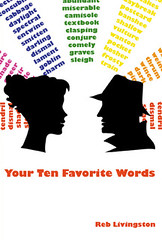
I hope everyone will join me and Nicole at 6:30 PM EST this evening in the chat room and on the phone for the show and the book club discussion. OK, this is me begging! 🙂

Reb Livingston’s Your Ten Favorite Words is a collection of poems that examines the battle between the sexes in a new way, creating caricatures of men and women.  Livingston has a way with imagery, alliteration, and riddles.  A number of poems roll into a rhythm, twist the tongue, and require readers to assess each line carefully.

The collection is broken down into three parts:  Our Rascal Asses; Unsweet and Looking for a Fix; Burgers and Pitchforks.  Readers are introduced to three caricatures Smitten Girl, The Man With the Pretty Chin, and The Heart Specter.  And each section begins with a mini-conversation or set of statements between the characters.  These set up each section, allowing them to unfold.

“The Smitten Girl [to The Man with the Pretty Chin]:  Will you be using your charm for good or injury?

The Heart Specter [murmuring]: (C)harm for G(o)od!” (Page 8 )

Livingston’s collection turns conventional expectations about female perspectives on relationships with men upside down.  Each narrator celebrates female sexuality and desire, but also questions the confusion that comes with that base emotion and need.  At the same time, there is a sense of the comedic in these lines, which pokes fun at the awkwardness of sex and interactions and expectations between men and women.

“He was dark brilliance and moans

(his moans, girlish and dusk, yet I gushed)”  (From Almost Took a Lover Once, page 12)

Livingston’s Your Ten Favorite Words is a collection with a title that will cause confusion among readers and leave them scratching their heads.  The title’s meaning and purpose to the collection could remain obscure for some time, but this is a collection readers will want to return to again and again to unravel the riddles and relish the inner truth of these frank discussions.

About the Poet:

Reb Livingston is a poet and editor of No Tell Books, a press devoted to poetry, and No Tell Motel, an online poetry magazine.  She also is the author of Your Ten Favorite Words (Coconut Books, October 2007) and Pterodactyls Soar Again (Whole Coconut Chapbook Series, 2006). Her poems have appeared in Best American Poetry 2006 and literary magazines.

This is my 26th book for the 2010 New Authors Challenge.

This is my 15th book for the contemporary poetry challenge.


This is my 3rd book for the Clover Bee & Reverie Poetry Challenge.

Since Reb Livingston is a local D.C. area poet, this is a great look at her work as part of The Literary Road Trip, which has moved to Jenn’s Bookshelves from GalleySmith.

***

Please don’t forget to check out the next stop on the National Poetry Month Blog Tour Life Is a Patchwork Quilt.