Quantcast

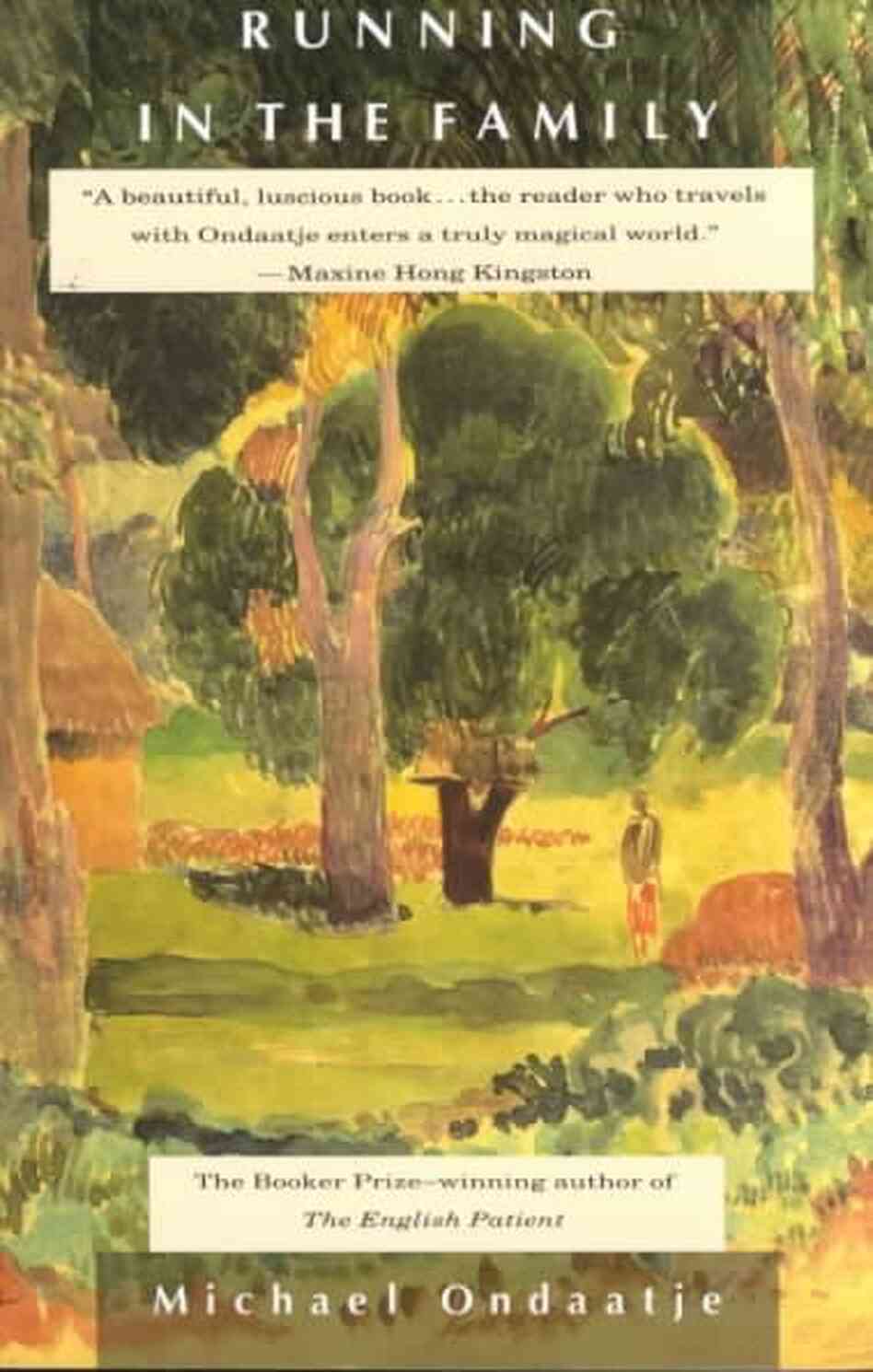
Running in the Family by Michael Ondaatje

Source: Public Library
Paperback, 207 pages
I am an Amazon Affiliate

Running in the Family by Michael Ondaatje is a travel and family memoir (highly recommended by Beth Kephart), and he says that it is a composite of two return trips to Sri Lanka, formally known as Ceylon, in the 1970s, as well as endless stories and questions-and-answers from family members and those that knew his father Mervyn best.  Michael is among the youngest of the family, having left Ceylon when he was 11 after his mother and father divorced.  Much of this memoir borders between fiction and truth, but like all memories and perceptions, the story of someone’s life can be as fluid as the relationships that begin and end with and around them.  The crux of this memoir, in which Ondaatje embarks on his own journey of remembering about his family and the country he came from, is about the fluidity of memory and the inability to truly know even our closest family members.

“What began it all was the bright bone of a dream I could hardly hold onto.  I was sleeping at a friend’s house.  I saw my father, chaotic, surrounded by dogs, and all of them were screaming and barking into the tropical landscape.  The noises woke me.  I sat up on the uncomfortable sofa and I was in a jungle, hot, sweating.”  (page 21)

Ondaajte’s magical realism shines through in the narrative, particularly as he takes trips to the former family home and into the jungle.  There are humorous anecdotes about his grandmother, Lalla, who clearly had a love for life and freedom.  There is one incident in which she doesn’t realize her breast is being fondled by a stranger on the bus, but the reasoning is something very unexpected.  His father and grandmother did not get along well, and whether that is because Mervyn is a victim of dipsomania, also known as alcoholism, or Lalla’s inhibition after her husband’s death that enables her to do as she pleases without one thought to the consequences.  

More than anything, Ondaatje’s memoir is about learning about his family’s outrageous past in a time of excess (1920s), but also realizing that there are mysteries about the interconnectedness of their lives that may never be resolved.  He must come to terms with what he knows about his family through his own memories and that of others and what will always remain a mystery — how can he reconcile the two.  But this is not just all prose, he also illuminates some of the family stories with poetry.  Running in the Family by Michael Ondaatje is sparkling in the jungle, a bead of sweat that slithers down your arm and seeps beneath the skin and causes a startling chill.
About the Author:

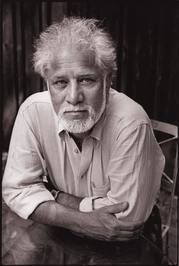
Michael Ondaatje is one of the world’s foremost writers – his artistry and aesthetic have influenced an entire generation of writers and readers. Although he is best known as a novelist, Ondaatje’s work also encompasses poetry, memoir, and film, and reveals a passion for defying conventional form. His transcendent novel The English Patient, explores the stories of people history fails to reveal by intersecting four diverse lives at the end of World War II. This bestselling novel was later made into an Academy Award-winning film.

The News from Spain by Joan Wickersham

Source: Public Library, though Beth Kephart’s review had me seek it out.
Hardcover, 208 pages
I am an Amazon Affiliate

The News from Spain: 7 Variations on a Love Story by Joan Wickersham explores what it means to love in its many forms, and how that emotion can be caught up with and distorted by other emotions and desires.  From the woman whose husband is a serial cheater even as she lays partially paralyzed and dependent upon him to the woman who is drawn again and again to a co-worker who is just out of reach, Wickersham demonstrates the power love has over our bodies and the helplessness we feel as we try to fight off that power.  Each story is titled “The News from Spain,” harkening to the segues used in conversation to divert attention or change the subject from something more personal and deeply wounding, as if calling attention away will make relationships and connections easier to bear or ignore.

“What they had together was pleasant.

But still that word continued to bother her, whenever she thought of it.  The fact that it appeared to be lauding, but the thing that it praised was a limitation.”  (Page 40)

There are characters here who are emotionally detached for a number of reasons, but even they find themselves in the midst of relationships, waffling through the navigation of their emotions.  Each character is seemingly stuck in a pattern of love, and these patterns continue infinitely through time as some of them long separated from these emotional or physical affairs continue to mull them over and remember them either fondly or quizzically.  Wickersham explores what it means to love and be loved, but also what it means to hurt the ones we love, to struggle in the quest for giving and receiving forgiveness, and also what it means to move beyond the hurt and pain to find peace and fondness without the bitterness and regret.

In one story, the narrator talks of unrequited love and the emotions running throughout her body becoming an unruly mob when she tries to rein them in after confessing to the man.  And this frenetic movement within her is reminiscent of those first flushes of love — requited or not — and the passions they inflame, but as she professes to continue to love her husband, readers may begin to wonder if it is love she feels at all for this other man or a want for those feelings of passion to reignite her life.  The News from Spain: 7 Variations on a Love Story by Joan Wickersham is at times an emotional roller coaster and at others a dark comedy on the passions of love, but her characters struggles are brought to life in a way that will leave a lasting impression on readers.

About the Author:

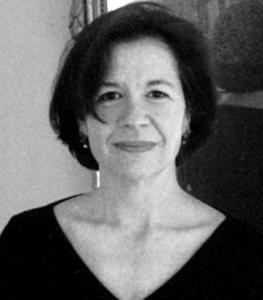
Joan Wickersham was born in New York City and grew up there and in Connecticut. Her new book of fiction, The News from Spain: Seven Variations on a Love Story, will be published by Knopf in October 2012. Her memoir The Suicide Index: Putting My Father’s Death in Order (Harcourt 2008) was a National Book Award Finalist. She is also the author of a novel, The Paper Anniversary.

Please visit her Website and her Facebook page.

This is my 49th book for the 2013 New Authors Challenge.

Letters From Skye by Jessica Brockmole

Source: TLC Book Tours and Random House
Hardcover, 304 pages
I am an Amazon Affiliate

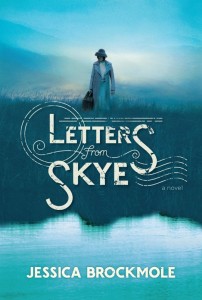
Letters from Skye by Jessica Brockmole, an epistolary novel that straddles two World Wars, is about falling in love, finding your soul mate, and poetry.  Elspeth Dunn, a Scottish poet on the Isle of Skye, lives a rather cloistered life on her island but one of her books makes its way across the Atlantic to a young man in Illinois, David Graham, who writes her a fan letter.  Over the course of several years beginning when WWI breaks out in Europe, Elspeth and David begin a correspondence that takes on a life of its own.

“It’s the war talking.  I know; I’ve seen it.  They head off, invincible, feeling as if the future is a golden pool before them, ready to dive into.  And then something happens — a bomb, a sprained wrist, a bullet that whizzes by too close for comfort — and suddenly they are grabbing for whatever they can hold on to.  That golden pool, it swirls around them, and they worry they might drown if they’re not careful.  They hold tight and make whatever promise comes to mind.  You can’t believe anything said in wartime.  Emotions are as fleeting as a quiet night.”  (page 33 ARC)

While David is in America struggling through college and hoping to subvert his father’s plans for medical school, Elspeth is busy writing poetry and becoming even more entrenched in the lines her muse is offering.  Her relationship with her brother Finlay is the closest she has, but war does change things.  The more her muse speaks, the more she’s pulled away from the life she’s always known and the more she is challenged to face her fears — including her fear of water.

Through Elspeth and David’s correspondence the wider impact of war is experienced, complete with the tension of the home front as wives and families wait for their loved ones.  But at the same time, the lives of women are broadening as they are able to enter into jobs once thought of as men’s work.  The feminist leanings of Elspeth are clearly front and center in some of her correspondence with David, but it never deters him in his pursuit of her.  The moral high ground has no place in this romantic jaunt across Scotland, London, and France as a young woman and man succumb to their emotional connection on the page.

Letters from Skye by Jessica Brockmole weaves Elspeth and David’s story with that of Margaret, Elspeth’s daughter, and her search for the past.  Margaret has never met her father, and her mother remains close-lipped about her past and her daughter’s father.  But when WWII begins to break out, all of the old transgressions and emotional upheaval of Elspeth’s past resurfaces, threatening to leave her unmoored once again.  But Margaret’s life is far from pristine when it comes to the tentacles of war as her fiance flies for the RAF.  Brockmole’s letters are frank, honest, and engaging as these relationships unfold and enfold, creating a family history that will be hard to forget.  And yes, there is a poem included!

About the Author:

Jessica Brockmole spent several years living in Scotland, where she knew too well the challenges in maintaining relationships from a distance. She plotted her first novel on a long drive from the Isle of Skye to Edinburgh. She now lives in Indiana with her husband and two children.

To learn more about Jessica and her work, visit her Website.

To WIN a copy of this book, leave a comment by July 19, 2013, at 11:59 PM EST; You must be a U.S. resident 18 years and older.

This is my 44th book for the 2013 New Authors Challenge.

Hokey Pokey by Jerry Spinelli

Hokey Pokey by Jerry Spinelli (published in January 2013) is a modern day fable in which the maxim “Kids live in their own little worlds” comes to life.  Bicycles become wild mustangs or horses in the plains to be captured by boys who are not just boys but cowboys with rope.  Girls hate boys and boys hate girls — taunting each other with harmless names and petty pranks.  In many ways, they relate to the opposite sex no differently than they relate to their own, though rather than offer advice or imparting skills and knowledge to their gender enemies, they stand apart from them and deride them as inferior.  Spinelli’s tale takes a few chapters to develop into a full blown world, but once it does, look out.  Readers will be wandering around and playing games.

There are four basic rules in this world of Hokey Pokey:  never leave a puddle unstomped; never go to sleep until the last possible minute; never kiss a girl; and never go near the Forbidden Hut.  With a male protagonist, Jack, Spinelli obviously is gearing the book more toward male readers, but female readers who can remember their childhoods and the games they played, may still find something to hold their attention here.  Jack is flanked by his amigos, Dusty and LaJo, and his enemy, Jubilee, has just stolen his mustang — Scramjet — the most famous bike in all of the land.  Jack is pissed, he’s vengeful, he’s sad, but more than anything, he’s noticed that something has changed since he woke up in the morning.

“The world looked exactly the same as always — the places, the kids — but this time there was a slippery sense, like an uncatchable moth, that he himself was no longer part of the picture, was on the outside looking in, that the world he was seeing was no longer his.  For a scary instant he thought his end of the seesaw was going to keep on rising and catapult him clear out of Hokey Pokey.”  (page 76 ARC)

Spinelli weaves a tale of growing up and leaving childhood behind and that sense of things being the same as they always were, but different somehow.  Highly inventive and at times surreal, Spinelli’s world can be a bit topsy turvy at first, but readers will soon wonder what is wrong with Jack and where he’s going if he is leaving Hokey Pokey when there is no train.  In a world absent of adults, kids run amok, taunt each other and take out their traumatic frustrations on one another in the form of games and the dangerous click, click, click of the exploder, which renders other kids “dead.”  In a land of make-believe and where anything is possible, Jack and his friends are free to think and feel how they wish without consequence.  But even in this world, there are boundaries to how others are treated.

Hokey Pokey by Jerry Spinelli, which is my first experience with this author, is an adventure for young and old.  However, the age range is 10 and up, and readers on the younger end of that range may find the themes and some language challenging, especially as Spinelli often mashes words together or creates his own as part of Hokey Pokey’s world.

About the Author:

Jerry Spinelli is an American author of children’s novels on adolescence and early adulthood. He is best known for the novels Maniac Magee, for which he won the Newbury Medal, and Wringer.  After graduating from Gettysburg College with an English degree, Spinelli worked full time as a magazine editor.  Spinelli was born in Norristown, Pennsylvania and currently resides in Phoenixville, PA.

This is my 88th book for the New Authors Reading Challenge in 2012.

The Queen’s Vow by C.W. Gortner

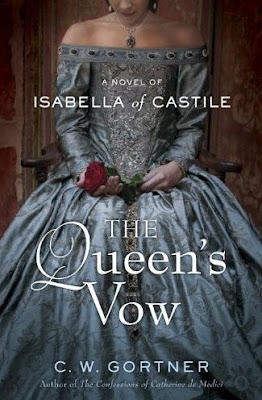
The Queen’s Vow by C.W. Gortner, published June 12, is another historical fiction powerhouse about a strong, young royal who cares for her family and her country more than herself.  Isabella of Castile is the daughter of the ailing Juan II and his second wife Isabel of Portugal, and she has a younger brother Alfonso, on whom she dotes.  Her relationship with her half-brother Enrique IV is tenuous at best, and when he is poised to takeover the crown when their father dies, her mother believes it is best to flee to Arevalo.

“I slowly reached up to take my mother’s hand.  I had never dared touch her before without leave.  To me, she’d always been a beautiful but distant figure in glittering gowns, laughter spilling from her lips, surrounded by fawning admirers — a mother to be loved from afar.”  (Page VIII)

Like most royal families, children rarely spend intimate time with their parents, though often they will spend more time with their mothers if they are girls.  Isabella spends little informal time with her mother until they are removed to Arevalo, and she has virtually no relationship with her father, Juan II.

“I was not yet four years old.  My father had been ill for weeks with a terrible fever, shut behind the closed doors of his apartments in the alcazar of Valladolid.  I did not know him well, this forty-nine-year-old king whom his subjects had dubbed El Inutil, the Useless, for the manner in which he’d ruled.  To this day, all I remember is a tall, lean man with sad eyes and a watery smile, who once summoned me to his private rooms and gave me a jeweled comb, enameled in the Moorish style.  A short, swarthy lord stood behind my father’s throne the entire time I was there, his stubby-fingered hand resting possessively on its back as he watched me with keen eyes.”  (page III)

Isabella knows that of all her siblings she is the last in line and as a female heir to the throne of Castile, she will likely be sold off into marriage for political or monetary reasons.  But as a young girl sent with her mother outside the company of the crown, she has the freedom to just enjoy her family.  Her and Alfonso have a great relationship, and she has a great relationship with Beatriz, her lady in waiting, but her respite from court intrigue does not last long.  Unfortunately, there are many times throughout the book that Isabella finds herself moving from place to place, fleeing those that would do her harm even her brother Enrique, whom she remains loyal to even though he is easily swayed by others.

Readers will experience the sorrow Isabella feels about her relationship with Enrique and how finally she must break that familial bond, if she plans to survive and marry the man she loves, Fernando of Aragon.  She is often tugged in more than one direction either between her family bonds and destiny or her duty as heir to the Castile throne and the pull of her heart. In a nation pulled this way and that by different powers and political interests attempting to usurp royal power outright or through the shadows, Isabella has many demands on her time and heart, and she’s pushed to the brink more than once. She’s a stronger woman than she realizes, and with Fernando at her side, they are a force to contend with.

The Queen’s Vow by C.W. Gortner is about a promise of a better tomorrow not only for Isabella and her loved ones, but also for the country she’s seen toil with her own eyes and hands. It is a novel of perseverance, following one’s heart and instincts, and justice, but it also is a novel of family and how it can be not only nurturing but also devastating if animosities and jealously are allowed to fester. Gortner is a master at historical details, weaving them throughout a narrative that is highly emotional, tense with drama, and at times poetic in its description of the Spanish landscape. Another winning novel from this author.

About the Author:

C.W. Gortner is the author of The Last Queen, The Confessions of Catherine de Medici and The Tudor Secret. He holds an MFA in Writing with an emphasis in Renaissance Studies from the New College of California.

In his extensive travels to research his books, he has danced a galliard in a Tudor great hall and experienced life in a Spanish castle. His novels have garnered international praise and been translated into thirteen languages to date. He is also a dedicated advocate for animal rights and environmental issues.

He’s currently at work on his fourth novel for Ballantine Books, about the early years of Lucrezia Borgia, as well as the third novel in his Tudor series,The Elizabeth I Spymaster Chronicles (US) or Elizabeth’s Spymaster (UK).

Half-Spanish by birth, C.W. lives in Northern California.

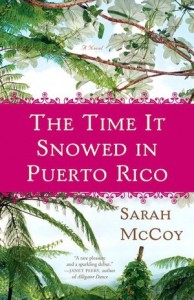
The Time It Snowed in Puerto Rico by Sarah McCoy

The Time It Snowed in Puerto Rico by Sarah McCoy is a coming of age novel about a young girl, Maria — also known as Verdita — in Puerto Rico during the debate about whether or not the nation should become a member of the United States or remain independent.  Part of Maria Ortiz-Santiago’s family lives in the United States and part lives on the island in a little barrio, and readers get a taste of the differences between the two lives when Omar, her cousin, comes back to visit.  As the two grow older and grow apart, Verdita continues to ramp up her competitive spirit when he’s near to retain her hold on her father.  She’s always had a fear that a boy would usurp her father’s affections, especially after her mother becomes pregnant.

“For my eleventh birthday, Papi made piraguas.  He left balloons of water in the freezer until they were solid, then peeled the plastic off like bright banana skins.  On the veranda, he used his machete to shave the globes into ice chips.  Hard bits of cold spit out where the ball and blade met, landing on my arms and legs, cheeks and nose.  Papi said it was a Puerto Rican snowfall, and laughed long and deep.”  (page 1)

Verdita is a willful girl and very curious about everything around her, including the independence debate, the cock fights at the local bar, and the United States.  Readers will find that she’s obsessed with the United States and how different it is from her home in the barrio.  She wants to be blond, listen to Elvis, and learn English.  She wants to remain close with her father, but push her mother away.  All this mixed up emotion and desire in one girl is so vibrant on the page, female readers especially will remember what it was like to become a senorita and leave girlhood behind and all of the mixed and high emotions that brought with it.

“I ate until my stomach pushed into the table ledge.  I didn’t even really like the hamburger, but I liked that it came from America — that I was eating like an American.  It made me feel bigger than my finca on the mountain, bigger than the whole island.  I’d seen the States, even if I hadn’t seen President Kennedy.  My stomach was full of America.”  (page 59)

Even as she sees the goodness in her roots and her family, she still longs for the foreignness of the United States.  She becomes accustom to sharing her life with a sibling, but still longs to break break free.  She’s struggling between the desire to grow beyond her roots, deeply earthed in Puerto Rico, but barely realizing that she can grow taller and broader by taking the leap without having to sever her ties to home.

McCoy’s choice of first person point of view is spot on for a coming of age story, and while filtered through Verdita’s eyes rather than the other characters, readers will not feel as though they have missed anything.  She’s observant, opinionated, curious, and eager to explore.  The Time It Snowed in Puerto Rico is not only about growing up, but about taking chances and spreading wings to find out who we are, who we want to be, and how we can make the best of everything we are given in terms of familial support and available opportunities.

This was a book I just had to pick up at the Gaithersburg Book Festival when Sarah McCoy was in town.  She’s a lovely writer and woman, and it was great to see her again and get another autograph.  I cannot wait to read her next novel.

About the Author:

SARAH McCOY is author of the novel, The Time It Snowed in Puerto Rico. She has taught English writing at Old Dominion University and at the University of Texas at El Paso. The daughter of an Army officer, her family was stationed in Germany during her childhood. She calls Virginia home but presently lives with her husband and dog, Gilbert, in El Paso, Texas. The Baker’s Daughter is her second novel. She is currently working on her next.

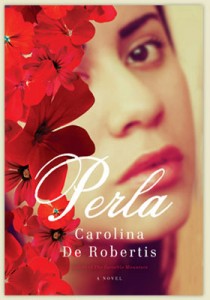
Perla by Carolina De Robertis

Perla by Carolina De Robertis (giveaway following the review) is captivating and intoxicating in its setting, mystery, and the psychological unraveling of the main protagonist, Perla.  She’s growing into a young woman, but her cloistered existence threatens to explode until she begins to release herself in books and in her relationship with Gabriel.

The past haunts everything around her, though she does not know it at first.  She is proud of her family and her father’s naval career and her mother’s quirky penchant for picking up new hobbies and discarding them.  But her pride is suddenly shaken when she learns of the Disappeared, Argentinians who were silently taken from their workplaces and homes in the 1970s and 1980s by the government for allegedly being subversives.  In school she writes a short story that wins a prize and is published in the newspaper, but her story has other unintended consequences.  It opens up hidden fissures in her family, and forces her to rebel and question the father she’s loved with blind devotion.

“He was uninvited moisture.  He had leaked into this house.  I had every reason to find his presence an affront, to be enraged at his invasion, or at least to eject him in calm tones.  Certainly he made me feel combustible, unsafe in my own skin.  But though I didn’t know why, though the feeling shocked me, I did not want him to leave.”  (page 28)

The fluidity with which De Robertis tells the tale is much like the Dali painting, “The Persistence of Memory,” hung in Perla’s childhood home, weaving in and out of reality and shaping a psyche that is struggling with secrets that are too devastating to hold inside.  Perla is a novel about identity and how it is created or comes into being and whether it is alive within us before we are even born.  In accordance with this look at identity, the novel examines the harsh treatment society places on new generations for the transgressions of the past.  Struggling with the truth of her father’s job and how it may have contributed to the disappearance of many Argentinians is enough for Perla to deal with as a young adult, but she also must confront the sneer and the unspoken disgust in the eyes of her classmates and friends when her father’s occupation is revealed.

Retreating into herself and her books, Perla finds a way to cope and becomes strong in a way that even she is unaware of, and when she meets Gabriel, her strength is tested once again.  Can she love her father and still love this man who writes articles condemning the actions of former military and government leaders who now have immunity?  Can she reconcile the two worlds of her life into one and live with herself?  And how can she explain her love for her father amidst the knowledge of what his actions before she was born did to the country and to other families?

De Robertis takes readers on a psychological journey through Perla’s mind as she processes the revelations of her family life and the nation she was born into.  Legacy plays an important role and it is clear that Perla must uncover what that legacy should be as she grows into a woman and leads her own life.  The prose is so enchanting and intoxicating, hours of reading fly by as streets in Buenos Aires become crowded with footfall percussion beats and musical laughter countered with the closed off rooms of Perla’s childhood home and the dark, swirling violet waves of her aunt’s painting.  Water also is a significant image throughout the book as it gives life and sustains it in the womb and in the soil, but it also connects everyone and everything in the story, running underground and supplying the sustenance to the tale.

“Flowers lurked at every turn.  You could not rest your gaze without encountering a geranium, two geraniums, hundreds of geraniums, and you could not walk without the feeling that geraniums were following you close at heel, bright mobs of them, crowding the air at your back.  You could not help feeling vastly outnumbered.” (page 90)

In a few sections when Perla’s mother has taken up gardening as a hobby and begins overpopulating the house with geraniums, it is clear that these flowers are like the bodies of the disappeared blossoming despite the cover up and lurking around every corner, haunting those that took part.  These bodies even when the blossoms fade from lack of care, continue to haunt the house and its inhabitants, prodding Perla’s family to look about them, to question, to uncover the truth beneath the well-manicured soil.

Perla by Carolina De Robertis melds the supernatural with reality in a way that it becomes a testament to all of the disappeared and the children of the disappeared who were restored and not.  It is an examination of an ugly part of Argentinian history in which women, children, and men were taken from their families and homes without warning, tortured, and released from planes above the Atlantic Ocean — erased from existence.  De Robertis does not dwell on the horrors of those times, but on the consequences of those actions and the reverberations felt for generations following the political upheaval that caused them.  She does so with aplomb and breath-taking imagery that transports readers to a South American nation ripe with beauty and dark secrets to explore what it means to have an identity and to be an individual in spite of what your family may have done in the past.  One last note, get the tissues ready!  Another for the 2012 best of list.

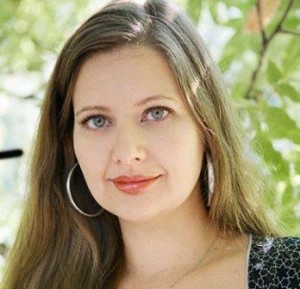
Author Carolina De Robertis

About the Author:

Carolina De Robertis is the author of Perla and The Invisible Mountain, which was an international bestseller translated into fifteen languages, the recipient of Italy’s Rhegium Julii Prize, and a Best Book of 2009 according to the San Francisco Chronicle, O, The Oprah Magazine, and BookList. Her writings and literary translations have appeared in Zoetrope: Allstory, Granta, The Virginia Quarterly Review, and elsewhere. She is the translator of Alejandro Zambra’s Bonsai, which was just made into a film, and Roberto Ampuero’s internationally bestselling The Neruda Case, which will be published for the first time in English in July 2012. De Robertis has been awarded a 2012 fellowship from the National Endowment for the Arts.

De Robertis grew up in a Uruguayan family that immigrated to England, Switzerland, and California. Prior to completing her first book, she worked in women’s rights organizations for ten years, on issues ranging from rape to immigration. She lives in Oakland, California, where she is currently elbow-deep in writing her third novel, which explores migration, sexual frontiers, and the tango’s Old Guard in early twentieth century South America.  Connect with her on Facebook, Twitter, and through her Website.

tlc tour host

This is my 37th book for the 2012 New Authors Challenge.


To enter for 1 copy of Perla by Carolina De Robertis (US/Canada), leave a comment about what you’d like to learn about the disappeared of Argentina.

Deadline is May 17, 2012, at 11:59PM EST

The Day the World Ends by Ethan Coen

The Day the World Ends by Ethan Coen, one half of the Coen Brothers film making team with great films under their belt like Brother, Where Art Thou? and No Country for Old Men, is a twisted and unexpectedly thoughtful collection in places.  The limericks are bawdy and remind me of Christopher Moore’s humorous prose, but less in the smart and sassy humor and more in the low-class bathroom humor sense.  Necromancy Never Pays stated that the poetry in the volume is geared toward a male audience, and in most cases, that is true — particularly with the dirty limericks.
"Stone-age man, thawed from glacier, aghast:
'Was some snowman in my recent past?
And if so, who fucked who?
My dick's numb and quite blue
And there's freezer burn all up my ass.'" (Page 28)

Additionally, Coen appears to love rhyme, no matter how trite or over-stretched it might be.  Readers could find this collection amateur at best in how Coen chooses his rhymes, even when they have a tongue-in-cheek quality.  Like the “bathroom” humor, these rhymes can get tiresome.  Take for instance the rhymes in “Vine-Covered Verse” (page 53), “Lord, keep this farmer’s soul in peace,/For, though he dallied with his niece,/And cow, and nephew, none can claim/He, during, failed to praise Your name;/And how commit a lesser sin/When neighbors are but kine and kin?//”   However, even in this poem, there are moments of deeper thought in which the narrator is asking what sins are worse and should they all be forgiven or all be condemned.  It also questions how well we know our partners or other humans in general and what secrets they will take to their graves.

Coen’s poetry in this collection seems built for laughs among men mostly, though there are moments in which the poems are not trying so hard to be humorous.  There are some with an anachronistic quality to them, while others like “My Father’s Briefcase” are more serious and reflective.  “Therapy” uses humor and disdain to point out the inane struggle we have against aging and the depression that accompanies the process of aging, as the narrator talks of his depression to a less-than-helpful therapist.

The Day the World Ends by Ethan Coen is not for everyone and could be trying if read from cover to cover, but for those looking for a humorous romp on the underside of humanity, take a dip into these pages.

Poet Ethan Coen

About the Poet:

Ethan Jesse Coen is one half of the American film making duo the Coen brothers.  Their films include Blood Simple, Fargo, The Big Lebowski, O Brother, Where Art Thou?, No Country for Old Men, and True Grit. The brothers write, direct and produce their films jointly, although until recently Joel received sole credit for directing and Ethan for producing. They often alternate top billing for their screenplays while sharing film credits for editor under the alias Roderick Jaynes.

To enter to win one of 2 copies for US/Canada readers:

Leave a comment about what tour stop on the National Poetry Month Blog Tour you’ve enjoyed most, either here or on one of the participants’ blogs.

Blog, Tweet, or share the link on Facebook for up to 3 additional entries.

Deadline is April 30, 2012.

***Today’s tour stop is at Arisa White, so check it out!***


This is the 11th book for my 2012 Fearless Poetry Exploration Reading Challenge.


This is my 29th book for the 2012 New Authors Challenge.

Interview with Sarah McCoy, Author of The Baker’s Daughter

If you haven’t seen reviews for The Baker’s Daughter by Sarah McCoy yet, you must have been living in a cave.  I reviewed this phenomenal historical fiction novel told from the perspectives of two equally strong, but scarred women. 

From my review:  “The recipe for a successful novel is two parts dynamic characters, one part intriguing plot and story lines, and one part clever writing style, and The Baker’s Daughter provides all the nourishment you’ll need.”

I’m particularly confident that this will make this year’s best of list for 2012.

And after meeting Sarah in person, I can honestly say she’s a writer I’ll be adding to that coveted list, whose books I read simply because of who wrote them.  Her personality infuses her stories and her writing, and even in dark tales, her positive attitude and joy for life shine through.

Today, I have a treat for my readers; Sarah agreed to answer a few questions even after traveling the country, attending a book festival, battling the flu, and conducting an online book tour.  I applaud her dedication and want you to give her a warm welcome.

Q: How much does your own life influence your writing? Like are there elements of family and friends in your characters?

A: As an author, you are the conduit through which the story is filtered so, of course, elements of your life (fragments of people, events, places, etc.) are incorporated but never replicated. I gave the analogy of a honeybee in this article on Beyond The Margins and I stand by it. I’m just a story bee buzzing from stem to stem collecting as much as I can to make into honey. Each season is different from the next depending on what’s in bloom along the roadside of my journey.

Q: In The Baker’s Daughter there are some chapters that are from male perspectives. When writing from male and female perspectives, which do you find harder to write and what are some of the main differences between them?

A: This was my first time writing from the male POV and I LOVED it! So much, in fact, that half of the novel I’m currently working on (my third)is from a male protagonist’s perspective. Gender doesn’t factor into the difficulty of writing so much as the character’s inner conflicts and moral complications. For instance, in THE BAKER’S DAUGHTER, one of the male perspectives is Josef, a Nazi officer. It took some work to separate my personal author judgements from my writing. In order to be genuine to Josef’s story line, I had to turn off present-day Sarah McCoy and fully embody what it might’ve been like for a German officer: what moral conflicts did he face; what emotional battles waged within; what governing pressures did he withstand; what cultural forces were at play? I had to do similarly for Elsie and the Schmidts. It’s the human spirit that often flummoxes me most–male and female!

Q: Was The Baker’s Daughter the original title of the book? What other titles were considered and how did you ultimately end up with the current title?

A: In my journal entries for the story, I called it the “Lebkuchen Tale”and the “Garmisch Story” as reference guides, but from the time the first word was typed, THE BAKER’S DAUGHTER has been its title. I was fortunate that my Crown editors and marketing team loved it too.

Q: What are some of your writing habits/obsessions that readers may be surprised to learn about (other than your love of history and tea)?

A: I have so many hidden quirks. I could probably fill ten pages with crazy-writer-lady idiosyncrasies. So for the sake of time, I’ll name one: I sit at my same writing desk without any sound during my writing days. No TV or radio. The phone ringer is turned off. Windows are closed, etc. I’m sealed up in a vacuum. That’s how I write best–in a kind of reality black hole where my imagination fills in all the senses: sound, sight, smell, taste, touch. Some people find this absolutely bizarre. Family members, included. But by the time I sit down to write the story on my laptop, I’ve dreamed on it for months. I’ve journaled. I’ve plotted. I’ve filled up my reservoirs with the pollinated story. I need the silent solitude so my characters can speak clearly, so I can feel the fictional landscape through their senses. Again, as I mentioned in the earlier, I consider myself (Sarah McCoy the author) merely the channel through which the story is processed.

Q: Since Savvy Verse & Wit has a focus on poetry a lot of the time, I like to ask authors about their poetry reading habits. If you read poetry, do you prefer contemporary or classic poetry? Form or free verse? And who are some of your favorite poets or poetry collections? (As a side note, have you checked out the Penguin Anthology of 20th Century American Poetry edited by Rita Dove?) Or why don’t you read poetry?

A: I hate to admit it, but I don’t read hardly enough poetry. I enjoy it, but I’m much more of a narrative reader. I need big, fat paragraphs of description and plot. However, some of my dearest friends are poets. When they read their work aloud, I am mesmerized. It’s as if they’ve cast a spell and I hang on every breath and syllable. If I had to pick my favorite, it’d be Maya Angelou. She is more than a poet. She’s a force of nature.


Thanks, Sarah, for sharing your thoughts with us about writing, your novel, and poetry.

About the Author:

SARAH McCOY is author of the novel, The Time It Snowed in Puerto Rico. She has taught English writing at Old Dominion University and at the University of Texas at El Paso. The daughter of an Army officer, her family was stationed in Germany during her childhood. She calls Virginia home but presently lives with her husband and dog, Gilbert, in El Paso, Texas. The Baker’s Daughter is her second novel. She is currently working on her next.

Website | Blog | Facebook | Twitter | GoodReads

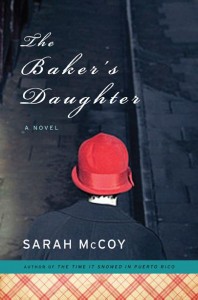
The Baker’s Daughter by Sarah McCoy

The Baker’s Daughter by Sarah McCoy is a novel told in a number of different points of view and spans several time periods, including the final year of World War II.  Two strong female protagonists, each haunted by the past and each past is tied to war in one way or another.

Elsie Schmidt is a German immigrant to El Paso, Texas, who spent the last year of WWII in her father’s bakery working and shying away from the decisions that came with living in Nazi Germany.  Unlike her sister, Hazel, who was in the Lebensborn program and praised for her work to help the Fatherland, Elsie sees herself as more of an outsider, lacking in the standard skills expected of a Good German.

“While Hazel thrived and grew more popular, Elsie felt oppressed and stifled by the uniforms and strict codes of conduct.  So at the tender age of eleven, she begged Mutti to work in the bakery.” (Page 16)

Reba Adams is also an El Paso transplant, but she’s a journalist looking for her latest feel-good piece for the magazine she works for, but she gets more than she bargained for when she meets Elsie.  Meanwhile, she’s hiding from her past and the ghosts of her dead Vietnam veteran father and failing to fully commit to the life she’s created in Texas with her fiance Riki, a border patrol officer.

“Everyone on campus knew her from the photograph in the Daily Cavalier: her lips bulging on the mouth guard; fuzzy, dark hair matted beneath the headgear; gloves up and ready.  They thought she was an anomaly coming from the Adams family.”  (Page 33)

The two different main perspectives in two different time periods is deftly handled by McCoy and each of her characters are strong and stubborn, but neither is lacking in dynamism or flaws.  Also unique to the novel is how well McCoy weaves in the elements of baking and pastry into her description; it is seamless and will make readers’ mouths water and have them itching to try the recipes in the back of the book.  Touching on family loyalty, mother-daughter bonds, father-daughter bonds, relationships of all kinds, plus the search for love and forgiveness, McCoy reaches deep inside the dough to knead the bonds of these women to help them grow outward and inward, allowing them to absorb more love and connections.  The recipe for a successful novel is two parts dynamic characters, one part intriguing plot and story lines, and one part clever writing style, and The Baker’s Daughter provides all the nourishment you’ll need.

Click for Tour Stops

About the Author:

SARAH McCOY is author of the novel, The Time It Snowed in Puerto Rico. She has taught English writing at Old Dominion University and at the University of Texas at El Paso. The daughter of an Army officer, her family was stationed in Germany during her childhood. She calls Virginia home but presently lives with her husband and dog, Gilbert, in El Paso, Texas. The Baker’s Daughter is her second novel. She is currently working on her next.

Website | Blog | Facebook | Twitter

This is my 16th book for the 2012 New Authors Challenge.

Vampire Knits by Genevieve Miller

Vampire Knits by Genevieve Miller is a collection of knitting patterns from a diehard Twilight series fan, who was so inspired that she created a collection of patters for other fans of the series and vampires in general.  However, some of these patterns could just be knitted and worn by everyday, non-vampire fans and fans of werewolves/shapeshifters too.  The book’s font and design seem very appropriate for the vampire inspired knitting in these pages, which are broken down into sections:  Protect Me; Just Bitten; Vampire Style; Bloody Accents; and Who’s Afraid of the Big, Bad Wolf?

There is a glossary of knitting abbreviations, which could help beginning knitters and a metric conversion chart.  The book also includes credits for contributing designers and a special skills section outlining what cables, stranded knitting, short rows, 3-needle bind off, and other stitches are.  For someone that doesn’t knit, this book is just pretty to look at, and if you have a friend who knits, this might be a perfect gift for them, especially if they knit you things for birthdays and holidays.  Each pattern offers step by step directions and designate the proper skill level for each pattern from beginner to expert.  There are scarfs, sweaters, hats, bottle cozies, purses, and even jewelery.

Looking through this book, readers could easily see Alice, Edward, and Bella wearing some of these designs, but there are others that would be perfect for the Goth crowd, like this Prim Reaper’s Corset.  Some of my particular favorite designs in the book are The Black Veil Scarf, Vampire Diary Protector (which you could use for books too), and Sitio Stockings.  The Tourniquet Scarf looks like something men would wear, and there are sweaters for kids with vampire teeth.

Vampire Knits by Genevieve Miller is an excellent book for knitters looking for something a little different, and some of the patterns and stitches look lovely and fashionable — this is not your grandmother’s knitting.  If I could knit — which I can’t at all — I’d try out some of these patterns in a heartbeat.  I’ll definitely be passing this one along to a knitter, and maybe I can get a nice Black Veil Scarf out of the deal?!

About the Author:

Genevieve Miller was inspired to design her own patterns after reading Twilight. She is the mother of three and luckily married to a guy who doesn’t mind the house being taken over by a giant yarn stash. She lives in Pasadena, California.


This is my 4th book for the 2012 New Authors Challenge.

Jane Austen Made Me Do It Edited by Laurel Ann Nattress

Laurel Ann Nattress, the woman behind Austenprose.com, is now the editor of Jane Austen Made Me Do It, a collection of Jane Austen-inspired short stories (check out the tour).  Authors not considered Austenites per se, like Frank Delaney writes with Diane Meier and Adriana Trigiani join those known for their Austen spinoffs, like Amanda Grange, Jane Odiwe, Alexandra Potter, and more.  The collection even includes the winner of the Jane Austen Made Me Do It short story contest — Brenna Aubrey’s “The Love Letter.”  But some Austen retelling favorites like Abigail Reynolds, Mary Simonsen, and Eucharista Ward are notably absent.  However, this only begs the question as to whether there will be another anthology in the future as the Austen subgenre continues to grow.

It is only fitting that the collection begins with the woman who started my journey onward into the world of Jane Austen and subsequent retellings and inspired novels, Syrie James with “Jane Austen’s Nightmare.”  The short story personifies every writer’s nightmare — that the characters will not like how they have been drawn and will seek justice.  From characters perceived as too perfect to those with a great number of flaws, Austen meets them all in her nightmare set in Bath, a city she despises.  Kicking off the collection here is a great introduction to all of Austen’s novels and characters and to her own fears and character as we know her to have been, possibly.

“Austen’s rise to fame has been steady since her nephew James Edward Austen-Leigh’s biography, A Memoir of Jane Austen, introduced ‘dear Aunt Jane’ to broader readership in 1869, but recently, two elements have been her strongest catalyst:  the Internet and a wet shirt.”  (page xii)

There are stories for five of her six novels, and Mansfield Park, though mentioned in passing or referred to slightly, is the one left out as an inspiration for a complete story.  Each author tackles a different novel and/or theme from the ridiculousness of ghost stories in “A Night at Northanger” by Lauren Willig to the trials of living with one’s in-laws, like in “Nothing Less Than Fairy-Land” by Monica Fairview.  Clever renderings of finding love in the most unlikely places in Beth Patillo’s “When Only a Darcy Will Do” are joined by modernized stories of renewed love and patience.  These stories are perfect for those looking for more Austen and for those who are unsure whether they would like Austen retellings/continuations.

There are outstanding stories and those that are not quite as good, but let’s be clear, if you love all-things Austen, you want this collection and there are no stories here that you will want to miss.  Writing Austenesque stories requires a certain level of imagination, while at the same time a certain commitment to her characters as she has created them.  Each of these writers does just that.  Jane Austen Made Me Do It has enough clever wit and modern sensibility for any reader, and would suit those looking for prime examples of how a short story can capture the heart.

About the Editor:

A life-long acolyte of Jane Austen, Laurel Ann Nattress is the author/editor of Austenprose.com a blog devoted to the oeuvre of her favorite author and the many books and movies that she has inspired. She is a life member of the Jane Austen Society of North America, a regular contributor to the PBS blog Remotely Connected and the Jane Austen Centre online magazine. An expatriate of southern California, Laurel Ann lives in a country cottage near Snohomish, Washington. Visit Laurel Ann at her blogs Austenprose.com and JaneAustenMadeMeDoIt.com, on Twitter as @Austenprose, and on Facebook as Laurel Ann Nattress.