Quantcast

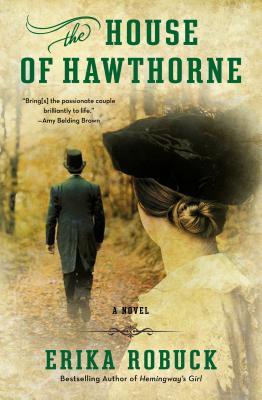
The House of Hawthorne by Erika Robuck

Source: Penguin Random House
Hardcover, 416 pgs
I am an Amazon Affiliate

The House of Hawthorne by Erika Robuck is word portrait of Sophia Peabody and Nathaniel Hawthorne’s courtship, marriage, and family, as well as the tensions that arise from two artists balancing their passions with their family.  Spoken in the voice of Sophia Peabody, readers are given a glimpse of her passionate painting and love of life despite her debilitating headaches before she meets Nathaniel, an aloof writer who feels the inadequacy of his words on paper.  From the 1830s to the U.S. Civil War, readers are taken through their early romance and their marriage.  While readers will find Sophia passionate about her work, she still finds joy and love in being a wife and mother, though she does miss her painting.  Despite the vacillation between poverty and moderate wealth, the Hawthornes are a family unit that loves deeply and remain loyal to their friends.

“One hand is open, overflowing with an abundance of joy and vitality; the other is a fist, clutching a void so desperately that the nails dig holes in the skin.” (pg. 247)

Like many artists there are period of abundance and times when the land is fallow, and this is true in terms of both writing and painting artistry as well as the funds they earn.  Sophia is a headstrong woman, but she quickly learns how to navigate her husband’s moods and comfort him in the best way she can for a reserved man.  Nathaniel is an enigma, but we get to see him through Sophia’s loving eyes, which can help soften some of his more anti-social behavior that others may see as mean or aloof.  It is wonderful to see the circle of friends the Hawthorne’s have and how those relationships evolve over time, particularly in light of the coming Civil War between the North and South.  From the drifting away from the Emersons to the effusive complements of Melville, the Hawthornes remain a tight knit family and rally around each other in times of loss and suffering.

“Our country simmers like a covered pot over the issue of slavery, and while Nathaniel and I do not approve of owning slaves, we cannot imagine what a division or even a war between the Northern and Southern states would do to our young nation.” (pg. 264)

The House of Hawthorne by Erika Robuck is a stunning narrative that illuminates the often overshadowed life of Sophia Hawthorne and demonstrates how two artists can live together and build a life despite their differences and their own need for solitude and succor.  The novel raises questions of self-identity, self-expression, compromise, and the desire to create and have it all.

About the Author:

Historical fiction writer, book blogger, voracious reader. Erika’s first novel, RECEIVE ME FALLING was self-published. Penguin Random House published HEMINGWAY’S GIRL, CALL ME ZELDA, FALLEN BEAUTY, and a short story anthology to which Erika contributed, GRAND CENTRAL: ORIGINAL STORIES OF POSTWAR LOVE AND REUNION. Her forthcoming novel THE HOUSE OF HAWTHORNE will release on May 5th, 2015.

Erika writes about and reviews historical fiction at her blog, Muse, and is a contributor to fiction blog, Writer Unboxed. She is also a member of the Historical Novel Society, the Hemingway Society, the Millay Society. and the Hawthorne Society.



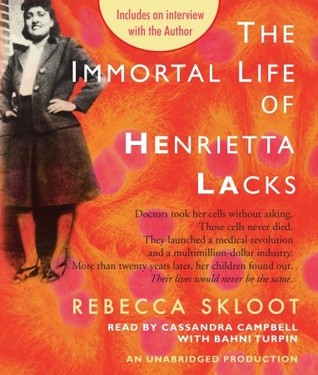
The Immortal Life of Henrietta Lacks by Rebecca Skloot (audio)

Source: Public Library
Audiobook, 12.5 hours
I am an Amazon Affiliate

The Immortal Life of Henrietta Lacks by Rebecca Skloot, narrated by Cassandra Campbell and Bahni Turpin, was our February book club selection.  Henrietta Lacks was a black woman who felt something was wrong, some lump was growing insider her, and that lump she had was eventually diagnosed as a kind of cervical cancer.  Her treatment commenced, but she bore it all on her own, telling very few in her family about it.  She also continued to bear children throughout the process.  Lacks has since become immortal in that her cancerous cells were collected and cultivated by scientists and renamed HeLa.  Those cells were used in the fight against polio and a number of other diseases.  While she was unable to see the fruits of her cells’ labors, she is in a way immortal.

Rebecca Skloot injects herself into this narrative, which becomes part memoir as she recounts her interactions with Lacks’ children, especially Deborah.  Skloot discovered that this family had been bombarded by requests for information long before she decided to write a book about Lacks and her cells, which had made them less than willing to speak to her.  Despite the many set backs and the paranoia that often ruled Deborah’s reactions to her questions, Skloot made headway and even took family members on road trips in ways that brought the true past of their mother back to the family.  In many ways, this is not just a story about Henrietta Lacks, how her cells helped science and cured disease, or about medical ethics, but it also is a story about a family regaining its connections and its past.

The audio production was well done, especially differentiating between Deborah’s thoughts and that of the author, making them easily discernible.  This audiobook also included an interview with the author about her research and her interactions with the Lacks family, as well as her writing process, which was fascinating.  And although the story shifts from the past to the current research, the book’s narrative flows well and is immediately engaging for those with an interest in science, medical research, and the history of HeLa.  But even then, this is a human interest story about how a family struggles to learn about their mother and her cells and what happened in the past.

The Immortal Life of Henrietta Lacks by Rebecca Skloot, narrated by Cassandra Campbell and Bahni Turpin, packs a punch — hitting the heart of medical research and the debate about who cells belong to, what rights patients have to their own cells, whether there should be more restrictions on their use, and whether compensation should be offered to those who donate their cells.

About the Author:

Rebecca Skloot is the author of the #1 New York Times Bestseller, The Immortal Life of Henrietta Lacks. Her award winning science writing has appeared in The New York Times Magazine; O, The Oprah Magazine; Discover; and many other publications. She specializes in narrative science writing and has explored a wide range of topics, including goldfish surgery, tissue ownership rights, race and medicine, food politics, and packs of wild dogs in Manhattan. She has worked as a correspondent for WNYC’s Radiolab and PBS’s Nova ScienceNOW.

Book Club had to be postponed due to a snowstorm, but I cannot wait for the discussion in March!

First Impressions by Charlie Lovett

Source: Viking
Hardcover, 320 pgs
On Amazon and on Kobo

First Impressions by Charlie Lovett is a literary mystery in which the fate of Jane Austen’s reputation as a premier novelist hangs in the balance.  Sophie Collingwood has finished her master’s degree at Oxford when she meets a beguiling Eric Hall, an American traveling through Europe.  In a meeting of the minds, they share one passionate kiss, but after he’s gone to France, she must deal with a lot more than her future after university when the family is hit by tragedy.  As she regains her footing, her sister, Victoria, provides her with the framework she needs to move forward, even if it is in baby steps.  She shares a similar relationship with her sister that Jane shared with her own, Cassandra.

“Uncle Bertram’s books were not arranged by author or title or more perplexing to little Sophie, by size or color.  ‘You have to read a book to understand its place on the shelf,’ said Uncle Bertram.”  (page 26)

Soon as a bookshop worker in Boxhill, Sophie finds that she is unwittingly at the center of a book controversy as two separate customers want her to locate the second edition of book, A Little Book of Allegories, by an obscure clergyman named Richard Mansfield.  Sophie is a bookish woman who loves a good mystery, but this mystery has a darkness to it, especially when one of the customers begins issuing veiled threats to motivate her in her search.  Even as she is afraid, she is still determined to uncover the mysterious connections between Mansfield and Austen, but she also finds herself being romantically pursued by two men.

First Impressions by Charlie Lovett is a literary mystery that is not hard to unravel, but it does make for a fun journey.  When your companions are Jane Austen and Sophie Collingwood, you’ll have little to be disappointed about.  From a young Austen crafting her novels at home and sharing them with her small family and social circle to Sophie finding her way after tragedy, Lovett has created an enjoyable mystery full of companionship, love, and suspense.

About the Author:

Charlie Lovett is a writer, teacher, and playwright whose plays for children have been seen in over 3000 productions worldwide. He served for more than a decade as Writer-in-Residence at Summit School in Winston-Salem, NC.  Check out the Book Club Kit.


84th book for 2014 New Author Reading Challenge.

Northern Lights by Tim O’Brien

Source: Personal library
Paperback, 372 pgs
On Amazon and on Kobo

Northern Lights by Tim O’Brien, which was our November and final book club pick of the year and a re-read for me, is the author’s first book, and not my favorite.  The story is about two brothers — Perry and Harvey — and one went to Vietnam and the other stayed home and got married.  Perry works for the agriculture department in Sawmill Landing, Minn., which is a small dying town with very few farmers left.  Heavily populated by Swedes, Finns, and Germans, the town has gone through periods of prosperity and periods of fallow ground.  Harvey is set to return from the war, and he’s altered in more than one way.  While O’Brien has crafted a story of brothers who were always different from one another — Harvey, the bull, considered the outdoorsy and confident brother, and Perry, the book smart and self-conscious brother — the story slowly unwinds to show just how false those perceived differences were.

“They call it a dying town.  People were always saying it: Sawmill Landing won’t last another decade.  But for all the talk, Perry never saw the death, only the shabby circumstances of the movements around him.  It was melancholia, seeded in the elements, but he had no idea where it started.”  (page 65)

When his brother returns, there is a heaviness that settles on the house, a house their father lived and died in and a house that was often filled with tension between the three men.  With Grace, Perry’s wife, in the house, there is a lightness from her womanly touch as she tries to keep the peace and make Harvey feel at home.  But then there is Addie, a young lady who flirts endlessly and teases all the time.  She’s an enigma, flirting with married Perry and with single Harvey, but it is clear that she’s never serious.  She likes the games.  The moral tension is palpable throughout the novel in whether Harvey and Perry are flirting with Addie, or whether Perry has to overcome his fears and hunt in the woods as his brother did with their father.

Rather than focus on the Vietnam War, Northern Lights by Tim O’Brien is a look at the home front after the soldier returns home and tries to fit back into society, as well as the brother’s struggle with seeing his own brother so changed.

***Unfortunately, due to car issues, I missed this meeting with the book club.  A meeting I was really looking forward to.***

About the Author:

Tim O’Brien was born in 1946 in Austin, Minnesota, and spent most of his youth in the small town of Worthington, Minnesota. He graduated summa cum laude from Macalester College in 1968. From February 1969 to March 1970 he served as infantryman with the U.S. Army in Vietnam, after which he pursued graduate studies in government at Harvard University. He worked as a national affairs reporter for The Washington Post from 1973 to 1974.  Here’s the reading group guide.

36th book for 2014 Historical Fiction Reading Challenge.


32nd book (Vietnam War) for the 2014 War Challenge With a Twist.

The House on Mermaid Point by Wendy Wax

Source: Berkley Books
Paperback, 416 pages
On Amazon and on Kobo

The House on Mermaid Point by Wendy Wax is like getting together with old friends — Nikki, Avery, Deidre, Kyra, and Maddie.  These renovation gurus are back shooting another season of their Lifetime television series, Do Over, but the next location is a surprise hidden in the Florida Keys.

(If you haven’t read the previous books in this series, this review could contain spoilers for previous books.)

Nikki and her man, Joe, seem to be on the right track, but she’s still got commitment issues after the brother she raised was sent to prison for his Ponzi scheme that took her money and those of her clients.  Meanwhile, Kyra and her son Dustin are adjusting to her mother’s new life as a 50+ single woman.  Maddie’s decided that its best to leave a sinking ship, and her ex-husband seems nonplussed about the break up.  Avery and Chase are still playing house and she’s still shutting out her mother, but the tensions are less on these pairings and more about Maddie and her search for a new life.  Like the name of their show implies, life is full of second chances, and many of these ladies have been given theirs in more ways than one.  Maddie is just the latest who needs to spread her wings.

“Close up, the house was far larger than they’d been able to discern from the water and in far worse shape.  The board-and-batten siding was not just devoid of paint but had been badly pummeled by the elements.  Like a boxer who’d gone one too many rounds, the house almost seemed to be standing upright from sheer force of will.  Of possibly from habit.” (page 51)

Mermaid Point, their next renovation project, is hidden on a private island, and private is how ex-rocker William Hightower would like to keep it.  Like the house, Hightower is a battered rocker who’s looking to redeem himself, just as some of these ladies have picked themselves out of the dumps and started new.  Hightower has a lot of repairing to do, from his relationship with his son to his ability to connect with people who want to get close to him.  There’s a lot of gentle nudging as they scrape the layers off the old wood to smooth it down, but as Hightower lets down his walls he’s struck by what’s been missing in his life — a sense of belonging and of family.  Like his home, he transforms little by little coming out from the jungle and the weathered walls to expose himself to scrutiny and relationships he never thought possible.

The House on Mermaid Point by Wendy Wax is a great summer beach read; these ladies will make you laugh, make you cry, but most of all want to hold all of your friends close.  Avery, Maddie, Deidre, Kyra, and Nikki all face their troubles head on, even if it is with a little push from their friends.  These ladies are ready to take on the next big challenge, and readers will be ready to go with them on their next adventure.

About the Author:

Award-winning author Wendy Wax has written eight novels, including Ocean Beach, Ten Beach Road, Magnolia Wednesdays, the Romance Writers of America RITA Award finalist The Accidental Bestseller, Leave It to Cleavage, Single in Suburbia and 7 Days and 7 Nights, which was honored with the Virginia Romance Writers Holt Medallion Award. Her work has sold to publishers in ten countries and to the Rhapsody Book Club, and her novel, Hostile Makeover, was excerpted in Cosmopolitan magazine.

A St. Pete Beach, Florida native, Wendy has lived in Atlanta for fifteen years. A voracious reader, her enjoyment of language and storytelling led her to study journalism at the University of Georgia. She also studied in Italy through Florida State University, is a graduate of the University of South Florida, and worked at WEDU-TV and WDAE-Radio in Tampa.

Also Reviewed:

Giveaway for 1 copy of The House on Mermaid Point by Wendy Wax for 1 U.S. resident.  Leave a comment below by July 16 by 11:59 PM EST.

China Dolls by Lisa See

Source: Random House
Hardcover, 400 pages
On Amazon and on Kobo

China Dolls by Lisa See spans pre-WWII, WWII, and after the war when Chinese immigrants and American-born Chinese were constantly stereotyped and pushed to the sidelines, and when America goes to war against Japan after the attack on Pearl Harbor, proving you’re American becomes even more important.  Grace Lee has left Ohio in a hurry and ends up in San Francisco with crushed dreams and no friends, until she meets Helen Fong, who is from a traditional Chinese family in Chinatown.  She’s uptight and traditional, harsh on Grace and later on Ruby Tom, but she’s also searching for her own path, wishing that her own dreams could be realized.  Hollywood is often considered the land where dreams come true, but in this case, these Asian women find their dreams in San Francisco, though those dreams are often marginalized by their own pettiness and the world that looks down on their culture and abilities.

“Helen and I sat on the floor a little apart from the other ponies, who massaged one another’s feet, stretched, and gossiped.  Every day Helen arrived at rehearsal in a dark wool skirt, long-sleeved black sweater, and charcoal-gray wool stockings, but she quickly changed out of them.  To my eyes, it seemed like she was shedding not just layers of clothing but layers of tradition.” (page 47 ARC)

Grace is a broken young woman of seventeen and very naive, and in many ways Helen and Ruby are all too happy to teach her lessons about the real world, but they often underestimate her resiliency, her willingness to forgive, and her determination to succeed.  Whether she is running from her past in Ohio, her failed attempt at stardom at the Golden Gate International Exposition, or the rumors that circulate around her during WWII, Grace must turn inward to find her strength and remain true to her dream.  She may take advantage of every opportunity around her when it presents itself, even if it comes as something tragic befalls her friends, but she never purposefully creates those opportunities.  Ruby and Helen, on the other hand, are downright Machiavellian, though in Helen’s case, her machinations come from an emotional devastation that she struggles to keep hidden daily.

“I don’t want to remind them”—and it didn’t take a brain surgeon to figure out I was talking about the FBI and the WRA—”I exist.  I don’t want to risk being sent to Leupp to join my parents.  I want to forget all that.  You left your mother behind.  Now I’ve left mine.” (page 262 ARC)

China Dolls by Lisa See is about chasing your dreams, making them come true, and all the petty jealousies and ups and downs that come with that, particularly in show business.  See masterfully weaves the history of the time period into these ladies’ lives.  It would be an excellent selection for book clubs as it raises questions about racial discrimination, inter-race relations, and prejudices within cultures based on socioeconomic and cultural differences, as well as what it means to be patriotic.

About the Author:

Lisa See, author of the critically-acclaimed international bestseller, Snow Flower and the Secret Fan (2005), has always been intrigued by stories that have been lost, forgotten, or deliberately covered up, whether in the past or happening right now in the world today. Ms. See’s new novel, Shanghai Girls, once again delves into forgotten history.  Visit her Website, Facebook, and Twitter.

17th book (WWII) for the 2014 War Challenge With a Twist.

The Mix & Match Guide to Companion Planting by Josie Jeffery

Source: Blogging for Books
Hardcover, 104 pages
I am an Amazon Affiliate

The Mix & Match Guide to Companion Planting by Josie Jeffery is a reference guide that not only helps first-time gardeners understand the principals of companion planting, but also explains basic botany.  Included in the guide is information about the parts of plants — to help pair certain plants together in the most beneficial way — and soil elements so that gardeners know to test their soil and ensure the right nutrients are available for flowering and vegetable plants.  At the very beginning is an explanation on how to use the directory section of the book that helps gardeners pair their plants effectively.  However, this explanation would have been better served right before the directory to keep all of that information in one place and after all of the explanations and background on companion planting.

While planting season has for the most part already started in the Washington, D.C., area, this guide will come in handy for next season.  The information about composting and rainwater use were very insightful, and some of the companion plants talked about were new to me.  Marigolds are one plant that makes a good companion because bugs tend to stay away from plants in the same area.  The Mix & Match Guide to Companion Planting by Josie Jeffery is more than just a guide to companion planting.  It offers beginners some background information on the basics and provides some innovative ideas to recycle products that are no longer being used, including hanging CDs in the garden to scare away birds and using cans around seedlings to keep out pests.

40th book for 2014 New Author Challenge.

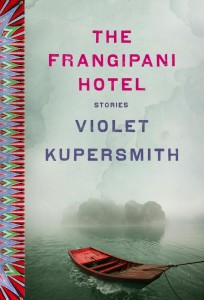
The Frangipani Hotel by Violet Kupersmith

Source: Random House and TLC Book Tours
Hardcover, 256 pages
I am an Amazon Affiliate


The Frangipani Hotel by Violet Kupersmith is a fresh short-story collection that spans the Vietnamese culture, myths, and the immigrant experience, straddling reality and the magical.  The Vietnam War hovers in the background of the characters’ lives as the mothers struggle to garner U.S. visas for themselves and their children born of American soldiers in “Guests” or in “Boat Story,” where a grandson asks his grandmother to explain her escape from Vietnam during the war.  Kupersmith’s style is clear and engaging, and the myths and magical moments are told in a storytelling style that is reminiscent of the oral traditions in Vietnamese culture.

“Whatever spirit had reanimated the corpse must have been a feeble one, for the body moved clumsily, legs stiff but head dangling loose as it struggled to keep its balance on the angry waves.  Grandpa sank down to his knees next to me, and we peered over the gunwale in helpless horror as the body tottered closer and closer.” (Page 8 ARC)

From ghosts in the Frangipani Hotel to the spirits in the woods, Kupersmith weaves in magic and myth seamlessly with reality. Her characters are oddities and not; they are rational but also open-minded about the unseen.  From the twin girls who border on feral to the young man who finds a ghost in the hotel, her characters are both real and unreal — they have a mystical quality.  The prose is witty, with a few moments that will leave readers chuckling.  At other times, the stories tackle serious issues like immigration and the soldiers who leave women behind with babies when the war is over, though with a sense of irony that never feels misplaced.

She can lull readers into a sense of complacency before her prose unsettles their world, and the mark of a great storyteller is one that can shift from male and female points of view with ease and who can create stories that will stay with readers long after they’ve been read.  The stories in The Frangipani Hotel by Violet Kupersmith shift in setting and time, but the roots do not change, merely grow and curl as the tales unfold.

***U.S. residents can enter to win 1 copy of Violet Kupersmith’s The Frangipani Hotel by leaving a comment by March 10, 2014, 11:59 PM EST.***

About the Author:

Violet Kupersmith was born in rural Pennsylvania in 1989 and grew up outside of Philadelphia. Her father is American and her mother is a former boat refugee from Vietnam. After graduating from Mount Holyoke College she received a yearlong Fulbright Fellowship to teach and research in the Mekong Delta. She is currently at work on her first novel.

7th book (Vietnam War) for the 2014 War Challenge With a Twist.


6th book for 2014 Historical Fiction Reading Challenge.


10th book for 2014 New Author Challenge.

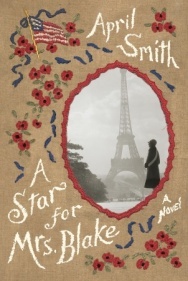
A Star for Mrs. Blake by April Smith

Source: TLC Book Tours and Random House
Hardcover, 352 pages
I am an Amazon Affiliate

A Star for Mrs. Blake by April Smith is set in the 1930s when the United States was sending the mothers of soldiers overseas to France to the cemeteries where their children had been buried after WWI.  Smith bases her novel on the diary of Colonel Thomas Hammond, who began his career in the military with one of the pilgrimages of the Gold Star Mothers, and he appears as a young principled officer seeking to live up to his family’s illustrious military history.  As these mothers make their journey across the Atlantic to pay respect to their lost sons, Hammond is unaware how much the journey will affect him and these women.  Smith builds the story from a small island town in Maine where Cora Blake struggles alongside her neighbors to make ends meet as the United States wallows in Depression to the deepest emotional hum a human being can experience at a foreign graveside in a country that is still rebuilding after war.

“He was in grave number 72, identified by his dog tags, which were apparently nailed to a stake.  The second card asked that she state her relationship to the deceased and answer yes or no to the question: ‘Do you desire that the remains be brought to the United States?'” (page 15 ARC)

Cora Blake is a young widow, who also has lost her son to a war in Europe, but she’s just beginning to breathe and learn that there could be happiness around the corner with Linwood Moody, a recently widowed soil scientist.  Mrs. McConnell is an Irish-American who knows the struggle of working for the wealthier classes, while Minnie is a Russian-Jewish immigrant who has seen discrimination first hand.  Mrs. Russell is a woman who has been struggling with mental breakdowns for much of her married life, but is determined to see where her son died.  Just as determined as Mrs. Russell, railroad-heir Mrs. Olsen is seeking some form of closure from this trip.  Smith shines in her characterization of these mothers, showing how they are bonded over grief, but also that class distinction and experience can still separate them.  It’s a novel about the struggles for equality that still threatened to separate every American — immigrant or not — but how the great tragedy of war made no such distinctions when taking their sons.

“Cora’s world had expanded so rapidly, but not from the vista.  She remembered what Selma told her in the women’s waiting room in Boston.  ‘You got a lot to learn.’” (page 89)

Smith’s research into the time period, the Gold Star Mother’s tours, and the war itself — including the artillery and tactics used — shines through in the story, the plot, the characters, and the emotional roller coaster these women find themselves on.  Once in France, these women are swept along with military precision, but even the military is not prepared for the will of a mother’s love and her defiance against being told what will placate them the easiest.  They are here for the full experience, they want the truth of their sons’ sacrifices and will accept nothing less.  Along the way, they are treated to the best France has to offer, the eccentricities of Paris artists, the bigotry of Europeans who see Americans as arrogant, and the mysterious ways in which injured soldiers and American reporters, like Griffin Reed, cope.

A Star for Mrs. Blake by April Smith is stunning without being overwrought with emotion, weaving the lives of these women and their children into reader’s minds and souls.  In reflective prose, Smith deftly handles the grief of these women, the tension between grief and duty, and the peace that comes from knowing their loved ones are at rest.  From the cutting edge of facial reconstruction to the remnants of war that could still be found in the weeds of Verdun, Smith has crafted a novel that breathes life into history, ensuring that we never forget the past.

To win a copy of this book, you must be a U.S. resident, age 18 and over.  Leave a comment below by Feb. 14, 2014, at 11:59PM EST.  

4th book (WWI) for the 2014 War Challenge With a Twist.


7th book for 2014 New Author Challenge.


4th book for 2014 European Reading Challenge; this is set in France.


4th book for 2014 Historical Fiction Reading Challenge.

Bad Intentions by Karin Fossum, translated by Charlotte Barslund

Source: Borrowed
Paperback, 184 pages
I am an Amazon Affiliate

Bad Intentions by Karin Fossum is the 9th book in the Inspector Konrad Sejer series and is set in Norway, but readers will get little sense of Norway other than the odd name here and there for places and people and the references to the bitter cold.  While Norway can be bitterly cold in the winter months, there has to be more to a country and its culture than that, but little of that comes across in this novel.  Additionally, the series stars Inspector Konrad Sejer, but readers will get little sense of him in this slim volume where he makes the rare appearance and the main focus of the book being on three young men — Jon, Reilly, and Axel.

“He disappeared into the kitchen and they heard him scrabbling.  Then he returned with the fireguard and placed it in front of the fire.  The cast-iron fireguard with two wolves baring their teeth.

Jon looked at the wolves and at his two friends.” (page 2)

Fossum has created a scenario that demonstrates the power that friends can have over one another, particularly when one of the friends is more dominant in the relationship than the others.  It is easier to agree to cover-up an accidental death than to call the emergency services, or is it.  These young men are like sketches of profiles that police would create following a crime, and while you uncover a little bit about their backgrounds and their pasts, you never really see them in full view, you cannot empathize with their decisions, and you cannot cheer for them to get away with their crimes.  The way in which Fossum has crafted these characters must be intentional, a cautionary tale against the pressures of friendship especially when it can lead to compromised principles.

“‘We’ve talked about the nature of truth before,’ he said.  ‘Many things are true, but they still need to be left alone.  Imaging if people always told the truth, it wouldn’t work.  Society would fall apart.  We need to start each day from scratch,’ he argued.  ‘Build something that people can see, that they can cope with and believe in.'” (page 10)

Bad Intentions by Karin Fossum could have been a stand alone novel without the inspector, as he plays a minimal role, but as it isn’t, the novel leaves readers with a desire for more — more characterization, so that the inspector and the young men become real.  Exploring the darker tendencies of peer pressure and how it tests our mettle when we are called upon to do what’s right is a tough subject to tackle.  Fossum explores a number of themes along this line, but with little background on the boys, it’s hard to keep up with their motivations.

***This experience hasn’t soured me on reading others in the series, but this one just fell short for me.

About the Author:

Karin Fossum is the author of the internationally successful Inspector Konrad Sejer crime series. Her recent honors include a Gumshoe Award and the Los Angeles Times Book Prize for mystery/thriller. She lives in a small town in southeastern Norway.

3rd book for 2014 European Reading Challenge; this is set in Norway.

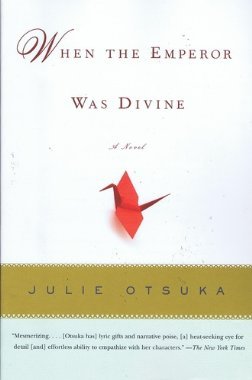
When the Emperor Was Divine by Julie Otsuka

Source: Library Sale
Paperback, 144 pages
I am an Amazon Affiliate

When the Emperor Was Divine by Julie Otsuka is set in the United States during World War II shedding light on the Topaz internment of Japanese-Americans and how it impacted them and their families.  Following an unnamed family Julie Otsuka gives readers a false sense of security, providing a false sense of distance between the reader and the family.  A powerfully short novel that raises questions about how we react out of fear or fold in on ourselves to avoid confrontation as well as fear.

“She took The Gleaners out of its frame and looked at the picture one last time.  She wondered why she had let it hang in the kitchen for so long.  It bothered her, the way those peasants were forever bent over above that endless field of wheat.  ‘Look up!’ she wanted to say to them.  ‘Look up, look up!’ The Gleaners, she decided, would have to go.  She set the picture outside with the garbage.”  (page 8)

Otsuka’s prose is simply beautiful, but filled with symbolic imagery and heartfelt emotion.  Shifting from the mother’s point of view, to the daughter’s, the son’s, and the father’s, readers are immersed in the memories and emotions of these characters so that they become real, even though they are nameless.  The daughter clearly sits between being an adolescent and a young girl, striving to remain strong for her mother and brother.  In the father’s absence, the son struggles to remember what his father looked like and how they interacted, but he’s distracted by the changes in his life from the internment camp to his sister’s behavior and his mother’s despondence.

Each family member deals with the crisis in their own way, from withdrawal and despondency to anger.  Although the last chapter is a tad long, the passionate confession from the father is well placed and sheds light on his experiences while he was away from the family.  When the Emperor Was Divine by Julie Otsuka explores life in the internment camp without the overwrought violence and horror of other novels, instead focusing on the emotional roller coaster this family experiences.

About the Author:

Julie Otsuka was born and raised in California. After studying art as an undergraduate at Yale University she pursued a career as a painter for several years before turning to fiction writing at age 30. She received her MFA from Columbia. She is a recipient of the PEN/Faulkner Award, the Asian American Literary Award, the American Library Association Alex Award, France’s Prix Femina Étranger, an Arts and Letters Award in Literature from the American Academy of Arts and Letters, a Guggenheim Fellowship, and was a finalist for the National Book Award, the Los Angeles Times Book Prize, and The International IMPAC Dublin Literary Award. Check out her Website and Facebook page.

2nd book (WWII) for the 2014 War Challenge With a Twist.


3rd book for the 2014 New Authors Reading Challenge.

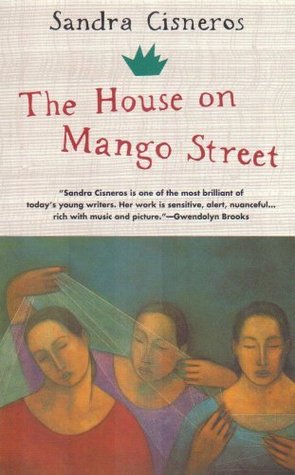
The House on Mango Street by Sandra Cisneros

Source: Purchased at Public Library Book Sale
Paperback, 110 pages
I am an Amazon Affiliate

The House on Mango Street by Sandra Cisneros is a coming-of-age story about Esperanza Cordero in a Latino neighborhood on Mango Street in Chicago.  She doesn’t remember much of the time before Mango Street, and it is clear that things were both good and bad there.  Neighbors she knew were hit by their husbands, while others had given up on their dreams simply because they got married.  In many ways these stories are woven together and are lyrical enough that they could be an epic poem about growing up as an immigrant in America.

Each short vignette tells a story from Esperanza’s point of view, revealing the harsh realities of growing up in an area other people are afraid to step foot in.

“All brown all around, we are safe.  But watch us drive into a neighborhood of another color and our knees go shakity-shake and our car windows get rolled up tight and our eyes look straight.”  (page 28)

Esperanza is growing up and learning how to become a woman, running in the city streets in heels an old lady hands her and her friends.  At the same time, she’s struggling to hold onto her childhood, while she’s admiring the older girls in the neighborhood wearing make-up and nylons.  She’s naive about relationships between girls and boys and she finds herself in situations where she can be taken advantage of, thanks to those she trusts.  But she also comforts her father when he cries.

“They don’t walk like ordinary dogs, but leap and somersault like an apostrophe and comma.” (page 71)

Cisneros paints a bleak picture as seen through Esperanza’s eyes, but at the same time she allows her character to feel something beyond the confines of her neighborhood.  She does not want to be that woman who merely looks at the possibilities and wallows in sadness and regret.  The House on Mango Street by Sandra Cisneros pays homage to these struggling women in a cadence, and she ensures readers not only glimpse a life that may be unfamiliar but that still contains a sliver of hope.

About the Author:

Sandra Cisneros was born in Chicago in 1954. Internationally acclaimed for her poetry and fiction, she has been the recipient of numerous awards, including the Lannan Literary Award and the American Book Award, and of fellowships from the National Endowment for the Arts and the MacArthur Foundation. Cisneros is the author of two novels The House on Mango Street and Caramelo; a collection of short stories, Woman Hollering Creek; two books of poetry, My Wicked Ways and Loose Woman; and a children’s book, Hairs/Pelitos. She is the founder of the Macondo Foundation, an association of writers united to serve underserved communities (www.macondofoundation.org), and is Writer in Residence at Our Lady of the Lake University, San Antonio.

This is my 58th book for the 2013 New Authors Challenge.