Quantcast

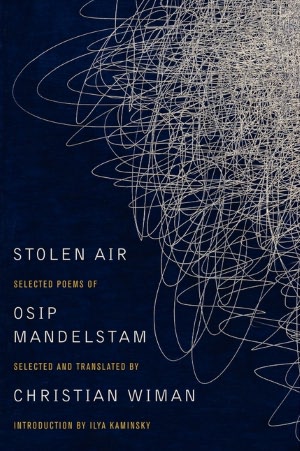
Stolen Air by Osip Mandelstam, translated by Christian Wiman

Stolen Air by Osip Mandelstam, translated by Christian Wiman is a selection of poems from Mandelstam’s entire career translated from his non-native Russian into English.  The introduction is rather long, but with good reason as it strives to capture a poet that was always evolving and striving to breath new life into the Russian language and to provide a voice to those seen as outsiders of the government.  Living through WWI and a Russian revolution, Mandelstam — a Poland born Jew who moved to Russia with his parents — became an exile and later died in a Siberian transit camp in 1938 after being arrested.

“From the inarticulate comes the new harmony.  The lyric poet wakes up the language:  the speech is revealed to us in a new unexpected syntax, in music, in ways of organizing the silences in the mouth.”  (Page XIX)

Mandelstam and Wiman approach poetry in much the same way, according to the introduction — not through word-for-word translation, but through the silences and the music of the lines.  The collection is broken into three sections beginning with his early poems between 1910 and 1925 and ending with the poems written between 1934 and 1937.  Mandelstam’s work is very musical and generally uses a great deal of rhyme and alliteration, but the ways in which these poems are translated, they are neither cutesy nor predictable.

Interrogation (page 21)

Official paper, officious jowls, unswallowable smells
Of vomit, vodka, cells, bowels,
And all these red-tape tapeworms gorging on reports.

Choir, stars, your highest, your holiest silences...
But first, sign here on the dotted line
That they may grant you permission to shine.

The poems are song-like, but ripe with derision for Stalin’s totalitarianism and the control over freedom, which provided many with the guise of free expression that was received at a high price. Mandelstam speaks of a life choreographed by others and punishments that are deeply harsh when spontaneity strikes. His words are like hammers on the chains attached to boulders in prisons of old, making sure the lack of freedom is felt most acutely. From the “legislated” freedoms to the starvation and lack of heat, it is all present in Mandelstam’s roving poetry. He moved from city to city, presumably fleeing the government, and this movement is in poems like “Night Piece” and “Prayer” but it also is in the other poems through their quick imagistic movements from one moment to the next — the narrator always in motion.

Stolen Air by Osip Mandelstam, translated by Christian Wiman is not only about the absence of freedom, but finding that freedom within that totalitarian regime — grabbing onto it, stealing the air to breathe creatively. The narrator has learned to grab onto that stolen air and run with it, traipsing through beauty and finding the music everywhere, even in the darkness.  The translation does not read as such with very few moments where the verse stumbles, and this is the best tribute to a poet — a translator who hears the same music even across time.  Well done and highly recommended.

About the Poet (from Poets.org):

Born in January, 1891, in Warsaw, Poland, Osip Emilievich Mandelstam was raised in the imperial capital of St. Petersburg, Russia. His father was a prominent leather merchant and his mother a teacher of music. Mandelstam attended the renowned Tenishev School and later studied at the Sorbonne, the University of Heidelberg, and the University of St. Petersburg, though he left off his studies to pursue writing. He published his first collection, Kamen, or Stone (1913), when Russian Symbolism was the dominant persuasion.

The Bolsheviks had begun to exert an ever increasing amount of control over Russian artists, and Mandelstam, though he had initially supported the Revolution, was absolutely unwilling to yield to the political doctrine of a regime that had executed Gumilev in 1921. The poet published three more books in 1928—Poems, a collection of criticism entitled On Poetry, and The Egyptian Stamp, a book of prose—as the state closed in on him. Mandelstam spent his later years in exile, serving sentences for counter-revolutionary activities in various work camps, until his death on December 27, 1938, in the Gulag Archipelago.

About the Translator:

Christian Wiman was born and raised in West Texas. He is the editor of Poetry and the author of three collections of poems, Every Riven Thing, Hard Night, and The Long Home, and one collection of prose, Ambition and Survival: Becoming a Poet.

This is the 16th book for my 2012 Fearless Poetry Exploration Reading Challenge.


This is my 41st book for the 2012 New Authors Challenge.



This is my 10th book for the WWI Reading Challenge.

The Cottage at Glass Beach by Heather Barbieri

The Cottage at Glass Beach by Heather Barbieri is about mothers and daughters and sisters and their tension and love filled relationships.  Nora Cunningham returns to Burke’s Island to get away from her scandalous political life in Boston with Malcolm and clear her head in upper Maine. Irish-American immigrant ancestors infuse her memories, memories she barely remembers from her younger childhood of her mother, Maeve, and their life together on the island before her mother’s disappearance. Nora reconnects with her aunt Maire as she begins to find her self — the person she is without Malcolm and the person she’s been deep inside.

“Her mother laughs.  Her voice is as sparkling as light on water.  The folds of her skirt cling to her legs.  She’d dived in fully clothed.  She isn’t like the other mothers with their rules and careful ways.”  (Page 1 ARC)

Nora’s daughters, Annie and Ella — ages seven and twelve — are like Maire and her sister Maeve used to be — one always cautious and one who lives in the moment.  Barbieri’s weaves in Irish folklore about selkies, seals that shed their skin to become humans on land.  These seals play a protective role in the story as they are always just off shore, watching carefully.  Soon, a man, Owen Kavanagh, washes up on shore near Nora’s cottage in the middle of a rainstorm.  But he’s not the only mysterious male on the island; there’s also a young boy named Ronan who befriends Annie.

“Indeed, a shiny head bobbed in the eddies that curled toward the shore, indigo depths between.  The creature met Nora’s gaze directly, its dark eyes wide and oddly human, before the children’s laughter drew its attention once more.”  (Page 18 ARC)

In many ways Ella and Annie act older than they are, but readers will see the toll that potential divorce can have on kids as their father makes a surprise visit to the island.  The island’s oasis atmosphere can be easily disturbed by outsiders, even if the inhabitants are eager to remain in between the past and the future like Nora.  However, how the characters react to those disturbances is a sign of strength and the support of their ancestors.  Barbieri blurs the lines between folklore and reality well here, and readers will be swept up in a cadence of storytelling that is reminiscent of Irish stories.

The Cottage at Glass Beach by Heather Barbieri is an oasis and a safe harbor in which Nora comes to reassess her life and decide how to move on after being deeply hurt by the one man she thought she could trust.  But she also must take into account the feelings and needs of her daughters, which is tough when harboring so much anguish.  A perfect summer read about mother-daughter bonds, bonds between sisters, and redemption.

Check out my review of The Lace Makers of Glenmara.

About the Author:

The author of two previous novels, The Lace Makers of Glenmara, and Snow in July, Heather Barbieri has won international prizes for her short fiction. She lives in Seattle with her family.  Please visit here on her Website and Facebook.


This is my 3rd book for the 2012 Ireland Reading Challenge.


Nadia Knows Best by Jill Mansell

In Nadia Knows Best by Jill Mansell, the Kinsella family is far from conventional with a mother, Leonie who skips out on her husband and two daughters, Nadia and Clare, and drops another daughter, Tilly, off with her former husband James years later.  Living with their high-brow grandmother, Miriam, Nadia and Clare are mostly well-adjusted young women sorting out their own lives, while their youngest sister, Tilly, is just 13 and still looking for her place in the family.

With Mansell readers know their will be misunderstandings, false-starts, romance, and comedy, but as with the last few books, there are moments of seriousness as well.  Nadia and Laurie have known each other for years and become a couple just as his career as a model begins to take off, prompting Laurie to sever ties and branch out to America and leave Nadia devastated.  Her chance meeting with Jay Tiernan, a hot man in the real-estate biz, a year ago still gets her heart beating fast, but it’s unlikely that they will meet again . . . until they do.  If that weren’t enough fodder for romance and mishap, Mansell introduces Clare and her shockingly narcissistic boy toy Piers, plus James, their father, finds himself popping into the same newsstand not just to pick up Tilly after work but to see Annie every day without saying a word.

“‘D’you have a brush in there?’ Piers nodded at the beaded clutch bag on her lap.

‘Yes, do you want to borrow it?’

‘I meant for you.’  He sounded amused.  ‘I prefer your hair down.'” (page 121 ARC)

Unlike Nadia who is honest and cognizant of how everyone feels, Clare is clearly unashamed to ask for what she wants, especially when it comes to selling her paintings.  Even as her relationship with Piers goes rocky, she’s still got her eyes open for the next big catch and on the next rich person to sell her paintings too.  She’s very shameless.  Nadia being the good sister tries to tamp down her sister’s enthusiasm, but at the same time, she’s also the peacekeeper in the family when Leonie resurfaces and wants Tilly to move home with her and her latest man, who has a daughter about the same age.

Despite the varied characters and numerous story lines, the main focus is Nadia who is caring for others almost through the entire book even after she’s dumped by Laurie.  Although the relationship with Laurie ends in the expected way, there are some loose ends that aren’t as neatly tied up as readers may expect, leaving Laurie in a positive light in Nadia’s eyes despite his less than stellar behavior.  There are fits and starts to many of these relationships, as the family members try to navigate their own lives and the drama with the disappearing-reappearing Leonie and other family drama, but it all works well in a complex roller-coaster ride that will keep readers turning the pages.

Nadia Knows Best by Jill Mansell is about taking a gamble, leaping into the unknown and finding out that sometimes there are good surprises in the deep end of the pool.  Mansell’s characters are charming, witty, and fun, but they’re also dynamic and flawed, which will keep readers coming back for more.

Darkroom by Joshua Graham

Darkroom by Joshua Graham is mind-blowing, fast-paced, secretive, and conspiratorial.  Conspiracy theorists, anti-government advocates, and the generally suspicious of all things military and political must read Graham’s book.  Mixing in elements of reality with those of fiction, Graham aptly captures the disillusionment with the Bush Administration just before the election of President Barack Obama and the fervor behind a movement for change that got our current president elected.

However, in this case, the candidate for change is independent, former Vietnam War military star Richard Colson.  He exudes confidence and decisiveness, even in the face of his wife’s health misfortunes and the continuous emergence of his past that must be addressed.  Cover-ups, suspicious natural and accidental deaths among members of the Vietnam War’s Echo Company, disappearing college students, and other events pepper the narrative, but Graham has written a story that is ultimately about faith in ourselves, our beliefs, and the uncharted.

Peter Carrick, a photojournalist from the war and friend of Colson’s, is a distant father, despite his daughter Xandra’s attempts to win his approval through cello recitals and her career as a photojournalist.  The death of Grace, Xandra’s mother, brings the story full circle as Peter and his daughter fly to Binh Son, Vietnam to scatter her ashes as she’s requested, but what the trip brings forth is ugly, horrifying, and disconcerting.  Soon Xandra is caught up in a case she has no physical connection to, and is guided only by the mysterious visions she sees in the darkroom when she develops her photographs.

“To my surprise, when we pass the wall of trees, the ground is level and clear.  Charred black, the skeletal frames of several farmhouses shudder, as though one strong gust could blow them away like dandelion spores.  The rest are simply dirt pads where other homes once stood.”  (page 16 ARC)

Alternating from the Vietnam War where Peter Carrick meets his wife Grace and falls in love to the present where his daughter is caught in an investigation that turns into a hunt for her as she becomes a fugitive, Graham has created not only a dynamic protagonist in Xandra who must overcome her incessant need to please her father and gain his approval, but he’s created secondary characters like her father, Colson, Agent Kyle Matthews, and others who are just as complex.  Book clubs would have a ton of topics to discuss from faith to whether not telling someone something or a lie by omission is still lying.  Further, readers will likely discuss the variety of conspiracy theories that have persisted throughout politics, including the true perpetrators of the JFK and MLK assassinations.

Darkroom by Joshua Graham is more than compelling, it’s engrossing with its alternating points of view in different chapters enabling the story of the Vietnam War to be filtered through the eyes of characters in the present and the conspiracy to unravel at a far more breakneck pace toward the end.  Graham is not afraid of unhappy endings nor afraid of making the tough choices to kill off integral characters, but have faith because all is not as it seems.

About the Author:

Joshua Graham is the award winning author of the #1 Amazon and Barnes & Noble legal thriller Beyond Justice. His latest book, Darkroom, won a First Prize award in the Forward National Literature award and was an award-winner in the USA Book News “Bests Books 2011” awards. Connect with Josh at his Website, Facebook, and on Twitter.

Also, check out this month’s guest post about the power of photography.

This is my 40th book for the 2012 New Authors Challenge.

Check the other tour stops

City of Thieves by David Benioff

City of Thieves by David Benioff, which was the May book club selection, is set during WWII on the Western front of the war between 1942 and 1945, though mostly during the nearly 900 day siege of Leningrad, which was cut off from supplies of food and more.  Lev and Kolya are thrown together by circumstance when Lev is arrested as a looter when a dead German is found in his neighborhood and he’s discovered taking items off the body and is sent to the Crosses.  Kolya a Red Army deserter is thrown in the Crosses where he meets Lev.  The dynamic between these characters is full of initial paranoia, which morphs into irritation and finally camaraderie.  Kolya loves to chat about anything and everything, but he’s particularly boastful about his sexual exploits and his experience with just about everything related to war.  He’s pompous but in a comical way, and he reminds me of those wise jesters in the king’s court who uses humor to slice to the root of truth, even at times when it could be fatal.  Lev is a young boy who often portrays himself as an older young man or younger as it is convenient to the situation.

“There was something oddly comforting in Kolya’s consistency, his willingness to make the same jokes — if you could call them jokes — over and over again.  He was like a cheerful senile grandfather who sat at the dinner table with beet soup splattered on his collar, telling once more the story of his encounter with the emperor, though everyone in his family could recite it now from memory.” (page 161)

The beginning almost sets it up as a framed story in which the author or someone with the same name as the author hears the story from his grandfather, the knife fighter.  It’s not a far stretch to imagine the beginning chapter sets the story up to read similar to a memoir of David’s grandfather, Lev Beniov.  However, the frame is never closed literally by the end of the story, which is good in this case because it provides the story with a greater emotional impact.

“Wick lamps lit the small apartment and out long shadows crept across the walls, across the frayed rugs on the floor, the brass samovar in the corner, and a white sheet hanging on the far side of the room — partitioning off the sleeping area, I assumed.  When the giant closed the door, the sheet billowed like a woman’s dress in the wind.  In the moment before it settled down I saw what lay behind it — not a bed, no furniture at all, just slabs of white meat hanging from hooks, suspended from a heating pipe by heavy chains, with a canvas drop cloth on the floor to collect the drippings.”  (page 59)

Lev and Kolya embark on a journey to find eggs — yes, that is a chicken in the far snowy distance on the cover — to save their own hides, a deal offered by a powerful Soviet colonel.  They mean cannibals, partisans, and of course Germans bent on killing them.  While there is darkness, mystery, and suspense, there also is a quaint feeling to the setting and the interactions between Lev and his new friend.  The absurdity of their situation is never lost on them, and it attempts to mirror the absurdity of war.  Despite the danger they find themselves in, they often joke and rag on one another as if they are playing baseball in the streets of Leningrad.

City of Thieves is a well written coming-of-age story at a time when the world was at war, but in spite of the danger, Lev and Kolya form an unbreakable bond.  It’s easy to see their tentative interactions blossom into true friendship, a bond that keeps them alive and watching each other’s backs throughout the novel.  While in the midst of German attacks, in the rural farmhouses appropriated by Germans as whorehouses, and even in a remote hunting cabin, the journey they are on is not only one in search of eggs, but in search of the faith and strength they need to survive.  Another for the best of list.

Here’s what Book Club thought (Caution may contain spoilers):

We actually had a rather long discussion about this book from the prologue and the interjection of the author in the prologue as the grandson of one of the main characters to what the eggs symbolized.  One of the members thought that the eggs symbolized the absurdity of war, while another thought it was the fragility of human life.  As for the prologue, most said that they had forgotten about it, while two others (including myself) thought it was the author’s ego leading him to place himself in the story.  Although it’s an interesting device, it also seems to make the story appear true when it is not — given that in interviews the author has said he was never able to ask his grandparents about their time in Germany during WWII before they died.  And the prologue is not the only instance of the author interjecting his family subtly into the novel — i.e. Lev Beniov is one of the main characters, a close last name to David Benioff.

There also was quite a lot of discussion about the “Courtyard of the Hound,” which was talked about as a great work of Russian literature by Kolya and whether it was a great work of literature, could be a great work of literature, or was merely a boring story about a shut in who finally leaves his apartment because of a dead dog.

Other elements we discussed is the lack of care with human life by the generals on both sides of the war — whether the Russian colonel sending Kolya and Lev on an absurd journey to find eggs when all Russians are starving or the callous way in which the Germans used Russian women as sexual play things.  One member also highlighted the seeming lack of outrage regarding the cannibals compared to the outrage displayed against the women who were being used as whores by the Germans and acquiesced so that they could survive — why was one form of survival better than another or at least more acceptable.  Another interesting point was made about the cinematic feel of the latter half of the book where there were dramatic scenes lumped together one after another from the dogs used to carry bombs under tanks to the German whorehouse and the showdown with the German elite assassins.  It seemed to be very packed in and gave the reader little time to breath or be deeply impacted by the events at hand, which I did notice that this half of the book read more like a screenplay (haphazard of the author’s screenwriting occupation perhaps?).

Also, please read Diary of an Eccentric‘s review.

About the Author:

David Benioff worked as a nightclub bouncer in San Francisco, a radio DJ in Wyoming and an English teacher/wrestling coach in Brooklyn before selling his first novel, The 25th Hour, in 2000.

He later wrote the screenplay for Spike Lee’s adaptation of Hour starring Edward Norton and Phillip Seymour Hoffman. In 2005, Viking Press published Benioff’s collection of short stories, When the Nines Roll Over.

Benioff’s screenwriting credits include Troy (2004), directed by Wolfgang Petersen, and Stay (2005), directed by Marc Forster, and The Kite Runner (2007). Jim Sheridan produced Benioff’s screenplay Brothers, and Hugh Jackman reprised his role as the clawed mutant in Benioff’s Wolverine. Viking published his most recent novel, City of Thieves, in May 2008.

Benioff is married to actress Amanda Peet; the couple has one daughter, Frances Pen. Also check out his interviews.  And another interview.

This is my 39th book for the 2012 New Authors Challenge.

The Opposite of Me by Sarah Pekkanen

The Opposite of Me by Sarah Pekkanen is about an empty shell of a woman whose career is her life and nothing else matters, other than being smarter than her twin sister, Alex, who looks nothing like her and is a beautiful model.  Lindsey is in line for a vice president position at her advertising agency in New York City when she’s outmaneuvered by a competing colleague who is not afraid to use her sexuality to get what she wants.  Cheryl’s down-and-dirty tricks shatter Lindsey’s hopes, leaving her twisting in the wind and rudderless after the announcement that Cheryl is the new VP.

“He kept hold of my hands as he rubbed his thumbs along my palms.  Doug made Bill Clinton look like a nun wearing a chastity belt at a Victorian tea party.”  (page 67)

While this may sound like the crux of the novel, it isn’t.  Lindsey is tough to like from the first pages with her obsessive nature and her workaholic personality.  It’s almost like she’s forgotten how to be a human being and interact with people beyond work projects and business dealings.  Although she knows the ins and outs of her job and refuses to play dirty, she also lacks the social skills to really connect with her co-workers and fails to have friends outside of work.  Her only friend is her colleague Matt, who she jokes with about Cheryl and other work-related things.  Once forced to start over, she heads back to Washington, D.C., and rethinks more than her advertising job.

“I put on my new black bra and matching panties, then slipped into my Rock & Republic jeans and black turtleneck.  The turtleneck looked simple and classic from the front, which made the flash of bare skin in the back all the more unexpected.  And my jeans hadn’t gotten any looser since yesterday.  I squatted and squeezed and shimmied my way into them, working up a light sweat.  On the bright side, if I wore them often enough, I wouldn’t ever have to go to the gym.  (On the not-so-bright side, I might be developing multiple personalities.  But hey, at least one of my personalities would be skinny!)” (page 174)

Pekkanen has created a dynamic that any reader with siblings can relate to, a deep-seated jealousy of what the other sibling seems to have.  Whether it’s Lindsey’s jealousy of her sister Alex’s beauty or the nuanced envy of her sister Alex for what Lindsey has, Pekkanen has created a set of characters with stories interwoven in a way that keeps readers in a state of anticipation.  What’s even more ironic is the job Lindsey lands once back home living with her parents and how much in common she has with the desperate people she meets.

In many ways, the title of the book is ironic because her sister is no more different from Lindsey than the clients she meets.  Each searches for the human connection that’s missing from their lives, whether that means connecting with their soul mate or connecting with their sister.  Lindsey’s clients help teach her to seek out what’s been missing from her life.

The Opposite of Me by Sarah Pekkanen is fun and serious, with a deeper message about finding confidence in yourself and your skills so that you can grab everything that life has to offer, even if it isn’t exactly what you planned. To answer Lindsey’s question about how you know which life is the right one for you: You Feel It. And Sarah Pekkanen has definitely chosen the “write” life.

About the Author:

Sarah Pekkanen is the internationally-bestselling author of the novels The Opposite of Me and Skipping a Beat and the upcoming These Girls, as well as the linked short stories available for ereaders titled “All Is Bright” and “Love, Accidentally.” For more information please visit her Website, Facebook, and Twitter.


This is my 38th book for the 2012 New Authors Challenge.

Perla by Carolina De Robertis

Perla by Carolina De Robertis (giveaway following the review) is captivating and intoxicating in its setting, mystery, and the psychological unraveling of the main protagonist, Perla.  She’s growing into a young woman, but her cloistered existence threatens to explode until she begins to release herself in books and in her relationship with Gabriel.

The past haunts everything around her, though she does not know it at first.  She is proud of her family and her father’s naval career and her mother’s quirky penchant for picking up new hobbies and discarding them.  But her pride is suddenly shaken when she learns of the Disappeared, Argentinians who were silently taken from their workplaces and homes in the 1970s and 1980s by the government for allegedly being subversives.  In school she writes a short story that wins a prize and is published in the newspaper, but her story has other unintended consequences.  It opens up hidden fissures in her family, and forces her to rebel and question the father she’s loved with blind devotion.

“He was uninvited moisture.  He had leaked into this house.  I had every reason to find his presence an affront, to be enraged at his invasion, or at least to eject him in calm tones.  Certainly he made me feel combustible, unsafe in my own skin.  But though I didn’t know why, though the feeling shocked me, I did not want him to leave.”  (page 28)

The fluidity with which De Robertis tells the tale is much like the Dali painting, “The Persistence of Memory,” hung in Perla’s childhood home, weaving in and out of reality and shaping a psyche that is struggling with secrets that are too devastating to hold inside.  Perla is a novel about identity and how it is created or comes into being and whether it is alive within us before we are even born.  In accordance with this look at identity, the novel examines the harsh treatment society places on new generations for the transgressions of the past.  Struggling with the truth of her father’s job and how it may have contributed to the disappearance of many Argentinians is enough for Perla to deal with as a young adult, but she also must confront the sneer and the unspoken disgust in the eyes of her classmates and friends when her father’s occupation is revealed.

Retreating into herself and her books, Perla finds a way to cope and becomes strong in a way that even she is unaware of, and when she meets Gabriel, her strength is tested once again.  Can she love her father and still love this man who writes articles condemning the actions of former military and government leaders who now have immunity?  Can she reconcile the two worlds of her life into one and live with herself?  And how can she explain her love for her father amidst the knowledge of what his actions before she was born did to the country and to other families?

De Robertis takes readers on a psychological journey through Perla’s mind as she processes the revelations of her family life and the nation she was born into.  Legacy plays an important role and it is clear that Perla must uncover what that legacy should be as she grows into a woman and leads her own life.  The prose is so enchanting and intoxicating, hours of reading fly by as streets in Buenos Aires become crowded with footfall percussion beats and musical laughter countered with the closed off rooms of Perla’s childhood home and the dark, swirling violet waves of her aunt’s painting.  Water also is a significant image throughout the book as it gives life and sustains it in the womb and in the soil, but it also connects everyone and everything in the story, running underground and supplying the sustenance to the tale.

“Flowers lurked at every turn.  You could not rest your gaze without encountering a geranium, two geraniums, hundreds of geraniums, and you could not walk without the feeling that geraniums were following you close at heel, bright mobs of them, crowding the air at your back.  You could not help feeling vastly outnumbered.” (page 90)

In a few sections when Perla’s mother has taken up gardening as a hobby and begins overpopulating the house with geraniums, it is clear that these flowers are like the bodies of the disappeared blossoming despite the cover up and lurking around every corner, haunting those that took part.  These bodies even when the blossoms fade from lack of care, continue to haunt the house and its inhabitants, prodding Perla’s family to look about them, to question, to uncover the truth beneath the well-manicured soil.

Perla by Carolina De Robertis melds the supernatural with reality in a way that it becomes a testament to all of the disappeared and the children of the disappeared who were restored and not.  It is an examination of an ugly part of Argentinian history in which women, children, and men were taken from their families and homes without warning, tortured, and released from planes above the Atlantic Ocean — erased from existence.  De Robertis does not dwell on the horrors of those times, but on the consequences of those actions and the reverberations felt for generations following the political upheaval that caused them.  She does so with aplomb and breath-taking imagery that transports readers to a South American nation ripe with beauty and dark secrets to explore what it means to have an identity and to be an individual in spite of what your family may have done in the past.  One last note, get the tissues ready!  Another for the 2012 best of list.

Author Carolina De Robertis

About the Author:

Carolina De Robertis is the author of Perla and The Invisible Mountain, which was an international bestseller translated into fifteen languages, the recipient of Italy’s Rhegium Julii Prize, and a Best Book of 2009 according to the San Francisco Chronicle, O, The Oprah Magazine, and BookList. Her writings and literary translations have appeared in Zoetrope: Allstory, Granta, The Virginia Quarterly Review, and elsewhere. She is the translator of Alejandro Zambra’s Bonsai, which was just made into a film, and Roberto Ampuero’s internationally bestselling The Neruda Case, which will be published for the first time in English in July 2012. De Robertis has been awarded a 2012 fellowship from the National Endowment for the Arts.

De Robertis grew up in a Uruguayan family that immigrated to England, Switzerland, and California. Prior to completing her first book, she worked in women’s rights organizations for ten years, on issues ranging from rape to immigration. She lives in Oakland, California, where she is currently elbow-deep in writing her third novel, which explores migration, sexual frontiers, and the tango’s Old Guard in early twentieth century South America.  Connect with her on Facebook, Twitter, and through her Website.

tlc tour host

This is my 37th book for the 2012 New Authors Challenge.


To enter for 1 copy of Perla by Carolina De Robertis (US/Canada), leave a comment about what you’d like to learn about the disappeared of Argentina.

Deadline is May 17, 2012, at 11:59PM EST

The Last Brother by Nathacha Appanah, translated by Geoffrey Strachan

The Last Brother by Nathacha Appanah, translated by Geoffrey Stachan is a quiet novel that hits the heart, twisting it until tears pour from the reader’s eyes.  Beginning slowly with the main character awaking from a dream, the novel builds to a crescendo, followed by still powerful diminuendo of reflection.  Appanah and Stachan’s translation provide a sense of distance from the characters at first, but pull readers in through the magic of the dreams and the jungle, generating the sense of hollowness and fullness of love in tension.

Set in Mauritius, Raj is in his 70s and is looking back on his time as an abused child in a poor family and the one friend he made following a major disaster that struck his small village of Mapou, which forced his family to leave and live near the island’s Beau-Bassin prison.  Raj’s family is poor, but happy as his two other brothers — Anil and Vinod — look out for him, even though he is the middle brother.  He is the one chosen to attend school, which he gladly shares with his brothers when he returns home to share the chore of obtaining water from the well.

“. . . in the old days at Mapou we used to crouch down, eating our mangoes with both hands, with the juice trickling down our forearms, quickly catching it with our tongues.  In the old days at Mapou we ate the whole mango, the skin, the little, rather hard tip that had held it to the branch and we sucked the stone for a long, long time until it was rough and insipid, good only to throw on the fire.” (page 44)

The connection between the brothers is severed and Raj is forced to leave his home with his parents as his father begins working as a guard at the Beau-Bassin prison, where in 1940 Jews were exiled during WWII.  Raj is still a child by modern standards at age 9 when he discovers the true wrath of his father and the world around him.  His father is easily displeased, particularly when drunk, and he often beats his children after taking whatever displeasure he has out on his wife.  In many ways, this rage shapes the boy that Raj becomes — secretive and imaginative.  He spends afternoons in the jungle, hiding and observing, especially once he learns of the prison and the bad man his father says are imprisoned there. It is his father’s rage and beatings that send Raj to the hospital inside the prison to recover and where he meets David.

Much of Raj’s life after leaving Mapou has been empty, but meeting David awakens in him his childhood and renews feelings of brotherhood.  The Last Brother by Nathacha Appanah and translated by Geoffrey Stachan is stunning in its double entendre as the story of the last brother Raj and his own last “brother” David.  Raj is a deeply complex character as he looks at the past, his regrets about the choices he made and promises he could not keep, and his hope that the future will learn about the past so as to maintain the memory of those who have been lost.

About the Author:

Nathacha Devi Pathareddy Appanah is a Mauritian-French author. She comes from a traditional Indian family.

She spent most of her teenage years in Mauritius and also worked as a journalist/columnist at Le Mauricien and Week-End Scope before emigrating to France.

Since 1998, Nathacha Appanah is well-known as an active writer. Her first book Les Rochers de Poudre d’Or (published by Éditions Gallimard) received the ” Prix du Livre RFO”. The book was based on the arrival of Indian immigrants in Mauritius.

She also wrote two other books Blue Bay Palace and La Noce d’Anna which also received some prizes for best book in some regional festivals in France.

***I read this because of Anna’s glowing review at Diary of an Eccentric.

This is my 35th book for the 2012 New Authors Challenge.

Domestic Violets by Matthew Norman

Domestic Violets by Matthew Norman is written very frankly and is told from the point of view of corporate cube dweller Tom Violet, whose father just happens to be the famous writer Curtis Violet who has just won the Pulitzer Prize for Fiction.  Tom is having marriage problems, hates his corporate job as a copywriter, and continues to have daddy issues; he’s on the precipice.  At work, he cuts into his enemy Greg every chance he gets and flirts with his underling, copywriter Katie.  He’s filling his days with useless interactions and writing that has no meaning for him.  He’s aimlessly adrift, but still wants his father’s approval, but how far is he willing to go to get it.  Will he become his father and chase after younger and younger skirts?  Will he become pretentious and full of himself, while looking down at other writers?  Norman’s character is adrift, but blissfully unaware of it until he loses his job and his thin connections to the “real” world.

“Then I realize that despite what both of them must suspect about me and my abilities as a man, Anna and Allie are looking at me.  They’re waiting for me to do something.  Waiting for me to protect them.  Even Hank is looking at me now, perfectly still, the rigid statue of an ugly little dog.”  (Page 9)

Like the characters his father writes about in his novels, Tom acts on impulse and very rarely worries about the consequences, and in fact, on occasion, thinks that the consequences will be positive.  The banter between Tom and Greg is highly entertaining and almost surreal because in a normal work environment wouldn’t Tom have been fired after how many complaints were filed against him by Greg?

“She tried to read it, but she had to put it down, stunned that she’d married a man who is so bad at writing books.  On almost every page, there’s something egregious to change.  There are typos, cliches, errors in logic, rambling sentences, and narration where there should be dialogue.”  (Page 163)

When Tom uncovers the truth about his family and his father, he’s faced with a hard choice.  He has to either move on and forgive or continue to flounder in self-pity, regret, and indecision to the point at which decisions will be made for him.  Norman has a clear grasp of what it means to be a writer, full of self-doubt and self-confidence at the same time, and his characters are dynamic and incredibly flawed.  Although there are moments when readers will not like Tom or his father, there are other moments where their hearts will soften for him.

How do you domesticate a writer, who is trained to run wild, at least in his imagination?  Domestic Violets by Matthew Norman is about finding peace with oneself and their family even if events are beyond their control and immutable.  It’s an adventure for readers and writers alike, and a true page turner.

***This is a book I picked up thanks to so many great reviews, including those from Booking Mama, Rhapsody in Books, Book Chatter, and Literate Housewife.

Author Matthew Norman

About the Author:

Matthew Norman is an advertising copywriter. He lives with his wife and two daughters in Baltimore. His first novel, Domestic Violets, was recently nominated in the Best Humor Category at the 2011 Goodreads Choice Awards. Read more on his blog or follow him on Twitter.


This was a stop on The Literary Road Trip because the author lives in Baltimore and the novel takes place in Washington, D.C., Maryland, and Virginia.


This is my 34th book for the 2012 New Authors Challenge.

The Day the World Ends by Ethan Coen

The Day the World Ends by Ethan Coen, one half of the Coen Brothers film making team with great films under their belt like Brother, Where Art Thou? and No Country for Old Men, is a twisted and unexpectedly thoughtful collection in places.  The limericks are bawdy and remind me of Christopher Moore’s humorous prose, but less in the smart and sassy humor and more in the low-class bathroom humor sense.  Necromancy Never Pays stated that the poetry in the volume is geared toward a male audience, and in most cases, that is true — particularly with the dirty limericks.

"Stone-age man, thawed from glacier, aghast:
'Was some snowman in my recent past?
And if so, who fucked who?
My dick's numb and quite blue
And there's freezer burn all up my ass.'" (Page 28)

Additionally, Coen appears to love rhyme, no matter how trite or over-stretched it might be.  Readers could find this collection amateur at best in how Coen chooses his rhymes, even when they have a tongue-in-cheek quality.  Like the “bathroom” humor, these rhymes can get tiresome.  Take for instance the rhymes in “Vine-Covered Verse” (page 53), “Lord, keep this farmer’s soul in peace,/For, though he dallied with his niece,/And cow, and nephew, none can claim/He, during, failed to praise Your name;/And how commit a lesser sin/When neighbors are but kine and kin?//”   However, even in this poem, there are moments of deeper thought in which the narrator is asking what sins are worse and should they all be forgiven or all be condemned.  It also questions how well we know our partners or other humans in general and what secrets they will take to their graves.

Coen’s poetry in this collection seems built for laughs among men mostly, though there are moments in which the poems are not trying so hard to be humorous.  There are some with an anachronistic quality to them, while others like “My Father’s Briefcase” are more serious and reflective.  “Therapy” uses humor and disdain to point out the inane struggle we have against aging and the depression that accompanies the process of aging, as the narrator talks of his depression to a less-than-helpful therapist.

The Day the World Ends by Ethan Coen is not for everyone and could be trying if read from cover to cover, but for those looking for a humorous romp on the underside of humanity, take a dip into these pages.

Poet Ethan Coen

About the Poet:

Ethan Jesse Coen is one half of the American film making duo the Coen brothers.  Their films include Blood Simple, Fargo, The Big Lebowski, O Brother, Where Art Thou?, No Country for Old Men, and True Grit. The brothers write, direct and produce their films jointly, although until recently Joel received sole credit for directing and Ethan for producing. They often alternate top billing for their screenplays while sharing film credits for editor under the alias Roderick Jaynes.

To enter to win one of 2 copies for US/Canada readers:

Leave a comment about what tour stop on the National Poetry Month Blog Tour you’ve enjoyed most, either here or on one of the participants’ blogs.

Blog, Tweet, or share the link on Facebook for up to 3 additional entries.

Deadline is April 30, 2012.

***Today’s tour stop is at Arisa White, so check it out!***


This is the 11th book for my 2012 Fearless Poetry Exploration Reading Challenge.


This is my 29th book for the 2012 New Authors Challenge.

The Penguin Anthology of 20th Century American Poetry edited by Rita Dove

The Penguin Anthology of 20th Century American Poetry edited by Rita Dove (listen to her NPR interview, where she talks about the anthology and provides advice for young poets) collects a few poems from some of the great poets at the the height of their craft between 1900 and 2000, and while Dove notes that some of the poets who were starting to emerge in the latter portion of the century may not be included, it is merely because the anthology had to have a cutoff point and those poets may have reached the height of their craft after 2000.

Moreover, her introduction goes on to demonstrate the various turns in social movements throughout the United States and how poets and their poetry fit in with those historic changes, ranging — of course — from the backlash following the U.S. Civil War and the beginnings of WWI to the antiwar protests, the emergence of the feminist movement, and the struggle for civil rights.  Each poet’s bio is included alongside samples of their work.

“. . . and I should have written it right then, before rereading, discovering, misplacing note; before tracking down copyright dates, crunching numbers — in short, before the politics of selection could interfere with my judgment.”  (Page XXIX)

“If I could, I’d make this introduction a fold-out book.  Open to the first page, and up would pop a forest: a triangle of birches labeled Robert Frost, a solitary Great Oak for Wallace Stevens, a patch of quirky sycamores tagged William Carlos Williams, and a Dutch Elm for Hart Crane, with a double lane of poplars for Elizabeth Bishop and a brilliant autumnal maple tree marked Langston Hughes bearing leaves called Harper, Clifton, Soto.”  (Page XXX)

The selection of poems for this collection must have been a tough task, and Rita Dove employed the best tools at her disposal.  She’s spoken frankly in the introduction of the politics behind the selection of poems, particularly regarding a budget that was unable to meet the rights fees for certain poems (i.e. Plath and Ginsberg, who are notably absent from the collection, but not the introduction).  While some can not forgive this decision (i.e. Helen Vendler, whose criticisms have been widely used in college classrooms, including some I’ve attended; please also view Rita Dove’s reply to Vendler’s criticism), some readers can accept the oversight given how widely known and published some of these absent poets are and were.  Dove has even discussed the problem of “rights” in an interview with The Writer’s Chronicle, in which she said that one of the worst offenders was HarperCollins, which owns the rights to Sylvia Plath and Allen Ginsberg (December 2011, pg. 22).  “What I hated most about this unsettling affair was seeing other, less iconic poets held hostage by the very company they had trusted to promote them,” Dove lamented in the interview after discussing how one publishing hose offered poets the option to have their poems included in the anthology if they gave up their share in royalties even though the publishing house would not.

As with any “collection of great works,” the anthology is bound to have its detractors who are dissatisfied with the selections and who lament the absence of their own favorite poets and poems.  Dove says in the introduction, “The impulse driving them all, however, stemmed from the same revelation:  that every person contains a story that, if told well, would resonate within us no matter how strange or unfamiliar the circumstances, bound as we are by the instincts and yearnings of human existence.”  (Page XXXIII)  Readers will find that some of the poems speak more to them than others, but that also is expected in a collection of multiple poets with multiple styles.

Insect by Annie Finch (Page 540):

That hour-glass-backed,
orchard-legged,
heavy-headed will,

paper-folded,
wedge-contorted,
savage--dense to kill--

pulls back on backward-moving,
arching
high legs still,

lowered through a deep, knees-reaching,
feathered down
green will,

antenna-honest,
thread-descending,
carpeted as if with skill,

a focus-changing,
sober-reaching,

tracing, killing will.

There are old favorites from classics like E.E. Cummings to contemporaries like Yusef Komunyakaa. Readers will want to dip in and revisit their old poet friends, but also find the undiscovered gems from the past, present, and future. Ruth Stone, for instance, is a prolific poet, who may not be known by may readers, but her verse is so present and relatable; From “Scars” (page 178): “Sometimes I am on a train/going to a strange city,/and you are outside the window/explaining your suicide,/” Then there are Edgar Lee Masters at the beginning of the century that may be overlooked in favor of Robert Frost and other more well-known poets, despite his prolific career. From “Fiddler Jones” (page 2), “The earth keeps some vibration going/There in your heart, and that is you./And if the people find you can fiddle,/Why, fiddle you must, for all your life.” As the anthology progresses there is a distinct inclusion of more minority and female poets, like Reetika Vazirani and Terrance Hayes.

The Penguin Anthology of 20th Century American Poetry edited by Rita Dove is one perspective on American poetry over the last century, while it touches upon each of the social and poetical movements in the nation, it does skew the reality of the poetic realm a little bit by being unable to include certain icons and including newer poets who may or may not have proved their historical impact on the world of poetry to the satisfaction of everyone.  However, the inclusion of new voices is always a blessing when so much of poetry is consider classic and iconic from Frost’s New Hampshire woods to Ginsburg’s outspoken Howl.  Dove’s anthology is a collection to be dipped into time and again to visit old favorites and delve into the images and verse of new voices who have emerged in the latter part of the 20th century.

Poet Rita Dove

About the Editor:

Rita Dove, born in Ohio, served as Poet Laureate of the United States and Consultant to the Library of Congress from 1993 to 1995 and as Poet Laureate of the Commonwealth of Virginia from 2004 to 2006. She has received numerous literary and academic honors, among them the 1987 Pulitzer Prize in Poetry and, more recently, the 2003 Emily Couric Leadership Award, the 2001 Duke Ellington Lifetime Achievement Award, the 1997 Sara Lee Frontrunner Award, the 1997 Barnes & Noble Writers for Writers Award, the 1996 Heinz Award in the Arts and Humanities and the 1996 National Humanities Medal.


This is the 3rd book for my 2012 Fearless Poetry Exploration Reading Challenge.


***For Today’s National Poetry Month Blog Tour post, hop over to Unabridged Chick***

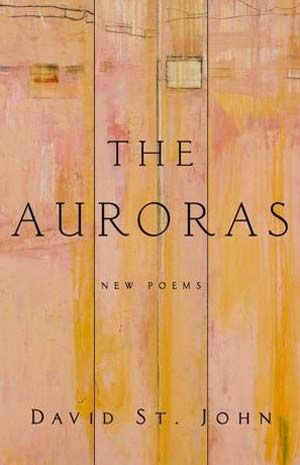
The Auroras by David St. John

The Auroras by David St. John is broken into three distinct sections:  Gypsy Davy, In the High Country, and The Auroras.  In this triptych of poems, “In the High Country” is flanked by the smaller sections “Gypsy Davy” and “The Auroras” but what ties the sections together is not a cohesive story as in Emma Eden Ramos’ Three Women, but a set of emotions ranging from unrest to pain and melancholy.  Both expressions of a poetic triptych are effective, but St. John’s is a little more subtle in its attempts at cohesiveness.

However, within these subtle lines and images, there are real gems, leaving conclusions and epiphanies with the reader, like in “The Aurora of the New Mind” (Page 4):

Still I look a lot like Scott Fitzgerald tonight with my tall
Tumbler of meander & bourbon & mint just clacking my ice
To the noise of the streetcar ratcheting up some surprise

I had been so looking forward to your silence
& what a pity it never arrived

Click for Tour Schedule

But even with these offhand remarks do not end the discourse of the poem; the narrator’s desire for silence is powerful and he has not qualms about uttering it aloud, but is he happy when he receives it or is he unsettled by the granting of that wish? Through subtle images and seemingly forthright comments, the narrator has brought to the surface questions of how when we receive our desires the result may be less adequate than expected. Following that train of thought, “Shopenhauer’s Dog Collar” (Page 14) speaks to the dissatisfying nature of desire fulfilled as Shopenhauer himself did in some of his philosophical works and the disillusionment of that realization in “Three Jade Dice” (Page 8-9):

I wish I could tell you that it's time for coffee
I wish I could tell you that the card table

Carved of onyx & ivory
Supports a life of orgasmic hope & certain prosperity

I wish I could tell you the legs of the piano reach
All the way to the ground as

I wish I could tell you the melody of the forgotten
Is as beautiful as the melody of the desired

“In the High Country” has poems that set the narrator apart from the action of each poem as events and moments — regretful and heartbreaking moments — are witnessed and observed in a helpless state, especially in “From a Bridge” (Page 23), “Waiting” (Page 24), “Human Fields” (Page 32), and “My Friend Says” (Page 34), but in “My Friend Says” the narrator begins to draw comparisons between himself and the subject of the poem or in some cases the “victim” of the events in the poem.

In the final section that mimics the name of the collection, the narrator becomes a mouthpiece of a higher power, speaking to the reader about the glories of the moment and how each is not perishable, but leaves a lasting imprint on the earth even if it is not explicitly seen. But there remains a questioning between the poems, a wondering about what will remain behind once one passes into the next world or simply ceases to exist. There is a reverberation of each person as we pass through the lives of one another, and those “auroras” will live on even after we have passed.

The Auroras by David St. John are at once deceptive in their simplicity and complex in their references to Fitzgerald, Shopenhaur and others, but the arc of the collection is that our beings impact one another and the world around us in even the most unapparent ways. And while we lament the passing of our family, friends, and those who have sought to move on without us to other places and times, their indelible marks remain as do our own.

About the Poet:

Prizewinning poet David St. John is the author of ten collections of poetry, including Study for the World’s Body: New and Selected Poems, which was a finalist for the National Book Award, as well as Where the Angels Come Toward Us, a volume of essays, interviews, and reviews. He is the co-editor, with Cole Swenson, of American Hybrid: A Norton Anthology of New Poetry. He teaches at the University of Southern California and lives in Venice Beach.

***For today’s National Poetry Month Blog Tour stop head over to Diary of an Eccentric.***

Want to win a copy of The Auroras for yourself?  Go enter.

This is the 2nd book for my 2012 Fearless Poetry Exploration Reading Challenge.


This is my 22nd book for the 2012 New Authors Challenge.