Quantcast

Handling the Truth by Beth Kephart

Source: Purchased from Hooray for Books
Paperback, 252 pages
I am an Amazon Affiliate

The best teachers are those that give of themselves freely to their students and their craft, and with reference books available on various ways to write, what to write, and when to write, many will glance at yet another writing reference and dismiss it out of hand. What does that mean? That those people are fools — for Handling the Truth: On the Writing of Memoir by Beth Kephart, released today, is not a reference, it is a memoir about writing memoir (marking a 6th memoir from her). It is a reference guide written from the perspective of a teacher and writer on how to approach a genre riddled with scandal and debunked by naysayers.  Not only does she peel back the layers that can and should be part of memoir creation, but she also peels back her own experiences and perspective to shed light on the hard work memoirists should expect of themselves.

“Teaching memoir is teaching vulnerability is teaching voice is teaching self.”  (page xii)

“Some of the best memoirs are built not from sensate titillations but from the contemplation of universal questions within a framed perspective.” (page 10)

She shares her favorite places, her favorite music, her favorite memoirs, and her students’ work, and she begs that anyone interested in writing memoir do it because the story must be told and is relate-able to someone outside the self.  Writing the genre requires the writer to be as honest with herself as she can be and to fill the gaps in memory with facts from documents or cross-referencing conversations and moments with those that share the memory.  Reading this reference memoir is like getting to know Kephart on a personal level, but it’s also about getting to know the writer inside you — the one that wants to write the book but doesn’t know where to start.  Although this advice is geared toward those who wish to write their own personal histories, there is sage advice for other writers — fiction writers struggling with what tense to put their book in, for example.

On Mark Richard’s memoir House of Prayer No. 2, she says, “He does it because, in this case, the you is more intimate, more forgiving, more moving than the I ever will be.  It enables Richard to say things about himself and his ungodly circumstance that would be otherwise unthinkable.”  (page 46)

Readers and writers will love the explanations, which are peppered with examples from other writers’ memoirs to demonstrate why certain forms and styles are selected, because at Kephart’s core is a dedicated teacher.  It is these dedicated people who write the best reference books because they put more of themselves and more of their passions into writing them, making them innately more engaging and interesting than other reference guides that merely spout out bullet point advice and little else.  Kephart not only references the memoirs she loves, pulling apart the choices authors made in creating them, but also the ways in which she gets students (and now the readers of her book) to think about memoir and their own lives.  Writing exercises that not only focus on early memories, but also the backgrounds of photos (which can be like those fuzzy memories that have little detail) and poems (from some of my favorites like Ted Kooser).

“A way of eating passes away with your mother.  How you held the sugar on your tongue.  How you stirred the crumbled cheese into the oiled broth.  How you savored the sweet grit of flour in the gravy pot, and the thick pink of the beef, and the heated pear with its nutmeg top, and the brownies with the confectioner’s crust.  You will dig through the freezer at your father’s house, mad for one last frozen roll of checkerboard cookie dough, one Tupperware of thick red sauce, one crystallized slice of eggplant parmesan.  You will burn your fingers with the cold.  Your mother’s cooking will be gone.”  (page 92)

But at all costs, she reminds us that “writing is a privilege,” and that privilege should NEVER be taken lightly.  Effectively, she dispels the myths about memoir, explains what memoir is not, and ensures readers and writers look deeper than the memories and events in their lives to uncover the recurring themes, which could provide insight to others and generate empathy, if not understanding and connection.  More importantly, she reminds readers that memoirs by-and-large leave huge chunks of people’s lives off the page, despite the journaling, writing, and researching done into every aspect.  Handling the Truth: On the Writing of Memoir by Beth Kephart is an intelligent, passionate reference that not only guides writers on how to tackle memoir writing, but also inspires them to read the memoirs of others and to learn from, as well as advising them on how to live with openness and curiosity.

***I don’t have too many writing reference books because I only keep the ones that speak to me and offer the best advice, and each of those is chock full of sticky flags, and Kephart’s book is going on that shelf.***

Also, check out how this book made me almost cry when reading it.

About the Author:

Beth Kephart is the author of 10 books, including the National Book Award finalist A Slant of Sun; the Book Sense pick Ghosts in the Garden; the autobiography of Philadelphia’s Schuylkill River, Flow; the acclaimed business fable Zenobia; and the critically acclaimed novels for young adults, Undercover and House of Dance. A third YA novel, Nothing but Ghosts, is due out in June 2009. And a fourth young adult novel, The Heart Is Not a Size, will be released in March 2010. “The Longest Distance,” a short story, appears in the May 2009 HarperTeen anthology, No Such Thing as the Real World.

Kephart is a winner of the Pennsylvania Council on the Arts fiction grant, a National Endowment for the Arts grant, a Leeway grant, a Pew Fellowships in the Arts grant, and the Speakeasy Poetry Prize, among other honors. Kephart’s essays are frequently anthologized, she has judged numerous competitions, and she has taught workshops at many institutions, to all ages. In the fall of 2009, Kephart will teach the advanced nonfiction workshop at the University of Pennsylvania.

The News from Spain by Joan Wickersham

Source: Public Library, though Beth Kephart’s review had me seek it out.
Hardcover, 208 pages
I am an Amazon Affiliate

The News from Spain: 7 Variations on a Love Story by Joan Wickersham explores what it means to love in its many forms, and how that emotion can be caught up with and distorted by other emotions and desires.  From the woman whose husband is a serial cheater even as she lays partially paralyzed and dependent upon him to the woman who is drawn again and again to a co-worker who is just out of reach, Wickersham demonstrates the power love has over our bodies and the helplessness we feel as we try to fight off that power.  Each story is titled “The News from Spain,” harkening to the segues used in conversation to divert attention or change the subject from something more personal and deeply wounding, as if calling attention away will make relationships and connections easier to bear or ignore.

“What they had together was pleasant.

But still that word continued to bother her, whenever she thought of it.  The fact that it appeared to be lauding, but the thing that it praised was a limitation.”  (Page 40)

There are characters here who are emotionally detached for a number of reasons, but even they find themselves in the midst of relationships, waffling through the navigation of their emotions.  Each character is seemingly stuck in a pattern of love, and these patterns continue infinitely through time as some of them long separated from these emotional or physical affairs continue to mull them over and remember them either fondly or quizzically.  Wickersham explores what it means to love and be loved, but also what it means to hurt the ones we love, to struggle in the quest for giving and receiving forgiveness, and also what it means to move beyond the hurt and pain to find peace and fondness without the bitterness and regret.

In one story, the narrator talks of unrequited love and the emotions running throughout her body becoming an unruly mob when she tries to rein them in after confessing to the man.  And this frenetic movement within her is reminiscent of those first flushes of love — requited or not — and the passions they inflame, but as she professes to continue to love her husband, readers may begin to wonder if it is love she feels at all for this other man or a want for those feelings of passion to reignite her life.  The News from Spain: 7 Variations on a Love Story by Joan Wickersham is at times an emotional roller coaster and at others a dark comedy on the passions of love, but her characters struggles are brought to life in a way that will leave a lasting impression on readers.

About the Author:

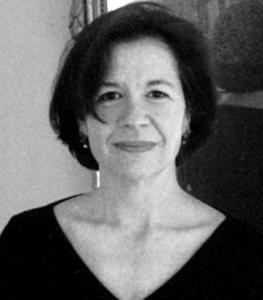
Joan Wickersham was born in New York City and grew up there and in Connecticut. Her new book of fiction, The News from Spain: Seven Variations on a Love Story, will be published by Knopf in October 2012. Her memoir The Suicide Index: Putting My Father’s Death in Order (Harcourt 2008) was a National Book Award Finalist. She is also the author of a novel, The Paper Anniversary.

Please visit her Website and her Facebook page.

This is my 49th book for the 2013 New Authors Challenge.

What Matters in Jane Austen? by John Mullan

Source: Public Library
Hardcover, 320 pages
I am an Amazon Affiliate

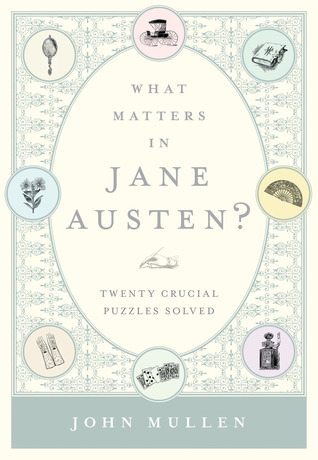
What Matters in Jane Austen by John Mullan is a detailed look at 12 stylistic techniques and concerns in Jane Austen’s numerous works, including the unfinished The Watsons and Sanditon.  The twelve puzzles Mullan explores range from the importance of age in her books, what characters call one another, and what games characters play to why her plots rely on blunders, what her characters read, and how experimental a novelist she was.  There are moments in the book where Mullan’s examinations become bogged down and overly verbose, but he clearly enjoys picking apart the most innocuous moments in Austen’s novels to support his theories.  Most of the theories he offers and backs up with source material from Austen’s books and letters to family members also are discussed by other scholars, whom he cites.  For aspiring writers, Mullan’s book can be used as a guide for creating those unique moments and nuances in a novel, emulating Austen but adapting it for modern sensibilities.  Although it is not a how-to guide for writers, it does offer some insight into elements of the craft.

“Admission to a bedroom is a rare privilege, for the reader as well as for a character.” (page 29)

“Names are used by Austen, as well as by her characters, as though they are precious material, so we sometimes hear only once, glancingly, what someone’s name is.  Thus the label on the trunk seen by Harriet Smith, directed to Mr. Elton at his hotel in Bath, which names him as Philip (II. v).” (page 46)

“But Austen wants us to think not so much about how characters look, but how they look to each other.  Her sparing use of specification when it comes to looks is striking when looks can be so important.”  (Page 57)

“Meteorology clues us in to the passing of the year.  But it is more than this.  Austen likes to make her plots turn on the weather.  Having arranged her characters and defined their situations, having planned her love stories and hatched the misunderstandings that might impede them, she lets the weather shape events.  It is her way of admitting chance into her narratives.” (page 101)

“The rather few critics who have written on speech in Austen’s fiction have discovered how each of her speakers seems to have their own idiolect — a way of speaking that is individually distinctive.”  (page 132)

Austen is an often underestimated author, especially in light of the writers who dismissed her early on.  Mullan pinpoints the genius of Austen beyond the morays of the time period in which she wrote and the social commentary.  Readers who have read all of Austen’s major works but once are likely to want to read them anew after reading Mullan’s examination.  Even those have read certain Austen books multiple times could find new theories in this book.  It is interesting to see what it means when characters blush, why weather is important, and what seaside resorts mean in Austen’s work.  Mullan also asks whether there is sex in her books.

What Matters in Jane Austen by John Mullan is less about the puzzles of Austen than about her techniques as a writer and creator of fiction.  It was an interesting look at how she stacked up to her contemporaries and offered something more.

About the Author:

John Mullan is a Professor of English at University College London. He specialises in 18th century fiction. He is currently working on the 18th-century section of the new Oxford English Literary History. He also writes a weekly column on contemporary fiction for The Guardian and reviews books for the London Review of Books and New Statesman. He occasionally appears as an 18th-century and contemporary literature expert for BBC Two’s Newsnight Review and BBC Radio 4’s In Our Time. Mullan was a judge for The Best of the Booker in 2008 and for the Man Booker Prize in 2009. He was a Research Fellow at Jesus College, Cambridge and a Lecturer at Fitzwilliam College, Cambridge, before coming to UCL in 1994.

This is my 47th book for the 2013 New Authors Challenge.

Lotería by Mario Alberto Zambrano

Source: TLC Book Tours and Harper
Hardcover, 288 pages
I am an Amazon Affiliate

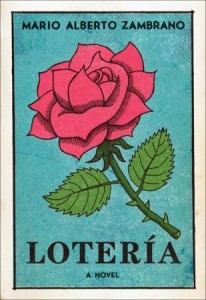
Lotería by Mario Alberto Zambrano is an imaginative coming-of-age story for eleven-year-old Luz Castillo that uses the cards from a Mexican game that resembles American bingo.  Each card can be covered in the game once the riddle is called and the players know what card it is based on the riddle, and each card is placed in a tablas in any order or in a standard order.  Like the game, Luz unwinds her memories just before a tragic event lands her in a center and her father arrested.  As she turns the cards over, a memory is triggered, and she writes it down in her journal at the behest of her auntie Tencha.  Like any child traumatized by a startling event, Luz’s memories do not follow any kind of straightforward timeline, but they do reveal a great deal about her family’s immigration, ties to Mexico, and adjustment in America.

“And because quiero can mean either want or love, I asked if it meant “I want you” or “I love you.”  Come here, because I love you,or, come here, because I want you? If you were saying to someone, come to me, then the person you loved wasn’t there, and if you had to tell someone to come to you then maybe he didn’t love you.  And to want someone to come to you is like an order.  If you have to order someone to come to you, how much love is in that anyway?”  (page 13 ARC)

Like the journal entries, Luz’s family life is complex and multilayered with her older sister, Estrella, having been born in Mexico and knowing to smoothly speak Spanish, while Luz is a natural born American who is self-conscious about speaking Spanish aloud even though she knows what those around her say.  While there are moments in this novel when Luz has more adult thoughts, the experiences she has at home with her parents always fighting and her cousins taking advantage of her youth when she visits in Mexico, it is clear that she is mature beyond her years and has given a great deal of thought to her life experiences.

Peppering the story with Spanish words, the meaning of which can be mostly gleaned from the context of the story, Zambrano has crafted a puzzle that will spur readers to keep reading and take the journey with Luz as she uncovers the memories she’s tried to forget about her family.  While Luz has grown up in a typically male-oriented household, it is clear that America has had an influence on the family as her mother takes a job outside the home and never cowers behind her skirts when her husband is out of control with drink.  Despite the hardships, Luz has faced, she still remains optimistic and open to the possibilities of a better life, as she speaks to God in her journal entries about her past and her own confusion and feelings.

Lotería by Mario Alberto Zambrano is well-crafted, stunning, and highly recommended.  It brings to light the horrors of familial dysfunction, abuse, and general family discord through the eyes of a mature child, who strives to cope with it all in the best way possible.  Not only does it highlight the transition of a family from life in Mexico to one in America — with its opportunities and disappointments — but it also examines the dichotomy of family relationships that produce both love and hate.  Zambrano is an author to watch for.

About the Author:

Mario Alberto Zambrano was a Riggio Honors Fellow at the New School and recently completed his MFA at the Iowa Writers’ Workshop as an Iowa Arts Fellow. He is a recipient of the John C. Schupes Fellowship for Excellence in Fiction. Lotería is his first novel.

Find out more about Mario at his Website and connect with him on Facebook.

This is my 46th book for the 2013 New Authors Challenge.

Letters From Skye by Jessica Brockmole

Source: TLC Book Tours and Random House
Hardcover, 304 pages
I am an Amazon Affiliate

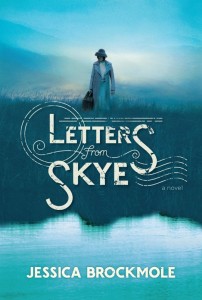
Letters from Skye by Jessica Brockmole, an epistolary novel that straddles two World Wars, is about falling in love, finding your soul mate, and poetry.  Elspeth Dunn, a Scottish poet on the Isle of Skye, lives a rather cloistered life on her island but one of her books makes its way across the Atlantic to a young man in Illinois, David Graham, who writes her a fan letter.  Over the course of several years beginning when WWI breaks out in Europe, Elspeth and David begin a correspondence that takes on a life of its own.

“It’s the war talking.  I know; I’ve seen it.  They head off, invincible, feeling as if the future is a golden pool before them, ready to dive into.  And then something happens — a bomb, a sprained wrist, a bullet that whizzes by too close for comfort — and suddenly they are grabbing for whatever they can hold on to.  That golden pool, it swirls around them, and they worry they might drown if they’re not careful.  They hold tight and make whatever promise comes to mind.  You can’t believe anything said in wartime.  Emotions are as fleeting as a quiet night.”  (page 33 ARC)

While David is in America struggling through college and hoping to subvert his father’s plans for medical school, Elspeth is busy writing poetry and becoming even more entrenched in the lines her muse is offering.  Her relationship with her brother Finlay is the closest she has, but war does change things.  The more her muse speaks, the more she’s pulled away from the life she’s always known and the more she is challenged to face her fears — including her fear of water.

Through Elspeth and David’s correspondence the wider impact of war is experienced, complete with the tension of the home front as wives and families wait for their loved ones.  But at the same time, the lives of women are broadening as they are able to enter into jobs once thought of as men’s work.  The feminist leanings of Elspeth are clearly front and center in some of her correspondence with David, but it never deters him in his pursuit of her.  The moral high ground has no place in this romantic jaunt across Scotland, London, and France as a young woman and man succumb to their emotional connection on the page.

Letters from Skye by Jessica Brockmole weaves Elspeth and David’s story with that of Margaret, Elspeth’s daughter, and her search for the past.  Margaret has never met her father, and her mother remains close-lipped about her past and her daughter’s father.  But when WWII begins to break out, all of the old transgressions and emotional upheaval of Elspeth’s past resurfaces, threatening to leave her unmoored once again.  But Margaret’s life is far from pristine when it comes to the tentacles of war as her fiance flies for the RAF.  Brockmole’s letters are frank, honest, and engaging as these relationships unfold and enfold, creating a family history that will be hard to forget.  And yes, there is a poem included!

About the Author:

Jessica Brockmole spent several years living in Scotland, where she knew too well the challenges in maintaining relationships from a distance. She plotted her first novel on a long drive from the Isle of Skye to Edinburgh. She now lives in Indiana with her husband and two children.

To learn more about Jessica and her work, visit her Website.

To WIN a copy of this book, leave a comment by July 19, 2013, at 11:59 PM EST; You must be a U.S. resident 18 years and older.

This is my 44th book for the 2013 New Authors Challenge.

What Changes Everything by Masha Hamilton

Source: Unbridled Books, unsolicited
Hardcover, 288 pages
I am an Amazon Affiliate

What Changes Everything by Masha Hamilton is a look at the reverberating impact of war on not only the countries directly affected, but also those countries who send people to help refugees and the injured.  Todd Barbery coordinates aid for refugees and hospitals with the help of his Afghan contact, Amin.  Todd is far from his wife Clarissa of about three years and his only daughter Ruby, who is just beginning her own life, but while Clarissa fears for his safety and has wrestled a promise from him that this will be his last rotation in Afghanistan, Todd wishes not to be so closely guarded and insists on moments of freedom.

“Already wearing sweatpants and a T-shirt, she tied the laces to her tennis shoes, tugged a sweatshirt over her head, and slipped downstairs.  Her stomach felt hollow.  Hunger had largely left her during these last days — she’d always been an indifferent eater, but now she found herself forgetting about food altogether until she’d notice her hands were shaking.”  (Page 135 ARC)

Each section is from a different perspective that alternates between Todd, the subject who is kidnapped and the major driver of the plot; Clarissa; Amin; Mandy; and Stela and Danil — a mother and her son, a young graffiti artist who lost his brother to Afghanistan and friendly fire.  While many of these characters’ experiences and lives intersect, Mandy and the letters written by Najibullah — a former ruler of the nation who is held by the UN and not allowed to leave for exile with his wife and daughters — are outside those interactions and direct connections to demonstrate a more compassionate and empathetic side of the story to juxtapose the heartbreak and devastation of war.

“The man turned toward Todd.  He was about twenty-five years old.  He wore a blue-gray turban and a brown vest over his salwar kameez, and his eyebrows were unusually thick, like angry storm clouds hovering over his eyes.”  (page 31 ARC)

There is great compassion and hidden understanding in these fictional lives, and much of that seems to stem from the torture and death of a historical figure, Najibullah, at least as a driving force for Amin.  However, the letters from the former president to his daughters in exile tend to pull the reader out of the rest of the story until the connection is made to Amin, and the novel may have been better served had those letters been truncated and included in Amin’s portion of the story as flashbacks or memories.  The tension with the kidnapping is well done as is the tension between Clarissa and her step-daughter as negotiations continue and the FBI is looking for the go-ahead for a military distraction even though they claim they do not know her husband’s exact location.

Danger is around every corner, or that’s how it should be perceived in this novel, and when it isn’t unfortunate things happen but at other times unexpectedly good things happen as well.  Hamilton’s prose is easy to read and is packed with emotion and perspectives that are rarely examined in war-based fiction.  The novel seeks to be well-rounded in perspective, which is tough given the complexities of the factions in Afghanistan.  What Changes Everything by Masha Hamilton is engaging and hammers home the impact of war not just on the immediate participants and their families, but also those on the periphery and who are actively compassionate in their work and have a need to assist in any way they can.

About the Author:

Masha Hamilton is currently working in Afghanistan as Director of Communications and Public Diplomacy at the US Embassy. She is the author of four acclaimed novels, most recently 31 Hours, which the Washington Post called one of the best novels of 2009 and independent bookstores named an Indie choice. She also founded two world literacy projects, the Camel Book Drive and the Afghan Women’s Writing Project. She is the winner of the 2010 Women’s National Book Association award.  Check out the inspiration behind the book, What Changes Everything.  She is also behind the Afghan Women’s Writing Project.

This is my 43rd book for the 2013 New Authors Challenge.

A Small Death in Lisbon by Robert Wilson

Source: Public Library
Hardcover, 440 pages
I am an Amazon Affiliate

A Small Death in Lisbon by Robert Wilson is a mystery set in Lisbon, Portugal, in the 1990s, but also a novel that has routes in World War II when Germans were looking for an escape route when the war looked to be ending, and not in their favor.  The novel opens with the death of a young teen, Catarina Oliveira, who has a promiscuous past and a less-than-ideal family life.  Inspector Zé Coelho is on the case, which drags him into conspiratorial intrigues and the dark, convoluted past of his home nation.  Shifting back to 1941, Wilson unveils Klaus Felsen, a German businessman who is “recruited” by the German SS for a particular purpose that takes him into Spain, Portugal, and later Africa, as some Nazis, including his recruiter Lehrer, begin to see the campaign against Russia as folly.  Wilson’s novel is about political regimes and how even their single-minded focus can be derailed by the most personal of matters.

Felsen is an opportunist who attempts to make the most of his new position in the SS, doing the best he can to game the Wolfram markets and garner more of the mineral and other materials away from Britain and the allies from neutral countries, like Portugal.  His meeting with a British agent Edward Burton turns ugly, marring his character and leading him down an ever darkening path that sets him adrift.  Coelho, meanwhile, is slowly investigating the murder of young girl, finding that the ghosts in Salazar‘s closet are not so hidden.  The links between the Oliveira girl and the Nazis’ past in Portugal are convoluted and sinister even as publicly the nation remained neutral.

“‘So you’ve seen some of Lisbon,’ he said.  ‘Now when you see Salazar’s capital after dark perhaps you understand my point about the harlot.  Lisbon’s a whore, a peasant Arab whore, who wears a tiara at night.'”  (page 92)

Wilson successfully paints an atmosphere of paranoia among the Germans as the war winds down, and demonstrates through a series of minor characters the tensions between fascism and communism in Portugal following the war.  These political tensions weigh heavily throughout the mystery novel creating a multilayered, interlocking puzzle to be unraveled by Coelho.  Ripe with sex scenes and the underbelly of prostitution in Lisbon, the darker elements of Felsen and later Miguel Rodrigues’s desires come into the light, along with incest, adultery, perversity, and murder.

Unfortunately, these multiple story lines seem forced together toward the end with newer, less important plot lines that could have remained unresolved by Wilson.  Ultimately, the most well drawn character in the book is Felsen, though for the latter third he disappears until the very end when there seems to be no other way to tie up the mystery.  Coelho is a carbon cut out of any police detective and doesn’t seem particularly Portuguese with any respect, which could be due to the time he spent in England with his wife and child.  His time in England, however, may have made him less old-world Portuguese in some sense, but at his core, readers may expect him to still have those old world values, which could leave readers feeling that Wilson’s detective is not authentic enough.  A Small Death in Lisbon by Robert Wilson works as a mystery novel but not as well as one would expect given the high number of coincidences, but the historical parts of this book are deeply engaging and unique.  Overall, a satisfying read that will keep readers turning the pages.

About the Author:

Robert Wilson is the author of nine previous novels, including A Small Death in Lisbon and The Company of Strangers. A graduate of Oxford University, he has worked in shipping, advertising, and trading in Africa, and has lived in Greece and West Africa.

This is my 42nd book for the 2013 New Authors Challenge.

Looking for Me by Beth Hoffman

Source: Author Beth Hoffman
Hardcover, 354 pages
I am an Amazon Affiliate

Looking for Me by Beth Hoffman is a coming of age story for Teddi Overman who has a gift for restoring old furniture that speaks to her.  Her small, close-knit family from Kentucky is as diverse in background and interests as any family could be, with her brother Josh so attuned to nature — he’s almost as wild as the animals he observes and cares for — to her uptight mother Franny, who has secrets hidden deep inside.  Teddi is an independent and stubborn girl whose life is altered when she meets an older man, Mr. Palmer, who’s passing through town.  He buys a refurbished chest from her side-of-the-road shop and encourages her to follow her dream and look him up in South Carolina.  When she graduates from high school, something irrevocably changes for her family as each member either seeks freedom or learns to find that freedom is already there.

“Some people run toward life, arms flung wide in anticipation.  Others crack open the door and take a one-eyed peek to see what’s out there.  Then there are those who give up on life long before their heart stops beating — all used up, worn out, and caved in, yet they wake each morning and shuffle their tired legs through another day.”  (page 1)

The double meaning in the title comes into play when her brother makes his flight from the family farm.  The close relationship between Josh and Teddi is tender and endearing, but it also makes his lack of communication with his sister heart-breaking.  In many ways, looking for me is not about Teddi finding herself — because she already knows who she is and what she wants out of life — but about her finding the piece of herself that went missing when her brother left.  Early on in the story, even Teddi recognizes that leaving home means leaving something of yourself behind, and she even suggests that it’s a piece that cannot be reclaimed, but waits for your return and for you to remember.  Recovering that piece of herself is a journey only she can accomplish, but even so, she can and does lean on the support system of friends she finds in Charleston.

Olivia and Teddi tell each other like it is, and like most real-life friends, keep secrets from one another when they know the unsolicited advice they’d receive is not something they would want to hear.  Teddi rebuilds and refinishes furniture, but in many ways she uses those same skills to restore her own family, which fell into disrepair through a series of missteps and miscommunications.  Through a greater understanding of her mother and father’s motivations and backgrounds, Teddi is able to come to terms with her past and embrace her future fully.  Grammy Belle, Josh, Sam, Albert, Inez, and Olivia will leave lasting impressions on Hoffman’s readers, causing them to be missed something fierce when the last page is turned.

Second novels can suffer from harsh criticism, especially when they follow a wildly successful debut novel, like Saving Cee Cee Honeycutt (my review), but Looking for Me breaks through preconceived expectations to weave a story that will enchant readers with not only its southern charm and hospitality, but also the mysteries of family connections and miscommunications.  Hoffman’s second novel is captivating from the first pages and will give readers hope that the future is brighter than we expect it to be.  Another winner from an author I love.

About the Author:

Twelve days after Beth Hoffman’s first novel was published in January 2010, she became a New York Times bestselling author with foreign rights selling to prestigious publishers in Italy, Germany, France, Poland, Norway, Hungary, Indonesia, Korea, Israel, and the United Kingdom.

Before beginning her writing career, Beth was president and co-owner of an interior design studio. An artist as well as an award-winning designer, her paintings are displayed in private and corporate collections in the United States, Canada, and the UK.

Beth lives, along with her husband and two very smart cats, in a restored Queen Anne home in a quaint historic district in Northern Kentucky. Her interests include the rescue of abandoned and abused animals, nature conservancy, birding, historic preservation, and antiquing.  Visit her on Twitter and Facebook.

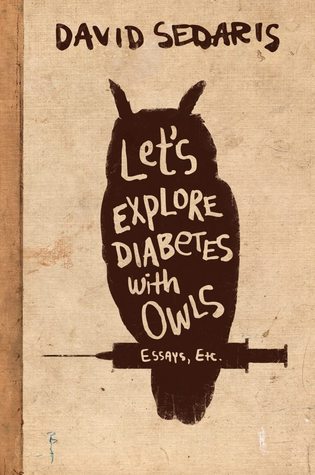
Let’s Explore Diabetes With Owls by David Sedaris

Source:  Little, Brown & Company
Hardcover, 275 pages
I am an Amazon Affiliate

Let’s Explore Diabetes With Owls by David Sedaris is a collection of essays and some short blurbs that he suggests could be used by students in their competitions for “forensics.”  Many people talk about Sedaris’ humor and outrageous tales, and while many will look for his signature humor here, they may find that it is a bit subdued and less abrasive than usual.  Many of these essays seem more reflective than probing (think poking with a needle), but they also resemble the tall tales that young children tell their parents when explaining what they did that day or why they got in trouble, etc.

“Their house had real hardcover books in it, and you often saw them lying open on the sofa, the words still warm from being read.” (page 60 ARC)

The first two essays in the collection showcase backhanded sarcasm aimed at American and especially modern ideas about parenting and socialized healthcare, especially the dark fear that socialized healthcare means dirty cots and “waiting for the invention of aspirin” and the coddling of kids who are clearly engaged in bad behaviors simply because a stranger points out the child’s misbehavior.  The end of the collection, “Dog Days,” is a bit more crass in its humor, written in a rhyming poem about various dogs and the parts of themselves that are licked, snipped, and dipped.  These little stanzas were by turns slightly funny to just mediocre as they are things that any person with “toilet” humor would come up with.  In this essay collection, they stood out from the rest, but in a grotesque way.

The essays that reach back into his early family life are the most interesting, and the essay “Author, Author” is ironically humorless in its telling, but it drives the point home not only about author tours — the good and the bad — but also the changing landscape of book stores and readers.  Let’s Explore Diabetes With Owls by David Sedaris is an interesting essay collection, but fans may find it a bit more subdued than his other work.

About the Author:

David Sedaris is a playwright and a regular commentator for National Public Radio. He is also the author of the bestselling Barrel Fever, Naked, Holidays on Ice, Dress Your Family in Corduroy, Denim, When You Are Engulfed in Flames and Me Talk Pretty One Day. He travels extensively though Europe and the United States on lecture tours and lives in France.  Visit his Website.
This is my 41st book for the 2013 New Authors Challenge.

Three-Ring Rascals: The Show Must Go On! (Book 1) by Kate Klise, illustrated by M. Sarah Klise

Source:  Anna of Diary of an Eccentric gave me this ARC as the book was aimed at readers younger than The Girl, but only slightly older than my girl. (probably the longest explanation EVER!)
Paperback, 141 pages
I am an Amazon Affiliate

Three-Ring Rascals: The Show Must Go On! (Book 1) by Kate Klise, illustrated by M. Sarah Klise, is a cute book about circus life, complete with talking animals, feats that defy gravity and the laws of physics, and a scoundrel, which is due for publication in September 2013.  Sir Sidney’s Circus is a story about redemption and about being true to your friends, but it’s also about the surprising things that can happen when you’re not looking.

Sir Sidney is getting older and he’s looking for a manager when he settles on a self-proclaimed lion tamer named Barnabas Brambles, but while Sidney is away, Brambles has plans of his own — to make money for himself.  The path he takes to make more money backfires even as he strives to accomplish even more devious strategies.  Meanwhile, the animals sure miss their owner and suffer at the hands of Brambles, though they don’t exact any revenge.

Leaving the acrobats in charge of driving the train, Brambles finds that his plans are thrown out into the wind as the train gets stuck in places that will boggle his mind.  Klise is an imaginative storyteller, and readers will like the little definition explanations she includes for some of the larger words used, as well as the explanation behind the made-up words used by the mice, Bert and Gert.  The illustrations are fun and simple, and they include dialogue bubbles as the animals talk amongst themselves while Brambles makes his plans.  The text is mixed in beside and inside the illustrations, which will keep readers exploring the pages, rather than rushing over the pictures.

Three-Ring Rascals: The Show Must Go On! (Book 1) by Kate Klise, illustrated by M. Sarah Klise, is a book that will entertain younger readers, though age 10 may be a little old for the book depending on the readers’ abilities.  The book indicates it is for kids ages 7-10, but it read more like a book for ages 5-8, but younger readers may need help reading.  As a book read at bedtime for younger ages, parents could break it up in installments over several evenings.  The book is fun and only the first in the series, with certainly more antics to come, especially from Bert and Gert who are a riot.

**The Three-Ring Rascals Website offers some great insights into how the author and illustrator are like Bert and Gert, the two mice, and there are resources for teachers and fun games for kids.

About the Author and Illustrator:

Kate Klise and M. Sarah Klise have collaborated on numerous middle-grade and picture book projects. Their most recent series, 43 Old Cemetery Road, has been nominated for reading awards in nearly twenty states to date and is a Junior Library Guild selection. The pair’s novels and picture books can be found on their Website.  And to find out more about the Three-Ring Rascals, visit the Website.

This is my 39th book for the 2013 New Authors Challenge.

The Neruda Case by Roberto Ampuero, Translated by Carolina de Robertis

Source: Riverhead Books, Penguin
Paperback, 374 pages
I am an Amazon Affiliate

The Neruda Case by Roberto Ampuero, translated by Carolina de Robertis (see my review of Perla), is set just before the dictatorship of Augusto Pinochet in Chile when Castro is in power in Cuba and Germany has been cut in half by the wall.  Cuban exile Cayetano Brulé has left Miami with his wife, Maria Paz Angela Undurraga Cox, for her home in Chile, but he continues to feel out of place as no one trusts a Cuban and he cannot find work.  Meanwhile, his wife is increasingly engaged in the reform movement in the country, while at the same time she is pulling away from her husband.  Wandering in a strange country with bad coffee, Cayetano unwittingly bumps into Pablo Neruda at a party in a library and shortly receives an offer he cannot refuse.

“The door was made of knotted wood.  It didn’t open.  He stroked the old bronze knocker, put his hands in the pockets of his fleece jacket, and told himself that all he could do now was wait.  He exhaled wafts of white breath into the overcast winter morning and thought, amused, that it looked as if he were smoking, even though, in this city, there were no more matches or cigarettes.”  (page 12)

Brulé is a man that is transformed by his business relationship with Neruda, who hires him to uncover the truth about his past that haunts him, but this relationship evolves into admiration and a personal connection that transforms Brulé into a confident detective.  Not only is the novel about finding solace, it also is about one man’s journey home.  Neruda was a complex man and legendary, and the author clearly admired the poet and held him in high regard, but the novel also demonstrates that even the most legendary of us have flaws.  It is those flaws that make us who we are, ensuring that those who love us are constantly challenged.  By the time Brulé meets Neruda, he is already a legend and Nobel laureate, and Neruda knows it and revels in his success — so much so that it becomes a crutch for any mean moment or poor decision in his life:  “I did it for my art.”

“‘Because if poetry transports us to the heavens, crime novels plunge you into life the way it really is; they dirty your hands and blacken your face the way coal stains engine stokers on trains in the south, where I was born.'”  (page 24)

“‘The casualties of our good fortune are a terrible thing, Cayetano.  But the road to personal happiness is paved with the pain of others.'”  (page 130)

Ampuero’s novel is a detective novel wrapped up in literary and historical fiction that depicts a turbulent time in Chile’s history, but also a time of idealism on the part of Neruda and President Salvador Allende.  The Neruda Case transports the reader back in time and paints a picture of idealism and its failures, but also its continued promise of hope.  Ampuero’s portrayal of Neruda is as complex as the man himself, and his detective is a man that readers will become emotionally attached to and cheer on in his mission.  One of the best, sweeping novels I’ve read this year.

**On a side note, I was pleased to find that Ampuero lived near Neruda’s home La Sebastiana as a boy and regrets that he never had the courage to knock on the poet’s door.**

About the Author:

Roberto Ampuero is an internationally bestselling, award-winning author. He has published twelve novels in Spanish, and his works have been translated around the world. The Neruda Case is his first novel published in English. Born in Chile, Ampuero is a professor of creative writing at the University of Iowa and currently serves as Chile’s ambassador to Mexico. He lives in Mexico City and Iowa City.


This is my 37th book for the 2013 New Authors Challenge.

Our Held Animal Breath by Kathryn Kirkpatrick

Source: Wordtech Communications and TLC Book Tours
Paperback, 96 pages
I am an Amazon Affiliate

Our Held Animal Breath by Kathryn Kirkpatrick is a slim volume of poetry that is broken into three sections.  Although there is a deep sense of anger and hurt over current events and the rape of the world by humanity, many of these poems also have a personal side to them — deep personal losses of friends and family.  At times, the narrator is baffled at how some things come to be, like in “Millennium” where the narrator is left with an altar in a room flooded with light.  “How did I come by this altar,/these windows of stained glass?/When I meet the fox again,/I set her free./The meadow she finds/is neither desert nor glacier.”  (page 11)

Kirkpatrick wonders about the connections between humans and nature, particularly animals.  She postulates in “At the Turkey Farm” whether we absorb the loneliness and longing of turkeys when we eat them during holidays, but at the same time she talks about their only solace as being able to stand in the fading light in their own poop.  At the heart of the poem, the narrator is exploring the existence of these animals as walking corpses and ghosts haunting the farms but not really living.  In a way the poem itself is haunting, forcing readers to contemplate these farms where animals are bred to be something other than themselves, serving mostly as food.

Strange Meeting (page 22-3)

Is this how an animal feels
on the other side of a human eye?

I was a woman speaking
to men I didn’t know.

Large and strong, they
knew about power
in ways I may never

I sat framed and assessed
no threat a square jaw decided
negligible bent knuckles said

I looked back through my animal
eye, saw

the slit throat of the cow
in the leather shoe

the poisons deep in the soil
where the cotton grew

the felled trees
of the papers stacked

the mountains leveled
in the electric hum of light and heat
where we sat.

I saw clearly
all they had done and would do
to make a world we’d be losing fast.

I saw why it was lost.
And I saw how we would lose it.

In some poems, Kirkpatrick weaves in the teachings of Buddhism, but in some instances, those teachings cannot stop the suffering. “After Zazen” explores the many forms of suffering facing humanity, including accidental swallowing of stones to cause near suffocation and death and the invasion of one country into another. Raising questions about suffering on many fronts, the narrators are searching for ways to end it or at least ease the pain. Meditation may not be the best solution or it could be. Beyond these moments of suffering, the narrator blur the lines between animal and human to find the similarities of feelings and behaviors, but to also outline the loyalties that have been forgotten, like that of a dog and master. Perhaps that loyalty should be expanded to include other aspects of nature.

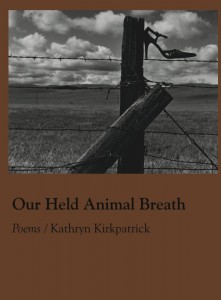
Our Held Animal Breath by Kathryn Kirkpatrick offers a wide range of poems for discussion in book clubs, focused on the impact of human activity on the environment and the changes that are possible if we just think outside the box.  What are the ways that we can brainstorm to feed ourselves and continue to live and grow without harming other animals and nature.  While the brown of the cover is a bit off-putting; the shoe seems out of place on the wire fence, though that may be on purpose given the sometimes out of place nature of our own existence in the world.

About the Poet:

Raised in the nomadic subculture of the U.S. military, Kathryn Kirkpatrick was born in Columbia, South Carolina, and grew up in the Phillipines, Germany, Texas and the Carolinas.  Today she lives with her husband, Will, and their two shelties in the Blue Ridge Mountains of North Carolina, and she currently holds a dual appointment at Appalachian State University as a Professor in the English Department and the Sustainable Development Program. She has a Ph.D. in Interdisciplinary Studies from Emory University, where she received an Academy of American Poets poetry prize.

Giveaway:  1 copy of Our Held Animal Breath

Want to win a copy of her book?  Leave a comment below with an email

I’ll contact the randomly drawn winner, who must be age 18 or older and live in US or Canada as the publisher is sponsoring the giveaway.  Deadline to enter is June 17, 2013 at 11:59 PM EST

This is my 23rd book for the Dive Into Poetry Challenge 2013.


This is my 35th book for the 2013 New Authors Challenge.