Quantcast

The Cellist of Sarajevo by Steven Galloway

Source: Public Library
Paperback, 235 pages
I am an Amazon Affiliate

The Cellist of Sarajevo by Steven Galloway is a truncated look at the siege of Sarajevo in the early 1990s that lasted about three years, though in this novel, it is reduced to about 30 days.  While the cellist is a real individual, Galloway has crafted him into a larger-than-life character, who signifies the hope that the people of Sarajevo cling to even in the face of dead bodies left to rot in the streets.  In addition to the cellist, who is more of an abstraction than a character with his own perspective, there is Arrow, a young, female sniper, Kenan, who has a wife and three children to care for, and Dragan, an older man who works at the local bakery.  Through alternating chapters, the fear and angst felt by these characters becomes heightened for the reader as they watch people fall to their knees after snipers shoot them or as the shelling begins and their own lives are at the mercy of chance.  The novel has a heavy atmosphere, a gray smoldering that permeates through the pages, weighing down the characters, slumping their shoulders and pushing them into darker places.

“If this city is to die, it won’t be because of the men on the hills, it will be because of the people in the valley.” (page 213)

Arrow has joined the resistance to fight against those that wish to destroy her people and the city, but while she’s been given free rein to choose her own military targets, things are about to change for her, and the hatred she feels for “them” — who are never clearly defined — becomes a motivator and a detriment to her.  Her character is pushed to the limit and she’s forced to make a decision that could be detrimental — a move that was rather dramatic and a bit predictable.  Kenan, meanwhile, is merely striving to keep his family alive, running to the brewery with his water containers to ensure they have enough to get through the next couple of weeks.  He makes these trips trembling in fear, but the fear only momentarily paralyzes him as he remembers the life before the siege and what life would be like without it.  He holds onto his daydreams of a family engrossed in its daily chores and entertainments, and keeps moving.  Dragan has been traveling to the bakery in solitude, rarely speaking to strangers and nearly always avoiding conversation with those he knew before the siege, cutting himself off.  Readers spend a great deal of time with him at an intersection where people are forced to take chances with their lives when they cross — some running, some sauntering, and some zigzagging across.

“‘Give Raza my love,’ she says, leaning in and hugging him.  She feels warm and substantial, much larger than when he hugged her only a short time ago.  She has become real to him again.” (page 115-6)

Galloway’s novel is about what it means to be in the midst of war, without understanding the reasons behind it, and yet, still facing the violence on a daily basis.  Readers will be required to ask themselves what is important, and to draw their own conclusions about why the cellist sits at 4 p.m. for 22 days to play Albinoni’s Adagio — the site of a mortar shelling where 22 people were killed while waiting in line for bread. Although lacking actual political/sociological motivations and the time line of the siege, Galloway seems to have a handle on the range of emotions and reactions people can have in war — whether it be a focus on hatred and revenge or the dissociation people can feel from their own country men in the face of uncertainty and death. The Cellist of Sarajevo is a novel in simple prose that belies the complexity of the moral and emotional issues it addresses.

About the Author:

Steven Galloway was born in Vancouver, and raised in Kamloops, British Columbia. He attended the University College of the Cariboo and the University of British Columbia. His debut novel, Finnie Walsh, was nominated for the Amazon.ca/Books in Canada First Novel Award. His second novel, Ascension, was nominated for the BC Book Prizes’ Ethel Wilson Fiction Prize, and has been translated into numerous languages. His third novel, The Cellist of Sarajevo, was published in spring of 2008. It was heralded as “the work of an expert” by the Guardian, and has become an international bestseller with rights sold in 20 countries. Galloway has taught creative writing at the University of British Columbia.

What the Book Club Thought:

Even though three members were unable to make the meeting, those that were able to attend seemed to like the novel, with one member saying that it was an easy and short read. Two members liked the POV of Arrow best, while one seemed to like both Arrow and Dragan and another preferred Kenan. One member believed that Kenan was the most human of the characters because of his interactions with other people throughout his travels to get water, while another thought that Dragan was more realistic in his detachment from others because of the harshness of war and the constant fear the residents endured. Arrow’s POV was more active, and one member enjoyed the use of strategy she employed in her efforts to protect the cellist. It seems as though this book was well received among the members in attendance.
This is my 78th book for the 2013 New Authors Challenge.
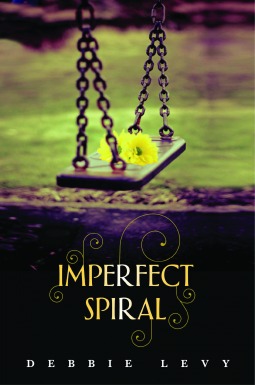
Imperfect Spiral by Debbie Levy

Source: Purchased Hooray for Books
Hardcover, 352 pages
I am an Amazon Affiliate

Imperfect Spiral by Debbie Levy is young adult novel that never speaks down to its reader as it asks questions about what it means to be a friend and what it means to be a neighbor and community member.  When tragedy strikes the fictional community of Franklin Grove in Meigs County, outside Washington, D.C., teen babysitter Danielle Snyder must cope with feelings of guilt and responsibility.  Her fear of speaking in public has haunted her long before the tragedy, but it is the loss of her friend, Humphrey, that causes her to speak out, to advocate on his behalf.  An unlikely friendship between a sophomore babysitter and a five-year-old boy blooms in the summer, but when it’s cut short, how does Danielle reconcile their unlikely connection and what has happened under her watch, especially when the small community is looking for someone to blame.

“I eat; the talk shifts to nothing in particular, which is good.  It’s as though we’re strangers sitting at the same table in one of those family-style restaurants.  We feel the need to make conversation, because that is what polite people do, but we are careful to keep the conversation safe.  Nothing to ignite sparks between Adrian and Mom.  Nothing to upset me.”  (page 4)

Her family life is not necessarily dysfunctional, but its not exactly serene when her brother Adrian is visiting after moving out.  And despite their inability to relate and emote without raising one another’s dander, the tragedy somehow brings them closer to reconciliation.  Shifting between the present after the tragedy and the past before the tragedy, Levy unfolds her story in an intricate way, allowing readers to see the whole complicated picture, even as Danielle begins to see it for the first time.  While her family dynamics play a role in the background, the real focus is on her relationship with Humphrey and the blame she lays at her own door for the tragedy.

“I rapped.  I crooned.  I rocked out.  Somehow dancing outdoors felt easier than in a school gym or hotel party room.  Plenty of space for my arms and legs.  I let myself lose control, and danced like crazy on the planet of Thrumble-Boo.

‘You look like a beautiful daddy longlegs!’ Humphrey said.”  (page 195)

Imperfect Spiral by Debbie Levy is about relationships that surprise us, about the illogical arguments of grief and assigning blame, but more than that, it’s about finding our way out of that grief to recognize the beauty in knowing and experiencing those relationships we may lose sooner than expected.  Levy’s characters are real, they’re the kids down the street searching for a sense of belonging, and they are burdened by the same emotions we all feel as adults.  It’s a highly emotional read that will leave a lasting impression.

About the Author:

Debbie Levy writes books — fiction, nonfiction, and poetry — for people of all different ages, and especially for young people. Before starting her writing career, she was a newspaper editor; before that, she was a lawyer with a Washington, D.C. law firm.  She has a bachelor’s degree in government and foreign affairs from the University of Virginia, and a law degree and master’s degree in world politics from the University of Michigan.  She lives in Maryland and spends as much time as she can kayaking and otherwise messing around in the Chesapeake Bay region.  Visit her Website, Facebook, and Twitter.

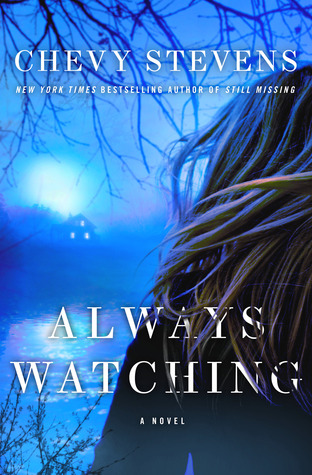
Always Watching by Chevy Stevens

Source: Novel Books
Paperback, 352 pages
I am an Amazon Affiliate

Always Watching by Chevy Stevens is well-paced, building the suspense and tension to a boil at the same time that it builds the characters, creating three-dimensional people — who in some cases are utterly terrifying.  Dr. Nadine Lavoie, whose appeared in Stevens’ Still Missing and Never Knowning as a therapist, is the protagonist, and as she searches the streets of Victoria, British Columbia, Canada, for her drug-addicted daughter, finds memories of her childhood are even more frightening than she first thought.  For those who have read the previous books and were intrigued by the therapist, this has been a long-awaited novel.  In true form, Stevens has built a believable world from which the current Dr. Nadine Lavoie has come, and although she cannot remember her most defining moments from childhood, it is clear they have helped shaped her into the woman and doctor she is.

“At first, the pain of the cold and the humiliation is excruciating.  I think I’m going to scream from it, but then I focus on the sound of the river, a bead of rain dripping off a leaf, chanting my mantra in my mind, until I’m able to separate from the pain, aware of it, but distantly.” (page 231 ARC)

Heather Simeon, Lavoie’s suicidal patient at the hospital, is not just depressed about being unable to make her parents proud, but she’s also devastated by the loss of her miscarriage and terrified by the commune people who are harassing her and her husband, Daniel, and who always seem to be watching.  Her interactions with the good doctor stir up something in Lavoie that she’s suppressed for most of her adult life — a childhood spent in a 1960s commune with her mother and brother.  As the memories resurface, she has little choice but to seek out former members to confirm events and look for clues about her past.  But what she stirs up is a relative hornet’s nest that not only swarms her and her family, but also those around her.

Stevens’ novel is finely crafted, full of twists and turns.  And while there is some predictability in what happens, she maintains her focus on the psychological impact of those events, detailing gripping breakdowns and triumphant rebounds of strength.  Always Watching is a book that’s hard to put down, and what happens in those pages will not stay there — the events will likely haunt readers for some time afterward.

About the Author:

Chevy Stevens grew up on a ranch on Vancouver Island and still calls the island home. For most of her adult life she worked in sales, first as a rep for a giftware company and then as a Realtor. At open houses, waiting between potential buyers, she spent hours scaring herself with thoughts of horrible things that could happen to her. Her most terrifying scenario, which began with being abducted, was the inspiration for STILL MISSING. After six months Chevy sold her house and left real estate so she could finish the book.

Chevy enjoys writing thrillers that allow her to blend her interest in family dynamics with her love of the west coast lifestyle. When she’s not working on her next book, she’s camping and canoeing with her husband and daughter in the local mountains.  Photo Credit: Poppy Photography

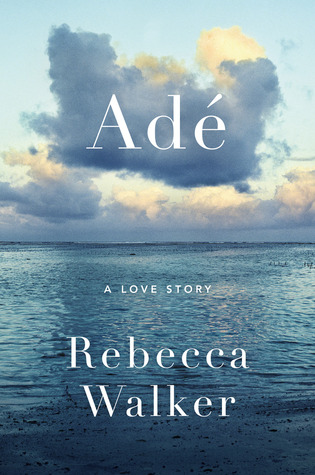
Adé: A Love Story by Rebecca Walker

Source: TLC Book Tours and New Harvest
Hardcover, 128 pages
I am an Amazon Affiliate

Adé: A Love Story by Rebecca Walker reads like a memoir, but it is fiction.  A young, American woman who has felt unmoored since her parents’ divorce, even at an Ivy League school until she falls into the web of Miriam, a free-spirited twenty-something whose eager to lose herself in the passions of others, particularly by having sex with men.  At the end of the school year, she and Miriam decide to see the “real” Africa and Middle East, traveling first to Egypt and slowly moving into more southern territories.  While Walker’s novella is considered a love story, it is far from overtly romantic, and it is more a search for identity, an identity that is strong and unwavering.  This nineteen-year-old, who later becomes known as Farida, is searching, always searching and consciously taking note of her place in the world.

“I was nineteen years old to Miriam’s twenty-one.  I felt raw and unfinished, where she seemed complete and self-assured.  I was a child of divorce and felt like I came from a thousand places — each one holding a little piece of me, and I drifted among them with no way to gather them up.  Miriam was from just one place, Miami, and more specifically, the moneyed enclave of Coconut Grove.” (page 4)

As they are touring Egypt, both young women are searching for something more authentic in their experience, rather than the tourist traps of Cairo and Giza, where Walker’s prose refers to tourists as flies around a plate of food.  Just from these early moments and descriptions, the reader can garner a sense that Farida is still searching for a home, a place where she not only feels worthy but safe and loved.  These tourist traps are not what she has come for her, with her “copper-colored” skin and “brown eyes the shape of almonds.”  As the narrative shifts away from Farida and Miriam’s experiences and becomes more focused on Farida’s alone, the reader gets a sense that something has shifted in the narrative — something more serious has come.

Even after she meets Adé, a Swahili Muslim from the Kenyan island of Lamu, Farida has succumbed to the feeling of belonging in these nations’ she’s visited, with their small villages and welcoming people.  Their romance is slow, and yet fast.  They begin with meetings at night after he works and walks throughout the town, then things heat up even faster after she reveals her passion for him.  Although this relationship blooms quickly and breaks her away from the past she’s known in America, her sensibilities have never strayed too far outside those democratic principles, and it is those principles that sets her apart in a world she’s come to think of as her own. Adé: A Love Story by Rebecca Walker is not a traditional story of love between a man and a woman, but of finding the love that can lift you up, complete you, and make you stronger even in the most adverse circumstances — and there are plenty of those here as the Persian Gulf War begins in the background.

About the Author:

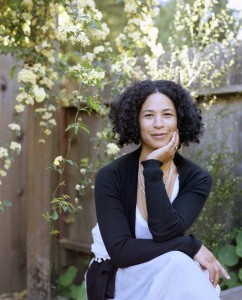
Rebecca Walker is the author of the best-selling memoirs Black, White and Jewish and Baby Love, and editor of the anthology Black Cool. She is also the editor of the anthologies To Be Real, What Makes a Man, and One Big Happy Family. Her writing has appeared in Bookforum,  Newsweek, Glamour, Marie Claire, The Washington Post, Vibe, and Interview, among many other publications, and she blogs regularly for The Root. For more information, please visit her Website and follow her on Twitter.


ENTER to win 1 copy of Rebecca Walker’s Adé: A Love Story by leaving a comment below by Nov. 18, 2013, at 11:59 p.m.

This is my 77th book for the 2013 New Authors Challenge.

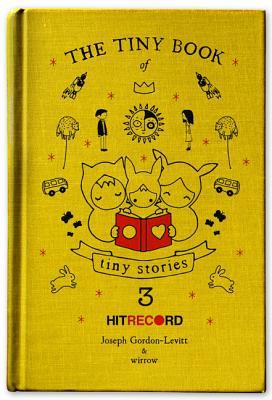
The Tiny Book of Tiny Stories: Vol. 3 by Joseph Gordon-Levitt

Source: It Books
Hardcover, 128 pages
I am an Amazon Affiliate

The Tiny Book of Tiny Stories: Vol. 3 by Joseph Gordon-Levitt is a collection of stories from 82 contributors out of the 35,905 contributions to the Tiny Stories collaboration on hitrecord.org — and the profits from the sale of the book will be split among the 82 contributors, which include writers and artists, and the Website.  Some of these stories are so small, they consist of just one sentence, while others are several sentences.  All of them are accompanied by an image, which is an interpretation of the words on the page or vice versa.  Some images and stories together will make readers laugh, but most of these stories are guaranteed to generate at least a smile.  Here are a few of my favorites:

10654259013_324cbc72a9_n10654026895_2caf4cc8a3

There are very few images with color, but those that do have color, do so for a purpose relevant to the story they portray.  The book is clearly a winner, especially for those that have very little time to read or even look at art — this book combines both, and there are some talented artists in these pages with varied imaginations.  The Tiny Book of Tiny Stories: Vol. 3 by Joseph Gordon-Levitt is a great diversion when there is little time between appointments or tasks.

About the Author:

HitRECord founder and director Joseph Gordon-Levitt’s acting career has managed to garner a massive popular appeal while maintaining a widely respected artistic integrity. He recently starred in Christopher Nolan’s Academy Award-nominated Inception and received Golden Globe, Independent Spirit and People’s Choice award nominations for his performance in (500) Days of Summer. Currently earning rave reviews for his performance in 50/50, also starring Seth Rogen, his upcoming films include David Koepp actioner Premium Rush and Rian Johnson’s sci-fi thriller Looper, with Bruce Willis.

Sense & Sensibiliy by Joanna Trollope

Source: TLC Book Tours and Harper
Hardcover, 368 pages
I am an Amazon Affiliate

Sense & Sensibility by Joanna Trollope is the first of the books in Harper’s Austen Project in which six bestselling contemporary authors use Jane Austen’s famous novels as a basis for their own modern versions.  With so many modern day versions, spin-offs, and continuations of Austen’s classic books, the expectations for the project are likely high, but this first rendition is a mixed bag.  While sticking very close to the original plots, Trollope’s main contribution to the original is an exaggeration of the characters — Elinor has too much sense (even more than Austen’s version) and Marianne is overly dramatic at every turn — and the introduction of modern technology, like Twitter, YouTube, iPods, and Facebook.  Although the exaggerated characters could be considered parody in a way, in some scenes they come off as merely annoying.

“It had been made plain to Sir John, from a young age, that the luxury of making choices in life simply did not exist without money.  Money was not an evil.” (page 42 ARC)

The social conventions of Austen’s time continue to play a role here, with characters motivated to find matches with money because without them, they will be destitute.  But in this modern society, it is hard to see that women would have just this option open to them, unless they are as shallow as Lucy Steele.  In fact, Elinor takes a job, at least part time until she completes her degree, but most everyone else seems content to sponge off their richer relatives, without much gratitude — though with relatives like these, it would be hard to muster gratitude.  Trollope clearly understands the foils that Marianne and Elinor play in the novel, and her exaggerations of their character in a modern society of social media may seem a bit much, but for young women constantly surrounded by their faults and mistakes, it might be believable.  Elinor, here, seems to represent a need in society for privacy, a greater need than society seems willing to allow unless people completely withdraw from society.  She’s strong, but at the same time, she’s vulnerable, as she pines for Edward.

Trollope has done a superb job with the youngest sister, Margaret, a young girl struggling with her emotions after her father’s death, being pushed out of the only home she’s ever known (Norland), and moving to a new school without her friends.  Bill Brandon is still reserved and quietly watching in the background, still considered boring by Marianne, and still caring, but there is a dynamic Trollope adds that will have readers cheering for something that was not in the original.  Meanwhile, John “Wills” Willoughby is even more dastardly in Trollope’s novel, yet he is still partially redeemable if you can buy that marrying for money is still a motivator in society, which it might still be among the more wealthy families.  Sense & Sensibility by Joanna Trollope is more focused on the excess in modern society as seen through her take on Marianne, Margaret, Elinor and the other characters, which can be extrapolated from their reactions to events and relationships.  Although readers would expect a more cohesive melding of the modern world with Austen, Trollope has created a new commentary on society that applies more easily to the modern world’s emphasis on excess and self-promotion.

About the Author:

Joanna Trollope is the #1 bestselling author of eighteen novels, including The Soldier’s Wife, Daughters-in-Law, Friday Nights, The Other Family, Marrying the Mistress, and The Rector’s Wife. Her works have been translated into more than twenty-five languages and several have been adapted for television. She was appointed to the Order of the British Empire in 1996 for her services to literature, and served as the Chair of Judges for the Orange Prize for Fiction 2012. She lives in London and Gloucestershire.  Find out more about Joanna on her website.  Photo credit: Barker Evans.

This is my 74th book for the 2013 New Authors Challenge.

Leviathan by Scott Westerfeld

Source: Purchased
Paperback, 440 pages
I am an Amazon Affiliate

Leviathan by Scott Westerfeld — our October book club selection — is a steampunk novel set during the onset of WWI.  Alek is whisked away in the middle of the night by his two teachers on a midnight run with one of their Austrian walkers, which they claim is practice for the coming battles.  Meanwhile, in England, Deryn is hoping to join the British military service as a boy even though she has very feminine features and is very light compared to other boys in their young teens who are signing up.  There is fact mixed with fiction, creating a fanciful landscape of genetically engineered animal ships and weapons alongside the mechanized beasts of gears and metal.  Alek is learning to run the walker at night, while Deryn is learning the ropes as a midshipman.  While things take a turn for the worse for both of these young people, both find their gumption to push through and find solutions, though not always the best or most satisfying.

When the story lines converge, it’s interesting to see how Deryn reacts to Alek’s self-importance and how timid Alek becomes in the presence of a science he’s only read about and never come in contact with.  Westerfeld has melded these modern ideas with the past in a way that makes the world he’s created seem like an alternate to the real past.  While the characters are coming of age in the time of war, there is still an innocence about this boy and girl that clings to them, and it’s clear that neither of them truly has a sense of fear when it comes to war — perhaps because of their sheltered lives and that the war they’ve encountered thus far has been minimal.  Both seem to believe that they are invincible, throwing themselves blindly into action.

The subordinate characters are not as well developed, except for Dr. Barlow who is a Darwinist engaged in the science of weaving together living beings.  The interplay between Barlow and the young teens is fun at times, but also enigmatic as each is hiding secrets from and about each other.  Count Volger is an interesting caricature who shines the most in his one-on-one fencing session with Alek.  The real stars of the novel are the Clankers’ machines and the beasts created by the Darwinists.  Westerfeld does weave in some facts, but it’s unlikely that younger readers would see which is fact versus which is fiction without reading the Afterword.  Leviathan by Scott Westerfeld is an adventure that young adults will enjoy for its fast-paced action and teenage bantering.

What the Book Club Thought:

Most of the book club enjoyed the book and seemed to prefer Deryn’s character more at first than Alek, but the ways in which the stories converged was well done.  One member even indicated they would give it five stars because they couldn’t see how Westerfeld could have made it better, at least in structure.  Most of the club said they would be interested in reading the second part of the series.  The mixing of the facts with the fanciful seemed to work with everyone in the book club, though two members had not finished reading at the time of the meeting.  The machines versus the genetically engineered beasts was an interesting angle, but the way in which the story is told demonstrated both sides so well that it enabled readers to see both sides of the story, rather than just see one as the enemy of the other.  This book was well balanced, adventurous, and touched on WWI, though a modified version of it.  Westerfeld also includes notes in the back about what facts were changed and which were maintained, which we felt was a good addition for those not as familiar with the time period.

About the Author:

Scott Westerfeld’s teen novels include the Uglies series, the Midnighters trilogy, The Last Days, an ALA Best Book for Young Adults and the sequel to Peeps. Scott was born in Texas, and alternates summers between Sydney, Australia, and New York City.


This is my 72nd book for the 2013 New Authors Challenge.

The Artist’s Way for Parents by Julia Cameron

Source: Finn Partners and Penguin
Hardcover, 288 pages
I am an Amazon Affiliate

The Artist’s Way for Parents: Raising Creative Children by Julia Cameron with Emma Lively and foreword by Domenica Cameron-Scorsese is less a how-to manual of creative activities for parents to engage in with their children, and more of a series of situations to emphasize the advice Cameron gives about how to cultivate creativity in children and ourselves.  From providing children with simple tools like paper and colored pencils to paints and free time on their own, rather than televisions, computers and video games, Cameron says that parents must adjust to new routines that incorporate their children, but also must remain open to creating a safe place in which children and parents can act creatively.

Each parent should begin by writing three pages per day of their thoughts and feelings before their child gets up for the day or even during snatches of quiet time, just to clear the decks.  Secondly, parents and children (depending on their age) embark on a once-weekly dual adventure, something that can be looked forward to, such as going to the zoo or a museum.  The final tool she offers is creating a bedtime ritual, which can either be reading a bedtime story together, singing songs, sharing the day’s highlights, and many other ways of unwinding.  Some great activities that can be done together including sharing the creation of meals with children through simple recipes, cutting out holiday decorations each season, visiting a florist or pet store to talk about each species and its requirements, and learning how to make instruments out of household objects.

Another part of the process is to create a creativity corner for both parent and child, which is where projects can be worked on together or in the same room but separately.  Cameron also talks about the benefit of allowing children to explore their own creativity without parents over-directing or re-directing their children’s activities.  One great aspect of the book is the discussion on reading together but separate books, and how that it is still considered sharing quality time together even if the parent and child are doing separate activity.  Separate activities in the same space are just as good as working together on projects, so long as the parent and child share their experiences with one another through discussion.

There are moments that come off preachy about faith and God, but overall the message is about nurturing children and their creativity without neglecting the well being of the parent or their own creativity.  It’s about seeing the possibilities in ourselves and our children without hindering growth and exploration.  The Artist’s Way for Parents: Raising Creative Children by Julia Cameron with Emma Lively and foreword by Domenica Cameron-Scorsese is a solid book that helps parents create the right mindset for themselves and their children, but only offers a few activities to consider.

About the Author:

Julia Cameron has been an active artist for more than thirty years. She is the author of more than thirty books, fiction and nonfiction, including her bestselling works on the creative process: The Artist’s Way, Walking in This World, Finding Water, and The Writing Diet. A novelist, playwright, songwriter, and poet, she has multiple credits in theater, film, and television.

Latest endeavor: Julia Cameron Live, an online course and artists’ community led by Julia. It is the most comprehensive discussion she has ever done on The Artist’s Way, and the first time she has allowed cameras in her home.

These are my 69th book for the 2013 New Authors Challenge.

Camelot’s Court by Robert Dallek

Source: Harper Collins
Hardcover, 512 pages
I am an Amazon Affiliate

Camelot’s Court by Robert Dallek (who was inspired to write the book after a poll similar to a recent one in Politico) is a highly detailed account of the Kennedy White House, but it also provides an inside look at the political machine the United States has become — from the bureaucrats with aspirations to rise above their stations to the military with its tunnel-vision to stop Communism at all costs.  One of the big takeaways from this book is JFK’s ambition to become president even when he won his first House seat — it was clear that he was bored with “small time” politics and merely cared about big picture issues, particularly foreign policy.  Dallek repeats most of what people already knew about Kennedy — that he liked the ladies, had an illness he hid from the press, and came from a rich family with some skeletons in the closet.  However, what Dallek provides is a comprehensive look at how dysfunctional an executive branch can be, particularly one with a young president at the helm who surrounds himself with the smartest of men (those that accepted the positions) and is forced to keep on less-than-desirable men for political reasons.  The interplay between the groups, the president, and even the brothers Kennedy is contentious, but it also becomes paralyzing.  However, it was not beneath Kennedy to use underhanded tricks or to dupe the press to get what he wanted.

“As Rusk sat in Kennedy’s living room, waiting to see the president-elect, he noticed a copy of the Washington Post sitting prominently on a coffee-table — it announced Rusk as secretary of state.  When Kennedy entered and saw the headline, he ‘blew his top,’ asking Rusk if he was the source of the leak.  Told no, Kennedy called Post publisher Philip Graham to chide him for printing the story.  After Graham explained that Kennedy was the one who had told him, Kennedy said, ‘But that was off the record.’  Hardly, since it was exactly what Kennedy wanted; Kennedy had no interest in giving Rusk a choice of accepting;”  (page 99 ARC)

Dallek carefully demonstrates his statements through dialogue from the men in the room with Kennedy when foreign policy issues were discussed, citing their own books, statements, diaries, and/or notes — not to mention the declassified government documents.  There are even quotes from Jackie Kennedy about private conversations she had with her husband or from conversations she overheard.  What’s telling about the situation when Kennedy was president is that he had the book knowledge from FDR and other presidents to guide him in building the best team, but that circumstances outside his control and his inability to ignore advice and go with his gut instinct often landed his administration in political hot water, like after the Bay of Pigs invasion of Cuba.  The defeat left a bad taste in the administration’s mouth, which may have fueled the military’s fire to win anywhere at any cost against Communism — hence the entry into the Vietnam War.

For those interested in Kennedy the man, this is not the book; but for those interested in how an idealist with big aspirations and big ideas about solving foreign policy issues gets caught up in the political machine and essentially worn down, this is the book for you.  Camelot’s Court by Robert Dallek is not a linear tale, but does touch upon the forces at work against the Kennedy Administration and how the administration pulled the wool over its own eyes when it came to foreign policy issues.  In many ways, the book chronicles a young president’s dream of greatness that fell short of its goals, not because of an assassination, but because of inexperience and failing to ask the right questions.

About the Author:

Robert Dallek is an American historian specializing in American presidents. He is a recently retired Professor of History at Boston University and has previously taught at Columbia University, UCLA, and Oxford.

These are my 68th book for the 2013 New Authors Challenge.

Short Reviews of 3 Children’s Books

Over Dewey’s 24-hour read-a-thon, my daughter and read three books she picked out of the library since I really didn’t have that much time to participate, but I did want to share our impressions of these books.

Freight Train by Donald Crews is a Caldecott Honor Book with few words and vibrant pictures written in 1978, it’s amazing that the book is still so relevant today.  The freight trains still run, and the parts of the train are still the same.  But this book strives not only to teach young children about the parts of a train and how it gets from one place to another, moving on through the day and night, but it also teaches colors with each part of the train a different color.  My daughter was engaged while I read and repeated each color with me, but she loved watching the train go as I flipped the pages.

Where’s Walrus? by Stephen Savage is similar to the Where’s Waldo? books I remember, but with a goofy looking Walrus.  The trick of this book is that many of the other images are gray, similar to the walrus, making it harder for kids to discern the walrus from his surroundings.  It’s a book about observation and recognition.  My daughter and I had fun with this book, as did her daddy.  We made it two games in one  — the first pass we found walrus and on the second pass we found the zoo keeper who was trying to get him back into the zoo.  She liked this one so much she wanted to keep playing it several more times in a row…and she’s almost got the word walrus enunciated correctly.

Halloween Forest by Marion Dane Bauer, illustrated by John Shelley is a book of poetry, or at least that’s how it reads…like the children’s books of my childhood (i.e. Little Miss Muffet).  The illustrations are engaging and unique, and in many ways would seem scary to young kids, since it is a forest made of bones.  However, my daughter is fascinated by the pictures and not scared at all by the bone forest, which could be related to the empowering statements of the poem-like lines in which the child is not scared but demands her trick-or-treat dues.  The little one and I enjoy this one a lot, and it is perfect for the current season.  Our library actually has shelf sections based on holidays and seasons, which is where I found this one for her and I to read.  Really engaging visually and textually.


That’s it, what good children’s books have you shared with your kids that you both enjoyed?

These are my 65th, 66th, and 67th books for the 2013 New Authors Challenge.

Forge by Laurie Halse Anderson

Source: Public Library
Hardcover, 297 pages
I am an Amazon Affiliate

Forge by Laurie Halse Anderson is the second book in the Seeds of America series for young adults (see my review of Chains, the first book in the series; the third book is expected in 2014).  ***This review could contain spoilers***

Isabel and Curzon have fled New York and the Locktons to seek out Freedom, but when we again meet up with Curzon, Isabel has fled in search of her sister, Ruth, who is known to be in Charleston.  After taking all of the money they had earned, Curzon has little choice but to make it on his own, and in so doing, runs smack in the middle of a skirmish.  During a standoff between a rebel soldier and a British soldier, Curzon makes a fateful decision that has him enlisted as a soldier under General Washington’s command at Valley Forge.  As winter sets in for the long haul, Anderson deftly paints a picture of the desperate times and weather conditions the rebel forces faced, forcing some to go against army rules and steal food from neighboring farms.

“‘We can mine for iron here?’ Eben asked.

‘No, blunderhead,’ Silvenus said.  ‘This camp is a forge for the army; it’s testing our mettle.  Instead of heat and hammer, our trials are cold and hunger.  Question is, what are we made of?'”  (Page 121)

Curzon finds a home among the soldiers, but he still thinks about Isabel and her fate, wondering why she won’t leave his mind.  As the winter digs in, however, Curzon’s luck changes with it once he’s recognized by Bellingham, who thought him dead in Bridewell Prison.  He becomes again that insolent slave looking for freedom and even longing again for the companionship of the army.  He bristles at his new circumstances and even wages an unspoken war against Bellingham until he realizes that his fate is not all that he holds in his hands.  Anderson has created a believable slave seeking his freedom by any means within his grasp, and his ties to Isabel grow stronger as the battle with the British gets closer.

Forge has a dual meaning in that the army’s mettle, as well as Curzon and Isabel’s, are tested, and these characters must forge ahead and overcome the challenges they face.  In a literal sense, Curzon tries to create a counterfeit of himself and pass himself off as a free man to become a soldier, as well as a key’s likeness to turn the lock on freedom.  Anderson peppers the novel with a number of details (having seen Valley Forge recently, these places were fresh in my mind), and she firmly grasps the intrigue of the time, including the use of slaves as spies for the British, and the internal politicking among Congressmen and generals.  Forge by Laurie Halse Anderson is a solid second book in a series of young adult historical fiction novels about the American Revolution, and in some ways an even better book than the first for its multiple layers, including subplots and dynamic characters.

About the Author:

Laurie Halse Anderson is the New York Times-bestselling author who writes for kids of all ages. Known for tackling tough subjects with humor and sensitivity, her work has earned numerous American Library Association and state awards. Two of her books, Speak and Chains, were National Book Award finalists. Chains also made the Carnegie Medal Shortlist in the United Kingdom.

Laurie was the proud recipient of the 2009 Margaret A. Edwards Award given by YALSA division of the American Library Association for her “significant and lasting contribution to young adult literature…”. She was also honored with the ALAN Award from the National Council of Teachers of English and the St. Katharine Drexel Award from the Catholic Librarian Association.

This is my 5th book for the American Revolution Reading Challenge 2013

Chains by Laurie Halse Anderson

Source: Public Library
Hardcover, 316 pages
I am an Amazon Affiliate

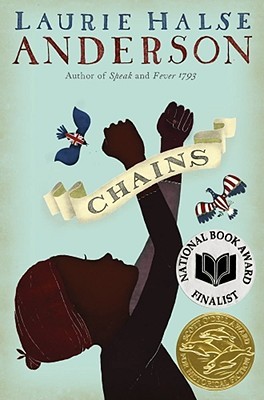
Chains by Laurie Halse Anderson is the first in a series of books set during the American Revolution, and Isabel is a young slave who must care for herself and her sister, Ruth, after the death of their mother and their owner.  She quickly finds that the things she had been promised by their owner do not come to pass, and she must prepare herself for new and more harsh owners, the Locktons.  In her new household in New York, where the Locktons have settled from England, she finds that her chores are many and grueling, but that her sister has garnered the special attention of Mrs. Lockton, who dresses her as a doll and requires her to be silent at all times.  New York also is where she meets Curzon, a young black boy working on the side of the rebels, for whom he hopes she will provide intelligence from the Lockton household.

“The bees swarmed again behind my eyes, making the scene grow dim and distant.  The sun was nearing the horizon, casting long shadows across the wharf.  I was a ghost tied to the ground, not a living soul.”  (page 182)

Isabel soon learns that both the British and American rebels are willing to use slaves as they see fit and promise them freedom they have no intention of granting.  Anderson’s young adult novel deftly balances the cruelty of slavery with the sensibilities of young adults, ensuring that the abuse and cruelty is never more than young readers can handle. However, there are some instances that do become graphic, but it is essential to demonstrate the fates that faced a number of slaves, especially those who attempted or even thought about escaping their masters.  Moreover, she easily demonstrates the excess and perfidy of the war and its opposing sides, as the British throw balls in honor of the queen at the same time the rebels are struggling to feed themselves.

“And then, the final triumph.  She used a tiny brush to paint a thin line of glue above each eye.  Madam opened an envelope and shook out two gray strips of mouse fur, each cut into an arch.  Leaning toward the mirror, she glued the mouse fur onto her own eyebrows, making them bushy and thick as the fashion required.”  (page 207)

Chains by Laurie Halse Anderson is the first in a series, and it ends with a wide open ending in many ways, but at least some of the issues are resolved.  Anderson brings to life not only the issue of slavery, but also of the opposing sides in the revolution and the confusion it brought with it on the battlefield and in the cities not immediately touched by the war.  The confusing reports, the captured cities, the changing of power, all of it comes to life.

About the Author:

Laurie Halse Anderson is the New York Times-bestselling author who writes for kids of all ages. Known for tackling tough subjects with humor and sensitivity, her work has earned numerous American Library Association and state awards. Two of her books, Speak and Chains, were National Book Award finalists. Chains also made the Carnegie Medal Shortlist in the United Kingdom.

Laurie was the proud recipient of the 2009 Margaret A. Edwards Award given by YALSA division of the American Library Association for her “significant and lasting contribution to young adult literature…”. She was also honored with the ALAN Award from the National Council of Teachers of English and the St. Katharine Drexel Award from the Catholic Librarian Association.

This is my 4th book for the American Revolution Reading Challenge 2013


This is my 60th book for the 2013 New Authors Challenge.