Quantcast

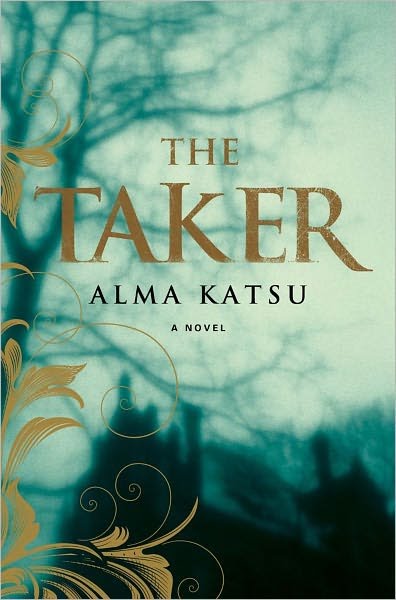
The Taker by Alma Katsu

Alma Katsu’s The Taker has received a number of rave reviews and some unfavorable reviews, and it was recently listed in BookList’s Top 10 Debut books.

Lanore, “Lanny,” shows up in her northern Maine hometown covered in blood, and the police say that she has confessed to killing a man and leaving him in the frozen woods.  ER doctor, Luke Findley, becomes the recipient of a Gothic fairy tale that is more dark and sinister than full of fairy dust, unless that fairy is an evil alchemist and sodomite.

“The stranger had appeared suddenly, at the edge of the gathering that evening.  The first thing Adair noticed about him was that he was very old, practically a shrunken corpse leaning on his walking stick, and as he got closer, he looked older still.  His skin was papery and wrinkled, and dotted with age spots.  His eyes were coated with a milky film but nevertheless had a strange sharpness to them.  He had a thick head of snow white hair, so long that it trailed down his back in a plait.  But most notable were his clothes, which were of Romanian cut and made of costly fabrics.  Whoever he was, he was wealthy and, even though an old man, had no fear of stepping into a gypsy camp alone at night.”  (page 162)

The Taker is a story within a story, within a story, spanning from the dark ages through the present day, and Lanny claims to be immortal, but do not be mistaken into thinking she’s a vampire or werewolf.  She is neither.  Her unrequited love for the town pretty boy, Jonathan St. Andrew, is the main crux of the story and how it brings about her downfall that leads to her life as an immortal.  Katsu spoke recently at Novel Places about the book and revealed that the story of Pinocchio is the backbone of her novel, which is clear in how the desire to grow up and become a woman with her own life separate from her family propels Lanny to be easily led astray.  However, that is where the similarity ends.  Katsu’s novel is ripe with sodomy, rape, kidnapping, murder, and more, which is why it would be a perfectly dark book to read this season as Halloween approaches and is what would once have been considered horror (rather than the popular category of paranormal, which has a “lighter” tone to it).

Lanny tells her story to Luke in the present day, but a more effective approach would have been to have her merely tell her story to the reader.  As many know story framing or using one character as a plot device for another character to tell his/her story is bothersome if the character/plot device is not well developed.  While Luke does have a back story here, it fails to round out the character enough, leaving him flat and boring compared to the characters of Lanny and Adair.  Even Jonathan is little more than a caricature of the pretty boy of the town’s founders, and it would have served to have more of him and Lanny’s interactions in the book at the beginning of their “romance” to demonstrate their affection for one another.  However, being told from Lanny’s point of view, it is incredibly difficult to demonstrate Jonathan’s perspective on their relationship and oftentimes he comes off as a callous womanizer who is incapable of love.

With that said, however, Katsu is adept at time shifts within the story that keep the pace of the novel moving quickly.  Moreover, she creates a deeply atmospheric novel where readers are combing through the mist to grasp the truth of Lanny’s story and to unravel the mystery of her immortality.  Some have said this is a romance; it is not.  Most will debate who is “The Taker,” but there is certainly more than one, and it will depend on your personal perspective as to which you believe is the taker.  They all are takers in their own way — taking what love and affirmation they can, taking the loyalty of others by forcing their hands, and taking pleasure in the act of taking.  Readers who shun violence in books, particularly against women should steer clear.  Katsu’s The Taker is dark and decadent; an excellent debut novel for those looking to tantalize their darker senses with interminable consequences.

Stay tuned for the next two books in this series; I know I will be waiting on the edge of my seat. I’m always on the lookout for horror books, as I’ve grown tired of EMO vamps and werewolves.

For a chance to win my gently used ARC (which has a signed bookplate), please visit this post about Alma Katsu’s reading near me.  If you’re looking for another bonus entry, leave a comment on this review.
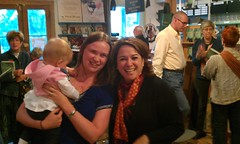
Alma Katsu (right) Me & Wiggles

About the Author:

Alma Katsu is a 30-year DC veteran who lives in two worlds: on one hand, she’s a novelist and author of The Taker (Simon & Schuster/Gallery Books). On the other hand, she was a senior intelligence analyst for CIA and NSA, and former expert in multilateral affairs.  Watch the book trailer or this one.
 

This is a stop on The Literary Road Trip since Katsu has worked in Washington, D.C., and now resides in Virginia.


This is my 61st book for the 2011 New Authors Reading Challenge.
Out of Breath by Blair Richmond

Out of Breath by Blair Richmond is a young adult novel that will have readers quickly turning the pages to find out what secrets Kat Jones is hiding and why the town of Lithia where she ends up seems so ethereal and mysterious.  Kat arrives in Lithia, where she was born, after running from something that happened in Texas, and everyone in the town is incredibly friendly and welcoming.

Richmond’s sparse narration, plus the focus on running races, ramps up the suspense as Kat’s secretive nature enables her to blend in and adopt a new life.  However, this new life quickly becomes more than she can handle, enticing her to strap on her running shoes and get out of town fast.  She’s a young woman who’s budding college life is cut short, and she turns to the only activity — running — that gives her solace to escape.  A vegan in a town of tree huggers and other like-minded nature and running enthusiasts, Kat is at home and relatively at peace.  However, the rivalry between Roman and Alex and their secrets threaten to disturb the tenuous life she’s starting to build.

“Since I was eight years old I’ve been a runner.  Not a jogger.  A runner.  I was always the fastest girl I knew, and, during junior high, was faster than any boy I knew.  I ran cross-country in high school and I won state during my junior year.  A scholarship to a major college seemed all but inevitable until my dad backed the car up over my left foot the summer before my senior year.  It’s funny how quickly dreams can be crushed.  Just as easily as my left foot.”  (page 3)

Like many other young adult novels on the market, Out of Breath has a touch of the paranormal — vampires and ghosts — but there is an unexpected twist here.  Vampires are actually dangerous, and certain vampires have quirky eating habits.  The ghosts play more of a role in the latter pages, and likely even more of a role in the other two planned books for the trilogy.  Yes, this is the first in a series — a series that focuses on nature, saving the environment, and vegan/vegetarianism.  Although the vegan/environmental angle can be heavy handed at times when Roman and Kat converse, it serves a purpose for the plot and can be overlooked by readers that may feel as though Kat is preaching to them.

Out of Breath by Blair Richmond is an eerie novel that takes a look at the consequences of our actions and how we cannot right the wrongs of the past, but only  strive to change our futures.  Readers will enjoy the mix of paranormal, young adult coming of age story, romance, and suspense mixed with a theme of environmental conservation and appreciation.  Even better is that unlike other trilogies, Richmond’s novel does not leave the reader with a major cliffhanger, but provides a modicum of resolution and leaves the reader with a stronger version of Kat.  An intriguing mix of themes and characters that creates a mystical world in the forest anchored in the reality of today’s environmental concerns.

About the Author:

Blair Richmond is the pen name of a writer living in the Northwest, where OUT OF BREATH is set. She is currently working on THE GHOST RUNNER, the second book in the trilogy featuring Kat and the mysterious town of Lithia.

Ashland Creek Press is hosting a Halloween virtual book launch party with an author Q&A, book giveaways, and more.  Mark your calendars


This is my 60th book for the 2011 New Authors Reading Challenge.

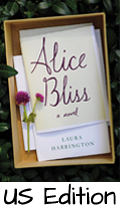
Alice Bliss by Laura Harrington

Alice Bliss by Laura Harrington is a coming of age story about a teen girl growing into adulthood at a time when her father, Matt, is sent to Iraq and her mother, Angie, is not dealing with his absence as well as Alice thinks she should.  The blissful life her family has had up until this point is turned around and twisted as Alice takes on more of her mother’s duties — making dinner, washing clothes, getting her sister’s (Ellie) lunch ready, and getting her sister to school.  She’s constantly worried about her father not returning home, about how she seems not to be anyone’s favorite, and the changes she sees in her friends, family, and Henry (her neighbor and friend).

Harrington creates a world and cast of characters that grab your heart and don’t let go.  The Bliss family story will have your tearing up right from the beginning when the father is first setting his affairs in order and explaining to Alice what she’s to do while he is at war.  Yes, he says, he is coming back, but readers know about the uncertainties of war and so does Alice, which makes his parting all the more heart-wrenching.  Alice only finds solace when running, like her mother finds solace when swimming, but they are too alike to find comfort in one another and often find themselves at odds.  Dynamic characters young and old tackle difficult questions of how to go on without a loved one, who often calmed the waters and even when that situation is expected to be temporary.

“This is the first time Alice has been allowed to walk back to their campsite from the Kelp Shed alone.  She is fourteen, barefoot, her sneakers tied together by the laces and slung across her shoulder so she can feel the soft, sandy dust of the single-track road between her toes.  Her sister fell asleep halfway through the square dance, dropping from hyperexcited to unconscious in a flash.  Her father carries Ellie draped over his shoulder, and casually, or so it seems, her mother says, ‘Come home when the dance is done.'” (page 1)

While Alice is a strong, young woman, she is also timid when it comes to her changing relationship with Henry and volatile when it comes to her relationship with her mother and sister and her schoolmates.  Alice’s life spirals out of control while she’s daydreaming and running away, but there are moments of hope when letters arrive and broken up phone calls pepper their days.  Alice is growing up before readers’ eyes.  She’s learning that her friendship with Henry is more complicated than she expects and at a time when she wants it to stay the same.  She’s flattered when a popular senior asks her to a baseball game, and she’s disenchanted with high school society when her childhood friend Steph remains distant even when it is obvious she needs someone to lean on.  Her sister Ellie tries to act more mature than her sister, and does on some occasions, but she’s still just eight and what’s important to her — a new haircut, new clothes, a nice lunch — skirts the realities of their lives without Matt.

Uncle Eddie and Gram are the rocks of the family that help hold up Angie, Alice, and Ellie — keeping them from imploding.  Harrington has created a wide cast of characters who evolve steadily throughout the novel.  Despite the third person omniscient point of view, Harrington’s narrative evokes an emotional connection between the characters and the reader.  The distance often felt with this point of view is not present here in the least.  Readers will feel the loss, the waiting, the anger, the sadness, and the confusion all at once — just as the characters do — while cheering them on to remain positive that Matt will return home.  This is a young adult novel adults will praise for its realistic portrayal of adult themes, while young adults will praise the relate-ability of its teen characters and their situations.

“Even though Mrs. Grover wears those awful sensible shoes and has gray hair that she wears in a bun, Alice thinks that maybe Mrs. Grover is still young in the ways that are important.  Like she’s not so serious all the time, and she sings and right now she’s teasing a cardinal.  Whistling in response to its call and damn if that cardinal doesn’t whistle right back.  Alice’s mother doesn’t even have a clothesline, let alone stand outside and lift her face to the sun and sing and whistle to the birds.” (page 101)

Harrington is talented at creating a world that is real — a small town where everyone knows one another and feels as though they are under a microscope at home and school — and generates an atmosphere of fear and uncertainty — in the silence of waiting.  What are those keepsakes that we hold dearest? What are those memories that we hold onto tightest? Alice and her family find these answers and more, making the novel even more suspenseful.  Alice Bliss not only tracks the evolution of Alice from child to adolescence and the bumps along the way, the novel teaches readers about heartache, compassion, and strength.

About the Author:

Laura Harrington’s award winning plays, musicals, operas, and radio plays have been widely produced in the U.S., Canada, and abroad. Harrington is a two time winner of the Massachusetts Cultural Council Award in playwriting and a two time winner of the Clauder Competition for best new play in New England for Mercy and Hallowed Ground.

“Alice Bliss”, a novel, published by Pamela Dorman Books, Penguin/ Viking, will be on sale spring 2011. She is currently writing a new novel, “A Catalogue of Birds,” as well as a song cycle with composer Elena Ruehr, and a series of choral works with composer Roger Ames. Ms. Harrington teaches playwriting at M.I.T and is a frequent guest artist at Tufts, Harvard (where she was a visiting Briggs Copeland Lecturer), Wellesley, University of Iowa, and other campuses.

Please also check out this great Q&A, an excerpt from the novel, and her blog.


This is my 59th book for the 2011 New Authors Reading Challenge.


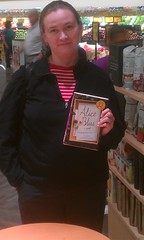
Alice blissI took part in the experiment to see where this book would end up once I read, reviewed, and released it into the world.  So, here’s a picture of me releasing it into the wilds of Maryland (Ok, its a Safeway/Starbucks Cafe).

I toyed with releasing it in a bookstore, at the library among the library sale stacks, and finally decided to release it in the Safeway near my house in their Starbucks Cafe.  It was done surreptitiously and I was incredibly self-conscious.  Nevermind that this is a book I really didn’t want to let go because I loved it so much.

I may just have to buy my own copy of this book to add to my shelves and read it again.  It was THAT GOOD!


Does the Noise in My Head Bother You? by Steven Tyler With David Dalton

Does the Noise in My Head Bother You? by Steven Tyler with David Dalton is my first rock n’ roll memoir.  Steven Tyler, lead singer for Aerosmith, always struck me as very Bohemian, and he even says as much in his memoir.  Readers will be surprised to find that the memoir is Steven Tyler telling his story and not some writer’s idea of what his story should sound like.  It’s not prettied up.  As the pages turn, readers will find that Tyler remembers a great many details, even street names and house/apartment numbers.

(Aerosmith was considered a Boston band, and many were thrilled when the band set up Mama Kin Music Hall.  The band was often considered the bad boys of Boston, and the closure of the club caused some angst among followers who felt the band had snubbed its nose at the hometown.  But I digress.)

There is a no-holds-barred quality to the writing and the story in this memoir, but that’s just how readers would want it.  From his early influences of piano played . . . more like breathed . . . by his father to his drug use and religious upbringing as a Bronx native who summered in New Hampshire, all sides of Steven Tyler are exposed.  His childhood seemed pretty typical for any boy with artistic parents, with summers in the country, a love of animals, hunting and fishing, and being overzealous about girls and just about everything.  His family moved to Yonkers and he was enrolled in a private school.

Tyler’s memoir is a bit of back and forth as memories seem to crop up and send him off in new directions, but readers will get a good sense of how he is on a daily basis with this kind of narration.  Drinking, drugs, and girls are his main vices, but the music is a constant as he jams with his father’s band as a young teenager on drums and eventually grows into his own as a musician.

Tyler loves capitalizing words for emphasis and he does “talk” to himself from time to time.  Readers put off by swears and other vulgar language may find the memoir to gritty, but for a rock n’ roll artist, what else can be expected.  An unexpected surprise throughout the book are snippets of poems, though it is not clear when exactly they were written or why.  Readers also will learn about musical terms from dissonance to fifth notes, etc.

Does the Noise in My Head Bother You? provides readers with an inside look at what it means to be a rock musician, what makes them great at what they do, and how they can maintain their success over the long term in spite of the downfalls and obstacles they face.  Steven Tyler offers more than just an inside look at his life; he’s offering an inside look at music, artistry, and the drive to succeed along the way.


This is my 58th book for the 2011 New Authors Reading Challenge.


Seeking help at a drug abuse treatment center is necessary for people who have been abusing drugs for a long time.

The Chameleon Couch by Yusef Komunyakaa

The Chameleon Couch by Yusef Komunyakaa — broken into three sections — challenges the mind and the internal rhythm of our souls.  It challenges our preconceptions about everything from music to what it means to be an African American.  In the form of aubades and odes, Komunyakaa evokes song throughout the collection, which have readers very focused on how the rhythms of the poems impact them beyond the words spoken.  The poet is striving to reach not only the logical mind here, but something deeper, ethereal, like a soul.

There are allusions in this volume that are religious, musical, and mythological, but these do not detract from the poems’ power.  “Kindness” (page 28), is one of the most dense poems in the collection, filled with a number of allusions including the consumption of salt as a sign of friendship.  However, even if not all the references are clear at first glance, it is clear that kindness is often recognized even in the bleakest of moments and in the darkest of places even if someone has been a “stranger” to it.

There are a range of emotions and thoughts in this collection, the narrator of these poems changes like the lizard, adapting to the moment and blending into the environment he finds himself in. The cover is reminiscent of the dark jungle of our lives as we try to navigate our way sometimes in the shadows for the silence of observation, but oftentimes to hide from the actions and decisions we have made or are frightened of making.  Meanwhile, other decisions seem inevitable and natural.

Excerpt from:  Conceived in a Time of War (page 37)

Because your mother & father kissed
beneath a hail of Roman candles,
you crawled out of one thousand
tiny deaths, stubborn as aster
in stony clay.  A goddess of dawn
scooted under a zing of barbed wire
to witness your birth. . . .

Komunyakaa’s poems have a musicality equivalent to Jazz.  “Jazz has space, and space equals freedom, a place where the wheels of imagination can turn and a certain kind of meditation can take place.  It offers a meditational opportunity,” he once said.  His poems are just like this, providing moments of pause, allowing readers to interact with the lines and images.  “How many ghosts followed us/into the basement to Muniak’s bepop gig/to hear the saxophone argue with the piano?/” from “Aubade at Hotel Copernicus” (page 33-4).

Komunyakaa is paying homage to all forms of the human spirit — good or bad — in The Chameleon Couch, but the poems are never indifferent. In “A Translation of Silk” (page 17), “One can shove his face against silk/& breathe in centuries of perfume/on the edge of a war-torn morning/where men fell so hard for iron/they could taste it. Now, today,/a breeze disturbs a leafy pagoda/printed on slow cloth. A creek/begins to move. His brain trails,/lagging behind his fingers to learn/suggestion is more than radiance/” Some poems are about the legacy we leave behind, the anger about historical events like the Holocaust, and the quieter moments each of us shares with our lover or family. Another extraordinary candidate for the 2011 Indie Lit Awards and the “best of” list.

Also please check out the poem from this collection that I featured in the 117th Virtual Poetry Circle.

About the Poet:

Yusef Komunyakaa is an American poet who currently teaches at New York University and is a member of the Fellowship of Southern Writers. Komunyakaa is a recipient of the 1994 Kingsley Tufts Poetry Award, for Neon Vernaculaand the 1994 Pulitzer Prize for Poetry. He also received the Ruth Lilly Poetry Prize. Komunyakaa received the 2007 Louisiana Writer Award for his enduring contribution to the poetry world.

His subject matter ranges from the black general experience through rural Southern life before the Civil Rights time period and his experience as a soldier during the Vietnam War.

This is my 26th book for the Fearless Poetry Exploration Reading Challenge.

Waking by Ron Rash

Waking by Ron Rash — a collection of poems broken up into five parts — and the cover’s barren landscape with its snowed in vehicle is a perfect depiction of the desolate landscape presented in the first selection of poems.  From “Woodshed in Watauga County” (page 7) “as mud daubers and dust motes/drifted above like moments/unmoored from time, and the world/” and from “Junk Car in Snow” (page 8), “No shade tree surgery could/revive its engine, so rolled/into the pasture, left stalled/among cattle, soon rust-scabs/”   Rash does desolation and emptiness well, but he also just as easily paints vivid imagery reminiscent of lucid dreams and the lingering impression of those dreams during the stages of waking.  In “Milking Traces” (page 5), “those narrow levels seemed like/belts worn on the hill’s bulged waist,/if climbed straight up, tall steps for/stone Aztec ruins–though razed/”

In section two, many of the poems focus on farming and the hard work that comes along with cutting through the wilderness to build a life.  In many ways, this could be construed as the cloudy ascent from sleep or the struggle of growing up from childhood into adolescence and adulthood.  Each journey can be arduous, but the destinations can be well worth the struggle or so Rash’s poems suggest.  In “Pocketknives” (page 18), “vanity of men caught once/when dead in a coat and tie,/so ordered from catalogs,/saved and traded for, searched for/in sheds and fields if lost, passed/father to son as heirlooms,/like talismans carried close/to the bone, cloaked as the hearts/”  But there is a subtly to the hope in these poems.

Each poem in this collection relies heavily on nature imagery and the suppositions the poet makes, and Rash seems to be reflective and regretful in some, while content and accepting in others.  Many of these poems can weigh heavily on the reader, especially if read in sequence.  The prologue poem really sets the tone for the collection, which can fulfill a dreary day or provide a modicum of solace for those who are feeling reflective.  The poem suggests that readers pause, reflect on their lives and moments with family and friends to see the true nature of them rather than rush through daily activities and becoming absorbed in the mere movement of life.

Resolution (page xi)

The surge and clatter of whitewater conceals
how shallow underneath is, how quickly gone.
Leave that noise behind.  Come here
where the water is slow, and clear.
Watch the crawfish prance across the sand,
the mica flash, the sculpen blend with stone.
It's all beyond your reach though it appears
as near and known as your outstretched hand.

Waking by Ron Rash is a solid collection of poems that shifts between reality and dreams and nostalgia and how things are.  Readers interested in the Southern traditions and culture will see a brighter presence of the majestic mountains and sparkling rivers.  They will see nature as it is and how southerners interact with it and build lives from the frontier that still exists.

About the Poet:

Ron Rash is the author of three prize-winning novels: One Foot in Eden, Saints at the River, and The World Made Straight; three collections of poems; and two collections of stories. A recipient of the O. Henry Prize, he holds the John Parris Chair in Appalachian Studies at Western Carolina University.

This is my 25th book for the Fearless Poetry Exploration Reading Challenge.


This is my 57th book for the 2011 New Authors Reading Challenge.

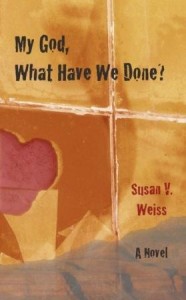
My God, What Have We Done? by Susan V. Weiss

Normally, I’ll write up my own summary for a book, but this week has been hectic, so I’ll provide you with summary from Amazon:

“In a world afflicted with war, toxicity, and hunger, does what we do in our private lives really matter? Fifty years after the creation of the atomic bomb at Los Alamos, newlyweds Pauline and Clifford visit that once-secret city on their honeymoon, compelled by Pauline’s fascination with Oppenheimer, the soulful scientist. The two stories emerging from this visit reverberate back and forth between the loneliness of a new mother at home in Boston and the isolation of an entire community dedicated to the development of the bomb. While Pauline struggles with unforeseen challenges of family life, Oppenheimer and his crew reckon with forces beyond all imagining. Finally the years of frantic research on the bomb culminate in a stunning test explosion that echoes a rupture in the couple’s marriage. Against the backdrop of a civilization that’s out of control, Pauline begins to understand the complex, potentially explosive physics of personal relationships. At once funny and dead serious, My God, What Have We Done? sifts through the ruins left by the bomb in search of a more worthy human achievement.”

My God, What Have We Done? by Susan V. Weiss combines two seemingly divergent topics under one roof — a marriage and the making of the atomic bomb — and readers get to watch it build to a crescendo and explode.  Told in first person point of view, readers get a real taste for how obsessed Pauline is with Oppenheimer, so much so that her honeymoon with Clifford is spent in Los Alamos where the atomic bomb was created.  This is where readers first meet them, and may be stunned by the emotional distance between the newlyweds.  As the story begins unfolding, Pauline continues to exhibit emotional distance, as if she is disconnected from her feelings and every moment of her life must be plotted and thought out thoroughly before she acts.

The stories of Pauline and Clifford’s marriage and how it builds is in parallel to the third person POV tale about the building of Los Alamos and the atomic bomb.  While Weiss uses an interesting premise, particularly the bomb itself to signify the creation of relationships and families and their destruction, the first person POV of Pauline’s life is more captivating.  She’s pulled between her desires to be a wife and mother and her old life, feeling a disconnect from her friends and life in Philadelphia, but there is a greater desperation within her.

“Although I envied his serenity, I sometimes wished I could get him to grab onto some of my challenges, to declare himself, to fight back.”  (page 12)

While Clifford is often compared to Oppenheimer by Pauline for his angular facial features and his bookish intelligence, she acts more like the scientists as she parents her son.  Like the atom bomb they created to end the war — all wars — Jasper is an experiment to be tinkered with and nurtured.  Readers will often question Pauline’s emotional state and whether she has the depth necessary to care for a child, herself, and her husband.  She’s an enigma, much like Oppenheimer was.  Readers easily find the parallels in this narrative, but Weiss’s characters appear to be more like caricatures of people, rather than complex human beings.

My God, What Have We Done? by Susan V. Weiss is an attempt to draw wider conclusions about logically minded people, and will prompt readers to self examine.  However, the struggle through the shifting points of view and story lines may bog down some readers’ enjoyment of her tale.  Ultimately, the premise was unique, and the struggle of a new housewife was interesting, but the Oppenheimer sections were a bit dry and read like a laundry list of encounters rather than a fictionalized account of true events.


Please check out the rest of the stops on the TLC Book Tour by clicking the tour host icon at the left.


About the Author:

Susan V. Weiss is a writer and a teacher who lives in Burlington, Vermont. Her stories have appeared in literary magazines and anthologies. In addition to teaching adult literacy and expository and creative writing, she has initiated community-outreach writing projects for offenders, refugees, and homeless people.


This is my 56th book for the 2011 New Authors Reading Challenge.

Around Germantown (MD) Then & Now by Margaret Coleman

Around Germantown (MD) Then & Now by Margaret Coleman takes a look at what Germantown was like before 1980 and what it was like after the Maryland-Nation Capital Park and Planning Commission adopted the area.  Coming from Massachusetts where many of the towns are older than the actual state and older than the United States, I had no idea that towns/cities were actually planned out ahead of time.  I really thought that they just came about when people started settling into an area and the businesses just cropped up naturally to service those people.  Silly, me.

Germantown, Md., is made up of six villages and the heart of the city has been moved a couple of times as populations and transit projects changed.  My husband and I looked at this book together and I told him we must have been destined to move here, since some of the founding families have the same last name as those of the town we grew up in.  The town also was settled by German farmers in addition to the English farmers already here.

We really enjoyed the photos of places that were and what they came to be, though it saddened us that so many of the original historic structures in the town had burned (on purpose or accidentally) and were not restored and of those that were restored were moved to other locations.  Unfortunately, progress seems to be the mainstay of this town as historic homes have been replaced by gas stations and other signs of commerce.  The tone of the book doesn’t seem as maudlin as I do about it, however.

Around Germantown (MD) Then & Now by Margaret Coleman is an interesting peak into the history of this town, its people, and its growth over the years.  I’d recommend it to locals interested in the area they have moved to or to those who have lived here but know little of its history.  I’ve always enjoyed these types of books even if I don’t live in the areas discussed.  The inclusion of photos of places then and now rounds out the story.

This is my 55th book for the 2011 New Authors Reading Challenge.

She by Saul Williams

She by Saul Williams is a collection of interconnected musical poems coupled with a collection of images from Marcia Jones that tells a story about a woman and their journey together.  On his Website, he says, “This book chronicles my thoughts and feelings as a young man working through an early relationship with an amazing visual artist as we embark on adulthood and parenthood in the same breath.”

Each of Williams’ poems has a unique rhythm to it, and should be read aloud for effect.  Each is as expressive as you would expect Williams to be in real life, becoming an extension of himself and his digital, visual, and audio art.  Unlike other collections, Williams’ She is a story beginning to end with a prologue and epilogue and prose poetry.  The nameless She is integral to the journey, a connection to the past and the future, illustrated through short lines and “out loud” cadence that screams to be read aloud.

While readers could dip in and out of the collection and experience it in small chunks, it is best to read it cover to cover to grasp its full impact. Tackling issues of separatism, aging, and opposing desires, Williams pinpoints the harshest of realities and deals them a deft blow when he demonstrates the commonalities between us all. Because these poems do not have titles, the clear intent is to create a continuous narrative in which “calamity makes cousins of us all” (page 22) and “we live.” (page xi)

Nature imagery and personification can make the issues more vivid, “there is a gathering in the forest. the leaves have refused to change. they say that they are tired of things never remaining the same, of dying to be reborn, of winter’s dry withered hand.” (page 7) But lest the images become to heavy, there are moments of whimsy as well.

I have seen the truth
many times
but for the first time
she saw me

I wore suspenders
for the judgment
in my pants

(page 13)

As the relationship goes down hill, readers will not a dramatic change in the poems as the narrator struggles to let go for the sake of love. “I am a canvas/painted over/whether it be by your hand/or mine own.” (page 113) The images included in the book are unusual and appear to mix mediums, and often resemble pages from a scrapbook that a mother would keep of her children. In a way these pages resemble Williams’ play on words as he picks them apart and alters their definitions to explain the moment he is in.

Reading She alone in a room is not enough. It should be read aloud, shared with others, and most who pick up a copy will do just that. Seeing Saul Williams read it would make it even better, but its up to you to find out where he’s reading or performing next. There is not enough that can be said about this collection, except go read it!

Some reason Saul reminds me of Don Cheadle in this photo.

About the Poet:

Saul Williams is an American poet, writer, actor and musician known for his blend of poetry and alternative hip hop and for his leading role in the 1998 independent film Slam.

From Wikipedia about Williams and Marcia Jones’ relationship:

Williams and artist Marcia Jones began their relationship in 1995 as collaborative artists on the Brooklyn performance art and spoken word circuit. Their daughter, Saturn, was born in 1996. His collection of poems S/HE is a series of reflections on the demise of the relationship. Marcia Jones, a visual artist and art professor, created the cover artwork for The Seventh Octave, images through-out S/HE in response to Williams, and set designed his 2001 album Amethyst Rock Star.

This is my 24th book for the Fearless Poetry Exploration Reading Challenge.


This is my 54th book for the 2011 New Authors Reading Challenge.

Buoyancy and Other Myths by Richard Peabody

Buoyancy and Other Myths by Richard Peabody is a slim collection that gets at the heart of family drama broken into three parts:  Shooting Myself in the Foot, Kissing Games, and Between Funerals.  The narrator in these poems ages and matures from a young boy eager to help his father but afraid of falling short to an older man similarly worried about falling short, but more accepting of reality.

Unlike the young man in “Family Secrets” who is shaking sense into his brother, the man in the latter poems, like “Orbits,” comes to the realization that the past cannot be hidden and regrets do nothing but hold you back.  You must roll with the punches.  What is striking in some of these poems is the calmness of the narrator, even as violent thoughts or actions are being displayed.  For instance, in “Family Secrets” (page 11) — which is a powerful way to start a collection — “Music isn’t enough tonight./Scratching, clawing, eyes like stones./If I erase him I will expand./His sins wiped clean. Nowhere/for him to leer from. No perch/or receptacle that can hold that/particular weight. He gives up./”  Is his brother still living and he wishes that he didn’t have to remember him or is it what happened to his brother that he does not wish to remember and it would be easier to erase him entirely?

Nearing the end of the collection, it seems as though this narrator has found peace or at least outwardly demonstrates contentment, or is it resignation?  In “I Live Behind a Bakery” (page 55-6), “Only most days/it’s easier/to just read a book/with that smell/all around me/and think buttery thoughts.//”  Peabody has a lot of cutesy ideas that he plays with in his poetry, like living behind a bakery or dating vampires, but these images are metaphors for other things like the contentment that you find in the simple things of life or even in the relationships you have.  However, there is an undercurrent in these poems urging readers to move beyond contentment, leap into more dangerous and possibly fulfilling territory.

Guitar Player (page 36)

Fingers know secrets
that eyes can’t understand.

While not all the poems are memorable or strong, there are a few gems within the collection’s pages that are worth reading more than once. Some are simply powerful in a few lines. Buoyancy and Other Myths by Richard Peabody explores the nature of relationships and how they propel us to greater things to seek out new directions and yes, to grow.

About the Poet:

Richard Peabody, a prolific poet, fiction writer and editor, is an experienced teacher and important activist in the Washington , D.C., community of letters. Peabody is the editor of Gargoyle Magazine (founded in 1976), and has published a novella, two books of short stories, six books of poems, plus an e-book, and edited (or co-edited) nineteen anthologies including: “Mondo Barbie,” “Conversations with Gore Vidal,” “A Different Beat: Writings by Women of the Beat Generation,” and “Kiss the Sky: Fiction and Poetry Starring Jimi Hendrix.” Peabody teaches fiction writing for the Johns Hopkins Advanced Studies Program.

This is my 23rd book for the Fearless Poetry Exploration Reading Challenge.


This is my 53rd book for the 2011 New Authors Reading Challenge.


This is a stop on The Literary Road Trip since Richard Peabody is a local Washington, D.C., area poet.

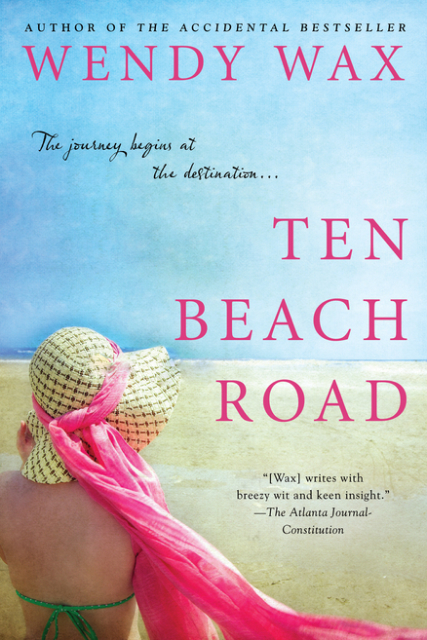
Ten Beach Road by Wendy Wax

Wendy Wax has an excellent beach read with substance in Ten Beach Road for those of you looking for an end of summer winner.  Ripped from the headlines, these three women find that their only remaining asset is a rundown beach house (Bella Flora) in Florida after Malcolm Dyer — aka Bernie Madoff — stole their life savings.  Madeline’s life has been flipped upside down when she realizes her investment advising husband not only lost his clients’ money in a giant Ponzi scheme perpetrated by Dyer, but also that of his family.  Meanwhile, Avery has discovered that her father’s estate was similarly lost just as her stint as a co-host of Hammer and Nail on HGTV as her ex-husband edges her out with his elbow.  Nicole’s situation is a bit different because she had a personal connection to Dyer and her trust was more born of that loyalty than a financial desire, which makes her financial crash all the more crushing.

“‘Yes, it’s a fine old home,’ the Realtor said as if their surprise had been of joy.  ‘And as you’ll see a large portion of it has been renovated.  It just needs a little tender loving care.’

‘More like hospitalization,’ Nicole said.  ‘Or a team of paramedics.'” (page 56)

Add to the mix, a former childhood male friend, Chase, who had the perfect family life that Avery wanted and an FBI agent, Giraldi, stalking Nicole and looking for Dyer, and you’ve got a bit of mystery and sexual tension.  Wax has a down-to-earth sense of humor that livens up the playful interactions of three strangers, who soon become friends offering advice and support as they deal with family drama.  Her characters are varied and out to prove themselves to one another, their families, and everyone else, demonstrating their strengths and hiding their weaknesses as best they can.  Avery is the degreed architect portrayed on television as an airhead; Nicole is the bombshell who makes her living pairing up the rich and famous; and Madeline is the trunk of her family tree, the one that holds it all together just as the hurricane is set to rip everything apart.

“The army had spread out to attack different sections of the garden.  John Franklin sat on a camp chair that had been placed near the fountain, a smile on his face as he watched his wife command her battalion.

‘Mrs. Franklin wanted to get started before it got too hot,’ Avery said.  ‘I don’t think a single one of them is under seventy-five.  They’ll fill in with some new plantings after the house has been pressure washed and painted.’

Nicole moved down the hall to peer out the rear windows above the loggia; that was the one advantage in being last in line — she didn’t need to hold on to her spot.  Only her bladder.  ‘Good God, that woman is climbing up that tree.  I think she’s got a . . . ‘

The whir of an electric saw drifted p to them followed by the crash of a limb landing on concrete.”  (page 237)

What makes this novel more than women’s fiction is the mystery of where Malcolm Dyer is and how tragedy can either pull families apart or bring them together.  Readers searching for a summer read to close out their holiday season should seriously consider Wendy Wax’s Ten Beach Road for its tropical locale — Florida — its hot men — Chase and Giraldi — and the triumph of its female leads as they find their inner strength and pursue their dreams of redemption.

This is my 52nd book for the 2011 New Authors Reading Challenge.

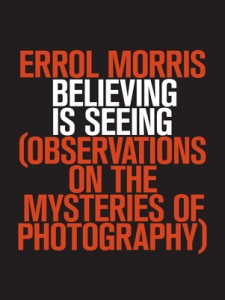
Believing Is Seeing by Errol Morris

Believing Is Seeing: (Observations on the Mysteries of Photography) by Errol Morris, a filmmaker, unravels the mysteries of documentary photography.  Why is Morris so skeptical about documentary photographs?  Does it relate to his deceased father and the secrecy around his role in the family or to his eye surgery as a child?  Beyond that, Morris seeks out factual evidence through testimony, history, and careful examination of light and contrast to determine the authenticity of photos and the stories behind them.

While some of the discussion and technical analysis of the Fenton photographs of the Crimean War can be a bit much for some readers, the conclusions drawn from these discussions are captivating.  Did Fenton stage the photo with the cannon balls on the road or did he not and which photo did he take first — The one with the cannon balls on the road or in the ditch?  When I first looked at the photographs, the one with the cannon balls on the road appeared to be a more powerful image, but then it appears to be staged because the balls are too evenly randomized.

“To use the familiar gestalt image of the duck-rabbit:  if we believe we see a rabbit, we see a rabbit.  If we believe we see a duck, we see a duck.  But the situation is even worse than the Gestalt psychologists imagined.  Our beliefs can completely defeat sensory evidence.”  (page 83-4)

Photographers often frame images in a way that captures the best of a scene, that’s the most aesthetically pleasing, and that provides the best lighting.  Moreover, photographers will take more than one picture of the same scene, if possible, and choose the best image to submit to magazines, etc.  They are framing the image we see regardless of whether readers realize it or not, but readers also are framing the scene and history.  Morris aptly titles this examination of photography “Believing Is Seeing” because each viewer’s beliefs, prejudices, etc., often frame their perspective when looking at a photograph.

Morris’ book is tutorial, historical, and poignant in how it examines photography, conjecture about photography and news articles, and human reactions to images.  My analytical brain was working overtime with this analysis, particularly when I got to the Abu Ghraib’s The Hooded Man.  One thing Morris clearly demonstrates is that each photo has a history or a context behind it, and without conducting appropriate research and background verifications, viewers and readers can draw the wrong conclusions.  In the discussion of The Hooded Man photo and the false identification of Ali Shalal Qaissi (called The Claw) as that man, two photos from two different perspectives are discussed, one taken by Sergeant Ivan Frederick without the flash that became iconic and one taken with a flash by Sabrina Harman.  While Qaissi is not the man in the iconic photo, Abdou Hussain Saad Falah (called Gilligan) is said to be that man, but in his testimony to the Taguba Commission he mentions a flash when his captors took his photo with the hood and blanket on.  So, is this telling us that he only remembers the flash and that maybe something happened between Frederick’s photo session and that of Harman’s, or is the flash more memorable because he was wearing a hood?

Believing Is Seeing: (Observations on the Mysteries of Photography) by Errol Morris is captivating from page one, and it will have readers, photographers, and more reassess their view of photography and history.  It raises questions about whether appropriate research was conducted, evidence collected, and correct facts appropriately used.  Like any good journalist or photographer, documents should include the facts of the moment, the event, and the context, and Morris’ book demonstrates that while many blame the 24-7 world in which we live for the slipshod journalism completed today, it has happened throughout the ages and may have less to do with technology and more to do with human nature and our desire to frame the story.  Photography is not the mystery here, it is the human mind and human behavior that is the mystery.  How are things cropped, framed, and modified to suit our purposes and why?  How can we as readers know that images and stories are modified to suit a specific purpose?  Morris suggests research, analysis, and skepticism, but also a curious mind bent on uncovering the truth.

About the Author:

Errol Morris is a world-renowned filmmaker—the Academy Award-winning director of The Fog of War and the recipient of a MacArthur genius award. His other films include Mr. Death, Fast Cheap & Out of Control, A Brief History of Time, and The Thin Blue Line.

Find out more about Errol Morris at his website, and follow him on Twitter.  Also there is this interesting interview from California Magazine.


Click the TLC Book Tours button to see the rest of the stops on the tour.


This is my 51st book for the 2011 New Authors Reading Challenge.