Quantcast

Dance Lessons by Áine Greaney

Dance Lessons by Áine Greaney is about the dance we play with our husbands, wives, in-laws, and our own parents as we strive to keep things amicable and not reveal too many of our own secrets, especially secrets we’re not comfortable with ourselves.  Sometimes, it is about the dance the characters play with themselves, balancing the truth and the lies.  Set in Boston, the North Shore, and mostly Gowna, Ireland, Greaney’s prose sways like a graceful dancer telling Ellen Boisvert’s (a young lecturer at Coventry Academy) story.  She learns that her Irish husband, Fintan, was not an orphan as he had told her, but has a mother still in Ireland, and there are many other secrets he never revealed to her while alive.

“Ellen has read this about nurses, psychotherapists, doctors.  Even the largest or most life-saving job boils down to its component pats, a roster of daily tasks.”  (page 132)

Despite Ellen’s desire to leave her husband, she stayed with him for more than a decade and never left him before he died in a tragic sailing accident.  Upon learning that she has a mother-in-law, she writes a letter to inform Jo Dowd of her son’s death.  After an eerie conversation with the woman and several ghostly dreams, Ellen decides to travel to Ireland.  Each step and each movement is part of a larger story, a larger existence.  Fintan’s life and decisions had more of an impact on those around him than he realized, from his mother to his one-time girlfriend and his current wife, Ellen.  Greaney’s story is not one just of grief, but of moving on, stepping out into the light and claiming one’s life back.

“It comes at night, that dagger-pain in the lower back.  It jolts her awake, then circles, snakes up to her shoulders.  You can bear anything, she tells herself, then tries to go back to sleep.  She reminds herself of all the pain, years and years of it, she has borne and borne well, without troubling a soul.  Giving birth.  And there were bee stings as a child.  Or once, years ago, in one of the upper meadows, a hay fork went straight through her foot.”  (page 53-4)

In death, there is a renewal, a new beginning, but people have to be willing to reach out and grab it.  Ellen, like Jo, has lived in the shadow of her sister, but unlike Jo, she is given the chance to excel to take a hold of the reins and steer her own destiny.  Greaney’s story is heartbreaking, heart warming, and as turbulent as the weather of Ireland and the human heart.  Readers also get a taste of the Irish hierarchy and the depressed economic times of the 1950s, and the influx of foreigners.  From jealousy and rage to pity and understanding, the range of emotions in Dance Lessons are reminiscent of the ballet and operatic pieces of some of classical’s greatest artists.

About the Author:

Born and raised in County Mayo, Áine Greaney is a writer and editor living on Boston’s North Shore. She is the author of the novel The Big House and the short story collection The Sheep Breeders Dance. In addition, she has written several award-winning short stories and numerous feature articles for the Irish Independent, the Irish Voice, Creative Nonfiction, and the Literary Review, among others.


This is my 2nd book for the Ireland Reading Challenge.


This is my 50th book for the 2011 New Authors Reading Challenge.

Mr. Darcy Goes Overboard by Belinda Roberts

Mr. Darcy Goes Overboard by Belinda Roberts reads like a campy “Lifestyles of the Rich and Famous” with its posh boutiques and yachts, and it is a parody of Jane Austen’s Pride & Prejudice.  In the seaside resort town of Salcombe, the Bennets are on vacation and their mother is thrilled to learn that Netherpollock has been bought by Mr. Bingley, an eligible bachelor.  The quest to marry off one of her daughters has begun, though the appearance of Mr. Darcy on the yacht, Pemberley, sours the first meeting as he considers Lizzy only tolerable.  All of this should very familiar to those who love Austen’s classic, but the story is more modern in its sensibilities and humor.

Roberts characterizations of Kitty and Lydia as in competition over dresses and boys, and Lydia’s “valley girl” attitude and use of “like” and “whatever” in conversation are welcome updates to the classic.  Humorously, the soldiers are now lifeguards in this story, and naturally, Lydia and Kitty are eager to become the “victims” in their training exercises.  Unlike the classic where their catty and flirtatious nature are subdued, Lydia and Kitty are more over the top as they become streakers at one gathering.

“The ordeal of a near drowning for the second time in one day had so shocked Mr. Collins that he was unable to stand, so Darcy was forced to carry him, in his arms, up the steps.  Physically, Mr. Collins succumbed like a baby to this mode of transport.  Mentally, however, he was quite alert and was not one to miss an opportunity.  Recovering slightly, he could see the closeness of the situation was the perfect moment for a little intimate conversation and proceeded to wrap his arms fondly around Darcy’s neck and to introduce himself.”  (page 84 of ARC)

There are moments of utter ridiculousness, and Roberts stays as true to the characters as she can in her wild rendition.  However, readers will note that her characterization of Mr. Bingley as a bit dim is outside the mark.  He cannot remember Mr. Bennet”s name correctly, and he continues to dig himself a hole when he talks of Jane’s various body parts in traction and how he will miss them, but she is still beautiful, though he doesn’t want her inconvenienced.

Readers looking for a story that is closer to the original will be disappointed, but if they are seeking a fun, parody of the classic, Mr. Darcy Goes Overboard is for them.  A quick light read to pick you up when you need it.

This is my 49th book for the 2011 New Authors Reading Challenge.

Here, Bullet by Brian Turner

Here, Bullet by Brian Turner, who served in the U.S. army for seven years after receiving his MFA and was a team leader for one year in Iraq with the 3rd Stryker Brigade Combat Team, won the 2005 Beatrice Hawley Award and was printed by Alice James Books — a nonprofit cooperative poetry press.  (The title poem, Here, Bullet,” was recently profiled in the Virtual Poetry Circle.)  The collection is broken down into four sections, and each section is preceded by a quote relevant to it, with some even quoting the Qur’an.  Turner is adept at illustrating the violence of war, but also the humanity that accompanies it.  From the startling nature of rockets going off over head to the silence of bullets as they enter the body, he provides a keen eye into how those instruments of war impact both sides of the battle equally psychologically, physically, and spiritually.

Soldiers who craft wartime poetry have generally either fallen into the category of using graphic violence to shock and awe the reader or using quieter imagery to bring about reader understanding about psychological impacts of battle.  There also are those that have political poems that are heavy on criticism or propaganda, but those would fall less into the wartime poetry category.  Turner combines both violence and peace in his imagery, but in a unique way that has violence silently creeping into the lines and shocking readers.  For instance, in “Eulogy” (page 20), readers may hardly notice the suicide of Private Miller because he takes “brass and fire into his mouth,” but once the birds fly up off the water by the sound, it is clear the brass and fire are from a gun.  While outright, violent images can be eye-opening for readers, the quiet power in some of Turner’s lines are that much more lasting.

From “Katyusha Rockets” (page 32), “Rockets often fall/in the night sky of the skull, down long avenues/of the brain’s myelin sheathing, over synapses/and the rough structures of thought, they fall/into the hippocampus, into the seat of memory–/where lovers and strangers and old friends/entertain themselves, unaware of the dangers/headed their way, or that I will need to search/among them.”  These poems not only pay tribute to soldiers on all sides, but the civilians, the heroes, and a soldier’s fears and his regrets.  Some poems are infused with deep sadness, while others are steeped in great pride.

Here, Bullet by Brian Turner and the title poem are a testament to war and all of its trappings.  Readers will enjoy the quiet power these poems hold and the deft hand with which Turner paints the humanity of both sides in war.  The collection also contains moments of observation that will have readers thinking about war in the greater context of our own “supposed” morality as espoused by the Bible and the Qur’an, noting in “Dreams From the Malaria Pills (Turner)” (page 46), “He knows the Qur’an and the Bible/have washed page by page to the shore,/their bindings stripped loose, their ink/blurred into the sea.//”

About the Poet:

Brian Turner is a soldier-poet who is the author of two poetry collections, Phantom Noise (2010) and Here, Bullet (2005) which won the 2005 Beatrice Hawley Award, the New York Times “Editor’s Choice” selection, the 2006 Pen Center USA “Best in the West” award, and the 2007 Poets Prize, among others. Turner served seven years in the US Army, to include one year as an infantry team leader in Iraq with the 3rd Stryker Brigade Combat Team, 2nd Infantry Division. Prior to that, he was deployed to Bosnia-Herzegovina in 1999-2000 with the 10th Mountain Division. Turner’s poetry has been published in Poetry Daily, The Georgia Review, and other journals, and in the Voices in Wartime Anthology published in conjunction with the feature-length documentary film of the same name.


This is my 48th book for the 2011 New Authors Reading Challenge.



This is my 22nd book for the Fearless Poetry Exploration Reading Challenge.

Enemy Women by Paulette Jiles

Enemy Women by Paulette Jiles is set during the U.S. Civil War in Missouri, which is torn apart by Union ties and Confederate rebel robberies and mischief.  Adair Colley’s father is taken by Union militia on suspicion of helping rebels, and the union soldiers have ripped through their home and taken many of their belongings.  Following the capture of her father, she and her sisters walk to inquire about their father’s imprisonment and to possibly barter for his freedom.  However, along the journey, Adair’s tactless mouth gets her in trouble and she is imprisoned in St. Louis and her sisters flee to relatives.  The novel is about the civil war peripherally and directly and how it impacts Adair and her life.

“There will be trouble in Missouri until the Secesh are subjugated and made to know that they are not only powerless, but that any attempts to make trouble here will bring upon them certain destruction and this . . . must not be confined to soldiers and fighting men, but must be extended to non-combatant men and women.” (Page 1 from beginning correspondence)

Jiles peppers the beginning of each chapter with “authentic” correspondence and dispatches from union and confederates alike, as well as from ordinary people.  On some occasions, these passages speak directly or indirectly to the action in the chapters they precede, but on others they do nothing more than offer additional background to the war and its terror.  They do provide a certain authenticity to a novel that is more fanciful in nature as Adair seems younger than her 18 years.  She sees the world as a young girl who believes that justice always prevails, and despite the challenges she faces, she seems unable to let go of her naivete.  She often is surprised by how people act and react, which she finds extremely disappointing.  Unfortunately, not much changes with Adair’s character throughout the book.  At times, she can be cunning and quick to make decisions that are beneficial, but at other times, she’s fumbling around and unable to be courageous.

“Do you not want out of here? He said.  He seized up the papers.  You think perhaps you care for me.  Would you care for me if you were not here? And dependent on my good will?” (page 126)

Jiles does have her moments where she demonstrates the changes in Missouri from farmland and traditional ways of life to a more industrialized and modern society.  Questions also are raised about whether Adair would have fallen in love with a union soldier had the war not taken place and they were not thrown together.  Readers may enjoy the plight of Adair, but they also may grow frustrated with her lack of growth and the plodding nature of the prose throughout the book.  War scenes only occur once or twice in the book, and while most of the book is about Adair and her journey, there are a couple of chapters thrown in that focus only on Major Neumann after he is sent to the war front from the St. Louis prison where Adair is held.

Enemy Women by Paulette Jiles illustrates the transitions Missouri and its people endured as a result of the war and its aftermath, and the harsh conditions the war brought to union and confederate alike is well depicted.  However, dialects and uneducated speech are not done well, and there are no quotation marks at all.  Moreover, the characterizations falter in several points in the book, and there are some convenient plot devices used to get Adair where she needs to go and to save her from discovery.  The ending left a great number of unanswered questions given the cryptic prose used by Jiles in the final moments of Adair’s story.  While Enemy Women by Paulette Jiles didn’t work most of the time, readers interested in the social impact of the U.S. Civil War might enjoy the story.

Please do check out the discussion for the read-a-long on War Through the Generations if you’ve read the book.


This is my 47th book for the 2011 New Authors Reading Challenge.


This is my 2nd book for the U.S. Civil War Reading Challenge 2011.
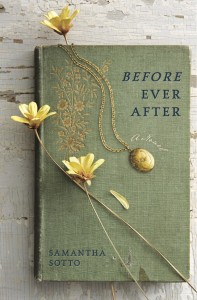



Before Ever After by Samantha Sotto

“Eggs and engagements.  Though slightly odd, they were a harmless pairing on most days, even with a greasy pile of bacon on the side.  But today was not like most days, because in less than an hour, they would make Shelley Gallus a twenty-six-year-old widow” (page 3 of ARC)

Before Ever After by Samantha Sotto is a debut novel that seemingly asks readers to suspend disbelief as Shelley Gallus discovers that her deceased husband, Max, may not have died three years ago and that he may in fact not ever age.  Oh, and he has a grandson, Paolo, from Italy who is now about 30 years old.  However, Sotto weaves her story with such beautiful prose that readers are immediately captivated and drawn into Shelley’s grief and her shock.  There is no conscious need to suspend disbelief, and readers will not even notice that they are doing it.

“Shelley’s ability to go through the motions wasn’t surprising considering that she had been schooled by the best. Her mom had never quite gotten over the death of her own husband, and Shelley grew up watching her paint on the brightest smile with a berry shade of Revlon lipstick. There had been days when her happiness had seemed so real, so genuine, that Shelley had almost believed it.” (Page 7 of ARC)

Death can leave a terrible emptiness in someone, especially when the person who dies is so ingrained and integral to their lives.  Sotto’s novel is more than a look a grief or the secrets spouses keep from one another; it is a journey through history that takes Shelley and Paolo through several countries and sheds light on Max’s past.  The narration shifts from present to immediate past (about five years ago when Max and Shelley first meet) to the distant past as Max recounts history in France, Austria, Slovenia, and other places.

In a way, Sotto’s prose is like traveling back in time, and while the main characters of Shelley, Max, and Paolo do not figure in those historical tales, readers never forget them or get confused.  The transitions between each time frame are seamless and almost fairytale like.  Shelley blossoms in this story from a young woman running away from the death of her parents (one literal and one figurative) only to assume a lifeless existence in London in advertising.  Her one shining moment is taking a trip through Europe on a whim — where of course she meets Max who teachers her to overcome her fears and take a leap of faith.

Before Ever After by Samantha Sotto bends time, and readers will stand on the precipice of each tale holding their breath as more of Max is revealed.  Tortured souls, romance, travel, mystery, and more are wrapped in between these pages.  Sotto has a good grasp of time and its hold on us, how we think about the past, hover over it with a magnifying glass, and torture ourselves with our longings and past errors.  A strong debut from a compelling mind that captures readers’ imaginations from page one.  A treasure to unearth in the waning days of summer that very well could be one of the best reads of the year.

About the Author:

SAMANTHA SOTTO fell in love with Europe’s cobbled streets and damp castles when she moved to the Netherlands as a teenager. Since then, she has spent nights huddled next to her backpack on a beach in Greece, honeymooned in Paris, and attended business meetings in Dusseldorf in the pleasant company of a corporate credit card. Before Ever After was inspired by her experiences living, studying, and traveling in Europe. Samantha lives in the Philippines with her family. This is her first novel.

For more info on Samantha and Before Ever After, check out her website, her blog, her Facebook page, and Twitter.


For the other stops on the blog tour, check out the TLC Book Tours site.


This is my 44th book for the 2011 New Authors Reading Challenge.

Ideal Cities by Erika Meitner

Ideal Cities by Erika Meitner, whom I interviewed in 2009, was published in 2010 by Harper Perennial as part of the National Poetry Series selected by Paul Guest. The collection is broken down into two sections: Rental Towns and Ideal Cities.  Rental towns appears to be at first glance about the transient nature of apartment or rental living, but on a deeper level its about the transient nature of our lives and how quickly we all want to grow up and become adults.  There zipping through memories and moments reminds us that our childhood moves too quickly and so innocence is gone before we realize it.  “The windows on the soon-to-be luxury/condos across the way say things/to the darkness I can’t hear.  Sometimes/they’re blocked by the train masticating/its way across town.  Now and then//” (from Vinyl-Sided Epiphany, page 5-6)

Each poem is ripe with stunning imagery, like in “January Towns” (page 38-9),  “. . . Sometimes the light/above the clouds winks out a full-size replica/of our lives.  We are crystals of frozen water;//”  Not only is life transient in nature as we move from one moment to the next, but it is also frozen in time for us to review at anytime in our memories.  A bit of us, as we were is frozen, captured.  We seek to capture those moments not only in our minds, but in photos and videos, and in some moments we see ourselves in the past and wonder who those people are.  From “Poem With/out a Face” (page 16-7), “Desire is serendipity,/is pity, is blind,is danger,is not/obligation, is poking the most/alien thing with a stick to see/if it stirs and clings, the way/”  Some memories are clearer than others, which is true even of those moments in our lives that we thought we’d remember forever through a clear, clean lens, only to find the lens is murky and obscured.

In the second section, “Ideal Cities,” Meitner’s poems are not about a utopia in the true sense of the word, like a world without crime, etc., but they are about the communities that reside in each city, with their diversity, quirkiness, and pain.  There are a great deal of images in these poems that pay homage to the sounds of cities, from construction equipment to the silence of social networking.  This section is smaller than the first, but tackles tougher subjects like the Holocaust, though both sections glance at pregnancy and birth.  From “Elegy With Construction Sounds, Water, Fish” (page 75-7), “There is music, and there is music./There is water from a plastic pitcher/hitting slate pavers, silenced by skin./There are valleys with houses tucked/into them and something trilling/”  From birth to death and city to the suburbs, Meitner’s focus is on the journey that life takes, even its most devastating parts.

Meitner’s poetry has a quickness that illustrates the transient nature of the modern world, and her poems beg the question of whether modernity is ideal or whether suburbia is ideal.  Readers will examine each of these poems and discover that the answer to that question lies within themselves.  The poet endorses neither one nor the other, but she does examine the old world versus the new world.  Ideal Cities by Erika Meitner is an enigmatic collection with moments on clarity and stunning imagery that highlights the transient nature of the modern world whether you live in the city or in suburbia.

Also check out the poem from this collection that was under discussion in the 109th Virtual Poetry Circle.

© Photo by Steve Trost, 2009

About the Poet:

Erika Meitner was born and raised in Queens and Long Island, New York. She attended Dartmouth College (for an A.B. in Creative Writing in 1996), Hebrew University on a Reynolds Scholarship, and the University of Virginia, where she received her M.F.A. in 2001 as a Henry Hoyns Fellow. Meitner is a first-generation American: her father is from Haifa, Israel; her mother was born in Stuttgart, Germany, which is where her maternal grandparents settled after surviving Auschwitz, Ravensbruck, and Mauthausen concentration camps

She is currently an Assistant Professor of English at Virginia Tech, where she teaches in the MFA program, and is also simultaneously completing her doctorate in Religious Studies at the University of Virginia, where she was the Morgenstern Fellow in Jewish Studies.


This is my 21st book for the Fearless Poetry Exploration Reading Challenge.


This is my 43rd book for the 2011 New Authors Reading Challenge.

Review of Quirk’s The Baby Owner’s Books

Normally, I don’t review three books in one post, but I’m making an exception for this set of baby-related books.  When the publicist at Quirk found out my husband and I were having our first child, they kindly sent us some reference guides on caring for her.

The Baby Owner’s Manual by Louis Borgenicht, MD, and Joe Borgenicht, D.A.D., can be used as a reference guide by all new parents and probably some who already have children.  The main approach of the book is similar to how a manual would talk about your new stereo or other consumer product by first describing its parts and functions and then discussing care and maintenance.  There are tips on how to perfectly swaddle the baby and how to deal with emergency situations.  Included also is a section on what accessories are not included, such as bottles and diapers, and a caution that some “models” may vary.  New parents don’t have a ton of time to read this book cover-to-cover, but it is easily dipped into for advice, particularly if they encounter a particular problem at feeding or bed time.

Readers will enjoy the instructional tone, but also the witty nature of the concept of baby as product, which eliminates the need for hard-to-understand medical jargon and other instructional nonsense that leave parents confused or bored.  Most of these tips are practical and easy to employ without incurring great expense, which is fantastic since most things related to babies are expensive and time-consuming.

The companion The Baby Owner’s Maintenance Log wasn’t as useful given that new mothers and fathers are merely scrambling around trying to find time to sleep, let alone write down each feeding and bowel movement.  Inside, there are spaces to record name, birth weight, eye color, bowel movements, feeding times and ounces, and of course developmental feats like rolling over.  To be honest, readers will not likely have time to write all of these moments down, though doctors will expect you to know roughly how many ounces the baby is eating, how frequently, and how long s/he sleeps.  It would be a blessing to have all of that information written down in one place, but from a practical standpoint, it is unlikely to happen unless the parents are super-organized and write down the details in the moment.

Finally, The Baby Owner’s Games and Activities Book by Lynn Rosen and Joe Borgenight offers a wide variety of activities to do with a baby and is grouped by specific age ranges to ensure proper development.  Again, this reference guide offers a fun and non-clinical look at development.  Surprisingly, I found myself doing some of the activities outside our daughter’s age range, but she seemed to just go with the flow and gobble up the knowledge.  The age ranges are not hard and fast rules/categories.

Babies tend to learn by modeling after activities done by their parents.  If you make a funny face, they will try it to — emulating you.  If you clap, they will try to clap.  Its fun to watch babies grow and adapt to new activities, even at ages younger than those outlined in this book.  There are probably activities that new parents will not have thought of or done that are included in this book, like having their child smell different flowers, etc.  These are merely exercises in development, but also in having fun with baby!

Overall, Quirk has an excellent set of baby manual books to help new parents that won’t be overly prescriptive or boring.  They will teach new parents and babies alike, but also be fun and enjoyable.  The only one in the set that seems least useful is the log book, but that’s just due to time constraints.  It could come in handy for parents who have nanny’s or babysitters and want to know what their baby did when they were at work or having date night.

This is my 40th-42nd book for the 2011 New Authors Reading Challenge.

The Snow Whale by John Minichillo

The Snow Whale by John Minichillo, which is published by local Maryland publisher Atticus Books, is a satire of Moby Dick by Herman Melville to a certain extent.  The debut novel centers on the life-changing decision of John Jacobs, a zombified office worker selling desk doodles to corporations via telephone, to find out his ancestry through a cheek-swab DNA test.  The results come back and find him more than one-third Eskimo/Inuit, and its enough for John to quit his job, take a vacation from his marriage, and head to Alaska to claim his birthright and go whale hunting.

“And why couldn’t a mild-mannered desk doodle salesman like Mike be the recipient of the Genghis Khan gene?” (page 9 of ARC)

His wife, Jessica, is equally in a rut, but still enjoys her job as a ballroom dance instructor.  She wishes that her marriage was more passionate and spontaneous, but the spontaneity she gets from John is not exactly what she’s looking for.  However, she agrees that he should go to Alaska given the passionate gleam in his eyes.  While some of the actions John takes are irrational and a bit nutty, readers will enjoy the shear witty prose and dialogue that accompanies the surreal situations presented.

“Q continued to walk with half steps, arms folded.
‘Stop shivering,’ Jacobs said.
‘I’m fucking freezing.’
‘Act Eskimo.’
‘What does that even mean?’
‘This is the thaw.  This should be warm for you.'”  (page 88 of ARC)

John is on a journey to find himself and to shake up the mundane, but in the midst of his journey he comes to realize that his life was already full before he left for Alaska.  Meanwhile, the chief of the Inuit tribe, Akmaaq, is looking for an end to his suffering as the leader being slowly shunned and cast aside following a dreadful whale hunt the year before.  He is like Ahab more than John because he is seeking to meet the white whale — his fate and death.  Although Akmaaq is native, like Queequeg in the original Melville novel, Akmaaq is neither a cannibal nor seeking adventure in the wide world beyond his isolated tribe, but he has established a friendship with John to ensure his safety — at least partially — and is aware that death awaits.  Ishmael is John, here in Minichillo’s novel, because he is seeking adventure and change — he is on the journey.

The Snow Whale by John Minichillo is an excellent debut novel that will likely be on the best of 2011 list.  It incorporates classic literature, though knowledge of Melville’s novel is not necessary to enjoy the wit and captivating story Minichillo creates.  John is a quirky character that readers will sympathize with, and his journey may be a bit surreal, but probably mirrors some of the fantasies readers have had about escaping their boring lives behind a cubicle wall.  Book clubs would find a great deal to discuss from the modernization of tribal people to the misconceptions “white” people have about different cultures and peoples, and themselves.

About the Author:

John Minichillo lives in Nashville with his wife and son.  This is his first novel.  Please do check out the interview with John at Atticus Books.  Here’s a sneak peak of the book.


This is my 39th book for the 2011 New Authors Reading Challenge.


This is a stop on The Literary Road Trip since this book is published by Maryland house Atticus Books.

The Book of Lies by Mary Horlock

The Book of Lies by Mary Horlock is written in chapters that alternate between the present with Catherine Rozier in 1984-5 and the past during the German occupation of Guernsey during WWII and her uncle Charles Rozier’s story.  Like her uncle, Cat is a liar.  Lies are often told to protect loved ones, to gain acceptance among peers, or to cover up bad behavior, and the lies told here are no different.  Unreliable narrators are tricky in that readers can often get frustrated with the lies or become disenchanted with the story because they no longer know how to gauge the truth.  However, Horlock hovers on the edge of that line so as to keep readers engaged by presenting “historic” documentation for the WWII portion of the story.

Cat’s father, Emile, often shut himself away from his family and buried himself in historical research about the German Occupation of Guernsey, and this isolationism led Cat to believe she needed to make up stories to fit in and gain attention from not only her peers and parents, but from everyone else on the island.  In a way readers will wonder throughout the novel if she is still lying to gain the attention of readers with her sensational narrative of murder and teen hijinks.

“It’s a 3,000-foot drop and even though I’m fat, I’m not fat enough to bounce.  I’ll dive headfirst into ye ancient Guernsey granite outcrops and then my mashed-up body will be washed out to sea.  Of course, if I get the tides wrong I’ll be stranded on the rocks with seagulls eating my eyes.  I know for a fact they’ll eat anything.”  (page 1)

Cat unwittingly gets swept up in a friendship with Nicollette Louise Prevost, a beauty and from a family of wealth.  Everything is grand as Nic and Cat drink, hang out, start rumors, and hit on boys and men, but something changes and Cat is cast aside in a callous manner, which drives her to engage in reckless behavior and possibly murder?!  Her uncle’s story is similar in that he is befriended by Ray, who quickly casts him aside, but they are reunited in an effort to escape the Germans.  Lies are told by each, and each face tough consequences as a result.  The incestuous nature of the island and the close ties of families on the island are often alluded to, and in a way the close-knit community resembles a large family, and like all families, they hurt those they love.

“I haven’t had a shower for as long as I can remember and there’s this spot on my chin that I’ve had to squeeze and squeeze.  Peter Falk might be able to get away with looking like he’s slept in a hedge but I’m not a famous TV detective (wearing what is surely a wig).”  (page 146)

Much of the world created by Horlock is fantasy, but readers know that their narrator is unreliable from the beginning.  The chapters about Charles’ life are taken from the transcripts of a conversation he had with his brother before his death, which provides a certain authenticity to them.  However, are these entries true?!  Readers will have to sort that out for themselves.  Horlock’s style places you in the thick of it with Cat, and readers will feel all of her emotions, particularly that of alienation.  However, how much whining and justification for her actions readers can take will determine how much they empathize with her.  One part of Cat’s character that could annoy was her overuse of “as per usual” and “as per” to clarify nearly every statement or situation.  Also some of the diction was just awkward and stilted.

Regardless of or in spite of the unreliable narrator, Horlock has created a well-crafted story that circles in on itself as ancestry is unraveled and history appears to repeat itself decades after Charles Rozier’s story of espionage and teen rebellion.  The Book of Lies will keep you guessing throughout its 300+ pages, –right up until the end — but readers will be riveted and satisfied once they get there.  An excellent selection for book clubs with the espionage, teen angst, and trail of lies to analyze and discuss.


About the Author:

Mary Horlock is an authority on contemporary art who has worked at the Tate Britain and Tate Liverpool, and curated the Turner Prize for contemporary art. She spent her childhood in Guernsey, and lives in London.


For the rest of the stops on the tour, please click the TLC Book Tour icon.  Thanks to TLC and Harper Perennial for sending me a copy of the book for review.


This is my 38th book for the 2011 New Authors Reading Challenge.


Flies by Michael Dickman

Michael Dickman‘s Flies, published in 2011 and a possible candidate for the Indie Lit Awards if it is nominated in September, won the Academy of American Poets James Laughlin Award, which is the only award for a second book of poetry.  The collection is a dark look at family, but also takes a stark look at death and loss.  However, there are lighter moments in the book, like in “Emily Dickinson to the Rescue” (page 21) that was highlighted in the Virtual Poetry Circle.

Beneath the whimsical wordplay and imagery of playgrounds and imaginary friends, there is a deep sense of unrest and yet acceptance of how things have turned out, though the narrator has many regrets.  In “Imaginary Playground” (page 27), the narrator is playing alone with his imaginary friends, but as the scene fills in, it is clear that where there once were trees and places to play, there is concrete and change.  The narrator is nostalgic for those moments, even if they were solitary moments with imaginary friends — wishing there was a way to return to the innocence of childhood and the creativity that period imbued.  “The swing sets/aren’t really/there// . . . On the blacktop/we lie down in each other’s arms/and outline our bodies/in chalk// . . . There are no hiding places anymore//” (page 27-9)

The reading of “Flies” (page 50-4) is slightly different from the printed version in Flies.

Each poem strives to revisit a memory or a loved one and shine a light on their current state, whether that is rotting beneath the ground or in the sky as a star, but these juxtapositions serve to show readers that it is not crystal clear what happens after we die.   The flies come and haunt those that remain behind with memories, regrets, and happiness, but those that die . . . vanish, never to be haunted by the past or present again. The recurring image of flies transforms from something that is friendly to something that is annoying and horrifying.

Translations (page 64-6)

My mother was led into the world
by her teeth

Pulled
like a bull
into the 
heather

She only ever wanted to be a mother her whole life and nothing else
      not even a human being!

One body turned into 
another body

Pulled by the golden voices of children

A bull 
out of hell

Called out
her teeth out in front of her
her children
pulling


*


First I walk my mother out
into the field
by a leash
by a lifetime
she walks me out
our coats
shimmering

I brush her hair

Wave the flies away from her eyes

They are my eyes

Who will ride my mother
when we aren't around
anymore?

Turned from one thing into another until you are a bull standing in
     a field

The field
just beginning
to whistle us


*


I am led by the mouth
out into the 
yellow

Light turning
to water in the early evening
the insects dying
in the cold and 
returning
in the morning

I put on my horse-head

Led by a bit

A lead

My leader is tall and the hair on her forearms is gold

We lower your eyes
into the tall grass
and eat

Dickman is relentless in his long poems with their ever-changing images that repeat and twist. Readers are exposed to the ways in which memories are recalled bit-by-bit and slapped together and rearranged until a full, clear image is presented. At first these lines are confusing, and some readers may step back from the lines, but only by pressing onward will they see the full impact of the memories he taps. Flies by Michael Dickman is a captivating collection that may require greater attention, but the sharp imagery and twists-and-turns will keep readers riveted even as the poems and memories expand over several pages. On a side note, the book cover is very indicative of the memory recall the poet experiences — it is haphazard and vivid.

About the Poet:

Michael Dickman was born and raised in the working-class neighborhood of Lents in Portland, Oregon. His first book, The End of the West, was published by Copper Canyon Press in 2009. His poems have appeared in The New Yorker, American Poetry Review, The New Republic, and Field, among others. Dickman is the recipient of fellowships and residencies from the Fine Arts Work Center in Provincetown, the Lewis Center for the Arts at Princeton University, and the Lannan Foundation. He has worked for years as a cook and has been active recently in the Writers in the Schools program.

This is my 20th book for the Fearless Poetry Exploration Reading Challenge.

This is my 37th book for the 2011 New Authors Reading Challenge.

Never Knowing by Chevy Stevens

Never Knowing by Chevy Stevens follows the success of her debut Still Missing (my review).  Again, Stevens uses therapy sessions with Nadine to tell a terrifying story that leaves readers anxious and biting their nails.  In her second novel, Sara Gallagher — resident of Victoria, British Columbia, Canada, who restores furniture for a living — walks her therapist through the search for her birth mother and how it led to her discovery that her birth father has committed some heinous acts.

Recapitalizing on the “waiting” in Still Missing, where the Annie waited for her captor to return and waited for her moment of escape, Sara Gallagher is waiting for the phone to ring, waiting for the other shoe to drop with her fiance, and waiting for her birth father to come out of hiding.

“When I first told you I found my mother, I said it was like standing on cracking ice.  This is like falling straight through into the freezing water.  You struggle back to the surface, your lungs burning, everything focused on that patch of light above you.  And you finally make it there, but the hole’s frozen over.”  (page 164 of ARC)

The sessions between Sara and her therapist ramp up the tension even further, keeping readers anxiously turning the pages.  Like other thrillers, the situations are surreal, but not to the point that they are unbelievable.  The police officers are running Sara ragged with their demands, veiled disappointments, and outright guilt trips.  Moreover, the entire situation has caused problems with her adoptive family and her fiance.  Readers will want to slap the cops in this one, while at the same time become suspicious of her fiance and the cops throughout the story and shake Sara.

“This last week I went through the motions, but I felt flat, disconnected — angry.  I didn’t know what to do with this new reality, the horror of my conception.  I wanted to bury it in the backyard, far away from anyone’s eyes.  My skin crawled with knowledge, with the evil that I’d looked into, that had created me.  I took long showers.  Nothing helped.  The dirt was on the inside.”  (page 31)

Stevens creates tension and builds sympathy easily.  The main protagonist, Sara, transforms from a woman with abandonment issues to a woman exhibiting the symptoms of a rape victim and to a strong mother bent on saving her own child from danger.  While some of the plot is predictable for avid mystery readers, there are revelations at the end of the novel that will make it worthwhile.  The story is tied up neatly at the end and is satisfying, though bittersweet.  Overall, Never Knowing is a fast-paced, thriller for the summer, and it begs the question would it be better to know or not to know about your birth parents or your own past if you were adopted.

About the Author:

Chevy Stevens grew up on a ranch on Vancouver Island and still calls the island home. For most of her adult life she worked in sales, first as a rep for a giftware company and then as a Realtor. At open houses, waiting between potential buyers, she spent hours scaring herself with thoughts of horrible things that could happen to her. Her most terrifying scenario, which began with being abducted, was the inspiration for STILL MISSING. After six months Chevy sold her house and left real estate so she could finish the book.

Chevy enjoys writing thrillers that allow her to blend her interest in family dynamics with her love of the west coast lifestyle. When she’s not working on her next book, she’s hiking with her husband and dog in the local mountains.  Please also check out her blog, follow her on Twitter, and on Facebook.

This is my 17th book for the 2011 Wish I’d Read That Challenge.  I’ve wanted to read this book since finishing Still Missing and listening to Chevy Stevens talk about her books live on BookTrib.

Enemy Women Read-a-Long at War Through the Generations

Anna and I hope you will join us for the August read-a-long of Enemy Women by Paulette Jiles as part of the U.S. Civil War Reading Challenge 2011.

We will read a handful of chapters every week throughout August, and every Friday, we will post discussion questions on War Through the Generations.

We welcome you to post your thoughts on your blog and provide a link or just type your thoughts in the comments section of the discussion post; whatever works best for you.  You can answer our questions or just discuss whatever you found most interesting in each section.

If you are interested in reading along with us, please let us know.  You don’t have to be participating in the U.S. Civil War Reading Challenge 2011 to join us!

Here’s a bit about the book from the publisher:

For the Colleys of southeastern Missouri, the War between the States is a plague that threatens devastation, despite the family’s avowed neutrality. For eighteen-year-old Adair Colley, it is a nightmare that tears apart her family and forces her and her sisters to flee.

The treachery of a fellow traveler, however, brings about her arrest, and she is caged with the criminal and deranged in a filthy women’s prison. But young Adair finds that love can live even in a place of horror and despair. Her interrogator, a Union major, falls in love with her and vows to return for her when the fighting is over. Before he leaves for battle, he bestows upon her a precious gift: freedom.

Now an escaped “enemy woman,” Adair must make her harrowing way south buoyed by a promise … seeking a home and a family that may be nothing more than a memory.

Here’s the schedule for the read-a-long:

Week One: Prologue – Chapter 6; discussion on Fri., Aug. 5

Week Two: Chapters 7-15; discussion on Fri., Aug. 12

Week Three: Chapters 16-24; discussion on Fri., Aug. 19

Week Four: Chapters 25-31; discussion/final thoughts on Fri., Aug. 26