Quantcast

Week 1: Ernest Hemingway A Farewell to Arms Read-a-Long

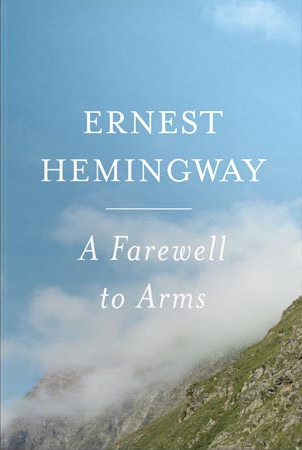
For the WWI Reading Challenge, we’re doing a group read of Ernest Hemingway’s A Farewell to Arms.

For this first week, participants of the challenge and non-participants read chapters one through 10.  Each Friday, we’ll be posting discussion questions and answers on the War Through the Generations blog.

Head on over today to check out what we’re discussing, but be aware that there could be spoilers.

Guest Post & Giveaway: My Favorite Spot to Write by Anita Hughes

Monarch Beach by Anita Hughes looks like another great summer read, and it will be published on June 19.  The debut novel tackles what it means to cope with love and betrayal as Amanda Blick thinks she has the perfect marriage only to discover her cheating husband is having an affair with his sous-chef.  She takes up her mother’s offer to get away with her son Max to St. Regis Resort in Laguna Beach.  While she should be relaxing and getting her life back on track, life throws her another curve ball as a divorcee enters the picture and showers her with attention.

Unfortunately, I don’t have time to review every great book out there before publication, but these are the moments I live for — writer’s willing to share their writing spaces with my readers, and today, that’s just what Anita Hughes is going to do.  Please give her a warm welcome.

I am very fortunate when it comes to choosing a favorite writing spot. I live in what is arguably one of the most beautiful places in the world. Six years ago, my family and I moved into a villa on the grounds of the St. Regis, Monarch Beach. It is an interesting place to raise children – the year is marked not just by the school calendar – but by the Easter Egg Hunt on the Grand Lawn, the Monarch Butterfly Release every Saturday during the summer, and the carolers who come to the hotel each Christmas.

Living at the St. Regis also gives me more beautiful places to write than any author could ask for. For months, when the idea for my debut novel MONARCH BEACH was percolating, I sat at the table in front of CRUST, the resort café, gazing out the window. This became my regular spot and the staff at CRUST knew not to ask if I wanted a coffee or chocolate croissant. I only wanted to soak up the ambiance, and let the story form in my head.

When I was ready to put the words down on my laptop, it was time to change locations. I didn’t want to be influenced by my surroundings; I only wanted to be guided by my thoughts. I looked around my villa to find the ideal writing spot. I considered the sofa in the living room that faces the bookshelf. But I always found myself gazing at the lovely covers of my book collection, and couldn’t concentrate on my own burgeoning manuscript.

Finally I settled on the love seat in my bedroom. It sits next to the window that overlooks the golf course. It is the perfect spot and I have written all three novels there. (Two more come out next year). Occasionally a golf ball lands in our garden and scares our dog, or I see baby bunnies and have to stop to admire them. But there is no Internet connection, no glorious view of the Pacific Ocean, no smell of fresh coffee or chocolate croissants to distract me. When I write, I like to leave the world I am in and submerge myself in my writing. Even though I am surrounded by so much natural beauty, I am bit like a horse with blinders on. I only want to see what is right in front of me: the words appearing on my computer screen.

Thanks, Anita, for sharing your writing space with us.

Photo by Sheri Geoffreys

About the Author:

ANITA HUGHES attended UC Berkeley’s Masters in Creative Writing Program, and has taught Creative Writing at The Branson School in Ross, California. Hughes has lived at The St. Regis Monarch Beach for six years, where she is at work on her next novel.  Please check out her Website.

Win a copy of Monarch Beach by commenting on this post how you react to obstacles. Giveaway is open internationally. Deadline June 15, 2012.

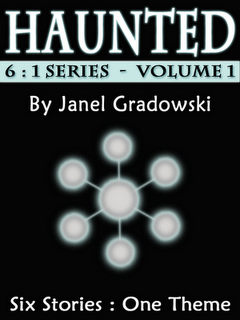
Haunted (6:1 Series, Volume 1) by Janel Gradowski

Haunted (6:1 Series, Volume 1) by Janel Gradowski is part of her six stories with one theme series and was the first she published as an ebook after much success in publishing her flash fiction in literary journals.  This collection is a quick read and can be read in about a day.  There is a surprising breadth of characters and situations representing the theme from a woman haunted by her jilted lover to a ghost unaware of his present state.

There are six stories in the collection: “Sequestered,” “New Friends,” “Retirement,” “Grandma’s Treasures,” “Uncleansed,” and “Strangers.”  Each cast of characters is haunted in one way or another whether by the past, the supernatural, or their deeds.  Among some favorites in the collection are “Sequestered,” “Strangers,” “Grandma’s Treasures,” and “Uncleansed” that have very dynamic characters in normal situations that turn a bit abnormal.  However, “New Friends” reminded me of other stories involving ghost children causing mischief in houses and mothers who don’t believe their children at first and think that their kids are exhibiting signs of trauma.  Readers may want a new twist in this kind of story, but the characters of Wendy and her daughter Mia are playful and have a charming relationship that makes them endearing.

In “Sequestered,” Stacie is jilted by her fiance and escapes to the woods to forget.  Haunted by a unrequited love and a future that can never be, she gets more than she bargains for.  The ending will knock the socks off readers, and there are some great descriptions in this short story.

“Naked trees contorted like tortured skeletons in the frigid, autumn wind.”

“Wisps of fog rose from the lake’s glassy water, materializing like an army of ghosts.”

Even in “Retirement,” Gradowski has a way of painting the scene so that readers are captured by the moment and emotionally charged.  “Autumn thunderstorms are always more vicious than their summer counterparts, like they are enraged by the cold air.”  She generates the heartache of Cecily as a palpable being that reaches beyond the page, haunting not only the character created, but also the reader.

Readers can identify with the oddities of family members from the crazy grandmother to the strange behavior of parents after a tragic event and the rituals they rely upon to keep their sanity.  “Grandma’s Treasures” and “Uncleansed” explore these relationships and their odd rituals in a unique way and each story uncovers family secrets that the protagonists Lindsey and Eva, respectively, never expected.

Haunted (6:1 Series, Volume 1) by Janel Gradowski is an excellent debut from a talented flash fiction and short story writer.  Short story is a difficult form to generate connections between readers and characters, but Gradowski achieves this easily through her word choices and narrative flow.  Haunting prose, unique characters, and surprising twists will keep readers coming back for more.

About the Author:

Janel Gradowski grew up, and still lives, in the mitten of Michigan. She is a wife and mother whose writing companion is a crazy Golden Retriever named Cooper. In the past she has worked many jobs. Renting apartments, scorekeeping for a stock car racetrack and selling newspaper classified advertisements are some of the experiences that continue to provide inspiration for her stories. Now she writes short fiction and is also a beadwork designer and teacher.

Her work has appeared in many publications, both online and in print. The 6:1 Series features themed collections of her stories. Each volume will have six stories, a mix of flash and short fiction, that are based on the title’s theme.  Visit her blog, Janel’s Jumble.

***And yes, for those keeping track, this is the second item I’ve read on my Kindle.

This is my 44th book for the 2012 New Authors Challenge.

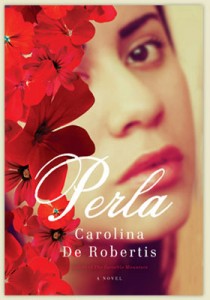
Interview with Author Carolina De Robertis

If you missed my review of the latest stunning novel from Carolina De Robertis, Perla, you must read it now and buy the book or vice versa.  The novel is set in Argentina and blends reality with the surreal as a young woman finds her place in the world and learns that politically motivated actions can have very personal consequences.  If you haven’t heard of the Disappeared, you must pick up this book and learn more.

Today, I’ve got an interview with Carolina De Robertis about her book and The Disappeared.  Without further ado, please give her a warm welcome.

Writing about the disappeared of Argentina must be quite a balancing act even after many decades. What inspired you to take on the subject and why choose to tell the story in a way that is at times surreal and very focused through the eyes of Perla?

My interest in the subject first arose from the extensive research I did for my first novel, The Invisible Mountain, which traverses ninety years of Uruguayan history, among them the revolutionary 60s and the dictatorship of the 70s and 80s. Inevitably, in studying those times, I also encountered the realities that unfolded on the other side of the river, in Argentina. It was more than could possibly fit in one novel, and inspired me to “cross the river” for my second novel, to Argentina, where I also have roots and relatives.

The surreal premise of Perla originally came as a vivid image I couldn’t get out of my head, of the disappeared who were thrown into in the river from airplanes, rising back up to visit the living. It wasn’t an intellectual decision. However, looking back, I think I was drawn to this choice because it allowed me to do something I haven’t seen anywhere else in the literature and filmography of the disappeared, which is to give the disappeared a voice of their own, to explore their side of the story in an immediate way. And telling the story through Perla, a military man’s daughter, allowed me to do something else that I hadn’t seen elsewhere, and that seemed urgent to me: to attempt to portray the full humanity of perpetrators of these crimes, without excusing them. Who would more honestly grapple with that difficult humanity than a perpetrator’s beloved daughter?

How much has the political landscape changed between when the disappeared were taken and today? Did that play a role in how you tackled the subject in fiction and were there any lingering concerns about how you portrayed the past in your fiction?

When the Mothers of the Plaza de Mayo first started organizing, in the late 70s, to defend the rights of their disappeared adult children, they were putting their lives at risk (and some of them in fact lost their lives as a result). Today, the Mothers have been honored in the Presidential Palace and are widely celebrated as heroines. Argentinean public opinion has come to decry the human rights abuses of the regime. Nevertheless, the wounds of those times are still viscerally alive in Argentinean society, in many ways. So I knew that I’d be touching on a national wound. I could only hope that the potential of art to create beauty and healing out of horror would outstrip the pain of having brought it to the surface.

The character of Perla is very complex in that she has a certain identity that is challenged from an early age given who her father was in the 70s and 80s. Did you have an outline of her character before you began writing her? Were there things about her character that surprised you? How so?

There were many things I knew about Perla when I began to write her into being, including the various layers of secrets that lie in her and in her family. However, I learned a great deal more about her as I wrote. In some ways, she is more vulnerable than I initially thought her to be. In other ways, she’s a great deal stronger than I first painted her. She has a wild streak. She also has a sense of humor that I didn’t see coming, which really emerges in her love affair with Gabriel, and which gives her another level of resilience.

Are there particular books you’d recommend to readers who want to learn more about the disappeared? Which ones and what makes them a must read?

There are many important books, but one of the most eloquent and devastating is Prisoner Without a Name and Cell Without a Number by Jacobo Timerman. Timerman was a respected journalist who was “disappeared” under the dictatorship, and only survived because international pressure forced his release. On his release he wrote this slim, amazing memoir that propels you right into the experience. I’d also recommend the Oscar-winning film The Official Story, which unfolds the world of a mother who begins to suspect her adopted daughter may be a child of the disappeared.

In the acknowledgements, you mention receiving Nunca Más. Upon reading the book, how has your world view changed and do you see your fiction writing as way to reveal to the world the deeper questions that events like the disappearance of Argentinians raise?

A book like Nunca Más, which gathers the testimonies of survivors of atrocity, is bound to shake you and your sense of the world. It forces you to look in the eye some of the tremendous cruelties we human beings are collectively capable of. How can such things happen? And why do they keep happening in so many places across the world? Most importantly, how does a society begin to truly move beyond such a tragedy and affirm the beauty and powerful forms of love that are also part of human experience? I do think that fiction plays a particular role in exploring such questions. Fiction can delve into the long-term, intimate effects of violence, and the complex and often astounding ways that people rebuild their lives. Fiction can open doors to healing, to awakening, and to fresh explorations of the truth. This may sound a bit hyperbolic, but I really do believe this, perhaps because, as a reader, novels have done all these things for me.

Finally, who are some of your favorite authors and poets? Or what are you reading now that you enjoy?

There are so many! Just a few of the authors I constantly turn and return to: Toni Morrison, Virginia Woolf, Gabriel García Márquez, Italo Calvino, Clarice Lispector, Walt Whitman, William Faulkner, Herman Melville, Dostoevsky. As for recent reading, I just finished The Danish Girl by David Ebershoff. It’s a portrait of Einar Wegener, the first person to successfully undergo male-to-female sex change surgery—and a stunning novel, told in the most vibrant, nuanced, and utterly unforgettable voice.

Thanks, Carolina, for answering my questions.

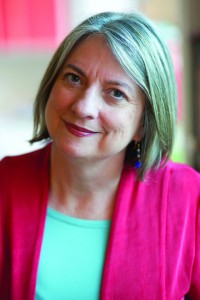
Interview with Poet and Author Molly Peacock

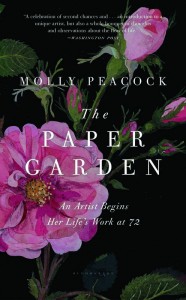
My review of The Paper Garden by Molly Peacock posted last week. The cover and the illustrations of Delany’s work is stunning, and like the multilayered mosaicks, Peacock has created an equally beautiful biographical collage that layers the works of Delany over the events in her life and sneaks in tidbits from the author’s own past.

I hope you have a chance to read the review and to read this interview with the author about writing, Mary Delany, and the Virtual Poetry Circle.

Without further ado, here’s the interview with Molly Peacock:

The Paper Garden is a biography of an older woman, Mary Delany, embarking on an artistic journey late in her life.  What about her story grabbed your attention and how has it inspired you or helped you to re-examine your own life?

Mrs. Delany’s work inspired me since I first saw it in 1986; the cut paper flowers are so magnificent!  But it was really that she invented an art form at the age of 72 that got to me.  I was 39 and establishing myself as an artist.  Later, in 2003, I discovered more about Mrs. Delany’s life that inspired me.  She had a marvelous mid-life marriage where she found herself branching out into many arts;  it helped me understand how much my own marriage has influenced my own branching out from poetry to prose.

Could you explain a little bit about the differences between writing poetry, memoir, biography, and prose?  How are they the same?

A lyric poem funnels down to an instant of revelation; it is almost as if the poem stops time, that the only dimension in a lyric poem is space.  In that way, it’s like a painting.  But prose unfolds in time; and time contains both obstacles and revelations.  Prose develops, the way characters and situations do.  It requires a flow.  A poem is an instant, lightning across the sky.  Prose is before the storm, the storm, after the storm.

I first read your book How to Read a Poem  in 2009, and it inspired me (ever since) to begin the Virtual Poetry Circle in which I post a poem each Saturday of the week for readers to read, enjoy, and offer up their impressions.  Have you engaged in poetry circles on a consistent basis and/or have you had any feedback from others who have taken up with a poetry circle?  Any further advice for Virtual Poetry Circle participants about reading and discussing poems?

Thank you for creating The Virtual Poetry Circle!  My advice is to incorporate a mix of poems, some golden oldies like “Ozymandias” by Shelley; some translations, like “The Word Exchange” edited by Michael Matto and Greg Delanty, with Anglo Saxon poems;  some forms of poetry, like “Villanelles,” a new anthology edited by Annie Finch; some ancient poems like “Greek Lyric Poetry” translated by Sherod Santos;  and some younger poets like Beth Ann Fennelly and A.E. Stallings.

I think it’s always great when participants focus on specific language, rather than generalizing.  When a poem gives you a certain feeling, you can try to locate the exact words, or sounds, or rhythm, or syntax that prompted it.  Looking for the specific moment in the poem that prompted your feeling often leads to further revelation.

If you were expected to describe yourself and your work in 10 words or less, what would you say?

How about 11 words?  A woman writer fascinated by inner life and the real world.

Finally, as a poet and a writer, do you feel that despite The Paper Garden‘s deeply personal connections that it should reach a wider audience?  Do you think writing in general should bring about social activism, like the poets of the Split This Rock Poetry Festival?

I am so gratified that The Paper Garden has reached a large audience!  Gardeners, artists, people facing late-life challenges, people who’ve always felt they had a special imaginative spurt inside them, history buffs, romantics of all ages, young and old creative people have all been drawn to the story of Mrs. Delany.  She’s a force!

I think writing unexpectedly brings about social activism.  Writing has to be internal first.  But bringing the inner life to the greater public can spark oceanic changes.

Thanks, Molly, for answering my questions.

Mailbox Monday #179

Mailbox Mondays (click the icon to check out the new blog) has gone on tour since Marcia at A Girl and Her Books, formerly The Printed Page passed the torch. This month’s host is Alternative Read.

The meme allows bloggers to share what books they receive in the mail or through other means over the past week.

Just be warned that these posts can increase your TBR piles and wish lists.

Here’s what I received since vacation the previous couple of weeks:

1. Porch Lights by Dorothea Benton Frank, unsolicited from William Morrow and I will find a new home for.

When Jimmy McMullen, a fireman with the NYFD, is killed in the line of duty, his wife, Jackie, and ten-year-old son, Charlie, are devastated. Charlie idolized his dad, and now the outgoing, curious boy has become quiet and reserved. Trusting in the healing power of family, Jackie decides to return to her childhood home on Sullivans Island.

Crossing the bridge from the mainland, Jackie and Charlie enter a world full of wonder and magic—lush green and chocolate grasslands and dazzling red, orange, and magenta evening skies; the heady pungency of Lowcountry Pluff mud and fresh seafood on the grill; bare toes snuggled in warm sand and palmetto fronds swaying in gentle ocean winds.

2.  Pride & Pyramids: Mr. Darcy in Egypt by Amanda Grange and Jacqueline Webb from Sourcebooks for review in July.

The Darcys get pulled into the Regency craze for Egypt in this romantic and adventurous Pride and Prejudice continuation by bestselling author Amanda Grange and Egyptology expert Jacqueline Webb.

When Elizabeth, Darcy and their lively children go to Egypt with Colonel Fitzwilliam’s younger brother, romantic interludes between Darcy and Elizabeth intertwine with the unraveling of a mystery dating back to an ancient Egyptian woman. They find long-hidden treasure, thwart a theft and betrayal by the ever villainous George Wickham, and lay to rest an ancient ghost.

3.  Ocean Beach by Wendy Wax from the publisher and Joan Schulhafer Publicity for review in June.

If you want to win a copy of your own, today is the last day to enter Wendy Wax’s giveaway for one of three advance reader copies of her upcoming OCEAN BEACH, to be sent to the winners prior to the June 26th on sale date. Best of luck to all!! Just go to http://www.writerspace.com/contests/ and scroll down to Wendy’s name!

Unlikely friends Madeline, Avery and Nicole have hit some speed bumps in their lives, but when they arrive in Miami’s South Beach neighborhood, they are all hoping for a do-over. Literally. They’ve been hired to bring a once-grand historic house back to its former glory on a new television show called Do-Over. If they can just get this show off the ground, Nikki would get back on her feet financially, Avery could restart her ruined career, and Maddie would have a shot at keeping her family together.

At least, that’s the plan – until the women realize that having their work broadcast is one thing, having their personal lives play out on TV is another thing entirely. Soon they are struggling to hold themselves, and the project, together. With a decades-old mystery—and the hurricane season—looming, the women are forced to figure out just how they’ll weather life’s storms…

4.  The Color of Tea by Hannah Tunnicliffe from TLC Book Tours in August.

Macau: the bulbous nose of China, a peninsula and two islands strung together like a three-bead necklace. It was time to find a life for myself. To make something out of nothing. The end of hope and the beginning of it too.

After moving with her husband to the tiny, bustling island of Macau, Grace Miller finds herself a stranger in a foreign land—a lone redhead towering above the crowd on the busy Chinese streets. As she is forced to confront the devastating news of her infertility, Grace’s marriage is fraying and her dreams of family have been shattered. She resolves to do something bold, something her impetuous mother would do, and she turns to what she loves: baking and the pleasure of afternoon tea.

Grace opens a café where she serves tea, coffee, and macarons—the delectable, delicate French cookies colored like precious stones—to the women of Macau. There, among fellow expatriates and locals alike, Grace carves out a new definition of home and family. But when her marriage reaches a crisis, secrets Grace thought she had buried long ago rise to the surface. Grace realizes it’s now or never to lay old ghosts to rest and to begin to trust herself. With each mug of coffee brewed, each cup of tea steeped and macaron baked, Grace comes to learn that strength can be gleaned from the unlikeliest of places.

5. Guilty Wives by James Patterson and David Ellis, which my mom lent to me after visiting her with “Wiggles.”

Only minutes after Abbie Elliot and her three best friends step off of a private helicopter, they enter the most luxurious, sumptuous, sensually pampering hotel they have ever been to. Their lavish presidential suite overlooks Monte Carlo, and they surrender: to the sun and pool, to the sashimi and sake, to the Bruno Paillard champagne. For four days they’re free to live someone else’s life. As the weekend moves into pulsating discos, high-stakes casinos, and beyond, Abbie is transported to the greatest pleasure and release she has ever known.

6. Private Games by James Patterson and Mark Sullivan, which my mom lent to me after visiting her with “Wiggles.”

Private, the world’s most renowned investigation firm, has been commissioned to provide security for the 2012 Olympic Games in London. Its agents are the smartest, fastest, and most technologically advanced in the world, and 400 of them have been transferred to London to protect more than 10,000 competitors who represent more than 200 countries.

7. Private #1 Suspect by James Patterson and Maxine Paetro, which my mom lent to me after visiting her with “Wiggles.”

Since former Marine Jack Morgan started Private, it has become the world’s most effective investigation firm–sought out by the famous and the powerful to discreetly handle their most intimate problems. Private’s investigators are the smartest, the fastest, and the most technologically advanced in the world–and they always uncover the truth.

8. Flesh by Khanh Ha, which I received from TLC for a book tour in June.

The setting is Tonkin (northern Vietnam) at the turn of the 20th century. A boy, Tai, witnesses the beheading of his father, a notorious bandit, and sets out to recover his head and then to find the man who betrayed his father to the authorities. On this quest, Tai’s entire world will shift. FLESH takes the reader into dark and delightful places in the human condition, places where allies are not always your friends, true love hurts, and your worst enemy may bring you the most comfort. In that emotionally harrowing world, Tai must learn to deal with new responsibilities in his life while at the same time acknowledge his bond, and his resemblance, to a man he barely knew-his father. Through this story of revenge is woven a another story, one of love, but love purchased with the blood of murders Tai commits. A coming-of-age story, but also a love story, the sensuality of the author’s writing style belies the sometimes brutal world he depicts.

What did you receive?

Ernest Hemingway’s A Farewell to Arms Read-a-Long

Even if you aren’t participating in the War Through the Generations WWI Reading Challenge this year, you’re still welcome to participate in the annual read-a-long.

This year, Anna and I selected Ernest Hemingway’s A Farewell to Arms for the read-a-long book.

If you’re interested, we’ll be posting discussion questions and answers each week on the Friday.  Here’s the schedule:

Week 1 — June 1-8 Chapters 1-10

Week 2 — June 9-15 Chapters 11-20

Week 3 — June 16-22 Chapters 21-30

Week 4 — June 23-29 Chapters 31-41

We hope you’ll join us for some great reading and discussion.

152nd Virtual Poetry Circle

Welcome to the 152nd Virtual Poetry Circle!

Remember, this is just for fun and is not meant to be stressful.

Keep in mind what Molly Peacock’s books suggested. Look at a line, a stanza, sentences, and images; describe what you like or don’t like; and offer an opinion. If you missed my review of her book, check it out here.

Also, sign up for the 2012 Fearless Poetry Reading Challenge because its simple; you only need to read 1 book of poetry. Please visit the stops on the 2012 National Poetry Month Blog Tour.

Today’s poem is from Elizabeth P. Glixman:

Laughing With My Father

My father’s body is dust. Yet darkness never comes.

Light sifts through memory. It is  bright.

I think of when he was here, vespers fly through my mind,

Not like praise but like a Halloween witch’s scream  
Scaring me to forget. Her crooked nose

Leads down the net path of dreams.  
I catch the light find how it weaves

Through the glass prism of wonderland.

No matter how I resist a different shape

My father is on my sleeping pillow

In my supermarket dreams. I pay

for lettuce at the cash register. He speaks. 
The world spins without vacation. He tells

Me to not forget the way his hair smelled  
Was full and dark, the way his Oldsmobile

hauled  newspapers, old mail, cancelled checks,

nose plugging sneakers and  Hershey Candy wrappers,

The way his stories were pliable as stale gum,

Only he would laugh at the boredom of this joke.

He tells me to not forget the way he hit the golf ball

No matter if it moved or not or flew

over the lake greens and disappeared. It didn’t matter,

Since he would always exist. Never be plucked.

The day is done. The darkness is full of a light that does not fade.

This dark is a gradation on the color chart of breathing

In a world that never can stop.

I watch late night TV in the blank hours

The shroud of gray filters out howling. I  rest 

in the dizziness of recall. The wind blows concisely outside

It writes the end chapter in our novel.

The crab apple trees in bloom.

On my pillow or in the supermarket isle he watches 
He sings yes, we have no bananas, a favorite song  
And tells me the darkness will not come, to go to bed  
Drink my milk, Don’t stay up late,

Be a good girl. Never sleep with boys.

Marry well.

What do you think?

The Paper Garden by Molly Peacock

Poet Molly Peacock’s The Paper Garden is not only a collage and biography of a woman, Mary Delany, who began a career as an artist late in life, but it also is partially a memoir of Peacock’s own life and the nuggets of wisdom she’s gained from her obsession with this floral artist and her collages or flower mosaicks.  Delany is a woman who began working with scissors and paper long before she gained recognition for her art, starting as a young girl in school.  While one of her classmates recognized her talent, life got in the way as Delany was plucked from her home and moved to her aunts and back again as English politics became tumultuous and her family backed the Pretender.

“A few of the papers she used — all of the papers in the eighteenth century were handmade — in fact were wallpapers, but mostly she painted large sheets of rag paper with watercolor, let them dry, then cut from them the hundreds of pieces she needed to reproduce — well, to re-evoke might be a better word — the flower she was portraying.  There is no reproduced hue that matches the thrill of color in nature, yet Mrs. D. went after the original kick of natural color, and she did it like a painter.”  (page 7-8 ARC)

Through all of the upheaval, Delany kept to her crafts and her music, once inspired by a meeting with Handel.  Peacock’s prose is intimate and conversational as she speaks of Delany like a beloved friend and peer.  She speaks of her journey to learn about Delany’s life and craft like a careful historian citing her sources and engaging in reverence for her subject.  Through her delicate prose, the beauty of Delany and her work emerge gradually, like the petals of a bud opening slowly as the sun rises.

Peacock does a fantastic job comparing individual mosaicks to events in Delany’s life in England and Ireland even though many of the pieces were created long after the death of her second husband and her younger sister, Anne.  She was an early mixed media artist who used wallpapers, paints, dried leaves, and other materials to create her portraits of flowers, breathing new life into even the most simple flower.

The Paper Garden by Molly Peacock is a quiet read chock full of details about Mary Delany’s craft, her family, and her inspiration, but it also is full of advice, beautiful images of Delany’s work, and tidbits about Peacock’s motivations in her own poetry and life.  Readers will dip into this book, think and wonder about Delany’s craft, but also ruminate on what this journey she embarked upon taught her and ourselves.  In almost a meditative way, the biography pulls the reader in and pushes them out to ensure the depth of the art and its meaning is thought about on a deeper level.

***Some of my favorite quotes from the book that can apply to writing***

“Great technique means that you have to abandon perfectionism.  Perfectionism either stops you cold or slows you down too much.  Yet, paradoxically, it’s proficiency that allows a person to make any art at all; you must have technical skill to accomplish anything, but you also must have passion, which, in an odd way, is technique forgotten.”  (page 28 ARC)

“Not to know is also sometimes the position of the poet, who depends on close observation to magnify a subject, hoping to discover an animating spirit.  There’s romance in that forensic impulse . . .” (page 34 ARC)

About the Author:

Molly Peacock is the award-winning author of five volumes of poetry, including The Second Blush. Her poems have appeared in the New Yorker, the Paris Review, and the Times Literary Supplement. Among her other works are How to Read a Poem . . .  and Start a Poetry Circle and a memoir, Paradise, Piece by Piece. Peacock is currently the poetry editor of the Literary Review of Canada and the general series editor of The Best Canadian Poetry in English. A transplanted New Yorker, she lives in Toronto.

Visit Molly Peacock’s Website.

Click for Tour Stops

This is my 4th book for the 2012 Ireland Reading Challenge.

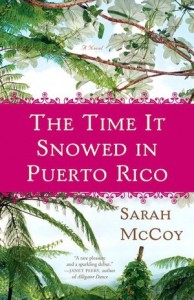
The Time It Snowed in Puerto Rico by Sarah McCoy

The Time It Snowed in Puerto Rico by Sarah McCoy is a coming of age novel about a young girl, Maria — also known as Verdita — in Puerto Rico during the debate about whether or not the nation should become a member of the United States or remain independent.  Part of Maria Ortiz-Santiago’s family lives in the United States and part lives on the island in a little barrio, and readers get a taste of the differences between the two lives when Omar, her cousin, comes back to visit.  As the two grow older and grow apart, Verdita continues to ramp up her competitive spirit when he’s near to retain her hold on her father.  She’s always had a fear that a boy would usurp her father’s affections, especially after her mother becomes pregnant.

“For my eleventh birthday, Papi made piraguas.  He left balloons of water in the freezer until they were solid, then peeled the plastic off like bright banana skins.  On the veranda, he used his machete to shave the globes into ice chips.  Hard bits of cold spit out where the ball and blade met, landing on my arms and legs, cheeks and nose.  Papi said it was a Puerto Rican snowfall, and laughed long and deep.”  (page 1)

Verdita is a willful girl and very curious about everything around her, including the independence debate, the cock fights at the local bar, and the United States.  Readers will find that she’s obsessed with the United States and how different it is from her home in the barrio.  She wants to be blond, listen to Elvis, and learn English.  She wants to remain close with her father, but push her mother away.  All this mixed up emotion and desire in one girl is so vibrant on the page, female readers especially will remember what it was like to become a senorita and leave girlhood behind and all of the mixed and high emotions that brought with it.

“I ate until my stomach pushed into the table ledge.  I didn’t even really like the hamburger, but I liked that it came from America — that I was eating like an American.  It made me feel bigger than my finca on the mountain, bigger than the whole island.  I’d seen the States, even if I hadn’t seen President Kennedy.  My stomach was full of America.”  (page 59)

Even as she sees the goodness in her roots and her family, she still longs for the foreignness of the United States.  She becomes accustom to sharing her life with a sibling, but still longs to break break free.  She’s struggling between the desire to grow beyond her roots, deeply earthed in Puerto Rico, but barely realizing that she can grow taller and broader by taking the leap without having to sever her ties to home.

McCoy’s choice of first person point of view is spot on for a coming of age story, and while filtered through Verdita’s eyes rather than the other characters, readers will not feel as though they have missed anything.  She’s observant, opinionated, curious, and eager to explore.  The Time It Snowed in Puerto Rico is not only about growing up, but about taking chances and spreading wings to find out who we are, who we want to be, and how we can make the best of everything we are given in terms of familial support and available opportunities.

This was a book I just had to pick up at the Gaithersburg Book Festival when Sarah McCoy was in town.  She’s a lovely writer and woman, and it was great to see her again and get another autograph.  I cannot wait to read her next novel.

About the Author:

SARAH McCOY is author of the novel, The Time It Snowed in Puerto Rico. She has taught English writing at Old Dominion University and at the University of Texas at El Paso. The daughter of an Army officer, her family was stationed in Germany during her childhood. She calls Virginia home but presently lives with her husband and dog, Gilbert, in El Paso, Texas. The Baker’s Daughter is her second novel. She is currently working on her next.