Quantcast

154th Virtual Poetry Circle

Welcome to the 154th Virtual Poetry Circle!

Remember, this is just for fun and is not meant to be stressful.

Keep in mind what Molly Peacock’s books suggested. Look at a line, a stanza, sentences, and images; describe what you like or don’t like; and offer an opinion. If you missed my review of her book, check it out here.

Also, sign up for the 2012 Fearless Poetry Reading Challenge because its simple; you only need to read 1 book of poetry. Please visit the stops on the 2012 National Poetry Month Blog Tour.

Today’s poem is from Natasha Trethewey, our new U.S. Poet Laureate:

Pilgrimage

Vicksburg, Mississippi


Here, the Mississippi carved
            its mud-dark path, a graveyard

for skeletons of sunken riverboats.
            Here, the river changed its course,

turning away from the city
            as one turns, forgetting, from the past—

the abandoned bluffs, land sloping up
            above the river's bend—where now

the Yazoo fills the Mississippi's empty bed.
            Here, the dead stand up in stone, white

marble, on Confederate Avenue. I stand
            on ground once hollowed by a web of caves;

they must have seemed like catacombs,
            in 1863, to the woman sitting in her parlor,

candlelit, underground. I can see her
            listening to shells explode, writing herself

into history, asking what is to become
            of all the living things in this place?

This whole city is a grave. Every spring—
            Pilgrimage—the living come to mingle

with the dead, brush against their cold shoulders
            in the long hallways, listen all night

to their silence and indifference, relive
            their dying on the green battlefield.

At the museum, we marvel at their clothes—
            preserved under glass—so much smaller

than our own, as if those who wore them
            were only children. We sleep in their beds,

the old mansions hunkered on the bluffs, draped
            in flowers—funereal—a blur

of petals against the river's gray.
            The brochure in my room calls this

living history. The brass plate on the door reads
            Prissy's Room. A window frames

the river's crawl toward the Gulf. In my dream,
            the ghost of history lies down beside me,

rolls over, pins me beneath a heavy arm.

What do you think?
Week 2: Ernest Hemingway A Farewell to Arms Read-a-Long

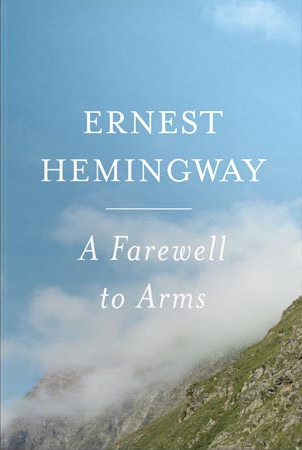
For the WWI Reading Challenge, we’re doing a group read of Ernest Hemingway’s A Farewell to Arms.

For the second week, participants of the challenge and non-participants read chapters 11-20.  Each Friday, we’ll be posting discussion questions and answers on the War Through the Generations blog.

Head on over today to check out what we’re discussing, but be aware that there could be spoilers.

Guest Post & Giveaway: Vincent N. Parrillo’s Writing Space

Yesterday, I reviewed Guardians of the Gate by Vincent N. Parrillo, a historical fiction novel about Ellis Island set in the early 1900s.  The novel is heavy in facts and even includes so historic pictures of Ellis Island at the time; Check out the review.

If you’re anything like me, I love learning about author’s writing habits and writing spaces.  And today, we’ve got a special look at Parrillo’s writing space.  Please give him a warm welcome.

As an author of numerous sociology textbooks, I am often asked, first, how I came to write an historical novel, second, why Ellis Island, and third, given my responsibilities as a professor and graduate director at William Paterson University, how I found the time to write it.

I’ve always liked the challenge of expanding my horizons, and—in writing—that desire led to 1) creating academic books on different subjects (cities, diversity, immigration, social problems); 2) becoming co-lyricist for a show (see www.hamlettherockopera.com); and 3) scripting two PBS television documentaries (I’m working on a third right now). Guardians of the Gate evolved as my desire to explore a new genre, using imagination to create characters, a setting, and plot that, hopefully, would result in a compelling read.

The genesis for choosing Ellis Island as the setting was my documentary work in 1991. I had the good fortune to be there before its restoration. Walking up the original staircase with steps deeply grooved by millions of immigrants, and seeing the examining rooms and corridors in their abandoned, deteriorating condition, all combined to create a haunting effect in my mind. I keenly felt the history of the place as a touchstone for the many that came in pursuit of the American Dream.

It occurred to me that, although much is “out there” about immigrants in photos, films, family histories, and nonfiction, little exists about the people who worked at Ellis Island. These were the first Americans the immigrants encountered. Who were they? Well, many were immigrants themselves, mostly Germans and Irish. Some were caring, dedicated workers; some were just doing a job; and some were scoundrels exploiting the greenhorns. So, I decided to focus mainly on them. Furthermore, most people know of Ellis Island only in its twentieth-century manifestation, but little about dramatic and provocative events occurring there in the 1890s. That was the story I wanted to tell. To spice up the narrative, I knew from the outset that I also wanted to include a good love story, one filled with challenges and passion.

Naturally, any writer of good historical fiction must research the subject fully. I had a head start with what I learned years earlier in writing my documentary, but now much more investigation was necessary. I sought and read anything I could find: memoirs, newspaper accounts, and histories. From these I created a timeline to incorporate actual events into the novel. I made my protagonist a young doctor, because he would have freer access to different work areas on the island (the inspection stations, hospital, and dormitories) and thus enable me to give a more complete portrait of immigration activities.

With my teaching and professional responsibilities consuming only three days a week, I could block out significant amounts of free time for research and writing. My work station, set in an alcove, includes good overhead lighting and a comfortable swivel chair. What I like best about this arrangement is that it’s downstairs (I live in a townhouse), away from all window views and other distractions in the upstairs living quarters.

On this lower level is the family room with sliding doors out to the patio, but my back is to all that and so I can easily concentrate on what I’m doing. My re-energizing breaks from writing are either a power nap on the nearby couch or a half hour on the treadmill. An occasional cup of hot green tea is another good, healthy stimulant to keep me going.

Over the years, I’ve had many different types of writing spaces, but this one is by far the best.

Thanks, Vincent, for sharing your writing space with us.

To enter to win Guardians of the Gate by Vincent N. Parrillo,

You must be a U.S. resident and leave a comment on this post about what interests you about Ellis Island.

Deadline to enter is June 22, 2012, at 11:59PM EST

Guardians of the Gate by Vincent N. Parrillo

Guardians of the Gate by Vincent N. Parrillo is a historical fiction novel about Ellis Island between 1893 and 1902 as immigration to the United States increases, particularly from Italy and other non-northern European nations, and sentiment in America turns against immigrants.  Dr. Matt Stafford and his wife have moved to New York City and are living the high life with a very busy social calendar as he works at Presbyterian Hospital.  After losing a child in a miscarriage, their relationship fractures and each seeks satisfaction in life through different means — Peg through social activities and Matt through his job as a surgeon and ultimately as a doctor at Ellis Island.  Stafford is a likeable doctor and clearly cares about his patients and learning different languages and cultures, but his morals become more flexible when his wife’s ailment takes a turn for the worse and he spends more time with a lovely nurse at Ellis Island — a relationship that starts too quickly given the set up of the nurse’s character as aloof and consummately professional, even shying away from small talk with co-workers.

Meanwhile, nearly half of the book is spent with Ellis Island’s lead administrator Dr. Joseph Senner, whose heavy handed management style rubs personnel the wrong way, but endears him to his kindred German immigrants.  Senner expresses his concerns about the operations at Ellis Island openly and sets about making changes.  Senner is aloof to his workers and his German accent remains thick, even after 13 years in America.  Parrillo’s adherence to the use of “v” rather than “w” and other typical German-American accented English words continue to pull the reader out of the story and could have been phased out early on after the cadence had been well established.  Given the aloof nature of Senner’s character from his employees, the relationship in the latter half of the book between him and Dr. Stafford is surprising.

“The impact of this grand hall was striking.  The hall was virtually the full size of the building itself.  Its vastness was enhanced by the cathedral ceiling and the light — even on this overcast day — that filtered through the tall, eave-high windows.  A wide-planked pine floor, resembling a sailing ship’s deck so familiar to the arriving ocean voyagers, set off the woodwork.  The place even seemed to have the scent of a ship.  Ten parallel aisles, framed by railings, marked where the immigrants began the screening process.  Potted plants, American flags, and red, white, and blue bunting festooned the hall.”  (Page 5)

However, Parrillo is clearly a student of Ellis Island history as details about the island, the immigrants, the inspection procedures, and even the buildings themselves pour into the dialogue between Senner, who is a new administrator, and his assistant Ed McSweeney.  The facts and figures, plus the inclusion of photographs from the real Ellis Island provide this historical fiction novel with a unique style, mimicking a piece of nonfiction.  There are good and bad workers on Ellis Island, but the story is less about them and the immigrants than it is about Stafford and his troubled love life.

While Parrillo does include fictionalized accounts of immigrants coming to Ellis Island and their histories, the prose merely tells and does not show the emotion of these characters, as it does when the immigration officials interact.  While the plot and Dr. Stafford anchor the story and keep the pages turning, readers may want greater depth from Parrillo’s characters who at times are wooden in their actions and conversation.  With that said, the historical details of the bureaucracy related to Ellis Island, the corruption of immigration officials, and the procedures that had to be put in place to accommodate an influx of immigrants is interesting.  Through carefully selected details, Parrillo ensures that Ellis Island comes to life, nearly becoming a larger-than-life character of the book and stealing the show from Dr. Stafford and others.

Guardians of the Gate by Vincent N. Parrillo is a satisfying look at Ellis Island’s struggles in the beginning of the 1900s as immigrants began flooding America’s shores.  Parrillo is adept at blending in historic details and data into his prose, bringing to life the historic buildings and struggles of those entering the country and those helping them enter.  Those interested in Ellis Island’s history (complete with photos) and immigration will enjoy the historic parts of the novel.

About the Author:

VINCENT N. PARRILLO is a professor of sociology at William Paterson University of New Jersey. An internationally recognized expert on immigration, he is the executive producer, writer, and narrator of the award-winning PBS television documentary, Ellis Island: Gateway to America (1991). He currently lives in northern New Jersey.

This is my 45th book for the 2012 New Authors Challenge.

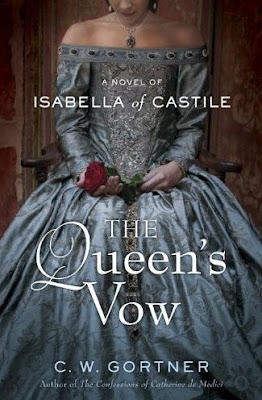
The Queen’s Vow by C.W. Gortner

The Queen’s Vow by C.W. Gortner, published June 12, is another historical fiction powerhouse about a strong, young royal who cares for her family and her country more than herself.  Isabella of Castile is the daughter of the ailing Juan II and his second wife Isabel of Portugal, and she has a younger brother Alfonso, on whom she dotes.  Her relationship with her half-brother Enrique IV is tenuous at best, and when he is poised to takeover the crown when their father dies, her mother believes it is best to flee to Arevalo.

“I slowly reached up to take my mother’s hand.  I had never dared touch her before without leave.  To me, she’d always been a beautiful but distant figure in glittering gowns, laughter spilling from her lips, surrounded by fawning admirers — a mother to be loved from afar.”  (Page VIII)

Like most royal families, children rarely spend intimate time with their parents, though often they will spend more time with their mothers if they are girls.  Isabella spends little informal time with her mother until they are removed to Arevalo, and she has virtually no relationship with her father, Juan II.

“I was not yet four years old.  My father had been ill for weeks with a terrible fever, shut behind the closed doors of his apartments in the alcazar of Valladolid.  I did not know him well, this forty-nine-year-old king whom his subjects had dubbed El Inutil, the Useless, for the manner in which he’d ruled.  To this day, all I remember is a tall, lean man with sad eyes and a watery smile, who once summoned me to his private rooms and gave me a jeweled comb, enameled in the Moorish style.  A short, swarthy lord stood behind my father’s throne the entire time I was there, his stubby-fingered hand resting possessively on its back as he watched me with keen eyes.”  (page III)

Isabella knows that of all her siblings she is the last in line and as a female heir to the throne of Castile, she will likely be sold off into marriage for political or monetary reasons.  But as a young girl sent with her mother outside the company of the crown, she has the freedom to just enjoy her family.  Her and Alfonso have a great relationship, and she has a great relationship with Beatriz, her lady in waiting, but her respite from court intrigue does not last long.  Unfortunately, there are many times throughout the book that Isabella finds herself moving from place to place, fleeing those that would do her harm even her brother Enrique, whom she remains loyal to even though he is easily swayed by others.

Readers will experience the sorrow Isabella feels about her relationship with Enrique and how finally she must break that familial bond, if she plans to survive and marry the man she loves, Fernando of Aragon.  She is often tugged in more than one direction either between her family bonds and destiny or her duty as heir to the Castile throne and the pull of her heart. In a nation pulled this way and that by different powers and political interests attempting to usurp royal power outright or through the shadows, Isabella has many demands on her time and heart, and she’s pushed to the brink more than once. She’s a stronger woman than she realizes, and with Fernando at her side, they are a force to contend with.

The Queen’s Vow by C.W. Gortner is about a promise of a better tomorrow not only for Isabella and her loved ones, but also for the country she’s seen toil with her own eyes and hands. It is a novel of perseverance, following one’s heart and instincts, and justice, but it also is a novel of family and how it can be not only nurturing but also devastating if animosities and jealously are allowed to fester. Gortner is a master at historical details, weaving them throughout a narrative that is highly emotional, tense with drama, and at times poetic in its description of the Spanish landscape. Another winning novel from this author.

About the Author:

C.W. Gortner is the author of The Last Queen, The Confessions of Catherine de Medici and The Tudor Secret. He holds an MFA in Writing with an emphasis in Renaissance Studies from the New College of California.

In his extensive travels to research his books, he has danced a galliard in a Tudor great hall and experienced life in a Spanish castle. His novels have garnered international praise and been translated into thirteen languages to date. He is also a dedicated advocate for animal rights and environmental issues.

He’s currently at work on his fourth novel for Ballantine Books, about the early years of Lucrezia Borgia, as well as the third novel in his Tudor series,The Elizabeth I Spymaster Chronicles (US) or Elizabeth’s Spymaster (UK).

Half-Spanish by birth, C.W. lives in Northern California.

5 Years in Book Blogging

5yr. blogiversary

Since staring this blog five years ago, its been a fun ride with crazy blogging events, book talk, giveaways, and more.  I thought in honor of five years, I’d talk about my favorite parts of this blog.

1.  Virtual Poetry Circle:  Even though I don’t get many responses week to week, I still get a kick out of sharing new poems that I find to post and share with others.  These poems can be from poets.org or from collections I’ve read the previous week or even long ago.  I try to vary the content from classic to contemporary, narrative to rhyming, and more.  This is always the fun part for me, “which poem will it be this week?” My index finger drumming my chin.  If there’s ever a poet you want to see featured, don’t hesitate to send a poem along or just recommend the poem by name.

2.  Interviews:  As a little girl, I longed to interview some of my favorite authors, and now I get to do that for real.  Most recently, I had the chance to interview a long-admired poet, Molly Peacock, who gave me the idea for the virtual poetry circle, and some local advocates for books and literacy like the Chair of the Gaithersburg Book Festival Jud Ashman.  It’s great to see what connects those who write books and those who promote them — love of the written world.

3.  National Poetry Month Blog Tour: This project takes a lot of planning and a lot of work to line up poets and authors, publishers, and bloggers.  Most people worry that they don’t have the “qualifications” to read and review poetry, but the only qualification you need in my book is the “joy of reading.”  If you love to read and you love to see how authors of novels create a scene or character, poetry should be a breeze.  Think of the poem as an unfolding blossom, opening up to the light with each word and each line opening to the sun.  Once you’ve reached the end, there is a full picture to behold.

4.  Community:  I started blogging around the same time as Anna, but soon fell into a wider group, led at that time by Dewey.  Even though she’s no longer with us, I know that her spirit lives on in the community — a community she loved and loved to see grow . . . and grow it has, exponentially.  I’ve got some old friends from that time, and I’ve made some new ones.  I love meeting these people in person at book festivals and conventions; it has been such a joy to share the love of books with people online and off, especially since my husband is not a big reader.

For this year’s blogiversary giveaway, You must tell me how you learned about Savvy Verse & Wit AND whether you have a favorite feature/post or read a book I recommended.

Prize pack will include:

a.  free access to 2012’s Best of List

b.  1 book of poetry from those I reviewed this year (your choice)

c.  1 book up to $25 from my local bookstore, Novel Places.

Deadline to enter will be June 30, 2012Open Internationally.

Revenge (6:1 Series, Volume 2) by Janel Gradowski

Revenge (6:1 Series, Volume 2) by Janel Gradowski is even more well crafted than the first volume of short stories and flash fiction, beginning and ending with a wallop.  Once again there are six stories in this collection: “Persistent Foe,” “Kaboom,” “Check Out,” “Inconvenience,” “Anniversary,” and “Addendum.”  Some are longer than others, but each is well paced, with only one typical revenge story — “Kaboom.”


Agnes from “Persistent Foe” is the neighbor you wish you could be when you have loud, inconsiderate neighbors of your own.  While she does not complain too much outright and doesn’t call the cops, she exacts her revenge little by little each day envisioning a big payoff in the end.  And the ending of this one is inspired and unique. Gradowski does a great job of foreshadowing in this short story as well: “She plucked the invasive vine out the basket and dropped it into the tangle of weeds flourishing on the other side.  ‘Time to join your ancestors.'”  Readers will be sitting alongside Agnes as she watches the show unfold in her neighbors backyard one late evening.

“Kaboom” was the most predictable of the stories, but what made this one heart-pumping was the descriptions Gradowski uses as she tells the revenge yarn from the point of view of the perpetrator as she’s performing the act of revenge on her ex.  Meanwhile, Josie’s revenge is only possible because of Erik’s pride in “Check Out.”  Working as a grocery store check out clerk can be incredibly mundane and tiring, but there are moments in life when even that kind of job can be satisfying, especially when you exact revenge on a boy who ditches you across town.  “Inconvenience” brings to the surface many of the emotions that swirled about following the financial crisis and the persistent unemployment born by much of the U.S. population in recent years.  With bills to pay, should the “breadwinner” in the family swallow his pride and take any paying job to support the family, or should he hold out for a better position?  The short story tackles this question and more, but the revenge exacted in this story will leave readers agape.

“Anniversary” is not the happy occasion you expect, but it twists the idea of a celebration into a revenge scenario that celebrates the ability to break free.  Gary has some serious concerns about his wife and his boss, but being an accountant, he takes stock of the situation — its pros and cons — and comes up with the best solution for everyone.  Bartender Amelia doesn’t have a clue how her luck is about to change when Gary walks into her bar.  “Addendum” is one of the longer short stories in the collection, and Karen is a bit of an enigma given her risk averse mentality when it comes to guys and her reaction to her boyfriend Don’s cheating ways.  In an apartment that has eyes and ears in the form of Mrs. Conway, its hard to keep secrets.  “She was either a gossip super hero or had bugged everybody’s apartments with microphones and hidden cameras.”  Living under a microscope must have added undue pressure on Karen.  There is a great deal at work in this short story, and could be a precursor to something longer from Gradowski.

Revenge (6:1 Series, Volume 2) by Janel Gradowski is an even more well rounded collection of short stories and flash fiction pieces with characters that are dynamic and crafty.  The characters she creates in this collection will have readers snickering and smirking as they are reminded of the revenge plots they’ve created when wronged by lovers, neighbors, and friends.  Deliciously devilish, a joy to read.

About the Author:

Janel Gradowski grew up, and still lives, in the mitten of Michigan. She is a wife and mother whose writing companion is a crazy Golden Retriever named Cooper. In the past she has worked many jobs. Renting apartments, scorekeeping for a stock car racetrack and selling newspaper classified advertisements are some of the experiences that continue to provide inspiration for her stories. Now she writes short fiction and is also a beadwork designer and teacher.

Her work has appeared in many publications, both online and in print. The 6:1 Series features themed collections of her stories. Each volume will have six stories, a mix of flash and short fiction, that are based on the title’s theme.  Visit her blog, Janel’s Jumble.

***And yes, for those keeping track, this is the third item I’ve read on my Kindle.

Mailbox Monday #180

Mailbox Mondays (click the icon to check out the new blog) has gone on tour since Marcia at A Girl and Her Books, formerly The Printed Page passed the torch. This month’s host is Burton Book Review.

The meme allows bloggers to share what books they receive in the mail or through other means over the past week.

Just be warned that these posts can increase your TBR piles and wish lists.

Here’s what I received:

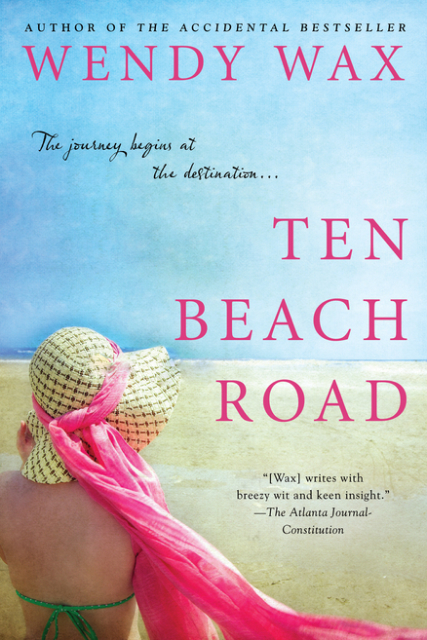
1. Monarch Beach by Anita Hughes, which I received for review.

When Amanda Blick, a young mother and kindhearted San Francisco heiress, finds her gorgeous French chef husband wrapped around his sous-chef, she knows she must flee her life in order to rebuild it. The opportunity falls into her lap when her (very lovable) mother suggests Amanda and her young son, Max, spend the summer with her at the St. Regis Resort in Laguna Beach. With the waves right outside her windows and nothing more to worry about than finding the next relaxing thing to do, Amanda should be having the time of her life—and escaping the drama. But instead, she finds herself faced with a kind, older divorcee who showers her with attention… and she discovers that the road to healing is never simple. This is the sometimes funny, sometimes bitter, but always moving story about the mistakes and discoveries a woman makes when her perfect world is turned upside down.

2. The Reckoning by Alma Katsu, which arrived for review from her publicist. So Excited.

Lanore McIlvrae is the kind of woman who will do anything for love. Including imprisoning the man who loves her behind a wall of brick and stone.

She had no choice but to entomb Adair, her nemesis, to save Jonathan, the boy she grew up with in a remote Maine town in the early 1800s and the man she thought she would be with forever. But Adair had other plans for her. He used his mysterious, otherworldly powers to give her eternal life, but Lanore learned too late that there was a price for this gift: to spend eternity with him. And though he is handsome and charming, behind Adair’s seductive façade is the stuff of nightmares. He is a monster in the flesh, and he wants Lanore to love him for all of time.

Now, two hundred years after imprisoning Adair, Lanore is trying to atone for her sins. She has given away the treasures she’s collected over her many lifetimes in order to purge her past and clear the way for a future with her new lover, Luke Findley. But, while viewing these items at an exhibit at the Victoria and Albert Museum in London, Lanore suddenly is aware that the thing she’s been dreading for two hundred years has caught up to her: Adair has escaped from his prison. He’s free— and he will come looking for her. And she has no idea how she will save herself.

3. Blood Line by James Rollins, which came unexpectedly from William Morrow and will be finding a new home.

In a thrilling masterwork that will make you rethink your perceptions of life and death, New York Times bestselling author James Rollins takes you to the edge of medicine, genetics, and technology, revealing the next evolutionary leap forward: immortality.

Galilee, 1025. Infiltrating an ancient citadel, a Templar knight uncovers a holy treasure long hidden within the fortress’s labyrinth: the Bachal Isu — the staff of Jesus Christ — a priceless icon that holds a mysterious and terrifying power that promises to change humankind forever.

A millennium later, Somali pirates hijack a yacht off the coast of the Horn of Africa, kidnapping a young pregnant American woman. Commander Gray Pierce is enlisted for a covert rescue mission into the African jungle. The woman is no rich tourist: she’s Amanda Gant-Bennett, daughter of the U.S. president.

Suspicious that the kidnapping masks a far more nefarious plot, Gray must confront a shadowy cabal which has been manipulating events throughout history…and now challenges the current presidency.

What did you receive?

Some Winners and Graham Parke Announcement

Winner Melissa of Melissa's Eclectic Bookshelf

Winners Ti of Book Chatter and Anita Yancey

Winner Anna of Diary of an Eccentric


And now an announcement from Graham Parke:

“I’m very polite by nature, even the voices in my head let each other finish their sentences.” Graham Parke, Unspent Time

I’d originally planned to have a monkey draw two random numbers out of a hat (then use the inverse hexadecimal value – because you cannot trust monkeys, not at the prices I’m willing to pay) but apparently there are laws against monkey labor. There are permits involved. It’s a whole thing. So instead I asked a friend to think of two random numbers while dressed in a monkey suit, without telling him what the numbers were for. This seemed sufficiently random to me, although it later occurred to me how worrying it was that my friend would actually do this without ever asking why. There might be a thinly veiled cry for help in there somewhere…

Kindle Fire Winner:Cecilia HuddlestonKindle Touch Winner:
Kathy Habel 


A big thank you to all the bloggers and readers who supported the Unspent Time launch event (especially those who bought multiple versions of the weird little novels that wrecked a thousand reasonably useful minds.)

Anyway, here’s the results, thank you all for joining in, winners will be contacted and forced to accept prizes, let me know if you ever come across bits in the novels you like, stay healthy and sane,

Graham Parke

“We played for about half an hour before I realized we were actually playing two different games. What I’d thought of as ludo was actually a game called gin rummy, and what Warren was playing seemed to be a mixture of craps and table tennis. Once we started playing by one consistent set of rules, though, the fun was really over.” Graham Parke, No Hope for Gomez!

153rd Virtual Poetry Circle

Welcome to the 153rd Virtual Poetry Circle!

Remember, this is just for fun and is not meant to be stressful.

Keep in mind what Molly Peacock’s books suggested. Look at a line, a stanza, sentences, and images; describe what you like or don’t like; and offer an opinion. If you missed my review of her book, check it out here.

Also, sign up for the 2012 Fearless Poetry Reading Challenge because its simple; you only need to read 1 book of poetry. Please visit the stops on the 2012 National Poetry Month Blog Tour.

Today’s poem is from Christopher Merrill:

A Boy Juggling a Soccer Ball

after practice: right foot
to left foot, stepping forward and back, 
   to right foot and left foot,
and left foot up to his thigh, holding 
   it on his thigh as he twists
around in a circle, until it rolls 
   down the inside of his leg,
like a tickle of sweat, not catching 
   and tapping on the soft
side of his foot, and juggling
   once, twice, three times,
hopping on one foot like a jump-roper 
   in the gym, now trapping
and holding the ball in midair, 
   balancing it on the instep
of his weak left foot, stepping forward 
   and forward and back, then
lifting it overhead until it hangs there; 
   and squaring off his body,
he keeps the ball aloft with a nudge 
   of his neck, heading it
from side to side, softer and softer, 
   like a dying refrain,
until the ball, slowing, balances 
   itself on his hairline,
the hot sun and sweat filling his eyes 
   as he jiggles this way
and that, then flicking it up gently, 
   hunching his shoulders
and tilting his head back, he traps it 
   in the hollow of his neck,
and bending at the waist, sees his shadow, 
   his dangling T-shirt, the bent
blades of brown grass in summer heat; 
   and relaxing, the ball slipping
down his back. . .and missing his foot.

   He wheels around, he marches 
over the ball, as if it were a rock
   he stumbled into, and pressing
his left foot against it, he pushes it
   against the inside of his right 
until it pops into the air, is heeled
   over his head--the rainbow!-- 
and settles on his extended thigh before
   rolling over his knee and down 
his shin, so he can juggle it again
   from his left foot to his right foot
--and right foot to left foot to thigh--
   as he wanders, on the last day
of summer, around the empty field.

What do you think?