Quantcast

Ashes by Ilsa J. Bick

Ashes by Ilsa J. Bick is part one in a trilogy of dystopian young adult books in which an EMP (electromagnetic pulse) wipes out all electronics, including pacemakers and other devices inside people’s bodies.  Alex is a 17-year-old girl with a brain tumor, who also has lost her parents in a horrific accident and has undergone numerous traditional radiation and experimental treatments.  She decides to leave her Aunt Hannah’s house near Northwestern University and head to the Waucamaw Wilderness of Michigan to determine what to do next — whether to go on fighting the tumor or move on.

While in the woods, she meets Ellie, her grandfather, and their dog Mina.  The 8-year-old Ellie is sarcastic and bit angry since her father’s passing in Iraq, but when the EMP hits, the only one left to rely on is a stranger and her dog, a dog that reminds her of all she’s lost.  Granted, she has a right to be angry and sad, but she whines just a bit too much and readers may find that they would be glad if Alex were to ditch her in the woods alone.

“The buzz on the plane faded and the quiet descended again like a bell jar over the forest.”  (Page 13)

Bick’s writing is suspenseful and clear, but the end of each chapter reads like a cliffhanger.  After 30 chapters, readers will be singing the equivalent of DUN DUN DUN.  Not every chapter ending needs to be this dramatic especially when there are no major plot twists revealed.  In addition to the EMP and the dramatic chapter endings, Bick introduces the Changed (aka the zombies/cannibals), those who survived the EMP, but turned primal and become cannibals.  This being a trilogy, there was no explanation of what changed these people into cannibals, nor why some kids, like Alex, Ellie, and Tom, do not change.

“She didn’t know if the tightness in her throat or the fullness in her heart meant that he was there; that they were connected somehow.  Maybe all that she saw and felt was the sensual fullness of memory:  that which abided and was nothing but the ghost of a touch, the whisper of a word, the lingering of a scent.”  (Page 374)

Ashes by Ilsa J. Bick is an action packed novel that reads like horror with all the graphic details about the killings and eating, but what it lacks is a cohesive story.  In one half of the book, Alex seems like a strong young lady interested in taking charge, but in the latter half of the book, she becomes mush.  Once in Rule, she no longer physically tries to fight or escape her captors once they’ve set her up in a house and she begins work in the hospice, and of course, meets a kind boy her own age.  The novel becomes less about the EMP and the zombies than it is about the cult-like settlement of Rule in which surviving women are passed off like chattle and are only good for propagating the species.  In many ways, it is like the author could not decide what story to tell, and whether the character was to be strong and a main catalyst or merely a weak pawn in a larger chess board.  At more than 400 pages, readers may find that editing could have compacted the story more and maybe the plot could have been tied up a little better, with fewer loose ends — even for a trilogy this has too many.  However, if you are looking for something entertaining and fast-paced, this is for you.

About the Author:

Ilsa J. Bick is an award-winning, best-selling author of short stories, e-books and novels. She has written for several long-running science fiction series, most notably Star Trek, Battletech, and Mechwarrior:Dark Age. She’s taken both Grand and Second Prize in the Strange New Worlds anthology series (1999 and 2001, respectively), while her story, “The Quality of Wetness,” took Second Prize in the prestigious Writers of the Future contest in 2000. Her first Star Trek novel, Well of Souls, was a 2003 Barnes & Noble bestseller.


This is my 62nd book for the New Authors Reading Challenge 2012.


Book Club Thoughts (Beware of Spoilers):

This selection was from one of the male members in the group who reads a great deal of young adult dystopian fiction.

Most members enjoyed the book for what it was, a fast-paced thrilling dystopian novel, but two of us disliked it because the zombies were implausible and the main character was too weak by the end.  One member said that the portion of the book in Rule was “bungled.”  While I felt that Chris in Rule was a cardboard cutout of a “good guy,” one other member liked him more than Tom, the earlier love interest for Alex.  The youngest member of the group hopes that Tom is still alive in book two, Shadows, because as of now, his fate is unknown.

Most of us agreed that should the world end as we know it that a marshal law would be necessary to keep people civil to one another and that controlling information — even about super senses — is an essential part of that.  However, I disagreed that Alex would have become as complacent as she did and merely though about squirreling away supplies; I wanted more from her — maybe more recon or attempting to find out how the town of Rule operated and why.  The information that she does glean is told to her by some rather chatty members of the town, and she learns the information with little effort on her part or very little help from her super smell.

In the final cliffhanger of the book, Alex learns that the town of Rule has been feeding the teen cannibals, but she doesn’t know why.  One of our female members suggested that maybe the teen cannibals were once some of the town’s own children that became the Changed and the members could not bring themselves to kill their own kids.  Another member said that feeding the enemy is incredibly stupid and that the town should be cutting off the food supply; at this point the town is merely aiding in their own doom.  There also are quite a few loose ends in the book that some of us noticed, and it would have been nice if some of them were tied up by the end of book one so that new mysteries could be revealed and unraveled in book two.

Five of us, which is a majority, said they would read the second book to find out what happens, but three of us were not interested in reading book two at all for a variety of reasons.  However, looks as though we’ll all be reading Shadows as it was selected from the nominations by the member who selected Ashes.
Mailbox Monday #191

Mailbox Mondays (click the icon to check out the new blog) has gone on tour since Marcia at A Girl and Her Books, formerly The Printed Page passed the torch. This month’s host is 5 Minutes for Books.

The meme allows bloggers to share what books they receive in the mail or through other means over the past week.

Just be warned that these posts can increase your TBR piles and wish lists.

Here’s what I received:

1.  The Vampire Diaries: Stefan’s Diaries Vol. 4: The Ripper by L.J. Smith, which is the final book to arrive from Barnes & Noble where I used my birthday gift card.

The year is 1888, and the scent of blood lingers heavy in the London air. Stefan Salvatore thought he could escape his violent origins by settling in the peaceful countryside of England, but when a heinous murderer named Jack the Ripper surfaces, Stefan fears darkness will always follow him. Drawn into the investigation, Stefan assumes the worst: This is the work of a vampire. And the more he learns, the more he becomes convinced that the killer is someone close to him—and that he can never outrun his past.

2.  A Father First by Dwyane Wade and Mim Eichler Rivas, which came unexpectedly from William Morrow.

As incredible as those achievements have been, it’s off the court where Dwyane has sought his most cherished goal: being a good dad to his sons, Zaire and Zion, by playing a meaningful role in their lives. Recounting his fatherhood journey, Dwyane begins his story in March 2011 with the news that after a long, bitter custody battle, he has been awarded sole custody of his sons in a virtually unprecedented court decision. A Father First chronicles the lessons Dwyane has learned as a single dad from the moment of the judge’s ruling that instantly changed his life and the lives of his boys, and then back to the events in the past that shaped his dreams, prayers, and promises.

What did you receive?

Book Club Schedule

At this point, the book club has been humming along, and we’ve come down to a name of Eclectic Bookworms as far as I can tell.  At this past meeting, we selected books for the end of this year and through May 2013.

  • Sept.  The Thirteenth Tale by Diane Setterfield, which I’ve had on the shelf since I began blogging five years ago!
  • Oct. The Help by Kathryn Stockett, which I bought ages ago and still sits unread.
  • Nov. King Solomon’s Ring by Konrad Lorenz
  • Dec. Eyes, Stones by Elana Bell — ah, poems, you’ll never guess whose nomination this was!
  • Jan. Ripper by Stefan Petruchia; I’ve got a disturbing fascination with Jack the Ripper.
  • Feb. Shadows by Ilsa J. Bick
  • Mar. Every Man Dies Alone by Han Fallada — Anna’s nominations were too hard for me to choose between, it’s a good thing majority ruled in this one.
  • Apr. Winters End by Jean-Claude Mourlevat, translated by Anthea Bell; I’m happy to see this is a translated work.
  • May The Last Van Gogh by Alyson Richman; I cannot wait to read this because yes, I have a fascination with certain artists and Van Gogh is one of them.

As usually, when I post the reviews of these books, I’ll be sure to add the book club’s thoughts on each and a spoiler warning.

What’s your book club reading?

164th Virtual Poetry Circle

Welcome to the 164th Virtual Poetry Circle!

Remember, this is just for fun and is not meant to be stressful.

Keep in mind what Molly Peacock’s books suggested. Look at a line, a stanza, sentences, and images; describe what you like or don’t like; and offer an opinion. If you missed my review of her book, check it out here.

Also, sign up for the 2012 Fearless Poetry Reading Challenge because its simple; you only need to read 1 book of poetry. Please visit the stops on the 2012 National Poetry Month Blog Tour.

Today’s poem is from Natalie Diaz’s When My Brother Was an Aztec:

The Red Blues (page 11-13)

There is a dawn between my legs,
a rising of mad rouge birds, overflowing
and crazy-mean, bronze-tailed hawks,
a phoenix preening
sharp-hot wings, pretty pecking procession,
feathers flashing like flames
in a Semana Santa parade. 

There are bulls between my legs,
a torera
stabbing her banderillas,
snapping her cape, tippy-toes scraping
my mottled thighs, the crowd's throats open,
shining like new scars, cornadas glowing
from beneath hands and white handkerchiefs
bright as bandages.

There are car wrecks between my legs,
a mess of maroon Volkswagens,
a rusted bus abandoned in the Grand Canyon,
a gas tanker in flames,
an IHS van full of corned beef hash,
an open can of commodity beets
on this village's one main road, a stoplight
pulsing like a bullet hole, a police car
flickering like a new scab,
an ambulance driven by Custer,
another ambulance
for Custer.

There is a war between my legs,
'ahway nyavay, a wager, a fight, a losing
that cramps my fists, a battle on eroding banks
of muddy creeks, the stench of metal,
purple-gray clotting the air,
in the grass the bodies
dim, cracked pomegranates, stone fruit
this orchard stains
like a cemetery.

There is a martyr between my legs,
my personal San Sebastian
leaking reed arrows and sin, stubbornly sewing
a sacred red ribbon dress, ahvay chuchqer,
the carmine threads
pull the Colorado River, 'Aha Haviily, clay,
and creosotes from the skirt,
each wound a week,
a coral moon, a calendar, a begging
for a master, or a slave, for a god
in magic cochineal pants.

There are broken baskets between my legs,
cracked vases, terra-cotta crumbs,
crippled grandmothers with mahogany skins
whose ruby shoes throb on shelves in closets,
who teach me to vomit
this fucshia madness,
this scarlet smallpox blanket,
this sugar-riddled amputated robe,
these cursive curses scrawling down my calves,
this rotting strawberry field, swollen sunset, 
hemoglobin joke with no punch line,
this crimson garbage truck,
this bloody nose, splintered cherry tree, manzano,
this metis Mary's heart,
guitarra acerezada, red race mestiza, this cattle train, 
this hand-me-down adobe drum,
this slug in the mouth,
this 'av'unye 'ahwaatm, via roja dolorosa,
this dark hut, this mud house, this dirty bed,
this period of exile.

What do you think?

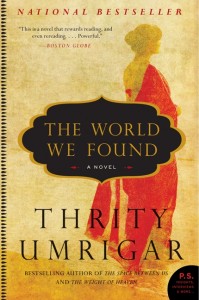
The World We Found by Thrity Umrigar

The World We Found by Thrity Umrigar focuses on four women — Laleh, Kavita, Armaiti, and Nishta — who were in college during the 1970s in India and were part of a socialist movement with their male friends Iqbal and Adish.  The students were caught in the midst of a nation’s struggle to improve its government and build a new identity as corruption had plagued the elections process and religious violence against Muslims and Hindus occurred relatively frequently.  In the late 1970s, The Emergency was declared in India, which gave the government extraordinary powers to restrict civil liberties, and led to a number of arrests and violence, among other things.

Laleh, Nishta, Armaiti, and Kavita were idealists looking to create a new world, and with their combined enthusiasm and wide-eyed innocence about a world that they could create for their futures and that of India, they dove headlong into the movement they thought best poised to help them achieve their goals.  However, the realities of social movements intervened, demonstrating the brutality on both sides and those realities forced them to choose the path that would lead them into adulthood.  Looking back on their college years, some of the group is filled with regret at what was not achieved and the friends lost, while others are glad to have had their delusions shattered and the truth revealed.  Umrigar’s characterizations demonstrate the ways in which poignant events in history can leave a lasting impression on idealists, forcing their perceptions to skew so much that they adopt the most radical of views or forcing them to realize that bodily and emotional harm are not endurable.  Although there is one member of the group who followed her ideals and made the tough choices, there are consequences of those hard decisions as well — the loss of friendships, family, and independence.

“Could time really alter things so much? If so, the devil that every religion taught people to fear and loathe was simply the passage of time.”  (page 113 ARC)

Following thirty years of silence, the women are called upon once again to come together, but this time for a friend in America who needs them.  One of them is dying and wishes to seem them all together again, but she cannot travel and they must come to her in America.  Reuniting is never easy, especially when each of them holds guilt about not keeping in touch, secrets from the past, and prejudices born of their not-so-shared history.  The world that each of them found may not be the world that they dreamed they would create together, but it is a world in which they all live now and must learn to either accept or make moves to change for themselves and one another.

“Color.  She was obsessed with color.  There was the read of the Shiraz that Richard had opened the night before.  The burnt orange of the handcrafted cherry table in the hallway.  The glitter of a computer chip, the history of human intelligence shrunk into a capsule.  The muted gold of this leather couch she was napping on.  It made you greedy, intoxicated, made you want to open your mouth and bite into the richness of the world.  It made you want to never leave it, never miss out on a day of this party, this wild carnival ride.”  (page 234 ARC)

Thrity Umrigar not only shares a bit of India’s history with her readers, but she shares some of the religious tensions that pervade Indian society and how it can color the perceptions of people who were once considered friends.  The World We Found is stunning, emotional, and heated in the issues it tackles from religious fanaticism to moral ambiguity and the tenuous bonds between friends and family.  The ties between Laleh, Kavita, Armaiti, and Nishta are unbreakable no matter what tore them apart after college, but the ties between Iqbal and Adish are no less strong, though they seem more complicated by the roles expected of men in their respective religions and Indian society.  Book clubs would have a great deal to discuss after reading this novel and are likely to come away from the discussion with a new perspective on religion and friendship.

About the Author:

Thrity Umrigar is the author of three other novels—The Space Between UsIf Today Be Sweet, and Bombay Time—and the memoir First Darling of the Morning. A journalist for 17 years, she is the winner of the Nieman Fellowship to Harvard University and a 2006 finalist for the PEN/Beyond Margins Award. An associate professor of English at Case Western Reserve University, Umrigar lives in Cleveland.  Please visit her Website.

Also check out my review of The Weight of Heaven.  Enter to win a copy at GoodReads before Sept. 10.

Some Local and Not So Local Events…

Washington, D.C., is a thriving literary community of poets, journalists, and authors, and there is never a dearth of writing events or readings for those looking for the next big book.  With that in mind, two great translated thrillers are coming out this month and both are translated by none other than K.E. Semmel, formerly the communications guru at The Writer’s Center in Bethesda, Md.

One More Page Bookstore in Arlington, Va., will be hosting him for a night of Scandinavian Noir in Translation on Aug. 23 at 7 p.m.

He’ll talk about his two translations and be interviewed by Art Taylor, who said The Caller was “chilling” and that it provided “a provocative portrait of a troubled mind.”  Between The Caller and The Absent One by Jussi Adler-Olsen, readers will be on the edges of their seats with excitement.

About The Caller:

One mild summer evening, a young couple are enjoying dinner while their daughter sleeps peacefully in her stroller under a tree. When her mother steps outside she is stunned: The child is covered in blood.  Inspector Sejer is called to the hospital to meet the family. Mercifully, the child is unharmed, but the parents are deeply shaken, and Sejer spends the evening trying to understand why anyone would carry out such a sinister prank. Then, just before midnight, somebody rings his doorbell.  No one is at the door, but the caller has left a small gray envelope on Sejer’s mat. From his living room window, the inspector watches a figure disappear into the darkness. Inside the envelope Sejer finds a postcard bearing a short message: Hell begins now.

About The Absent One:

Carl Mørck used to be one of Copenhagen’s best homicide detectives. Then a hail of bullets destroyed the lives of two fellow cops, and Carl—who didn’t draw his weapon—blames himself. So a promotion is the last thing he expects. But Department Q is a department of one, and Carl’s got only a stack of Copenhagen’s coldest cases for company. His colleagues snicker, but Carl may have the last laugh, because one file keeps nagging at him: a liberal politician vanished five years earlier and is presumed dead. But she isn’t dead … yet.

For those of you outside the D.C. area, Sarah McCoy, author of The Baker’s Daughter, and Gillian Flynn, author of Gone Girl, will be engaged in an Aug. 23 jamboree at the Crown Publishing Facebook page at 7 p.m.

Many of you have likely read Sarah’s book (check out my review) and loved it, so here’s your chance to chat with her for an hour. For those of you reading or hearing the buzz about Gillian’s book, this is a great opportunity to pick her brain.

For those of you that cannot get enough of short stories and reading, check out the third issue of The Coffin Factory, which is chock full of stories from greats like Joyce Carol Oates and James Franco. Oates has said the magazine is “a brilliantly imagined, highly readable, and important new literary magazine with the most incongruous title.”

The magazine has not only short stories, but also illustrations, and considers itself a “magazine for people who love books.” What more could book bloggers and readers ask for?

The first and second issues are available for PDF download, but why not check out a subscription or pick up a copy in your local indie bookstore?

Also, there’s going to be a great short story discussion on Savvy Verse & Wit in September of “The Mapmaker” by Thaisa Frank, which is from her collection Enchantment.  If you haven’t entered to win one of 4 copies, you better get a move on.  Time is running out.

Winner of The Color of Tea

Out of 19 entrants or so, Random.org selected #7, who was Margaret who said, “Pasteis de nata (Portuguese custard pastry) Yum!  I remember eating them in Macau,” when leaving a comment about her favorite pastry or tea for The Color of Tea by Hannah Tunnicliffe.

There is still time to enter the giveaway for Enchantment by Thaisa Frank.

The Voice I Just Heard by Susan Dormady Eisenberg

Look at this book’s cover, as the woman walks out on the stage and sees the waterfalls before her, this is a perfect metaphor for the stage fright that grips Nora Costello when she sings, especially when her dismissive parents are in the audience. Imagine what singing is like for an artist, it is the air they breathe and the thrum of their soul, but imagine how it would be to recapture your flagging confidence in the presence of parents who disapprove of the theater as a career, particularly after one of your staunchest supporters, your brother Liam, dies in the Vietnam War dashing your father’s hopes of another brilliant doctor in the family.  The Voice I Just Heard by Susan Dormady Eisenberg is an operatic debut of epic proportions, with a story that takes readers behind the scenes of theater and opera through an emotional journey of losing a brother at one of the most controversial times in U.S. history — the Vietnam War.

“As Liam and I stood elbow to elbow at the fence, he said, ‘I should’ve memorized the whole poem, but I only recall the first four lines and the last four.’  His expression turned solemn.  ‘Here’s how it ends.  “Oh may my falls be bright as thine, may heaven’s forgiving rainbow shine, upon the mist that circles me, as soft as now it hangs o’er thee.”‘

‘That’s sweet,’ I said.  ‘But what does it mean?’

‘I asked Sister Perpetua.  She said we have the power of the falls in each of us.  When we screw up, heaven sends us a rainbow to tell us we’re forgiven.’  He shrugged.  ‘It’s weird.  I’ve come here three times and never seen a rainbow, so I wonder if Moore made it up.'”  (page 152)

Eisenberg, who has written profiles of singers, actors, and more, deftly weaves in the story of Liam and Nora’s childhood and the pressures they faced to be perfect for their upper crust parents — even if that meant tamping down their desires for a new direction and passion — with the present day family dynamics of losing a son to war.  Nora is set adrift without the anchoring relationship of her brother, who in a way was her buffer between her passions and dreams and her parents’ disapproval.  Her father is stoic in his response to his child’s death, and her mother withdraws from everything.  Eisenberg’s prose brings to life the grief of these characters as the mother goes to mass daily, the father buries himself in work, and Nora seeks solace in the theater where she runs public relations for the summer showing of Annie Get Your Gun in Cohoes, N.Y., alongside her gay boss Graham Chase.  A former mill town, Cohoes is a hot bed of hidden beauty in more ways than one, and it’s the perfect setting for two battered singers to meet — Nora Costello and Barton Wheeler, where they can come to terms with the right path for their artistry and their souls.

Eisenberg’s characters are deeply emotional, high strung, and respond before thinking, which gets them into a number of situations that can be misinterpreted and blown out of proportion, and in this way, her dramatic story resembles the missteps in Pride & Prejudice.  Nora must learn to see the courage within herself, repair her relationships with her parents and childhood friend Liz, and determine what path is best for her without the influence of others.  Bart, on the other hand, is balancing his true career with the need to support his two daughters from a previous marriage, while still holding onto the family business.  When they come together sparks fly.

The Voice I Just Heard by Susan Dormady Eisenberg is about finding the confidence in oneself to reach out passionately for the life you want to lead and to never let go of it, not matter what the detractors say.  Sage advice for any artist — whether singer or poet.  Nora is spunky, head strong, and passionate, while Bart is more restrained (probably due to his age and life experiences), but he’s equally adrift as he’s lost confidence in his abilities and the right path for himself.  From the stage in Cohoes to Washington, D.C., Nora and Bart grow into themselves and their voices — voices that are their own and remind them of where they belong.  When overture sounds and the cast steps on the stage, the voices in this novel will sweep the reader away into a operatic crescendo like no other.

There is some strong sexual language in this book, so beware.

About the Author:

Susan Dormady Eisenberg is a writer based in Maryland. She has published articles in Opera News and Classical Singer (such as a November 2011 cover profile of baritone Robert Orth), as well as The Hartford Courant and The Albany Times Union. On February 3, 2012, she released her first novel, The Voice I Just Heard, as an indie ebook.

As a freelancer Susan has written promotional publications for clients throughout Greater D.C. Prior to launching her business, she did publicity for Goodspeed Opera House and Syracuse Stage, and marketing for the Joffrey Ballet/New York.

Please also check out my interview with her for the D.C. Literature Examiner.

This is my 61st book for the New Authors Reading Challenge 2012.


Mailbox Monday #190

Mailbox Mondays (click the icon to check out the new blog) has gone on tour since Marcia at A Girl and Her Books, formerly The Printed Page passed the torch. This month’s host is 5 Minutes for Books.

The meme allows bloggers to share what books they receive in the mail or through other means over the past week.

Just be warned that these posts can increase your TBR piles and wish lists.

Here’s what I received:

1.  Skeleton Women by Mingmei Yip, for a TLC Book Tour in September.

2.  The Vampire Diaries Stefan’s Diaries Vol. 5 The Asylum, which I ordered with a gift certificate I had for my birthday from Barnes & Noble, though two other books I ordered have not arrive yet.

3.  I’m Just Sayin! by Kim Zimmer (Guiding Light’s Reva Shayne!) and Laura Morton for review from Penguin.

4. A Walk in the Park by Jill Mansell for review in November.

5. Ladybug Girl book and doll set by Jacky Davis and David Soman, which I ordered with my giftcard.

What did you receive?

163rd Virtual Poetry Circle

Welcome to the 163rd Virtual Poetry Circle!

Remember, this is just for fun and is not meant to be stressful.

Keep in mind what Molly Peacock’s books suggested. Look at a line, a stanza, sentences, and images; describe what you like or don’t like; and offer an opinion. If you missed my review of her book, check it out here.

Also, sign up for the 2012 Fearless Poetry Reading Challenge because its simple; you only need to read 1 book of poetry. Please visit the stops on the 2012 National Poetry Month Blog Tour.

Today’s poem is from Elana Bell‘s Eyes, Stones:

Flags  (page 41)

Everywhere, in the fertile soil of this land, 
we've planted flags. Flags sprout like the hair
from an old man's nostrils. Blue and white 
or red, black, green and white, they shroud 
windows, standing in for a family 
you can't see: a flag instead of the mother 
who hums and spices the lentils, a flag 
for Father, who runs the blade against his cheek
each morning with the rooster's kukuku. 
Later, in the dark, he holds his wife 
while the children sleep wrapped in flags. 
Flags grow in the garden, flags from the beaks
of muted birds. Shredded flags drape phone wires, 
flags hang from the pines like dead hands—

What do you think?