Quantcast

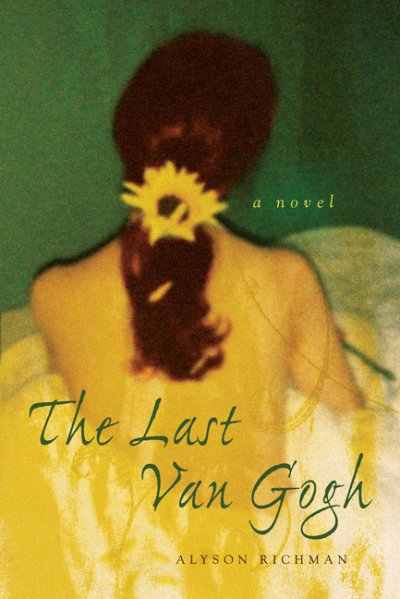
The Last Van Gogh by Alyson Richman

Book Source:  Library
Paperback: 308 pages
I am an Amazon Affiliate:

The Last Van Gogh by Alyson Richman, which was our May book club selection (unfortunately, I missed this meeting due to obligations at the 2013 Gaithersburg Book Festival), is based on true events in near the end of Vincent Van Gogh’s life in Auvers, France, in the 1890s.  Told from the point of view of Marguerite Gachet, a story unfolds not so much about Van Gogh but about the cloistered life of a young woman trapped inside her own family home by not only an overbearing and controlling father, but also family secrets.  More than that, it is a tribute to an artist and the tension between that art and the desire to have a normal life, as well as the struggle between family obligation and one’s own desires.

“For a home that had so many colors and vibrant paintings on its walls, there were still so many shades of gray between us.”  (page 182)

Richman does really well in using painting techniques and colors to describe the scenes in Auvers, and it is almost as if the reader has stepped inside one of Van Gogh’s paintings and is walking around among the village’s people.  Another surprising element is that the chapter headings, which often appear in some translated works, are less in-your-face about each chapter’s contents.  The headings also add to the atmosphere of the novel, reinforcing the painting and French aspects of the novel.

“I had gone out to do my errands, as I always did in the early afternoon.  It was a warm, radiant day in May.  The sky was cornflower blue, the sun the color of crushed marigolds.  I have to confess that I walked a little slower that day when I passed by the station.  I knew approximately which train he would be arriving on.  So I walked with smaller steps than usual, carrying my basket of eggs and my loaves of bread.”  (page 1)

From the moment readers meet Marguerite, they can see her rebellious nature, even though her daily tasks showcase her obedience to her father at every turn.  When the secrets begin to unravel, she finds herself less torn between duty and desire and more willing to follow her own mind and heart, even if it means getting caught.  Her father is the most irritating and self-absorbed character as he seeks to ingratiate himself into the artistic community by claiming his tinctures are actual cures.  And the son, Paul, is just as bad as he attempts to please his father at every turn and garner his favor.  The only way he can gain that favor is through Marguerite’s downfall, which she brings about on her own during her fateful meeting with Van Gogh.

The Last Van Gogh by Alyson Richman is a rich story in character, setting, and nuance.  Van Gogh’s perceptive nature as an artist shines through in his painting of Dr. Gachet as an aging man with sallow features, but it also shines through in his paintings of Marguerite at the piano and in the garden.  A love story in painting that comes alive with each brush stroke, only to be mired by the rain streaked canvases touched by tinctures that are misused and the controlling desires of a man torn between propriety and his obsession with art.

About the Author:

Alyson Richman is the author of “The Mask Carver’s Son,” “The Rhythm of Memory (formerly published as Swedish Tango),” The Last Van Gogh,” and the national best-seller, “The Lost Wife.” She loves to travel, cook, ride her yellow bicycle, and do ballet. She currently lives in New York with her husband and two children.
This is my 33rd book for the 2013 New Authors Challenge.
Mailbox Monday #221

Mailbox Monday (click the icon to check out the new blog) has gone on tour since Marcia at A Girl and Her Books, formerly The Printed Page passed the torch. May’s host is 4 the LOVE of BOOKS.

The meme allows bloggers to share what books they receive in the mail or through other means over the past week.

Just be warned that these posts can increase your TBR piles and wish lists.

Here’s what I received for review:

1.  Controlled Hallucinations by John Sibley Williams, which I received from the poet.

Filled with impassioned logic and musicality, John Sibley Williams’ debut collection strives to control the uncontrollable by redefining the method of approach. In these compact poems, so edged in dark corners and the strenuous songs of beauty and identity, Williams establishes a unique world of contradictions and connections that bridge the foreign and the familiar. Moving through art and history, through apocalyptic visions and family, into and back out of the paradox of using language to express languagelessness, Controlled Hallucinations weaves universal themes and images with the basic human reality of touch, word, and what is lost in their translation.

What did you receive?

202nd Virtual Poetry Circle

Welcome to the 202nd Virtual Poetry Circle!

Remember, this is just for fun and is not meant to be stressful.

Keep in mind what Molly Peacock’s books suggested. Look at a line, a stanza, sentences, and images; describe what you like or don’t like; and offer an opinion. If you missed my review of her book, check it out here.

Also, sign up for the 2013 Dive Into Poetry Challenge because its simple; you only need to read 1 book of poetry. Check out the stops on the 2013 National Poetry Month Blog Tour and the 2012 National Poetry Month Blog Tour.

Today’s poem is from Jeannine Hall Gailey’s Unexplained Fevers: (my review) (This one is for Ti over at Book Chatter)

Sleeping Beauty's Insomniac Twin
             an homage to Haruki Murakami's After Dark

I thought you might recognize me
without the dress and haircut.
Black eyeglasses and a thick book
are enough to dissuade most of the nightcrawlers,
the men looking for a good time and easy lay.
If you come with me, you'll cower at the mafia men
at midnight, pimps and broken prostitutes wrapped in sheets.
We'll narrowly miss being hit by a car.
The late night coffee shops croon their old, seedy jazz tunes.
Come with me, through the open mouth of the city,
where we will rescue the other half of our souls.
If you fall asleep, you'll miss what's right in front of you.

What do you think?

2013 Gaithersburg Book Festival

Tomorrow between 10 a.m. and 6 p.m., the fourth annual Gaithersburg Book Festival will offer authors, poets, and activities for kids.

Among the authors I’m looking forward to are these:

And those poets on the Poetry in the Afternoon Panel, I’m moderating are:

I hope that if you are in the area, you’ll stop by the panel or at least see some great authors.  This is always a great family event and shares the love of books.

Trace by Eric Pankey

Book Source: Purchased at Novel Places
Paperback, 68 pgs
I am an Affiliate of Amazon.com

Trace by Eric Pankey, published by Milkweed Editions on 100 percent post-consumer waste paper, is a melancholy collection of poems that explores faith and the vacillation between believing and not.  Combining science and philosophy with observations of nature, Pankey examines the impact of life upon life, memory, and the other.  “If all matter is constant, what can one add to creation?”, the narrator of “A Line Made While Walking” asks.  What are these lines that we draw between our past and present, God and ourselves, and even between one another — are they not just arbitrary demarcations.  Like in “Out-of-the-Body,” the narrator watches the river otter and wonders if the animal is at play or working and whether even such distinctions enter into his thoughts while he’s busily breaking up the ice.  And if the otter does not make these distinctions, why do we, especially when we lie awake at night.  If only we could watch ourselves from outside of ourselves, what would we see?

Pankey’s preoccupation with death and its ultimate push to think about faith in something greater than ourselves permeates each and every poem in the collection, though some more intensely than others.  “All of winter, like a suppressed yawn, wells up inside me” is just one line from “Cogitatio Mortis” or I think of death (a rough Latin-to-English translation).  Death is never far from us or our thoughts, especially in today’s media hyped up world in which news from across the globe reaches us in seconds and wars continue to break out across the world.

Edge of Things

I wait at the twilit edge of things,
A dry spell spilling over into drought,

The slippages of shadow silting in,
The interchange of dusk to duskier,
The half-dark turning half-again as dark.

There:  night enough to call it a good night.

I wait for the resurrection, but wake to morning:
Mist lifting off the river.
Ladders in the orchard trees although the picking's done.

There are moments of hope in the collection, as Pankey’s poems discuss the death of the body, but not the soul. In “The Place of Skulls,” the narrator talks about the millstones and the hauling down of the bodies, but that the tree continues living and bearing fruit. Whether this is a poem about reincarnation, the absorption of the soul into the tree, or the mere image of saplings that have grown up and bear their own fruit after the sire has passed on does not matter because there is hope that life never just stops.  Faith is at the edges of these poems and underneath them, but on the surface, there is death, loss, and memories of all that has passed, even if those memories are faded and carry different emotional context than they did in the moment of creating them.

Trace by Eric Pankey is a collection focused on faith and passing on and what one wishes to leave behind, compared to what is actually left behind.  It is about the struggle to continue to get up every day and face it head on, even if death is closer than ever.

About the Poet:

Eric Pankey is the author of nine collections of poetry. TRACE, published by Milkweed Editions this year is the most recent. Two new collections, DISMANTLING THE ANGEL, and CROW-WORK are forthcoming. He is the Heritage Chair in Writing at George Mason University.

He’ll be at the May Gaithersburg Book Festival for “Poetry in the Afternoon” moderated by me!


This is my 21st book for the Dive Into Poetry Challenge 2013.


This is my 32nd book for the 2013 New Authors Challenge.

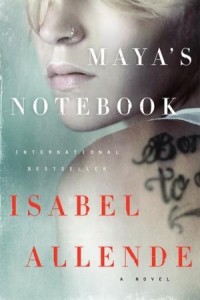
Maya’s Notebook by Isabel Allende

Book Source: HarperCollins and TLC Book Tours
Hardcover: 400 pgs
I am an Affiliate of Amazon.com

Maya’s Notebook by Isabel Allende is written in a notebook form without chapter breakdowns and is not a linear narrative.  Maya Vidal is a very troubled youth when tragedy strikes her very unconventional family of her pilot father who is rarely home, her grandparents Nidia and Popo, her absent mother Marta Otter, and the family friend Mike O’Kelly.  The novel is a departure from Allende’s typical historical fiction novels, but do not expect history to be absent from this coming-of-age novel — the takeover of Chile by Pinochet is present in the background, hanging over the Vidal family like a hazy cloud.  From her nose ring and tattoos to her goth clothes, Maya and her vampire friends set out on a path of self-destruction as a way to rebel against their family lives that they claim are very distasteful and harmful.  However, unlike Debbie and Sarah, Maya’s life is far from abusive and emotionally vacant, though it has changed significantly.

“I love some of the island’s customs, like truco, but there are others that bug me.  If a chucao, a tiny loudmouthed bird, chirps to the left of me, it’s bad luck, so I should take off a piece of clothing and put it back on inside out before going any farther; if I’m walking at night, I’m supposed to carry a clean knife and salt, because if I cross paths with a black dog with one ear lopped off, that’s a brujo, and in order to get away I have to trace a cross in the air with the knife and scatter salt.”  (Page 47 ARC)

Allende is a novelist that handles details with aplomb, weaving them in the disjointed narrative at just the right time, leading readers on an emotional journey that evokes not only frustration at Maya’s behavior, but also one of sympathy and sadness for the losses she feels.  She needs to hit rock bottom in order to climb up and rebuild her life, even though she falls off a high cliff into the abyss of drug dealers, mafia criminals, and the sex trade.  Allende does not sugarcoat anything that Maya experiences in her rehab stints or her escapes and drop off the map inside Las Vegas.  Unwittingly or willfully blind, Maya stumbles into a crime ring that is bigger than she ever thought it could be and it puts her life and the lives of her loved ones in danger as she never could have imagined. However, the end game with the conspiracy feels a bit contrived.

Maya’s past is never far behind, even as her life spirals out of control, chirping behind her ear at every turn.  Running is the only way she knows how to deal with her emotions, and its the way her family has dealt with the harsh struggles of their lives since the time of Pinochet. The ties that bind this family are stronger than ever, even as dynamics change between them and secrets of the past are uncovered. Love is the strongest tie, but fear also can be a great motivator as the walls close in. Maya’s Notebook by Isabel Allende is a modern marvel that will make a lasting impression on readers as a headstrong girl becomes unmoored and is forced to not only confront her own demons but the ghosts of the past.

About the Author:

Born in Peru and raised in Chile, Isabel Allende is the author of many bestselling novels, including, most recently, Island Beneath the SeaInes of My Soul, Zorro, Portrait in Sepia, and Daughter of Fortune. She has also written a collection of stories; three memoirs, The Sum of Our Days, My Invented Country, and Paula; and a trilogy of young adult novels. Her books have been translated into more than 27 languages and have become bestsellers across four continents. In 2004 she was inducted into the American Academy of Arts and Letters. Allende lives in California.  Find out more about Allende, her books, and her foundation at www.isabelallende.com, and connect with her on Facebook.

The Klipfish Code by Mary Casanova

The Klipfish Code by Mary Casanova is a young adult novel set during World War II when Norway was occupied by the Nazis for five years.  Rather than acquiesce to all of the Nazis demands and become indoctrinated, many of them showed their solidarity in small ways, including wearing paperclips on their clothes and not speaking to those in the community who turned into Nazi informers.

Marit is a young girl of ten when the first bombs fall on Norway, which has become a pawn in the war as the Germans seek to control the ports and the British seek to do the same.  Her parents are eager to join the Resistance and help the British as best they can — her father’s knowledge of bridges and roads and her mother’s ability to speak English — but it forces them to break up the family and send their children to Godøy Island to live with their grandfather Bestefar and their aunt Ingeborg.  While Marit and her brother Lars have spent summers there, Marit does not get along well with her grandfather who she finds favors her brother.

“She couldn’t believe he was actually speaking to her.  She didn’t know if he wanted an answer or not, but she gathered her courage.  ‘But Bestefar, if no one fights back, the Germans will be here forever!'” (page 41)

Casanova’s story is based in fact, which can be found in the notes at the back of the book, and her characters are believable as young children caught in a war they do not understand.  Marit struggles with her morals as she’s forced by her peers to not speak to her friend Olaf in school because his parents turned in a Norwegian to the Nazis.  While Marit is brave at the beginning of the occupation, she falters as any young child would in the face of oppression and danger, and she must come to terms with her own convictions and if they are worth the price she and her family might pay.

Unlike other suspenseful young adult novels in which children are the main protagonists and the most important actors in the plot, Casanova has stuck to the real world dynamics of the world in which children do not know everything and are not the main actors.  Marit demonstrates fear as she strives to deliver the klipfish code and when she encounters the Germans up close.  The Klipfish Code by Mary Casanova is a realistic account of Norway’s struggles during the Nazi occupation without being too graphic about the violence that came with that regime.

About the Author:

Mary Casanova is an award-winning children’s author of novels and picture books. Many of her books stem from her life on the Minnesota-Canadian border; yet some of her stories have taken her as far away as France, Norway, and Belize for research. Whatever the setting for her books, Casanova writes stories that matter–and stories that kids can’t put down.

Her book awards include: American Library Association “Notable,” Aesop Accolades by the American Folklore Society, Parents’ Choice “Gold” Award, Booklist Editor Choice, and two Minnesota Book Awards. Her books frequently land on state children’s choice book master lists across the country. “The greatest reward for me,” Casanova states, “is when a young reader tells me she or he loves one of my books. For me, it’s all about communicating writer-to-reader through a character and story.”

This is my 31st book for the 2013 New Authors Challenge.
Mailbox Monday #220

Mailbox Monday (click the icon to check out the new blog) has gone on tour since Marcia at A Girl and Her Books, formerly The Printed Page passed the torch. May’s host is 4 the LOVE of BOOKS.

The meme allows bloggers to share what books they receive in the mail or through other means over the past week.

Just be warned that these posts can increase your TBR piles and wish lists.

Here’s what I received for review:

1.  The Neruda Case by Roberto Ampuero for review from Penguin.

Roberto Ampuero’s novels starring the wonderfully roguish Cayetano Brulé are an international sensation. In The Neruda Case, readers are introduced to Cayetano as he takes on his first case as a private eye. Set against the fraught political world of pre-Pinochet Chile, Castro’s Cuba, and perilous behind-the-Wall East Berlin, this mystery spans countries, cultures, and political ideas, and features one of literature’s most beloved figures—Pablo Neruda.

Cayetano meets the poet at a party in Chile in the 1970s. The dying Neruda recruits Cayetano to help him solve the last great mystery of his life. As Cayetano fumbles around his first case, finding it hard to embrace the new inspector identity foisted upon him, he begins to learn more about Neruda’s hidden agenda. Neruda sends him on a whirlwind expedition around the world, ending back in Chile, where Pinochet’s coup plays out against the final revelations of their journey.

2.  Our Held Animal Breath by Kathryn Kirkpatrick for review for TLC Book Tours.

Our Held Animal Breath is a collection of poems grappling with the failure of human political and social structures to effectively address the dilemmas of our crucial historical moment.  Registering an eco-feminist consciousness, the narrators of these poems expose the intertwined vulnerabilities of women, animals, and the land to masculinist agendas of mastering nature for profit.

Poems in the opening section explore the ways powerful elites compromise the habitats of human and non-human animals alike.  The lives of tethered foxes, bewildered squirrels, displaced buffalo, and factory-farmed turkeys echo the lives of ordinary citizens experiencing degradation and disenfranchisement in the face of climate change, war-mongering, and political corruption.

3.  Marilyn’s Red Diary by E.Z. Friedel, which came unexpectedly from Meryll L. Moss Media that will likely find a new home.

Based on shocking new information, MARILYN’S RED DIARY documents Miss Monroe’s roller-coaster final years, culminating in her murder.The star, yearning to become a mother, suffers several miscarriages. Distraught, she becomes infatuated with the Kennedy’s, only to be brought down by their enemies. Through her renowned psychiatrist, Marilyn’s medical problems, drug use, and cause of death are explained.

In June of 1960, on the urging of psychiatrist Ralph Greenson, Marilyn Monroe begins keeping a diary. The former foster child feels unloved, unfulfilled, and unappreciated. Professionally, she wants to be considered a serious dramatic actress. Her husband, honored playwright Arthur Miller. has penned THE MISFITS script for her next project. Emotionally, she fervently hopes for a child to begin her family. Despite several pregnancies, Marilyn has been unable to carry to term. She blames her supportive older partner and her own severe gynecological scarring. Extremely promiscuous, she remains hopelessly in love with John Kennedy, the dashing Senator who is beginning his presidential campaign. After a decade long affair, they are once again hot and heavy.

4.  The Cinnamon Peeler by Michael Ondaatje, which I got at the library sale.

Michael Ondaatje’s new selected poems, The Cinnamon Peeler, brings together poems written between 1963 and 1990, including work from his most recent collection, Secular Love. These poems bear witness to the extraordinary gifts that have won high praise for this truly original poet and novelist.

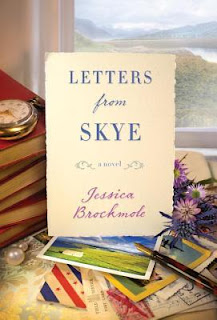
5. Letters from Skye by Jessica Brockmole from the publisher for a TLC Book Tour.

A sweeping story told in letters, spanning two continents and two world wars, Jessica Brockmole’s atmospheric debut novel captures the indelible ways that people fall in love, and celebrates the power of the written word to stir the heart.   March 1912: Twenty-four-year-old Elspeth Dunn, a published poet, has never seen the world beyond her home on Scotland’s remote Isle of Skye. So she is astonished when her first fan letter arrives, from a college student, David Graham, in far-away America. As the two strike up a correspondence—sharing their favorite books, wildest hopes, and deepest secrets—their exchanges blossom into friendship, and eventually into love.

But as World War I engulfs Europe and David volunteers as an ambulance driver on the Western front, Elspeth can only wait for him on Skye, hoping he’ll survive.   June 1940: At the start of World War II, Elspeth’s daughter, Margaret, has fallen for a pilot in the Royal Air Force. Her mother warns her against seeking love in wartime, an admonition Margaret doesn’t understand. Then, after a bomb rocks Elspeth’s house, and letters that were hidden in a wall come raining down, Elspeth disappears. Only a single letter remains as a clue to Elspeth’s whereabouts. As Margaret sets out to discover where her mother has gone, she must also face the truth of what happened to her family long ago.

What did you receive?

201st Virtual Poetry Circle

Welcome to the 201st Virtual Poetry Circle!

Remember, this is just for fun and is not meant to be stressful.

Keep in mind what Molly Peacock’s books suggested. Look at a line, a stanza, sentences, and images; describe what you like or don’t like; and offer an opinion. If you missed my review of her book, check it out here.

Also, sign up for the 2013 Dive Into Poetry Challenge because its simple; you only need to read 1 book of poetry. Check out the stops on the 2013 National Poetry Month Blog Tour and the 2012 National Poetry Month Blog Tour.

Today’s poem is from Seth Abramson’s Thievery:

Things Unso (page 18)

If the wind takes the house
it will be someone else's
soon enough, and they too
will find it cold.  What breaks
breaks open.  After a house
one finds oneself in a wood,
and after too long in a wood
one finds oneself sullen
in heaven.  Someone else lies
in my bed now so I can't sleep
any better than they do.
To be lost is to be connected
interminably.
When they turn in my bed
the whole house turns, and I 
turn, and the wind is emptied
through my own and theirs
and through a common door
to some place I do not know.
If things fall far enough apart,
they are all equally gone.

What do you think?

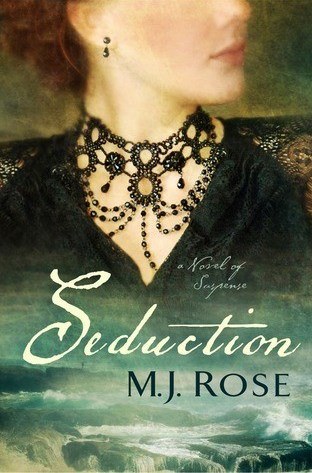
Seduction by M.J. Rose

Seduction by M.J. Rose shifts from the present day to the 1850s as Jac E’Toile uncovers more of her family and Malachai’s secrets, as well as the connections to seances, the Druids, and reincarnation.  Memories and past lives cricle in on themselves revealing bit by bit how entwined Jac’s life is with Theo Gaspard, the man who invites her to the Isle of Jersey to research the island’s Celtic roots.  In the process, readers see a side of Victor Hugo they may not have heard of before, a side that has been documented in his own notations.  Like the other books in Rose’s reincarnationist series, Seduction can be read as a stand alone novel, though some readers may want to read The Book of Lost Fragrances (my review) first.

“They climbed the wrought-iron circular spiral. Its steps were narrow and turned on themselves sharply, making them hard to navigate and easy to fall down, Jac thought. The upper balcony hung over the fist floor. From the slightly different scent, Jac knew there was a concentration of older volumes up here.” (page 153 ARC)

Rose weaves mystery with romance, history, and elements of spiritualism.  Hugo and the Gaspard family become obsessed with loss and overly consumed to the point where they are nearly willing to make a deal with the devil to bring back those they love.  Jac and Malachai have known each other since she was a teenager, and while he continues to obsess over the search for the 12 memory tools, Jac continues to hold him in esteem until events shake her faith in him.  However, Seduction is less about the search for memory tools and more about uncovering the past and past lives.  Each of these characters is seduced, either by their grief or their fear, and in the end, their triggers may be different but their obsessions threaten to take them over.

“To be a decent writer you must have both empathy and imagination.  While these attributes aid your art, they can plague your soul.  You don’t simply suffer your own sadness, experience your own longing and worry about your own wife and children, you are burdened with experiencing the emotional states of multitudes of others you don’t know.”  (page 80 ARC)

While the narrative slips between Jac’s story and that of Victor Hugo, as well as a period during the time of the Druids, these stories could have easily stood on their own had it not been for the reincarnation connection threading through the entire novel.  In many ways, the connection to Hugo could have been explored without the Druid connection, but Rose’s story arc carries a deeper sense of connection between her characters.  In addition to reincarnation and seances, the narrative has elements of the Gothic, with the dark brooding sea and the mysterious disappearances of young girls, intertwined with the treasure hunt for Victor Hugo’s journal.  Rose’s narrative is like the faint scents of perfume winding their way into the nasal cavity from a distance, only to strengthen as the tantalizing aroma beckons the reader further on the journey to the source.  Seduction by M.J. Rose is a novel full of mystery that only unravels with time and patience as Jac journeys outside her comfort zone to embrace her talents as a perfumer and a reincarnated soul.

I, for one, cannot wait to see what Rose has in store for the next installment in this series, though I’m not ready to say goodbye to Jac.

About the Author:

M.J. Rose is the international best selling author of eleven novels and two non-fiction books on marketing. Her fiction and non-fiction has appeared in many magazines and reviews including Oprah Magazine. She has been featured in the New York Times, Newsweek, Time, USA Today and on the Today Show, and NPR radio. Rose graduated from Syracuse University, spent the ’80s in advertising, has a commercial in the Museum of Modern Art in NYC and since 2005 has run the first marketing company for authors – Authorbuzz.com. The television series PAST LIFE, was based on Rose’s novels in the Renincarnationist series. She is one of the founding board members of International Thriller Writers and runs the blog- Buzz, Balls & Hype. She is also the co-founder of Peroozal.com and BookTrib.com.

Rose lives in CT with her husband the musician and composer, Doug Scofield, and their very spoiled and often photographed dog, Winka.

For more information on M.J. Rose and her novels, please visit her WEBSITE. You can also find her on Facebook.

Also Reviewed:

The Hypnotist by M.J. Rose
The Memorist by M.J. Rose
The Book of Lost Fragrances by M.J. Rose