Quantcast

The Fact of the Matter by Sally Keith

The Fact of the Matter by Sally Keith, published by Milkweed Editions on 100 percent post-consumer waste paper and who will be at the 2013 Gaithersburg Book Festival) allows nature to run rampant through the poems, lifting up the reader and at the same time opening the door to reality.  While we strive to compartmentalize our lives to the before, during, and after of pivotal moments, the reality is that these moments are not separate and cannot be separated.  This analytical approach to our very journeys runs contrary to the emotional and experiential ways in which we live.  The struggle between the logical part of the brain and the emotional part can be seen in every poem, but it is particularly pronounced in the poems “Providence,” “Knot,” and “Crane.”

Keith’s use of nature elements, especially wind, provide readers with not only emotional cues to the state of things, but also paints vivid landscapes that evoke emotional responses.  In each poem, there is a longing for the past and what was, but it is not so overwhelming that the present moment nor the emotional memory of the past is lost.  While facts play a key role in grounding some of these poems, behind the scenes Keith weaves a narrative that haunts each poem with a depth of emotion and progression toward the realization of one’s own mortality and its nearness at all times.  “What is Nothing But a Picture,” is a prime example of this technique as the narrator paints a mural of seascapes and battles in the past, while examining the past, present, and end.  Like with many artists, there is a restless to the narrative, and this restlessness becomes overwhelming by the end of the poem when “The dogs’ hot breath hits in gusts./Clouds thicken.  Clouds splice/down far-off mountainsides no one sees./The surface of the ocean is heavy./The surface is a ruin that breathes./”  (pages 27-42)

For Example (page 52)

The pale undersides of sycamore leaves, knocking
at seed pods hanging in brown bunches

so that they helicopter down.
Slag heap, mad slack, taut song:

Which morning am I making up now?
Somewhere wild animals are seeking cool hollows

in which to lay themselves down.
A wall of cotton disperses in the wind.

Keith references the great battles and losses of Achilles and Hector on more than one occasion, and it would seem that these references point to a kinship between these heroes and the people of today, although the losses may not achieve the same legendary magnitude.  The Fact of the Matter by Sally Keith explores not only the facts of matter, but also the emotional ties that bind us and the art that is born out of those experiences, which can never truly capture those moments in the same way that they were lived — a kind of existential examination of grief and mortality.

About the Poet:

Sally Keith is the author of two previous collections of poetry: Design, winner of the 2000 Colorado Prize for Poetry, and Dwelling Song, winner of the University of Georgia’s Contemporary Poetry Series competition. Her poems have appeared in Colorado Review, A Public Space, Gulf Coast, New England Review, and elsewhere. Keith teaches at George Mason University and lives in Washington, DC.
This is my 20th book for the Dive Into Poetry Challenge 2013.


This is my 30th book for the 2013 New Authors Challenge.


She’ll be at the May Gaithersburg Book Festival for “Poetry in the Afternoon” moderated by me!

Unexplained Fevers by Jeannine Hall Gailey

Unexplained Fevers by Jeannine Hall Gailey builds on the poet’s exploration of popular myths and legends centered on women, only unlike Becoming the Villainess (my review) where the characters become vengeful, these characters are striking out for parts unknown, examining their legends, and telling the real tales behind the fairy magic.  From Jack and Jill who vowed to stay together against all odds who find themselves in Ohio to Alice in Wonderland who merely gets lost in a coat closet, Gailey is poking fun at the fantasies that rely on women being beautiful and little else to prove their worth.  These heroines are set free, and outside the confines of their tales, they are able to contemplate their past choices and their futures in ways they never though possible.

She Had Unexplained Fevers (page 3)

some nights she just wasn't
herself, skin pale and damp as a child's
they lay her in a glass coffin
told me there was something in her throat
and I said yes we've all swallowed a lot of crap
choked down broken promises like apple.

In looking at these tales, Gailey is not only calling into question their validity but also their impact on the generations that have read them. Are women supposed to be only beautiful and only want that prince to come rescue them? And by the end of the collection, the poet asks readers to think about how much has changed even in the modern world. May be there are few princes with castles and white steeds, but don’t they have other “enticements” like good paying jobs and the house in the suburbs that women continue to gravitate towards as safe and what they should want from their lives?

Like “Alice, Through the Looking Glass,” there are poems that are more universal and do not stick as closely to the stories as some other poems do, and in these poems, Gailey raises questions about body image and the prevalence of women in advertising to not only sell products, but also to sell an idea of what beauty is and should be for every woman. The narrator in “Alice” asks, “What am I doing here in this white room/with no smell but dust and soap//” Meanwhile, Snow White asks the reader in “I Like the Quiet: Snow White” to get her out of our own looking glasses — break free from the need for a certain appearance — readers would see their true selves and who each of us really is and how we matter without the constant need to live up to a beauty standard. Snow White is just like all of us, wanting to spend time alone, wanting space to decide the course of our lives, wanting not to rush into a marriage even with a prince, and all the trappings and decisions we make in our lives.

Unexplained Fevers by Jeannine Hall Gailey easily parallels the myths and stories we’ve read and memorized as children with the current modern lives we lead.  Though lest you think all of the poem narrators are female, there are male narrators, including one knight who did not get the fairytale ending he was expecting.  In this way, Gailey is calling into question the fantasies that men are fed as children as well; must they be rescuers and be the strongest and bravest to get the girl?  A phenomenal collection from beginning to end — one that has a permanent place in my library, right next to her others.

About the Poet:

Jeannine Hall Gailey is the Poet Laureate of Redmond, WA and the author of Becoming the Villainess, She Returns to the Floating World, and Unexplained Fevers, available spring of 2013. Her work has been featured on NPR’s The Writer’s Almanac, Verse Daily, and The Year’s Best Fantasy and Horror. Her poems have appeared in The American Poetry Review, The Iowa Review, and Prairie Schooner. She teaches part-time at National University.

This is my 19th book for the Dive Into Poetry Challenge 2013.

The Collected Poems of Marcel Proust edited by Harold Augenbraum

The Collected Poems of Marcel Proust edited by Harold Augenbraum includes not only the original French alongside the English translations of the poems, but also detailed notes on the various references and historical context for each of the poems at the end of the collection. As an interesting addition, there are a few of the original drawings that Proust sent along with the poems in his correspondence.  Proust is generally known for his prose, and most people don’t know that he wrote poems.  (While I’ve read some of his poems before, I have not read his prose.  I’m a bit out of the norm.)  “The poems were composed from when Proust was seventeen to when he was fifty,” says the introduction on page xvi.  That’s a long period of time, and there are a great many poems.  How many of these poems were written down in one moment or revised is unclear, but some of these poems clearly were further along in the process.

Proust’s poems range from witty to plainspoken and sarcastic.  Some of his poems about love border on the edge of passion and hatred, and there are moments in certain poems that may remind readers of the great Romantic poet Percy Bysshe Shelley.  Proust’s poems celebrate not only art, but also music, language, and friendship — even those relationships that sour.  Many of these poems were untitled.

Poem 9 (page 27)

Madame, it's possible that I have forgotten
Your divine and birdlike profile,
That I have pushed past my own madness
Like one jumping through a hoop,
But always still your eyes will shine
Like bright chandeliers on the ceiling of my mind.

His poems are playful and cutting at the same time, and his grasp of language and all its capabilities is astounding. Readers will wonder about the subjects that are not clearly named, but at the same imagine their own obsession or loved one in their stead. Even without knowing the subject of poem 9, the reader can gather that the woman once held an esteemed place in the poet’s heart, but has now fallen into disgrace in his eyes. And yet, even though the love affair has gone downhill, she still is remembered fondly but will remain in the past.

From the traditional forms of sonnet to the less-than-traditional prose-like poetry in the collection, readers will get a sense of Proust’s evolution as a writer and his experiences as he saw them. The Collected Poems of Marcel Proust edited by Harold Augenbraum has a lot to offer readers, and while it is not necessary to read the French, those who can will have a richer experience.

About the Poet/Author:

Valentin Louis Georges Eugène Marcel Proust was a French novelist, critic, and essayist best known for his monumental novel In Search of Lost Time. It was published in seven parts between 1913 and 1927.

This is my 18th book for the Dive Into Poetry Challenge 2013.


This is my 29th book for the 2013 New Authors Challenge.

Mailbox Monday #219

Even though my Mailbox Mondays have been on hiatus for the most part this month, I wanted to share all the books I’ve received, some of which already were reviewed.

Mailbox Monday (click the icon to check out the new blog) has gone on tour since Marcia at A Girl and Her Books, formerly The Printed Page passed the torch. May’s host is 4 the LOVE of BOOKS.

The meme allows bloggers to share what books they receive in the mail or through other means over the past week.

Just be warned that these posts can increase your TBR piles and wish lists.

Here’s what I received for review:

1.  Let’s Explore Diabetes With Owls by David Sedaris, which came unexpectedly from Little & Brown and may be passed along to someone else.

From the unique perspective of David Sedaris comes a new book of essays taking his readers on a bizarre and stimulating world tour. From the perils of French dentistry to the eating habits of the Australian kookaburra, from the squat-style toilets of Beijing to the particular wilderness of a North Carolina Costco, we learn about the absurdity and delight of a curious traveler’s experiences. Whether railing against the habits of litterers in the English countryside or marveling over a disembodied human arm in a taxidermist’s shop, Sedaris takes us on side-splitting adventures that are not to be forgotten.

2.  Pain, Parties, Work by Elizabeth Winder for review with TLC Book Tours.
In May of 1953, a twenty-one-year-old Plath arrived in New York City, the guest editor of Mademoiselle’s annual College Issue. She lived at the Barbizon Hotel, attended the ballet, went to a Yankee game, and danced at the West Side Tennis Club. She was supposed to be having the time of her life. But what would follow was, in Plath’s words, twenty-six days of pain, parties, and work, that ultimately changed the course of her life.


3.  Three-Ring Rascals: The Show Must Go On! by Kate Klise and illustrated by M. Sarah Klise from Anna.

Ladies and gentlemen! Boys and girls!

Step right up and hear the amazing tale of Sir Sidney’s Circus.

Listen to how Sir Sidney, a kindly old circus owner, needed a rest.

Read and weep when Sir Sidney leaves the circus in the hands of a big mean baddie.

Shriek with terror as Barnabas Brambles cracks his whip at Elsa the elephant.

Cry in horror when Mr. Brambles tries to sell Leo the lion to a zoo.

Hide your eyes as the Famous Flying Banana Brothers perform death-defying feats to get the circus train to the show on time!

Can they do it? Will they make it? They better, because THE SHOW MUST GO ON!

Black and white line drawings throughout.

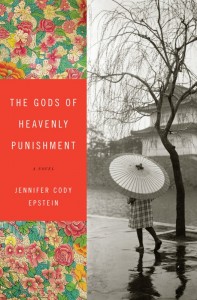
4.  The Gods of Heavenly Punishment by Jennifer Cody Epstein for review with TLC Book Tours (2 copies — one will be passed on to someone).

In this evocative and thrilling epic novel, fifteen-year-old Yoshi Kobayashi, child of Japan’s New Empire, daughter of an ardent expansionist and a mother with a haunting past, is on her way home on a March night when American bombers shower her city with napalm—an attack that leaves one hundred thousand dead within hours and half the city in ashen ruins. In the days that follow, Yoshi’s old life will blur beyond recognition, leading her to a new world marked by destruction and shaped by those considered the enemy: Cam, a downed bomber pilot taken prisoner by the Imperial Japanese Army; Anton, a gifted architect who helped modernize Tokyo’s prewar skyline but is now charged with destroying it; and Billy, an Occupation soldier who arrives in the blackened city with a dark secret of his own. Directly or indirectly, each will shape Yoshi’s journey as she seeks safety, love, and redemption.

5.  Emily & Herman by John J. Healey, which I received for review from Arcade Publishing.

The manuscript of this novel was discovered by John J. Healey in a box left by his grandfather, Professor Vincent P. Healey, after his death. This engaging work of fiction is a romantic account in which four iconic figures of American Letters play a leading role.

In the summer of 1851 Herman Melville was finishing Moby Dick on his family farm in the Berkshire Hills of western Massachusetts. Surrounded by his mother, sisters and pregnant wife, it was a calm and productive season until his neighbor Nathaniel Hawthorne lured him to Amherst. There they met twenty-year-old Emily Dickinson and her brother Austin. On a whim the two distinguished authors invited the Dickinson siblings to accompany them on a trip to Boston and New York. In Manhattan they met journalist Walt Whitman and William Johnson, a runaway slave, and it was there, despite their efforts to control it, that Emily and Herman fell in love.

This, for the first time, is their story.

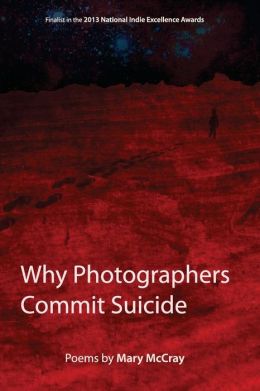
6.  Why Photographers Commit Suicide by Mary McCray from the poet for review.

Why Photographers Commit Suicide explores, in small narratives and lyrical poems, the American idea of Manifest Destiny, particularly as it relates to the next frontier—space exploration. Mary McCray examines the scientific, psychological and spiritual frontiers enmeshed in our very human longing for space, including our dream of a space station on Mars. These poems survey what we gain and what we lose as we progress towards tomorrow, and how we can begin to understand the universal melancholy we seem to cherish for what we leave behind, the lives we have already lived. McCray unearths our feelings about what it means to move ahead and stake out new territory, and what it means to be home.

7.  The Fact of the Matter by Sally Keith, which I purchased from Novel Places.

Moving from the mundane to the profound, first through observation of fact and matter, then shifting perspective, engaging a deeper sense of self, these poems re-imagine things great and small, making us care deeply about the world around us. In this cultivated and intricately crafted collection, Sally Keith shows the self as a crucible of force—that which compels us to exert ourselves upon the world, and meanwhile renders us vulnerable to it. Force by which a line unfurls—as in Robert Smithson’s colossal Spiral Jetty—or leads with forward motion—a train hurdling along the west-reaching railroad; Edweard Muybridge’s photographic reels charting animal and human locomotion. With poems remarkable in their clarity, captivating in their matter-of-factness, Keith examines the impossible and inevitable privacy of being a person in the world, meanwhile negotiating an inexorable pull toward the places we call home—one we alternately try and fail to resist.

8.  Trace by Eric Pankey, which I purchased from Novel Places.

His arresting ninth collection of poems, Eric Pankey’s Trace locates itself at a threshold between faith and doubt—between the visible and the invisible, the say-able and the ineffable, the physical and the metaphysical. Also a map of the poet’s journey into a deep depression, these poems confront one man’s struggle to overcome depression’s smothering weight and presence. And with remarkable clarity and complexity, Trace charts the poet’s attempt to be inspired, to breathe again, to give breath and life to words. Ever solemn, ever existential, Pankey’s poems find us at our most vulnerable, the moment when we as humans—believers and nonbelievers alike—must ultimately pause to question the uncertain fate of our souls.

9.  Miss Plastique by Lynn Levin, which I received from the poet for review.

Miss Plastique, the fourth full-length poetry collection by Lynn Levin, invites the reader into a world of female bravado in which Miss Plastique and her many selves rant, fret, joke, fall in love, dress up, and do their hair. Poems in this collection first appeared in Boulevard, Artful Dodge, Hunger Mountain, Connecticut Review, Knockout, Nerve Cowboy, and other places. Lynn Levin, a poet known for her eclecticism, humor, and range of poetic styles, is the author of the previous poetry collections Fair Creatures of an Hour, a Next Generation Indie Book Awards finalist in poetry; Imaginarium, a finalist for ForeWord Magazine’s Book of the Year Award; and A Few Questions about Paradise (all from Loonfeather Press). Her craft of poetry book, Poems for the Writing: Prompts for Poets (with Valerie Fox) is forthcoming from Texture Press in 2013. Lynn Levin is also a writer and literary translator. She has received nine Pushcart Prize nominations, two grants from the Leeway Foundation, and Garrison Keillor has read her work on his radio show The Writer’s Almanac. Born in St. Louis, Missouri, Levin has lived in the Philadelphia area since 1980. She is the 1999 Bucks County, Pa. poet laureate and currently teaches at Drexel University and the University of Pennsylvania. Advance praise for Miss Plastique: Miss Plastique is a busy girl: giving it to her enemy in stiletto heels, giving it up to an Elvis impersonator, thumbing a ride across Texas. She has turned from the mirror and can’t look back. She’s sexy and seductive and refuses to be pinned down; she’s silk so fluid you could drink her-read her instead, but watch she doesn’t explode in your hands. -Meg Kearney, author of Home By Now

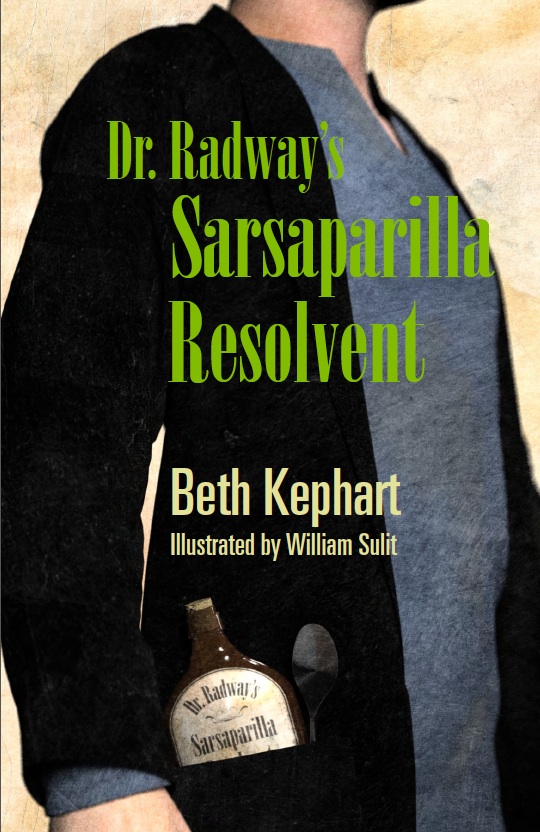
10. Dr. Radway’s Sarsaparilla Resolvent by Beth Kephart, illustrated by William Sulit, a surprise from my dear author friend.

Flavored by the oddities of historic personalities and facts, Dr. Radway’s Sarsaparilla Resolvent is set in Bush Hill, Philadelphia, 1871—home to the Baldwin Locomotive Works and a massive, gothic prison. Acclaimed writer Beth Kephart captures the rhythms and smells of an extraordinary era as William Quinn and his Ma, Essie, grapple with life among terrible accidents, miraculous escapes, and shams masquerading as truth.

11.  Antonia Lively Breaks the Silence by David Samuel Levinson, unexpectedly from the publisher Algonquin.

Catherine Strayed is living a quiet, un-
remarkable life in a secluded college town following the mysterious death of her husband, a promising writer whose death may have been an accident, a suicide, or perhaps even a murder. When her former mentor (and onetime lover)—a powerful critic who singlehandedly destroyed her late husband’s chance for success—takes a teaching job at the college, Catherine’s world threatens to collapse. For with him has come his latest protégé, an exotic young woman named Antonia Lively. Antonia’s debut  novel has become a literary sensation—but it is, in fact, an almost factual retelling of 
a terrible crime that she relates without 
any concern for the impact its publication will have on the lives of those involved.  As Antonia insinuates herself into Catherine’s life, mysterious and frightening things start to happen, because unbeknownst to Catherine, the younger woman intends to plunder her own dark, regrettable past—and the unsolved death of her husband—for her next literary triumph.

12. Beautiful Decay by Sylvia Lewis, which came unexpectedly from Running Press, though may be appropriate for some near-teenager I know….

Things have a way of falling apart around Ellie Miller. Literally. With a touch that rots, she keeps everyone at a distance—for others’ safety as much as her own comfort.

When newcomer Nate MacPherson makes it his mission to get close to Ellie, she does her best to steer clear. But as Nate reveals an unusual ability of his own, Ellie recognizes a kindred spirit who could accept her for who she is . . . if she lets him.

As family secrets unravel, Ellie will have to discover the beauty within her reach in order to save the ones she loves.

13.  The Look of Love by Bella Andre from Meryl Moss Media unexpectedly — this will likely be passed on to someone else.

Chloe Peterson has vowed never to make the mistake of trusting a man again. Her reasons are as vivid as the bruises on her cheek. So when her car skids off a wet country road straight into a ditch, she’s convinced the gorgeous guy who rescues her must be too good to be true.

As a successful international photographer, Chase Sullivan has his pick of beautiful women. He’s satisfied with his life—until he finds Chloe and her totaled car on the side of the road in Napa Valley.

With every loving look—and every sinfully sweet caress—the attraction between them sizzles, and Chloe can’t help but wonder if she’s met the man who may be the exception to her rule….

14.  A Half Forgotten Song by Katherine Webb from HarperCollins for review.

In Half Forgotten Song, fourteen-year-old Mitzy Hatcher’s lonely life on the wild Dorset coast is changed forever when renowned artist Charles Aubrey arrives to summer there with his exotic mistress and daughters.  Mitzy develops a bond with the Aubrey household, gradually becoming Charles’s muse. Over the next three summers, a powerful love is kindled in her that grows from childish infatuation to something far more complex.  Years later, a young man in an art gallery looks at a hastily drawn portrait and wonders at its intensity. The questions he asks lead him to a Dorset village and to the truth about those fevered summers in the 1930s.

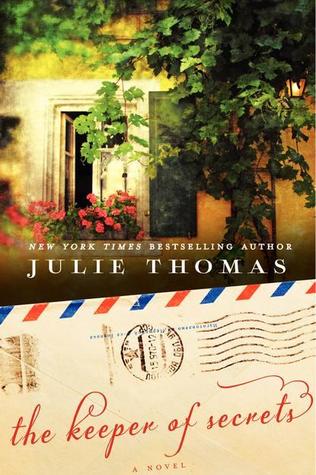
15.  The Keeper of Secrets by Julie Thomas from HarperCollins/William Morrow for review.

Beautiful and mysterious, The Keeper of Secrets by Julie Thomas follows a priceless violin across generations—from WWII to Stalinist Russia to the gilded international concert halls of today—and reveals the loss, love, and secrets of the families who owned it.   In 1939 Berlin, 14-year-old Simon Horowitz’s world is stirred by his father’s 1742 Guarneri del Gesu violin. When Nazis march across Europe and Simon is sent to Dachau, he finds unexpected kindness, and a chance to live.   In the present day, orchestra conductor Rafael Gomez finds himself inspired by Daniel Horowitz, a 14-year-old violin virtuoso who refuses to play. When Rafael learns that the boy’s family once owned a precious violin believed to have been lost forever, Rafael seizes the power of history and discovers a family story like no other.

What did you receive?

200th Virtual Poetry Circle

Welcome to the 200th Virtual Poetry Circle!

Remember, this is just for fun and is not meant to be stressful.

Keep in mind what Molly Peacock’s books suggested. Look at a line, a stanza, sentences, and images; describe what you like or don’t like; and offer an opinion. If you missed my review of her book, check it out here.

Also, sign up for the 2013 Dive Into Poetry Challenge because its simple; you only need to read 1 book of poetry. Please sign up to be a stop on the 2013 National Poetry Month Blog Tour and visit the stops on the 2012 National Poetry Month Blog Tour.

Today’s poem is from Mary McCray’s Why Photographers Commit Suicide:

Starbaby

When I was a baby, my mother called me her Martian child.
Now at sixteen, she calls me her starbaby, in the evening hours
when she thinks I'm too tired to hear and the nurses,
breaking for a smoke, snicker in the garage.
But I don't believe in highway abductions
or starship inseminations.  So what can they tell me
about who my father is, from where my alienation comes.
I have such a desire to overcome this life.
But I'm not good at it.  Immune to nothing,
my body has taken the path of least resistance
and my lungs argue breathing.

My mother calls me her starbaby
as if trying to remind me of my kind
of half-breed quality.  But I don't believe
in sudden memory recovery, like some circuit
fully convalesced:

             My father in curious landscapes, fire-blizzard outside
             hands on the strings of low-gravity swing,
             scratching his sandy face, long fingers, an ovalesque
             mouth blowing smoke, blue ceiling, six
             shadows at the door, he's trying to tell me
             something, maybe wisdom, maybe recognition --
             tugging on a smooth sleeve

What can she tell me about who my father is,
about what maneuvers he has made on my behalf:
what little alms of life, like pieces of himself
he may have left behind? Maybe his good intentions
were lost, peeled-off in space, over the barricades
he would have had to cross to reach me.

I can imagine his eyes appearing and disappearing
beyond the shadows of my bed, the missing years --
all back over my shoulder, these bones of his
holding up my body.

How did we come to be me?

In dusk -- when I am alone, lost reclining
in the solemn relief of a back-porch rocker,
I'll clear my throat and the night sounds will quiet
as if listening to what I'm about to say.

Beyond the trellis, some unidentifiable presence
will speak out to my future, my possibilities.
But in the end, I'm never up to the journey,
and the nurses resume their gossiping
and I wonder who was there, caught up in the door
as I was breaking down.

When I stop breathing,
who will be there with the key?

What do you think?

Winter’s End by Jean-Claude Mourlevat, translated by Anthea Bell

Winter’s End by Jean-Claude Mourlevat, translated by Anthea Bell, is a dystopian young adult novel set some time after a civil war has torn apart an unnamed nation.  If any of this sounds familiar, it should — Hunger Games — and like Suzanne Collins’ book, kids and adults are required to fight in an Arena, though more in gladiator style with swords.  And the similarities do not end there, but there are differences between this world and Collins’ world, with the Hunger Games capital seemingly more dangerous and the world of the districts more stark.

Mourlevat spends a great deal of time on the boarding school and building the characters of Milena and Helen.  These young girls are taken to a boarding school at the edge of the world, where they must memorize and follow 20 rules to stay out of the SKY, which isn’t the sky at all.  During the year, they have three opportunities to meet in the village with their consolers, who basically provide the children comfort and guidance.  The girls’ adventures begin on one such trip they meet two boys, Milos and Bartolomeo.

“The Sky did not deserve its name.  Far from being high in the air above, the detention cell was underneath the cellars.  You reached it from the refectory, down a long, spiral staircase with cold water dripping from the steps.  The cell measured about seven by ten feet.  The walls and floor smelled musty, earthy.  When the door closed behind you, all you could do was grope your way over to the wooden bed, sit or lie on it, and wait.  You were alone in the darkness and silence for hours.”  (page 7)

In the back of the book, the author mentions that the story is based upon the life of Kathleen Mary Ferrier, an English contralto singer.  In some ways the recruitment of Ferrier during WWII is similar to Milena’s mother’s story, but in other ways they are vastly different.  There is a resistance in Winter’s End, but it remains very mysterious to the very end when the network begins to take action against the Phalange.  While the oppressors show no compassion for those different than themselves and shoot down unarmed individuals or send dog-like men against the innocent, the Phalange remain mysterious — their origins, their motivations, and the history with the oppressed.  In many ways, the actions against Milena’s mother and Bart’s father seemed more related to a broken-hearted man, than an over-arching battle between the Phalange and the resistance.

Winter’s End is a thrill ride in the latter half of the book, and it will definitely keep the attention of younger readers.  It’s also aptly named, as the sun seems to be shining more brightly by the end of the novel, though an epilogue about Helen’s consoler and her son was not necessarily needed and seemed like it was tacked on as an afterthought.  Overall a satisfying read, but not near the caliber of other books in this category.

About the Author:

Jean-Claude Mourlevat once wrote and directed burlesque shows for adults and children, which were performed for more than ten years in France and abroad. The author of several children’s books, he lives in a house overhanging the River Loire, near Saint-Etienne, France.

About the Translator:

Anthea Bell OBE is an English translator who has translated numerous literary works, especially children’s literature, from French, German, Danish and Polish to English.

This is my  28th book for the 2013 New Authors Challenge.

Here’s What the Book Club Thought:

Overall, most of us enjoyed the writing in this YA book the most, and there was a great many symbols of French culture, particularly the power of music and symbols to a revolution.  The young lady in the group who selected the book did not like Milena as much because she was too perfect, while another member said she was more like a symbol than a character — harkening to the symbol of the revolution bit that the author seemed to be striving for.  Two or three members were saddened by events that killed off one particular character who had become a favorite, and another member pointed out how there was a lot of build up in the book about the revolution but little action.  One member wanted more of that action, and I think most agreed that the end of the book seemed rushed.  Overall, it was just an OK read for most of the group, with the youngest member planning to give it four stars.

Night Train to Lisbon by Pascal Mercier, translated by Barbara Harshav

Night Train to Lisbon by Pascal Mercier, translated by Barbara Harshav, is about the paths we take in our lives, the regrets we carry, and the desire to connect with something or someone outside of ourselves.  Raimund Gregorius is a Swiss classical languages teacher in Bern, who has cloistered himself among his texts and his classes to the detriment of his marriage and his social life.  He’s governed by a routine existence that is abruptly changed one morning on the way to the lycée.  His love of language and learning takes him on an unexpected journey into the language and heart of Lisbon as seen through the eyes of Amadeu de Prado, a young doctor caught up in a test of his principals like none other at the time of the Salazar dictatorship.

“Gregorius took off the glasses, and covered his face with his hands.  The feverish change between dazzling brightness and threatening shadow pressing with unusual sharpness through the new glasses was a torment for the unprotected eyes.  Just now, at the hotel, after he had woken up from a light and uneasy afternoon nap, he had tried the old glasses again.  But now the dense heaviness felt disturbing, as if he had to push his face through the world with a tedious burden.”  (page 111)

Through a mix of text from Prado that Gregorius translates and the teacher’s interactions with Prado’s family and friends, a tale of hunger, deprivation, and principals emerges that will keep readers on their toes.  The parallels Mercier draws between Prado and Gregorius are uncanny, and yet, the men are so different from one another in how they choose their paths.  At the same time, both men are swept up in a hunger for more life and more connection, especially given how both their fathers had suffered and how little they knew them.  In many ways, it seems as though part of that hunger is fed by the “absence” of the father — though not their physical absence — and the expectations that absence placed on these men as they grew older.

Who could in all seriousness want to be immortal?  Who would like to live for all eternity?  How boring and stale it must be to know that what happens today, this month, this year, doesn’t matter:  endless more days, months, years will come.  Endless, literally.  If that was how it was, would anything count?”  (page 170-1)

Gregorius begins his journey in Lisbon with Prado’s book in his hands, seeking the truth of the man who wrote such inspiring words — words that spurred his desire to drop his old life and journey into a new world.  There moments when he loses himself, bumping around Lisbon and falling into the life of Prado so much so that he forgets texts that he lived and breathed in for years.  But even in returning to Bern, Gregorius is out of place; it is no longer comfortable or it does not feel like home.  Both Prado and Gregorius reach a certain precipice in their lives, and how they handle it is so similar; it is like a mirror image of the past facing the present.

Mercier explores the compartmentalization of our own lives and how we can not really know others as intimately as we can know ourselves, but even that is questioned as we can also fall into deceiving ourselves about our own abilities, emotions, and more.  Memories are fleeting and often distorted, but to uncover an unvarnished truth about the past, all sides of the story must be sough out to find the truth in the middle.  Beyond that there are questions of whether one should be sacrificed for the many or the good cause and what exactly the fear of death is about.  Night Train to Lisbon is a methodical and deep account of two men with their own convictions and perceptions about life and what it is that are challenged by the world around them.  Deeply moving, profound, philosophical and engaging.

About the Author:

Peter Bieri, better known by his pseudonym, Pascal Mercier, is a Swiss writer and philosopher.  He studied philosophy, English studies and Indian studies in both London and Heidelberg.  Mercier cycling team is a former French professional cycling team that promoted and raced on Mercier racing bikes. Together with the Peugeot cycling team, the Mercier team had a long presence in the cycling sport and in the Tour de France from 1935 until 1983.

About the Translator:

Barbara Harshav translates from French, German, and Yiddish, in addition to Hebrew. Her translations from Hebrew include works by prominent authors such as Michal Govrin, Yehudah Amihai, Meir Shalev, and Nobel Laureate S.Y. Agnon. She teaches in the Comparative Literature department at Yale University.

This is part of my own personal challenge to read more books set in or about Portugal.

This is my 27th book for the 2013 New Authors Challenge.

The Gods of Heavenly Punishment by Jennifer Cody Epstein

The Gods of Heavenly Punishment by Jennifer Cody Epstein chronicles Yoshi Kobayashi’s life before, during, and after WWII, with a particular emphasis on the Tokyo fire bombings that preceded the atomic bombings of Hiroshima and Nagasaki.  Billy Reynolds, whose family lives in Tokyo before the war, is a sensitive young boy who loves his new camera, and adores taking photos of Yoshi, family, friends, and more.  Cam Richards and Lacy Robertson are American college students who meet and quickly fall in love just as war is about to break out between America and Japan after Pearl Harbor, and their lives are torn apart by the war.  But ultimately, Epstein’s novel is about Yoshi and how the war tore apart a flourishing culture that once embraced American capitalism.

Not only will readers get an in-depth look at Tokyo before, during, and after the war, but they also see how war impacts not only Americans who once lived in Japan, but also those who were married to those who flew to avenge the deaths of so many in Hawaii.  Initially, readers will be duped into thinking Cam Richards and Lacy Robertson are the main protagonists — a testament to her ability to get readers to care even about secondary characters — but Yoshi is the heroine here, though there are big gaps in time that are not explored, which can leave a reader wanting more.  There is a moment near the end in particular when readers will wonder how Yoshi ends up playing piano at The American Club after the war when they last left her getting into a boat with an older man after the fire bombings, heading away from Tokyo.

“Almost by reflex Cam released the brakes and started to roll.  And then they were racing down that slippery white line, his heart pounding with the rhythmic throbbing of the twin Cyclones.  The dungaree blue of the sailors’ uniforms and the dirty gray of the ship’s island bled together as the Blonde Bombshell picked up speed.  As they passed by the signal officer (now safely flattened against the deck), Cam pulled on the yoke so hard that he felt his elbows crack, and saw the sky lunge towards him like a wet concrete wall.  They hit the ship’s edge in the after-trough of another white-topped crest, and as his plane’s nose plunged towards the water Cam’s gut plunged right along with it.”  (page 79)

Epstein is a phenomenal writer.  She captures intense moments so well, that it places the reader there with the characters.  Yoshi is a precocious young girl learning three languages thanks to her continental mother, but unfortunately, she’s held a little back by her attachment to her mother and her father’s old world conceptions of women in society.  She sees her father’s love of the new paradise, Manchuria, as a possible solution to her escape, until she learns the truth about her father’s work there.  When she heads back home, she throws herself into the national effort for the war, hoping that she can escape the disintegrating world around her in which her mother slips more and more each day.  The Gods of Heavenly Punishment by Jennifer Cody Epstein is about the outside forces that shape who we are depending on how strong we are on the inside and our ability to make our way out of the darkness into the light.

About the Author:

Jennifer Cody Epstein is the author of The Gods of Heavenly Punishment and the international bestseller The Painter from Shanghai. She has written for The Wall Street Journal, The Asian Wall Street Journal, Self, Mademoiselle and NBC, and has worked in Hong Kong, Japan and Bangkok, Thailand. Jennifer lives in Brooklyn, NY with her husband, two daughters and especially needy Springer Spaniel. To connect with Jennifer, “like” her on Facebook.

Thievery by Seth Abramson

Today marks the end of National Poetry Month, and I hope that you found some great poets and poetry collections to try this month. I’m especially pleased that we had so many participants for the Friday activities. See all of you next year for another blog tour of poetry, but I hope you’ll stick around for the rest of this year too. If you missed some of the posts this month, just click here and scroll through.

The action of the poems in Thievery by Seth Abramson, published by the University of Akron Press, occur in between the silences and the pauses of each line break and each trick phrase, highlighting the theft of what has been stolen.  From the innocence of our children to the rallying of small towns around their own even when the most horrifying things occur.  Abramson performs a sleight of hand in his poems, changing their trajectory at a moment’s notice, calling attention to the illusions that are around us everyday.

From "Chronophrenia, Part VII"

At the end of traveling
I wear the road.  Within my skin it is bad.
It's worst without --
the particulates of being nowhere entirely.
From "Chronophrenia, Part VIII," the poet asks:

Do you pay
for each silence, and if so
why start.  Can I admit this thing,
can I clothe myself
in something like it, is it time now.
Does the time come.  Does it ever.

Are we too afraid to speak up or to change the world around us and make it better, or have we just become too complacent.  This silence and complacency is a pervasive problem Abramson tackles in his poems and what the possible consequences of that silence is.  In “Only,” “If it moves/I see it coming, sometimes I do/I swear.  I have been in the places things/were coming true/that were unwanted, in places/things went/unwell, where things went and went//”  (page 37)  There is an unraveling that these poems want to bring into the light for closer examination, though it could be the unraveling of our morality or our societies — with some poems being more ambiguous than others.  Additionally, there are several poems that focus on the abuse of men at the hands of women, like in “Hometown Courage” where the man is held down by women and in “Poem for Battered Man.”

From "All You Ploughboys":

I am sure
to do something horrible.  Half the wood is
halfway there.
And half this town is half in love with itself,
but me I go all the way.

Thievery by Seth Abramson is subtle, and at times too much so, in its exploration of change throughout society and within individuals as it asks readers and others when is the time to stand up and to create change for a better world. When is the time for us to stop the thieving from others and ourselves? These are questions that should be asked and should be met with action.

About the Poet:
Seth Abramson is the author of The Suburban Ecstasies (Ghost Road Press, 2009). In 2008 he was awarded the J. Howard and Barbara M.J. Wood Prize by Poetry. A former public defender, he currently attends the Iowa Writers’ Workshop. Please check out his blog.

Please click the image below for the latest tour stop on the National Poetry Month Blog Tour!

This is my 17th book for the Dive Into Poetry Challenge 2013.

This is my 26th book for the 2013 New Authors Challenge.

Guest Poet: Seeking Limpid Balance by Tamara Woods

Today, Pen Paper Pad‘s Tamara Woods is stopping by today to share one of her poems. Please give her a warm welcome.

For National Poetry Month, I’ve been blogging (almost) everyday, writing poetry and trying to get the courage to record a video poem. Here is a poem I wrote that I may try to digitize later.

Seeking Limpid Balance

Hand shakes
Fingertips tap
one time, two times, three  
Sharp pull from e-cig
Not the same, not the same, not the

New cocktail
tenuous strains to normality
Not quite
quieting fears,
disconnected discontent
Lids hanging
eyes sensitive
one time, two times, three 

Static burns neck's nape
Oxygen has escape room through
lighta beaming from window
bouncing from wall to ceiling floor
all white. all white, all 
one time, two times, three

Lines rips down wrist
raised coils against
pale skin
Stark black tangles 
Snarls past ears
catching air with
pacing,
one time, two times, three

The world outside these walls
tasted red, 
she felt muddy,
All feelings 
passed through her leaving
residue behind.
Never truly clean.
One time, two times, three.

About the Poet:

Tamara Woods is a poet, blogger, and generally pusher of words from Honolulu by way of West Virginia. Her first collection of poetry, The Shaping of an “Angry” Black Woman will be available this summer. Find her on Twitter, Facebook and check out her mumbling on her blog, PenPaperPad.

***Please check out my review of Sarah Arvio’s collection night thoughts: 70 dream poems and notes from an analysis.***