Quantcast

Dear Wild Child by Wallace J. Nichols and Wallace Grayce Nichols, illustrated by Drew Beckmeyer

Source: Media Masters Publicity
Hardcover, 32 pgs.
I am an Amazon Affiliate

Dear Wild Child: You Carry Your Home Inside You by Wallace J. Nichols and Dr. Wallace Grayce Nichols, illustrated by Drew Beckmeyer, is based on a letter from a father to a grown daughter after the 2020 CZU Lightning Complex Fires destroyed her childhood home on the Slow Coast north of Santa Cruz, California, following a brilliant lightning storm.

The book opens before the birth of the child in the story, as the parents are planning and designing their home in the redwoods. The illustration of the house as a patchwork of trees is beautiful and abstract. Opening up to the inside of the home, it’s cozy and filled with books and music and love. Like the strength of the trees making up the floors and walls of the house, the young girl grows stronger each day, learning to sing, and enjoy nature, and explore all that the woods has.

Beckmeyer lends his skills as an imaginative artist with crayons (or at least it gives that child-like impression). His illustrations are deep and textured, resembling the crayon wax that is left behind on the page when a child colors. This effect ensures readers will see the trees as three-dimensional and coarse with bark.

Dear Wild Child: You Carry Your Home Inside You by Wallace J. Nichols and Dr. Wallace Grayce Nichols, illustrated by Drew Beckmeyer, shares the beauty of a home filled with love, and though it may no longer exist in physical form, all of that love and those memories are carried inside that “wild child.” While loss can be extremely devastating, this books illustrates the beauty of memory and love, as well as that beauty in destructive forces.

RATING: Cinquain

***To help those communities impacted by these destructive wildfires, please consider helping After the Fire.***

About the Authors and Illustrator:

Wallace Grayce Nichols is a student of sustainable design, problem solver, and water lover. Her father, Dr. Wallace J. Nichols, is a marine biologist and the author of the bestselling book Blue Mind: The Surprising Science That Shows How Being Near, In, On, or Under Water Can Make You Happier, Healthier, More Connected, and Better at What You Do. Home is the slow coast of California. Drew Beckmeyer is a fine artist, illustrator, and elementary school teacher. He lives in Northern California.

Mailbox Monday #703

Mailbox Monday has become a tradition in the blogging world, and many of us thank Marcia of The Printed Page for creating it.

It now has its own blog where book bloggers can link up their own mailbox posts and share which books they bought or which they received for review from publishers, authors, and more.

Thank you to Velvet for stepping in when Mailbox Monday needed another host.

Emma, Martha, and I also will share our picks from everyone’s links in the new feature Books that Caught Our Eye. We hope you’ll join us.

Here’s What I Received:

Dear Wild Child by Wallace J. Nichols and Wallace Grayce Nichols, illustrated by Drew Beckmeyer from Media Masters Publicity.

A story inspired by a letter from a father to his daughter about wildfire, loss, and learning that we carry our homes inside us wherever we go

In the shade of ancient redwood trees, by a creek, not far from the ocean, a father builds a house for his newborn daughter, where she grows up wild and strong in their coastal canyon home. When a wildfire takes back their beloved house, he writes his now-grown daughter a letter telling her it’s gone. Inspired by the real letter the author wrote his daughter, this poignant story—written together by father and daughter—joyfully declares that a home is more than just wood and stone; it is made of love and can never be taken away. You carry home with you wherever you go.

What did you receive?

The Attic on Queen Street by Karen White

Source: Publisher
Paperback, 416 pgs.
I am an Amazon Affiliate

**don’t read this one until you’ve read the others**

The Attic on Queen Street by Karen White is the seventh and last book in this ghostly mystery series. Melanie and Jack Trenholm are not in a good place at the start of this one. He’s no longer living in the Tradd Street home and they are sharing custody of their twins, while his daughter, Nola, stayed with Melanie. It’s clear that there is some tension between them, but the love they share and the heat are still present, even if they choose to ignore it.

“…faces of my children and Jack stared out at me from the computer’s background wallpaper, a reminder of everything we had lost. Or maybe we had just misplaced it.” (from ARC)

In this story, Melanie is trying to help Veronica, an old friend, solve the murder of her sister, which has been a cold case since their college days. Veronica’s husband, however, is eager to move out of their house and into a new place, as well as close the book on his sister-in-law’s unsolved murder. As with all other books, ghosts are showing up, leaving things in places they shouldn’t, and making things a little difficult for Melanie who is a reluctant communicator with the dead.

In the midst of this mystery, Marc Longo makes another appearance, and desperation has Jack and Melanie agreeing to be under the same roof and allow filming on the book Marc stole from Jack to begin in their house. You can imagine what kind of tension there will be.

The Attic on Queen Street by Karen White has everything I’ve loved about this series from the beginning – ghosts, mysteries, and complicated relationships. I’m so glad this ended happily, and I cannot wait for the New Orleans spinoff series to begin.

RATING: Cinquain

Other Reviews of the Series:

Other Books by Karen White:

About the Author:

Karen White is a New York Times and USA Today bestselling author and currently writes what she refers to as ‘grit lit’—Southern women’s fiction—and has also expanded her horizons into writing a mystery series set in Charleston, South Carolina. Karen hails from a long line of Southerners but spent most of her growing up years in London, England and is a graduate of the American School in London. When not writing, she spends her time reading, scrapbooking, playing piano, and avoiding cooking. She currently lives near Atlanta, Georgia with her husband and two children, and two spoiled Havanese dogs.

My Dog, Hen by David Mackintosh

Source: Media Masters Publicity
Hardcover, 40 pgs.
I am an Amazon Affiliate

My Dog, Hen by David Mackintosh is a cute story about a boy and his new dog from the shelter. Hen is a “good as new” dog but he has some things to learn. He wants to chew everything in sight from the dog bowl to his bed and all of his toys. The chewing seems never-ending until the boy’s grandmother comes to the rescue.

The illustrations are simple sketches of the house, the dog, and the people. Many of the drawings resemble kids’ drawings when they are young. What I loved about this book was the message that not all old things should be discarded because they can be mended or made into something new with a different purpose.

The paragraphs are made up of simple sentences that young readers can easily read, though the paragraphs are a bit longer than in other picture books. This could be a bridge book for those who are struggling readers who need images and simpler sentences.

My Dog, Hen by David Mackintosh not only reminds us to be patient and repair the old, but it also reminds us that we all have things to learn when we’re young. We all need a little direction, even Hen.

RATING: Quatrain

About the Author:

David Mackintosh loves books with pictures in them, flying, visiting cities, and being read to. His picture book Marshall Armstrong Is New to Our School was short-listed for the Roald Dahl Funny Prize and long-listed for the Kate Greenaway Medal. He lives in London.

Mailbox Monday #702

Mailbox Monday has become a tradition in the blogging world, and many of us thank Marcia of The Printed Page for creating it.

It now has its own blog where book bloggers can link up their own mailbox posts and share which books they bought or which they received for review from publishers, authors, and more.

Thank you to Velvet for stepping in when Mailbox Monday needed another host.

Emma, Martha, and I also will share our picks from everyone’s links in the new feature Books that Caught Our Eye. We hope you’ll join us.

Here’s what I received:

Chalk Dust Memories by John Johnson for consideration for the 2023 Gaithersburg Book Festival.

John Johnson is a poet who loves language but also data and numbers. He resides in Northern Virginia where in addition to running his consulting firm as a professional econometrician, he loves pizza, professional wrestling, and regularly writes with his wild writing circle. John’s poetry tends to focus on humorous aspects of his geeky childhood and his journey as it relates to entrepreneurship, family and friendship, and failed athletic endeavors.

Everything Is Normal Here by Alison Palmer for consideration for the 2023 Gaithersburg Book Festival.

The title of Alison Palmer’s second poetry chapbook suggests the comfort of, or perhaps a yearning for, the known; but really it begs the question: What is our normal? The answers she provides often are far from comfortable, but she deals in necessary truths. She opens with a “Spark”: “The one-man-band kisses the silver lady. They become a flash / of sound.” And like thunder that flash and sound reverberate through these pages. “We’re designed to break after only years,” she reminds us, which brings an urgency to those years. “Honesty makes me nervous,” she admits – and no wonder, when her honesty contains both love and its loss, and entails great personal exposure. “It’s not enough to be awake / when the world winds away,” not enough merely to observe passively. Our normal world must be embraced, in all its pain and peril – and potential. “We try to be resewn of nothing left, lovely in our suits of armor. Only / the last will be exquisite, will be re-thought / into alkaline or ash.” She counsels (and comforts), “The way to master death is to make it be everywhere” – for that is truly our normal. In her appropriately titled closing poem, “The End,” she asks us to “Pretend I talk in tiny truths” – but while this collection may be tiny, her truths are large – and yes, necessary.

Why We Never Visited the Elms by Marianne Szlyk, which I purchased.

Why We Never Tried to Find the Elms gathers strands of poetry to weave them into a tapestry of memory and imagination. This whole includes a glimpse beneath a mirror that once appeared to show everything so clearly. Two examples are the title poem and “The Roadrunner,” poems that grew out of conversations with others about what they themselves remembered about the incidents depicted. The tapestry includes cultural and historical context as in “Woolworth’s, 1970,” a meditation on the absence of people of color in my memories of the small New England city where my mother grew up, and “Frida without Arms,” an imagining of Frida and Diego as young squatters in 21st-century Detroit. This tapestry contains not only my parents’ beach house in Maine or the Willow jazz club in Massachusetts but also Food Lion and Tippecanoe Mall as these too have been part of my quotidian. But the tapestry goes beyond myself and my perspective (and corrections to it) as later strands like poems inspired by Hung-Ju Kan reveal. Some say that the chapbook is best at presenting variations on a theme. However, even a chapbook is a whole world peopled by more than the poet.

Nothing You Build Here, Belongs Here by Sara Cahill Marron, which I purchased.
From its vividly drawn, lyrically rich title poem to its digitally coded dialogues, Sara Marron’s dynamic and masterful nothing you build here, belongs here rails against the futility of urban living, wails against societal inequalities, and clutches its loved ones close amidst viral fears. A rush of vibrant imagery, this book skilfully counterbalances luxuriant elegiac language choices (“My Mountains Could Care Less About You”) with clipped syntax (“Clorox, Wellbutrin”), adept experimentation with form (throughout), and razor-sharp observation (“Applying for EBT in California”). Embodying a compelling urge to summon our shared humanity, this is an urgent and vital book of, and for, our time.

—Anne Casey, Author of out of emptied cups (Salmon Poetry)

“As if the heat is a thing / you can hide from,” Sara Cahill Marron writes in “My Mountains Could Care Less About You.” She draws a portrait of a world tottering, laid low by COVID-19 in particular, but also by our political fragmentation and by our laying waste to the environment, one in which Styrofoam cups are thoughtlessly discarded next to grand art—Rodin (“Chick-fil-A Styrofoam cups / dance semi-circles between feet”). Echoes of Yeats, Whitman, and Tennyson, but also experimental language are threaded through Cahill Marron’s collection. “Kiss10100love” the screen on her device says, despite the headlines. At first, this seems a cutely romantic but somewhat bewildered Apple product. But then, she carefully warns us, “Some will die.”

—Susana H. Case, Author of Dead Shark on the N Train (Broadstone Books)

Reading Sara Cahill Marron leads me on a voyage of lyrical bliss, a song-filled walking through a landscape filled, however, with fallen trees, buildings, and people of a world devastated by plague. “Nothing you build here belongs here,” she declares, and yet we have these beautiful verbal dwellings, written by a devotee to perfecting the harmony of sound and sense. Readers, you are witnesses here to the growth of an essential lyric poet, one we will read and learn from as we walk with her into the uncertain dark, healed by her word music, keeping contagions at bay.

—Indran Amirthanayagam, Author of The Migrant States (Hanging Loose Press)

What did you receive?

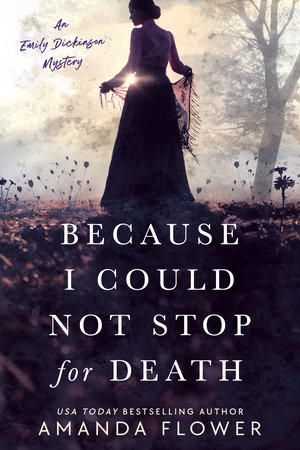
Excerpt: Because I Could Not Stop for Death by Amanda Flower

Poetry is my love, and I’ve loved Emily Dickinson’s poetry since I was in school. My copy of The Complete Poems of Emily Dickinson is well worn. And one of her most famous poems (#479) begins “Because I could not stop for Death—”.

Today, I have a treat. Amanda Flower will share an excerpt from her new Emily Dickinson mystery, Because I Could Not Stop for Death.

About the Book:

Emily Dickinson and her housemaid, Willa Noble, realize there is nothing poetic about murder in this first book in an all-new series from USA Today bestselling and Agatha Award–winning author Amanda Flower.

January 1855 Willa Noble knew it was bad luck when it was pouring rain on the day of her ever-important job interview at the Dickinson home in Amherst, Massachusetts. When she arrived late, disheveled with her skirts sodden and filthy, she’d lost all hope of being hired for the position. As the housekeeper politely told her they’d be in touch, Willa started toward the door of the stately home only to be called back by the soft but strong voice of Emily Dickinson. What begins as tenuous employment turns to friendship as the reclusive poet takes Willa under her wing.

Tragedy soon strikes and Willa’s beloved brother, Henry, is killed in a tragic accident at the town stables. With no other family and nowhere else to turn, Willa tells Emily about her brother’s death and why she believes it was no accident. Willa is convinced it was murder. Henry had been very secretive of late, only hinting to Willa that he’d found a way to earn money to take care of them both. Viewing it first as a puzzle to piece together, Emily offers to help, only to realize that she and Willa are caught in a deadly game of cat and mouse that reveals corruption in Amherst that is generations deep. Some very high-powered people will stop at nothing to keep their profitable secrets even if that means forever silencing Willa and her new mistress….

Without further ado, please read the following excerpt from Amanda Flower’s Because I Could Not Stop for Death:

“The Dickinsons are moving?” I asked.

“Yes,” she said in a crisp voice. “It has been Mr. Dickinson’s goal to return to the homestead for many years. His father ran into a bit of financial trouble and lost it. He fled to Ohio in disgrace.” She looked
around with bright red cheeks. “Don’t repeat that.”

“I won’t,” I promised. My hands began to shake. I clasped them in front of me and pressed them into my skirts.

“Was the boardinghouse your first position?” Miss O’Brien asked, getting back to the task at hand.

“No, I’ve been in domestic work for the last eight years.” She frowned. “Eight years. You can’t be more than sixteen.”

“I am twenty, ma’am. I started work when I was twelve.”

“What made you work so young?” She eyed me. “Should you not have been in school? The Dickinsons put great value in education, even in the education of girls such as yourself.”

“My mother died, ma’am, and I had to provide for my younger brother and me. I had to go to work. Our mother taught us to work hard, so it was no trouble to take over that role.”

“Haven’t you got a father?” She narrowed her eyes.

“Not that I know of,” I said and pressed my clenched hands deeper into my skirts. My father was not a topic for conversation even if it cost me the position at the Dickinson household. I would not speak of him, ever.

“How much younger is your brother than you?”

“Two years, ma’am,” I said. “He’s an adult now, too, and works just as much as I do. He works even harder, I should say, because of the physical labor required for man’s work.”

Miss O’Brien stood up. “I’m interviewing several more girls for this post. I will let you know by mail by the end of the week if we choose you.” She looked at my wet, muddy skirts again.

My heart sank. If there were several young ladies applying for this position, what chance did I really have at winning the spot? I was the girl who came to the interview covered in mud and who was too young without the proper experience for the post. Why did I think I was the only one who would have been interested in the ad? As I told Miss O’Brien, the position was a chance to move up-this was true not just for me but for anyone in domestic work. There were many young women in my place that would want to do so.

“Thank you for your time,” I said. “Would you like me to let myself out?”

Before Miss O’Brien could answer, a breathy voice said, “There will be no more interviews. Margaret, you have found the right maid.”

I turned and a small woman stood in the doorway. She was petite and wore a brown dress that was cinched around her small waist. Her chestnut red hair was pinned back in a fashionable knot and her dark eyes shone with interest, but there was a faraway look about them too. She was a very pretty woman, but there was something birdlike in her movements as she stepped into the room. Her hands fluttered like the tips of wings.

Miss O’Brien jumped to her feet. “Miss Dickinson, can I help you with something?”

“You have helped. You have found our new maid. I’m very grateful to you for that. Mother wants us to keep a clean house, especially when she is in the middle of one of her episodes.”

Episodes? What does she mean by this?

Miss Dickinson studied me with an exacting gaze. “She looks like she has a strong back too. It’s something that we will need if Father insists on pulling us up and moving us back to the place of my birth.” She said this like she wasn’t very keen on the idea.

“Very well, Miss Dickinson.” Miss O’Brien dipped her chin.

“Thank you, Margaret.” The small woman looked me in the eye. “I like someone who would sacrifice herself for her family and duty. That’s just the kind of person I want on our staff. I think there have been enough questions. Margaret, please show the young maid to her room and cancel the rest of your interviews for the position.”

Miss O’Brien pressed her lips together as if she were unsure. “If you are certain, Miss . . .”

“Very certain. I like her, Margaret. If I like her, Father will agree.”

Miss O’Brien nodded. “Please follow me, Miss Noble. I will show you to your room.”

I blinked; it was all happening so fast. I glanced back at Miss Dickinson, but she was no longer there. She was gone.

— Excerpted from Because I Could Not Stop for Death by Amanda Flower Copyright © 2022 by Amanda Flower. Excerpted by permission of Berkley. All rights reserved. No part of this excerpt may be reproduced or reprinted without permission in writing from the publisher.

Thank you, Amanda, for sharing this excerpt.

About the Author:

Amanda Flower is the USA Today bestselling and Agatha Award-winning mystery author of over forty novels, including the nationally bestselling Amish Candy Shop Mystery Series, Magical Bookshop Mysteries, and, written under the name Isabella Alan, the Amish Quilt Shop Mysteries. Flower is a former librarian, and she and her husband, a recording engineer, own a habitat farm and recording studio in Northeast Ohio.

Listen to an excerpt here.

Also a Poet: Frank O’Hara, My Father, and Me by Ada Calhoun

Source: Publisher
Hardcover, 272 pgs.
I am an Amazon Affiliate

Also a Poet: Frank O’Hara, My Father, and Me by Ada Calhoun is a memoir that seems to have started out as a biography of Frank O’Hara, but really was an attempt by a daughter to capture her father’s attention through the poet that tethered, at least in part, their lives together. Peter Schjeldahl is an art critic who also wrote poetry, essays, and other works, and was immersed in the New York School of poetry in which O’Hara was considered a major poet. Calhoun has felt unseen by her father, according to the memoir, even as she, too, pursued a career in writing, though mostly as a ghostwriter.

Calhoun’s O’Hara journey begins long before she finds the tapes in her father’s drawer and starts to listen to the interviews he conducted when trying to write a biography of the poet. The ghost of the poet has haunted her father and their lives since the start – a father dejected by the cancellation of his biography on a man he admired and a man who threw himself into writing as a critic and more to the detriment of all else, even his own poetry (which some in the book praised to Ada).

For Ada, O’Hara’s poetry was a gift from her father, and through those poems, she experienced New York City in the way that she believed her father must have. She also used this connection to draw her own conclusions about her father and his obsessions, which may or may not have reflected reality for her father. In many ways, she equates O’Hara’s poet-ness with her father’s writer-ness and the obsessiveness it requires to shut everything else out, but what she fails to see early on is how both simply wanted to make connections and to reach out from their own emptiness and fill it up.

Calhoun is on a journey taken by her father years ago, and like many things when we seek something we don’t think we already have, it becomes a competition to do better and be better as a way to prove our worth to someone we desperately want approval from. Maureen Granville-Smith, O’Hara’s sister and executor of his estate, plays a pivotal role in both the journey of Calhoun and her father. What’s more is that Calhoun unravels this late in the memoir – almost too late.

Past the mid-way mark, Calhoun says something about confidence being “the age requirement for everything,” (pg. 134), and there is something to that. We all reach an age where we finally have that confidence we need to overcome certain obstacles or deal with certain moments in our lives, and it is through that we become capable and achieve the seemingly unachievable. This is where were are with the memoir, as well. She has reached that age of confidence where she can finally speak to her father as a writer to a writer and explore how each has lived that life very differently — he shutting everything else out and she carving out time from her other responsibilities to concentrate on writing alone in a chunk of time. And in many ways, she answers her own questions about “How ruthless do you need to be?” to be a writer.

Also a Poet: Frank O’Hara, My Father, and Me by Ada Calhoun is so much more than a memoir; it’s a peek inside the world and work of enigmatic artists and poets and how their lives unravel while they’re working at their craft and they are completely unaware. Calhoun is equally unaware, but soon she begins to realize that she’s seen the signs all along and that no writer/parent will ever be perfect because we are all flawed, we are all editing as we go along.

RATING: Cinquain

The New Gods by William O’Daly

Source: Purchased
Paperback, 92 pgs.
I am an Amazon Affiliate

The New Gods by William O’Daly is as unpredictable as the ocean’s waves, as the poet pushes us to action and halts our momentum for moments of reflection. Opening the collection with “The Fire” readers are dropped into a glade of sorts where water is tumbling to a hot canyon, and it is clear that despite the destruction of the fires in the forest and the danger to the birds and horses, there is still beauty here. Does that beauty survive? It’s hard to say, but O’Daly makes sure we pause to see it.

Moving further into that opening poem, O’Daly shifts the focus to the tension and angst we create with our fire of invention and the risks it carries. The hail of spitballs in a classroom reminding the narrator of the nuclear fission that could rip them to shreds and render the world of friends and brothers, etc., into vapor. It’s again another familiar scene that many of us recognize that is destroyed by an outside force that could be of our own making. In the final lines, it is clear that we are all just on the cusp of a precipice.

O’Daly has a keen eye for detail in these poems, creating a world you fall into and instantly recognize. But he also asks readers why “we live far from ourselves and/each other…” (pg. 35, “The Unwritten Letter”) It’s like a bird’s call for us to slow down, pay closer attention, and learn from what’s around us, what has come before, and even the destruction we cause. There are lessons to be gleaned and beauty even in that darkness.

The Flag Is Burning (pg. 37-8)

We, friend, are the body of the country
burning in the street,
eyes open against the sky,
the child running,
the mother on her knees
reaching for the soldier aiming,
the village on fire -- the shrapnel littered ruins
...

It is in this poem where we are reminded of our place in society and a country and that we are responsible equally for its actions if we remain inert. O’Daly revisits this concept again in “Handout,” where a huddled figure in the fog is feared by the narrator rather than shown compassion until his daughter takes action with her hand out to him, an offering of food. The New Gods by William O’Daly spans a great many subjects, historic moments, but it is in its quiet moments where he’s at work, teaching us that we are the “new gods,” the ones with the power to effect change.

RATING: Cinquain

Photo courtesy of Kristine Iwersen O’Daly

About the Poet:

William O’Daly’s most recent book of poems, The New Gods, which includes these poems, will be published by Beltway Editions on September 15, 2022. O’Daly has translated eight books of Pablo Neruda’s late and posthumous poetry and Book of Twilight, the Chilean Nobel Laureate’s first book.

Mailbox Monday #701

Mailbox Monday has become a tradition in the blogging world, and many of us thank Marcia of The Printed Page for creating it.

It now has its own blog where book bloggers can link up their own mailbox posts and share which books they bought or which they received for review from publishers, authors, and more.

Velvet, Martha, and I also will share our picks from everyone’s links in the new feature Books that Caught Our Eye. We hope you’ll join us.

Here’s what I received:

Not Happy Campers by Ash Keller, a Kindle freebie.

Lance Blakeman is an up-and-coming literary agent with a chance to represent the biggest horror writer since Stephen King. Unfortunately, the client doesn’t want to work with a bachelor. Lance needs a fiancée—fast.

Lainey Fredrickson is a struggling artist making ends meet by waitressing at a local diner. Or, she had been, until pretty boy Lance got her fired for accidentally spilling a beer on him. The way he carried on, you’d think she had deliberately doused him with radioactive waste. Now, she has exactly $4.23 to her name—not enough for an iced latte, let alone rent.

When Lance offers Lainey cash to pose as his fiancée, she can’t afford to say no, even if it means spending a week in a cramped RV with him. But can they fool the client without fooling themselves? There’s a fine line between love and hate. And with kisses this sweet, the line is bound to get blurred.

What did you receive?

Falling Leaves: An Interfaith Anthology on the Topic of Consolation and Loss edited by Susan Meehan and Robert Bettmann

Source: Purchased
Paperback, 96 pgs.
I am an Amazon Affiliate

Falling Leaves: An Interfaith Anthology on the Topic of Consolation and Loss edited by Susan Meehan and Robert Bettmann is a prayer for the anguish felt around the globe by each of us whether that be during the pandemic or at another point in our lives. Each poem is founded on a tradition in faith, but the poets reinterpret some of these traditions in their lines.

Offering prayers, acceptance, and healing, these poets are reaching out to readers to demonstrate that we are not alone in dealing with loss. No loss is greater than another; all are equally harrowing. Even in this loss there is connection to ourselves, our ancestors, and the future.

As Luther Jett points out in “Ha’azinu,” “… Don’t pretend/that I am up there/in the sky — aloof,/unattainable//Don’t imagine/that I am only in/the gentle places–/the sweet moments/you wish to recall.//” (pg.9-10) And in “Come Sunday,” Lori Tsang says, “I give thanks/for this chance/to remember/I am part/of something/Larger” (pg. 57-8)

Falling Leaves: An Interfaith Anthology on the Topic of Consolation and Loss edited by Susan Meehan and Robert Bettmann is anthology readers can turn to again and again to find comfort. If you experienced a loss, and we all have, this collection will help you see that you are not alone in that sea of grief.

RATING: Quatrain