Quantcast

Mailbox Monday #152 & Some Winners

Before I get to the mailbox, I wanted to congratulate some winners.  The winner of Jane Austen Made Me Do It edited by Laurel Ann Nattress (my review) was Eva.  The winner of The September Queen by Gillian Bagwell (guest post) was Gwendolyn.  Congrats to you both.
Mailbox Mondays (click the icon to check out the new blog) has gone on tour since Marcia at A Girl and Her Books, formerly The Printed Page passed the torch. This month’s host is the Mailbox Monday tour blog.

Kristi of The Story Siren continues to sponsor her In My Mailbox meme.

Both of these memes allow bloggers to share what books they receive in the mail or through other means over the past week.

Just be warned that these posts can increase your TBR piles and wish lists.

Here’s what I received this week:

1.  Astride a Pink Horse by Robert Greer, which came unexpectedly in the mail.

2.  The Iguana Tree by Michel Stone, which also came unexpectedly in the mail, which I gave to a friend.

3.  The Uncommon Reader by Alan Bennett, which I picked up from the library sale and had to add to my own personal library after reading a copy from the library at Dewey’s urging.

4.  Blue Shoe by Anne Lamott, which I picked up from the library sale since I want to give her fiction a try after reading Bird by Bird.

5.  Puppy Love, a snuggle book, which I picked up at the library sale for “Wiggles.” She’ll love it because the outside of the book is fuzzy and the back has a fuzzy tail.

6.  Little Miss Giggles Has a Giggle by Roger Hargreaves, which I picked up at the library sale for “Wiggles.”

7. Natasha’s Daddy came from her visiting “auntie” who went to the library sale too.

8. Elmo’s Delicious Christmas came with the visiting “auntie” on the plane!

What did you receive?

123rd Virtual Poetry Circle

Welcome to the 123rd Virtual Poetry Circle!

Remember, this is just for fun and is not meant to be stressful.

Keep in mind what Molly Peacock’s books suggested. Look at a line, a stanza, sentences, and images; describe what you like or don’t like; and offer an opinion. If you missed my review of her book, check it out here.

Also, sign up for the 2011 Fearless Poetry Reading Challenge because its simple; you only need to read 1 book of poetry. Please contribute to the growing list of 2011 Indie Lit Award Poetry Suggestions (please nominate 2011 Poetry), visit the stops on the National Poetry Month Blog Tour from April.

Today’s poem is from A Wreath of Down and Drops of Blood by Allen Braden:

Grinding Grain (page 36)

The belt, tight as a razor strop,
whips from tractor to hammer mill
and scares out of our grain bin an owl.
Welded pipe coughs flour into bags

stenciled H & H or Logan’s Feed & Seed.
I take another off my father’s hands,
another cinched with his square knot
better than any I used to tie.

Easily I buck those bags onto the stack
that shoulders the granary wall.
The air thickens this morning light
sifting around the blurred belt.

When I turn back, he’s gone
inside a cloud bank of flour
the way burlap can swallow
so many pounds of ground durum.

All our lives we work this way.
He sacks and ties.
I lift and stack.
Our bodies slowly growing white.

What do you think?

Interview With Beth Kephart

Earlier today, I posted my review of You Are My Only by Beth Kephart, which I thoroughly enjoyed, and later on in the interview, I’ll let you know how you can win a copy of your own.

I’ve read Beth’s work for the last few years, and I’ve enjoyed her books very much, and I’ve come to understand her writing process through her blog posts and her email conversations.  I just adore her spirit and she’s very motivating even if she doesn’t realize she’s being so.  I was so happy when she agreed to be interviewed about her stellar novel about child abduction, a tough topic for adult and young adult readers alike.

Many of you may have read enough reviews of this book, and some of you may be avoiding the book for one reason or another.  I hope that this interview will help those on the fence about the book to jump off and give Kephart’s work a try.  Without further ado, please welcome Beth.

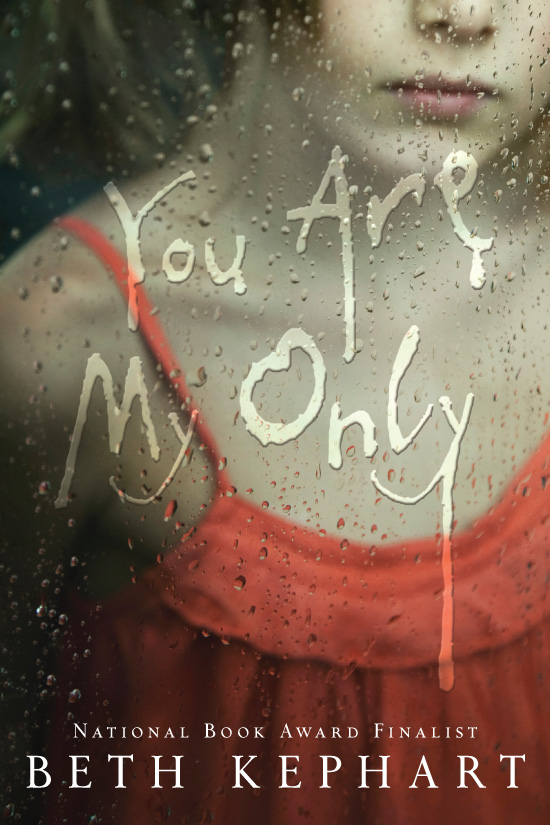
1. You Are My Only is a haunting title with an equally haunting cover. Was it your intention to create a story that would haunt its readers and get them thinking more in depth about child abduction?

Thank you, Serena, for asking such a great first question. First, the cover credit belongs entirely to Neil Swaab, whose work is exquisite. He reads the books he illustrates and that makes all the difference. Second, this book was evolved over such a long period of time that I cannot say that I set out, from the start, to get people thinking more about child abduction. I was thinking about heartbreak—the loss of a child—and how one manages to survive it. I was thinking about the compassion we must have for people whose hearts have been broken.

2. Some readers have said that Sophie’s voice is stronger and the most engaging in the novel. Do you see one voice as stronger than the other? Why or why not?

I am delighted that readers are distinguishing between the voices, for that, I think, is one of the hardest things to do—to make certain the characters sound just precisely like themselves. Sophie is 14 and while she lives an unusual life, she has not been crushed; she is also gaining an education, however unorthodox. Emmy is not nearly as educated, but she has her own poetic intelligence, and she is heartbroken. I love the characters equally. I typically hear a greater preference for Emmy from adult readers and a greater preference for Sophie from teen readers. It never occurred to me that readers would choose one voice over the other; the two voices are necessary to complete the story.

3. Of the scenes that your wrote in the novel, the soaked feet of Emmy swimming like fish in the pond of her Keds has stayed with me longest, in effect symbolizing the disembodiment of her from the life she knew before her child was abducted. Is there a particular scene that woke you from sleep or came to surprise you as you were writing?

Thank you, Serena. This entire book kept me awake for a very long time. The truth is that, while You Are My Only is a novel, some women do live the terribly bereft life of a lost child, and some children are growing up inside airless homes. I felt a great desire to get this right, a great urgency to keep reworking the stories until they honored the emotions (if not the precise storylines) of what real people have endured. I hardly ever sleep when I am working, which is to say: I sport some pretty dark circles under my eyes.

4. Your work often has a poetic feel and I know that you’ve written poetry before. Did/do you have plans for a poetry collection in the future? If not, have you read any great poetry collections that you’d recommend?

I do not have a poetry collection pending, though years ago I thought (for a brief moment) about trying to package a book of poetry and art. It still sits on my computer. I love Neruda, Stern, Gilbert, Ondaatje, Kunitz.

5. Poetry is often considered elitist or inaccessible by mainstream readers. Do poets have an obligation to dispel that myth with their writing styles? Or what other solutions do you see to get more mainstream readers interested in poetry?

Oh, my goodness. This is a great question, but I am not sure I have a good answer for it. Poets have an obligation to be rigorous with language, to imagine deeply, to feel deeply, to know. The rest of us are impoverished souls if we can not find our way to the work of these poets. (And please know that I am not counting myself among these poets; real poets do more than I can do or have done.)

6. Finally, your blog often covers writing struggles, shares photography, and some of your recent reading. How do you find time to balance the blog, writing, and your job teaching? Are there particular habits, routines, or obsessions that help you accomplish that balance?

Oh, Serena, I have no balance. I am grabbing at time, getting up very early, despairing that I will never finish or sell another book. The only thing I know for sure right now is that I cannot work on the computer when I am writing a novel. I have to go to another room and find a slice of sun and some silence. The vast majority of my time is spent running a business—a boutique marketing communications firm called Fusion. The next big chunk of time is spent making sure the house is in order—the bills paid, the floors swept, the meals on the table, and (when my beautiful son is home from college, I try to spend as much time as I can with him, of course). During spring semesters at the University of Pennsylvania, I spend about twenty-five hours each week teaching, preparing for class, working with new students and former students. Finally, to relieve the pressure of things, I dance. And so I write far more slowly than anyone realizes. Weeks will go by without a novelistic or memoiristic word. The blog is my outreach, my way of writing at least some one thing each day.

Thanks, Beth, for answering my questions; it has been a pleasure conversing with you in last year or so. As a bonus to my readers, Beth agreed to share a picture of her writing space; isn’t it gorgeous!

Beth Kephart's Office

To Enter to win 1 of 2 copies of You Are My Only by Beth Kephart, leave a comment on this post.

For a second entry, let me know that you commented on my review.

For up to 3 more entries, share this giveaway with people on Facebook, Twitter, and/or your blog and leave a link.

Deadline Nov. 18, 2011, at 11:59 PM EST. Perfect holiday gift.

You Are My Only by Beth Kephart

You Are My Only by Beth Kephart tackles the tough topic of child abduction from two perspectives — that of the young victim, Sophie, and that of a mother, Emmy, whose child is stolen.  In this powerful, yet quiet novel, Kephart explores how one unexpected event can devastate entire worlds.

While the topic is ripped from the headlines, there is no sensationalism here.  Through carefully selected words in her poetic prose, Kephart builds tension and suspense, like the quiet vibration growing louder on the railroad tracks as the train approaches.  It also provides a quiet space — like the air between the branches of a tall tree — for readers to contemplate what each voice is saying, what each voice is struggling to address, what pain is closed inside of them and just clawing to get out.

“My feet are two pale fish inside the tight ponds of my Keds.  I leave the street for the train station.  I leave the station and cross onto the tracks, slick-backed and shiny as snail glisten.  The black gauze of the clouds flap at the moon, and from the tracks I can see into the backs of people’s houses, the private places where the lamps have not gone off.  It’s like looking through snow globes, worlds behind glass.”  (page 21)

Kephart’s prose is very lyrical and imagistic, and readers need to pay careful attention to her lines.  For instance, the above passage perfectly demonstrates Emmy’s frame of mind after losing her child.  She is lost, drowning, unmoored.  She has become separate from those who have “normal” lives because that’s what she believed she had with her child and husband, no matter how imperfect the marriage.

Emmy and Sophie have strong voices, both with stories to tell, and having one without the other here would have left too much unsaid.  Kephart is a masterful storyteller, building characters from the inside out, ensuring readers receive well-rounded men and women with strengths and weaknesses.  But there is always a mystical element to her novels, something in the background that is left unexplained.  She trusts the reader to uncover the truth of these relationships she’s building and the mysteries of what motivates them to keep moving forward even when things are at their most dark and uncertain.

“But my voice skids away, rides the slippery tracks.  Far away, at the bend in the rails, the night is lamped.  It is yellow and growing brighter, and now I understand:  the train has big yellow eyes.  Lovely ocher liquid eyes.  They put the shimmer down on the tracks and splatter the dark.”  (Page 22)

Beyond the main story, there are Helen and Cloris a devoted couple of aunts to a young boy, Joey, who is as normal as can be to Sophie.  Like Joey who supports Sophie, quirky Arlen and fantastical Autumn support Emmy in ways that are unexpected.  Although Emmy’s scenes, which are told from her point of view, limit readers’ knowledge of how she becomes institutionalized, it is not how she got there that is important to the story.  What is important is what happens there and how it transforms her.  Some of the hospital scenes are reminiscent of One Flew Over the Cuckoo’s Nest — minus the booze, floozies,and Nurse Ratched — in that she is there against her will and wants to escape, but for a while she merely is.  The relationship Emmy builds with Autumn helps her repair her broken psyche, and in this way, Kephart’s hospital is the antithesis of what happens in One Flew Over the Cuckoo’s Nest.

You Are My Only is an emotional powerhouse drawing redemption out of the shattered pieces of lives rendered asunder by a single event.  Through faith and love these characters can begin the heal, rebuild, and flourish.  What more could readers ask for?  Stunning, precious, and captivating from beginning to end.

About the Author:

Beth Kephart is the author of 10 books, including the National Book Award finalist A Slant of Sun; the Book Sense pick Ghosts in the Garden; the autobiography of Philadelphia’s Schuylkill River, Flow; the acclaimed business fable Zenobia; and the critically acclaimed novels for young adults, Undercover and House of Dance. A third YA novel, Nothing but Ghosts, is due out in June 2009. And a fourth young adult novel, The Heart Is Not a Size, will be released in March 2010. “The Longest Distance,” a short story, appears in the May 2009 HarperTeen anthology, No Such Thing as the Real World.

Kephart is a winner of the Pennsylvania Council on the Arts fiction grant, a National Endowment for the Arts grant, a Leeway grant, a Pew Fellowships in the Arts grant, and the Speakeasy Poetry Prize, among other honors. Kephart’s essays are frequently anthologized, she has judged numerous competitions, and she has taught workshops at many institutions, to all ages. Kephart teaches the advanced nonfiction workshop at the University of Pennsylvania. You can visit her blog.  Also check out this chat.

My other Beth Kephart reviews:

Please come back this afternoon for my interview with Beth Kephart about You Are My Only and for a giveaway.

Guest Post: Regina Jeffers’ Writing Space

With an influx of new Jane Austen inspired short stories and novels hitting the market, authors are looking for the best way to get readers’ attentions.  Regina Jeffers has written Christmas at Pemberley, in which Georgiana Darcy must embrace the challenges of her hostess duties while her brother and his wife, Elizabeth, are stranded in a small town on the way to Pemberley by a blizzard.  Jeffers uses the Christmas season to bring the Darcy, Bennet, and Bingley families under one roof, and you can imagine what kinds of rivalries and misunderstandings will occur.

Today, Regina will give us a sneak peek into her writing space and habits.  It also seems that we share a certain Mr. Darcy obsession, and my husband would definitely love her selection of NFL Quarterback since he loves the Miami Dolphins.

Finally, one lucky reader will receive a copy of her book by entering the giveaway below.  Without further ado, please welcome Regina:

For writing my novels, I prefer to have everything within my reach. Purposely, I separate where I actually compose my books from where I word process and edit my novels. I need the “disconnect” in order to separate the steps. I write my novels in spiral notebooks, usually wide ruled because I write large. I know from experience that 30 pages of my handwritten story equals ten pages of typed text (Times New Roman, 12 point font). I, personally, hate to read chapters that are longer than ten pages so I have trained myself to work toward that goal. If you read my novels, you’ll note the consistency in the length of my chapters.

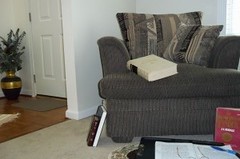
Regina's Favorite Chair!

I love the reflected sunlight of this room. In the Regency period, this would have been a small sitting room used for waiting guests to be announced to the master. Note the lap desk, encyclopedic dictionary, and synonym finder beside my favorite chair. Some day, I will have to have this chair reupholstered. I fear my “inspiration” lies in the lumpy cushions. Normally, there is a cup of tea sitting on the nearby table. I brew my own – no American tea bags for me. One can also see my journal sitting at the side, along with my Bible. This is where the creative process comes about.

Once I have written the book, I retreat to my “office” space to do the hard work. My office is the smallest of the three bedrooms in my North Carolina home. From the window, I overlook the curve of the cul de sac upon which I live. Not much happens in this small incorporated village, something I appreciate. It is quiet and relatively crime free. When I first moved here in 2003, “Miss Kitty,” my neighbor, brought me over a chocolate cake. (I didn’t tell her that I prefer white cake to chocolate. It would be rude.) I love the South!!!

Matthew Macfayden Photos

The office reflects my eclectic tastes. I love oversized furniture. The walls hold my “interests.” Of course, there are multiple pictures of Matthew Macfadyen. I enjoy Colin Firth’s work (am a big fan), but I really LOVE Matthew. All the pictures are signed. Yes, I realize this is an obsession, but daily I remind myself that the word “fan” comes from “fanatic.” (BTW, I have seen “The Three Musketeers” six times to date.) I use post it notes of different colors to keep track of appearances, guest blogs, etc.

Miami Dolphins Quarterback Chad Pennington

I also am a big fan of Chad Pennington, the NFL quarterback. He attended Marshall University, where I went to school, but my respect for Pennington comes from his kindness to my son during the difficult period when my mother was dying. He showed himself to be a true gentleman. In Darcy’s Temptation, Chadwick Harrison is so called because of Pennington.

Although I do not write much outside, I often take a cup a tea and a bit of research of which I want to peruse and sit in one of the two “cozy” spaces I have created. The first is a sheltered area at the front of my house. I bricked it all in and set up the potted plants and benches. I loved my hybrid roses and the hibiscus, but mums and pansies surround the area also. In North Carolina, the vegetation lasts well into late November. Behind my house, there is another bench draped by a weeping willow. It serves the purpose well.

So, this is where I have managed to write twelve novels (Darcy’s Passions, Darcy’s Temptation (a 2009 Booksellers’ Best Award finalist), Vampire Darcy’s Desire, Captain Wentworth’s Persuasion, The Phantom of Pemberley (took 3rd in romantic suspense for the SOLA Awards), Christmas at Pemberley, The Scandal of Lady Eleanor, Honor and Hope, A Touch of Velvet, A Touch of Cashémere, First Wives’ Club, and Second Chances), in addition to two novellas (His Irish Eve and His American Heartsong) and one short story (“The Pemberley Ball”) in a little over four years.

Christmas at Pemberley is my newest release and is currently available. I have a December 1 deadline for The Disappearance of Georgiana Darcy, which will take up where Christmas at Pemberley leaves off, but it will be a cozy mystery, rather than an inspirational romance. I am working on two others (one Austen, one non-Austen) at the same time. This is my Writing World. Quite simple. Quite plain. All me.

Thanks, Regina for sharing your writing space with us.Please also check out the slide show of the remaining photos from her writing space.

For those readers interested in reading about the Darcys, Bennets, and Bingleys during the holidays, enter the giveaway below.

1. Leave a comment about what you found most interesting about Regina’s writing space.

2. For up to 3 more entries, share the giveaway on your blog, Facebook, and Twitter, and leave a link for each in the comments.

3. Follow Savvy Verse & Wit for another entry.

Deadline is Nov. 18, 2011, at 11:59PM EST (US/Canada only)

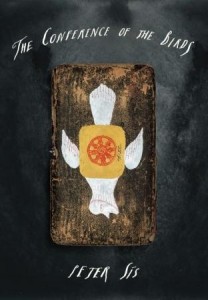
The Conference of the Birds by Peter Sis

The Conference of the Birds by Peter Sis, an acclaimed children’s author and illustrator, has taken his skills to a 12th century Sufi epic poem of the same name written by Farid ud-Din Attar, who was not only a poet but a mystic.  Often these types of poems have a hidden spiritual meaning, and Sis deftly captures the essence of Attar’s poem with illustration.

In this illustrated version of the epic poem, the pictures speak for the poet, Attar who wakes from a dream to realize he’s a hoopoe bird.  Once he transforms, he calls all of the birds of the world together to find their true king, Simorgh, by flying through the seven valleys — The Valley Of Quest, The Valley Of Love, The Valley Of Understanding, The Valley Of Detachment, The Valley Of Unity, The Valley Of Amazement, and The Valley Of Death — to reach Mountain Kaf.

In the beginning, the transformation of Attar is shown much like animated cartoons would have been created, with the flipping of each panel where each image has slight differences to create the illusion of movement.  Once the birds agree to take the journey, it is clear that it will take them through a number of valleys that will test their resolve, with each bird’s skills and weaknesses hammered by adversity and uncertainty.  Sis creates vivid birds of various colors and species.  Even if the pages of this book were not textured, readers could see the feathers and layers on these birds.

And there are many layers to these birds, their feathers, and their story.  The poem sheds light on the inner spiritual journey each of us travels, the trials that we face, and the perseverance it takes to stay on course and believe in ourselves.  For some the journey is too hard, and they turn back, but for others, it is important enough to move onward despite the risks and sorrow.  Like the poem, The Conference of the Birds by Peter Sis is multilayered, with great attention to detail from the feathers on the birds, the birds making up the larger birds, and the trees that create the mountains.  A gem of a book from an illustrator and writer who sees beyond just the words to the world it creates and the messages it brings.  Likely to be on the best of list for the year.

As an aside, I read this a couple of times carefully and with my infant daughter. She loved feeling the pages and looking at the vivid imagery, and I can tell you that keeping her attention for an entire book is difficult. This is great for kids and adults. Sis has created something of lasting beauty.

About the Author:

Born in Brno, in the former Czechoslovakia, in 1949, Peter Sís is an internationally acclaimed illustrator, author, and filmmaker. Most recently, in 2007, he published The Wall: Growing Up Behind the Iron Curtain, which was awarded the Robert F. Sibert Medal and was also named a Caldecott Honor Book. Peter Sís was named a MacArthur Fellow in 2003. He is the author of twenty children’s books and a seven-time winner of the The New York Times Book Review Best Illustrated Book of the Year.  Please check out his Web page.

Please check out this video interview from BEA:

According to the Seattle Post-Intelligencer, Sis pays homage to traditional Islamic art and its figurative representations and geometric patterns as the valleys are depicted as a series of mazes.  (Seriously, read that review, it is stunning).


If you’d like to check out the rest of the tour, please click on the TLC Book Tour icon at the right.


This is my 29th book for the Fearless Poetry Exploration Reading Challenge.


This is my 66th book for the 2011 New Authors Reading Challenge.

Interview With Emma Eden Ramos

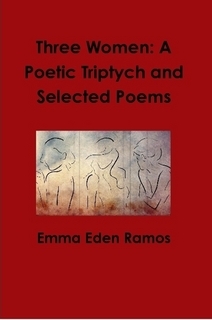
I recently had the pleasure of reading and reviewing Emma Eden Ramos‘ first chapbook, Three Women:  A Poetic Triptych and Selected Poems at the beginning of November.  Her collection creates three unique female voices who are connected.  I had the pleasure of interviewing Emma via email to learn a little more about her as a poet and her collection.

Without further ado, please welcome her.

1.  How would you introduce yourself to a crowded room eager to hang on your every word?  Are you just a poet, what else should people know about you?

I’m pretty shy and self-conscious in front of large groups of people, so I would probably begin with a short anecdote as a way to personally connect with the crowd. From there, I would go into my background.

I am a twenty-four-year-old student from New York City. I’ve wanted to be a writer since I was about seven-years-old. That year I wrote my first short story, a fable, which ended up in a collection of children’s stories called Witches Brew.

I became interested in poetry later when my mother gave me a collection of Emily Dickinson‘s poems in my freshman year of high school. That was a rough year and I remember finding a great deal of solace in Dickinson’s words. I wrote my first poem that year, a poem about the main character from Edith Wharton‘s novel Summer. My English teacher was very supportive and encouraged me to continue writing. I did, on and off, until 2009 when I decided to take my writing more seriously. I wrote a novelette entitled Where The Children Play that was published in the Spring of 2010. I’ve been writing continuously ever since.

2.  How did you create the three women in your chapbook, Three Women:  A Poetic Triptych and Selected Poems?  Were they based upon people you know or yourself?

After I agreed to write a poetry chapbook, I grew nervous. though I have a deep love for poetry, I see myself as more of a fiction writer. Creating and developing characters is essential to my writing process. I need them as guides. With Three Women I was lucky because, though the editor of Heavy Hands Ink had never published a chapbook with a storyline and characters before, he was supportive of the idea.

When developing the three characters, I attached each woman to a certain female archetype from Greek Mythology. I saw Annette as a manifestation of Aphrodite. She is outwardly beautiful and has relied on her beauty throughout her life. However, after her son’s suicide, Annette’s physical “perfection” has become more of a handicap. The beauty she once treasured now fully masks Annette’s internal torment.

I saw Julia as Persephone. She is the daughter trapped in the Underworld, which in her case, is adolescence. However, Julia is also very much based on myself.

Milena is a warrior. I have met many women like her and am always floored by their resilience. As an archetype, I saw her as Athena. Milena possesses courage, intelligence, wisdom, and strength. She may be under Annette’s “professional” care, but she is not the one who is lacking in emotional resources.

3.  Do you see spoken word, performance, or written poetry as more powerful or powerful in different ways and why? Also, do you believe that writing can be an equalizer to help humanity become more tolerant or collaborative? Why or why not?

I love spoken word and performance poetry and am a fan of artists such as Ursula Rucker and Anne Waldman. There is a power, an electricity, that comes from experiencing a poem  performed. Initially, I think performance poetry is probably more powerful than written poetry because it is synesthetic. There is a hidden quality to the written word, however, that I think makes it more durable. When I read a poem, the words are locked in my consciousness in a very different way than when I hear a poem performed.

I do believe that writing can be an equalizer, a tool through which human beings can find a common ground. Writing is a form of communication. Thoughts and perhaps, more importantly, feelings are channeled and conveyed through writing. While individuals are different, as a collective we share feelings that are fundamental to the human condition. Writing–poetry, fiction, non-fiction–can and has been a medium through which those universal feelings are expressed.

4.  Poetry is often considered elitist or inaccessible by mainstream readers.  Do poets have an obligation to dispel that myth and how do you think it could be accomplished?

When I hear people say that they struggle with this or that poem, find it impenetrable, I often agree. I cannot count the number of occasions that I have finished reading a poem and thought, “Wow. Beautiful language. Beautiful imagery. If only I knew what the writer was talking about.” I don’t know why this is. I have heard poets argue that poetry is personal. It comes from an unconscious place and therefor can only be understood by the poet. I respect this answer and the artist’s desire for self-expression. However, as I said earlier, writing, poetry included, has the potential to be a tool for communication.

5.  Please share some of your favorite contemporary and classic poets and a favorite collection or two from those poets and why you enjoy their work.

One of my favorite contemporary poets is a woman named Brooke Axtell. I discovered Brooke when I came across her first poetry collection, Daughter of the Burning. This collection, as well as Axtell’s other work, is a perfect example of the power poetry has to communicate strong emotions and inspiration.

Other poets I love are Adrienne Rich, Patricia Smith, Linda Gregg, Sarah Hannah, Sharon Olds, and the list could go on.

Thanks so much Emma for answering my questions.  I wish you great success in your poetry.

Mailbox Monday #151

First, I would like to congratulate (Ryan) on winning My Soul to Take by Tananarive Due (my review) from the last Mailbox Monday giveaway.

Mailbox Mondays (click the icon to check out the new blog) has gone on tour since Marcia at A Girl and Her Books, formerly The Printed Page passed the torch. This month’s host is the Mailbox Monday tour blog.

Kristi of The Story Siren continues to sponsor her In My Mailbox meme.

Both of these memes allow bloggers to share what books they receive in the mail or through other means over the past week.

Just be warned that these posts can increase your TBR piles and wish lists.

Here’s what I received this week:

1.  You Are My Only by Beth Kephart; finally my 5 pre-ordered books arrived (so the two of you readers who have won a copy should receive them soon from me) and 1 autographed copy from Beth after I won her Treasure Hunt, which I will treasure forever.

2.  Dreaming of Mr. Darcy by Victoria Connelly for review in January from Sourcebooks.

3.  Christmas at Pemberley by Regina Jeffers for review in December from Ulysses Press.

4.  Henry Tilney's Diary by Amanda Grange for review in December from Berkley/Penguin.

5.  The Unexpected Miss Bennet by Patrice Sarath for review in December from Berkley/Penguin.

6. Ivan and Misha by Michael Alenyikov, which I won from Unabridged Chick!

7. All the Flowers in Shanghai by Duncan Jepson from Library Thing Early Reviewers.

What did you get in your mailbox?

Some Lucky Winners….

Today, I want to congratulate some winners of some spectacular books.

The two winners of You Are My Only by Beth Kephart:

Jill of Rhapsody in Books
Janel of Janel’s Jumble

The winner of The Taker by Alma Katsu:

Johannah from A Book and a Bite

Congrats ladies!

122nd Virtual Poetry Circle

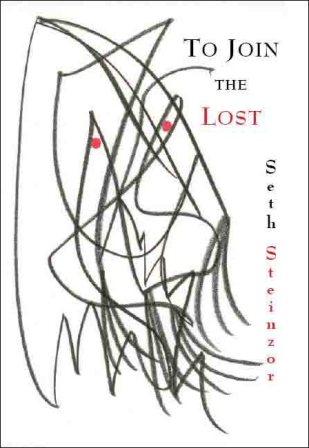
Today’s poem is from To Join the Lost by Seth Steinzor, which I reviewed earlier in the week and modernizes Dante’s Inferno:

Canto I (page 11-6)

Midway through my life’s journey, I found myself
   lost in a dark place, a tangle of hanging
vines or cables or branches – so dark! – festooning
   larger solid looming walls or
trunks or rocks or rubble, and strange shapes
   moving through the mist, silent or
howling, scuffling through the uneven dirt or
   dropping from the blotchy sky like
thicker clouds, so close sometimes I ducked in
   fright so that they never quite touched me.

Someone I had trusted had led me there.
   Perhaps it was persons, I could not remember,
only how their words and gestures, once so
   sensible and clear, gradually grew
obscure, how their features, once so individual
   and expressive – this lifted tuft of
eyebrow, that kindly smile, that belly laugh –
   smoothed to nothing in the murk,
and how at last they turned away, gibbering,
   gone. Without them was no path

that I could see. A bit ahead to the right the
   curtain seemed lighter, its patterns more
distinct and loosely entwined and permeable,
   so I stepped over that way, stumbling
on the occasional root or protuberance,
   until I splashed ankle deep
into a pool of sucking mud that spread
   among the blackened boles and mounds its
unforgiving mirror far as could be
   seen, and I could go no farther.

Perhaps, I thought, what I had followed, moth-like,
   was just the sky’s dim luminescence
the marsh cast back, and then I knew despair,
   and pulled my sodden shoe back out, and
turned, and a cry swelled in my throat. But just
   before I let it loose, another
shimmer caught my eye. Perhaps, I thought,
   I’d wandered off my course through tending
to my feet and not to where they were going;
   and holding my gaze level, and gingerly

feeling the way with toes that slid forward and sometimes
   up and around or suddenly down (so
my attention was sharply bifurcated
   while a third, unattended
part of me coordinated) towards that
   distant barely backlit scrim, while
yet a fourth part of my poor divided
   self was straining not to feel a
thing at all. Of all four tasks, this last was
   hardest. Hope and fear impelled me

“Run!” but who could run on that turf, rough and
   sharp as a grater? And vehement voices
muttering a flow of words so soft they’d
   lost their forms now clogged my hearing,
aural mush, except that here and there, as
   clear and hard as pebbles, numbers
struck me; and unseen hands behind me plucked my
   clothing, grabbed my shoulders, stroked my
hair. My knees gave way. I huddled there, in
   sudden lonely silence, long.

Then slowly, like a fern uncurling, I rose,
   not recalling having fallen
asleep or having passed the border into
   awareness of this dismal dawn.
Before me, jarringly stood the only straight
   and undistorted object in my
view: a man, tall and thin, head topped by
   what I took to be a red fleece
ski hat, barefoot, robed in simple brown he’d
   cinched about the waist with a cord.

His skinny neck, that sprouted from an itchy
   looking undergarment, upheld
a long and narrow face. A long and narrow
   nose, sharply hooked, ran like a
ridge between the hills of his high cheekbones,
   and the basins of his cheeks
converged upon a small and beautiful mouth.
   The upper lip was thin and long,
the lower shorter, plusher, so the top one
   drooped a little at the corners,

and they made an arc much like a bow
   whose arrows aim to pierce the clouds,
not quite primly frowning, more the meeting of
   strength and sensitivity. But his
great, sad, brown eyes! There’s a
   distant gaze that looks within,
and a regard like a net we cast upon the
   outer world, that in his eyes were
combined: alertly pensive, missing nothing.
   They were what held me. I stepped forward.

Glancing at my squelching shoes, “O voi che siete in piccioletta barca, ”
he said, “Oh you who follow me in
   little boats.” His voice was sweet and
soft, and the phrase was one of the few I knew in
   Italian. Odder to meet an Italian who
can’t quote Dante than one who can. Well!
   Humor was the last thing I’d
expected in that desolation. Taken
   quite aback, I paused, and at that

instant, growls, a vicious snarl, a rumble
   low and ominous, all issued
from behind the stumps of a shattered pylon
   thirty feet away. His robe
flaring, he whirled and faced the hidden beasts.
   “Whatever you were seeking, you won’t
find it here,” he said, glancing back.
   (Oddest: how I did not find it
odd to understand him.) “If you don’t lose your
   way yourself, those three will lose it

for you. Come, and I will show you the path
   out of here.” And backing slowly
towards me over shards and ankle-busting
   holes as if his feet had eyes,
he glided, holding all the while the animal
   danger at bay by looking at it with
fiercer focus than any predator, then
   guided me some yards away
behind a ragged rubbish berm. I thought he’d
   stop to talk, then. Instead, assured

I was still with him and unharmed, he whirled so his
   garment flared like a tulip again, and
strode away, impatiently gesturing at me
   to follow. Not that I had much choice,
but still I hesitated. Then I gathered
   in my hope and hurried after,
catching up with him a while before I
   caught my breath enough to ask him,
“Who are you? And what do you want with me?”
   He answered: “Last things first. You are

the one whose fifteenth year blossomed in the
   city by the Arno, where they were
drying the pages of books the river had drenched
   two years before?” My face froze. He nodded.
“And of course you’ve not forgotten her
   you stood with by the river wall,
your arms around each other’s waists, not holding,
   sweetly ratifying the seal your
bodies made from ankle to shoulder?” I could not
   move. He halted with me. “And how

you stood there, watched the brown-green flood,
   minute by minute on the brink of a kiss
that never came because you were afraid?
   Well, it was she who visited me
from one of those bright circles you cannot
   quite bring yourself to believe in, glowing
and slender and blonde and passionate, and she asked me
   to help you find your way. She called you
My Seth, whom I knew as a poet and one of love’s authors.
   She knew how to ask so her will would be mine.”

With finely calculated disregard
   for how much shock I could absorb,
he added, “As for who I am: that year
   you met and said good-bye to her
not knowing how long, you lived in my home town,
   the place they kicked me out of and
set death at the gate to keep me away. You lived
   in a small hotel off Via Fiume
named for her whose hand reached down for me
   as your Victoria reaches for you.”

Welcome to the 122nd Virtual Poetry Circle!

Remember, this is just for fun and is not meant to be stressful.

Keep in mind what Molly Peacock’s books suggested. Look at a line, a stanza, sentences, and images; describe what you like or don’t like; and offer an opinion. If you missed my review of her book, check it out here.

Also, sign up for the 2011 Fearless Poetry Reading Challenge because its simple; you only need to read 1 book of poetry. Please contribute to the growing list of 2011 Indie Lit Award Poetry Suggestions (please nominate 2011 Poetry), visit the stops on the National Poetry Month Blog Tour from April.

What did you think?

Interview With Seth Steinzor

After reading To Join the Lost by Seth Steinzor (my review), I got to thinking about why anyone would “dare” take on Dante and modernize it.  Given the daunting task ahead of Seth when he undertook  the project, its no wonder that there was a very organic germination of ideas as he wrote.

Although some of the epic poem worked better for me as a reader than other places (which is pretty typical with larger poetry works to begin with), it is a solid first book with a great deal to say about our modern world.  Whether you agree is another issue altogether.

Seth was kind enough to answer a few questions about the book and writing in general, so without further ado, please give him a warm welcome.

1. To take on Dante must have been a daunting task, so what prompted you to modernize the tale? Do you have plans to modernize the entire Divine Comedy?

It didn’t start out as a project of modernization, although it certainly was daunting at first. For a while, until I relaxed into it, I felt as if I were building a scale model of the Eiffel Tower out of toothpicks. The idea that got me going is a good example of the convoluted way my mind works. I had loved Dante’s work for decades, but, being neither a scholar nor a critic, I always found myself at something of a loss when I tried to explain to people what I saw in it.

At last I realized that, as a poet, I could speak most comprehensively, vividly and precisely through poetry, and I also realized that the best way to describe what I saw in the Commedia was to place myself in the middle of it. “Modernization” was a consequence of that, but not a goal in itself.

2. Your training as an attorney must have been informed by your younger years as a poet, learning how to use an economy of words and to play with meaning in an effort to reap a desired result. What first drew you to poetry and later to the law? And have the two facets of your life ever conflicted on the page or elsewhere?

Law shares with poetry an extreme sensitivity to the meanings of words and punctuation, and a strong concern with matters of form. Of course, “meaning” in law and “meaning” in poetry are two different concepts. As long as I can remember, I’ve written poems. What drew me to law is a longish story, but basically, after I graduated from college, law presented itself as an interesting and congenial way for me to use my natural abilities and proclivities in the cause of justice. I spent about a year and a half working as an investigator for a Public Defender in Vermont, and then went to law school.

Law school itself turned me off, and although I graduated and passed the bar exam, I didn’t practice law for another eleven years, until I was given an opportunity to do an appellate argument and had great fun with it. I started working as a lawyer not long after that. My experiences working as an investigator and as a lawyer have fed my life as a poet, most conspicuously in the “thieves” and “fraudsters” sections of To Join the Lost. The only conflict, really, is that I have to work to make a living, and that takes time and energy away from my writing.

3. How much of your day job was modified and adapted to fit into To Join the Lost?

A lot. Several sections of the book were drawn from my legal experiences and knowledge. Also, as a lawyer, I have evolved a habit of thinking syllogistically, which in turn has made it easier to relate to Dante, whose primary mode of discursive thought was through aristotelian logic.

4. What kinds of obsessions, habits, or requirements do you have when you write? (i.e. love of chocolate, total silence, raging metal music in the background, etc.)

I need it to be quiet and still. In my house, my computer is in a small room lined with bookcases. The windows are too high to see out of. There’s an oriental rug on the floor and too much clutter on the horizontal surfaces, but it is a still and calming place. When I’m away from home, I use a spiral notebook and a pen and I can jot thoughts down just about anywhere, but for sustained effort I need the isolation and quiet.

On the other hand, once I have settled into the right space – physical and psychological, and the work is flowing, my cat is welcome to come and sit on my lap. I type and she purrs, until she gets bored and goes away. I usually write in the evenings after dinner, or on weekend mornings. Sometimes I wake up in the middle of the night and can’t get back to sleep until I have jotted down whatever lines had popped into my head. About half the time, that “inspired” stuff turns out to be worth keeping,and half the time, it’s junk.

5. What one piece of advice did you receive early on as a writer that propelled you to keep going and who said it?

This is a tough one! The temptation is to recall some bit of ego gratification I received, like when a beloved teacher told me,”You’re a poet.” But honestly, writing is just something I would have done anyway. I wasted a lot of years, time and energy going nowhere with it, however, due to substance abuse and other issues. The best piece of writing advice I ever got, the only one that has really made a difference, was so simple: write every day. I don’t remember where I first encountered it, or who said it in a way that finally sank home, and I don’t actually achieve it, but I actively aspire to it. Even if all I get is one line or phrase, even if I end up crossing that line or phrase out later, the discipline and constant attention to the work make all the difference. It took me years to understand this.

Thanks, Seth, for answering my questions. I wish you much success with your poetry.

To Join the Lost by Seth Steinzor

To Join the Lost by Seth Steinzor is a modernization of Dante’s Inferno, and the irony that Dante takes a lawyer with him on his next visit should not be lost on readers.  Seth infuses his epic poem with modern tools and vices from bulldozers to politics.  Traveling the same path as Dante into the depths of Hell’s nine circles, Seth sees those trapped in between and those who have sinned in a multitude of ways.

With each canto there is a flavor of “famous” sinners, but also references to the poet’s own sins and regrets.  Where the epic poem is strongest is where Steinzor references his own troubles, his own lack of faith, his own indecision, and his own failures. “loading racks and shoving them along a/track of stainless steel into a/box of stainless steel — lower the lever,/close the gate — punch the big red/button, wait — shuddering, hissing — raise/the gate, releasing white clouds –/reach in, extract a rack of formerly filthy,/now gleaming and steaming glasses, or shiny,/clunky porcelain, or scratched-up aluminum/knives, forks, and spoons so hot//” (page 18 of Canto II)

Yes, the poem references some events, many the most horrific in nature (i.e. the Holocaust), and yes, this may seem trite and unnecessary, but these are the moments that most of humanity knows either first hand or through study.  These historic instances of unmitigated evil correlate to the references Dante makes from his historical knowledge, such as the reign of Julius Caesar and family wars that existed during that time.  However, Dante relies heavily on mythology and religious text to craft each of his cantos, though there are references to his own love, Beatrice, within the poem.  This is how Steinzor’s and Dante’s poems are similar.

Unlike Dante who uses mythology and Catholicism to make his points, Steinzor relies more heavily on Buddhism.  “. . .  That flat little pebble’s the/world of your daily awareness.  The pond is/everything else.”  (page 43, Canto VI)  The line break after “is” signifies a Buddhist precept of being in the here and now without thought to the past or the future — to be in the moment.  Many parts of this epic poem are enjoyable, but are bogged down in parts by movement through the circles with Dante and similar pungent smells.  However, Steinzor’s verses shine beneath the mire with vivid imagery in stunning ways occasionally.  “crowd of moving parts that, overlapping,/layer almost to opacity,/the eye drawn in, each figure a mottled window/into unimaginable//dimension, an almost empty pane.”  (page 23 of Canto III) or “Then, suddenly, he dived down smack/upon the landfill — a belly-flop! I sat/on his back, and he body-surfed across/the writhing mass.  We regained our feet near an/idling ‘dozer.” (page 44 of Canto VI)

To Join the Lost by Seth Steinzor modernizes Dante’s Inferno in a way that is personal for the poet and tackles some of histories most evil moments and most controversial politically.  Some readers will not enjoy the comments about a former president or other topics touched upon in this epic poem, but the gems in this epic are the more personal aspects of the piece.

***Stay Tuned tomorrow for my Interview with Seth Steinzor.***

About the Author:

Seth Steinzor has been writing poetry nonstop since his teens. To Join the Lost is his first book.  Visit his Website.  Here’s a preview of one Canto.


Please check out the other stops on the tour by clicking the TLC Book Tours image at the left.


This is my 28th book for the Fearless Poetry Exploration Reading Challenge.


This is my 65th book for the 2011 New Authors Reading Challenge.