Quantcast

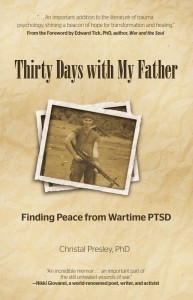
Thirty Days With My Father: Finding Peace From Wartime PTSD by Christal Presley, Ph.D.

Thirty Days With My Father:  Finding Peace From Wartime PTSD by Christal Presley, Ph.D., is the result of a 30-day project Presley undertook to get to know her father and his Vietnam War experiences after not relating for more than a decade, and she got much more than she expected.  Alternating between conversations wither her father and memories written down in her journal — the idea of her therapist — Presley relives parts of her own past just as her father does when speaking of Vietnam and what happened there.

Delmer Presley was drafted into the Vietnam War and never once thought about running off and dodging the draft, and he was a member of Americal Division, First Battalion, Sixth Infantry, referred to as the Gunfighters.  He entered the war following the Tet Offensive and came back a changed man.  While Presley’s book talks about his experiences as they were related to her during phone conversations and other encounters with her father, the memoir focuses mainly on Christal Presley’s intergenerational PTSD symptoms and childhood as it relates to those war memories.

Living in constant fear due to unpredictable behavior and other outside forces can cause heightened awareness fueled by adrenaline.  In the case of warriors and soldiers, this constant state of awareness can be hard to shake even when the unpredictability of the situation is removed and soldiers are sent home.  Consequently, the families that these soldiers return to find that their loved ones are altered, and in some cases, these situations can become very volatile and lead to unintended consequences, such as families subject to verbal abuse and more.

“‘I just didn’t consider those people human.  I never saw a Vietnamese before in my life, and I hated them.  We didn’t even call them Vietnamese back then.  Called them Charlies, dinks, and gooks.  That’s all I knew.  They taught us that.  I was trained not to see them as human.  The government can say whatever they want, but they trained us that way.  It hurt me more to see a dog or cat dead than them Vietnamese.  The government likes young boys who ain’t got no sense.  Easier to train, easier to brainwash that way.'”  (page 59 ARC)

The relationship between father and daughter always has been fragile.  The tentative nature with which Christal makes her calls to her father and feels him out before she asks each question is how readers would imagine any conversation to go given the years of silence between them, but particularly given traumatic nature of her upbringing.  Thirty Days With My Father:  Finding Peace From Wartime PTSD by Christal Presley, Ph.D., is about finding yourself amidst the chaos of family life, particularly a family life full of baggage, and about forgiveness for yourself and your family.  One of the most surprising and astonishing memoirs I’ve read in a long while.  It will have you re-evaluating your own conceptions about your childhood and how to repair relationships that have been damaged.
About the Author:

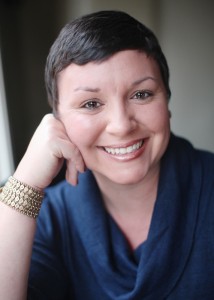
Christal Presley received her bachelor’s degree in English and her master’s degree in English Education from Virginia Tech.  She received her Ph.D in Education from Capella University. She is a former intern at Algonquin Books of Chapel Hill, and spent seven years teaching middle and high school English in Chatham and Danville, Virginia.

Her first book, Thirty Days with My Father:  Finding Peace from Wartime PTSD, will be published by Health Communications, Inc. in November 2012.

Christal grew up in Honaker, Virginia, and currently lives in Atlanta, Georgia. She is the founder of United Children of Veterans, a website that provides resources about PTSD in children of war veterans. In her spare time, you can find Christal playing with her dogs, tending to her chickens, and gardening.

***IF you would like to win a copy, leave a comment on this post about your interest by Nov. 21, 2012, at 11:59 PM EST***

This is my 80th book for the New Authors Reading Challenge in 2012.

Giveaway: When It Happens to You by Molly Ringwald

I’ve got a surprise giveaway for everyone, a signed copy of Molly Ringwald’s When It Happens to You, a novel in stories.  Here’s the skinny:

When it happens to you, you will be surprised. That thing they say about how you knew all the time, but just weren’t facing it? That might be the case, but nevertheless, there you will be.

Molly Ringwald mines the complexities of modern relationships in this gripping and nuanced collection of interlinked stories. Writing with a deep compassion for human imperfection, Ringwald follows a Los Angeles family and their friends and neighbors while they negotiate the hazardous terrain of everyday life—revealing the deceptions, heartbreak, and vulnerability familiar to us all.

In “The Harvest Moon,” a stay-at-home mom grapples with age, infertility, and an increasingly distant husband. In “Ursa Minor,” a former children’s television star tries to rebuild his life after being hospitalized for “exhaustion.” An elderly woman mourns the loss of her husband and her estranged relationship with her daughter in “The Little One.” In “My Olivia,” a single mother finds untapped reserves of strength to protect her flamboyant six-year-old son who wishes only to wear dresses and be addressed as Olivia. And in the devastating title story, a betrayed wife chronicles her pain and alienation, leading to an eviscerating denouement.

As the lives of these characters converge and diverge in unexpected ways, Ringwald reveals a startling eye for the universality of loss, love, and the search for connection. An unflinching yet poignant examination of the intricacies of the human heart, When It Happens to You is an auspicious literary debut.

Enter by leaving a comment on this post by Nov. 20, 2012, at 11:59 PM EST. Giveaway is open to all U.S. and Canadian residents.

Interview with Jill Mansell

As everyone knows, my go-to author for hilarious fun in the Britain is Jill Mansell.  Her books never fail to make me laugh, cry, or just have a great time as her heroines go on adventures that change their lives — whether its a new career, like in Rumor Has It, or finding the Mr. Right, like in Take a Chance on Me.  Her characters are always fresh and quirky, generally naive about themselves and where they are going, and always fun to have at a party.

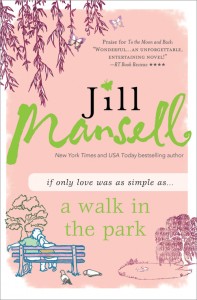
Her latest U.S. release is A Walk in the Park, in which Lara Carson returns home to Bath after leaving her boyfriend Flynn and her family 18 years ago without a word.  You can bet their will be secrets to uncover and blundering around, making Lara’s return a little less smooth than she might expect.  There is a reason that I am a self-proclaimed Mansell junkie, and these story lines are just one reason.  To find out more about why I adore this author and her books, check out the interview:

If there were one genre that you would write other than your current women’s fiction, what would it be and why?  Have you ever tried to write in it before?  How did it go?

Do you know, I never have tried any other genre. Sometimes we just have an instinct for what we’re good at and it seems to make sense to stick to it. When I first started writing I did try category romance (Harlequin) because I thought they might be easy. Needless to say, they weren’t! I sent off a few and the reasons for rejection were always that there was too much humour in them and not enough sustained emotional depth. In the end I gave up and wrote the kind of books I would like to read myself…and that’s how I got my first publishing contract. The term chicklit hadn’t been invented back then!

You’re forthcoming release in the United States is A Walk in the Park.  How does the publishing process in the U.S. differ from others?  How did you go about getting books published in other countries?  What’s the lag time between when a book comes out in England to when it comes out elsewhere?

The time lag varies according to the publisher but Sourcebooks is aiming to catch up with the UK next year and also bring out another of my older books in the US. It’s always entertaining, receiving a long list of British words from my editor that need to be ‘translated’ into American before the book can go to press. We definitely speak a different language! Getting published in other countries is all down to my agent and her sub-agents around the world. It’s brilliant going along to the London Book Fair each year and meeting some of the other agents and publishers from all over.

Who are some up-and-coming writers that readers should be on the look out for?

I’m not reading much fiction, but two books this year by writers new to me have absolutely blown me away.

John Green is a YA author, but this is a book for everyone — The Fault in Our Stars. Astonishing and emotional.

I adored this one too, Wonder by RJ Palacio. Just an amazing, incredible book.

I also loved The Runaway Princess by Hester Browne, which is great fun and a real feel-good read. I always love Hester Browne’s books.

Many writers these days are being told to market their own books through Websites and social media. What’s been your experience? Do you have any tips for others?

Well, it’s entirely my UK publisher’s fault that I’m on Twitter – they asked me to give it a try and I told them I would HATE it. But they insisted, so I gave it a go and within a couple of days I was hooked. I love it so much I’d far rather chat away on Twitter than write my books, which probably wasn’t what they had in mind…

But I think the reason it is working for me is because I do enjoy it and I’m not just endlessly plugging my own work. I very rarely do, in fact. I find relentless self-promotion from others a huge turn-off and it actually makes me LESS inclined to try a new author’s work. I would far rather think for myself how interesting/fun/nice they are, then quietly buy their book.

So the moral of the story is…just have fun and enjoy yourself. The ability to cyber-meet people all over the world is such a magical gift, why spoil it?

Just for fun, what television shows or music are you enjoying or find inspirational?

Well, inspiration can come from anywhere so I feel it’s my duty to watch lots of TV, all in the name of research. I’m getting into Strictly Come Dancing – our version of Dancing With the Stars. Still watching American Idol and UK’s X Factor but maybe starting to get a teeny bit bored with them now. The revelation this year for us in the UK has been the Olympics followed by the even more amazing Paralympics. We had masses of TV coverage and beforehand many people wondered if the Paralympics would be able to match up. Well, I know there was very little coverage of it in the US but let me tell you, it was BRILLIANT, completely life-enhancing and even MORE enthralling and inspirational than the Olympics. It has genuinely changed the view of the nation with regard to physical disability. The paralympic athletes have become superstars and we love every last one of them – our Superhumans. Inspiration-wise, who could ask for more?

Thanks, Jill, for answering my questions.  Your books are always a blast.

Past reviews:

If you’d like to win a copy of A Walk in the Park by Jill Mansell, please leave a comment here.  Deadline is Nov. 20, 2012 at 11:59PM EST  (US/Canada residents Only)

Mailbox Monday #201

Mailbox Mondays (click the icon to check out the new blog) has gone on tour since Marcia at A Girl and Her Books, formerly The Printed Page passed the torch. This month’s host is Bermudaonion.

The meme allows bloggers to share what books they receive in the mail or through other means over the past week.

Just be warned that these posts can increase your TBR piles and wish lists.

Here’s what I received:

1.  Cascade by MaryAnne O’Hara for a TLC Book Tour in December.

2.  The Missing Manuscript of Jane Austen by Syrie James for review.

What did you receive?

175th Virtual Poetry Circle

Welcome to the 175th Virtual Poetry Circle!

Remember, this is just for fun and is not meant to be stressful.

Keep in mind what Molly Peacock’s books suggested. Look at a line, a stanza, sentences, and images; describe what you like or don’t like; and offer an opinion. If you missed my review of her book, check it out here.

Also, sign up for the 2012 Fearless Poetry Reading Challenge because its simple; you only need to read 1 book of poetry. Please visit the stops on the 2012 National Poetry Month Blog Tour.

Today’s poem is from Henry Wadsworth Longfellow:

The Harvest Moon

It is the Harvest Moon! On gilded vanes
  And roofs of villages, on woodland crests
  And their aerial neighborhoods of nests
  Deserted, on the curtained window-panes
Of rooms where children sleep, on country lanes
  And harvest-fields, its mystic splendor rests!
  Gone are the birds that were our summer guests,
  With the last sheaves return the laboring wains!
All things are symbols: the external shows
  Of Nature have their image in the mind,
  As flowers and fruits and falling of the leaves;
The song-birds leave us at the summer's close,
  Only the empty nests are left behind,
  And pipings of the quail among the sheaves.

What do you think?

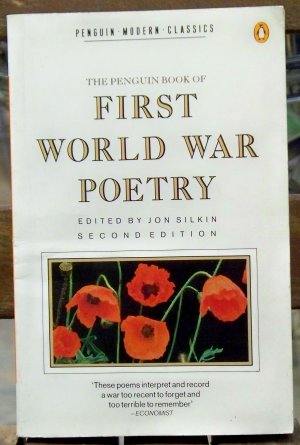
The Penguin Book of First World War Poetry (Second Edition) edited by Jon Silkin, David McDuff

The Penguin Book of First World War Poetry (Second edition) edited by Jon Silkin and David McDuff is a collection of poetry from and about the WWI.  Silkin and McDuff  increased the number of poems in translation included in the collection.  There are poems translated from German, French, Italian, Russian, and Hebrew, and Silkin was a poet himself.  As expressed in the not at the beginning, “For some, war was moral athletics; others looked forward to the experience of war as a ‘vacation from life’ — a vacation from a society disjoined by class and constrained by the rigid structures of labour.”  (page 12)

***However, I’m not one for long introductions so I skipped over it this time around and got straight to the poetry. ***

The anthology includes some of the more well known WWI poets, Thomas Hardy and Robert Graves, but also some who are not as well known.  One of the most well known WWI poems is “Anthem for Doomed Youth” by Wilfred Owen, which seeks to command a respect for the thousands who died in a cause for freedom and defense.  Steeped in religious allusions Owen makes reference to the candles lit where bodies lie and to the drawing of blinds in those same rooms as well as the prayers that often accompany the mourning process, but there also is an underlying celebration for their sacrifice as the bells are rung and anthems are sung.

Each of these poems brings with it a different perspective on war in the trenches, love, life, and loss, but above all patriotism.  Isaac Rosenberg’s “Dead Man’s Dump” (page 211) is particularly haunting:

"The wheels lurched over sprawled dead
But pained them not, though their bones crunched,
Their shut mouths made no moan.
They lie there huddled, friend and foeman,"

Meanwhile, there is a true sense of fear in Ivor Gurney’s “The Silent One,” (page 116):

"Who died on the wires, and hung there, one of two --
Who for his hours of life had clattered through
Infinite lovely chatter of Bucks accent:
Yet faced unbroken wires; stepped over, and went
A noble fool, faithful to his stripes -- and ended
But I weak, hungry, and willing only for the chance
Of line -- to fight in the line, lay down under unbroken
Wires, and saw the flashes and kept unshaken
Till the politest voice -- a finicking accent, said:
'Do you think you might crawl through there: there's a hole'
Darkness, shot at:  I smiled, as politely replied --
'I'm afraid not, Sir.' There was no hole no way to be seen
Nothing but chance of death, after tearing of clothes."

Each poet in the collection bring their own perspective to war, but there seems to be a pervading reverence to the fight these soldiers’ waged and all that they sacrificed.  There were certain translated poems in the book that didn’t resonate as well as some others, including Benjamin Peret’s “Little Song of the Maimed,” but it was good to revisit an old WWI poet, Osip Mandelstam (check out my earlier review of Stolen Air).  The Penguin Book of First World War Poetry (Second edition) edited by Jon Silkin and David McDuff offers a collection of poems that provide a wide perspective on war from the patriotism the soldiers felt to their fear and horror at the experiences they had.

About the Editors:

Jon Silkin was born in London, in a Jewish immigrant family and named after Jon Forsyte in The Forsyte Saga, and attended Wycliffe College and Dulwich College. During the Second World War, he was one of the children evacuated from London, and for a period of about six years in the 1950s, after National Service, he supported himself by manual labour and other menial jobs. He wrote a number of works on the war poetry of World War I. He was known also as editor of the literary magazine Stand, which he founded in 1952, and which he continued to edit (with a hiatus from 1957 to 1960) until his death.

David McDuff is a British translator, editor and literary critic. He attended the University of Edinburgh, where he studied Russian and German. After living for some time in the Soviet Union, Denmark, Iceland, and the United States, he eventually settled in the United Kingdom, where he worked for several years as a co-editor and reviewer on the literary magazine Stand. He then moved to London, where he began his career as a literary translator.


This review first appeared on Historical Tapestry for WWI Week.


This is my 14th book for the WWI Reading Challenge.


This is the 21st book for my 2012 Fearless Poetry Exploration Reading Challenge.

A Walk in the Park by Jill Mansell

A Walk in the Park by Jill Mansell is another engaging story about love and coming together as a family.  Lara Carson is forced to leave home at the age of 16 and returns to Bath 18 years later for her father’s funeral.  Things have changed drastically, but Evie is still the warm friend she remembers.  Lara believes she’s prepared to deal with the past, but when Flynn Erskine arrives unexpectedly her feelings nearly overcome her.  Not only does she owe the two most important people from her past an explanation, but she also has secrets she has to reveal — secrets that Flynn and Evie may not be ready for.

Mansell’s characters are always quirky, and there is no absence of that here, from Lara’s strong Aunt Nettie in Keswick to Don the jewelry shop owner in Bath.  While many of these characters are looking for love, denying that they are looking for love, or hoping to fall out of love with a cad, Mansell quietly addresses the fear that still haunts gays who have not come out of the closet, single-parenting obstacles, and how secrets can topple families.

Meanwhile, Lara is blindly making decisions that are best for her daughter, Gigi, but she refuses to look around her to see how her decisions affect herself and others.  She’s also busy trying to make love matches for her aunt and friends, at the same time she’s struggling to ignore her own passionate feelings for Flynn — her former teenage boyfriend.  Life and love is anything but a walk in the park for Lara and her friends, especially when the death of Lara’s mother raises questions about her mother’s faithfulness and about where she got the money to buy the family home.

Readers will note there are a variety of subplots, and while they are successfully concluded, there are some that felt a little rushed, which may be partially due to the multitude of characters Mansell creates.  Mansell novels are full of romance and flirty fun, but this one has some serious notes and a more mature set of story lines.  With a mother-in-law from hell and the outrageous behavior of rap star EnjaySeven, A Walk in the Park by Jill Mansell is a literary soap opera that leaps off the pages and makes readers thank their lucky stars their lives are less complicated.

About the Author:

Jill Mansell lives with her partner and children in Bristol, and writes full time. Actually that’s not true; she watches TV, eats fruit gums, admires the rugby players training in the sports field behind her house, and spends hours on the internet marvelling at how many other writers have blogs. Only when she’s completely run out of displacement activities does she write.

WWI Week: Review of WWI Poetry

Today on WWI Week at Historical Tapestry, my review of The Penguin Book of First World War Poetry (Second Edition) edited by Jon Silkin and David McDuff.

Mine is just one guest post in a slew of guest posts, reviews, and other activities to remember the 100th Anniversary of the start of WWI.

I hope that you’ll stop by and check out my review and some of the other WWI-related posts between Nov. 4-17.


The School of Essential Ingredients by Erica Bauermeister

The School of Essential Ingredients by Erica Bauermeister is a novel about food and characters as original and complementary as the dinners they create during Lillian’s Monday night School of Essential Ingredients at her restaurant.  From the older couple Helen and Carl who are seasoned and aged by salted wounds and mellowing cream to the spunky and unsure experimental flavors of Chloe who strives to build her confidence in the kitchen and her relationships, Bauermeister has created a culinary masterpiece that will melt in readers’ mouths.

“The girl was a daughter of a friend and good enough with knives, but some days.  Lillian thought with a sigh, it was like trying to teach subtlety to a thunderstorm.”  (page 7)

“Some smells were sharp, an olfactory clatter of heels across a hardwood floor.  Others felt like the warmth in the air at the far end of summer.  Lillian watched as the scent of melting cheese brought children languidly from their rooms, saw how garlic made them talkative, jokes expanding into stories of their days.”  (page 17)

“The more she cooked, the more she began to view spices as carriers of the emotions and memories of the places they were originally from and all those they had traveled through over the years.  She discovered that people seemed to react to spices much as they did to other people, relaxing instinctively into some, shivering into a kind of emotional rigor mortis when encountering others.”  (page 20)

Readers will smell the food, taste it, touch it, and become inspired to create their own culinary delights at home and share them with their families and friends.  Bauermeister threads the memories and problems of each character through the movements and creations in Lillian’s cooking class, alternating points of view and providing insight into each of their lives.  The true beauty of her prose is that cooking terms are even used when cooking is not the main focus of the story, and she excels at creating a mood of melancholy or a mood of frustration or even a mood of nostalgia as each character reviews their lives and their journeys in the kitchen.

Although the stories contained in the novel are short, Bauermeister does a magnificent job of creating characters that are three-dimensional.  Like the spices and other ingredients in Lillian’s recipes, each character is an essential ingredient to the whole of the novel.  In many ways, her novel is about enjoying each moment to its fullest, even those moments of guerrilla cooking in which someone is over your shoulder adding spices or tips to make a dish better, even if those moments of advice are unwanted at the time.  Taking criticism and advice with a touch of acceptance that we all need a little help is what the recipe to life requires to make it great.  The School of Essential Ingredients will leave readers wanting more, but willing to embark on their own journeys of food and so much more.

About the Author:

ERICA BAUERMEISTER is the author of The School of Essential Ingredients and Joy for Beginners. She lives in Seattle with her family.  Check out her Facebook page.

This is my 79th book for the New Authors Reading Challenge in 2012.

The Lost Art of Mixing by Erica Bauermeister

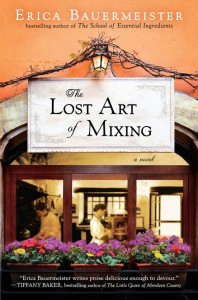
The Lost Art of Mixing by Erica Bauermeister (January 2013) picks up where her earlier novel, The School of Essential Ingredients (Check out my review tomorrow), left off — revisiting with Lillian, Chloe, Isabelle, and Tom.  Bauermeister also brings in some new characters as well as she leads readers on a journey of human interaction and family.  In many ways, recipes still play a role here as they did in the first book, though the imagery and word choices here are less about ingredients and cooking than they are about nature and the people themselves.  Isabelle plays a more integral role here than she did in the last book as a mother to grown children concerned about their new role as caregivers and to her wayward roommate, Chloe.  She’s also a motherly figure to Lillian when she finds herself in uncharted waters.

“For all the glamour of restaurants, the underlying secret of the successful ones was their ability to magically repurpose ingredients, a culinary sleight of hand that kept them financially afloat and would have made any depression-era housewife proud.”  (page 3 ARC)

Bauermeister expands on her early work and how food and emotions are closely tied to one another, looking deeper into her recipe to the ingredients and how they blend together or are mixed.  When a recipe is created, are the essential ingredients lost in one another or do they merely bring out the best elements of one another to create something luminous?  Isabelle’s memory loss highlights the mixing element further in terms of how memories are mixed in our minds with scents and seemingly innocuous objects, but the recall of those memories in those moments when scents and objects are present is all at once disconcerting, phenomenal, and joyous.

Bauermeister has created another set of deep characters with nuanced personalities and places them in unusual situations that are all at once odd and plausible, and readers will be swept up in the relationships within these pages and how the characters mingle and mesh with one another in different ways.  Whether a chance meeting when returning a lost coat or a rushed moment in the accountant’s office, lives are touched and changed.  The Lost Art of Mixing by Erica Bauermeister examines the relationships we have, the ways in which we perceive them and ourselves, and how an outside perspective can improve our interactions with those we think we know the best and are closet to, creating even deeper connections than we thought possible.

About the Author:

ERICA BAUERMEISTER is the author of The School of Essential Ingredients and Joy for Beginners. She lives in Seattle with her family. Check out her Facebook page.

Also look for a giveaway and interview in January when the book is released.

174th Virtual Poetry Circle

Welcome to the 174th Virtual Poetry Circle!

Remember, this is just for fun and is not meant to be stressful.

Keep in mind what Molly Peacock’s books suggested. Look at a line, a stanza, sentences, and images; describe what you like or don’t like; and offer an opinion. If you missed my review of her book, check it out here.

Also, sign up for the 2012 Fearless Poetry Reading Challenge because its simple; you only need to read 1 book of poetry. Please visit the stops on the 2012 National Poetry Month Blog Tour.

Today’s poem is from Adelaide Crapsey:

November Night

Listen. . .
With faint dry sound, 
Like steps of passing ghosts, 
The leaves, frost-crisp'd, break from the trees 
And fall.

What do you think?

The Lighthouse Road by Peter Geye

The Lighthouse Road by Peter Geye feels like the frozen tundra and the heat of the tropics all at once as his eccentric characters hack their lives out of the wilderness outside Duluth, Minn., between the 1890s and 1920s in Gunflint.  Odd is a young fisherman with his own small boat, whose mother died soon after he was born.  Raised by the local apothecary owner, Hosea Grimm alongside his daughter Rebekah, Odd strives to make his mark in the rough-around-the-edges town.

Geye’s narration shifts between Thea and Odd’s stories, with Thea’s set during the late 1890s when the town is just beginning and Odd’s story set during the 1920s during prohibition.  Earning money and carving out a life from the wilderness is tough work, and Odd begins making whiskey runs for the local bars and Grimm.  As the narrative shifts from Odd’s life to Thea’s life, the secrets of Gunflint are revealed slowly.  These secrets have lasting consequences for Odd as he falls in love.

“They all looked the same at a glance, so she learned to identify them by their grotesqueries:  the missing fingers or hands, the peg legs, the hunch backs, the harelips, the sunken chests, the pruritus and scabies.  It seemed as if each of the men possessed some defect or wound.”  (page 47)

Although the novel is about the residents of Gunflint, it also is an immigration and pioneering story.  The members of Gunflint are the first to hack their lives out of the woods, and Thea is the immigrant from Norway among them, who speaks little to no English when she arrives.  Geye once again relies on his abilities to paint a thorough picture of the town and its people, setting the stage for his story — even providing Odd a deformity of his own that mirrors the most prevalent problem in the town, which allows the secrets and lies to grow and fester.

Odd is a man who builds things with his hands, hoping that by building a larger boat he can improve his lot in life and to find a new life with his love.  Despite his realization that the town turns a blind eye to the tawdry goings on in town and its festering secrets, he is blind to the myth of the “grass is always greener on the other side.”  Geye’s novel is about the glimmer of hope in our lives and how it must be nurtured to bloom, but it also is about holding on too tight to that hope, so tight that it becomes extinguished.  Geye has hit another one out of the park with The Lighthouse Road.  **Excellent book for book club discussions**

About the Author:

Peter Geye received his MFA from the University of New Orleans and his PhD from Western Michigan University, where he was editor of Third Coast. He was born and raised in Minneapolis and continues to live there with his wife and three children. He is the author of the award winning novels, Safe from the Sea and The Lighthouse Road.

Please check out the reading guide.

Other reviews:
Safe From the Sea