Quantcast

The Ghost Runner by Blair Richmond

The Ghost Runner by Blair Richmond (book 2 in the Lithia Series, published by small publisher Ashland Creek Press) finds Katherine Healy unable to outrun her past and her father.  Ghosts begin appearing in her life, just as she has settled into her new home in Lithia, a home her family abandoned long ago for Houston.  Roman, an immortal carnivore, has been cast aside in favor of Alex, an immortal vegan and environmentalist, by Kat, but even her perfect relationship is showing signs of cracking under the new pressures Kat faces.

In the wooded town, most of the residents are happy knowing everyone in town and supporting causes that keep the forests protected, but developers are still in the shadows waiting to swoop in and change their way of life.  While Kat is hung up on two men, she’s also trying to get her life back to normal, enrolling in college again (at least part time) and holding down her job at the sports show store in town.  After running for her life in the last book, Richmond has Kat tackling more mundane obstacles, like keeping good grades and juggling her responsibilities at the store and school.

“I don’t care that it’s 8:15 on a Monday morning and that most of the other fifteen students are straining to keep their eyes open.  I don’t care that the room is as drab as a prison, with cinderblock walls painted an uninspiring off-white.”  (page 20)

“A ghost runner is someone who is always right behind you, pushing you, always about to pass you.  Or so you think.  Sometimes there is no runner.  Sometimes it’s just a ghost of a runner, the idea of a runner right behind you, that keeps you at your pace.”  (page 68)

The return of Kat’s father throws a monkey wrench into the situation, stirring up trouble not only between her and Alex, but also throughout the town.  Richmond maintains her engaging sparse prose and her first person narration to capture her reader’s attention and engendering a connection between Kat and the reader.  Kat is a 20-year-old woman who is finding that being a grown up is a bit more responsibility than she expected, even if she has been on her own for more than a year working to make ends meet and outrun her past.  What’s nice about the second book is that the theme of running is continued, but not in a cliched way — it is part of Kat, it is who she is, how she clears her head, how she thinks.

The Ghost Runner by Blair Richmond is a solid second book in a trilogy.  The novelist mixes environmental concerns with themes of finding your ground amidst a turbulent sea and the ghosts of the past.  It’s about dealing with your responsibilities as a part of nature and as a part of a wider society, and more than that it’s about changing your own actions and behaviors to make the changes in the wider society and world you seek.

About the Author:

Blair Richmond is the pen name of a writer from the Pacific Northwest. Out of Breath and The Ghost Runner are books one and two of the Lithia Trilogy. Visit Blair’s blog for the latest on The Lithia Trilogy.

Also Reviewed:

Out of Breath

Keys to the Repository by Melissa de la Cruz (Book 4.5)

Keys to the Repository by Melissa de la Cruz is really a companion book to the series, rather than a continuation of the action. In the introductory letter from the author, Cruz says, “The Repository Files, which include character profiles, were written by rather crotchety historians who work for the humorless Committee, so you might find their estimation of the characters a little astringent.”  (page 5)

The book chronicles the series up to the fourth book, provides some additional short stories/chapters that may have been cut from those books or that provide additional background to the story.  In many ways, these short stories are the missing pieces or scenes that some readers may have wanted to see, like the big breakup scene between Jack and Schuyler or what happened to Dylan Ward when he disappeared.  One of the most endearing elements of Jack and Schuyler’s relationship is the books that they share with one another, and upon their first meeting, he gives her The Plague by Albert Camus and Pride & Prejudice by Jane Austen, two seemingly unrelated books, though both are about love and longing.

“Feeling reckless and giddy, and just a tad plucky — like the kind of girl who tramped around the marshes in the dark — she scribbled a note and slipped it under Jack’s door.

Mr. Darcy, I will be there as requested. — Elizabeth.”  (page 57)

“This was a boy who spoke through books:  longing and exile — The Plague — banter and obstacles — Pride and Prejudice.  He spoke her language.”  (page 59)

Cruz also creates an appendix of characters in the books and their role in the books, definitions of the secret language words and other events in the books.  In one chapter, she even more fully explains the hierarchy of the vampire world from the Order of the Seven to the Committee and the Conclave.  Finally, there is an additional chapter on Bliss Llewellyn and her adventures to find the Hounds of Hell, which Cruz apparently spun off into a series of its own (as if I need yet another series to read, though I’ll likely pick it up someday).

Keys to the Repository by Melissa de la Cruz is an companion book to the Blue Bloods series that can help remind readers what has happened in the past, shed additional light on the characters and relationships in the series, and offers a refresher course on the terms, history, and customs of the Blue Bloods.  It reads like the notebooks of a writer would, giving readers an inside peak into the characters as Cruz sees them and their story, though there are elements that are “redacted” by the recordkeepers, most likely because they are elements revealed in future books.

About the Author:

Melissa de la Cruz is the New York Times and USA Today best-selling author of many critically acclaimed and award-winning novels for teens including The Au Pairs series, the Blue Bloods series, the Ashleys series, the Angels on Sunset Boulevard series and the semi-autobiographical novel Fresh off the Boat.

Photo © Denise Bovee

Thankfully Reading Weekend 2012

I’ve unofficially participated in Thankfully Reading Weekend, finishing Keys to the Repository by Melissa de la Cruz, beginning and finishing The Ghost Runner by Blair Richmond, and starting the book club pick Ripper by Stefan Petrucha and Misguided Angel by Melissa de la Cruz.

Challenge #1 was what is the perfect book recipe or reading recipe:

My favorite place to read is on the couch, generally lying down but propped up on pillows and with a glass of something ice cold (usually water) or something piping hot (like coffee or hot cocoa) — the beverage often depends on the weather.  The blanket can be fluffy, fuzzy, or just plain warm as long as the legs are covered.  As for a book…generally the writing has to be easy to follow, absorbing, and about things I enjoy reading about, which can either mean poetry, the environment, vampires, Ireland, Boston, or those struggling to find their identities or home.  I love internal struggles most of all, so books where the character is having an internal struggle are the most appealing.

Challenge #2 was about the book we’re most thankful for, and I have to say that its Thrall by Natasha Trethewey because it made me think about race and father-daughter relationships in a new way.  I loved that she used paintings and other artwork to illustrate her points, but that she also drew on the more personal aspects of father-daughter relationships.  And when you hear her read in person, you can just feel the emotion of these poems.  It has inspired me to find more books that move me in that way and to write poetry that will carry a more emotional rather than theoretical weight.

For Challenge #3, we were asked about our family reading traditions or memories about books; here’s what I shared:

Our family didn’t read much, but my nana read to us all the time and she let me loose in the library at a very young age, and I would beg my mother to take us many days of the week to reload my shelves. The love of reading is something I hope to pass onto my daughter, who already knows the word “read” and says it every time she picks up a book from the shelf and hands it to me. And when I’m working or busy with dinner, you’ll often catch her in a sea of books on the floor saying the few words she remembers from the books — reading to herself or her stuffed animals. Too cute. And it makes me proud.

I hope to at least get partially through a third book before the end of the weekend, so wish me luck.  I also cheer on everyone who is participating or not even participating, but reading.

177th Virtual Poetry Circle

Welcome to the 177th Virtual Poetry Circle!

Remember, this is just for fun and is not meant to be stressful.

Keep in mind what Molly Peacock’s books suggested. Look at a line, a stanza, sentences, and images; describe what you like or don’t like; and offer an opinion. If you missed my review of her book, check it out here.

Also, sign up for the 2012 Fearless Poetry Reading Challenge because its simple; you only need to read 1 book of poetry. Please visit the stops on the 2012 National Poetry Month Blog Tour.

Today’s poem is from Frazier Russell:

Blue Tango

Say it's the year of their courtship, 
your mother and father, 
in the ballroom of the Shoreham Hotel, 
summer 1952.

In this plush setting, 
the orchestra swells 
time and again to a tune 
always their favorite.

Any Friday night you could find them
on the dance floor.
He in tux and cummerbund. 
She in a black strapless, 
hem brushing the waxed wood 
as though it were a lilypad.

Surrounded on all sides by Jesuits 
and their débutante dates 
in crushed velvet, 
pearls around their necks 
like a load of light.

How you love to imagine
that somehow everyone in that room 
although a little tipsy
will get home safely
and fumble in love for their beds.

That the smoke from cigarettes 
ringing the room in red 
like hot coals is still rising.

Say somewhere birds lift off the lake
and it never gets light.

What do you think?

Winners…

Here’s another few reasons to be thankful, at least for these winners:

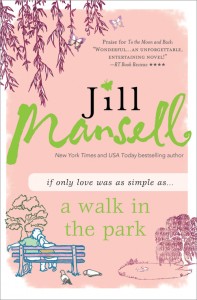
Leslie of Under My Apple Tree won the latest U.S. release from Jill Mansell, A Walk in the Park.


Lori of She Treads Softly won Molly Ringwald’s When it Happens to You.


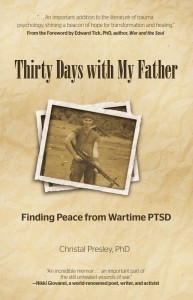
Kathy of Bermudaonion won Thirty Days With Father by Christal Presley.


Congrats to all of you!

Happy Thanksgiving

Happy Thanksgiving to all of you celebrating here in the United States today. I want to wish you and your families a great day of good food, conversation, and maybe even reading or at least the sharing of books with your loved ones.

Here’s to a full cornucopia for all of you!

The Van Alen Legacy by Melissa de la Cruz (Book 4)

The Van Alen Legacy by Melissa de la Cruz is the fourth book in the Blue Bloods series.  The pacing of this story is much better as each chapter is told from a different setting and set of characters, increasing the tension for readers looking to uncover the grand plan of the Silver Bloods.  Schuyler and Oliver, her human conduit, have been on the run since the end of the last book, and after more than a year of running from the Venators, they have done little to uncover the truth of her family’s legacy or the plans of the Silver Bloods.  In many ways, Schuyler has taken a backseat in these books to allow Mimi to come into her full powers and true destiny as she and her fellow Venators search the globe for the Watcher, who was taken from Bliss Llewellyn family.

Bliss, on the other hand, has her own set of problems as she fights to regain control over her life and uncover what her father, the senator Forsyth, has been up to behind closed doors.  Meanwhile, she realizes that even the people she has lost are carried with her always and are available to help her regain control and take appropriate action to prevent further devastation.

“Stepping into someone’s subconscious is like discovering a new planet.  Everyone’s internal world is different and unique.  Some are cluttered, stuffed with dark and kinky secrets pushed to the edge of their minds, like racy underwear and handcuffs shoved in the back of a closet.  Some are pristine and clear as a spring meadow:  all hopping bunnies and falling snowflakes.  Those are rare.”  (page 26)

“Memories were moving pictures in which meaning was constantly in flux.  They were stories people told themselves.  Using the glom — the netherworld of memory and shadow, a space the vampires could access at will in order to read and control minds — was like stepping into a darkroom, into a lab where photographers developed their prints, submerging them in shallow pans of chemicals, drying them on nylon racks.”  (page 70-1)

Meanwhile, the Forces begin to realize that the bond that they share may not be as unbreakable as they have been told it is.  But beyond that, they must don their previous lives and knowledge to battle the forces of evil and save not only their Blue Bloods society, but also humanity.  De la Cruz has stepped up the detail in this novel, carefully unfolding the layers of her vampire society’s past and the political machinations that continue even amidst the ominous threat of the Silver Bloods who may have infiltrated their community.

The Van Alen Legacy by Melissa de la Cruz renewed my faith in the series, even though little time is spent on the actual Van Alen legacy.  Cruz has further developed her characters, though the love triangles can be a little tiresome.  It is an action-packed guilty pleasure, looking for a novel to spend a few entertaining hours away from the television and the turkey.

About the Author:

Melissa de la Cruz is the New York Times and USA Today best-selling author of many critically acclaimed and award-winning novels for teens including The Au Pairs series, the Blue Bloods series, the Ashleys series, the Angels on Sunset Boulevard series and the semi-autobiographical novel Fresh off the Boat.

Photo © Denise Bovee

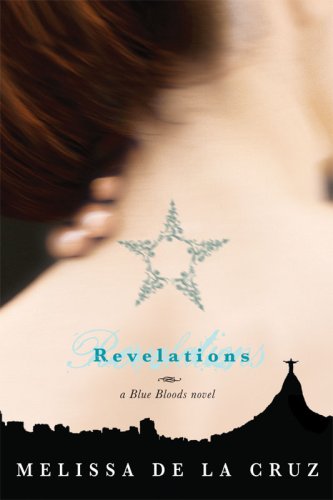
Revelations by Melissa De La Cruz (Book 3)

Revelations by Melissa De La Cruz is the third book in the Blue Bloods series in which an upper crust society of vampires, mostly teens in a private New York City school is on the verge of battle with dark forces.  As this is the third book in the series, readers should read the first two novels before tackling this one as without the background of those novels readers could find themselves adrift.  Secondly, even those who have read the previous two novels, should consider rereading them and even with that could find themselves a bit lost in this one.  De La Cruz has a lot going on with her Blue Blood vampires and there is quite a bit of cloak and dagger going on that keeps the readers in the dark up until the end chapters.

The novel opens shortly after a major even in the second book in which an attack on one of the elder vampires by a Silver Blood is successful, and the beginning of this one is set up as though it will be a solvable mystery.  In some ways it is, but not to a satisfying conclusion as more questions about the feud between Blue Bloods and Silver Bloods are raised than answered.  Schulyer, who is referred to as a half-blood (think Harry Potter and the similar connotations apply here, though in a vampire world), is still wandering around, not doing her “lessons” to learn about vampire history, and pining for Jack Force, the twin of Mimi (think soul mate, not sibling).

These vampire characters are supposed to be the earthbound representations of the archangels, and while it creates a unique line of lore for vampires, not much of this history is revealed to the reader as Schuyler refuses to take part in the lessons.  The high-school struggles of vampires among mortals is completely forgotten in favor of a secret conclave-directed set of lessons to help these teen vampires, who have been reincarnated again, to come into their full power.  But even so, the author fails to demonstrate these powers outside of the classroom without explanation.  For example, Mimi suspects her soul mate Jack is seeing someone else, and rather than turn into fog or mist to follow him, she trails him in a Bentley.  Readers will find this disconnect disappointing since half the point of reading vampire novels is for the lore and world building.

Although the novel is full of name drops in the fashion world and in terms of locales in Rio rather than actual descriptions to transport readers to these locations, De La Cruz has created a novel that is a quick read when you want to just turn your brain off for a while — it’s candy for the mind.  Revelations by Melissa De La Cruz was a bit cliched in places and disappointing when vampire powers were not used, but overall, its a quick read that doesn’t require too much thinking and provides a source of entertainment.

About the Author:

Melissa de la Cruz is the New York Times and USA Today best-selling author of many critically acclaimed and award-winning novels for teens including The Au Pairs series, the Blue Bloods series, the Ashleys series, the Angels on Sunset Boulevard series and the semi-autobiographical novel Fresh off the Boat.

Photo © Denise Bovee

Mailbox Monday #202

Mailbox Mondays (click the icon to check out the new blog) has gone on tour since Marcia at A Girl and Her Books, formerly The Printed Page passed the torch. This month’s host is Bermudaonion.

The meme allows bloggers to share what books they receive in the mail or through other means over the past week.

Just be warned that these posts can increase your TBR piles and wish lists.

Here’s what I received:

1.  Tears in Rain by Rosa Montero, translated by Lilit Zekulin Thwaites, which came unexpectedly.

What did you receive?

176th Virtual Poetry Circle

Welcome to the 176th Virtual Poetry Circle!

Remember, this is just for fun and is not meant to be stressful.

Keep in mind what Molly Peacock’s books suggested. Look at a line, a stanza, sentences, and images; describe what you like or don’t like; and offer an opinion. If you missed my review of her book, check it out here.

Also, sign up for the 2012 Fearless Poetry Reading Challenge because its simple; you only need to read 1 book of poetry. Please visit the stops on the 2012 National Poetry Month Blog Tour.

Today’s poem is from Jack Gilbert, who passed away this past Veteran’s Day:

Tear It Down

We find out the heart only by dismantling what
the heart knows. By redefining the morning,
we find a morning that comes just after darkness.
We can break through marriage into marriage.
By insisting on love we spoil it, get beyond
affection and wade mouth-deep into love.
We must unlearn the constellations to see the stars.
But going back toward childhood will not help.
The village is not better than Pittsburgh.
Only Pittsburgh is more than Pittsburgh.
Rome is better than Rome in the same way the sound
of raccoon tongues licking the inside walls
of the garbage tub is more than the stir
of them in the muck of the garbage. Love is not
enough. We die and are put into the earth forever.
We should insist while there is still time. We must
eat through the wildness of her sweet body already
in our bed to reach the body within the body.

What do you think?

Thrall by Natasha Trethewey

Thrall by Natasha Trethewey examines the lines between father and daughter and the African-American experience through a set of personal and analytical poems focused on race and culture.  In “Miracle of the Black Leg,” Trethewey examines the juxtaposition of white and black men in paintings and other artwork in which the leg of one man is taken and attached to the thigh of another man.  There are similarities in pain stricken faces in some images, paralleling their similar situations, but there are also clear disparities in how each man is treated, even if the leg is taken from a newly deceased person.  The imagery she chooses in this poem is particularly haunting, especially when taken in the historical context of how the images are presented throughout the years — with the black donor swept to the side and only the black leg as a representation of the whole.

"See how the story changes:  in one painting
     the Ethiop is merely a body, featureless in a coffin,
so black he has no face.  In another, the patient --
     at the top of the frame -- seems to writhe in pain,
the black leg grafted to his thigh.  Below him
     a mirror of suffering:  the blackamoor --" (page 11)
". . . The black man, on the floor,
holds his stump.  Above him, the doctor restrains
    the patient's arm as if to prevent him touching
the dark amendment of flesh.  How not to see it -- 
    the men bound one to the other, symbiotic --
one man rendered expendable, the other worthy
    of this sacrifice?  In version after version, even
when the Ethiopian isn't there, the leg is a stand-in,
    a black modifier against the white body," (page 12)

The title of the collection tells readers all they need to know about the topics covered, including the moral, mental, and physical slavery or servitude as well as the complete emotional absorption that can happen in relationships. As Trethewey examines works of art through a lens of racial demarcation, she also looks at daughters’ relationships with their fathers, which can sometimes be congenial and at other times turbulent. In “Knowledge,” she is looking at the dissection of a woman and the men who stand around her as the cut is made into her flesh, and Trethewey’s narrator concludes that her father was not just one type of man, but each of the men in the room — all at once contemplative, scientific, and artistic, even though at times she felt he were just one of those men.

It is easy to see why Thrall by Natasha Trethewey could captivate a packed audience at the Library of Congress when she was inducted as the newest U.S. Poet Laureate, and hearing a poet read their own work can be the best gift.  While her reading can enthrall you and bring you near tears, her careful word selection in each poem will ensure that you reflect on the meaning of each line in each verse before you even think about the overarching themes of separation and connection as well as their juxtaposition.  A collection that will be on the best of list for sure.

Check out the recap of the U.S. Poet Laureate Event.

This is the 22nd book for my 2012 Fearless Poetry Exploration Reading Challenge.

King Solomon’s Ring by Konrad Z. Lorenz

King Solomon’s Ring by Konrad Lorenz, an Austrian ethologist, is not your typical science book in that it is written with a less-scientific audience in mind.  Complete with minimal illustrations from Lorenz, the book does not read like a scientific experiment that can be precisely duplicated, but more like a series of observations and anecdotes from a man who invited the wild into his home.  Unlike King Solomon, Lorenz claims not to need a magic ring to learn the language of animals and to communicate with them.  While there are discussions of domesticated and wild dogs, among other animals, Lorenz mainly focuses on the behaviors of the water shrew, his aquarium fish, and the Jackdaw.

While considered a premier examination of animal behavior and discussing in detail the phenomenon of imprinting, on some occasions he appears to anthropomorphize these animals, making them seem more human than they are, particularly when discussing their mating rituals.  Lorenz also is very descriptive of the animals and their interactions with one another and with the humans who lived in the home and surrounding neighborhood.  These descriptions, while interesting to a scientist, may border on tedium for others.

“The whole charm of childhood still lingers, for me, in such a fishing net.”  (page 12)

“I intend to develop further this mixed breed, now that it has happily survived the war, and to continue with my plan to evolve a dog of ideal character.”  (page 142)

He raises some interesting questions about the parallels between certain species and humans in that some species, like humans, share their experiential knowledge of dangers and enemies with their young, rather than their young having an instinctual knowledge of what animals are their natural enemies.  Lorenz also discuss language and how body language is a lost art among humans, but is alive and well among animals, like yawning and smiling in humans to signify an emotion.

His wife must have had enormous levels of patience, though the bit about leaving their own child in a cage while the animals roamed free in the house and outside was hopefully a joke.  King Solomon’s Ring by Konrad Lorenz is light on scientific method and heavy on observation, but at times the descriptions get bogged down with too much detail even for a general audience.  For those who have studied imprinting and other aspects of animal behavior before, the book could seem very repetitive and far from engaging.  Additionally, there are moments where he pats himself on the back or the backs of his friends who achieve some interesting feats with animals, which can seem a bit self-serving.

About the Author:

Konrad Z. Lorenz ForMemRS was an Austrian zoologist, ethologist, and ornithologist. He shared the 1973 Nobel Prize with Nikolaas Tinbergen and Karl von Frisch.


This is my 81st book for the New Authors Reading Challenge in 2012.


What Book Club Thought:

This book, which was our November pick, really wowed one member of the book club, who said he learned a great deal from Lorenz and his theories about animals in his care, while most of us seemed to think that we’d learned all of the things he talked about in the book already through other sources — most likely in school or the animal channel.  The rest of us either thought it was an OK book or didn’t like it very much at all.  Our youngest member said that there should have been more about Penguins, though Lorenz lived in a place where Jackdaws were the most prevalent bird it seemed.  Two members found the chapter about dog ancestry and behavior the most interesting, particularly about the relationship to masters and one another in a pack versus the dog that prefers to be alone.

One heated discussion was about whether animals are intelligent or not, with one member playing devil’s advocate and insisting that animals act on pure instinct and are not problem-solving beings with intelligence.  In one scenario, the member suggested the lion would simply die in the arctic and be unable to problem-solve their way out of the situation or find food, but it was argued that there are different levels of intelligence in the animal kingdom and that some things can be learned by animals and other things cannot.  Additionally, there was a discussion about adaptability versus intelligence as well as the teaching of danger to young animals by their parents, much like humans teach their own children about dangers.