Quantcast

The Neruda Case by Roberto Ampuero, Translated by Carolina de Robertis

Source: Riverhead Books, Penguin
Paperback, 374 pages
I am an Amazon Affiliate

The Neruda Case by Roberto Ampuero, translated by Carolina de Robertis (see my review of Perla), is set just before the dictatorship of Augusto Pinochet in Chile when Castro is in power in Cuba and Germany has been cut in half by the wall.  Cuban exile Cayetano Brulé has left Miami with his wife, Maria Paz Angela Undurraga Cox, for her home in Chile, but he continues to feel out of place as no one trusts a Cuban and he cannot find work.  Meanwhile, his wife is increasingly engaged in the reform movement in the country, while at the same time she is pulling away from her husband.  Wandering in a strange country with bad coffee, Cayetano unwittingly bumps into Pablo Neruda at a party in a library and shortly receives an offer he cannot refuse.

“The door was made of knotted wood.  It didn’t open.  He stroked the old bronze knocker, put his hands in the pockets of his fleece jacket, and told himself that all he could do now was wait.  He exhaled wafts of white breath into the overcast winter morning and thought, amused, that it looked as if he were smoking, even though, in this city, there were no more matches or cigarettes.”  (page 12)

Brulé is a man that is transformed by his business relationship with Neruda, who hires him to uncover the truth about his past that haunts him, but this relationship evolves into admiration and a personal connection that transforms Brulé into a confident detective.  Not only is the novel about finding solace, it also is about one man’s journey home.  Neruda was a complex man and legendary, and the author clearly admired the poet and held him in high regard, but the novel also demonstrates that even the most legendary of us have flaws.  It is those flaws that make us who we are, ensuring that those who love us are constantly challenged.  By the time Brulé meets Neruda, he is already a legend and Nobel laureate, and Neruda knows it and revels in his success — so much so that it becomes a crutch for any mean moment or poor decision in his life:  “I did it for my art.”

“‘Because if poetry transports us to the heavens, crime novels plunge you into life the way it really is; they dirty your hands and blacken your face the way coal stains engine stokers on trains in the south, where I was born.'”  (page 24)

“‘The casualties of our good fortune are a terrible thing, Cayetano.  But the road to personal happiness is paved with the pain of others.'”  (page 130)

Ampuero’s novel is a detective novel wrapped up in literary and historical fiction that depicts a turbulent time in Chile’s history, but also a time of idealism on the part of Neruda and President Salvador Allende.  The Neruda Case transports the reader back in time and paints a picture of idealism and its failures, but also its continued promise of hope.  Ampuero’s portrayal of Neruda is as complex as the man himself, and his detective is a man that readers will become emotionally attached to and cheer on in his mission.  One of the best, sweeping novels I’ve read this year.

**On a side note, I was pleased to find that Ampuero lived near Neruda’s home La Sebastiana as a boy and regrets that he never had the courage to knock on the poet’s door.**

About the Author:

Roberto Ampuero is an internationally bestselling, award-winning author. He has published twelve novels in Spanish, and his works have been translated around the world. The Neruda Case is his first novel published in English. Born in Chile, Ampuero is a professor of creative writing at the University of Iowa and currently serves as Chile’s ambassador to Mexico. He lives in Mexico City and Iowa City.
 

This is my 37th book for the 2013 New Authors Challenge.
Mailbox Monday #225

Mailbox Monday (click the icon to check out the new blog) has gone on tour since Marcia at A Girl and Her Books, formerly The Printed Page passed the torch.  June’s host is Dolce Bellezza.

The meme allows bloggers to share what books they receive in the mail or through other means over the past week.

Just be warned that these posts can increase your TBR piles and wish lists.

Here’s what I received:

1.  Everybody Has Everything by Katrina Onstad, which came unexpectedly from Hachette Books.

After years of unsuccessful attempts at conceiving a child, Ana and James become parents overnight, when a terrible accident makes them guardians to 2 ¿ year-old Finn. Suddenly, two people who were struggling to come to terms with childlessness are thrust into the opposite situation-responsible for a small toddler whose mother’s survival is in question.

Finn’s crash-landing in their tidy, urban lives throws into high relief some troubling truths about their deepest selves, both separately and as a couple. Several chaotic, poignant, and life-changing weeks as a most unusual family give rise to an often unasked question: Can everyone be a parent?

2.  The Nine Fold Heaven by Mingmei Yip, which came from the author for review.

In this mesmerizing new novel, Mingmei Yip draws readers deeper into the exotic world of 1930s Shanghai first explored in Skeleton Women, and into the lives of the unforgettable Camilla, Shadow, and Rainbow Chang.

When Shadow, a gifted, ambitious magician, competed with the beautiful Camilla for the affections of organized crime leader Master Lung, she almost lost everything. Hiding out in Hong Kong, performing in a run-down circus, Shadow has no idea that Camilla, too, is on the run with her lover, Jinying—Lung’s son.

Yet while Camilla and Shadow were once enemies, now their only hope of freedom lies in joining forces to eliminate the ruthless Big Brother Wang. Despite the danger, Shadow, Camilla, and Jinying return to Shanghai. Camilla also has her own secret agenda—she has heard a rumor that her son is alive. And in a city teeming with spies and rivals—including the vengeful Rainbow Chang—each battles for a future in a country on the verge of monumental change.

What did you receive?

206th Virtual Poetry Circle

Welcome to the 206th Virtual Poetry Circle!

Remember, this is just for fun and is not meant to be stressful.

Keep in mind what Molly Peacock’s books suggested. Look at a line, a stanza, sentences, and images; describe what you like or don’t like; and offer an opinion. If you missed my review of her book, check it out here.

Also, sign up for the 2013 Dive Into Poetry Challenge because its simple; you only need to read 1 book of poetry. Check out the stops on the 2013 National Poetry Month Blog Tour and the 2012 National Poetry Month Blog Tour.

Today’s poem is in honor of those fathers out there. It is from Li-Young Lee:

The Gift

To pull the metal splinter from my palm
my father recited a story in a low voice.
I watched his lovely face and not the blade.
Before the story ended, he’d removed
the iron sliver I thought I’d die from.

I can’t remember the tale,
but hear his voice still, a well
of dark water, a prayer.
And I recall his hands,
two measures of tenderness
he laid against my face,
the flames of discipline
he raised above my head.

Had you entered that afternoon
you would have thought you saw a man
planting something in a boy’s palm,
a silver tear, a tiny flame.
Had you followed that boy
you would have arrived here,
where I bend over my wife’s right hand.

Look how I shave her thumbnail down
so carefully she feels no pain.
Watch as I lift the splinter out.
I was seven when my father
took my hand like this,
and I did not hold that shard
between my fingers and think,
Metal that will bury me,
christen it Little Assassin,
Ore Going Deep for My Heart.
And I did not lift up my wound and cry,
Death visited here!
I did what a child does
when he’s given something to keep.
I kissed my father.

What do you think?

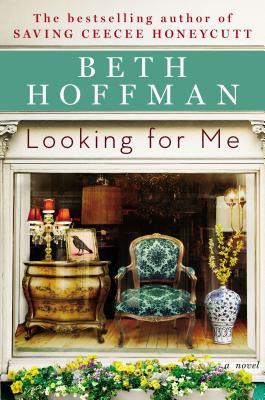
Winner of Looking for Me by Beth Hoffman

savvyverseandwitWinners

Congrats to Amy F who won a copy of Beth Hoffman’s Looking for Me.

She said, “These reviews sound great. I have read a few duds and am looking for a book that will emotionally pull me in. This sounds like the book.”

From GoodReads:

Teddi Overman found her life’s passion for furniture in a broken-down chair left on the side of the road in rural Kentucky. She learns to turn other people’s castoffs into beautifully restored antiques, and eventually finds a way to open her own shop in Charleston. There, Teddi builds a life for herself as unexpected and quirky as the customers who visit her shop.  Though Teddi is surrounded by remarkable friends and finds love in the most surprising way, nothing can alleviate the haunting uncertainty she’s felt in the years since her brother Josh’s mysterious disappearance. When signs emerge that Josh might still be alive, Teddi is drawn home to Kentucky.  It’s a journey that could help her come to terms with her shattered family—and to find herself at last.  But first she must decide what to let go of and what to keep.

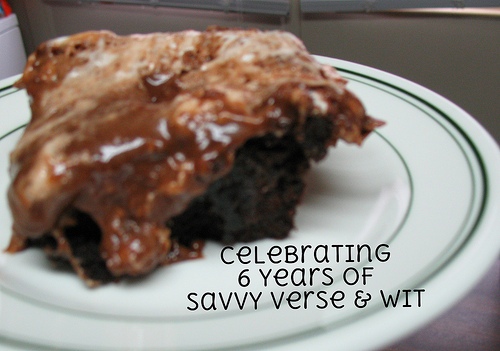
Savvy Is 6 Years Old Today

8952783867_1af55b0709I cannot believe it has been six years of blogging; I don’t usually share stats, but you can look them up if you want to.  However, for those interested, here are a few:

  • More than 2,000 posts
  • Nearly 13,500 comments on those posts
  • Nearly 600 reviews
  • Nearly 180 poetry reviews
  • More Than 200 Virtual Poetry Circles
  • About 218 of those reviews from my own books or those borrowed from the library or other people

But what makes me keep coming back with posts about poetry and other books is my readers, and I want to thank you all for sticking with me through the disappearance of my domain and the commenting issues some of you have had.  I hope that all of those issues have been resolved for the time being at least — I’d like to say forever, but you know how the Internet can be.

And if you are wondering, YES, celebrate today with gooey chocolate and tell everyone that I gave you permission because Savvy Verse & Wit has turned 6.

Virgin Soul by Judy Juanita

Source: Viking
Hardcover, 306 pages
I am an Amazon Affiliate

The rhythm of Virgin Soul by Judy Juanita’s narrative is reminiscent of scat singing, but with a street-based undertone, jumping from moment to moment creating an atmosphere that resembles the turbulent nature of the 1960s.  In this way, she captures the atmosphere, especially among African-Americans in California at that time, really well.  The protagonist Geniece Hightower has always felt like an outsider since her mother died and her father skipped out, but when she heads off to college, she thinks that she’s finally found a place to fit in.  She meets some people engaged in the civil rights movement, and falls in love with Allwood, who becomes her lover and teacher.  She falls in and out of relationships, but at her heart Allwood is her first love.

Juanita breaks the book into one year of college from Freshman to Senior year, and its first-person narrative makes it read more like a memoir than fiction.  The novel bounces from moment to moment, reading more like a journal than fiction, and Geniece is tough to get a handle on as she’s pulled between the moral and conservative views of her family and the angrier, more liberal thinking of her friends.

“Uncle Boy-Boy was a dentist and Aunt Ola Ray was his wife and I was not their adored child–I was more obligation than kin, their dark-skinned orphan-in-residence.  I had gotten accepted into SF State as a freshman, but my ‘financial resources’ amounted to my seventy-two-dollar monthly Social Security check.  I wasn’t about to ask them to support me.”  (page 3)

Geniece is looking for her place in the world, and as she’s felt like an outsider in her own family, it’s easier for her to be captured by the passions of others, and eventually, she falls into the Black Panthers.  While she’s caught up in the movement, she never loses sight of getting her education, knowing from her family that it is about the only way she can break free from poverty.  As a member of the party, she learns that she is as angry as the men in the party, but she draws the line at killing.  Geniece never seems to grow out of the naive way in which she relates to the men in her life — falling into bed at a moment’s notice, even when there is very little attraction — but her relationships with her female friends are at arms length in most cases.

“Whenever Allwood insisted, I resisted, but only to a point.  I wanted to know what he knew, feel what he felt inside that righteousness.  The only way in was to surrender, and I was willing.  I had plenty of motivation and a demonstrated interest, but I needed a catalyst.  Allwood was the reason I became black.”  (page 35)

Huey Newton and Bobby Seale, the leaders of the Black Panthers, are here, along with many others from history, but they are more in the backdrop than in the foreground.  Other figures from history include Stokely Carmichael, Betty Shabazz, Eldridge Cleaver, and more.  Geniece, however, is on the sidelines and working with the community and the children and on the paper, but she has little to do with the violent protests and demonstrations.  She’s a bystander, but she isn’t.  Her involvement is focused on the rebuilding of the community, and in this way, her character matures and becomes a focal point for what was good about the Panthers.  Readers looking for an in-depth connection to these historical figures will be disappointed because the novel’s focus is Geniece and her experiences during the 1960s and the civil rights movement, which also gets caught up in the controversy of the Vietnam War and the deaths of Black soldiers on the front lines.

When the police and the FBI are watching your every move, it is naive to think that even as a mere writer or community volunteer that you wouldn’t be a target.  Unfortunately, Geniece is very naive in terms of precarious situation as a party member — a perception that she has to face head on later in the book.  Moreover, it seems as those she simply falls into a socialist movement, and gets herself deeper involved without thinking about the consequences.  Where the novel failed is at the end where too many things are left unresolved and hanging, and Geniece’s character is only partially evolved beyond her first introduction.  The relationships between the main character and the male party members are vague at times or seemingly non-existent until they fall into bed.

Virgin Soul by Judy Juanita is not for every reader; it is definitely frank about the 1960s movements, the violence, the drug use, the rampant sexual activity without commitment, and the paranoia that many in the African-American community felt.  However, Juanita has a firm grasp of her setting and time period, making it easy for readers to transport themselves back in time and to feel the tension and paranoia that these activists felt as they strived for change.  Another aspect that comes to life is the color differences and prejudice within the Black community itself, particularly in how darker skin men and women were treated compared to those with lighter brown skin.  Overall, a turbulent novel that reads more like a series of memories.

About the Author:

Judy Juanita’s poetry and fiction have been published widely, and her plays have been produced in the Bay Area and New York City. She has taught writing at Laney College in Oakland since 1993. This is her first novel. She lives in Oakland.  Check out this Interview from Publisher’s Weekly.

This is my 36th book for the 2013 New Authors Challenge.

Our Held Animal Breath by Kathryn Kirkpatrick

Source: Wordtech Communications and TLC Book Tours
Paperback, 96 pages
I am an Amazon Affiliate

Our Held Animal Breath by Kathryn Kirkpatrick is a slim volume of poetry that is broken into three sections.  Although there is a deep sense of anger and hurt over current events and the rape of the world by humanity, many of these poems also have a personal side to them — deep personal losses of friends and family.  At times, the narrator is baffled at how some things come to be, like in “Millennium” where the narrator is left with an altar in a room flooded with light.  “How did I come by this altar,/these windows of stained glass?/When I meet the fox again,/I set her free./The meadow she finds/is neither desert nor glacier.”  (page 11)

Kirkpatrick wonders about the connections between humans and nature, particularly animals.  She postulates in “At the Turkey Farm” whether we absorb the loneliness and longing of turkeys when we eat them during holidays, but at the same time she talks about their only solace as being able to stand in the fading light in their own poop.  At the heart of the poem, the narrator is exploring the existence of these animals as walking corpses and ghosts haunting the farms but not really living.  In a way the poem itself is haunting, forcing readers to contemplate these farms where animals are bred to be something other than themselves, serving mostly as food.

Strange Meeting (page 22-3)

Is this how an animal feels
on the other side of a human eye?

I was a woman speaking
to men I didn’t know.

Large and strong, they
knew about power
in ways I may never

I sat framed and assessed
no threat a square jaw decided
negligible bent knuckles said

I looked back through my animal
eye, saw

the slit throat of the cow
in the leather shoe

the poisons deep in the soil
where the cotton grew

the felled trees
of the papers stacked

the mountains leveled
in the electric hum of light and heat
where we sat.

I saw clearly
all they had done and would do
to make a world we’d be losing fast.

I saw why it was lost.
And I saw how we would lose it.

In some poems, Kirkpatrick weaves in the teachings of Buddhism, but in some instances, those teachings cannot stop the suffering. “After Zazen” explores the many forms of suffering facing humanity, including accidental swallowing of stones to cause near suffocation and death and the invasion of one country into another. Raising questions about suffering on many fronts, the narrators are searching for ways to end it or at least ease the pain. Meditation may not be the best solution or it could be. Beyond these moments of suffering, the narrator blur the lines between animal and human to find the similarities of feelings and behaviors, but to also outline the loyalties that have been forgotten, like that of a dog and master. Perhaps that loyalty should be expanded to include other aspects of nature.

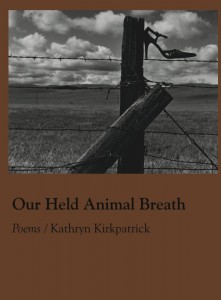
Our Held Animal Breath by Kathryn Kirkpatrick offers a wide range of poems for discussion in book clubs, focused on the impact of human activity on the environment and the changes that are possible if we just think outside the box.  What are the ways that we can brainstorm to feed ourselves and continue to live and grow without harming other animals and nature.  While the brown of the cover is a bit off-putting; the shoe seems out of place on the wire fence, though that may be on purpose given the sometimes out of place nature of our own existence in the world.

About the Poet:

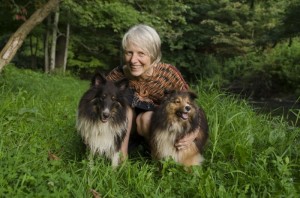
Raised in the nomadic subculture of the U.S. military, Kathryn Kirkpatrick was born in Columbia, South Carolina, and grew up in the Phillipines, Germany, Texas and the Carolinas.  Today she lives with her husband, Will, and their two shelties in the Blue Ridge Mountains of North Carolina, and she currently holds a dual appointment at Appalachian State University as a Professor in the English Department and the Sustainable Development Program. She has a Ph.D. in Interdisciplinary Studies from Emory University, where she received an Academy of American Poets poetry prize.

Giveaway:  1 copy of Our Held Animal Breath

Want to win a copy of her book?  Leave a comment below with an email

I’ll contact the randomly drawn winner, who must be age 18 or older and live in US or Canada as the publisher is sponsoring the giveaway.  Deadline to enter is June 17, 2013 at 11:59 PM EST

This is my 23rd book for the Dive Into Poetry Challenge 2013.


This is my 35th book for the 2013 New Authors Challenge.
Mailbox Monday #224

Mailbox Monday (click the icon to check out the new blog) has gone on tour since Marcia at A Girl and Her Books, formerly The Printed Page passed the torch.  June’s host is Dolce Bellezza.

The meme allows bloggers to share what books they receive in the mail or through other means over the past week.

Just be warned that these posts can increase your TBR piles and wish lists.

Here’s what I received:

1.  The Lavender Garden by Lucinda Riley from Anna, who had an extra copy! Thanks!

La Côte d’Azur, 1998: In the sun-dappled south of France, Emilie de la Martinières, the last of her gilded line, inherits her childhood home, a magnificent château and vineyard. With the property comes a mountain of debt—and almost as many questions . . .

Paris, 1944: A bright, young British office clerk, Constance Carruthers, is sent undercover to Paris to be part of Churchill’s Special Operations Executive during the climax of the Nazi occupation. Separated from her contacts in the Resistance, she soon stumbles into the heart of a prominent family who regularly entertain elite members of the German military even as they plot to liberate France. But in a city rife with collaborators and rebels, Constance’s most difficult decision may be determining whom to trust with her heart.

As Emilie discovers what really happened to her family during the war and finds a connection to Constance much closer than she suspects, the château itself may provide the clues that unlock the mysteries of her past, present, and future. Here is a dazzling novel of intrigue and passion from one of the world’s most beloved storytellers.

2.  Rutherford Park by Elizabeth Cooke, which came unexpectedly from the publisher.

Snow had fallen in the night, and now the great house, standing at the head of the valley, seemed like a five-hundred-year old ship sailing in a white ocean…

For the Cavendish family, Rutherford Park is much more than a place to call home. It is a way of life marked by rigid rules and lavish rewards, governed by unspoken desires…

Lady of the house Octavia Cavendish lives like a bird in a gilded cage. With her family’s fortune, her husband, William, has made significant additions to the estate, but he too feels bound—by the obligations of his title as well as his vows. Their son, Harry, is expected to follow in his footsteps, but the boy has dreams of his own, like pursuing the new adventure of aerial flight. Meanwhile, below stairs, a housemaid named Emily holds a secret that could undo the Cavendish name.

On Christmas Eve 1913, Octavia catches a glimpse of her husband in an intimate moment with his beautiful and scandalous distant cousin. She then spies the housemaid Emily out in the snow, walking toward the river, about to make her own secret known to the world. As the clouds of war gather on the horizon, an epic tale of longing and betrayal is about to unfold at Rutherford Park…

3.  A Strange Place to Call Home by Marilyn Singer and illustrated by Ed Young, which I bought for my daughter at the new Novel Books location in Clarksburg, Md.  Can’t wait to read it with her.

Under the desert’s cracked and barren skin, spadefoot toads are waiting for rain. In the endless black of the deepest caves, blind fish find their way. Even in the frozen hearts of glaciers, ice worms by the billion flourish. In this fascinating look at fourteen animals who defy the odds by thriving in Earth’s most dangerous places, renowned poet Marilyn Singer and celebrated artist Ed Young show that of all the miracles of life, it is life’s persistence that astounds the most.

What did you receive?

205th Virtual Poetry Circle

Welcome to the 205th Virtual Poetry Circle!

Remember, this is just for fun and is not meant to be stressful.

Keep in mind what Molly Peacock’s books suggested. Look at a line, a stanza, sentences, and images; describe what you like or don’t like; and offer an opinion. If you missed my review of her book, check it out here.

Also, sign up for the 2013 Dive Into Poetry Challenge because its simple; you only need to read 1 book of poetry. Check out the stops on the 2013 National Poetry Month Blog Tour and the 2012 National Poetry Month Blog Tour.

Today’s poem is from Sally Keith from The Fact of the Matter (my review):

Providence (page 3)

The restaurant owner opened the doors
to let in the smell from the sea
which stuck on the breeze.  On the table,
a white linen, a low candle, a tiger lily bouquet.
The specials chalked in cursive we read
from a slate, while the waiter, starched shirt
and folded apron, explained them and we ordered,
at first, a carafe of a thinner than usual pale colored wine.
My mother sat across from me.
She did not lean into her elbow on the table, did not
slide her weight up her arm to make a leading shoulder.
The light in her eyes was first a pool, then a line.
Outside the skiffs in exit sailed toward us.
On the corner a crushed Diet Coke can.
What she then told me, I remember.
Salt was exploding all over the sea.

What do you think?

Writers on the Edge: 22 Writers Speak About Addiction and Dependency edited by Diana M. Raab and James Brown

Source: Modern History Press
Paperback, 185 pages
I am an Amazon Affiliate

Writers on the Edge: 22 Writers Speak About Addiction and Dependency edited by Diana M. Raab and James Brown is a collection of essays, memories, poems, and stories about addiction and dependency, but more than that they are harrowing experiences of surviving with addiction and dependency and the continuous struggle that dogs these writers throughout their lives.  Most, if not all, of these essays are frank and honest about the vacillation between lying about an addiction and being honest about it and confronting it.  The poems are similar in that way.  From alcoholism to suicide and depression as well as overeating addictions, these writers share the struggle with themselves, each other, their readers, and sometimes even their families.  “These writers were more often than not, perps–their own or somebody else’s.  It’s roughly akin to reading a recollection of Nagasaki survivors by people who dropped the bomb on themselves,” says Jerry Stahl in the Foreword.

There are perfect examples in these writers’ lives of what addiction can lead to, and there are examples of friends who successfully killed themselves that haunt these writers and scare them to keep away from their addictions.  But even the scariest moments in these addicts lives may not be enough to stave off addictions for long, while there are times when addiction is held at arms length for a longer period of time, there are always moments of weakness around the corner.  What these writers strive to illustrate through these essays is that life and addiction go hand in hand, and some addictions may be more destructive than others, but it is when they become obsessions that people can lose control of themselves and lose all that they have and love.

From John Amen's "23":

... Jul called an ambulance,
and I came to in intensive care, sunlight flooding
through barred windows, tubes flowing like power lines.
I'd been here before, each survival bolstering some
myth of invincibility, but this time I knew I was treading

Clarity is the moment when each addict learns that they are addicts and that they must do something differently or die. “The language of poetry is the means by which one human consciousness speaks most intimately, directly, and precisely to others. Yet it is also an empty mirror, if I tell the truth of what I see,” says Chase Twichell in “Toys in the Attic.” More than a look at the addiction that has shaped these writers, this volume offers lessons and examples of struggle and includes an appendix of organizations and support groups to help those who need it.  Writers on the Edge: 22 Writers Speak About Addiction and Dependency edited by Diana M. Raab and James Brown is heartbreaking and inspiring, with selections that echo off one another to shout the louder truth of surviving addiction — it is a never ending process that must be undertaken every day, every hour, and at every moment.

Joy for Beginners by Erica Bauermeister

Source: borrowed from Anna
Paperback, 269 pages
I am an Amazon Affiliate

Joy for Beginners by Erica Bauermeister is the perfect summer read, and while summer may be a few weeks away yet, this book hit the spot.  A group of friends came together unexpectedly from different walks of life and varied backgrounds and families, with some divorced, others perpetually single, and even a few happily married and content with family life.  These women — Daria, Marion, Sara, Hadley, Caroline, Ava — came together at first to help out Sara, a mother with twins and not enough hands, through a baby holding circle.  Once the twins grew old enough and Sara adapted to her new role as a mother of three, the women turned to another challenge, helping Kate through chemo and her battle with cancer.  As her daughter challenges Kate to take on the rapids of the Grand Canyon, she challenges all of these supportive women to face their own fears and challenges, and luckily each of them agrees.  From baking bread to getting a tattoo, these challenges are as varied as the women who must accomplish them.

“Two months later, Henry came into town just in time for Thanksgiving, bringing with him the smells of travel, cigarette smoke from a crowded train in Poland, yeast from a bakery in Alsace-Lorraine.  The toys he brought the children were not made of plastic; the music he hummed was nothing she recognized.  He was her twin, and looking at him she had never felt more as if he was her second half, the one she had sent out into the world while she stayed home.  She felt as if she could not stand close enough to him, listen to his stories long enough, as if doing so would make her a complete person again.” (page 107 ARC)

Like Bauermeister’s previous and current books that focus on people and food, so does Joy for Beginners, and in many ways all of her books center on the theme of learning to enjoy life and make the most of it.  Rediscovering what it means to be alive is at the heart of this novel, and it was a wonderful ride to see these women conquer their fears and face the challenges before them.  Like her previous books, readers will taste and smell the foods the women eat and find; they’ll smell the perfumes and scents around them; and they’ll experience the joy, surprise, and invigoration each of these women find.

Each of these women’s stories reads like a separate short story, but what makes this novel work are the connections these women share with one another and between themselves.  Kate and Sara may have brought these women together to nurture them and be their rocks of support, but its the connections that they continue to build together that propels these stories onward and deepens the ties that bind them together.  Readers are likely to want to see more from these women as their stories seem to be just beginning.  Joy for Beginners by Erica Bauermeister is uplifting, fun, and reflective, but it also demonstrates the perseverance of the human soul despite the challenges of life that can seem overwhelming.

About the Author:

ERICA BAUERMEISTER is the author of The School of Essential Ingredients (my review) and The Lost Art of Mixing (my review).  She lives in Seattle with her family.  Check out her Facebook page.

Vacation Fun….

So, the blog has been silent.  We headed to Florida to see my cousin for a long weekend trip and boy did we have fun, and you know I went to the beach because I’m burnt!  Crispy, even.  I’d say I’m in pain, but who cares so long as the little one isn’t … and she’s not, though she did get a little reddish pink.  I thought I’d share some favorite photos of mine from the trip.

IMG_2530This is from the Tampa Aquarium; she had a great time touching starfish, rays, and sea anemones and playing with the otters who were jumping around in their tank.

IMG_2588

This is a gorgeous shot at Clearwater Beach in Florida; I do have others on Facebook if you are interested in checking those out.  Wiggles didn’t like the sand at first and made daddy pick her up, but once I got her to take her shoes off and go in the ocean, she didn’t want to leave.

IMG_2596This is from our trip to Busch Gardens in Tampa.  Wiggles wanted to ride the choo-choo as she calls it and she had a great time looking at all the animals.  That’s my cousin, Carrie, in the background — thanks to her for letting us stay with her.  We had a great time.

IMG_2660

As if you couldn’t have guess what Wiggles’ favorite part of Busch Gardens was — Sesame Street Safari of Fun — where she got to meet her favorite characters.

DSC_0147Honeymoon Beach in Florida was the last trip for us before heading back home.  Wiggles had a great time with Daddy on the beach and all of us really.  They even made a sand turtle.

DSC_0155