Quantcast

The Devil’s Scribe by Alma Katsu

The Devil’s Scribe by Alma Katsu is an e-short story released by Simon & Schuster this month, and it’s the first thing I’ve read on my Kindle!  Can you believe it?!  What prompted me to finally read on the Kindle?!  You’ll never guess, well maybe you will by the end of this unconventional review.

“He fell on the bottle before he took a seat, pouring two fingers of whiskey into his wineglass, streaked with the last of a red he’d consumed.  Now that he’d gotten his invitation, his tentative edge fell away, replaced by relief.”  (from the e-story)

Lanore McIlvrae from The Taker (my review) meets with the one and only Edgar Allan Poe by chance in an expensive Baltimore hotel in 1846 after having been gone from America for the last 20 years.  Poe describes himself as an orphan and a widower able to support himself as the “devil’s scribe,” but Lanny seems passingly interested in his life story and the fact that he’s a writer.  However, in spite of her preoccupation with why she came back to America, she walks with this stranger through the streets of Baltimore, careful not to reveal too much of herself to him.

The story raises the idea of telling strangers secrets as a way to unburden the soul without having to deal with the same consequences one would have to deal with should they tell someone they know intimately or should they tell a family member.  It is reminiscent of the relationship between dying soldiers and/or patients and the priest that comes to hear their sins, though in this situation, Poe cannot offer Lanny absolution.

Even in this short story, Katsu is adept at creating tension and suspense as Lanny and her new companion make their way to Boston.  The story is predictable — though because I’ve already read The Taker — but well written.  Readers who know anything about Edgar Allan Poe should realize where the story is headed, but I’ll not give it away.  I really enjoyed learning more about Lanny and her fears, and it will likely play into Katsu’s next book, The Reckoning.

***Reading on the Kindle***

It wasn’t too bad with a short story.  I actually was surprised how I remained focused, but I’m not sure that I can remain focused for a full length novel.  I may try doing that soon, but for now, I’m still a fan of “real” books.
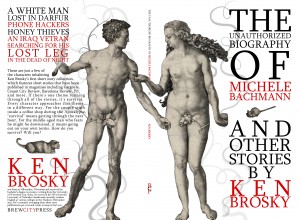
The Unauthorized Biography of Michele Bachmann and Other Stories by Ken Brosky

The Unauthorized Biography of Michele Bachmann and Other Stories by Ken Brosky is a collection of short stories prefaced by a bit of background about each story in the collection, including his trio of “Dodge County” stories.  While this kind of preface can be enlightening or amusing, this one just seems unnecessary given the powerful stories beyond this “prologue.”  From surviving a car accident that takes the life of your best friend to surviving the loss of a new friend in Darfur, these stories are poignant and threatening.  They serve to demonstrate that loss can happen unexpectedly and can tear at you emotionally and physically.

“When you see your best friend’s neck snap back with all the force of three thousand pounds behind it before everything goes black, there are other bruises, too.  They hide under the skin, just out of sight, and they take longer to heal.” (“The Third Pile,” page 50)

Some of these tales of survival border on the surreal, such as the arrival of the horseman of the apocalypse or a man deciding his future based on how many virtual deer are killed in a video game.  Beyond the theme of survival, the collection also touches upon the theme of carpe diem — to stop waiting for something to happen or your fortunes to change — and take a risk.  Each story is narrated by the first person, but the narrators are not the same, though they are similar in humor.  Some narrators are harsh in their machismo, while others are self-deprecating about their accomplishments and talents.  Brosky offers a variety of insecure male perspectives in these stories, which demonstrate how men cope with their insecurities. However, there are perspectives that are determined and secure in their convictions, no matter how unorthodox.  Another interesting aspect of these survival stories is the settings chosen from rural areas to urban Washington, D.C., and with a range of characters from artists to war veterans.

The Unauthorized Biography of Michele Bachmann and Other Stories by Ken Brosky brings to the fore the power of indecision and chaos in a way that forces each narrator to struggle and survive even when circumstances are not as they expect them to be nor as they want them to be.  Brosky’s prose is clipped at times, weaving stories in very few pages that leave a lasting impression.  In some cases the characters are not as well developed and appear to be mouthpieces talking to the reader, although there is one essay with a satiric bent in which that is to be expected.  Some stories leave their marks better than others, but overall, it is a satisfying look at survival in a number of different situations.

About the Author:

Ken Brosky was born in Milwaukee, Wisconsin and received his bachelor’s degree in creative writing from the University of Wisconsin-Eau Claire. He received his MFA from the University of Nebraska-Omaha and currently teaches English at various colleges in the Madison-Milwaukee area. He’s currently averaging 3 short story publications per year and wants to keep it that way.


Additionally, this is a stop on The Literary Road Trip since some of these stories take place in/near Washington, D.C.


This is my 14th book for the 2012 New Authors Challenge.

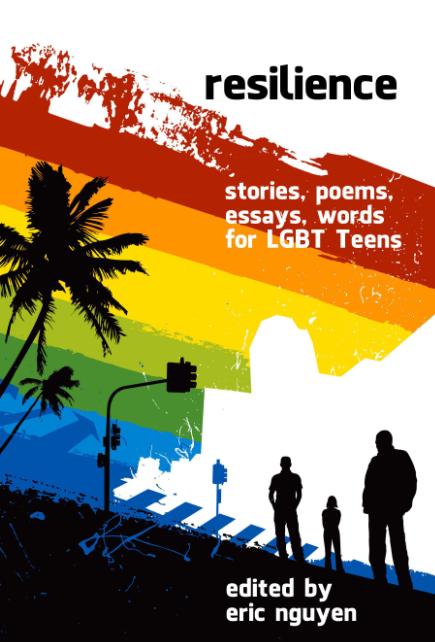
Resilience Edited by Eric Nguyen

Resilience edited by Eric Nguyen is a collection of essays, poems, stories, and advice for young gay, lesbian, bi-sexual, and transgender teens and young adults, but there are lessons in these stories for everyone, including those that bully, talk down to, or otherwise belittle people.  The world would be a much better place if we were secure in ourselves and didn’t give others’ hate speech the credence that we do or given them the power over our own lives, but those of us who need support, deserve a system of people and community willing to stand up for others.

The collection has some powerful short stories and inspiring essays, and there are poems that demonstrate the pain, confusion, and bullying that LGBT teens experience daily.  It is both heartbreaking and inspiring.  There are letters to the younger self, plays, monologues, and more.  While some of these cry out the injustices experienced by the writers or their characters, others share the regret of not stepping forward to defend their friends and family from bigots and those narrow minded people who tortured and ostracized others because they were different.

From When the Bully Apologizes by J.J. Sheen(page 79):

“Something about the stillness of sitting there in the dark with Marie’s hand all wrapped up in mine made everything boiling inside me fall out and I started crying in a way that I had never allowed myself to.  I tucked my head into my hands and felt like I might be stuck that way forever.  I felt so embarrassed and exposed and wrong and sitting next to the only person who really knew me, I felt lonelier.”

Emma Eden Ramos, whose poetry collection Three Women: A Poetic Triptych and Selected Poems was nominated for the 2011 Indie Lit Awards, offers a genuine short story, “Where the Children Play,” that will have readers by turns anxious and hopeful.  These are the stories readers will cling to, hoping that the world will begin to emulate the acceptance and the unconditional love in these pages.  Readers may have a tough time reading the collection cover to cover, but its meant to unsettle conventional thoughts and open readers’ eyes to the struggles of LGBT teens as they struggle to find themselves and “come out” to their friends, parents, and loved ones.  Although they may accept themselves, telling someone who has a different perception of you is a conversation wrought with fear and longing.

Resilience edited by Eric Nguyen is a collection for not only the community it represents in its stories, poems, and essays, but also for those of us who need to be reminded that these teens are people struggling with issues that go beyond what clothes to wear and what activities to engage in at school and outside of it.  For those without role models or who live in cloistered families with traditional beliefs, this can be restrictive and even more difficult to overcome.

For those in NYC:

On March 17 at 3-5PM, an Open Mic night will be held for contributors to the collection at WordUP Books.

For more information about the Resilience project, visit the blog.


This is my 13th book for the 2012 New Authors Challenge.


This is the 1st book for my 2012 Fearless Poetry Exploration Reading Challenge.

Tracks by Eric D. Goodman

Tracks by Eric D. Goodman is a expressive and reflective novel told in stories or what some would call a short story collection published by Maryland-based publisher Atticus Books, and unlike other short story collections, there are very few weak stories, if any.  Each protagonist in the story is on the train headed somewhere and each of their lives is in transition, from a young woman on the verge of promotion who must decide between lover and career to a man and woman at the end of their years who must face their fears.  Goodman is adept at ensuring readers care about his characters in just a few pages, and even though the end of each story comes quickly, there is rarely a sense that there was more to the story that was not told.

“The train has a way of transforming a person.  Sometimes passengers become aware of things they didn’t know before boarding.  Something about the stillness on a moving train, being around people and alone at the same time.  They’re neither here not there — in transition.  That frees them up to do things or say things they might not ordinarily do or say.” (from the preface)

The Cardinal that rides between Baltimore, Md., and Chicago, Ill., carries all of these passengers on their way, and some of these passengers have been on the train in both directions, while others have traveled the rails between Chicago and Washington, D.C., and more than once.  It does not matter where these characters come from; what matters is that the rails provide them with hope and a time out from their hustle of their daily lives.  The train and the rails are an escape, a quiet place to contemplate their lives as the undulating sway of the cars lulls them into deep meditation.  Paralleling their actual lives, the trip on the train has each member making contact with strangers, and like the conscience that guides their decision making, the conductor on the train whispers advice and nuggets of observation/wisdom to those with whom he speaks.  Beyond the characters, the city of Baltimore and the rail line itself loom large in the story, almost becoming characters themselves, with the city representing an anchor weighing down certain characters and the rail a symbol of liberation.

“one station, joy; the next, grief
the soul pulled along
by the hope for peace
at the next junction.” (page 198)

Each story is tied together by the people the characters meet on the train, the conductor, and the railway itself.  The rails come to symbolize the journey life takes us on, with some of the moments in our lives speeding by us too quickly for us to pause and reflect, while others gently impress upon us the gravity of their meaning.  Readers spend time with each character, getting to know their reasons for being on the train, the events that have hammered them recently, and how they view their fellow passengers, but Goodman also sprinkles in a bit of mystery and mayhem into the narration with the introduction of Gene Silverman in “Reset” and Charlie in “One Last Hit.”  Several stories also delve into the detrimental effect of war on not only the victims who survive, but also the soldiers called to action.

Tracks by Eric D. Goodman demonstrates how we are all traveling the same line and how we have similar fears and failings, but also similar hopes and dreams.  In spite of that, we all end up in different places.  Even with the characters who seem unsavory or hard to like, they offer a lesson to readers — seize the moment because in the next, it could be gone.  Opportunity arises and disappears just as quickly, and life on the train ride of life is quick and unrelenting.  There’s not much time for reflection and a deeper examination of pros and cons when living life at full tilt, but stepping back for a few hours on a train ride can be enough to reassess and rejoin life’s journey with a new purpose.  Excellent novel in stories with a common theme, setting, and interacting characters tying them together.

About the Author:

Eric D. Goodman has been writing fiction since he was in the third grade, when a story assignment turned him on to the craft more than a quarter century ago. He regularly reads his fiction on Baltimore’s NPR station, WYPR, and at book festivals and literary events. His work has appeared in a number of publications, including The Baltimore Review, The Pedestal Magazine, Writers Weekly, The Potomac, Grub Street, Scribble Magazine, The Arabesques Review, and New Lines from the Old Line State: An Anthology of Maryland Writers. Eric is the author of Flightless Goose, a storybook for children. Check out this interview with Eric at Atticus Books.


This is my 2nd book for the 2012 New Authors Challenge.


This is a stop on The Literary Road Trip since a lot of the book Tracks focuses on Baltimore, Md., the author is a regular on Baltimore’s NPR, and the publisher is based in Maryland.

The Tiny Book of Tiny Stories Volume 1 edited by Joseph Gordon-Levitt

The Tiny Book of Tiny Stories Volume 1 edited by Joseph Gordon-Levitt (I found at Bermudaonion and had to check out) is a collection of short stories and illustrations. hitRECord is an open, collaborative website joining musicians, authors, illustrators, and other artistic people in the creative process. The book itself is short with a mere 83 pages, very little text, but engaging images.

Some of these stories are witty and play on old wives tales and sayings, while others use text as an image to convey their messages.  A quick read over the holidays or during a waiting room jaunt at the doctor’s office, this slim volume will provide moments of amusement and fun, but there also are moments of sadness when the sun comes out to play and his friends disappear.

For a collaborative project, it would seem that there is something missing, particularly since musicians participate in the collaborative.  It’s almost as if the book should be an ebook with sound to accompany the images enclosed between the covers.  The volume is just one in a series of books planned, and may work better on the website rather than in book form.
However, that is a minor criticism given the inventiveness of the stories and the collaboration that has taken place to create the volume.  The Tiny Book of Tiny Stories Volume 1 by Joseph Gordon-Levitt is mostly aimed at an older audience, but certain stories could be read aloud to kids for their enjoyment and discussion with parents about the meanings behind the words and pictures.

This is my 75th book for the 2011 New Authors Reading Challenge.

Jane Austen Made Me Do It Edited by Laurel Ann Nattress

Laurel Ann Nattress, the woman behind Austenprose.com, is now the editor of Jane Austen Made Me Do It, a collection of Jane Austen-inspired short stories (check out the tour).  Authors not considered Austenites per se, like Frank Delaney writes with Diane Meier and Adriana Trigiani join those known for their Austen spinoffs, like Amanda Grange, Jane Odiwe, Alexandra Potter, and more.  The collection even includes the winner of the Jane Austen Made Me Do It short story contest — Brenna Aubrey’s “The Love Letter.”  But some Austen retelling favorites like Abigail Reynolds, Mary Simonsen, and Eucharista Ward are notably absent.  However, this only begs the question as to whether there will be another anthology in the future as the Austen subgenre continues to grow.

It is only fitting that the collection begins with the woman who started my journey onward into the world of Jane Austen and subsequent retellings and inspired novels, Syrie James with “Jane Austen’s Nightmare.”  The short story personifies every writer’s nightmare — that the characters will not like how they have been drawn and will seek justice.  From characters perceived as too perfect to those with a great number of flaws, Austen meets them all in her nightmare set in Bath, a city she despises.  Kicking off the collection here is a great introduction to all of Austen’s novels and characters and to her own fears and character as we know her to have been, possibly.

“Austen’s rise to fame has been steady since her nephew James Edward Austen-Leigh’s biography, A Memoir of Jane Austen, introduced ‘dear Aunt Jane’ to broader readership in 1869, but recently, two elements have been her strongest catalyst:  the Internet and a wet shirt.”  (page xii)

There are stories for five of her six novels, and Mansfield Park, though mentioned in passing or referred to slightly, is the one left out as an inspiration for a complete story.  Each author tackles a different novel and/or theme from the ridiculousness of ghost stories in “A Night at Northanger” by Lauren Willig to the trials of living with one’s in-laws, like in “Nothing Less Than Fairy-Land” by Monica Fairview.  Clever renderings of finding love in the most unlikely places in Beth Patillo’s “When Only a Darcy Will Do” are joined by modernized stories of renewed love and patience.  These stories are perfect for those looking for more Austen and for those who are unsure whether they would like Austen retellings/continuations.

There are outstanding stories and those that are not quite as good, but let’s be clear, if you love all-things Austen, you want this collection and there are no stories here that you will want to miss.  Writing Austenesque stories requires a certain level of imagination, while at the same time a certain commitment to her characters as she has created them.  Each of these writers does just that.  Jane Austen Made Me Do It has enough clever wit and modern sensibility for any reader, and would suit those looking for prime examples of how a short story can capture the heart.

About the Editor:

A life-long acolyte of Jane Austen, Laurel Ann Nattress is the author/editor of Austenprose.com a blog devoted to the oeuvre of her favorite author and the many books and movies that she has inspired. She is a life member of the Jane Austen Society of North America, a regular contributor to the PBS blog Remotely Connected and the Jane Austen Centre online magazine. An expatriate of southern California, Laurel Ann lives in a country cottage near Snohomish, Washington. Visit Laurel Ann at her blogs Austenprose.com and JaneAustenMadeMeDoIt.com, on Twitter as @Austenprose, and on Facebook as Laurel Ann Nattress.

Ghost Hunt by Jason Hawes and Grant Wilson

Ghost Hunt by Jason Dawes and Grant Wilson is due out this September for young readers and contains not only short stories, but also a guide the Ghost Hunters use on every investigation, plus activity pages.  If you haven’t seen this show on television, you are missing out on one of the originals and best investigative teams examining the paranormal.  They never go into a case believing the ghosts are there, but enter homes with the assumption that noises and events mostly have logical explanations.

In this chapter sampler, readers get a glimpse into the short stories (based on investigations done by the TAPS team) available in the full book.  In each of the short stories, kids are at the center of the haunting activities.  This angle will help young readers see themselves in the stories and relate to the characters, but the prose does not condescend to readers in the way that some stories of this nature would, but it does explain some of the technology used in the investigations.

From ‘Pennies from a Ghost,’ “The sound grew louder, louder, LOUDER.  A deep throaty rumble.  Like thunder, Scott thought.  But it wasn’t thunder.

Without warning, a burst of light appeared on the wall across from the boys’ beds.  Scott heard Jerry make a strangled sound.  The light flickered.  It seemed to hover in the same place.”  (page 5 of the sampler)

Young readers will be engaged by the ghost stories and investigations, and will have a fun time working through the TAPS steps in the guide from the interview to the sweep of the house and the collection and analysis of evidence.  The guide also includes a glossary of terms used in the book and the guide to help readers not only understand the investigative techniques, but also expand their vocabularies.  Overall, Ghost Hunt would be a fun addition to the bookshelves of young paranormal fans.

***Thanks to Anna from Diary of an Eccentric for passing along her extra copy to me.

This is my 44th book for the 2010 New Authors Reading Challenge.

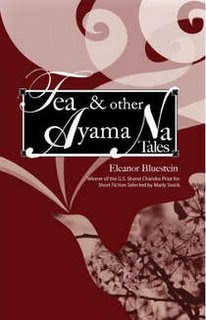
Tea & Other Ayama Na Tales by Eleanor Bluestein

Welcome to the TLC Book Tour stop for Eleanor Bluestein‘s Tea & Other Ayama Na Tales. Today, we have a bunch of things in store for you. After my review, please take a trip through Eleanor’s writing space (complete with photos) and enter the giveaway for her short story book, Tea & Other Ayama Na Tales.

About the Book:

The ten stories in Tea and other Ayama Na Tales take place in the fictional country of Ayama Na, a small Southeast Asian nation recovering from a devastating internal coup and a long drought, both of which have left the population reeling.

The fictional country of Ayama Na is inspired by the sights and sounds of Southeast Asia. A street of fortune tellers in Ayama Na borrows details from one in Singapore; royal palaces, Buddha shrines, and hill tribes echo their counterparts in Thailand; sidewalk cafes in Ayama Na’s capital roll up corrugated metal exteriors and blare music to the street as they do in Viet Nam. But in emotional content and historical detail, Ayama Na most closely resembles Cambodia, where a brave young population, still rebuilding both country and culture in the wake of the Khmer Rouge genocide, operates with a seriousness of purpose and good humor that fills the author of this collection with awe and admiration.

Bluestein’s short stories read like morality plays in which flawed characters struggle with what actions will lead them on the right path and bring about justice. From the McDonald’s worker, Mahala, who wants to set things right for her friend, co-worker, and fellow student, Raylee, to Dali-Roo, a down-on-his-luck farmer working at a Sony factory to make ends meet, Bluestein uses scene breaks to build tension and quicken the pace for some of her more ambitious story lines. She also does an excellent job of weaving in details of her fictional South Asian location, Ayama Na, including the setting, the language, and Asian mysticism.

“Home was a houseboat in a floating village not far from the mouth of the lake, a squalid kitchen and cramped bunk beds ruled over by a mother who hadn’t attended school three days in her life, who worked morning to night cooking and mending nets for Song’s father and brothers, whose stained and wrinkled hands smelled of shrimp and dried fish. The houseboat lapped up and down and moved in and out at the mercy of the weather, and in the dry season, it flowed with the whole floating village closer to the center of the lake, exposing garbage-strewn banks.” (“Skin Deep,” Page 77)

Readers will enjoy many of the stories in this volume, including “Skin Deep,” in which a university student, Song, enters a beauty pageant and takes a year off from school. She has no talents to speak of, but eventually writes and recites three poems before the local judges and wins the competition. Once at the nationals, she concludes she needs a more dazzling talent and embarks upon a journey. She becomes an amateur ventriloquist. The scenes between Song and her mother are wrought with tension because Song is not fulfilling her destiny, and her automaton, Lulu, agrees. The final scene of this story drives the moral home and–like many of the other stories in this book–with a bang.

“While he waited for the artist to take a breath and notice him, Jackman studied the tiny iridescent beetle exploring the edge of Faraway’s beard, the grime sloshing in the creases of his sweaty forehead, the shivers regularly shaking a body swaddled for a brisk fall Philadelphia day.” (“The Artist’s Story,” Page 94)

Each of these stories highlights the struggles facing the people of Ayama Na, which may mirror the struggles of many emerging nations today, as they strive to hold onto their traditions in the face of modernization and globalization. In many cases the modern world is juxtaposed with the cultural norms of this fictional society, and almost all of the characters are faced with a moral dilemma. From the surprise endings in “Skin Deep” and “Pineapple Wars” to quieter changes in character in “The Artist’s Story,” Bluestein is a gifted storyteller who will have readers examining their own lives and learning how to integrate their own cultural roots into their modern lives. These stories also help us examine larger societal issues, like providing aid to devastated nations and cities like New Orleans and China and providing assistance to developing nations. Bluestein’s short story collection showcases her talents, and the book will provide fodder for book club discussion.

Also Reviewed By:

Meghan
The Bluestocking Society
Bookstack
Nerd’s Eye View
Lotus Reads
8Asians
1979 Semi-finalist…
Ramya’s Bookshelf
Feminist Review
Trish’s Reading Nook
Everything Distils Into Reading
Hey Lady! Whatcha Readin’?

About the Author:

Eleanor Bluestein grew up in Brookline, Massachusetts, and attended Tufts University. After graduating with a degree in biology, Eleanor taught science in public school, first in New York and then in Maryland.

For a decade, along with an early literary mentor, Mel Freilicher, Eleanor co-edited Crawl Out Your Window, a San Diego based journal featuring the work of local writers and artists.

Eleanor spent a year in Paris, France, writing fiction and studying French at the Alliance Française. Later, she completed a Professional Certificate in Teaching English as a Second Language at U.C. San Diego. These experiences found their way into the novel Syntax, a current project.

I’d like for you to welcome Eleanor to Savvy Verse & Wit at its new domain.

Above my desk, on the wall to the right of my computer screen, there’s a framed collage created by Matt Foderer, an artist I worked with some years ago. Along with other writers, designers, artists, and computer programmers, Matt and I sat at cubicles in a vast office space, producing multimedia educational products. I wrote words; Matt did computer graphics to accompany the text.

We were as creative as we possibly could be, mindful of the kids who would use these instructional products. But Matt and I both wished we were somewhere else—he creating his own art in the studio behind his house, I at my computer in my narrow home office writing stories.

I have purchased several works of art from Matt—two oil paintings for my living room and the collage on the wall that you see in the photo of my office. I want to describe it to you a little more in words and tell you what it means to me. You can also see it in detail at Matt Forderer.

The collage is one in a series Matt calls “Typewriterheads.” In each work in this series, against some intriguing setting, Matt has placed a human figure who has an antique typewriter where his head should be. In the collage I own, standing with his back to the ocean, is a person I imagine to be a waiter, apron-clad, towel in his hands, an old Underwood for a head. To the waiter’s right a plane lands on the water, a goat on a rock rises from the ocean, and in the sky, looking for all the world like a flying saucer, a huge shell whirls against the clouds.

I bought this collage because, to me, it portrays the poignant life of a writer who needs to work for a living while his head teems with the fantastic stories he dreams of writing. And also because Matt’s collage represents what I aspire to in my own work. Like his art, I want my writing to be funny, smart, evocative, hyper-imaginative, a bit surreal, and poignant, all at the same time. That’s a tall order, and probably why there are so many pages on my cutting room floor.

I no longer live a “cubicle life.” I am fortunate. So many individual’s creative lives are limited or outright thwarted by poverty, illness, war, and the myriad other forms bad luck takes. So if I struggle to get the words on the page, if they fall short of what I hope for, if some days the delete key gets more pounding than any other, if I even think of forgetting how lucky I am, I can look up at my wall. There’s that waiter with his back to the ocean and the untyped words swirling in his funny old typewriter head, wishing he were me, sitting at my desk, making up stories.

Thank you so much Eleanor for an inspiring guest post! Now readers, if you would like to read Eleanor’s short story collection, Tea & Other Ayama Na Tales, check out the giveaway details below.

***Giveaway***

This is open internationally.

1. Leave a comment on this post about what you enjoyed most about this tour stop or what inspires you as a writer.

2. Spread the word about this giveaway and leave me a link on this post for a second entry.

3. Become a follower and leave me a comment telling me that you did (If you already do follow me, please leave me a comment about that) for a third entry.

Deadline is May 6, 2009; 11:59PM EST

Check out the other stops on the tour:

Wednesday, April 1st: The Bluestocking Society

Monday, April 6th: Bookstack

Thursday, April 9th: Nerd’s Eye View

Friday, April 10th: Lotus Reads

Monday, April 13th: 8Asians

Wednesday, April 15th: 1979 Semi-finalist…

Friday, April 17th: Ramya’s Bookshelf

Monday, April 20th: Feminist Review

Thursday, April 23rd: Trish’s Reading Nook

Tuesday, April 28th: Medieval Bookworm

Wednesday, April 29th: Savvy Verse and Wit

*** Giveaway Reminders***

There’s a giveaway for 5 copies of Girls in Trucks by Katie Crouch, here; deadline is April 29, 2009, 11:59 PM EST.

A giveaway of The Mechanics of Falling by Catherine Brady, here; Deadline is May 1 11:59 PM EST

5 Joanna Scott, author of Follow Me, books giveaway, here; Deadline May 4, 11:59 PM EST.

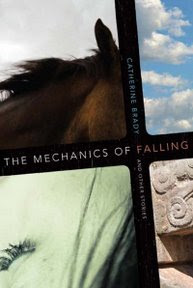
The Mechanics of Falling by Catherine Brady

Welcome to the TLC Book Tour for The Mechanics of Falling and Other Stories by Catherine Brady. You’re in for a real treat today, not only a review, but also an interview and giveaway for my U.S. readers.

They came back inside to find Owen still at the table, a shot glass engulfed by his long, broad-tipped fingers. He was older than the others, his face taut and creased, so tall that he had to slouch in his chair to keep his knees from banging the table. He claimed he was the only black man within a radius of ten miles. What am I doing here? he said. I can’t walk through the campgrounds alone at night. (“Looking for a Female Tenet,” Page 7)

Catherine Brady’s had a lot of practice writing short stories, and it shines through in The Mechanics of Falling & Other Stories. In “Slender Little Thing,” Brady modifies a poetic form, known as Pantoum, in which the second and fourth lines of the first stanza are repeated as the first and third lines of the next stanza. The Pantoum is a variation of the Villanelle, in which the first and third lines in a three line stanza poem are repeated as a refrain alternately throughout the poem. Here’s an example of a Pantoum and an example of a Villanelle. Poets interested in form will enjoy this story because it uses a version of these forms to hammer home the heart of the story where a mother, Cerise, struggles with her lot in life as a nanny to richer parents and as a nurse assistant in a nursing home while trying to raise her daughter, Sophie, to be more than she is.

“The Dazzling World” packs a punch when Judith and Cam are robbed at gunpoint in a foreign country on their way to meet Judith’s sister at her archaeological dig site. Not only does this story immerse readers in a foreign nation, it also leads them on a journey of discovery, almost rediscovery for Judith.

While these stories are each around 20-30 pages each, the characters are complex and on the verge or dealing with a perspective shattering event. Many of these characters are somber, and more than complacent–resigned–until an event jars them awake to look at their world through different eyes.

She pulled a compact from the purse that still hung open on her arm, angling the mirror to examine her hair, reaching up to snag unruly strands. Of the beautiful, fluttering girl, only this artlessness remained. (“Scissors, Paper, Rock,” Page 85)

Settings in this volume of short stories are varied; the characters share common traits, but lead different kinds of lives–two young waitresses trying to pay for college and find themselves, a horse rancher and his roommate’s game of relationship chess, a mother trying to raise her daughter successfully and send her off to college, a couple whose relationship is disintegrating, and many more. Readers will enjoy the surface of these stories as well as their deeper meanings beneath the layers of protective skin. Brady’s prose is captivating and thought provoking all in just a few lines, and she easily fuses poetic lines and techniques into her narratives. (I should have asked her if she writes poetry.)

I want to thank Catherine Brady for her time in answering my questions about her writing. Check out the giveaway details after the interview. Without further ado, here are her answers:

1. I noticed on your website that you’ve published a number of successful short story collections. What is it about your execution of the genre that you think has made it so successful and do you have plans to expand into novel writing?

I feel lucky to have published three collections and for my work to be included in Best American Short Stories. I have a little bit of trouble defining success. If I were fully satisfied by any of my stories, I could quit and take it easy. I think you keep writing because you haven’t achieved all your ambitions for your work. The short story is such a challenging form that there’s plenty left for me to shoot for, and I really, really love the form. I could probably do a better job of defining what I am aiming for than guessing whether I’m successful or not.

I believe a good story satisfies any reader in the most basic way—you care about the characters and their fate. Art always opens a door for any reader, so if you like the plot, or connect with the characters, or enjoy the language, or even dissect every sentence, the story should reward you for whatever effort you are willing to make (and reward you more for more effort). The kind of story I hope to write is one that asks the reader to do some of the imagining and promises to engage her heart as well as her mind.

I am working on a novel right now, and I’ve really been enjoying the writing, which has never been true when I’ve attempted a novel before. So maybe someday I’ll have a novel.

2. Do you find publicizing your short story collections is more challenging that it would be to market a novel? Why?

Yes. It’s more difficult to promote stories. People assume they’re going to be literary and obscure and more difficult than a novel, and nobody really expects you to sell very many copies. It’s much easier to label a novel as being about a specific subject, and what people most enjoy about novels is the chance to get really intimate with a character. A book of stories keeps moving you on to a new set of characters and then another new set. BUT . . . each story should offer you the sudden, deep knowledge of another person that you experience in life when you’re thrown together with someone in a crisis. Which is a different kind of satisfaction.

3. Would you like to share some of your obsessions and how they keep you motivated or inspired?

In a story collection, you’re often writing about people whose lives have unexpected things in common. You get to explore how different people might be dealing with similar or related predicaments, and for me, the best thing about this is that each story poses its own truth, and each truth is partial. I’m obsessed with “yes, but” kinds of questions.

I’m also really motivated to write because you don’t know what will happen once you really get to work. You might think the story is headed in a particular direction, but nine times out of ten, surprises crop up. I often anticipate a story is going to end at a certain point, and I’ll be writing away when all of a sudden, much sooner than I’d expected, the ending just leaps up and declares itself. I’m also obsessed with grammar—prim pince-nez correctness but also the way that you can use sentence structure to build out a story, to make it more three-dimensional. I have strong personal feelings about punctuation, I like to pile up things in a long list, I hate semi-colons—you get the idea. Writing is something of a fetish. But it’s also a craft, and I want to get better at making a beautiful object. Musical sentences. Surprising images. Intricate little tricks that a reader might never notice, but I’ll know that they are there. So, for example, in The Mechanics of Falling and Other Stories, there are images of boxes and containers in nearly all the stories, which makes sense for a collection that’s concerned with how people are held in place in their lives, when that feels like safety and when it feels like a trap. I like knowing that there is this “below the radar” connection among the different stories.

4. If you could choose your favorite story from The Mechanics of Falling and Other Stories, what would it be and why?

I probably have a few favorites. I’m partial to “Slender Little Thing,” because it has a form that uses repetition in ways that aren’t supposed to be used in stories. I like to break rules once in a while, and this is also a story that means a lot to me personally. The main character is someone whose life can seem really hemmed in if you take a certain view of her, and one of the reasons I wanted to use repetition was to get that perspective on the page, so that I could then try to counter it. Let the reader see what’s wearingly repetitive and also what can’t be accounted for by a simple summing up of her life.

I also like “Dazzling World” and “Looking for Female Tenet.” I like “Wicked Stepmother” at least in part because some people have mentioned they didn’t much like the main character, and you always defend the child who’s being criticized by someone else.

5. Please describe your writing space and how it differs (if at all) from your ideal writing space.

I like the space that I’m working in. My home office opens on to our tiny back yard so I’ve got great light and I can look out at our garden. I’ve crammed in as many books as will fit, and I have a great big desk so that I can make a mess when I’m working and scatter papers all over. I really need to have my favorite books close by—when I get stuck, I just open a book of Pablo Neruda’s poems or Alice Munro’s story so I can remember that anything is possible, that a sentence might lead anywhere. It also helps to bow several times before Chekhov’s collected stories.

About the Author (From Brady’s Website):

Catherine Brady’s most recent collection, The Mechanics of Falling & Other Stories, was published in 2009. Her second short story collection, Curled in the Bed of Love, was the co-winner of the 2002 Flannery O’Connor Award for Short Fiction and a finalist for the 2003 Binghamton John Gardner Fiction Book Award. Brady’s first collection of short stories, The End of the Class War, was a finalist for the 2000 Western States Book Award in Fiction. Her stories have been included in Best American Short Stories 2004 and numerous anthologies and journals. Click Here to Read more about Catherine. Read some excerpts, here. Check out Catherine Brady’s list of appearances and her other tour stops with TLC Book Tours.

***Giveaway Details (Only for U.S. Residents)***

Catherine Brady has offered 1 copy of The Mechanics of Falling and Other Stories to one of my U.S.-based readers.

1. Leave a comment on this post about the review or interview and you receive one entry.

2. Blog or spread the word about this giveaway and leave a comment here with a link.

Deadline is May 1, 2009, 11:59 PM EST.

THIS GIVEAWAY IS NOW CLOSED!

***My Other Giveaways***

Don’t forget to enter the Keeper of Light and Dust giveaway, here and here. Deadline is April 28 at 11:59 PM EST.

There’s a giveaway for 5 copies of Girls in Trucks by Katie Crouch, here; deadline is April 29, 2009, 11:59 PM EST.