Quantcast

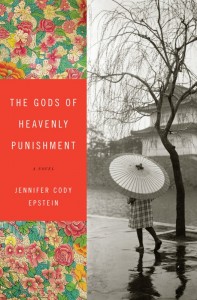
The Gods of Heavenly Punishment by Jennifer Cody Epstein

The Gods of Heavenly Punishment by Jennifer Cody Epstein chronicles Yoshi Kobayashi’s life before, during, and after WWII, with a particular emphasis on the Tokyo fire bombings that preceded the atomic bombings of Hiroshima and Nagasaki.  Billy Reynolds, whose family lives in Tokyo before the war, is a sensitive young boy who loves his new camera, and adores taking photos of Yoshi, family, friends, and more.  Cam Richards and Lacy Robertson are American college students who meet and quickly fall in love just as war is about to break out between America and Japan after Pearl Harbor, and their lives are torn apart by the war.  But ultimately, Epstein’s novel is about Yoshi and how the war tore apart a flourishing culture that once embraced American capitalism.

Not only will readers get an in-depth look at Tokyo before, during, and after the war, but they also see how war impacts not only Americans who once lived in Japan, but also those who were married to those who flew to avenge the deaths of so many in Hawaii.  Initially, readers will be duped into thinking Cam Richards and Lacy Robertson are the main protagonists — a testament to her ability to get readers to care even about secondary characters — but Yoshi is the heroine here, though there are big gaps in time that are not explored, which can leave a reader wanting more.  There is a moment near the end in particular when readers will wonder how Yoshi ends up playing piano at The American Club after the war when they last left her getting into a boat with an older man after the fire bombings, heading away from Tokyo.

“Almost by reflex Cam released the brakes and started to roll.  And then they were racing down that slippery white line, his heart pounding with the rhythmic throbbing of the twin Cyclones.  The dungaree blue of the sailors’ uniforms and the dirty gray of the ship’s island bled together as the Blonde Bombshell picked up speed.  As they passed by the signal officer (now safely flattened against the deck), Cam pulled on the yoke so hard that he felt his elbows crack, and saw the sky lunge towards him like a wet concrete wall.  They hit the ship’s edge in the after-trough of another white-topped crest, and as his plane’s nose plunged towards the water Cam’s gut plunged right along with it.”  (page 79)

Epstein is a phenomenal writer.  She captures intense moments so well, that it places the reader there with the characters.  Yoshi is a precocious young girl learning three languages thanks to her continental mother, but unfortunately, she’s held a little back by her attachment to her mother and her father’s old world conceptions of women in society.  She sees her father’s love of the new paradise, Manchuria, as a possible solution to her escape, until she learns the truth about her father’s work there.  When she heads back home, she throws herself into the national effort for the war, hoping that she can escape the disintegrating world around her in which her mother slips more and more each day.  The Gods of Heavenly Punishment by Jennifer Cody Epstein is about the outside forces that shape who we are depending on how strong we are on the inside and our ability to make our way out of the darkness into the light.

About the Author:

Jennifer Cody Epstein is the author of The Gods of Heavenly Punishment and the international bestseller The Painter from Shanghai. She has written for The Wall Street Journal, The Asian Wall Street Journal, Self, Mademoiselle and NBC, and has worked in Hong Kong, Japan and Bangkok, Thailand. Jennifer lives in Brooklyn, NY with her husband, two daughters and especially needy Springer Spaniel. To connect with Jennifer, “like” her on Facebook.

Thievery by Seth Abramson

Today marks the end of National Poetry Month, and I hope that you found some great poets and poetry collections to try this month. I’m especially pleased that we had so many participants for the Friday activities. See all of you next year for another blog tour of poetry, but I hope you’ll stick around for the rest of this year too. If you missed some of the posts this month, just click here and scroll through.

The action of the poems in Thievery by Seth Abramson, published by the University of Akron Press, occur in between the silences and the pauses of each line break and each trick phrase, highlighting the theft of what has been stolen.  From the innocence of our children to the rallying of small towns around their own even when the most horrifying things occur.  Abramson performs a sleight of hand in his poems, changing their trajectory at a moment’s notice, calling attention to the illusions that are around us everyday.

From "Chronophrenia, Part VII"

At the end of traveling
I wear the road.  Within my skin it is bad.
It's worst without --
the particulates of being nowhere entirely.
From "Chronophrenia, Part VIII," the poet asks:

Do you pay
for each silence, and if so
why start.  Can I admit this thing,
can I clothe myself
in something like it, is it time now.
Does the time come.  Does it ever.

Are we too afraid to speak up or to change the world around us and make it better, or have we just become too complacent.  This silence and complacency is a pervasive problem Abramson tackles in his poems and what the possible consequences of that silence is.  In “Only,” “If it moves/I see it coming, sometimes I do/I swear.  I have been in the places things/were coming true/that were unwanted, in places/things went/unwell, where things went and went//”  (page 37)  There is an unraveling that these poems want to bring into the light for closer examination, though it could be the unraveling of our morality or our societies — with some poems being more ambiguous than others.  Additionally, there are several poems that focus on the abuse of men at the hands of women, like in “Hometown Courage” where the man is held down by women and in “Poem for Battered Man.”

From "All You Ploughboys":

I am sure
to do something horrible.  Half the wood is
halfway there.
And half this town is half in love with itself,
but me I go all the way.

Thievery by Seth Abramson is subtle, and at times too much so, in its exploration of change throughout society and within individuals as it asks readers and others when is the time to stand up and to create change for a better world. When is the time for us to stop the thieving from others and ourselves? These are questions that should be asked and should be met with action.

About the Poet:
Seth Abramson is the author of The Suburban Ecstasies (Ghost Road Press, 2009). In 2008 he was awarded the J. Howard and Barbara M.J. Wood Prize by Poetry. A former public defender, he currently attends the Iowa Writers’ Workshop. Please check out his blog.

Please click the image below for the latest tour stop on the National Poetry Month Blog Tour!

This is my 17th book for the Dive Into Poetry Challenge 2013.

This is my 26th book for the 2013 New Authors Challenge.

night thoughts: 70 dream poems and notes from an analysis by Sarah Arvio

Click the image above for today’s National Poetry Month tour post!

night thoughts: 70 dream poems and notes from an analysis by Sarah Arvio is a poetry collection that defies convention in its cathartic purpose as a series of free-association dream poems with accompanying notes on those dreams from the poet at the time she was tackling some serious trauma.  It is more than a collection of poems and notes about those dreams they capture, it is a memoir written as she uncovers some deeply traumatic events in her childhood as she was on the cusp of womanhood.

“It’s easy to forget how complex and intense are the thoughts of children, and how everlasting.  I mean that the thoughts last in the mind, enacting their meanings, even when they seem to be forgotten.”  (page 132)

Arvio’s notes are essential in many ways to the understanding of her dream poems, which are often surreal and disjointed.  The notes help carve out her images and how they associate to one another and which dreams came to her in the same span of time.  She breaks down her word choices for lines in the poems, the origins of words and how their meanings are uncannily related to the trauma she experienced and subsequently forgot.  She also provides insight into the artwork that she saw and that reminded her of the trauma and how certain colors appear and reappear in her poems because of their relation to the trauma.

watermelon (page 19):

in the brightwhite kitchen a tiny pink
watermelon lies on the pink counter
or white it may be white by the fruit
is pure pink flesh I take a bite of it
then I recall a photograph of me
standing & biting the watermelon
in the newspaper that was black & white
though I know my shirt was white & pink
at the fair on something hill (named for
a fruit) where my father bought me a book
that was called something hill something that meant
flesh & then I knew it was fanny hill
the place was strawberry hill & little 
me as francesca seduced by a book

Arvio utilizes repetition of color and words in her poem to illustrate the remembering of a dream while awake, as the mind filters through the image details to carve out the truth of the events. Her poems read like dream interpretations without the conclusion, and in this way, she leaves the poems open to interpretation until the reader gets to her notes section. While these are dream poems, the images and actions will likely make some readers squirm and look away, particularly with the maiming of animals, among other things. These poems are stark and sometimes profane, much like the shame and the trauma explored in the dreams.

night thoughts: 70 dream poems and notes from an analysis by Sarah Arvio is poignant, frightening, and “super real.” Start with the notes at the end of the book, if you want background on her dream poems before you read them, or hold off and read them at the end to get a richer experience. This memoir/poetry collection is meant to disturb.

About the Poet:

Sarah Arvio is a poet who has lived in New York, Paris, Caracas, Rome and Mexico.  For many years a translator for the United Nations in New York and Switzerland, she has recently also taught poetry at Princeton.

Her poems are widely published, in such journals as The New Yorker, The New Republic, Literary Imagination, Boston Review, The Kenyon Review and Poetry Kanto and in many online reviews.

Composers have set her poems to music:  Miriama Young set “Cote d’Azur” as “Inner Voices of Blue”; Steve Burke set “Armor” for the song cycle “Skin”; and William Bolcom set “Chagrin” for the song cycle “The Hawthorn Tree.”

She’ll be at the May Gaithersburg Book Festival for “Poetry in the Afternoon” moderated by me!

This is my 16th book for the Dive Into Poetry Challenge 2013.

This is my 25th book for the 2013 New Authors Challenge.

Why Photographers Commit Suicide by Mary McCray

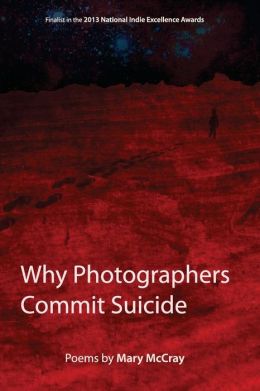
Why Photographers Commit Suicide by Mary McCray, illustrated by Emil Villavincencio and published by Termentina Books, is a collection of science fiction poetry — yes, you head that right!  These poems mesh not only the exploration of space with the modern world here on Earth, but they also harken to older themes of Manifest Destiny dating back to America’s youngest roots as a nation.  It’s a collection about the opportunities space exploration can represent, which is highly ironic given the government’s recent decision to shut down the manned shuttle program.

From "Helga Post-Orbit" (page 52)

No, it's not the sentimental, leftover space

that matters as much as the idea of Helga, open-eyed
and drifting, somewhere out of the room.
Or this mortal part of me -- lost in a raw,
everlasting free-fall of disconnected, disordered love,

knowing I'll uncover Martians, (Martians!),
the impossible mysteries of Mars,
before I'll ever know
where Helga has gone.

McCray’s poems are fantastical, opening up a solar system to the reader that delves into questions of existence and the hereafter, but also the never-ending search for more.  She explores space, Mars, and even artificial intelligence.  There are some beautiful moment of motion, like in “All of a Sudden,” where the narrator awakens:  “Last night, a woman in a hospital smock laid her fingers/on the shiny bells and, mouth over face,/blew tornadoes into the water-pale toes./Then, eyes shut and palms summoning,/my child asked me if I knew who I was./And I said, yes, I am the speed at which/particles collide.//”  For the most part, these poems draw comparisons between the society we create here on Earth and its focus on the material, and how any society on another planet would likely be more of the same.  As we seek to comfort ourselves in the unfamiliar by bringing along the unfamiliar — even to the detriment of animals brought along in the rocket.

McCray paints extraordinary pictures with her words, but the accompanying drawings from Emil Villavincencio do not add very much to the overall collection, though they are well crafted and seem to be mostly pencil renditions.  Beyond the poems about space and exploration, there are more personal poems about alienation from family members, the beauty of poetry as a reflection of space, and the amazing experience of “Sex in Zero Gravity”:  “astronaut, astronaut –/kiss me with your incomplete sentences/and your raw relativity,/run your fingers like lasers,/escape velocity through my motor heart,/the acceleration thrust/of your deep-space Cadillac cruising/my jelly-fish tremors,/touching the swirling hurricane/that is the red G-Spot of Jupiter/”  There has never been such a beautiful references to spaceships taking off and hurricanes on foreign planets in poetry to describe a sexual encounter.

Why Photographers Commit Suicide by Mary McCray is imaginative and one of the best written science fiction collections of poetry out there, and it will have readers questioning their place in the world and the need to explore more.  Like the poet points out in the title poem, we leave a bit of ourselves in the world around us, and we should be mindful of our impact.

About the Poet:

Mary McCray is the co-author of St. Lou Haiku, a collection of haiku poetry about St. Louis, Missouri, and Why Photographers Commit Suicide, poems about space exploration and new frontiers.  Visit her Website, visit her on Twitter, and on Facebook.  Also check out her bookshelf on GoodReads.


Click on the image below to check out the latest National Poetry Month Blog Tour!


This is my 24th book for the 2013 New Authors Challenge.


This is my 15th book for the Dive Into Poetry Challenge 2013.

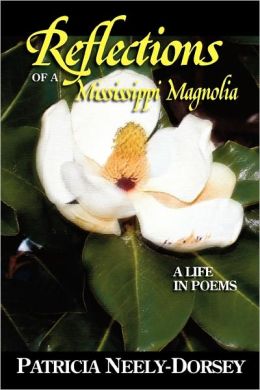
Reflections of a Mississippi Magnolia by Patricia Neely Dorsey

Reflections of a Mississippi Magnolia by Patricia Neely Dorsey is a very personal and reflective collection about growing up in the south and celebrating its culture.  Through rhyming poetry, Dorsey creates poems that have their own beats and rhythms that carry readers all the way through the poems.  While most of these rhymes are elementary and some seem forced, the collection is not about technique as much as it is about living and breathing the southern culture.

From "The Rules" (page 6)

Life can be much easier,
When you know what to do or not;
And you're sure to learn a lot of them,
If Southern parents you have got.
From "A Country View" (page 17)

What might you see as you go your way
On a walk through the country any spring day?
There's an old car tire without its rim,
Filled with flowers to the brim.
A bottle tree glistens in the sun,
And kids chunk rocks at it just for fun.

The poems do not hide their meaning behind complex metaphor and read more like short essays or memories. “Shelling Peas” and “Slopping Hogs” brought back images of farm life that are so vivid and filled with innocent joy and happiness. Readers will learn about the Agnews and much of the food and past times of the poet’s Southern life. Dorsey has succeeded in demonstrating a slice of life in the South.  There are some assertions about Southern life that ring very true, at least what most people typically think about Southerners, but there also are assertions in the poems that would ring true for others not raised in the South, but simply raised with a good moral compass.

Dorsey is never cryptic and clearly shows pride in her heritage, and her “Getting Personal” section of the collection is the most empowering because it is about learning to love oneself despite what others may think and say about you.  In Reflections of a Mississippi Magnolia by Patricia Neely Dorsey what you see is what you get, and that’s good enough.

***Check out the rest of the stops on the blog tour!***

About the Poet:

PND Bio


This is my 14th book for the Dive Into Poetry Challenge 2013.


This is my 23rd book for the 2013 New Authors Challenge.


Click the image below for today’s National Poetry Month blog tour post!

Come Late to the Love of Birds by Sandra Kasturi

Come Late to the Love of Birds by Sandra Kasturi, published by Tightrope Books, is a well-crafted collection about love and freedom from the bonds of illusion.  Kasturi uses bird imagery to explore ancient fairy tales and stories from the ill-fated flight of Icarus to songs like Sing a Song of Sixpence and the blackbirds confinement in a pie.  She takes these long memorized stories and songs and turns them upside down, revealing the twists and turns that these stories could have taken in a modern world.

From "The Evolution of Birds" (page 17)

birds knew of our coming;
could sense our soft limbs millennia ahead,

could sense our drab colours and dull teeth,
our nothing lives.

They dropped their scales, made themselves small,
grew into winged things, soft and bright,

Beyond these twists and turns, Kasturi also plays with the notions in the bird kingdom and the simplicity of their lives — categorizing things into those with and without wings and nothing more. In “One Red Thought,” the red-tailed hawk and the narrator encounter one another, with the narrator questioning, “He must be/tethered to something/because why would a hawk/sit so still, why would/a hawk let me creep/close as a cat, me/” and then realizing “For him–/there are no/cameras or shoes,/there are no ornamental/gardens or lawn gnomes/or pants that need to be ironed.// There are only winged things/and non-winged things.// Only himself and the sky,/the curve of the earth/tilting how he wills it.//  There is the simplicity of the encounter, coupled with the encounter during which the narrator finally understands the reality of the hawk’s world.

From "Crucible" (page 49)

I am curled under piecrust like a blackbird, trapped.
salted and basted and oven-ready.
The kitchen clock's tick settles around me--
keeping time over what's burned or broken.

Salted, basted and oven-ready
I've become claustrophobic and butter-heavy.
Keeping time over what's burned or broken,
my fingers push and dimple the roof.

Each of these poems surprises the reader either once or repeatedly, and Kasturi’s sensitive handling of birds and human motivations alike are musical and magical. With poems rendering a clear relationship between humans and birds to those that draw hopes and dreams from birds in flight and in trees, the collection also has poems dedicated to Bradbury and Neil Armstrong. Come Late to the Love of Birds by Sandra Kasturi is wondrous and lively, full of wit and cunning, and utterly beautiful with each verse and turn of phrase.

About the Poet:

Sandra Kasturi is a writer, publisher, book reviewer and Bram Stoker Award-winning editor. She is the co-owner of the World Fantasy Award-nominated press, ChiZine Publications. She managed to snag an introduction from Neil Gaiman for her previous poetry collection, The Animal Bridegroom (Tightrope Books). She lives in Toronto with her husband, writer and publisher Brett Alexander Savory.

This is my 13th book for the Dive Into Poetry Challenge 2013.


This is my 22nd book for the 2013 New Authors Challenge.


Click the image below for today’s National Poetry Month blog tour post!

When All My Disappointments Came at Once by Todd Swift

When All My Disappointments Came at Once by Todd Swift, published by Tightrope Books, are poems about a series of mid-life crisis in literature and throughout history, with some less grandiose crises in the mix.  There are new takes on the midlife crisis, with the narrator in “The Shelf” trying to take on the life of another through their writing, only to find the words fit falsely and do not ring true.  But in others, like “Michael Kohlhaas,” reference the vengeful exploits that go off of the deep end to the point that the narrator cannot be brought back from the brink.  With a wide breadth of topics, Swift covers a lot of historic and emotional ground in his poems, though clearly some of these poems will require additional research into some of the historic and literary elements referenced, especially if they are not familiar.

From "In Memory of F.T. Prince" (page 15)

Desire ages, ages hardly at all,
Edges, like those of a book,
Curled at the beach, where waves,
Sent by the summer, brush

The salt away, finely-combed,
And it is homosexual love
That holds us in its palm,
That cuts and dries the hair

Beautifully rendered, Swift harkens to the original poem written by Prince about soldiers bathing in a river during World War II, but he also takes a new twist on the scene, pinpointing the desire that can rise up when all that surrounds you is death. Where is the beauty, where is the love — you find it where you can, at least to a certain extent. While some of these poems are dark and harrowing, others are sad, suspenseful, and heart-pounding as Swift takes readers on a journey through several devastating events in history and literature.

However, there are moments in the collection where Swift shows his humor, like using two rhyming lines in “Hunting Party” to make the celebratory scene after the hunt more comical, poking fun at the midlife crisis aspect depicted in the poem. In others, there is a ray of hope even as the narrator loses faith in God. These poems have a wide range of perspectives to offer, and Swift is masterful in some poems and cryptic in others. When All My Disappointments Came at Once by Todd Swift is an interesting examination of midlife crises, the emotions tied to that, and the rays of hope and comedy that can emerge from those incidents.

About the Poet:

Dr. Todd Swift is Lecturer in English Literature and Creative Writing, at Kingston University, London. He is Director and Editor of new small press Eyewear Publishing. Published by the age of 18 in The Fiddlehead, Swift is the prolific author of eight collections of poetry and many more pamphlets. He is editor or co-editor of a dozen anthologies, most recently Lung Jazz: Young British Poets for Oxfam, with a preamble from David Lehman. His poems have appeared in numerous international publications, such as Poetry (Chicago), Poetry Review (London), and The Globe and Mail (Toronto). He has been Oxfam’s poet-in-residence, based in Marylebone, since 2004. His widely-read blog, Eyewear, has been archived by The British Library.

Please click on the National Poetry Month Blog Tour image for today’s tour stop:

This is my 7th book for the Dive Into Poetry Challenge 2013.


This is my 18th book for the 2013 New Authors Challenge.

No Ocean Here by Sweta Srivastava Vikram

No Ocean Here by Sweta Srivastava Vikram, published by Modern History Press, is a collection of poems about the subjugation of women and all of its forms, across not only the Middle East and Africa, but also throughout the various parts of Asia and South Asia.  These poetic portraits are often prefaced by some facts about a particular woman’s story encapsulated in the poem or about statistics of crimes against women in various countries.  Not all of the poems are prefaced, but even those that are could stand on their own and speak for the women they represent.  Beyond the violence and inequality women deal with on a daily basis, these poems also shed light on the women-on-women violence and the silent acceptance among older women of continuing these traditions with the younger generations.

From War (page 12; which is related to Sri Lankan battles)

The sun was shining on shells
of burnt-out houses in their neighborhood.
Her mother, sister, and she were drinking

coffee, thanking bees for leaving them alone
when three men in uniforms entered

their house under the pretense of search.

All cavities of the women's trust were emptied out
when each man selected a victim:

Vikram’s poetry not only provides a story that is easily accessible on the surface, but she also provides themes and hardships that call for closer inspection.  In this way, her collection would make an excellent book club pick, which could be even further enhanced by additional materials on the subjugation of women across the globe even today. Her poetry speaks of social injustice in a way that shocks the reader, but also pays homage to those who have suffered with the deft strokes of her imagery.  Some poems are stronger than others in terms of theme and imagery, while others are more in-your-face and full of surface meaning.

No Ocean Here by Sweta Srivastava Vikram is a vast ocean of pain, discomfort, and horror that should make women in the modern world, including those inside and outside the United States, stand up for themselves and others. Beyond that, it should make men stand up and take notice that their actions and those of other males in societies across the world should not be tolerated — and ended.

About the Author:

Sweta Srivastava Vikram is an award-winning poet, writer, novelist, author, essayist, columnist, and educator. She is the author of four chapbooks of poetry, two collaborative collections of poetry, a novel, a nonfiction book, and a book-length collection of poems (upcoming). Her work has also appeared in several anthologies, literary journals, and online publications across six countries in three continents. Sweta has won two Pushcart Prize nominations, an International Poetry Award, Best of the Net Nomination, Nomination for Asian American Members’ Choice Awards 2011, and writing fellowships. A graduate of Columbia University, she lives in New York City.

This is my 6th book for the Dive Into Poetry Challenge 2013.


Click on the image below for today’s National Poetry Month Blog Tour post:

Survival Skills: Stories by Jean Ryan

Survival Skills: Stories by Jean Ryan is stunning, absorbing the reader into the lives of her characters — animal and human — and forcing them to contemplate wider questions of what it means to love, change, and grow.  The collection melds nature and human nature flawlessly as Ryan explores the parallels between the natural world and the human world.  For an example of this, please check out my short story spotlight of the story “Greyhound.”

There are moments when characters connect with animals in ways that are astonishing, like a goose that follows a human who never feeds it in “Migration,” and the love between a woman and an an octopus in “A Sea Change.”  But each of these stories is more than a moment in time, and in some cases, they examine a lifetime in just a dozen or so pages.  Ryan has a gift for creating characters and relationships that are realistic, without leaving the reader wondering what’s next by the end of the story.  Encapsulating the right moments and memories, she demonstrates her short story creating skills in a way that ensures readers remember her characters vividly.

“She had read that many Canada geese were no longer bothering to migrate, particularly those in populated areas.  The margins between people and wildlife were beginning to blur, and there was something unnerving about the intersection:  pigeons living on dropped French fries; raptors nesting on sooty skyscrapers; geese, sated and lazy staggering through city parks.  How many generations would pass before their wings grew stunted and useless?  Fly, she thought, staring at the flock.  Fly before it’s too late.”  (page 69 ARC)

There are so many well written and emotional stories in this collection, and it’s clear that Ryan is a observer of not only nature and how it operates, but also how humans have shown similar attributes and skills.  But these characters are more than just studies in how they interact and resemble other animals in the wild, they live and breath the calm experiences of the world around them, sometimes without even realizing its influence.  There are subtle messages about slowing down, enjoying the moment and loved ones while they are here, but there are also calls to action.  Act on that love or that need for change, do more than just survive, which is interesting given that one of the stories is called “Survival Skills.”

Survival Skills: Stories by Jean Ryan, which will be published in April 2013 by Ashland Creek Press on paper from Sustainable Forestry Initiative Certified sources, is a highly enjoyable collection that will get readers thinking about their own lives, the nature around them, and even their own pets, but most of all, readers will be entranced by these stories.

***If you haven’t read novels or short stories from Ashland Creek Press, you are missing out on some really great finds.  Might I suggest you start with Ryan’s collection?***

About the Author:

Jean Ryan, a native Vermonter, lives in Napa, California.  A horticultural enthusiast and chef of many years, Jean’s writing has always been her favorite pursuit. Her stories and essays have appeared in a variety of journals, including Other Voices, Pleiades, The Summerset Review, The Massachusetts Review, The Blue Lake Review, Damselfly, and Earthspeak. Nominated twice for a Pushcart Prize, she has also published a novel, Lost Sister.  Visit her Website.

This is my 17th book for the 2013 New Authors Challenge.

Short Story Friday: Greyhound by Jean Ryan

Survival Skills: Stories by Jean Ryan is a slim volume, but each of the stories packs a visual and analytical punch as she draws parallels between what it means to be human and the behaviors found in nature.  While I’m still absorbing these stories at a slow pace, I wanted to share a bit about the short story, “Greyhound.”

The narrator seeks out a gift to cheer up her significant other, and finds herself at a greyhound rescue.  These dogs are retired from dog racing after just a few years and mostly due to injury, but Clara’s Gift is special because she chose to stop running at a young age.  While she is like the other greyhounds, shying away from human touch and affection at first, there is a certain intelligence in her eyes.  She meets her new owner, Holly, and the home they will all share, but coaxing does not win the dog over. Ryan paints a cohesive picture of this new family and its tentative steps around one another, but she also draws parallels between Holly and the dog — both wounded and unsure — and how they need to be approached to come out of their shells.

“…she rarely imparts information about herself; most of what I know about her I’ve had to piece together.  If she has fallen short of her goals, if she yearns for something more than me and this house we’re constantly mending, she doesn’t burden me with it.”  (page 10)

Wounded animals generally have a couple of base reactions — lash out or retreat — and in the case of “Greyhound,” retreating seems to be the best option.  While the narrator enjoys fixing things, like the house, there are some things that cannot be fixed, but must heal on their own.  The experience with the new dog teaches her to back away, to patiently wait on the sidelines, something that she’s clearly not accustomed to doing.  Even her role as a homeopathic seller imparts to the reader her desire to fix things, to offer comfort to others, and to provide aid where needed, even if it isn’t.

Ryan’s subtle style builds with each page of this story, and her links between nature and humanity become stronger with each connection.  “Greyhound” is just one powerful story, and I look forward to finishing this collection.

What are your thoughts on short stories?  Do you find them as powerful as novels?

About the Author:

Jean Ryan, a native Vermonter, lives in Napa, California.  A horticultural enthusiast and chef of many years, Jean’s writing has always been her favorite pursuit. Her stories and essays have appeared in a variety of journals, including Other Voices, Pleiades, The Summerset Review, The Massachusetts Review, The Blue Lake Review, Damselfly, and Earthspeak. Nominated twice for a Pushcart Prize, she has also published a novel, Lost Sister.  Visit her Website.

My City, My Los Angeles by Jeryl Brunner

My City, My Los Angeles by Jeryl Brunner, author of My City, My New York (my review), is another book, published in April 2013, that offers some stunning sights and out-of-the way places for tourists to visit.  In Los Angeles, Brunner finds that the actors, actresses, and other celebrities that live there have a lot of advice and stories to share.  Shaun White and Luanne Rice are just some celebs offering their advice in the section on Beaches, Gardens, Hideaways, and Secret Spots, while Lisa Ling and Josh Groban are among those offering advice on the best places to eat.  There’s also advice from nocturnal places to stores, markets, and spas, and sexy spaces to saunters, sails, rides, hikes, and drives.  What’s interesting is that more than one celebrity has said that it takes about 20 years to get used to living in Los Angeles, including Ruth Vitale.

For a newbie to Los Angeles, Brunner’s guide will likely make them feel like an insider, while still ensuring that they hit all the top touristy spots.  In addition to information about each location discussed by the celebrities, readers are given an inside look into the impressions and reasons why celebrities enjoy a particular space and what that space provides them.  Molly Shannon says about the Annenberg Community Beach House, built by William Randolph Hearst for his mistress, “I love the idea that I’m swimming in the mistress’s pool.” (page 4)  Readers will enjoy the back stories as actors and others talk about how they came to Los Angeles, and how they take stay-cations with their spouses to enjoy the sights around them that they normally don’t get to see because they are too busy.

Pink’s has the best hot dogs.  I like the spicy polish because I’m spicy Polish,” says Richard Dreyfuss.  (page 37)

From producers to city councilmen, Brunner has interviewed a wide range of Los Angeles residents to ensure readers get the most varied information possible.  What’s clear from all of these accounts is that LA is right in the middle of everything from beaches to mountains and hiking as well as museums, gardens, some of the best food, and more.  In the more category is the one story of how Celebrity Autobiography began with Eugene Pack and Dayle Reyfel just reading out loud at a fun space from memoirs of celebrities for fun, and then it grew organically from there.  This story and others seem to be a testament to how artists can create fun and a rewarding project without realizing it — all in a space devoted to nocturnal fun, mingling, and most likely drinking.

One of my favorite openings to a section is in Stores, Markets, & Spas, where Brunner quotes Patti Smith’s plea that we not abandon the paper book and Natalie Compagno’s connection to books from a young age and her determination to buy a closing bookstore devoted to books on travel.  Readers will want to sink into Mandy Patinkin’s Beverly Hot Springs and visit any of the farmer’s markets in the LA area, as well as the unforgettable The Cheese Store of Silver Lake.

My City, My Los Angeles by Jeryl Brunner will make readers’ mouths water for the food in the city and for the relaxation to be had on the beaches and in the mountains.  But more than that, she provides an insider’s look at an American icon.  It makes me want to visit LA, how about you?

***Now I’d love to see one about Washington, D.C.***

About the Author:

For author and journalist, Jeryl Brunner, a good interview is like a tango – complex, soulful, fiery, exciting and illuminating. And she’s been dancing for years, contributing to a variety of publications including O, the Oprah Magazine, National Geographic Traveler, Travel + Leisure, Delta Sky, Elle.com, ForbesTraveler.com, Four Seasons, People, Us Weekly, Brides, Parade, AOL and Huffington Post.

The Best of PUNK Magazine by John Holmstrom and Bridget Hurd

The Best of PUNK Magazine by John Holmstrom and Bridget Hurd, with a foreward from Deborah Harry (yes, the singer from Blondie) and Chris Stein (co-founder of Blondie), is a compilation of the best articles and artwork from the magazine, and it opens with a fun depiction of New York City — “The PUNK Map of N.Y.C.: For jerks who just don’t know their way around.”  The drawings of the rivers and the streets and the realistic, and yet, out there cartoons are likely to generate smirks, if not genuine smiles.

As someone born in the late 1970s, but in love with punk music and Blondie, this collection is something that provides not only more background about the emergence of punk, but also the  whimsical fun and sort of not-a-care-in-the-world feel of the genre.  PUNK magazine had a lot to live up to as the voice of 1970s New York, but it also had a lot to break away from in terms of what was expected of a music magazine.  Clearly, PUNK was a magazine dedicated to snarkiness in all its forms — visual and textual — and it worked well.  It was gritty, it was real, and the glamor was no where in its photos or its comics, but that seems to be why the magazine stood out.  There was a whole lot of youthful exuberance in the beginning of this magazine as nicknames were handed out and spaces were renamed — like the PUNK Dump.

The opening interview with Lou Reed is just the tip of the mosh pit with this magazine.  Reed is so candid, it’s almost like he forgot he was being interviewed by a magazine, and it is unlikely anyone told him the interview would be turned into a comic strip.  The comics are filled with typical masculine and bathroom humor at times, but the drawings are enough to carry the jokes beyond their static line.  A really cool moment in the collection is the results of the Patti Smith Graffiti Contest, where some are so tasteful and others are just outrageous.


By the third issue, the magazine’s editors knew they were a hit when the Ramones snagged a record contract in part because of the magazine’s coverage of their band.  One particular gem in the collection is Holmstrom’s explanation of punk:  “sound — faster and louder; humor — like the novelty songs of the 1950s and 1960s; fashion — no glam, just the classics: shades, blue jeans, t-shirt, sneakers; minimalism — less is more.  No bombast; attitude — similar to the hippie ethos “Do your own thing but let me do mine,” but more like: “F**k you! I don’t care what you do, just leave me alone!”; do it yourself — publish your own ‘zine, make your own record; retro rock/conservatism — mining the tradition of rock ‘n’ roll from the 1950s and early 1960s, while rejecting everything after the hippies took over in 1967.”

The Best of PUNK Magazine by John Holmstrom and Bridget Hurd is a great compilation, but you may not want to leave it on the coffee table with conservative parents or in-laws around.  It’s got some bawdy humor, creative ideas, fantastically candid photos and interviews with punk rock stars of the time, and so much more.  Reminiscent of MAD Magazine and the like, but it really has a garage feel about it — a passion of the listener, the true fans of PUNK.

About the Author:

John Holmstrom is a cartoonist and writer and co-founder (with Legs McNeil) of Punk magazine. He illustrated the covers of the Ramones albums Rocket to Russia and Road to Ruin, and created the characters Bosko and Joe, which were published in Scholastic’s Bananas magazine from 1975-1984, as well as in Stop! Magazine, Comical Funnies, Twist, and High Times. Holmstrom’s work and unmistakable artistic style has become the key visual representation of the Punk era.

This is my 13th book for the 2013 New Authors Challenge.