Quantcast

Gracianna by Trini Amador

Source: Historical Fiction Virtual Book Tours
Hardcover, 277 pages
I am an Amazon Affiliate

Gracianna by Trini Amador is based on true events of the author’s great-grandmother’s life.  Gracianna is headstrong and determined to achieve her dream of going to America no matter who she leaves behind.  High in the Pyrenees Mountains among her Basque people along northeastern Spain and southwestern France, women tend to be strong, persevering against all odds, while traditionally, men run in fear or have wanderlust.  Amador chooses a third-person, seemingly omniscient narrative in which readers will see and hear the actions and reactions of Gracianna, Constance, and Juan.  Unfortunately, this method lends itself to more telling than showing, leaving the reader at a distance from the characters.

“Once she decided to engage with anyone on a given subject, they would become transfixed by her confidence, and the grasp and depth of her knowledge.  Her sureness came from her strong core.” (page 7)

While the 1940s through WWII is a tumultuous period full of tension and anguish, readers are likely to be pulled in and out of the story as the points of view shift even within chapters between main and minor characters.  From the French Resistance to the concentration camps in Auschwitz, Amador describes the conditions with aplomb, though there are moments where prisoners are asked by newcomers where they have landed in a way that makes it seem like they’ve arrived at a hotel or paradise resort — thus shifting the tone and diminishing the frightening atmosphere readers may expect.

Through the novel, Amador relies on sometimes obvious, and at other times unnecessary headline-like title breaks in the middle of chapters that often foreshadow the action to come.  Readers could find these distracting.  Gracianna is a character that readers want to love and cheer on throughout the novel, but the unusual structure makes that difficult.

In many ways, the author’s style is too focused on Gracianna’s cultural compass and how it guides her actions and decisions, and does little to shed light on her emotional losses and connections with others.  The relationship she has with her sister is tough to get a handle on given the time lapse between when she last sees her in Basque and when Constance shows up in Paris, and her relationship with her husband seems one-sided, as though she is pressured into marriage by the war.  Gracianna by Trini Amador pays homage to the author’s heritage and great-grandmother, weaving a story of fact and fiction that leaves readers looking for more dynamic characters they can connect with.

About the Author:

Trini Amador vividly remembers the day he found a loaded German Luger tucked away in a nightstand while wandering through his great-grandmother’s home in Southern California. He was only four years old at the time, but the memory remained and he knew he had to explore the story behind the gun. This experience sparked a journey towards Gracianna, Amador’s debut novel, inspired by true events and weaving reality with imagination. It’s a tale drawing from real-life family experiences.  Visit him on Facebook and Twitter.
Gracianna Tour Banner FINAL

This is my 50th book for the 2013 New Authors Challenge.

Emily & Herman: A Literary Romance by John J. Healey

Source: Arcade Publishing
Hardcover, 238 pages
I am an Amazon Affiliate

Emily & Herman: A Literary Romance by John J. Healey begins with the pretext that the author finds the manuscript among his deceased grandfather’s belongings and that the author’s name has been concealed.  The manuscript is set during the period in which Herman Melville is writing Moby Dick and is enticed by his sometime-mentor Nathaniel Hawthorne to take a trip to Boston and onto New York.  But on the way, which logistically makes no sense, they stop in Amherst to pay a visit to Hawthorne’s friend, the father of Emily and Austin Dickinson.  But the elder children are the only ones at home.  Barely age 20 and far from the hermetic woman she becomes, Emily Dickinson’s imagination is running wild as her esteemed guests propose a journey outside of her home town, an adventure she has a few reservations about, but ultimately decides to go for her brother’s sake, if not her own secretive yearnings to see more of the world.

The Dickinsons having been raised in a stern, Christian home are much more reserved than Melville, who has a reputation for his sea-faring adventures and his amorous encounters with natives.  Hawthorne is slightly less reserved, but still bristles at some of Melville’s more controversial statements about religion and humans’ animal instincts.  Meanwhile, Austin has a secret life outside the home in which he has been sowing his wild oats before committing fully to his soon-to-be betrothed — a more proper fit for the reserved Dickinson family.  Emily, on the other hand, enjoys reading as her escape and her solitude, until she glimpses what life could be outside of her cloistered existence in Amherst.

“‘If I were to answer with honesty, I would say there is wild within all of us, lurking underneath as you say.  It is perhaps our most irksome, mysterious and profound characteristic.'” (page 30)

Based upon the “Master” letters found among Dickinson’s belongings — letters which were never sent — an imagined relationship blooms between Melville and Dickinson.  They match wits on an intellectual level, and Melville finds in her a naive, but thoughtful young woman who is eager to learn and grow beyond what she has been taught.  Despite the changes around them, Dickinson is still confined by the role of a woman and her ruin can come from even just a whiff of scandal — something she is very much aware of even as she speaks most boldly about religion, animal instinct, and more.

The novel’s strength lies in the intellectual connections made over literature and the discussions they have about the world and its machinations.  When Whitman and an escaped slave William Johnson enter their path, even more of the changing world around them is revealed.  While there are some transitional moments that are bumpy, like when William Johnson is first introduced and when the narrative shifts from Hawthorne to Melville and the Dickinsons, the multiple perspectives help to round out the story.

Healey’s novel is graphic about certain sexual encounters, which could be troublesome for some readers — particularly those who do not wish to see Emily Dickinson or any author as objects of desire.  In some ways, perhaps the novel would have been better served had it been told from Dickinson’s point of view, looking backward on her affair with Melville.  The novel raises a number of questions not only about the differences between love freely given and the love codified by marriage vows, but also about how change can be a long, arduous process.  Emily & Herman: A Literary Romance by John J. Healey is more about the world as it changes from one in which strict puritan ideals are the only way to live to one in which slavery is slowly becoming less acceptable.

About the Author:

John J. Healey is the author of the recently published novel EMILY & HERMAN, (Arcade), a love story between Emily Dickinson and Herman Melville. He has been published in the Harvard Review and has directed two documentary films, ‘Federico García Lorca’ and the award-winning ‘The Practice of the Wild’. He lives in the United States and Spain and is currently working on a new work of fiction: ‘riverrun’.

This is my 48th book for the 2013 New Authors Challenge.

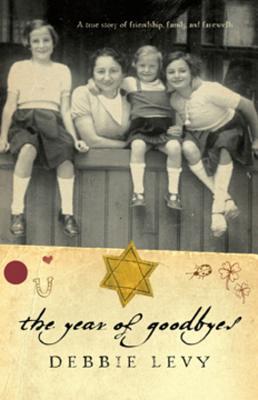
The Year of Goodbyes by Debbie Levy

Source: Book Expo America 2010
Hardcover, 136 pages
I am an Amazon Affiliate

The Year of Goodbyes by Debbie Levy is an adaptation of her mother’s poesiealbum (poetry album) into a narrative poem, peppered with images and actual entries, and a WWII historical time line as well as a resource listing and a section catching up with Jutta Salzberg’s family and friends and their ultimate fates.  This powerful hybrid poem/memoir not only examines the horrifying snowball effect of Nazi Germany’s laws against Jews, but also how Jewish children still found ways to maintain their childhood and enjoy the joyous moments they still had.

Salzberg lived in Hamburg, Germany, and was the daughter of a Polish born Jew who emigrated to Germany before the Nazi’s came to power, and the poetry album, much like American autograph books, begins in 1938, which became a pivotal year for Jutta.  Her father was a successful, belt, suspender, etc. salesman, who is eventually dismissed from his job because he’s a Jew. As a young lady on the verge of womanhood, she is capable of not only enjoying gossip and games with classmates, but also understand the deep seriousness of the changes around her.

Parents (page 32)
...
He sags
and I think how Father could use something
to hold him up--
a belt,
a suspender,
a garter...

She also has the ability to question the changes around her within the context of the words from her friends, like respecting one’s elders. Jutta wonders how she can respect someone like Hitler, who is her elder, when he spread such fear and hatred.  There is great tension in this short, narrative poem/journal as a young girl tries to find the silver lining in her circumstances, remember her friends, and enjoy moments with her family, while at the same time worrying that her immediate family will be unable to leave Germany for America as the consulate will not issue them U.S. visas.  The section of the narrative poem that is the most heart-wrenching is when Jews are forced to seek out kindness from strangers in America who just happen to have their same last name.

The Year of Goodbyes by Debbie Levy is powerful and a great testament to her mother’s memory, her own family’s past, and the hope generated by that remembering.  The book is not only a year of goodbyes between Jutta and her family and friends, it also contains information that may not be as well known, including the role of Jutta’s cousin Guy Gotthelf in the French Resistance and the impact of one Jewish man, Herschel Grynszpan, on those left behind in Germany when he avenged the murder of his own family back in Germany.  Lasting, eye-opening, and a must read for young and old.

About the Author:

Debbie Levy writes books — fiction, nonfiction, and poetry — for people of all different ages, and especially for young people. Before starting her writing career, she was a newspaper editor, and a lawyer with a Washington, D.C. law firm. She has a bachelor’s degree in government and foreign affairs from the University of Virginia, and a law degree and master’s degree in world politics from the University of Michigan. She lives in Maryland and spends as much time as she can kayaking and otherwise messing around in the Chesapeake Bay region.  Follow her on Twitter and Facebook.  Also please check out the article on her family’s journey in The Washington Post, and her own article on finding the journal in the same publication.

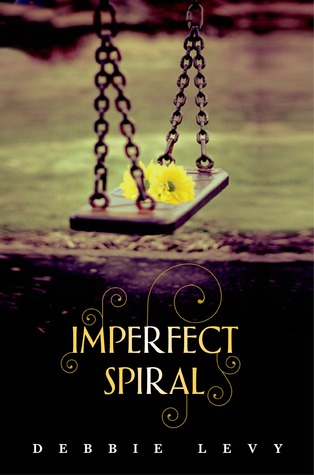
Also, check out her new book, Imperfect Spiral, which is published today!

Danielle Snyder’s summer job as a babysitter takes a tragic turn when Humphrey, the five-year-old boy she’s watching, runs in front of oncoming traffic to chase down his football. Immediately Danielle is caught up in the machinery of tragedy: police investigations, neighborhood squabbling, and, when the driver of the car that struck Humphrey turns out to be an undocumented alien, outsiders use the accident to further a politically charged immigration debate. Wanting only to mourn Humphrey, the sweet kid she had a surprisingly strong friendship with, Danielle tries to avoid the world around her. Through a new relationship with Justin, a boy she meets at the park, she begins to work through her grief, but as details of the accident emerge, much is not as it seems. It’s time for Danielle to face reality, but when the truth brings so much pain, can she find a way to do right by Humphrey’s memory and forgive herself for his death?

On July 27, 2013, at 3:30 pm for those in the Alexandria, Va., area, Debbie will be with Beth Kephart in a joint event at Hooray for Books.

This is my 45th book for the 2013 New Authors Challenge.

Looking for Me by Beth Hoffman

Source: Author Beth Hoffman
Hardcover, 354 pages
I am an Amazon Affiliate

Looking for Me by Beth Hoffman is a coming of age story for Teddi Overman who has a gift for restoring old furniture that speaks to her.  Her small, close-knit family from Kentucky is as diverse in background and interests as any family could be, with her brother Josh so attuned to nature — he’s almost as wild as the animals he observes and cares for — to her uptight mother Franny, who has secrets hidden deep inside.  Teddi is an independent and stubborn girl whose life is altered when she meets an older man, Mr. Palmer, who’s passing through town.  He buys a refurbished chest from her side-of-the-road shop and encourages her to follow her dream and look him up in South Carolina.  When she graduates from high school, something irrevocably changes for her family as each member either seeks freedom or learns to find that freedom is already there.

“Some people run toward life, arms flung wide in anticipation.  Others crack open the door and take a one-eyed peek to see what’s out there.  Then there are those who give up on life long before their heart stops beating — all used up, worn out, and caved in, yet they wake each morning and shuffle their tired legs through another day.”  (page 1)

The double meaning in the title comes into play when her brother makes his flight from the family farm.  The close relationship between Josh and Teddi is tender and endearing, but it also makes his lack of communication with his sister heart-breaking.  In many ways, looking for me is not about Teddi finding herself — because she already knows who she is and what she wants out of life — but about her finding the piece of herself that went missing when her brother left.  Early on in the story, even Teddi recognizes that leaving home means leaving something of yourself behind, and she even suggests that it’s a piece that cannot be reclaimed, but waits for your return and for you to remember.  Recovering that piece of herself is a journey only she can accomplish, but even so, she can and does lean on the support system of friends she finds in Charleston.

Olivia and Teddi tell each other like it is, and like most real-life friends, keep secrets from one another when they know the unsolicited advice they’d receive is not something they would want to hear.  Teddi rebuilds and refinishes furniture, but in many ways she uses those same skills to restore her own family, which fell into disrepair through a series of missteps and miscommunications.  Through a greater understanding of her mother and father’s motivations and backgrounds, Teddi is able to come to terms with her past and embrace her future fully.  Grammy Belle, Josh, Sam, Albert, Inez, and Olivia will leave lasting impressions on Hoffman’s readers, causing them to be missed something fierce when the last page is turned.

Second novels can suffer from harsh criticism, especially when they follow a wildly successful debut novel, like Saving Cee Cee Honeycutt (my review), but Looking for Me breaks through preconceived expectations to weave a story that will enchant readers with not only its southern charm and hospitality, but also the mysteries of family connections and miscommunications.  Hoffman’s second novel is captivating from the first pages and will give readers hope that the future is brighter than we expect it to be.  Another winner from an author I love.

About the Author:

Twelve days after Beth Hoffman’s first novel was published in January 2010, she became a New York Times bestselling author with foreign rights selling to prestigious publishers in Italy, Germany, France, Poland, Norway, Hungary, Indonesia, Korea, Israel, and the United Kingdom.

Before beginning her writing career, Beth was president and co-owner of an interior design studio. An artist as well as an award-winning designer, her paintings are displayed in private and corporate collections in the United States, Canada, and the UK.

Beth lives, along with her husband and two very smart cats, in a restored Queen Anne home in a quaint historic district in Northern Kentucky. Her interests include the rescue of abandoned and abused animals, nature conservancy, birding, historic preservation, and antiquing.  Visit her on Twitter and Facebook.

The Neruda Case by Roberto Ampuero, Translated by Carolina de Robertis

Source: Riverhead Books, Penguin
Paperback, 374 pages
I am an Amazon Affiliate

The Neruda Case by Roberto Ampuero, translated by Carolina de Robertis (see my review of Perla), is set just before the dictatorship of Augusto Pinochet in Chile when Castro is in power in Cuba and Germany has been cut in half by the wall.  Cuban exile Cayetano Brulé has left Miami with his wife, Maria Paz Angela Undurraga Cox, for her home in Chile, but he continues to feel out of place as no one trusts a Cuban and he cannot find work.  Meanwhile, his wife is increasingly engaged in the reform movement in the country, while at the same time she is pulling away from her husband.  Wandering in a strange country with bad coffee, Cayetano unwittingly bumps into Pablo Neruda at a party in a library and shortly receives an offer he cannot refuse.

“The door was made of knotted wood.  It didn’t open.  He stroked the old bronze knocker, put his hands in the pockets of his fleece jacket, and told himself that all he could do now was wait.  He exhaled wafts of white breath into the overcast winter morning and thought, amused, that it looked as if he were smoking, even though, in this city, there were no more matches or cigarettes.”  (page 12)

Brulé is a man that is transformed by his business relationship with Neruda, who hires him to uncover the truth about his past that haunts him, but this relationship evolves into admiration and a personal connection that transforms Brulé into a confident detective.  Not only is the novel about finding solace, it also is about one man’s journey home.  Neruda was a complex man and legendary, and the author clearly admired the poet and held him in high regard, but the novel also demonstrates that even the most legendary of us have flaws.  It is those flaws that make us who we are, ensuring that those who love us are constantly challenged.  By the time Brulé meets Neruda, he is already a legend and Nobel laureate, and Neruda knows it and revels in his success — so much so that it becomes a crutch for any mean moment or poor decision in his life:  “I did it for my art.”

“‘Because if poetry transports us to the heavens, crime novels plunge you into life the way it really is; they dirty your hands and blacken your face the way coal stains engine stokers on trains in the south, where I was born.'”  (page 24)

“‘The casualties of our good fortune are a terrible thing, Cayetano.  But the road to personal happiness is paved with the pain of others.'”  (page 130)

Ampuero’s novel is a detective novel wrapped up in literary and historical fiction that depicts a turbulent time in Chile’s history, but also a time of idealism on the part of Neruda and President Salvador Allende.  The Neruda Case transports the reader back in time and paints a picture of idealism and its failures, but also its continued promise of hope.  Ampuero’s portrayal of Neruda is as complex as the man himself, and his detective is a man that readers will become emotionally attached to and cheer on in his mission.  One of the best, sweeping novels I’ve read this year.

**On a side note, I was pleased to find that Ampuero lived near Neruda’s home La Sebastiana as a boy and regrets that he never had the courage to knock on the poet’s door.**

About the Author:

Roberto Ampuero is an internationally bestselling, award-winning author. He has published twelve novels in Spanish, and his works have been translated around the world. The Neruda Case is his first novel published in English. Born in Chile, Ampuero is a professor of creative writing at the University of Iowa and currently serves as Chile’s ambassador to Mexico. He lives in Mexico City and Iowa City.


This is my 37th book for the 2013 New Authors Challenge.

Virgin Soul by Judy Juanita

Source: Viking
Hardcover, 306 pages
I am an Amazon Affiliate

The rhythm of Virgin Soul by Judy Juanita’s narrative is reminiscent of scat singing, but with a street-based undertone, jumping from moment to moment creating an atmosphere that resembles the turbulent nature of the 1960s.  In this way, she captures the atmosphere, especially among African-Americans in California at that time, really well.  The protagonist Geniece Hightower has always felt like an outsider since her mother died and her father skipped out, but when she heads off to college, she thinks that she’s finally found a place to fit in.  She meets some people engaged in the civil rights movement, and falls in love with Allwood, who becomes her lover and teacher.  She falls in and out of relationships, but at her heart Allwood is her first love.

Juanita breaks the book into one year of college from Freshman to Senior year, and its first-person narrative makes it read more like a memoir than fiction.  The novel bounces from moment to moment, reading more like a journal than fiction, and Geniece is tough to get a handle on as she’s pulled between the moral and conservative views of her family and the angrier, more liberal thinking of her friends.

“Uncle Boy-Boy was a dentist and Aunt Ola Ray was his wife and I was not their adored child–I was more obligation than kin, their dark-skinned orphan-in-residence.  I had gotten accepted into SF State as a freshman, but my ‘financial resources’ amounted to my seventy-two-dollar monthly Social Security check.  I wasn’t about to ask them to support me.”  (page 3)

Geniece is looking for her place in the world, and as she’s felt like an outsider in her own family, it’s easier for her to be captured by the passions of others, and eventually, she falls into the Black Panthers.  While she’s caught up in the movement, she never loses sight of getting her education, knowing from her family that it is about the only way she can break free from poverty.  As a member of the party, she learns that she is as angry as the men in the party, but she draws the line at killing.  Geniece never seems to grow out of the naive way in which she relates to the men in her life — falling into bed at a moment’s notice, even when there is very little attraction — but her relationships with her female friends are at arms length in most cases.

“Whenever Allwood insisted, I resisted, but only to a point.  I wanted to know what he knew, feel what he felt inside that righteousness.  The only way in was to surrender, and I was willing.  I had plenty of motivation and a demonstrated interest, but I needed a catalyst.  Allwood was the reason I became black.”  (page 35)

Huey Newton and Bobby Seale, the leaders of the Black Panthers, are here, along with many others from history, but they are more in the backdrop than in the foreground.  Other figures from history include Stokely Carmichael, Betty Shabazz, Eldridge Cleaver, and more.  Geniece, however, is on the sidelines and working with the community and the children and on the paper, but she has little to do with the violent protests and demonstrations.  She’s a bystander, but she isn’t.  Her involvement is focused on the rebuilding of the community, and in this way, her character matures and becomes a focal point for what was good about the Panthers.  Readers looking for an in-depth connection to these historical figures will be disappointed because the novel’s focus is Geniece and her experiences during the 1960s and the civil rights movement, which also gets caught up in the controversy of the Vietnam War and the deaths of Black soldiers on the front lines.

When the police and the FBI are watching your every move, it is naive to think that even as a mere writer or community volunteer that you wouldn’t be a target.  Unfortunately, Geniece is very naive in terms of precarious situation as a party member — a perception that she has to face head on later in the book.  Moreover, it seems as those she simply falls into a socialist movement, and gets herself deeper involved without thinking about the consequences.  Where the novel failed is at the end where too many things are left unresolved and hanging, and Geniece’s character is only partially evolved beyond her first introduction.  The relationships between the main character and the male party members are vague at times or seemingly non-existent until they fall into bed.

Virgin Soul by Judy Juanita is not for every reader; it is definitely frank about the 1960s movements, the violence, the drug use, the rampant sexual activity without commitment, and the paranoia that many in the African-American community felt.  However, Juanita has a firm grasp of her setting and time period, making it easy for readers to transport themselves back in time and to feel the tension and paranoia that these activists felt as they strived for change.  Another aspect that comes to life is the color differences and prejudice within the Black community itself, particularly in how darker skin men and women were treated compared to those with lighter brown skin.  Overall, a turbulent novel that reads more like a series of memories.

About the Author:

Judy Juanita’s poetry and fiction have been published widely, and her plays have been produced in the Bay Area and New York City. She has taught writing at Laney College in Oakland since 1993. This is her first novel. She lives in Oakland.  Check out this Interview from Publisher’s Weekly.

This is my 36th book for the 2013 New Authors Challenge.

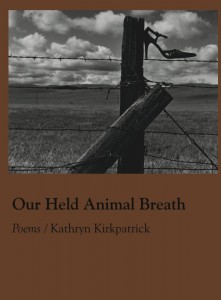
Our Held Animal Breath by Kathryn Kirkpatrick

Source: Wordtech Communications and TLC Book Tours
Paperback, 96 pages
I am an Amazon Affiliate

Our Held Animal Breath by Kathryn Kirkpatrick is a slim volume of poetry that is broken into three sections.  Although there is a deep sense of anger and hurt over current events and the rape of the world by humanity, many of these poems also have a personal side to them — deep personal losses of friends and family.  At times, the narrator is baffled at how some things come to be, like in “Millennium” where the narrator is left with an altar in a room flooded with light.  “How did I come by this altar,/these windows of stained glass?/When I meet the fox again,/I set her free./The meadow she finds/is neither desert nor glacier.”  (page 11)

Kirkpatrick wonders about the connections between humans and nature, particularly animals.  She postulates in “At the Turkey Farm” whether we absorb the loneliness and longing of turkeys when we eat them during holidays, but at the same time she talks about their only solace as being able to stand in the fading light in their own poop.  At the heart of the poem, the narrator is exploring the existence of these animals as walking corpses and ghosts haunting the farms but not really living.  In a way the poem itself is haunting, forcing readers to contemplate these farms where animals are bred to be something other than themselves, serving mostly as food.

Strange Meeting (page 22-3)

Is this how an animal feels
on the other side of a human eye?

I was a woman speaking
to men I didn’t know.

Large and strong, they
knew about power
in ways I may never

I sat framed and assessed
no threat a square jaw decided
negligible bent knuckles said

I looked back through my animal
eye, saw

the slit throat of the cow
in the leather shoe

the poisons deep in the soil
where the cotton grew

the felled trees
of the papers stacked

the mountains leveled
in the electric hum of light and heat
where we sat.

I saw clearly
all they had done and would do
to make a world we’d be losing fast.

I saw why it was lost.
And I saw how we would lose it.

In some poems, Kirkpatrick weaves in the teachings of Buddhism, but in some instances, those teachings cannot stop the suffering. “After Zazen” explores the many forms of suffering facing humanity, including accidental swallowing of stones to cause near suffocation and death and the invasion of one country into another. Raising questions about suffering on many fronts, the narrators are searching for ways to end it or at least ease the pain. Meditation may not be the best solution or it could be. Beyond these moments of suffering, the narrator blur the lines between animal and human to find the similarities of feelings and behaviors, but to also outline the loyalties that have been forgotten, like that of a dog and master. Perhaps that loyalty should be expanded to include other aspects of nature.

Our Held Animal Breath by Kathryn Kirkpatrick offers a wide range of poems for discussion in book clubs, focused on the impact of human activity on the environment and the changes that are possible if we just think outside the box.  What are the ways that we can brainstorm to feed ourselves and continue to live and grow without harming other animals and nature.  While the brown of the cover is a bit off-putting; the shoe seems out of place on the wire fence, though that may be on purpose given the sometimes out of place nature of our own existence in the world.

About the Poet:

Raised in the nomadic subculture of the U.S. military, Kathryn Kirkpatrick was born in Columbia, South Carolina, and grew up in the Phillipines, Germany, Texas and the Carolinas.  Today she lives with her husband, Will, and their two shelties in the Blue Ridge Mountains of North Carolina, and she currently holds a dual appointment at Appalachian State University as a Professor in the English Department and the Sustainable Development Program. She has a Ph.D. in Interdisciplinary Studies from Emory University, where she received an Academy of American Poets poetry prize.

Giveaway:  1 copy of Our Held Animal Breath

Want to win a copy of her book?  Leave a comment below with an email

I’ll contact the randomly drawn winner, who must be age 18 or older and live in US or Canada as the publisher is sponsoring the giveaway.  Deadline to enter is June 17, 2013 at 11:59 PM EST

This is my 23rd book for the Dive Into Poetry Challenge 2013.


This is my 35th book for the 2013 New Authors Challenge.

Writers on the Edge: 22 Writers Speak About Addiction and Dependency edited by Diana M. Raab and James Brown

Source: Modern History Press
Paperback, 185 pages
I am an Amazon Affiliate

Writers on the Edge: 22 Writers Speak About Addiction and Dependency edited by Diana M. Raab and James Brown is a collection of essays, memories, poems, and stories about addiction and dependency, but more than that they are harrowing experiences of surviving with addiction and dependency and the continuous struggle that dogs these writers throughout their lives.  Most, if not all, of these essays are frank and honest about the vacillation between lying about an addiction and being honest about it and confronting it.  The poems are similar in that way.  From alcoholism to suicide and depression as well as overeating addictions, these writers share the struggle with themselves, each other, their readers, and sometimes even their families.  “These writers were more often than not, perps–their own or somebody else’s.  It’s roughly akin to reading a recollection of Nagasaki survivors by people who dropped the bomb on themselves,” says Jerry Stahl in the Foreword.

There are perfect examples in these writers’ lives of what addiction can lead to, and there are examples of friends who successfully killed themselves that haunt these writers and scare them to keep away from their addictions.  But even the scariest moments in these addicts lives may not be enough to stave off addictions for long, while there are times when addiction is held at arms length for a longer period of time, there are always moments of weakness around the corner.  What these writers strive to illustrate through these essays is that life and addiction go hand in hand, and some addictions may be more destructive than others, but it is when they become obsessions that people can lose control of themselves and lose all that they have and love.

From John Amen's "23":

... Jul called an ambulance,
and I came to in intensive care, sunlight flooding
through barred windows, tubes flowing like power lines.
I'd been here before, each survival bolstering some
myth of invincibility, but this time I knew I was treading

Clarity is the moment when each addict learns that they are addicts and that they must do something differently or die. “The language of poetry is the means by which one human consciousness speaks most intimately, directly, and precisely to others. Yet it is also an empty mirror, if I tell the truth of what I see,” says Chase Twichell in “Toys in the Attic.” More than a look at the addiction that has shaped these writers, this volume offers lessons and examples of struggle and includes an appendix of organizations and support groups to help those who need it.  Writers on the Edge: 22 Writers Speak About Addiction and Dependency edited by Diana M. Raab and James Brown is heartbreaking and inspiring, with selections that echo off one another to shout the louder truth of surviving addiction — it is a never ending process that must be undertaken every day, every hour, and at every moment.

Regulated for Murder by Suzanne Adair

Source: Author provided review copy
Paperback, 230 pages
I am an Amazon Affiliate

Red coat soldier and criminal investigator Michael Stoddard has landed himself in a pickle in the first American Revolutionary War Thriller installment, Regulated for Murder by Suzanne Adair.  Stoddard must dress in plain clothes before making his way to Hillsborough, N.C., to deliver a vital dispatch to Cornwallis, and he must not let on that he is a British soldier.  He’s less than pleased by his new assignment as he was attempting to close in on Bowater, who is accused of defrauding two men.  Stoddard assumes the name of Compton after stumbling upon a murder scene in a town not loyal to the British and being surrounded by lawmen and residents who are very suspicious of strangers.  Quickly, he’s rescued from certain jail time by his “cousin,” Kate, just as he is recruited by the town’s German sheriff Schmidt to find the killer of a local man.  What transpires is a criminal investigation wrought with danger at nearly every turn, which set during another time period might be perceived as a little too much.  However, given the American revolutionary time period in question when loyalties were tested and retested, Adair handles the investigation and interactions with a town full of former Regulators and those who opposed them carefully.

“Electric readiness charged Michael’s muscles.  He sprang into the house and pivoted to avoid Schmidt’s paw swipe.  The German kicked the door shut, leaving his lackeys outside.  Michael’s forearm deflected the second swipe, followed it with a slash from his dagger that snagged Schmidt’s sleeve.  Then his heel caught on an upturned rug.  Schmidt advanced into his stumble, batted the dagger from his hand.  It clattered to the foyer floor out of reach.” (page 69)

Adair provides enough backstory for readers to follow along with Stoddard and understand his background, though it is clear that more is haunting this man.  Adair fleshes out Stoddard’s conflicted character, providing readers with glimpses of his struggles with his moral conscience, but she also depicts him as a highly logical man.  It was interesting to see that this are was plagued by corruption even before the American Revolution and that the townspeople sought to root it out themselves, which calls to mind the driving force behind the American fight for freedom from British rule.  However, Adair also touches upon the tension people felt after getting to know some of the soldiers that occupied their towns, getting to know them as people made it harder to see them as enemies.

Regulated for Murder by Suzanne Adair is a solid mystery set in the period of the American Revolution that will keep readers entertained and learning about our nation’s past.  The author even provides historical notes about what parts of the novel are based in fact and which are fiction.  While the book started off a little slowly, it quickly picked up pace once Stoddard entered the town of Hillsborough.  There were some moments that seemed a little too coincidental, but they were intended to be so given the circumstances of the murder investigation, but the appearance of Stoddard’s nemesis seemed a bit forced, though it was still enjoyable to see the moral dilemma it presented to the main character.

About the Author:

Award-winning novelist Suzanne Adair is a Florida native who lives in a two hundred-year-old city at the edge of the North Carolina Piedmont, named for an English explorer who was beheaded. Her suspense and thrillers transport readers to the Southern theater of the Revolutionary War, where she brings historic towns, battles, and people to life. She fuels her creativity with Revolutionary War reenacting and visits to historic sites. When she’s not writing, she enjoys cooking, dancing, hiking, and spending time with her family.  Visit her on Facebook, Twitter, and blog.

This is my 1st book for the American Revolution Reading Challenge 2013



This is my 34th book for the 2013 New Authors Challenge.

Miss Plastique by Lynn Levin

Book Source:  Poet provided me with a copy
Paperback: 58 pages
I’m an Amazon Affiliate

Miss Plastique by Lynn Levin reminded me of the comic book character Plastique in that many of the female narrators in this collection are very explosive. And the cover of this collection is very ironic, with the sweet looking Barbie doll decked out in a corset-like shirt and chain necklaces, giving a hint of her edginess.  In one of the first poems, “Miss Plastique,” Levin references the explosive nature of C-4 and how it must be handled with care, much like the narrator. Levin examines the notion of judging a book by its cover, and how something that doesn’t look dangerous can be exactly that.

Some poems have a bit of tongue-in-cheek humor, like in “The Foundations of Poetry,” the narrator recounts some advice from an English teacher long ago, “‘You should expose/your thoughts and feelings/when you write poems,’ taught Mrs. Hay./’In verse, a little thigh is fine/and you may dream your truth into your lines./Only do not lie to yourself.’//”  (page 16)  These poems contain material that can be explosive if not handled with care, but in Levin’s hands the tension in the poem is sometimes just enough to sustain it without a bomb going off, but in other poems, there is just no other way to express the emotion that has been building.

A selection from: Please Understand (page 39)

I love to say your name, it's like candy
in my mouth.  I love to say your name,
it's like saltwater taffy.
When I steal a look at your eyes
it's like I'm shoplifting in a jewelry store,
and my heart's arrested
when you catch me.

Levin has a gift in that she knows precisely when to change the mood in the poem, turning the tables on the reader, who thinks there is a love sonnet but realizes soon enough that the object of the poem is no longer a love interest but someone who has spurned the narrator. In the latter section of the book, Lilith appears — a long used symbol of rebellion for feminists — and she alongside Eve stands tall and ready to act, rather than simper and wait for things to change.

Miss Plastique by Lynn Levin is about taking charge, being a force to be reckoned with, and standing tall in the face of adversity — whether its a mundane as a dilemma as choosing the best outfit or as dire as escaping a violent relationship.  But there are moments of vulnerability in these poems as well as explosions.  These poems will make sure readers are kept on their toes.

This is my 22nd book for the Dive Into Poetry Challenge 2013.

Unexplained Fevers by Jeannine Hall Gailey

Unexplained Fevers by Jeannine Hall Gailey builds on the poet’s exploration of popular myths and legends centered on women, only unlike Becoming the Villainess (my review) where the characters become vengeful, these characters are striking out for parts unknown, examining their legends, and telling the real tales behind the fairy magic.  From Jack and Jill who vowed to stay together against all odds who find themselves in Ohio to Alice in Wonderland who merely gets lost in a coat closet, Gailey is poking fun at the fantasies that rely on women being beautiful and little else to prove their worth.  These heroines are set free, and outside the confines of their tales, they are able to contemplate their past choices and their futures in ways they never though possible.

She Had Unexplained Fevers (page 3)

some nights she just wasn't
herself, skin pale and damp as a child's
they lay her in a glass coffin
told me there was something in her throat
and I said yes we've all swallowed a lot of crap
choked down broken promises like apple.

In looking at these tales, Gailey is not only calling into question their validity but also their impact on the generations that have read them. Are women supposed to be only beautiful and only want that prince to come rescue them? And by the end of the collection, the poet asks readers to think about how much has changed even in the modern world. May be there are few princes with castles and white steeds, but don’t they have other “enticements” like good paying jobs and the house in the suburbs that women continue to gravitate towards as safe and what they should want from their lives?

Like “Alice, Through the Looking Glass,” there are poems that are more universal and do not stick as closely to the stories as some other poems do, and in these poems, Gailey raises questions about body image and the prevalence of women in advertising to not only sell products, but also to sell an idea of what beauty is and should be for every woman. The narrator in “Alice” asks, “What am I doing here in this white room/with no smell but dust and soap//” Meanwhile, Snow White asks the reader in “I Like the Quiet: Snow White” to get her out of our own looking glasses — break free from the need for a certain appearance — readers would see their true selves and who each of us really is and how we matter without the constant need to live up to a beauty standard. Snow White is just like all of us, wanting to spend time alone, wanting space to decide the course of our lives, wanting not to rush into a marriage even with a prince, and all the trappings and decisions we make in our lives.

Unexplained Fevers by Jeannine Hall Gailey easily parallels the myths and stories we’ve read and memorized as children with the current modern lives we lead.  Though lest you think all of the poem narrators are female, there are male narrators, including one knight who did not get the fairytale ending he was expecting.  In this way, Gailey is calling into question the fantasies that men are fed as children as well; must they be rescuers and be the strongest and bravest to get the girl?  A phenomenal collection from beginning to end — one that has a permanent place in my library, right next to her others.

About the Poet:

Jeannine Hall Gailey is the Poet Laureate of Redmond, WA and the author of Becoming the Villainess, She Returns to the Floating World, and Unexplained Fevers, available spring of 2013. Her work has been featured on NPR’s The Writer’s Almanac, Verse Daily, and The Year’s Best Fantasy and Horror. Her poems have appeared in The American Poetry Review, The Iowa Review, and Prairie Schooner. She teaches part-time at National University.

This is my 19th book for the Dive Into Poetry Challenge 2013.

The Collected Poems of Marcel Proust edited by Harold Augenbraum

The Collected Poems of Marcel Proust edited by Harold Augenbraum includes not only the original French alongside the English translations of the poems, but also detailed notes on the various references and historical context for each of the poems at the end of the collection. As an interesting addition, there are a few of the original drawings that Proust sent along with the poems in his correspondence.  Proust is generally known for his prose, and most people don’t know that he wrote poems.  (While I’ve read some of his poems before, I have not read his prose.  I’m a bit out of the norm.)  “The poems were composed from when Proust was seventeen to when he was fifty,” says the introduction on page xvi.  That’s a long period of time, and there are a great many poems.  How many of these poems were written down in one moment or revised is unclear, but some of these poems clearly were further along in the process.

Proust’s poems range from witty to plainspoken and sarcastic.  Some of his poems about love border on the edge of passion and hatred, and there are moments in certain poems that may remind readers of the great Romantic poet Percy Bysshe Shelley.  Proust’s poems celebrate not only art, but also music, language, and friendship — even those relationships that sour.  Many of these poems were untitled.

Poem 9 (page 27)

Madame, it's possible that I have forgotten
Your divine and birdlike profile,
That I have pushed past my own madness
Like one jumping through a hoop,
But always still your eyes will shine
Like bright chandeliers on the ceiling of my mind.

His poems are playful and cutting at the same time, and his grasp of language and all its capabilities is astounding. Readers will wonder about the subjects that are not clearly named, but at the same imagine their own obsession or loved one in their stead. Even without knowing the subject of poem 9, the reader can gather that the woman once held an esteemed place in the poet’s heart, but has now fallen into disgrace in his eyes. And yet, even though the love affair has gone downhill, she still is remembered fondly but will remain in the past.

From the traditional forms of sonnet to the less-than-traditional prose-like poetry in the collection, readers will get a sense of Proust’s evolution as a writer and his experiences as he saw them. The Collected Poems of Marcel Proust edited by Harold Augenbraum has a lot to offer readers, and while it is not necessary to read the French, those who can will have a richer experience.

About the Poet/Author:

Valentin Louis Georges Eugène Marcel Proust was a French novelist, critic, and essayist best known for his monumental novel In Search of Lost Time. It was published in seven parts between 1913 and 1927.

This is my 18th book for the Dive Into Poetry Challenge 2013.


This is my 29th book for the 2013 New Authors Challenge.