Quantcast

Lost In The Woods: A Photographic Fantasy by Carl R. Sams II and Jean Stoick

Source: Purchased — gift from cousin
Hardcover, 48 pgs.
I am an Amazon Affiliate

Lost in the Woods: A Photographic Fantasy by Carl R. Sams II and Jean Stoick is an adorable story about life in the woods for a fawn left on his own.  A doe must leave her child alone so that danger will not find him, which it won’t because he doesn’t have a scent.  Not only can kids learn about nature and why animals behave how they do, they also can see when it is wise to listen to parents.  The fawn meets a number of other young animals along the way while stretching his legs, and while he does have moments of trepidation, he remembers his mother’s words and remains calm and hides.

My daughter enjoys photographs, particularly ones that are vibrant and have animals.  This is a good book for her because it has a simple story with a lesson, but also eye-catching images that will keep her riveted to the story.  At the back, there are more surprises, as the authors have created a game of find our lost friends, challenging kids to go back through the photographic pages to find animals hidden among the flowers and trees.

Lost in the Woods: A Photographic Fantasy by Carl R. Sams II and Jean Stoick is beautifully rendered.  It’s a wonderful story with sounds and sights to behold, and there are games afoot in the tall grasses for your own young fawns.

About the Authors:

Carl R Sams II and Jean Stoick are professional wildlife photographers from Milford, Michigan. Their images have appeared in hundreds of national and international publications. Honored recipients of the People’s Choice Award for the best of show 11 times at major wildlife exhibits, Carl and Jean were also the first photographers ever to be honored as featured artists at a major wildlife art event.  Find out more about them on their Website.
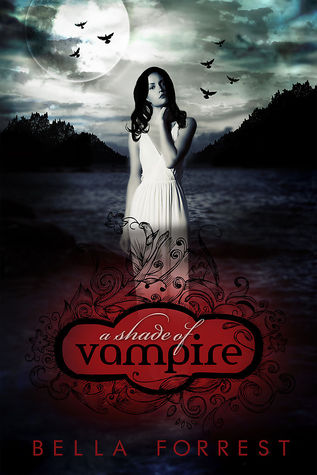
A Shade of Vampire by Bella Forrest

Source: Purchased
ebook, 296 pgs.
I am an Amazon Affiliate

A Shade of Vampire by Bella Forrest is a short novella in which Sophia Claremont is kidnapped by vampires and brought to The Shade to become a slave. She’s given to Prince Derek Novak as a gift from his siblings, though his brother Lucas has already claimed her in his mind. Sophia has had a rough time growing up and was finally settled with a neighboring family and her best friend Ben, whom she’s had a crush on for some time. But she also has debilitating anxiety in crowded spaces, almost like she’s on sensory overload.  However, when she finally awakes on this vampire island, very little is seen of her disorders, until she’s attacked one evening.

“She was beautiful because, at a time when she had every right to be terrified, she managed to show comfort to another person who needed it.”

Derek, who has awakened from a 400 year long sleep, cannot stay away from Sophia and he keeps her like a caged bird in his treetop penthouse.  Her humanity has captured his attention, and even though her blood calls to him, he makes every effort to battle his desires.  As she teaches him about technology and he begins to show her respect, their bond intensifies.  Sophia is a naive character who is led by her emotions easily, and in many ways, she falls for the guy who acts like her protector — whether its teenage Ben at home or Derek the powerful vampire on The Shade.

“I know an excuse when I hear one.  Don’t you dare deceive yourself into believing that you’re the victim.”

A mantra that Ben has used many times to snap her out of her anxiety trances, Sophia finds it can be useful in more ways than one, but even as she tames Derek’s inner beast, she fails to see how she is a victim and needs to take action.  One failed escape attempt is all it takes for her to become complacent, which does little for the tension in the book.  While the characters, setting, and world are intriguing, there is little back story, which can leaving the feud between Derek and Lucas seem empty and can leave the lore of this vampire series feel incomplete.

A Shade of Vampire by Bella Forrest provides an engaging way to spend the afternoon, but unless there is more back story in the subsequent novels less telling, rather than showing, it would be hard to sustain interested beyond two more books.  There are 18 books in this series.  It boils down to wanting more from the setting and lore beyond the main characters who are dynamic and troubled.

About the Author:

Bella Forrest is the million-bestselling author of the “A Shade of Vampire” series.

The Same-Different: Poems by Hannah Sanghee Park

Source: Academy of American Poets (purchased)
Paperback, 72 pgs.
I am an Amazon Affiliate

The Same-Different: Poems by Hannah Sanghee Park, 2014 Walt Whitman Award winner, straddles the line between myth and reality, as Park examines some global myths from China and India to Norway and Greece.  She uses phonemes to uncover the secrets in the words she’s chosen to get at the heart of their meaning to not only reach an origin but to generate a response.  Upon first reading, these poems seem like an exercise in word play, but reading more deeply encourages readers to see the similarities and differences inhere in the words chosen and how those nuances should be celebrated.

From "Bang" (pg. 3)

Just what they said about the river:
rift and ever.

And nothing was left for the ether
there either.

And if anything below could mature:
a matter of nature.

Here the interplay of words peeks beneath the surface of creation myths from the big bang theory to the story of creation in scripture. Rather than focus on the age-old battle between whether creationism or evolution is the correct theory of what happened, Park asks “to have left the world,/to what is left of it –/could you have anything left to cove?” Rather than battle for the correct theory and covet the glory of being correct, shouldn’t we be more focused on the awe of it all and our minor part in it? Park forces readers to question their perceptions of what is important about life, not just what happens in their own lives but also the life around them.

& A (pg 22)

Being a matter
of importance, there

is no mastering
this but to bind you,

thrash and all, to the 
mast.  O you won't reach

irresistible song,
but the rope will teach

you the body's give.
Go down to the bone,

then tell me again
there what matters.  It

will give you every
-thing you need to know

about what I cannot tell you and then,
just maybe then, could it be enough.

Similarities and differences are looked at with new eyes, and in many ways, those differences can be dangerous. However, these poems suggest that even in these perceived dichotomies there is beauty, something to be savored and to be loved. In the final section of poems — Fear — the sum of the poems reads like a single force, gyrating and churning the seas of perception until the final lines. Park wonders aloud what it means to be the fear-driven species that strives to become the sole survivor and upon reaching the summit what is there left but more fear. From “Beyond the meadow, the horizon fails” (pg. 47), “what then to our victor’s highest marks?/Only fear regrouping in your heart of hearts.” And yet, despite all this dreariness and dark, Park leaves readers with a hope, a bleak hope — “everything in life is a placeholder.” The Same-Different: Poems by Hannah Sanghee Park is stunning in its twists and turns, but it will require several reads and recitation aloud in some cases. But the gems within these lines and phrases are well worth the work.

About the Poet:

Hannah Sanghee Park was born in Tacoma, Washington and earned a BA from the University of Washington and an MFA from the Iowa Writers’ Workshop. She is the author of a chapbook, Ode Days Ode (Catenary Press, 2011). She is the recipient of fellowships and awards from The Fulbright Program, 4Culture, The Iowa Arts Council/National Endowment for the Arts, and the MacDowell Colony. Her work has appeared in various journals and publications, including LVNG, Petri Press, Poetry Northwest, and Best New Poets 2013. In 2014, Park won the Academy of American Poets’ Walt Whitman Award.

Park lives in Los Angeles, where she attends the Writing for Screen & Television Program at the USC School of Cinematic Arts.


LOVE: A Philadelphia Affair by Beth Kephart

Source: Purchased
Hardcover, 176 pgs
I am an Amazon Affiliate

LOVE: A Philadelphia Affair by Beth Kephart (this has a gorgeous cover) is a collection of essays, many of which were published in the Philadelphia Inquirer, that read not like essays but mini-memoirs. It has been a pleasure to read about Philadelphia — a city I was fortunate to visit briefly and not spend enough time in — through the eyes of someone who loves it dearly. All of its nooks and crannies, its alleys, its rivers, its art, its history — it is all laid bare with Kephart’s fondest memories and recollections. The city comes alive in her hands — it breathes.

The graffiti, the artisans, the food markets, and the University of Pennsylvania are moving through these pages like the Schuylkill River, leaving its gleaming beauty behind in its wake.  She says in the preface, “Love: A Philadelphia Affair is about the intersection of memory and place.  It’s about how I’ve seen and what I’ve hoped for, what ‘home’ has come to mean to me.  It’s about train rides, rough stones, brave birds, rule breakers, resurrectionists, unguided and mostly solo meanderings.  It is experiential, not encyclopedic.  Reflective, not comprehensive.” (pg. x)  In this way, Kephart has enabled readers to ruminate on their own memories, which may or may not be of Philadelphia and only tangentially related to her own.  I’ve remembered train journeys to NYC, ice cream I loved as a kid made in a small Massachusetts town, and a journey to Valley Forge that was at once solemn and beautiful.

“There’s something about standing on the platform watching the curve for the Silverliner.  Something about feeling the rumble in the sole’s of one’s feet.  Something about the rituals of travel.  Leaving and returning — that’s where I’ve lived.  I’m sympathetic to the crossties of the tracks.” (pg. 7-8; “Time In, Time Out”)

Kephart establishes the tone for these essays in these lines, telling her readers that she will straddle the past and present, the before and the after, and the moment and the remembering of the moment.  Many of us do this as our minds wander between where we are and where we have been, noting the connections that are only apparent to us until we voice them aloud.  And in “Psychylustro,” we, like the train, become museums — a collection of our own artifacts, memories, and temporal importance.

One minor thing readers may notice, there are only a few photos at the start of each essay, and more photos would have been a lovely addition.  However, LOVE: A Philadelphia Affair by Beth Kephart is a love story involving a city, but it’s also a testament to the love we hold and can freely give through art and action — so long as we can check our ego and greed at the door.  We all want recognition and love, but we need to also realize that these do not come without our own generosity.  It is not just the generosity that we show toward others, but also to ourselves and the world around us.

About the author:

Following the publication of five memoirs and FLOW, the autobiography of Philadelphia’s Schuylkill River, I’ve had the great pleasure of turning my attention to young adult fiction. UNDERCOVER and HOUSE OF DANCE were both named a best of the year by Kirkus and Bank Street. NOTHING BUT GHOSTS, A HEART IS NOT A SIZE, and DANGEROUS NEIGHBORS were critically acclaimed. In October YOU ARE MY ONLY will be released by Egmont USA. Next summer, Philomel will release SMALL DAMAGES. I am at work on a prequel to DANGEROUS NEIGHBORS, a novel for adults, and a memoir about teaching.

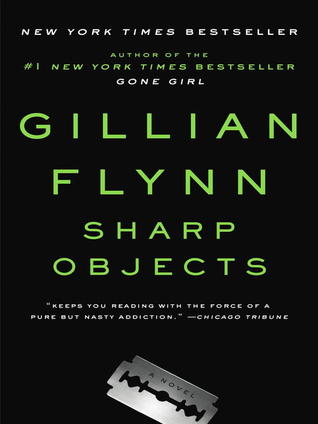
Sharp Objects by Gillian Flynn

Source: Purchased
Paperback, 254 pgs.
I am an Amazon Affiliate

Sharp Objects by Gillian Flynn, which was our book club selection for August, is a suspenseful, twisted tale for a modern audience of Grimms’ fairytale lovers.  Camille Preaker is a mediocre reporter from a small paper in Chicago, and while her editor remains behind her 100%, he sends her home to Wind Gap — a place she has not visited in nearly a decade — to cover a couple of child murders.  Flynn’s style can be abrasive and abrupt, but it fits the mood of the novel well, instilling suspense and the right amount of creepiness.

“For no good reason, I held my breath as I passed the sign welcoming me to Wind Gap, the way kids do when they drive by cemeteries.  It had been eight years since I’d been back, but the scenery was visceral.” (pg. 7)

This small town has dark secrets, and these secrets are about to explode as Camille and the cop from Kansas City start poking around to find the killer.  Flynn’s narration is clipped and fast moving, and her characters are off-the-chain and some are surreptitiously evil.  Camille’s dysfunctional relationship with her mother is just the tip of the iceberg, and the more she sees about her step-sister’s life with their mother, the more disturbed she becomes.  Identifying with the young victims in the case she’s reporting on, Camille is falling down a dark rabbit hole that could possible swallow her whole.

Sharp Objects by Gillian Flynn is an train wreck that readers will be unable to look away from, but its graphic language and description could be a bit much for some readers.  Fans of Stephen King and other horror writers will find this novel as equally twisted.  As a debut novel, Flynn has clearly made a splash in this genre.

About the Author:

Gillian Flynn is an American author and television critic for Entertainment Weekly. She has so far written three novels, Sharp Objects, for which she won the 2007 Ian Fleming Steel Dagger for the best thriller; Dark Places; and her best-selling third novel Gone Girl.

Her book has received wide praise, including from authors such as Stephen King. The dark plot revolves around a serial killer in a Missouri town, and the reporter who has returned from Chicago to cover the event. Themes include dysfunctional families,violence and self-harm.

Urban Art Berlin: Version 2.0 by Kai Jakob

Source: A gift from Emma Eden Ramos
Hardcover
I am an Amazon Affiliate

Urban Art Berlin: Version 2.0 by Kai Jakob does have words, but words as rendered in urban art, also called graffiti.  This collection is of art in Berlin, and what’s interesting is how artists have set their work on top of others.  Art here has no boundaries, nothing to pin it in.  The introduction and foreword are in both German and English, which is helpful for those who don’t know German, and in it, Jakob says that public space is in actuality free space.  Berlin is the home to many artists, including those engaged in graffiti.  Jakob says that as urban landscapes become very monotone and similar, it is a splash of color and an unexpected image that can provide visitors with a glimpse into the true heart of the city.

The photos in this book bring to life not only spray painted images, but those made of paper stuck on walls, stickers on street signs, and more.  I’d recommend this book for those interested in other cultures, graffiti, photography, and art.  Jakob has collected a wide variety of images from the streets of Berlin, and some are comical, while others are downright bizarre.

About the Author:

Check out the Street Art in Berlin Facebook page.

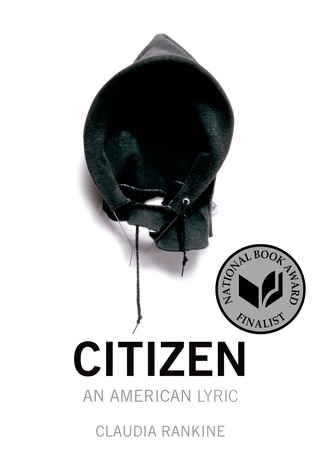
Citizen: An American Lyric by Claudia Rankine

Source: Purchased
Paperback, 169 pgs
I am an Amazon Affiliate

The power of Citizen: An American Lyric by Claudia Rankine makes me wonder what the winner of the National Book Award could have written to outshine Rankine’s words in 2014.  In her collection of essays, poems, and vignettes, Rankine points: “‘The purpose of art,’ James Baldwin wrote, ‘is to lay bare the questions hidden by the answers.'” (page 115)  She took this to heart when writing this collection because she raises up those questions about race in America and brandishes them like a flag.  That is not to say that racism is something that is wholly owned by just white people or white police, but that it is perpetuated by the actions, behaviors, and assumptions both races make about one another.  What does it mean to be American? Does it mean as citizens we brush aside these issues and move forward? Does it mean that we must embrace all of this darkness into ourselves and find solutions that may not work for everyone? Or does it mean that we must take a more internal approach and remedy that which we do to perpetuate those wrongs around us?

from page 135:

because white men can’t
police their imagination
black men are dying

What is engaging about Rankine’s work is that she blurs the lines between the you, the I, the she, the he, to make it less clear cut who is being discriminated against and who is suffering. In this way she takes the time to juxtapose the traditional black victim of white racism formula with a less black-and-white distinction, and it’s done with purpose.

“In any case, it is difficult not to think that if Serena lost context by abandoning all rules of civility, it could be because her body, trapped in a racial imaginary, trapped in disbelief — code for being black in America — is being governed not by the tennis match she is participating in but by a collapsed relationship that had promised to play by the rules.  Perhaps this is how racism feels no matter the context–” (page 30)

Lest you think this book is about racism only through the lens of the victim, it is not.  There a great deal to discuss about racism, its roots, its ignorance, and its pervasiveness in American society.  While many, if not all, the references are contemporary, they could have been pulled from many times throughout history.  Book clubs could discuss this collection of essays and poems for hours.  I cannot explain to you how deeply affected by the book I have been.  I will likely read and re-read this book many times.  I may even put it forth to my book club as a suggestion.

Citizen: An American Lyric by Claudia Rankine is essential reading for every American — young or old, black or white, Hispanic or Asian; it is the beginning of a dialogue that is desperately needed in this country where the presumption of ignorance or incivility is based upon a skin color rather than an individual’s actions and behaviors.  While discrimination against “other” continues, it is not merely one-sided, and until we are able to break down those walls to the truth of our humanity, discrimination and racism will always exist.

***Best of 2015 — not a contender, firmly on the list***

About the Author:

Claudia Rankine was born in Jamaica in 1963. She earned her B.A. in English from Williams College and her M.F.A. in poetry from Columbia University. She is the author of four collections of poetry, including Don’t Let Me Be Lonely (Graywolf, 2004); PLOT (2001); The End of the Alphabet (1998); and Nothing in Nature is Private (1995), which received the Cleveland State Poetry Prize.

Rankine has edited numerous anthologies including American Women Poets in the Twenty-First Century: Where Lyric Meets Language (Wesleyan, 2002) and American Poets in the Twenty-First Century: The New Poetics (2007). Her plays include Provenance of Beauty: A South Bronx Travelogue, commissioned by the Foundry Theatre and Existing Conditions, co-authored with Casey Llewellyn. She has also produced a number of videos in collaboration with John Lucas, including “Situation One.” A recipient of fellowships from the Academy of American Poetry, the National Endowments for the Arts, and the Lannan Foundation, she is currently the Henry G. Lee Professor of English at Pomona College.  (Photo credit: John Lucas)


The Book of Goodbyes by Jillian Weise

Source: Academy of American Poets membership benefit
Paperback, 88 pgs
I am an Amazon Affiliate

The Book of Goodbyes by Jillian Weise, recipient of the Isabella Gardner Poetry Award in 2013 and the 2013 James Laughlin Award, is a collection of poems that highlights the power of goodbye and how it can free us from limitation.  Whether those limitations are self-imposed or imposed upon us by others or the outside distractions that keep us locked in place.

There are several poems in the collection about laws against the disabled being seen in public and the societal burdens that come with those medical miracles — prosthetic legs, for instance — and how those “norms” are meant to weigh down the potential of those human beings. While these “norms” must be recognized to be overcome, it is a big obstacle to overcome, especially when those limitations or “norms” become self-imposed limitations on the self. Saying goodbye to those can be a hard process to perform and a distance that can be difficult to maintain, but there is an inherent power in saying goodbye to those things.

Goodbyes (pg. 50)

begin long before you hear them
and gain speed and come out of 
the same place as other words.
They should have their own
place to come from, the elbow
perhaps, since elbows look
funny and never weep. Why
are you proud of me? I said
goodbye to you forty times.
I see your point. That is
an achievement unto itself.
My mom wants me to write
a goodbye poem. It should fit 
inside a card and use the phrase,
“You are one powerful lady.”
There is nothing powerful
about me though you might 
think so from the way I spit.
I don’t want to say goodbye
to you anymore. I heard
the first wave was an accident.
It happened in the Cave 
of the Hands in Santa Cruz.
The four of them were drinking
and someone killed
a wild boar and someone else
said, “Hey look, I put my hand
in it. Saying goodbye is like that.
You put your hand in it and then
you take your hand back.

Weise touches upon the hardships and the freedom of goodbye, but she also talks about its empowering nature. There is a willfulness to when we choose to make those breaks, and there are many of those moments in this collection.  The Book of Goodbyes by Jillian Weise, recipient of the Isabella Gardner Poetry Award in 2013 and the 2013 James Laughlin Award, offers a great deal to discuss, and would be an interesting selection for a book club discussion.

About the Poet: (Photo credit: Guillermo Morizot Hires)

Jillian Weise was born in Houston, Texas, in 1981. She studied at Florida State University; the University of North Carolina at Greensboro, where she was the Fred Chappell Fellow; and the University of Cincinnati.

Weise is the author of The Book of Goodbyes (BOA Editions, 2013), which received the 2013 James Laughlin Award from the Academy of American Poets, which recognizes a superior second book of poetry by an American poet. Her debut poetry collection, The Amputee’s Guide to Sex, was published by Soft Skull Press in 2007.


Short Story Friday: Christmas Canapes & Sabotage by Janel Gradowski

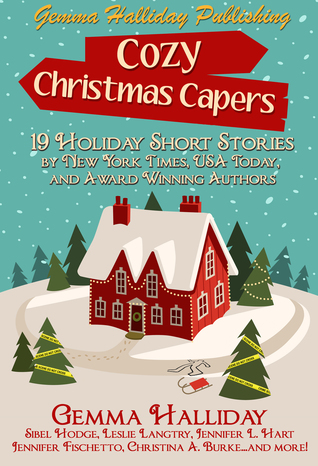
In a renewal, I’ve been reading some short stories in collections, and I really love Janel Gradowski‘s writing.  Her cozy mysteries are always full of food and fun.  One of her latest stories was published in the Cozy Christmas Capers: Holiday Short Story Collection.  I wanted to share a little bit about why I am enjoying these cozy mysteries from Janel and why we as a community should support more writers like her.
Christmas Canapes & Sabotage by Janel Gradowski is part of the culinary competition mystery series of books — her new one is coming out this month, Chicken Soup & Homicide — that find an amateur cook embroiled in a deadly mystery at local food competitions.  Amy is a winner when it comes to these amateur cooking competitions, but she is always humble about her skills, even if she is as inventive in the kitchen as some professional chefs.  Why do I gravitate to these books?  1. food 2. humor.

“‘Old Man Winter can ease up any time now.  It isn’t even Christmas, and I’m tired of the deep freeze.  I think the girl who handed my my registration packet had blue fingernails, and the color wasn’t from nail polish.'”

“‘You’re like a foodie super hero, saving the masses with a pot of tea.'”

Janel is the queen of the instant one-liners, and she’s a book blogger who has made her writing dreams a reality.  She started with flash fiction pieces published in online journals, and from there dove into more challenging, longer projects.  I love her spunk in tackling larger projects that challenged her, and I think that she’s found a great niche.

Have you found other book bloggers who’ve entered the world of authorship?  Have you read their books?  I’d love to hear about it.

To enter Janel’s party giveaway, go here.

Silent Flowers edited by Dorothy Price, illustrated by Nanae Ito

Source: Library sale
Hardcover, about 40 pgs
I am an Amazon Affiliate

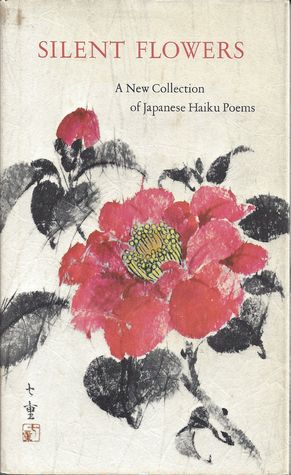
Silent Flowers: A New Collection of Japanese Haiku Poems edited by Dorothy Price, illustrated by Nanae Ito, is gorgeously illustrated and focuses on a lot of traditional haiku poets and their poems, which focus on the seasons, nature, and humans in nature.  There are about three haiku per page, English translations only from the likes of Basho, Buson, and Issa.

“Sacred music at night;
Into the bonfires
Flutter the tinted leaves.” — Issa

I was reminded reading the introduction to this book of Suey’s comment about defining poetry or what a proper definition would be.  Price mentions in the introduction that Wordsworth, another poet, defined poetry as “emotion recollected in tranquility.”  I’m not sure that helps much.  What I’ve loved about haiku is its ability to recognize something unexpected in nature and describe it in a way that illustrates something of the spiritual. I’ve written some horrible haiku but I still love the form and I think its one of the easiest to learn and teach, even if the poems are no where near as good as the old masters.

“The moon in the water;
Broken and broken again,
Still it is there.” — Choshu

A haiku by Basho about a butterfly is accompanied by a wonderful depiction of the butterfly among the orchids, and it is seamlessly incorporated with the poem on the page.   Silent Flowers: A New Collection of Japanese Haiku Poems edited by Dorothy Price, illustrated by Nanae Ito, won me over with not only its beautiful imagery in verse, but also its gorgeous, black and white illustrations.

Enzo Races in the Rain! by Garth Stein, Illustrated by R.W. Alley

Source: Purchased
Hardcover, 40 pgs
I am an Amazon Affiliate

Enzo Races in the Rain! by Garth Stein introduces children to a younger Enzo of The Art of Racing in the Rain fame.  R.W. Alley’s illustrations will make young readers easily identify with Enzo, with his open face and enthusiasm for the outdoors, running, and exploring.  Reading this book aloud to a young girl and an aging grandmother, it was good to see them both smile, and whether they were both smiling at Enzo or one another, it did not matter because in that moment, they were sharing the joy of Stein’s writing.

Living on a farm, Enzo is surrounded by animals and people, and the cars that whiz by on the road. What’s frustrating for this pup is that he not only doesn’t have a name, but that he also is not understood by humans.  It is not until he meets a young girl, Zoe, and finds his place with her family that Enzo begins to learn what it means to be home.

Enzo is a curious and fun pup, who is bound to get into a little bit of trouble, even when he finally has a family and a home.  Enzo Races in the Rain! by Garth Stein, illustrated by R.W. Alley, well illustrated and told, packing a twofold punch for young readers, showing them what it means to have a family who will always love and miss you and a home that you can always return to as long as you remember the way.

About the Author:

Garth Stein is the author of four novels: the New York Times bestselling gothic/historical/coming-of-age/ghost story, “A Sudden Light“; the internationally bestselling “The Art of Racing in the Rain“; the PNBA Book Award winner, “How Evan Broke His Head and Other Secrets“; and the magically realistic “Raven Stole the Moon.” He is also the author of the stage play “Brother Jones.” He has a dog, he’s raced a few cars, climbed a bunch of really tall trees, made a few documentary films, and he lives in Seattle with his family. He’s co-founder of Seattle7Writers.org, a non-profit collective of 74 Northwest authors working together to energize the reading and writing public.

About the Illustrator:

R.W. Alley has illustrated more than one hundred children’s books, including the popular Paddington Bear books by Michael Bond.

In 2010, he received a Theodor Seuss Geisel Honor Award for Pearl and Wagner One Funny Day by Kate McMullan. In 2008, There’s a Wolf at the Door by Zoë B. Alley was selected as a Washington Post Best Book of the Year.

Going After Cacciato by Tim O’Brien

Source: Purchased
Paperback, 336 pgs
On Amazon and on Kobo

Going After Cacciato by Tim O’Brien, which was the final read-a-long for the 2014 War Through the Generations challenge, is the story of soldiers in Vietnam as they struggle with courage and honor and fate.  Paul Berlin appears to break from reality and is the daydreamer of the group, but he latches onto the dream of Cacciato, who claims you can walk out of the Vietnam War, across Asia and into Europe, all the way to Paris.  In a series of chapters that alternate from reality to fantasy and back again, O’Brien examines what it means to be a soldier in war, struggling to process all the dangers and lulls in danger around them.  Berlin is an observer, but he is quaking in his boots when he arrives.  However, he has a plan, stay on the outside of everything, don’t get attached, and he’ll make it through.

“They were all among the dead.  The rain fed fungus that grew in the men’s boots and socks, and their socks rotted, and their feet turned white and soft so that the skin could be scraped off with a fingernail, and Stink Harris woke up screaming one night with a leech on his tongue.  When it was not raining, a low mist moved across the paddies, blending the elements into a single gray element, and the war was cold and pasty and rotten.”  (page 1)

As O’Brien blends reality and fantasy, readers will want to believe in the fantasies to cling to the adventure story, which also perilous seems less dire than trudging through rice paddies and jungles in search of the enemy.  There is that pervasive feeling throughout the book of being caught — a hopelessness of the situation and a desire to escape it by any means necessary.  When the only purpose to war is the winning of it, morale gets bogged down in the failures and the confusion, at least this is the case for Berlin and his squad members.

Going After Cacciato by Tim O’Brien is O’Brien at his best, using magical realism to bring forth the realities of the war for soldiers and their internal struggles.  A complex novel with a great deal for book clubs to discuss about duty, honor, courage, and self-preservation.  O’Brien is considered one of the best novelists writing about the Vietnam War and this book proves his skill and compassion.

About the Author:

Tim O’Brien was born in 1946 in Austin, Minnesota, and spent most of his youth in the small town of Worthington, Minnesota. He graduated summa cum laude from Macalester College in 1968. From February 1969 to March 1970 he served as infantryman with the U.S. Army in Vietnam, after which he pursued graduate studies in government at Harvard University. He worked as a national affairs reporter for The Washington Post from 1973 to 1974.

34th book (Vietnam War) for the 2014 War Challenge With a Twist.