Quantcast

The Eight Stages of Translation by Robert Bly

Source: Purchased
Paperback, 107 pages
I am an Amazon Affiliate

The Eight Stages of Translation by Robert Bly is a slim how-to manual for amateur translators or those just beginning to dip their toes into poetry translation.  He breaks down the process into eight stages, which he illustrates using a René Maria Rilke poem, XXI.  He translates the poem in several drafts from the German into American English.  The eight stages he talks about and provides examples for through his drafts are:

  1. Setting down the literal translation
  2. Get a handle on the concepts and beliefs presented in the original poem; abandon the poem if the translator does not feel a connection with them.
  3. Rewrite the literal translation to ensure the meanings of the poem are not lost.
  4. Translate the latest draft into spoken English, using phrases that have been heard in natural conversation.
  5. Examine the translation in terms of tone to ensure that it carries over from the original (whether happy, sad, etc.)
  6. Listen to the original for sound and carry those same sounds over to the translation, such as the use of open vowel sounds.
  7. Speak with a native speaker to go over the translation to ensure meanings and tone are maintained.
  8. The final stage is completing the translation with all of the advice given and paying close attention to the original poem’s rhythm and rhymes (which are often less about end rhymes than internal rhymes).

The thought process through which Bly guides the reader through translation can be easily understood in the example given and the drafts presented, but even for those with no interest in translating poems themselves, the book includes some breathtaking translations done by Bly himself.  Although I am not fluent in any language, other than English, reading translations is always a peek inside another culture and world.  These translations are no different.  Bly has taken great care with them, and it shows.  Read The Eight Stages of Translation by Robert Bly not for the how-to, but for the poetry.

About the Poet:

Robert Bly is an American poet, author, activist and leader of the mythopoetic men’s movement. His most commercially successful book to date was Iron John: A Book About Men (1990),[1] a key text of the mythopoetic men’s movement, which spent 62 weeks on the The New York Times Best Seller list.[2] He won the 1968 National Book Award for Poetry for his book The Light Around the Body.


Book 13 for the Dive Into Poetry Reading Challenge 2014.


19th book for 2014 New Author Challenge.


For today’s 2014 National Poetry Month: Reach for the Horizon tour stop, click the image below:
Never Too Little to Love by Jeanne Willis, illustrated by Jan Fearnley

Source: Gift from Nana
Hardcover, 32 pages
I am an Amazon Affiliate

Never Too Little to Love by Jeanne Willis, illustrated by Jan Fearnley is the cutest little Valentine’s Day gift for a silly little toddler who loves books with peek-a-boos and flaps.  Tiny Too-Little is in love, but to reach his love, he must collect a bunch of things to reach new heights to profess his love.  As each page is flipped, he stands upon small items, taller items, and they stack up and up, until finally, he reaches his goal.  But on the way there, he meets with a big fall and mess, leaving him sad that he cannot give his love a kiss.  But Topsy Too-Tall has other ideas on how they can reach each other.  This cute little book provides a big lesson in love and how it knows no bounds.

Wiggles loves this book so much you can hear her reading it in her own way and she squeals when the mouse and the giraffe reach each other for a nice kiss.

About the Author:

Jeanne Willis was born in St Albans and trained as an advertising copywriter at Watford College. She worked for various agencies creating press adverts and TV, cinema and radio commercials. She is now a full-time writer and has published over 80 books. Her hobbies include gardening, reading (non-fiction), natural history and collecting caterpillars. Jeanne has also worked on scripts for TV, including POLLY POCKET and THE SLOW NORRIS, and a pilot TV series for DR XARGLE. She lives in North London with her husband and two children.

11th book for 2014 New Author Challenge.

Sunrise Over Fallujah by Walter Dean Myers

Source: Purchased
Paperback, 282 pages
I am an Amazon Affiliate

Sunrise Over Fallujah by Walter Dean Myers is for readers age 12 and up given the subject matter, though there is less gruesome violence in this book than in other war books.  Robin “Birdy” Perry is a new recruit to the Civilian Affairs Battalion from Harlem who finds himself confused as to who the enemy is in Operation Iraqi Freedom.  His division’s mission is to secure and stabilize the country, providing medical attention and supplies whenever they can.  The confusion begins when civilians begin shooting at them and planting IEDs that blow up their convoys and other Iraqis in the streets.

“I looked to where she was nodding and saw the sun on the horizon and above it a thin red line that stretched endlessly in the distance.  There was also sand, rising like a shadow with shifting shades of dark brown and orange, coming toward us.  Cameras were brought out and guys stepped away from the trucks to get clear pictures.” (page 45)

Birdy’s got a crush on Marla, and he’s fast friends with Jonesy, who wants to own a Blues club when he gets out of the military.  Told in first person point of view, readers are limited to what they know about the war until Birdy becomes aware.  Unlike hand-to-hand combat or even WWI and WWII, the war in Iraq is more impersonal, as the enemy is often obscured by the lack of knowledge Americans had about the factions in the country or the bombs they detonate without being in close proximity.

Myers’ characters are a bit stereotyped in this novel, with the macho tough girl, Marla, and the laid back Jonesy.  And there are moments when Birdy’s reading the newspapers to get information about the war, which seems incongruous with the availability of the Internet and television in the Green Zone, where he spends most of his time.  Much of the story centers on Birdy’s fears about being in combat and worrying whether he’s good enough to be a soldier.  Once he becomes a little more comfortable in his skin, he worries about whether he’s doing a good job or accomplishing the mission — but then the team is ambushed or bombed and the fear becomes real.

Sunrise Over Fallujah by Walter Dean Myers is a good introduction for young readers to the realities of war without being overly gruesome.  Myers examines the camaraderie between soldiers, the mixed up feelings that war stirs up, and confusion of war in the modern world.

About the Author:

Walter Dean Myers is an African-American writer of children’s books best known for young adult literature. He has written over fifty books including picture books and nonfiction.

6th book (Gulf Wars — Operation Iraqi Freedom) for the 2014 War Challenge With a Twist.


5th book for 2014 Historical Fiction Reading Challenge.

Still Love in Strange Places by Beth Kephart

Source: Gift from LibraryThing SantaThing
Paperback, 240 pages
I am an Amazon Affiliate

Still Love in Strange Places by Beth Kephart is part travel, cultural immersion, and marital memoir.  El Salvador, the country of her husband’s birth, is seismologically and politically volatile, much like a marriage can be as we seek similarities and rarely understand the differences between us when we first begin a life together.  Kephart speaks of her husband’s country as someone who has never traveled to Central America before and only knows about the country from the horrific political turmoil and devastating earthquakes she has seen on the news.  She begins the novel very much on the outside of her husband’s life before he went to the United States for college and married her, living a suburban, quiet, American life.

“When I married my husband, I married into all of this.  I married a legacy, traditions, danger.  I married a man who is not at home unless he’s standing in the shadows of his grandfather’s land or asserting the privileges of a jeep on jungle roads.  My husband isn’t home here, where we together live, and yet years would go by before I could begin to understand, before my imagination would let me close to where he’d come from.”  (page 10-11)

For a woman that has lived a very privileged American life — for that’s what she says — her experiences traveling were limited to very advanced economies, rather than the more emerging markets in Central America, which have had a harder time coming together and staying together socially and politically.  Speaking only English, as many Americans do, arriving in a country where Spanish is spoken in rapid, unending bursts with little time to pause and translate, Kephart illustrates her loneliness and her separateness when she perches in a tree and merely watches from afar as her husband reconnects with his home and his family.  This separateness is partly her own making because of her almost desperate need to be part of his family in all ways, but also her desire to pull him back into the world of their American life so that she can be more comfortable.

However, this is not just a memoir about a marriage; it is also a memoir about coming to love a country and a culture that at first seems so foreign and incomprehensible to her.  As she sets out to tell her son about his father’s life before America and his heritage, Kephart learns that there is love in the strangest of places — places that were once alien, places that made her feel separate and foreign herself.

What’s beautiful about the memoir is that it doesn’t focus on the rifts or the arguments or the silences these differences between her and her husband may have caused, it is focused on a woman immersing herself in the culture, a history, a people and its coffee.  Through its history — political and otherwise — Kephart paints a picture of a country that struggles with its own land and its own people to find itself.  El Salvador comes alive in her hands, becomes a living, breathing being with its beauty and darkness, and while there are frightening times of civil unrest and bandits, Kephart is huddled in the family bubble — cradled in their acceptance of her.

“It was an accident, Bill’s falling in love with me.  It was a risk, binding himself up in a marriage to an American girl, a suburban girl so entirely naive that she thought she’d be somehow big enough to hold him.”  (page 127)

Still Love in Strange Places by Beth Kephart is about love and learning to love even the strangest parts of ourselves and our spouses, it’s a love that embraces everything despite our initial fears and misgivings and misunderstandings.  Love should be big enough not only to conquer all, but also to breed acceptance for what we do not understand or know about ourselves and those we love.  Love is an expansion of who and what we are; it is the exploration and embracing of what is outside of us and bringing that into ourselves.

About the Author:

Beth Kephart is the author of 10 books, including the National Book Award finalist A Slant of Sun; the Book Sense pick Ghosts in the Garden; the autobiography of Philadelphia’s Schuylkill River, Flow; the acclaimed business fable Zenobia; and the critically acclaimed novels for young adults, Undercover and House of Dance. A third YA novel, Nothing but Ghosts, published in June 2009, and a fourth young adult novel, The Heart Is Not a Size, released in March 2010.

Kephart is a winner of the Pennsylvania Council on the Arts fiction grant, a National Endowment for the Arts grant, a Leeway grant, a Pew Fellowships in the Arts grant, and the Speakeasy Poetry Prize, among other honors. Kephart’s essays are frequently anthologized, she has judged numerous competitions, and she has taught workshops at many institutions, to all ages. She teaches the advanced nonfiction workshop at the University of Pennsylvania.

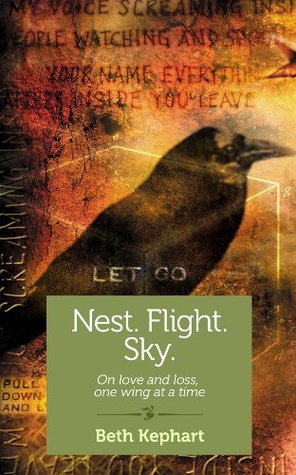
Nest. Flight. Sky.: On Love and Loss, One Wing at a Time by Beth Kephart

Source: Purchased for Kindle
eBook, about 34 pages
I am an Amazon Affiliate

Nest. Flight. Sky.: On Love and Loss, One Wing at a Time by Beth Kephart illustrates how the death of the person we’re closest to — oftentimes our mother — sends us out into the world, looking for answers or at least some hope.  Letting go is never about forgetting, while our loved ones may not physically be present any more and all we have is memory — a tricky thing indeed — we have the ability to seek out meaning and hope in the miracles around us.  Anyone who has read Kephart’s books before knows that she loves birds and what they can mean and represent in all their incarnations, but this obsession with birds clearly began with the loss of her mother.

“I work in a square room, watch the world (a garden like an archipelago, a museum of flowering trees) through two wide windows.  I work early in the day, a bare bulb turned on, and I work alone.  But in the months after my mother passed away, much too early, the finches came.  They were still wearing their winter coats.  They favored the crack of dawn.  They held themselves up with the acrobatics of their wings, touched their beaks to my wide windows, and hammered.”

Kephart ties together the memories of her mother’s accident and misdiagnosed and re-diagnosed illness — without naming it because it is unnecessary to do so — with the passionate love of birds held by Genevieve Estelle Jones and Katrina van Grouw.  Like these early scientists, Kephart is exploring the enigma of birds — not so much how they continue to fly and what their eggs and nests look like — but how those former dinosaurs continue to capture the imagination and offer solace to those not too busy to pause.

Readers could imagine glorious photos or illustrations of birds sweeping across the pages, along with Kephart’s words as she remembers the best parts of her mother and the best parts of herself.  Nest. Flight. Sky.: On Love and Loss, One Wing at a Time by Beth Kephart strives to give all those who grieve the hope that there is peace, a peace that we can live with and thrive with, as long as we remember to breathe and be alive.

***This ebook memoir was published by the new venture SheBooks, which published short ebooks for women, by women.  Check out what Beth Kephart had to say.

About the Author:

Beth Kephart is the author of 10 books, including the National Book Award finalist A Slant of Sun; the Book Sense pick Ghosts in the Garden; the autobiography of Philadelphia’s Schuylkill River, Flow; the acclaimed business fable Zenobia; and the critically acclaimed novels for young adults, Undercover and House of Dance. A third YA novel, Nothing but Ghosts, is due out in June 2009. And a fourth young adult novel, The Heart Is Not a Size, will be released in March 2010. “The Longest Distance,” a short story, appears in the May 2009 HarperTeen anthology, No Such Thing as the Real World.

Kephart is a winner of the Pennsylvania Council on the Arts fiction grant, a National Endowment for the Arts grant, a Leeway grant, a Pew Fellowships in the Arts grant, and the Speakeasy Poetry Prize, among other honors. Kephart’s essays are frequently anthologized, she has judged numerous competitions, and she has taught workshops at many institutions, to all ages. In the fall of 2009, Kephart will teach the advanced nonfiction workshop at the University of Pennsylvania.  Check out her blog.

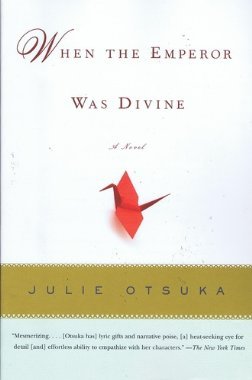
When the Emperor Was Divine by Julie Otsuka

Source: Library Sale
Paperback, 144 pages
I am an Amazon Affiliate

When the Emperor Was Divine by Julie Otsuka is set in the United States during World War II shedding light on the Topaz internment of Japanese-Americans and how it impacted them and their families.  Following an unnamed family Julie Otsuka gives readers a false sense of security, providing a false sense of distance between the reader and the family.  A powerfully short novel that raises questions about how we react out of fear or fold in on ourselves to avoid confrontation as well as fear.

“She took The Gleaners out of its frame and looked at the picture one last time.  She wondered why she had let it hang in the kitchen for so long.  It bothered her, the way those peasants were forever bent over above that endless field of wheat.  ‘Look up!’ she wanted to say to them.  ‘Look up, look up!’ The Gleaners, she decided, would have to go.  She set the picture outside with the garbage.”  (page 8)

Otsuka’s prose is simply beautiful, but filled with symbolic imagery and heartfelt emotion.  Shifting from the mother’s point of view, to the daughter’s, the son’s, and the father’s, readers are immersed in the memories and emotions of these characters so that they become real, even though they are nameless.  The daughter clearly sits between being an adolescent and a young girl, striving to remain strong for her mother and brother.  In the father’s absence, the son struggles to remember what his father looked like and how they interacted, but he’s distracted by the changes in his life from the internment camp to his sister’s behavior and his mother’s despondence.

Each family member deals with the crisis in their own way, from withdrawal and despondency to anger.  Although the last chapter is a tad long, the passionate confession from the father is well placed and sheds light on his experiences while he was away from the family.  When the Emperor Was Divine by Julie Otsuka explores life in the internment camp without the overwrought violence and horror of other novels, instead focusing on the emotional roller coaster this family experiences.

About the Author:

Julie Otsuka was born and raised in California. After studying art as an undergraduate at Yale University she pursued a career as a painter for several years before turning to fiction writing at age 30. She received her MFA from Columbia. She is a recipient of the PEN/Faulkner Award, the Asian American Literary Award, the American Library Association Alex Award, France’s Prix Femina Étranger, an Arts and Letters Award in Literature from the American Academy of Arts and Letters, a Guggenheim Fellowship, and was a finalist for the National Book Award, the Los Angeles Times Book Prize, and The International IMPAC Dublin Literary Award. Check out her Website and Facebook page.

2nd book (WWII) for the 2014 War Challenge With a Twist.


3rd book for the 2014 New Authors Reading Challenge.

Definitely Not Mr. Darcy by Karen Doornebos

Source: Purchased at Novel Places (which unfortunately had a ripped page and a ton missing) and borrowed from Anna
Paperback, 384 pages
I am an Amazon Affiliate

Definitely Not Mr. Darcy by Karen Doornebos demonstrates just how hard it would be for a modern woman to give up not only email and cellphones, but also the behavioral freedoms we take for granted in our everyday actions.  Chloe Parker’s business is nearing insolvency, and with a daughter to care for and an ex-husband with a high-powered job ready to swoop in and take over at any moment, she has little choice but to jump at the best chance she has for getting a large sum of cash quickly.  Auditioning for an Austen-inspired documentary, Chloe thinks that she’s found the perfect solution, until they call her to England to take part in not a documentary, but a reality tv show, much like The Bachelor.  The twist is that she cannot have any contact with the outside world, has to give up all modern conveniences, and live by the mores and social constructs of 1812.

“She gave up pink drinks and took up tea long ago.

Chloe Parker, even after her divorce, still dreamed of a more romantic era.  An age when a lady, in her gown and gloves, would, for sheer amusement, banter with a gentleman in his tight breeches and riding boots, smoldering in a corner of the drawing room.”  (page 1)

She finds herself in the English countryside enjoying her additional free time to draw and take up crafts she never had time for when she was caring for her daughter and running her business.  While she does worry about how her daughter is faring with her ex-husband looming in the background with his new fiancee and living with her parents, Chloe finds that she’s enjoying the step back in time.  Men were more charming and courteous, bowing and only talking to women they were introduced to, and they even catered to the women’s every comfort, even if it was mostly out of duty.  What she finds she doesn’t care for is the constraints on female behavior — the inability to apologize to men directly, to talk to men you are not formally introduced to, and to tell rivals exactly what you think of their behavior.

Definitely Not Mr. Darcy by Karen Doornebos is a novel about how we romanticize the past and put blinders on when it comes to what we think will bring us the most happiness.  It’s about seeing what is right in front of us and learning to grab onto it and hold it tight.  Chloe needs to take a chance, step outside her comfort zone, and learn to reach for the stars, even if the risk of failure is great and the adventure itself is a scary one.

About the Author:

Once an award-winning copywriter for brands such as Diet Coke and Johnnie Walker, I switched to tea with my debut novel, Definitely Not Mr. Darcy, now published in three countries. Undressing Mr. Darcy, my second novel, has garnered four stars from RT Book Reviews. I graduated with honors in English Literature from the University of Wisconsin-Madison and lived and worked in London. That inspired my books, but the reality of life in a Chicago suburb with my husband, my son, daughter, and various pets provided the opportunity to write it.  Check out her Facebook page, GoodReads page and follow her on Twitter.

Dog Songs by Mary Oliver

Source: Purchased at Novel Books
Hardcover, 144 pages
I am an Amazon Affiliate

Dog Songs by Mary Oliver is a collection of poems about her dogs and her relationship with those dogs, but it also is about the human condition and what our relationships with these animals means to us and to them.  Oliver is known as a dog lover, but she’s also known as a poet that takes the most average moments and things in life and enlarges their scope and their meaning through her poems.  While in this collection that are moments of this extrapolation — such as when Percy gazes up into her face as if she were a full moon in “The Sweetness of Dogs” or when Sammy consistently breaks free of his ropes to roam through town in “Ropes” — many more of these poems are simply homages to the dogs she has known and loved.

While this collection is not as deep as some of her other collections may be, there are moments of pure joy, deep sadness at the dog’s passing, and hilarity when dogs are being just that — dogs.  People who love dogs, and even just love animals, will enjoy these poems, nodding their heads about the truthful honesty in Oliver’s lines.  We and our dogs lean on and learn from one another, and these poems clearly illustrate those moments shared with our canine friends.  Although it is not the same many readers will expect from Oliver, readers will find some of the same universality that is found in her other poems.  In many ways, these poems are even more of the heart, more about the poet and her life, opening her up to the emotions she may not express publicly as much.

Dog Songs by Mary Oliver becomes a large ode to the symbiotic relationship we have with our dogs, a relationship that tries us and rewards us based upon how willing we are to accept it for what it is.  Beyond the freedom these dogs have to be as they are and to succumb to their own wildness, there is still that deep loyalty to their person — do not dare say owner.  There’s also a little bit of Oliver’s own opinion here, in that dogs off leashes are preferable to those constrained by them because dogs loyal to their owners merely because of the leash could be considered mere property.

About the Poet:

A private person by nature, Mary Oliver has given very few interviews over the years. Instead, she prefers to let her work speak for itself. And speak it has, for the past five decades, to countless readers. The New York Times recently acknowledged Mary Oliver as “far and away, this country’s best-selling poet.” Born in a small town in Ohio, Oliver published her first book of poetry in 1963 at the age of 28; No Voyage and Other Poems, originally printed in the UK by Dent Press, was reissued in the United States in 1965 by Houghton Mifflin. Oliver has since published many works of poetry and prose.  Visit her Website.

Book 1 for the Dive Into Poetry Reading Challenge 2014.

Christmas at the Beach by Wendy Wax

Source: Purchased for Amazon Kindle
E-Novella, 92 pages
I am an Amazon Affiliate

Christmas at the Beach by Wendy Wax is an e-novella that follows the talented women of Ten Beach Road and Ocean Beach (click for my reviews) — Madeline, Nicole, and Avery — told from the point of view of Madeline’s daughter, Kyra.  Kyra and her now one-year-old son Dustin are arriving at Ten Beach Road and Bella Flora under the close scrutiny of paparazzi.  She has little choice but to don a disguise to keep the photographers on their toes and protect her son as much as she can from Daniel Deranian’s fame and infidelity.

“The celebrity bar has dropped so low that if it were being set for a game of Limbo, that bar would be ankle-height.”

“A couple of weeks ago a crazed Daniel Deranian fan stole one of Dustin’s dirty diapers out of the trash and tried to sell it on eBay.”

Her time at Bella Flora was healing for her and her mother, as well as their new found friends who all found out they owned a piece of the rundown historic site.  Kyra is still struggling with her quasi-fame as the mother of an illegitimate Deranian child, but she still wants her own family to remain the same.  It’s unfortunate that her life plans have a way of changing on her, but she’s clearly poised to learn and grow from those changes.  Wax has created a cast of lovable characters with their own flaws, but these women are tough and ready to take on anything thrown in their way.

“What I really want is something built like a tank and with darkened windows, so that if I mow down a few photographers no one will see the satisfaction on my face,…”

Christmas at the Beach by Wendy Wax is a great novella to catch up with these women and a great set up for the next novel in the series, The House on Mermaid Point.  Kyra’s definitely got her plate full already, but when she learns what’s going on with her own family, she’s bound to feel overwhelmed.  Wax has set up readers for an eventful new novel that comes out in July 2014.

About the Author:

Award-winning author Wendy Wax has written eight novels, including Ocean Beach, Ten Beach Road, Magnolia Wednesdays, the Romance Writers of America RITA Award finalist The Accidental Bestseller, Leave It to Cleavage, Single in Suburbia and 7 Days and 7 Nights, which was honored with the Virginia Romance Writers Holt Medallion Award. Her work has sold to publishers in ten countries and to the Rhapsody Book Club, and her novel, Hostile Makeover, was excerpted in Cosmopolitan magazine.

A St. Pete Beach, Florida native, Wendy has lived in Atlanta for fifteen years. A voracious reader, her enjoyment of language and storytelling led her to study journalism at the University of Georgia. She also studied in Italy through Florida State University, is a graduate of the University of South Florida, and worked at WEDU-TV and WDAE-Radio in Tampa.

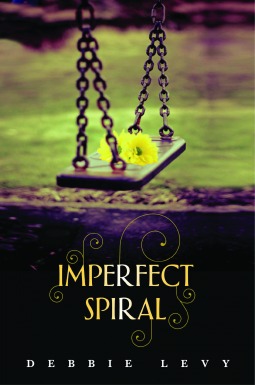
Imperfect Spiral by Debbie Levy

Source: Purchased Hooray for Books
Hardcover, 352 pages
I am an Amazon Affiliate

Imperfect Spiral by Debbie Levy is young adult novel that never speaks down to its reader as it asks questions about what it means to be a friend and what it means to be a neighbor and community member.  When tragedy strikes the fictional community of Franklin Grove in Meigs County, outside Washington, D.C., teen babysitter Danielle Snyder must cope with feelings of guilt and responsibility.  Her fear of speaking in public has haunted her long before the tragedy, but it is the loss of her friend, Humphrey, that causes her to speak out, to advocate on his behalf.  An unlikely friendship between a sophomore babysitter and a five-year-old boy blooms in the summer, but when it’s cut short, how does Danielle reconcile their unlikely connection and what has happened under her watch, especially when the small community is looking for someone to blame.

“I eat; the talk shifts to nothing in particular, which is good.  It’s as though we’re strangers sitting at the same table in one of those family-style restaurants.  We feel the need to make conversation, because that is what polite people do, but we are careful to keep the conversation safe.  Nothing to ignite sparks between Adrian and Mom.  Nothing to upset me.”  (page 4)

Her family life is not necessarily dysfunctional, but its not exactly serene when her brother Adrian is visiting after moving out.  And despite their inability to relate and emote without raising one another’s dander, the tragedy somehow brings them closer to reconciliation.  Shifting between the present after the tragedy and the past before the tragedy, Levy unfolds her story in an intricate way, allowing readers to see the whole complicated picture, even as Danielle begins to see it for the first time.  While her family dynamics play a role in the background, the real focus is on her relationship with Humphrey and the blame she lays at her own door for the tragedy.

“I rapped.  I crooned.  I rocked out.  Somehow dancing outdoors felt easier than in a school gym or hotel party room.  Plenty of space for my arms and legs.  I let myself lose control, and danced like crazy on the planet of Thrumble-Boo.

‘You look like a beautiful daddy longlegs!’ Humphrey said.”  (page 195)

Imperfect Spiral by Debbie Levy is about relationships that surprise us, about the illogical arguments of grief and assigning blame, but more than that, it’s about finding our way out of that grief to recognize the beauty in knowing and experiencing those relationships we may lose sooner than expected.  Levy’s characters are real, they’re the kids down the street searching for a sense of belonging, and they are burdened by the same emotions we all feel as adults.  It’s a highly emotional read that will leave a lasting impression.

About the Author:

Debbie Levy writes books — fiction, nonfiction, and poetry — for people of all different ages, and especially for young people. Before starting her writing career, she was a newspaper editor; before that, she was a lawyer with a Washington, D.C. law firm.  She has a bachelor’s degree in government and foreign affairs from the University of Virginia, and a law degree and master’s degree in world politics from the University of Michigan.  She lives in Maryland and spends as much time as she can kayaking and otherwise messing around in the Chesapeake Bay region.  Visit her Website, Facebook, and Twitter.

Leviathan by Scott Westerfeld

Source: Purchased
Paperback, 440 pages
I am an Amazon Affiliate

Leviathan by Scott Westerfeld — our October book club selection — is a steampunk novel set during the onset of WWI.  Alek is whisked away in the middle of the night by his two teachers on a midnight run with one of their Austrian walkers, which they claim is practice for the coming battles.  Meanwhile, in England, Deryn is hoping to join the British military service as a boy even though she has very feminine features and is very light compared to other boys in their young teens who are signing up.  There is fact mixed with fiction, creating a fanciful landscape of genetically engineered animal ships and weapons alongside the mechanized beasts of gears and metal.  Alek is learning to run the walker at night, while Deryn is learning the ropes as a midshipman.  While things take a turn for the worse for both of these young people, both find their gumption to push through and find solutions, though not always the best or most satisfying.

When the story lines converge, it’s interesting to see how Deryn reacts to Alek’s self-importance and how timid Alek becomes in the presence of a science he’s only read about and never come in contact with.  Westerfeld has melded these modern ideas with the past in a way that makes the world he’s created seem like an alternate to the real past.  While the characters are coming of age in the time of war, there is still an innocence about this boy and girl that clings to them, and it’s clear that neither of them truly has a sense of fear when it comes to war — perhaps because of their sheltered lives and that the war they’ve encountered thus far has been minimal.  Both seem to believe that they are invincible, throwing themselves blindly into action.

The subordinate characters are not as well developed, except for Dr. Barlow who is a Darwinist engaged in the science of weaving together living beings.  The interplay between Barlow and the young teens is fun at times, but also enigmatic as each is hiding secrets from and about each other.  Count Volger is an interesting caricature who shines the most in his one-on-one fencing session with Alek.  The real stars of the novel are the Clankers’ machines and the beasts created by the Darwinists.  Westerfeld does weave in some facts, but it’s unlikely that younger readers would see which is fact versus which is fiction without reading the Afterword.  Leviathan by Scott Westerfeld is an adventure that young adults will enjoy for its fast-paced action and teenage bantering.

What the Book Club Thought:

Most of the book club enjoyed the book and seemed to prefer Deryn’s character more at first than Alek, but the ways in which the stories converged was well done.  One member even indicated they would give it five stars because they couldn’t see how Westerfeld could have made it better, at least in structure.  Most of the club said they would be interested in reading the second part of the series.  The mixing of the facts with the fanciful seemed to work with everyone in the book club, though two members had not finished reading at the time of the meeting.  The machines versus the genetically engineered beasts was an interesting angle, but the way in which the story is told demonstrated both sides so well that it enabled readers to see both sides of the story, rather than just see one as the enemy of the other.  This book was well balanced, adventurous, and touched on WWI, though a modified version of it.  Westerfeld also includes notes in the back about what facts were changed and which were maintained, which we felt was a good addition for those not as familiar with the time period.

About the Author:

Scott Westerfeld’s teen novels include the Uglies series, the Midnighters trilogy, The Last Days, an ALA Best Book for Young Adults and the sequel to Peeps. Scott was born in Texas, and alternates summers between Sydney, Australia, and New York City.


This is my 72nd book for the 2013 New Authors Challenge.

Solving the World’s Problems by Robert Lee Brewer

I use Grammarly’s plagiarism checker because it works! Have you tried it?

Source: Purchased
Paperback, 92 pages
I am an Amazon Affiliate

Solving the World’s Problems by Robert Lee Brewer is the debut collection of a poet who has spurred inspiration virtually for many years as part of the Writer’s Digest team, and as a debut, it oozes deconstruction, construction, and reflection in each poem’s white spaces in ways that are thought-provoking and eye-opening.  There are love poems, break-up poems, and get back together poems, but the overwhelming theme seems to be that love is the great connector of us all — no matter how successful the relationships ultimately are — and the poet seems to postulate that love can “solve the world’s problems.”  While some of these poems have a pessimistic hint in them, they are balanced with a certain amount of light.

From "Matters of Great Importance" (page xv-xvi)

poets consider which chair
                is going to inspire them
                                  to write the poem

that inspires other people
                  to build chairs and
                                    drive trucks and write poems

Within each poem there is an expansion, an expanse left open for the reader to explore and think about on their own.  While these poems cover well-worn territory at times, each line break and word choice makes them crisp, inspiring the reader to look at the subject anew.  In “worried about ourselves,” the narrator talks of how the moon was once something godly and now is just a chunk of rock floating in space, but toward the latter half of the poem, the new perception is turned on the reader, examining the never-ending analysis of ourselves to the point we begin to believe our own perceptions about reality are true, even when they are not.  Some of the best lines are the simplest, like in “I think the world is a pin cushion” (page 48):

there's a space between everyday matters
that makes someone feel every day matters

But there are more serious moments, moments in which social issues are addressed, such as global warming in “one day we looked for the snow” (page 49) and living in a fast-paced modern world where appearances matter and wars are inevitable — “why I never mention the traffic report” (page 52).  But more interestingly, there is an exploration of the modern world and the perceived increase in connection between humans, but the reality is that we seek these outlets to distance ourselves from one another — walking out the door has never been easier when face-to-face takes a back seat.

Solving the World’s Problems by Robert Lee Brewer is a chance to find ourselves reflected in ourselves and the world around us.  From “the noises that scare us” (page 30):

to uncover and hope no shots are fired
we're not here to find something new        we want
reminded of who we were when the birds

first spoke  our wings dissolve as we age   and

About the Author:

Robert Lee Brewer is Senior Content Editor for the Writer’s Digest Writing Community. He edits books, manages websites, creates electronic newsletters, crafts blog posts, writes magazine articles, participates in online education, and speaks nationally on writing and publishing topics. As a poet, Robert was named Poet Laureate of the Blogosphere in 2010, has been a featured reader at several poetry events around the country, and is the author of Solving the World’s Problems (Press 53). Follow him on Twitter @robertleebrewer.

This is my 63rd book for the 2013 New Authors Challenge.


This is my 26th book for the Dive Into Poetry Challenge 2013.