Quantcast

Mr. Darcy’s Refuge: A Pride & Prejudice Variation by Abigail Reynolds (audio)

Source: Purchased
Audible, 9+ hrs
I am an Amazon Affiliate

Mr. Darcy’s Refuge: A Pride & Prejudice Variation by Abigail Reynolds, narrated by Pearl Hewitt, is a variation that begins in a flood — a flood of the river near Hunsford during the disastrous proposal of Mr. Darcy and a flood of emotion.  Thankfully, Darcy’s proposal is interrupted by the villagers who seek refuge at the house and in the nearby barn, requiring Darcy to focus his energies on those he deems it his duty to protect and care for, including Miss Elizabeth Bennet, who happened to be at Hunsford because of a headache.  Reynolds carries the characteristic banter and misunderstandings through this variation, but given the current situation, Miss Bennet may be viewed as compromised unless Darcy marries her.

An entertaining variation, but it could be viewed coolly by some readers who prefer certain characters to remain as they view them in Austen’s original work.  Mr. Bennet, for example, is not his laid back, mocking self so much as an ogre spurred by adolescent grudges from his own past, and Colonel Fitzwilliam, who is jovial, seems a bit less enamored with Miss Bennet than readers may expect.  Despite these character changes, the kernel of Austen’s characters remains beneath the surface.  Readers, however, will most likely object to Jane Bennet’s new perspective and on Bingley’s less than amiable nature.  Of all the variations available, Reynolds is testing her readership’s preconceptions and she’s forcing them to consider something very new.

The narrator does a commendable job, but at the beginning, I was less-than-impressed by her voice for Mr. Darcy — he sounded very angry all of the time, but that tapered off about halfway through.  Her narration of the other characters was wonderfully done, though Charlotte sounded very high-pitched and very similar to the young girl rescued during the flood.

Mr. Darcy’s Refuge: A Pride & Prejudice Variation by Abigail Reynolds, narrated by Pearl Hewitt, will test readers’ notions about Austen’s characters.  Most of the plot centers on Darcy and Elizabeth, as readers would expect, but the subplots — especially those involving Jane, Bingley, and the Colonel — seemed rushed and under-developed.  This was a satisfying listen over a few days in the summer heat, but this reader wanted more from the secondary characters and the bit about the rescued girl seemed very rushed.

RATING: Tercet

Other Reviews:

About the Author:

Abigail Reynolds has spent the last fifty years asking herself what she wants to be when she grows up. This month she is a writer, a mother and a physician in a part-time private practice. Next month is anybody’s guess. Originally from upstate New York, she indecisively studied Russian, theater, and marine biology before deciding to attend medical school, a choice which allowed her to avoid any decisions at all for four years.

She began writing Pride & Prejudice variations in 2001 to spend more time with her very favorite characters. Encouragement from fellow Austen fans convinced her to continue asking ‘What if…?’, which led to seven other Pemberley Variations and two modern novels set on Cape Cod.

The Raven King by Maggie Stiefvater (audio)

Source: Purchased
Audible, 11+ hrs.
I am an Amazon Affiliate

The Raven King by Maggie Stiefvater, narrated by Will Patton, is the fourth installment in the Raven Boys series of books, and it is a looped and twisted journey that could have readers wondering how much time has folded over onto itself.

***Read this series in order. SPOILERS below***

Stiefvater packs this installment with revelations about Blue Sargent, who is from a family of psychics and who has been told most of her life that her kiss will cause the death of her true love. Noah, Adam, Ronan, and Gansey have become a family throughout the trials of the Raven Cycle, and this tight-knit group learns to make room not only for Blue but also Henry.  They know that Gansey is fated to die and that Blue’s kiss will lead to that death, but they continue to make plans and find a way to prevent that from happening.  Amidst these plans, these young people are falling in love and tentatively walking on egg shells around one another until they can bear it no longer.  Stiefvater does a fantastic job of depicting young, tentative love.

Patton as always is a terrific narrator, and readers will never be lost as to which character is speaking and to whom. His acting skills come alive with Stiefvater’s prose, and he breathes life into the swirling magic that surrounds these characters, much of it wrapped up in the dream-forest called Cabeswater.

The Raven King by Maggie Stiefvater, narrated by Will Patton, is a wonderful conclusion to the series, but there is enough of an opening that should she choose, Stiefvater could return to these characters or even just some of them to begin new adventures in magic.

RATING: Quatrain

Other Reviews:

About the Author:

New York Times bestselling author of The Shiver Trilogy, The Raven Cycle, and The Scorpio Races. Artist. Driver of things with wheels. Avid reader. All of Maggie Stiefvater’s life decisions have been based around her inability to be gainfully employed. Talking to yourself, staring into space, and coming to work in your pajamas are frowned upon when you’re a waitress, calligraphy instructor, or technical editor (all of which she’s tried), but are highly prized traits in novelists and artists. She’s made her living as one or the other since she was 22. She now lives an eccentric life in the middle of nowhere, Virginia.

Stiff: The Curious Lives of Human Cadavers by Mary Roach

Source: Purchased
Paperback, 320 pgs.
I am an Amazon Affiliate

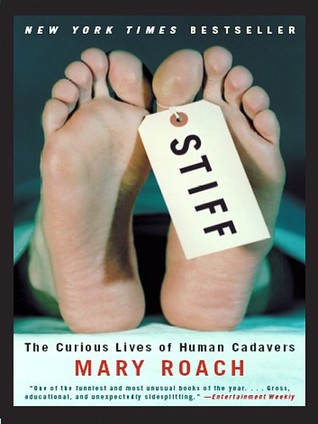
Stiff: The Curious Lives of Human Cadavers by Mary Roach, the May book club selection, is not for the faint of heart, as Roach discusses some of the most gruesome experiments and studies in science that involve cadavers.  However, she does pepper her examination of these curious lives with humor that helps to break up the grosser aspects of the book.

“The way I see it, being dead is not terribly far off from being on a cruise ship.  Most of your time is spent lying on your back.  The brain has shut down.  The flesh begins to soften.  Nothing much new happens, and nothing is expected of you.”  (pg. 9)

Through her — what some would call — irreverent humor, Roach explores the role that cadavers have played not only in scientific and medicinal research, but also in auto safety and military ballistics.  Readers may find they need to take breaks from reading as Roach gets very detailed, but others may find that reading straight through is made easier by her asides and funny anecdotes.  Even the people she talks to have to have a sense of humor so they can disconnect from the sadness of lost life, like one surgical student who said she didn’t have a problem working on heads, but she did find it uncomfortable to work on hands because they hold you back.

Stiff: The Curious Lives of Human Cadavers by Mary Roach is a sensational look at the role of cadavers in modern society and in our past, and is often the case, cadavers are not given their due.  These cadavers, which were mostly donated, have given us insight into the human systems, the impacts the body can sustain before dying, and some of the wacky theories that scientists and doctors had about severed head reanimation and more.

RATING: Quatrain

About the Author:

Mary Roach is the author of the New York Times bestsellers STIFF: The Curious Lives of Human Cadavers; GULP: Adventures on the Alimentary Canal, PACKING FOR MARS: The Curious Science of Life in the Void; and BONK: The Curious Coupling of Science and Sex.

Her most recent book, GRUNT: The Curious Science of Humans at War, is out in June 2016.

Mary has written for National Geographic, Wired, Discover, New Scientist, the Journal of Clinical Anatomy, and Outside, among others. She serves as a member of the Mars Institute’s Advisory Board and the Usage Panel of American Heritage Dictionary. Her 2009 TED talk made the organization’s 2011 Twenty Most-Watched To Date list. She was the guest editor of the 2011 Best American Science and Nature Writing, a finalist for the 2014 Royal Society Winton Prize, and a winner of the American Engineering Societies’ Engineering Journalism Award, in a category for which, let’s be honest, she was the sole entrant.

What the Book Club Thought:

Most of us enjoyed the book and its curiosities.  I have no idea why this book sat so long on my bookshelf unread.  A couple others were a bit put off by the author’s tangents, but they also read the book in a once-through fashion.  As I read it in spurts, I didn’t find the tangents to be that off-putting.  One member expressed that the book could have been improved by some editing to make it less wordy and more like the author’s published newspaper/magazine articles.  Mostly, the members found the subject matter fascinating, though one member did mention that the part about animals seemed a little out of place.  Overall, it seemed as though everyone enjoyed this book club selection.

John Dies @ the End by David Wong

Source: Public Library and Audible
Hardcover, 362 pgs.
I am an Amazon Affiliate

John Dies @ the End by David Wong, which was our April book club selection, is like falling off the frame and into a Salvador Dalí surrealist painting and its topsy-turvy world where very little makes sense and there is no straight path to some kind of satisfactory resolution.

Wong is a long-time editor at Cracked.com, which from what I gather is a humor website, and Wong is really a pen name.  So should you take anything in his novel seriously, even if it is considered in the horror genre?  My answer would be no.

In this novel, the soy sauce is a drug that enables John and David to see ghosts, demons, and other underworld-like things, and these unsuspecting and slacker heroes are less-than-motivated to take action, unless they have to.  Our unreliable narrator, David Wong, is socially inept and ogles women everywhere he goes, but readers are not even sure if he is David or John or someone else because the names of been changed.  In B-horror movie fashion, plots are introduced, left hanging, and reworked into even more ridiculous adventures.

“‘I call it Dante’s Syndrome,’ John said.  I had never heard him call it any such thing. ‘Meaning, I think Dave and I gained the ability to peer into Hell. Only it turns out Hell is right here, it’s all through us and around us and in us like the microbes that swarm through your lungs and guts and veins. Hey, look! An owl!'” (pg. 7)

“‘But I can bless water to make it holy. The ice statue, I mean.’
John’s face brightened and he said, ‘That’s perfect!’ He thrust his index finger into the air. ‘We bless the ice, then we just have to somehow get all hundred or so of those monsters to lick the statue!'” (130 pgs.)

These examples should provide you with the humor in this book, but some of this just seemed inserted for humor’s sake and did little to add to the story.  My final impression of John Dies @ the End by David Wong — the narrator for Audible was Stephen R. Thorne — is one of being overwhelmed by the descriptive info-dumps and the absurdity.  Because of the overwhelming and topsy-turvy nature of the narrative, this one did not work well on audio at all, leaving me lost most of the time, which is why I switched to the book.

RATING: Couplet

What the book club thought:

Sounded like most everyone thought the book was OK, but was not overly excited about the book. One member who said they were not sad to have read the book, said that they were not interested in reading any of the sequels. Another member said that the book was humorous, but most members said that the book had a plot that went nowhere and where there were no consequences for anything that happened.

Yellow Brick War by Danielle Paige (audio)

Source: Purchased
Audible, 8+ hours
I am an Amazon Affiliate

Yellow Brick War by Danielle Paige, narrated by Devon Sorvari, is the third part of this young adult series in an alternative world to the one we grew up with in Oz. This is a series that would be hard to follow without having read the first two books in the series — Dorothy Must Die and The Wicked Will Rise.

Amy Gumm finds herself back in Kansas, but she’s not alone.  The Wicked are with her as well, and she must find something to help get them back to Oz before Dorothy destroys everything.  This is Amy’s worst nightmare — returning to high school where she’s picked on by her peers and her mother is too drunk to even care where she is or if her homework is finished.  However, the witches show her that things have changed since her disappearance, and her mother is now sober and her former bullies are nicer now that they’ve been ostracized.

In this installment, the action is much slower as Amy reunites with her mother and the peers that once tortured her.  She feels just as out of place here as she did in Oz, but at least in Oz she could use magic and had a purpose.  She meets up with the former quarterback and his former girlfriend — Amy’s nemesis — and they strive to uncover the truth about the real Dorothy from Kansas.  It’s clear that Dorothy’s story was real and that no one believed her, but there is something magic still hidden in Kansas, and Amy must find it.

Yellow Brick War by Danielle Paige, narrated by Devon Sorvari, is a unique retelling of the Oz story, and readers will enjoy the characters and plot twists.  However, the dangling cliffhanger means there is sure to be another book in this series.  When the action abruptly ends, readers can be frustrated, especially in the case here where there is a big question mark over everyone’s fate.

Rating: Tercet

About the Author:

Danielle Paige is a graduate of Columbia University and the author of Dorothy Must Die and its digital prequel novellas, No Place Like Oz and The Witch Must Burn. Before turning to young adult literature, she worked in the television industry, where she received a Writers Guild of America Award and was nominated for several Daytime Emmys. She currently lives in New York City.

This Is the Story of You by Beth Kephart

Source: Purchased
Hardcover, 264 pgs.
I am an Amazon Affiliate

This Is the Story of You by Beth Kephart has the slow build-up of a weather front across thousands of miles of ocean, and when it hits, you are still unprepared because you’re in denial that you’ll be blown away and that your life could be upended by one wisp of wind, let alone a hurricane.  Invincibility is something many of us have in common at one point or another in our lives, whether it is in our teen years or later in life.  Eventually, that illusion is shattered — by a death in the family, a near miss, an unexpected circumstance.

Mira Banul and her friends are from those families that live on Haven year-round, and they are not like the tourists who visit for the beach and sun in the summer months.  Although their livelihoods can be dependent upon those summer tourists, their lives are more than just them.  Mira is an observer, while her friends Deni and Eva are the fixer and optimist, respectively.  Their personalities are big on the page as Kephart fully fleshes out these young ladies in description and in terms of their passions and quirks.  Mira and her skates, Deni and her aviators (“walked around with two pools of reflected sky on her head”), and Eva and her stories about lost civilizations.

“‘Weather’s bigger than the rest of us.’
‘I wanted to stop it.’
‘No, Deni.  All of us. None of us could stop it.'” (pg. 145)

As graduation nears for these ladies, it is hard for them to see past the current moment or the current projects.  When Shift comes to town and breaks up their merry threesome, Mira and Deni are left wondering what the draw is to this mysterious boy who comes to Haven in the middle of the school year.  Has Eva allowed herself to fall head-over-heels as she has done in the past, or is she merely being overly generous to the new kid in town?  Deni wants to protect her, Mira wants to see how it all shakes out.  In the background another storm is brewing, as nature decides its time to shake the trees.

If you’ve read other books by Kephart, you’ll see the birds in the trees and skies, and you may even perceive a nod to her previous work (at least, I thought of the one where the Schuylkill River is personified when Mira and her classmates talk about their Project Flows — or perhaps I read too many Kephart books, though I doubt that).  Her prose is poetic and requires attention, but it is worth the extra time, falling into the worlds she creates and the realistic characters she crafts, though I suspect they guide her hand.

This Is the Story of You by Beth Kephart will astonish you with the resilience of young people, their drive to make things right, and their ability to withstand more than expected, but it is in the final pages that the true mystery is resolved.  I will say this, I’m not often surprised by book endings or mysteries, but Kephart exceeded my detective skills for the first time in a long while.  (I had suspicions, but not a fully formed conclusion.)  Readers who love to immerse themselves in realistic places and explore humanity won’t be disappointed.  Kephart is a talent at creating places that come alive and characters that grab hold of us emotionally.

**You’ve probably already suspected this is a contender for the best of 2016 list at the end of the year!**

RATING: Cinquain

About the Author:

Following the publication of five memoirs and FLOW, the autobiography of Philadelphia’s Schuylkill River, I’ve had the great pleasure of turning my attention to young adult fiction. UNDERCOVER and HOUSE OF DANCE were both named a best of the year by Kirkus and Bank Street. NOTHING BUT GHOSTS, A HEART IS NOT A SIZE, and DANGEROUS NEIGHBORS were critically acclaimed. In October YOU ARE MY ONLY will be released by Egmont USA. Next summer, Philomel will release SMALL DAMAGES. I am at work on a prequel to DANGEROUS NEIGHBORS, a novel for adults, and a memoir about teaching.

Other Books Reviewed:

The Seven Ages by Louise Glück

Source: Purchased
Paperback, 80 pgs.
I am an Amazon Affiliate

The Seven Ages by Louise Glück is a book about transformation and, by extension, aging and death — the battle between faith and the fear of mortality.  The title opens with a cryptic tale of a human who arrives on Earth even before the Garden of Eden, when it is just dust.  The narrator loves it all the same, even in its barrenness, but like many humans she wants to possess it.  How do you hold onto something that changes and is going to continue changing? The short answer is: you can’t.  Except maybe in a dream but even memories change.

Throughout the book, Glück touches, tastes, and experiences a variety of things, but in “The Sensual World,” she says, “I caution you as I was never cautioned:// you will never let go, you will never be satiated./You will be damaged and scarred, you will continue to hunger.//” (pg. 7)  We have entered that garden and we have tasted the forbidden fruits, and even as we are punished, we still want more.  We cannot get enough sensory input, which leads to emotional attachments that continue even as we age, even if they are not acted upon.

In “Birthday,” the narrator remembers “that age. Riddled with self-doubt, self-loathing,/and at the same time suffused/with contempt for the communal, the ordinary;…” (pg. 20) The narrator is on the outside at this party, watching those who are wrapped up in making friends and making connections, but also vividly aware of the solitary member who prefers their own counsel.  Here again, the narrator cautions that in silence it is difficult to “test one’s ideas.  Because they are not ideas, they are the truth.//”  She speaks of this again in “From a Journal”: “how ignorant we all are most of the time,/seeing things/only from one vantage, like a sniper.//” (pg. 25)

Once we come away from ourselves and view the world differently, usually after years of a narrow focus, we come to realize that we want more time.  We want “to extend those days, to be inseparable from them./ So that a few hours could take up a lifetime.//” (“The Destination”, pg. 28)  The Seven Ages by Louise Glück is an exploration of aging through the lens of an observer, someone who has experienced life and who has separated herself from it when necessary.  Things we see are not as we expect, things we obtain do not satiate our appetites, and in our haste to achieve things, we break them.  Human frailty cannot be escaped, and we cannot return to our youth.  Glück attests to these stages and says that appreciating what has come before is hard, especially when we are hungry for more and have run out of time.

Rating: Quatrain

About the Poet:

Louise Glück was born in New York City of Hungarian Jewish heritage and grew up on Long Island. Glück attended Sarah Lawrence College and later Columbia University.

She is the author of twelve books of poetry, including: “A Village Life” (2009); Averno (2006), which was a finalist for The National Book Award; The Seven Ages (2001); Vita Nova (1999), which was awarded The New Yorker’s Book Award in Poetry; Meadowlands (1996); The Wild Iris (1992), which received the Pulitzer Prize and the Poetry Society of America’s William Carlos Williams Award; Ararat (1990), which received the Library of Congress’s Rebekah Johnson Bobbitt National Prize for Poetry. Louise Glück has also published a collection of essays, Proofs and Theories: Essays on Poetry (1994), which won the PEN/Martha Albrand Award for First Nonfiction.

Field Work by Seamus Heaney

Source: Purchased
Paperback, 80 pgs.
I am an Amazon Affiliate

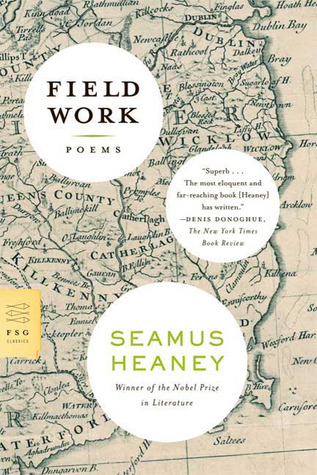
Field Work by Seamus Heaney is a collection of poems that follow his removal from Belfast, Ireland, to the country south of Dublin in the County Wicklow.  It’s clear that even as his family has been away from the troubles in Northern Ireland, they are still foremost in his mind and poems.  Some of these poems are elegies to the friends and family he has lost along the way, but these poems are less focused on the political and more focused on his internal, emotional struggle with the issues in Ireland.  In “Oysters,” the narrator talks of himself as an estuary in which the oysters atop, and as he tastes the saltiness he recognizes that the oysters are “alive and violated.”  As the poem evolves, it is clear that the oysters are Ireland, split in two — ripped apart violently.  As the narrator eats, he recognizes that he must be deliberate in his actions or he will be forced into action, actions that could be reckless.

In “Casualty,” the narrator wants to supply a full picture of the Irish struggle — a man sits at a bar and continues to drink from the high shelf and he’s a “dole-breadwinner.”  But soon we see him through the eyes of the narrator, a man with a quick, observant eye.  His death is swift and among the other 12 in a Derry blast, in which “Everybody held/his breath and trembled.”  A man that questioned and raised concerns, simply swept away by a random decision to enter an bar that was not his usual.  How many times can we say we have deviated from our routines and how soon before we find ourselves the next casualty of a decision we had no idea was bad.

The downtrodden, the working class, and others are here between these pages.  “The gunwale’s lifting ear –/trusting the gift,/risking gift’s undertow–/is unmanned now//” (“In Memoriam Sean O’Riada”)  In a nod to Yeats, Heaney examines what the artist and musician means to him, but cautions that he is not the same as the fisherman that Yeats held in esteem.  There are several references and allusions to Yeats in this collection.

However, one of the best rendered sections may be the “Glanmore Sonnets” where Heaney turns his keen eye to the country around him.  Here he demonstrates his love for the people in the country and their welcoming nature, though his thoughts do turn to other times, especially during a “first night … in that hotel … ”

X

I dreamt we slept in a moss in Donegal
On turf banks under blankets, with our faces
Exposed all night in a wetting drizzle,
Pallid as the dripping sapling birches.
Lorenzo and Jessica in a cold climate.
Diarmuid and Grainne waiting to be found.
Darkly asperged and censed, we were laid out
Like breathing effigies on a raised ground.
And in that dream I dreamt -- how like you this? --
Our first night years ago in that hotel
When you came with your deliberate kiss
To raise us towards the lovely and painful
Covenants of flesh; our separateness;
The respite in our dewy dreaming faces.

There is a dream-like quality to many of these poems, as Heaney meditates on the past and the present issues facing Ireland. The narrator says in “High Summer,” “On the last day, when I was clearing up,/on a warm ledge I found a bag of maggots/and opened it. A black/and throbbing swarm came riddling out/life newsreel of a police force run amok,/sunspotting flies in gauzy meaty flight,/the barristers and black berets of light.//” It’s clear that the struggles are ever-present, even in the country, and there is no escaping their dark shadows even in Field Work by Seamus Heaney.

About the Poet:

Seamus Heaney was an Irish poet, writer and lecturer from County Derry, Ireland. He was awarded the Nobel Prize in Literature in 1995, “for works of lyrical beauty and ethical depth, which exalt everyday miracles and the living past.”

The Wicked Will Rise by Danielle Paige (audio)

Source: Purchased
Audiobook, 9+ hours
I am an Amazon Affiliate

The Wicked Will Rise by Danielle Paige, narrated by Devon Sorvari, is book two of a series, and this is a series you’ll want to read in order. (check out my review of Dorothy Must Die)

Amy Gumm is battered and bruised and concerned about The Revolutionary Order of the Wicked, particularly about the safety of Nox, a brooding young warlock. Even though she’s failed in her mission to kill Dorothy, she is determined to complete her collection of the objects controlling the Scarecrow, Tin Man, and Cowardly Lion.

She’s still unsure who she should trust in the world of Oz, a place that’s full of fluctuating magic.  Left on her own, she finds herself face-to-face with distrustful wingless monkeys who refuse to get involved in the war against Dorothy.  She has little choice but to strike out on her own and find Nox and figure out how best to take care of Dorothy and the evil powers that rule the Emerald City.  As she enters the land of forgetfulness and digs deep to find her true self, she must struggle to keep the dark magic at bay.

Unlike the previous installment, Paige has created a very fast-paced book that provides the right balance between backstory and action, as well as character development and description.  Amy is the main focus, and as she comes into her own, readers will cheer her on, even when she’s making decisions that may not have the best outcome.  Readers will want to root for her.  Even as she still has doubts about her abilities and her role in the war, she’s coming to terms with her place in it and she’s taking action.

The Wicked Will Rise by Danielle Paige, narrated by Devon Sorvar, does end on a cliffhanger of sorts, but readers won’t mind since they’ll be even more invested in Amy’s story by the end of this second book.

Rating: Quatrain

About the Author:

Danielle Paige is a graduate of Columbia University and the author of Dorothy Must Die and its digital prequel novellas, No Place Like Oz and The Witch Must Burn. Before turning to young adult literature, she worked in the television industry, where she received a Writers Guild of America Award and was nominated for several Daytime Emmys. She currently lives in New York City.

Alone with Mr. Darcy: A Pride & Prejudice Variation by Abigail Reynolds (audio)

Source: Audible
Audiobook: 9+ hours
I am an Amazon Affiliate

Alone with Mr. Darcy: A Pride & Prejudice Variation by Abigail Reynolds, narrated by Elizabeth Klett, is swoon-worthy.  Mr. Darcy is in a dire struggle with his emotions for Elizabeth Bennet, and even as he has resolved to not act on those feelings, fate steps in and changes his course.  Elizabeth happens upon him in a blizzard, and she cannot in good conscience leave him on the roadside to perish.  Alone with Mr. Darcy is the last place she wants to be given his perplexing manner and his pride, but she has little choice as the snow gets deeper and deeper.  As the snow levels on the ground rise, Lizzy finds herself in deeper than she ever expected where it concerns Mr. Darcy, who is injured and confused.  Despite the damage to her reputation, she remains with him for several days in a secluded cabin, with little to keep them apart.

Klett does a commendable job voicing all of the female and male characters, each of them easily discernible.  She’s got the accents right and the attitudes correct for each character.  Her rendition of the banter between Lizzy, Darcy, Richard, Charlotte, and Darcy’s steward will have readers laughing at the absurdity of it all, especially regarding all of Darcy’s well thought out plans without his own knowledge.  Reynolds understands that there is a need not only for social observation in a Pride & Prejudice variation but also witty banter.

Alone with Mr. Darcy: A Pride & Prejudice Variation by Abigail Reynolds, narrated by Elizabeth Klett, is a nice re-imagining in which Lizzy and Darcy not only prevent themselves from giving in to their feelings, but the best intentions of family and friends end up throwing more obstacles in their way.  Reynolds has created another charming variation of these beloved characters.

Rating: Quatrain

Other Reviews:

About the Author:

Abigail Reynolds has spent the last fifty years asking herself what she wants to be when she grows up. This month she is a writer, a mother and a physician in a part-time private practice. Next month is anybody’s guess. Originally from upstate New York, she indecisively studied Russian, theater, and marine biology before deciding to attend medical school, a choice which allowed her to avoid any decisions at all for four years.

She began writing Pride & Prejudice variations in 2001 to spend more time with her very favorite characters. Encouragement from fellow Austen fans convinced her to continue asking ‘What if…?’, which led to seven other Pemberley Variations and two modern novels set on Cape Cod.

Buddha in a Birdcage and Other Poems by Betty Oliver

Source: Purchased
Paperback, 64 pgs.
I am an Amazon Affiliate

Buddha in a Birdcage and Other Poems by Betty Oliver is a collection of poems and photos of her mixed media art, which was published posthumously by the Haystack Mountain School of Crafts where she once taught.  The executor of her estate Billy Bernstein indicated that she performed her poems, sometimes “fighting her way out of a giant paper bag.”  In the Foreword, Stuart Kestenbaum says, “Reading these poems you may not be able to see Betty fighting her way out to begin to speak, but you will feel the power — and the need to speak — that she brought to this work.” (pg. 1) In many cases, this is true. You can imagine her up on a stage struggling through a paper bag, trying to get those words out. Some of these poems have lines that repeat, and it is almost like there is so much passion behind them that the voice of the poem stutters.

Untitled (pg. 11)

The bear’s purple gutted chest
gave off steam suggesting life
he looked stunned not dead
the men still high from his blood
pranced and preened by the pick up truck
I went closer to look
the heat from his cooling heart
met my gaze.

Her artwork often involves the use of paper in unusual ways, and like her art, these poems are unusual. Her verse is at times playful, but also stern in its criticism of how the world operates or is expected to operate. She’s interested in providing readers with a new perspective on the ordinary, and she holds nature as sacred and tangible. Living on a dairy farm, she had a very close knowledge of milking cows, and what jobs men were expected to do every day. In “Fenceposts,” she talks about how men use posthole diggers and women do not, and how in her family, she has held onto her father’s posthole digger as her mother held onto her father’s twenty-two pistol.

From her time on a dairy farm to her moments in New York City, Oliver’s poems are moments in time that recall things from her past and remind her about the ephemeral nature life, especially when she falls ill. Buddha in a Birdcage and Other Poems by Betty Oliver offers readers just a little of Oliver’s work, and what’s here can seem unfinished at times, but overall, her work is about our moments in time and the thought we do or don’t give them as we live them.

Rating: Tercet

About the Poet:

Betty was truly a multi-media artist. Her visual art was focused on sculpture incorporating paper, paper pulp, and found objects. Though born, raised and perhaps haunted by her childhood in Eastern Virginia, she eventually elected to make New York her home, establishing a home and studio in upper Manhattan and channeling the vibrant texture and rhythms of the city and her neighborhood into her life and work. In a sense, the city became her pallet. She incorporated all manner of discarded and found objects into her art. Old phone books, calendars, Chinatown boxes, newspapers and jigsaw puzzles all were processed into her creative output of sculpture, paintings and photos.

Around 1990 she began to write and perform poetry, and created a powerful body of written work. As a poet, Betty was an engaging and compelling performer, often beginning readings by fighting her way out of a giant paper bag. As in her visual work, her writing echoes the many voices of her experience. A scream from the sidewalk on 110th Street, an impassioned plea to a lover, a strident declaration from the pulpit all resonate with truth, soul, and authenticity.

Betty was a very effective and sought after teacher and led many classes and workshops primarily at Penland School of Craft in the mountains of North Carolina, and Haystack Mountain School of Craft on the Maine coast. The book will be marketed by these schools and any profits will be given to the scholarship funds of these two schools.


The Girl on the Train by Paula Hawkins (audio)

Source: Audible
Audiobook, 11 hrs.
I am an Amazon Affiliate

The Girl on the Train by Paula Hawkins — narrated by Clare Corbett, Louise Brealey, and India Fisher — is a mystery in which a woman with low self-esteem, who is an alcoholic, continues to stalk her ex-husband, mostly at a distance.  Rachel Watson’s divorce and drinking caused her to lose her job, but she still wakes up like clockwork to take the train into London so her roommate is unaware that she’s lost her job. She has some money saved, and even though she could be moving on with her life and getting a new job, she wallows in her sorrow at the bottom of a bottle, creating perfect, imaginary lives for the people she sees out the train windows.

Jason and Jess become a couple that she can imagine lives in marital bliss, but in reality, Megan and Scott Hipwell have a marriage that has lost its appeal, at least for Megan. She desires something more than what she has with Scott, who she fails to see as controlling even as he goes through her emails on a regular basis.  She wants her life to be more than just sitting at home waiting for her husband to come home.  Like Rachel, she is dissatisfied with what her life has become.

Rachel, meanwhile, is on the outside of her ex-husband’s life with his new wife and daughter, who continue to live in the house she and he used to live in, and she’s on the outside of the world looking in, much like she’s staring out the train windows.  She’s searching for something, she needs to belong to something, but what she ends up entangling herself in is something that could lead to her own death.  Meanwhile, her ex-husband’s new wife Anna is terrified of Rachel, worried that her stalking will turn to something more.

Listening to the audio was never boring and the different narrators helped when Hawkin’s story changed points of view.  Moreover, the narrator for Rachel really put you in the mindset of a broken woman who was down on herself, blamed herself, and was unable to break out of her self-destructive cycle of drinking and blacking out.  Hawkins’ The Girl on the Train is a twisted tale of the suburban lives we often perceive as idyllic, and the lives we believe we have but actually do not.  How well do we know our spouses, their experiences, their families, and how well do they know us?  Many of us have inner demons or secrets we would rather not face, so we lie about them to ourselves and those we love.

Rating: Quatrain

About the Author:

Paula Hawkins worked as a journalist for fifteen years before turning her hand to fiction. Born and brought up in Zimbabwe, Paula moved to London in 1989 and has lived there ever since. The Girl on the Train is her first thriller.