Quantcast

Fallen Angels by Walter Dean Myers

Fallen Angels by Walter Dean Myers is a young adult novel for ages 9-12 or ages 12 and older depending upon maturity.  It touches upon the role and racism encountered by young African-American draftees and volunteers in the Vietnam War.  The coming-of-age novel was banned by certain school districts for its use of profanity, violence, sexual language, and vulgarity, and continually challenged by parents and teachers for the last decade.  Myers pulls no punches in this young adult novel, painting a picture of war as teens drafted in the 1960s would have experienced it and been impacted by it.

Harlem, New York’s Richie Perry volunteers to join the army at age 17 after he realizes its the best option to provide for his alcoholic mother and younger brother and that college is a dream that is too far out of reach since his father abandoned them.  He joins Alpha Company once in Vietnam and meets a cast of characters from a soldier who preaches faith to Peewee who acts as tough as he does on the Chicago streets and sees racism in every comment.

“Hot.  Muggy.  Bright, Muggy.  That was the airport at Tan Son Nhut.  We deplaned, followed Lieutenant Wilson across the field into an area in front of some Quonset huts, and started forming ranks.  It took a while.  The sergeant with the clipboard came along and tried to encourage us as best he could.

‘You faggots can’t even line up straight, how you gonna fight?’ he shouted.” (page 7)

Perry thinks a lot about what to write to his mother and his brother, Kenny, and he details every moment of his time in Vietnam as if he’s keeping a journal.  His relationship with Peewee continues to grow even though their outlooks on getting back to the World differ and their reactions to tragic events are opposite.  Death touches these men in many ways, but mostly they try to forget despite the visions that flit in front of their minds out in the field as they fight the Viet Cong.

“‘How about people in the hamlet?’ Brew asked.

‘We got to show them that we can be peaceful if they peaceful with us, or we can mess them up,’ Sergeant Simpson said.

‘Pacify them to death!’ Peewee said.”  (page 120)

Fallen Angels tackles very adult themes, but from the point of view of young teenagers thrown into a war they do not understand, are unable to describe to their loved ones, and have a hard time dealing with on a day-to-day basis.  How do you define courage? Can killing the enemy and seeing fellow soldiers die be forgotten and should they?  From the spider holes used by the Viet Cong in their guerrilla warfare against the Americans to the miscommunications and changed orders for each unit, Fallen Angels provides an inside look at this confusing war, and sheds light on how inexperienced soldiers react when facing death and superiors they do not understand.  Walter Dean Myers tackles not only morality, but also racism, courage, forgiveness, and finding oneself amidst terrifying circumstances.  The anniversary edition includes information about the author and some book club discussion questions with answers from the author.

About the Author:

Walter Dean Myers is a writer of children’s and young adult literature. Walter Dean Myers was born in West Virginia in 1937 but spent most of his childhood and young adult life in Harlem. He was raised by foster parents and remembers a happy but tumultuous life while going through his own teen years. Suffering with a speech impediment, he cultivated a habit of writing poetry and short stories and acquired an early love of reading.

This is my 53rd book for the 2010 New Authors Reading Challenge.


This is my 10th book for the 2010 Vietnam War Reading Challenge.

Mr. Darcy Takes the Plunge by J. Marie Croft

J. Marie Croft’s Mr. Darcy Takes the Plunge is filled with alliteration, puns, and word play, which can take away from the unique story she’s attempting to tell.  While plays on words and puns can be amusing, there are entire paragraphs and sections of alliteration that take away from the pace of the novel, such as one scene between Darcy and Lizzy viewing an art exhibit.

“Elizabeth was preoccupied with attempting to espy a certain gentleman and said, ‘Yes, but fashion is something that goes in one era and out the other.'” (page 141 of ARC)

Rather than have Elizabeth Bennet and Fitzwilliam Darcy meet at a ball in Hertfordshire, they meet at the Pemberley estate when her aunt brings her to visit an old friend Mrs. Reynolds, the Darcy’s housekeeper.  Jane meets Bingley and Colonel Fitzwilliam, and there is a new man on the scene for Georgiana — Ellis Fleming.  How they meet is unconventional to say the least and a bit embarrassing for each of the men, though it does raise the sexual tension beyond the norm of other Pride & Prejudice spinoffs or retelllings.

“‘Jane, why does it feel like the most beautiful woman in the world is in my arms?’  Good God Almighty, please, please tell me I did not just repeat that inanity aloud.

‘You are not allowed to address me in such a familiar manner, sir.  You are far too forward.  Are you, perchance, a trifle disguised, Colonel?’

‘I am not drunk, dear lady, just intoxicated by you.’  He winced slightly.  Oh God, I am a Colonel of corn!”  (page 165 of ARC)

Croft’s inspiration is clearly the 1995 BBC movie version with its infamous lake scene, but it’s twisted to display a sillier side of Austen’s characters.  However, what is most captivating about this version of the story is that the Bennet household is not as lowly or poor as it was in the original, and there is an heir to their estate.  The obstacles to Darcy and Elizabeth are not wealth and position, but misunderstandings, other suitors, and the hurdles most relationships have.

Readers that dislike puns, extensive alliteration, and wordplay on a nearly constant basis should avoid reading Mr. Darcy Takes the Plunge.  Rather than confine the puns to Mr. Bennet where they could be considered a part of his personality and occasionally allowing Lizzy to use them since she is most like him, Croft drags the trait into even the upper echelons of society with the Darcys.  Taken all at once, the wordplay also can take away from the story Croft is telling, and the introductions to each part of the novel still incite head scratching.  Unfortunately, the puns and world play seem overdone and detract from the more creative aspects of the novel.  However, if unique takes on Jane Austen’s characters and alternative story lines are welcome, even when liberties are taken with the characters, Croft’s novel is for you.

About the Author: (from Rhemalda Publishing)

J. Marie Croft, a Nova Scotia resident and avid reader all her life, discovered Jane Austen’s works later than others but made up for lost time by devouring the six novels and as many adaptations and sequels as she could find. In the midst of reading prodigious amounts of Austen-based fan-fiction, she realized, “Hey, I can do that.” In her spare time, when not working at a music school or on a wooded trail enjoying her geocaching hobby, she listens to the voices in her head and captures their thoughts and words in writing. Her stories are light-hearted; and her motto is Miss Austen’s own quote, “Let other pens dwell on guilt and misery.”

J. Marie Croft is a member of the Jane Austen Society of North America (Canada) and admits to being “excessively attentive” to the 1995 BBC version of Pride and Prejudice.

This is my 10th book for the Jane Austen Challenge 2010.

This is my 6th book for the Everything Austen II Challenge.

This is my 52nd book for the 2010 New Authors Reading Challenge.

Playing Basketball With the Viet Cong by Kevin Bowen

Kevin Bowen‘s Playing Basketball With the Viet Cong is his first collection of poems and they focus on his memories of the Vietnam War.  Although there are moments of brutality and horrifying images, many of these poems intend to infuse the enemy with humanity — whether that enemy is a U.S. soldier or a member of the Viet Cong.  In a way these poems diverge from other war veterans’ writings in that rather than attempt to sort through mere emotional trauma, Bowen seeks to draw parallels between two nations that were once at war with one another and highlight their similarities in a way that will generate peace and forgiveness.

From “Willie, Dancing” (page 27):

When we moved south
we found comfort
nights at base in new dug bunkers,
the womb hum of generators,
artillery thud and mortars
marking time.  And whiskey,

Bowen’s lines are sparse, but use each word to its fullest potential to provide a sensory overload, much like the one he may have experienced in Vietnam himself.  Readers will hear the bombs hit the ground and feel the anxiety of the soldiers as each poem unfolds.  How did these soldiers ever “feel at home” in the jungles surrounded by the enemy?  Did they live in constant fear as the adrenaline pumped through their veins?

Poetry often tries to convey more than the lines state on the surface.  Bowen often blurs the lines of his memories with reality and myths from Vietnamese lore.  But always there is a connection made between enemies through their humanity.  For example, the lines of “Missing:” (page 34-5)

I was there that day, felt the tug,
looked down and saw my own face
looking up to me from the paddy,
searching the sky where already you’d disappeared.

Everything, even in war is connected and on some level the soldiers killing the Viet Cong were in a way killing themselves — little by little.  Not all of Bowen’s poems are from a soldier’s perspective, with poems narrated by a female voice, perhaps a wife, dealing with the far off glances, the silence, and the nightmares her lover experiences.  Readers will enjoy the wide variety in Playing Basketball With the Viet Cong, which strives to pull to the forefront the humanity in everyone and find a common ground from which each side can begin anew.

Incoming (page 22)

Don’t let them kid you–
The mind no fool like the movies,
doesn’t wait for flash or screech,
but moves of its own accord,
even hears the slight
bump the mortars make
as they kiss the tubes good-bye.
Then the furious rain,
a fist driving home a message:
“Boy, you don’t belong here.”
On good nights they walk them in.
You wait for them to fall,
stomach pinned so tight to ground
you might feel a woman’s foot
pace a kitchen floor in Brownsville;
the hushed fall of a man lost
in a corn field in Michigan;
a young girl’s finger trace
a lover’s name on a beach along Cape Cod.
But then the air is sucked
straight up off the jungle
floor and the entire weight
of Jupiter and her moons
presses down on the back of a knee.
In a moment, it’s over.
But it takes a lifetime to recover,
let out the last breath
you took as you dove.
This is why you’ll see them sometimes,
in malls, men and women off in corners:
the ways they stare through the windows in silence.

About the Poet:

Kevin Bowen was drafted at age 21 and served in the 1st Air Cavalry Division in the Quang Tri Province near the DMZ (demilitarized zone) and the Tay Ninh Province in Vietnam from 1968-1969. He is a 1973 graduate of the University of Massachusetts Boston. A former Danforth Fellow and Fulbright Fellow at New College, Oxford, he earned his Ph.D. in English Literature from the State University of New York at Buffalo. He worked as an aide and speechwriter for Lt. Governor Thomas P. O’Neill, III prior to becoming director of the Veterans’ Upward Bound Program at Umass Boston in 1984 . He was appointed co-director of the Joiner Center in 1984.

Playing Basketball with the Viet Cong, his first collection of poetry, was published by Curbstone Press in 1994. His poems have appeared in Agni, American Poetry Review, Boston Review, Ploughshares Press, Prairie Schooner, TriQuarterly, Witness and other places.

This is my 9th book for the 2010 Vietnam War Reading Challenge.

This is my 12th book for the Clover Bee & Reverie Poetry Challenge.

ShapeShifter: The Demo Tapes, Year 2

Susan Helene Gottfried‘s ShapeShifter:  The Demo Tapes, Year 2 is another volume of outtakes, short stories, and character sketches related to her newly published novel, Trevor’s Song.  The band ShapeShifter is like a wheel with its center, Trevor and Mitchell, and the spokes around that wheel.  Once these guys are on the road, look out because it’s a wild ride.

What readers will enjoy most about this second slim volume is the camaraderie between the characters, the outbursts they have, and the seemingly mundane yet fun conversations they have.  For example, there’s a conversation between Mitchell and Trevor before they make it big as rock stars about why Mitchell should get an earring — sounds like a typical teenage disagreement/peer pressure situation.

“‘No one’s gonna think I’m gay,’ Precious Boy said.  ‘That’s not the problem.’

‘Yeah, and I’m already a fucking rock star.’  Trevor eyed Mitchell, convinced he knew what the guy was about to whine:  It’ll hurt, Trev.

‘Dad,’ Mitchell said instead.  Without whining; in fact, he was pretty damned convinced.  ‘He meant it when he said he’d kick me out of the house if I do it.’

Trevor smirked.  ‘You’re not going to do it.  I am.’

‘Same thing, as far as Dad cares.’

Trevor sighed as loudly as he could.  Was Mitchell really this stupid? ‘That’s why you grew your hair out, asshole.’

‘I thought it was to get girls.’

‘Well, since you’re too lame to make that work, maybe this is the reason.'” (page 24 of ARC)

What writers will enjoy about this inside look at the band and its antics are the introductions Gottfried has included about what inspired her to write particular snippets.  When discussing the short outtake “Hands,” she notes, “Sometimes, fiction is like this.  Something springs out of an unidentified source.  It dares you to set it down on a page or screen, to save it in ink or memory cards.”  (page 71)

Readers will thoroughly enjoy getting to know these characters as they prepare to read Trevor’s Song, and most will want to buy the Demo Tapes 1 and 2 before the novel, especially since they get to learn about the characters’ histories with one another and even before they met.  Well done, Susan Helene Gottfried.

***Thanks to the author for sending me a copy of this book for review.***

About the Author: (from Amazon.com)

Susan Helene Gottfried is the author of The Demo Tapes: Year 1, The Demo Tapes: Year 2, and Trevor’s Song, three books (and counting) about the fictional band ShapeShifter.

A tone-deaf rocker at heart, Susan worked in retail record stores, in radio stations, as stage crew, and as a promoter while earning two college degrees in creative writing.

Drop in at Susan’s online world: http://westofmars.com and stop by the official author’s blog, The Meet and Greet. Check out the book reviews at Rocks ‘n Reads, and see what other writers are up to around the Internet at Win a Book.

Jane and the Damned by Janet Mullany

Janet Mullany‘s Jane and the Damned follows Jane Austen’s transformation into Nosferatu shortly after the rejection of her first novel in 1797.  Jane is as brash and outspoken as Elizabeth Bennet, and her sister Cassandra is as beautiful and demure as Jane Bennet in Mullany’s novel.  Attending country assemblies bores Jane, but she takes out her frustration by writing, but disappointments lead her to take chances she might not have otherwise.

While her sister and their friend are off playing cards and dancing, Jane is charmed by Mrs. Smith who comes to her aid and later her brother, Mr. Smith.  Jane knows about their affliction and confidently challenges them with her wit, but her openness about her negative experiences leads to her transformation.

“The vampire who called himself Mr. Smith lowered the unconscious woman onto a chair.  The room was still empty, and the dance, with its imperfect harmonies and clumsy thudding of feet, continued.  They would not find her for a good fifteen minutes, a tiny grain of dust in time.

He licked the last of the blood from her arm and breathed the wound closed.”  (page 21)

Once transformed will Jane take to her new nature or seek out the curing waters of Bath?  And will she learn that her new strengths could come in handy to fight the French as they invade England?

Mullany mixes the supernatural with Regency England deftly to create a clash of cultural norms that don’t necessarily apply to the new Jane.  She uses modern language to depict the struggles of Jane in her new role and to illustrate that even class differences influence the society of vampires.  However, certain aspects of the period are lost in that the Austens are not often referred to in more formal manners, instead addressed by their first names, and Jane seems to shun propriety a lot more than some readers may expect.  Additionally, in some ways the novel takes itself too seriously, and readers may be expecting a more tongue-in-cheek sense of humor.  Overall, Jane and the Damned provides a dash of adventure with the society readers have come to know through Jane Austen’s very own novels, and it provides an absorbing tale in which readers could lose themselves.

About the Author:

Janet Mullany was reared in England on a diet of Jane Austen and Georgette Heyer, and now lives near Washington, D.C. She has worked as an archaeologist, waitress, draftsperson, radio announcer, performing arts administrator, proofreader, and bookseller.

Connect with Janet via Twitter, on Facebook, and through her Website.

Check out the other stops on the TLC Book Tour.


This is my 51st book for the 2010 New Authors Reading Challenge.

This is my 9th book for the Jane Austen Challenge 2010.

This is my 5th book for the Everything Austen II Challenge.

Mr. Darcy’s Obsession by Abigail Reynolds

Abigail Reynolds is a go-to author of Jane Austen variations.  Mr. Darcy’s Obsession tells the story after Elizabeth Bennet and Mr. Darcy meet at Rosings, but Mr. Darcy never has a chance to propose because Lizzy must return home when her father falls gravely ill.  The death of her father, unfortunately, sends the Bennet family further down the social ladder when Mr. Collins becomes the new owner of Longbourn, forcing the family to rely upon the Gardiners and other family members’ kindness.

“She needed to acknowledge that Miss Elizabeth Bennet of Longbourn was no more, and in her place was an impoverished young lady with a patchwork education and no prospects.”  (page 103 of ARC)

Reynolds clearly knows Pride & Prejudice very well, and while she does create alternative story lines for these characters, she never loses sight of their essence.  Darcy fights his desire to be with Lizzy, but finds himself drawn to her against his “better judgment,” and Lizzy falls for Darcy in spite of her misconceptions about him and their misunderstandings.  Meanwhile, new characters — like Lady Seaton — come on the scene to spice up the narrative and make it fresh.

Mr. Darcy’s Obsession by Abigail Reynolds is a novel for Austen enthusiasts, and there are fewer stolen moments — those ones that defy common behaviors of the Regency period — between the lead characters than in previous variations.  Readers should be warned that not all is pleasant with the Bennets, particularly where Jane and Bingley are concerned and of course, there is the ever-impetuous Lydia.  Overall, another well written, cast, and lively variation from Reynolds.

***Thanks to Sourcebooks and Abigail Reynolds for sending me a copy of this book for review.***

This is my 8th book for the Jane Austen Challenge 2010.


This is my 4th book for the Everything Austen II Challenge.

Take a Chance on Me by Jill Mansell

Jill Mansell‘s Take a Chance on Me is another romp in England with some outrageous characters from the chauffeur Cleo Quinn to teenager Georgia Summers.  Set in Channings Hill, Cleo has been unlucky in love for a long time, but she’s had dreams of meeting Mr. Right for a long time, so long as he meets her expectations set by her sister Abbie’s marriage to Tom.  Johnny LaVenture, a former classmate and now famous sculpture, was the closest to her dream boy until he asked her out on a bet in high school and ruined her impressions of him forever.

The drama in this novel is over the top, but engaging.  Each character is quirkier than the last, but each is endearing to readers in their own special way.  Cleo is often helping her friends find their true love while sitting on the sidelines, and for too much of the book, she seems to be the supporting character.  However, readers soon discover that she is the glue that holds this madcap bunch together and keeps them rolling.

“He was looking smarter than usual in a dark suit and with his habitually wayward black hair combed back from his forehead.  For a split second, he glanced to the left and their eyes met, prompting a Pavlovian jolt of resentment in her chest.  She couldn’t help it; old habits die hard.  Then Johnny looked away, carried on past, and took his place between his ancient aunts in the front pew.”  (page 3 of ARC)

Despite her disastrous love life, Cleo manages to help her DJ friend Ash snag his dream girl, repair her sister’s marriage, and help Johnny meet the needs of his aunt.  Mansell has a gift for witty dialogue and creating characters who are memorable and that you love to hate.  Georgia is forthright to a fault, and Fia fawns too heavily over Johnny, but eventually even these characters mellow and stabilize.  Another fun, quirky winner from Mansell.  Take a Chance on Me is more than a fun chicklit novel, dealing with not only promiscuity, alcoholism, shyness, and childhood trauma, but also finding oneself, learning to stand on your own, and learning to love without fear.

***Thanks to Sourcebooks and Jill Mansell for sending me a copy for review.***

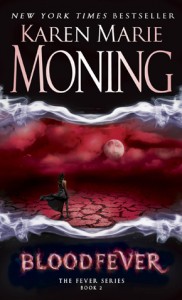
Bloodfever by Karen Marie Moning

Bloodfever by Karen Marie Moning is the second book in the MacKayla Lane fantasy/paranormal series. Like book one, Darkfever (click for my review), Mac is still learning about her skills as a sidhe-seer and attempting to navigate the world she’s familiar with and the world of the Faery.

“If I’ve been guilty of anything, it’s having the blithely sunny disposition of someone who enjoyed a happy childhood, loving parents, and long summers of lazy-paddling ceiling fans and small-town drama in the Deep South which–while it’s great–it doesn’t do a thing to prepare you for life beyond that.”  (page 17)

She’s since discovered who murdered her sister, learned about her unknown heritage, and allied herself with an enigma Jericho Barrons, who oozes male sexuality and danger.  On the flip side, Mac remains cautiously intrigued by the Fae prince, V’Lane, who can bend reality to suit his needs and that of humans giving them what they desire most, but at a price.  Mac often wonders where the normalcy in her life has gone, but she attempts to make her life as normal by day as she could from cleaning the bookshelves to servicing customers.

“The Fae prince raised his brow but said nothing.

I raised a brow back.  He was Pan, Bacchus, and Lucifer, painted a thousand shades of to-die-for.  Literally.”  (page 38)

Mac and Jericho continue to search for the tools that will improve their chances against the Fae, while still searching for the darkest book, the Sinsar Dubh — a book that makes her feel dreadfully ill when it is near and pass out unconscious if it is near for too long.  Assassins and sinister Fae are at every turn, but Mac has discovered she is not as alone as she believed.

Bloodfever is a natural progression from the first book in the series, and readers will enjoy the fast-paced plot provided.  Moning is developing Mac in a slow and natural progression, allowing readers to uncover her hidden strengths as she discovers them and cheering her on when she asserts herself, even against the darkest Fae and criminals in Ireland and Wales.

About the Author:

Karen Marie Moning was born in Cincinnati, Ohio, one of four children. She graduated from Purdue University with a BA in Society and Law. After a decade of working with insurance litigation and arbitration, she quit her job to pursue her dream of a writing career. Four manuscripts and countless part-time jobs later, Beyond the Highland Mist was published by Bantam Dell and nominated for two prestigious RITA awards. Author of the beloved HIGHLANDER series and the thrilling new FEVER series, featuring MacKayla Lane, a sidhe seer. Her novels have appeared on The New York Times, USA Today, and Publisher’s Weekly bestsellers lists, and have received many industry awards, including the RITA.

Thanks to TLC Book Tours, Karen Marie Moning, and Random House for sending me a review copy of this book.

Please check out the rest of the Karen Marie Moning blog tour.

This is my 15th book for the 2010 Thriller & Suspense Reading Challenge.

Green Beauty Recipes by Julie Gabriel

Green Beauty Recipes by Julie Gabriel, with over 300 recipes, is an excellent reference guide for those seeking more eco-friendly ways of creating and wearing makeup, lotion, fragrances, deodorants, and more.  The introduction explains how these recipes are different and what types of alcohols and other materials to use in lieu of rubbing alcohol and other ingredients that are processed or contain artificial ingredients.

Another great find of the introduction is how to appropriately conduct a patch test to determine whether you are allergic to a particular compound or ingredient in each recipe.  For those with sensitive skin, this will come in handy, especially since many of the recipes include alternatives should they find themselves allergic to a particular material.  For those concerned about the shelf life of these products, not to worry because there are natural preservatives can be added to stave off bacteria, fungi, and other toxic elements that can render the products ineffective.

In the Handmade Beauty Basics chapter, Gabriel outlines what amount of space is necessary and what tools should be on hand to mix the minerals and other ingredients to make a variety of makeup and cleansing products.  Readers should be sure to ensure that their work space should be clean, using ethanol, and that tools are either stainless steel or medical glass, which needs to be cleaned before and after each use.  Most ingredients can be found in the grocery store, home cupboards, or drug stores; for those interested, many of these recipes are used to create products for Gabriel’s Petite Marie Organics line of cosmetics.

Since many readers will be trying these recipes for the first time, it is helpful that Gabriel included some FAQs to deal with common problems found when making these natural products.  From fixing moisturizers that are too runny to offering ten steps to finding and creating toners, Green Beauty Recipes offers a number of remedies, recipes, and advice.  Gabriel’s experience as a holistic nutritionist and mother dedicated to eco-friendly living shines through in this reference guide.  Readers can either jump in all at once or take on a few recipes to tackle their top beauty concerns.

***This book is published by a carbon-neutral, eco-conscious publisher, Petite Marie, and distributed by Ingram.***

About the Author:

Julie Gabriel is a holistic nutritionist educated at Canadian School of Natural Nutrition. A former magazine beauty editor, a television journalist, a weight loss coach, and a new mom, Julie Gabriel is a dedicated advocate of green living and holistic natural eating.

A Canadian living in Switzerland, Julie is a regular guest at Martha Stewart’s Living Radio and has been featured in USA Today, Washington Post, Toronto Star, Sun Sentinel, Natural Solutions, Body & Soul, and many other publications.

Dante’s Divine Comedy adapted by Seymour Chwast

Dante’s Divine Comedy by Seymour Chwast is a graphic novel adaptation of the classic, allegorical epic poem written in three parts:  Inferno, Purgatory, and Paradise.  Dante’s lines were written in Italian, the language of the people, rather than Latin as a way to protest the political influence of the church and the Pope.  Chwast has taken a great many liberties with the text and Dante’s poetic lines.  Although the poetic lines are not as lyrical, the text is easier to read for those who find language in the middle ages and poetry hard to understand.  Chwast’s Divine Comedy graphic adaptation would be an excellent introduction to this classic without causing new readers to shy away from poetry.

“We witness carnal sinners/Those lustful creatures/who committed sins of the flesh/who are tossed about carelessly in the dark/by the most furious winds.” (page 19)

Dante, the poet, is guided through the inferno, purgatory, and paradise by the poet Virgil and several female muses, including Dante’s real life love, Beatrice.  Chwast’s illustrations capture the essence of each canto, though the depictions of Virgil and Dante in what looks to be 1940s clothes is an unusual selection.  The characters almost look like they are from The Untouchables.

Chwast makes this classic accessible to many more readers, but for people that love the classic’s lines or the original Italian words, the book could read like Cliffs Notes.  However, the illustrations are very detailed and accurately depict the travels of Dante and Virgil.  Dante’s Divine Comedy by Seymour Chwast is a helpful introduction to a classic, epic poem from the middle ages, by a politically active poet.

***The book is printed on natural, recyclable paper from wood grown in well-managed forests.***

This is my 50th, and final, book for the 2010 New Authors Reading Challenge.

Bon Jovi: When We Were Beautiful, Conversations with Phil Griffin

Bon Jovi:  When We Were Beautiful, conversations with Phil Griffin came with a copy of the latest album, The Circle, as part of the Book Blogger Convention auction.

The book is chock full of behind the scenes, on stage, and recording photos, plus interviews with the band members.  Fans of Bon Jovi will be fascinated to learn about the family that is Bon Jovi.  Bon Jovi:  When We Were Beautiful is not only a look at the past, present, and possible future of the band, but also about the dedication and ambition that each member holds in unison for what they have created.

The book is a testament to that dedication and how the band continues to survive throughout the decades as the music scene changes and other bands have fallen out of favor.  The book was autographed by the band, and the book is a nice hefty hardcover.

Another fun fact about the book is that one of our very own blogger friends, Jo-Jo from Jo-Jo Loves to Read!!! is in the book on page 122 in one of the photos from a recent Bon Jovi concert.  As Jo-Jo puts it, “I also have my cell phone open thinking I would take a pic, but it didn’t turn out anyway!  I remember thinking, How in the world did I even consider NOT going to this concert?”  How could she have thought not to go, indeed!

Bon Jovi:  When We Were Beautiful is a great addition to anyone’s coffee table collection of books. One takeaway from the book is that young people interested in becoming famous singers or rock stars should dream big and not just want to be in a famous singer, but go to takelessons and start their journey to be that famous singer. Making dreams come true takes ambition, dedication, and determination.  Fans will surely read it all in one sitting and cherish every page and every photo, and others will simply enjoy perusing through its pages at a leisurely pace getting to know each of the band members one at a time.

This is my 49th book for the 2010 New Authors Reading Challenge.

A Vampire Is Coming to Dinner! 10 Rules to Follow by Pamela Jane, Illustrated by Pedro Rodriguez

Pamela Jane‘s A Vampire Is Coming to Dinner! 10 Rules to Follow is a picture book for ages three to eight and is brightly illustrated by Pedro Rodriguez.

The images and text teeter between light and dark, balanced enough to engage young readers and keep them on their toes.  The pranks the young boy comes up with to keep the vampire guessing are hilarious and just something a young kid would come up with.

The only drawback for some younger readers is the design of the book in which the flaps would be hard for their uncoordinated hands to open without ripping.  The book has a final surprise for kids that will have them smiling.  A Vampire Is Coming to Dinner! 10 Rules to Follow is a hard bound children’s book with bright images, fun pranks, and rules that are familiar and new where vampires are concerned.  Kids will enjoy the book, and parents can have fun reading it with their children.

About the Author:

Pamela Jane is the author of twenty-six books for children, including Noelle of the Nutcracker illustrated by Jan Brett (Houghton Mifflin) which has been optioned for a film, and the “Winky Blue” and “Milo” series published by Mondo. Her new book, A Vampire is Coming to Dinner! 10 Rules to Follow, illustrated by Pedro Rodriquez, has just been released (Price Stern Sloan, a division of Penguin Books for Young Readers).

To check out the rest of the tour stops, click the link.

***Thanks to the author and TLC Book Tours for sending a review copy of this book.***

This is my 48th book for the 2010 New Authors Reading Challenge.