Quantcast

How to Be an American Housewife by Margaret Dilloway

Margaret Dilloway‘s How to Be an American Housewife is reminiscent of Amy Tan and Lisa See’s fiction in that the main characters are of Asian descent and struggle with cultural differences and generational gaps that hamper their ability to relate with one another smoothly.

“After the first hour watching scratchy TV in the blood lab, I wished I had a book with me.  Charlie and I weren’t big readers.  Books were too expensive and library books were full of germs from all the people who had checked them out.”  (page 123 of ARC)

Shoko is a Japanese woman who marries an American soldier, Charlie, shortly after the bombing of Nagasaki and Hiroshima.  She tells her story of how she moved from a happy childhood to a tumultuous adolescence at a time when her nation was occupied by a foreign invader and her family had lost its position in the caste society.  She’s an independent woman still beholden to Japanese traditions, though she takes time out to find true love.

“I understood then that my skills in school or in sports would not make my life come about in the way I wished.  I took my bows at that recital, vowing I would learn what I needed and make the best marriage possible.”  (page 6 of ARC)

Her trip down memory lane, unfortunately, is a bit stilted with little emotion, which could make it harder for readers to connect with Shoko.  However, once readers are engaged with Shoko’s struggles as an American housewife as she adapts to different cultural norms and strives to raise her children properly.  Mike and Suiko, her children, are as different as night and day, with Mike floating through life and Suiko taking her responsibilities to heart even to the detriment of her own dreams.  Shoko’s relationship with her children is strained, but she must soon learn to rely on them when she tries to reunite with her estranged brother, Taro.

Dilloway’s novel is captivating as Shoko continues to tell her story and when her daughter, Sue takes over the narration when she heads to Japan to learn about her family’s past and reconcile her family after many decades of silence.  As a debut, it is solid in drawing dynamic characters and creating fun dialogue between Shoko and Charlie and between Sue and Helena, Shoko’s granddaughter.  Three generations populate these pages, but really How to Be an American Housewife is a story about the strong, independent women in this family.

About the Author:

Margaret Dilloway was inspired by her Japanese mother’s experiences when she wrote this novel, and especially by a book her father had given to her mother called The American Way of Housekeeping. She lives in Hawaii with her husband and three young children.

Please follow her on Twitter, check out her blog, and view the reading group guide for her debut novel.

Thanks to TLC Book Tours, Penguin, and Margaret Dilloway for sending me a copy of How to Be an American Housewife for review.
This is my 40th book for the 2010 New Authors Reading Challenge.

The Hypnotist by M.J. Rose

The Hypnotist by M.J. Rose is the third book in the Reincarnationist series and FBI Lucian Glass remains on the trail of Dr. Malachai Samuels.

Reincarnation and the use of memory tools to reach deep into past lives reappears in this novel, alongside the use of hypnosis.  Glass is recovering from injuries sustained in The Memorist (If you missed my review of book 2, The Memorist, please check it out.), but he’s not eager to sit out the investigation on the sidelines.  In Vienna, he’s accosted while looking at the only translation of a list of memory tools, which would surely entice Samuels.

But there are other mysteries to be solved beyond who steals the list.  The Iranian government is eager to get its hands on a sculpture of Hypnos, even if it means court battles and other underhanded means.  Lucian’s past also resurfaces when a painting stolen from a framing shop where his girlfriend worked reappears more than 20 years later slashed to bits.

“Young and handsome, with sensitive eyes, sensuous lips and a finely wrought nose, his bone structure was elegant and the expression on his face was both sultry and serene . . . as if he was slipping into a dream himself.” (Page 105)

M.J. Rose carefully crafts a variety of characters and weaves in several story lines, while maintaining suspense and drama.  Not only are their mysteries to solve and memory tools to find, but Lucian must find himself and reconcile his past lives in order to move beyond the 20-year ball of pain he’s carried in his chest.  Overall, The Hypnotist is a fast-paced, absorbing read that will keep you on the edge of your seat this summer, but this thriller is a thinking-person’s game.  Can you solve the mysteries before FBI agent Glass?  The only way to find out is to pick up your copy or enter this giveaway!

About the Author:

M.J. Rose is the internationally bestselling author of several novels and two non-fiction books on marketing.  Check out her website, follow her on Twitter, and on Facebook. Check out a 100-page sampler from the Reincarnationist series.

The television series Past Life was based on Rose’s Reincarnationist series. The real stories about how she was inspired to write each book in this series as well as the knowledge she has about reincarnation and the art world make Rose an interesting and compelling blog guest. She’d love to visit.

Giveaway Details:  1 copy of The Hypnotist and a phoenix pin (US/Canada)

1.  Leave a comment on this post about whether you believe in reincarnation or not and why?

2.  Don’t forget to leave a way for me to contact you.

3.  Blog, Tweet, Facebook, etc. and leave me a link for an additional entry.

Deadline is August 13, 2010, 11:59 PM EST


This is my 13th book for the 2010 Thriller & Suspense Reading Challenge.


Thanks to M.J. Rose, Meryl L. Moss Media Relations, Inc., and TLC Book Tours for sending me a copy of The Hypnotist for review.

Paco’s Story by Larry Heinemann

Paco’s Story by Larry Heinemann chronicles the war experiences of Paco, the only surviving soldier of the Fire Base Harriette massacre from Alpha Company.  The narrative is unusual in that Paco does not tell his own story of his survival or his recovery and ultimate return to the United States from the Vietnam War.  Though readers get to know Paco through the eyes of others and his nightmares, Paco is a vivid and lost character in search of peace.

“Paco is in constant motion, trying to get settled and comfortable with that nagging, warm tingling in his legs and hips.”  (Page 35)

Heinemann’s language is raw, scraping down to the guts and bones in his readers, making them cringe, turn away, and stand agape.  A number of readers may find the graphic scenes in this novel to be too much, but what makes them uncomfortable are the realities of war and the breakdown of humanity.  Paco struggles not only with why he was the only survivor, but how to assimilate himself back into a society he no longer recognizes once stateside.

“(A body never gets used to humping, James.  When the word comes, you saddle your rucksack on your back, take a deep breath and set your jaw good and tight, then lean a little forward, as though you’re walking into a stiff and blunt nor’easter, and begin by putting one foot in front of the other.  . . .”  (Page 9)

Paco is an enigma, which is typical of most returning soldiers from the Vietnam War.  “The intricate ironwork–the tension beams and torsion beams and, overhead, trellis-looking crossbeams–is delicate and well made” (Page 66-7) is an image that will stick with readers as they wonder about Paco and his ability to return from the land of ghosts and emerge from the memories that haunt him.

“And he’s just a man like the rest of us, James, who wants to fuck away all that pain and redeem his body.”  (Page 173)

Heinemann is a brilliant writer, meshing the surreal with the reality of Paco’s life as a dishwasher in the Texas Lunch of Boone, Texas.  Ghosts that push Paco to remember, veterans that tell their own stories, and the looks of townsfolk as he hobbles to and from work all serve to keep Paco entrenched in the jungle with the events that took his innocence and his life.  Paco’s Story is an every soldier story in the way it depicts the horrors of war and the impact of those events on the psyche of those soldiers.

If you’ve missed the read-a-long discussion, please check out my answers to the discussion questions for sections 1, 2, and 3.

This is my 8th book for the 2010 Vietnam War Reading Challenge.

Nexxt Leena Angled Bookshelf Review

CSN Stores has a wide variety of bookshelves and other products, and I have purchased shelves with them before and loved them.  Recently, I was offered a bookshelf for review.  My husband selected the Nexxt Leena Angled Bookshelf.  When the first box arrived, the vertical pieces were cracked during shipment, so I had to request a replacement box.

The second box came, and my husband was thrilled he could finally put this shelf together.  The directions were very sparse with very little explanation of which pieces went where on the vertical pieces or which way it should be assembled.  Unfortunately, while putting this shelving unit together following these directions, the vertical pieces couldn’t handle the pressure and cracked once again.
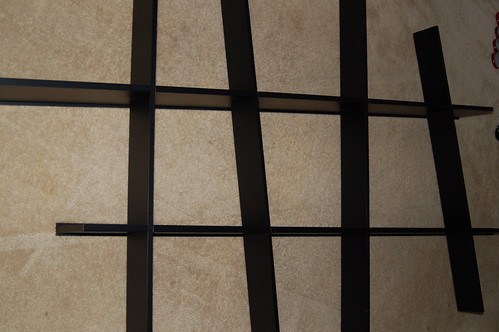
Upon calling CSN’s customer service in the evening about this unit, I was told to call when the warehouse was open to have them check to make sure the directions were written correctly?!  I’m not sure how that would have helped or how they would have determined that the directions were wrong.  The next day, they offered to send me yet another box.

It came later than the 2 days promised, but I took the afternoon to assemble it myself.  I measured each shelf and measured each section bisected by the vertical pieces to make sure the horizontal shelves were in the correct locations after taking the time to deduce that the crazy scribbled numbers in the directions of the fully assembled piece were those measurements.  I put the shelf together and waited for my husband to bring home his electric drill.
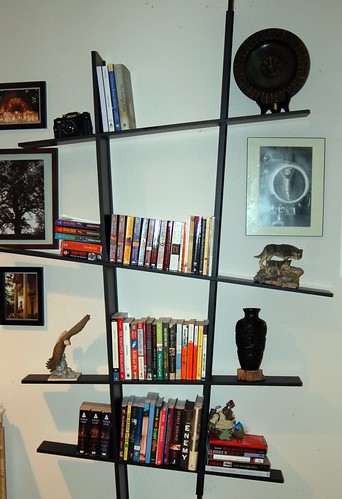
After much frustration and angst over this shelf, we finally got it together and struggled to put it up on the wall.  We noticed that the placement for the wall anchors on the direction sheet were incorrect, and we had to shift around the anchors a few times to get the shelf to sit right on the wall.  I got to put some great books on the shelves.

These shelves are very full now, and it does look nice, but I doubt we’d buy this shelf again after all that trouble.

A Hundred Feet Over Hell by Jim Hooper

Jim Hooper‘s A Hundred Feet Over Hell is a true account of the 220th Reconnaissance Airplane Company, with which his brother Bill served as one of the Myth Makers flying single-engine Cessnas that were extremely vulnerable to artillery and other ground fire.  These men were charged with flying over hot zones and locating the enemy for bombers, giving precise coordinates for dropping bombs and napalm.

“Rather than sharing our joy at his return, Bill was angry.  Not because of the crippling wound received in an unpopular war — he accepted that as part of what he had signed on for.  The anger came from being here.  In a demonstration of uncompromising loyalty over logic, it was, he believed, a betrayal of the warrior family he’d left behind.”  (Page xi)

Hooper has captured the essence of these men and their time in Vietnam from their crazy stunts to the moments when they feared for their lives.  Through alternating points of view the stories unfold quickly as one man feeds off and expands on the story being told by their friend and colleague.  Readers will meet characters like Doc Clement and Charlie Finch, but these men are not characters, but real human beings who lived through the harsh realities of war.

“Bill Hooper:  . . . I can’t remember more of that day, save weeping in the privacy of my room.  Perhaps the saddest thing of all was that I would learn to be unemotional about killing, eventually joining others who were very good at it.”  (Page 23)

Hooper pulls no punches in the organization of this book and doesn’t seem to modify the military language these men used on a regular basis; some examples include VC for Viet Cong and DMZ for demilitarized zone, which is clearly a misnomer, to the lesser known terms DASC for Direct Air Support Control Center and Kit Carson scout for those former Viet Cong recruited to assist with counterintelligence.  Readers of military history and fiction are likely to understand many of these acronyms and terms easily, but others may have to refer to the provided glossary.  However, once they get a grip on the terminology, readers will plunge into the narrative easily, getting to know each of the soldiers and how they coped with the war.

A Hundred Feet Over Hell by Jim Hooper will remind readers of those in-the-field journalistic interviews with soldiers and those documentaries where one soldier begins a story only to be continued by another soldier, providing a deeper impact.  Each man shares their fears, their triumphs, and their more embarrassing moments.  One of the best books about the Vietnam War, not about infantry.

Please check out this book trailer to see what these men flew over enemy territory without armor or weapons.

A Hundred Feet Over Hell

Please also check out these great photos.

About the Author:

After graduating with a degree in Slavic Studies from the University of South Florida, Jim Hooper worked as a documentary research-writer for WFLA-TV in Tampa, with weekends set aside as a skydiving instructor and team captain. He gave up television after three years to devote himself full time to jumping out of airplanes, logging over 3000 freefalls and building the world’s premier skydiving center in Zephyrhills, Florida. His thirst for adventure unfulfilled, he sold the business in 1984 to realize a long-held dream of being a war correspondent and author, making his home in England and setting off for Africa.

I want to thank Lisa Roe at Online Publicist and the author Jim Hooper for sending me a copy of A Hundred Feet Over Hell for review.

This is my 39th book for the 2010 New Authors Reading Challenge.

This is my 7th book for the 2010 Vietnam War Reading Challenge.

Unincorporated Persons in the Late Honda Dynasty by Tony Hoagland

As part of the Graywolf Press — one of my favorite small presses that publishes poetry and fiction — Spotlight on Small Presses (click on the badge at the bottom of the post for the tour stops), I chose a poetry book to review, which I picked up at the 2010 Book Expo America.

Unincorporated Persons in the Late Honda Dynasty by Tony Hoagland is his first collection of poems in 10 years, according to the Graywolf representative at the expo.  The collection features poems that call into question the realities of the modern world from our dating rituals to our trips to the mall food court.

In “Big Grab,” Hoagland suggests language is taking on meanings that are less than they are.  “The Big Grab,/so the concept of Big is quietly modified/to mean More Or Less Large, or Only Slightly/Less Big than Before.// Confucius said this would happen –/that language would be hijacked and twisted/”  (page 5).  This collection not only tackles the language changes our society faces and what those changes mean, but it also looks carefully at the world of celebrity in “Poor Britney Spears.”

Expensive Hotel (page 24)

When the middle-class black family in the carpeted hall
passes the immigrant housekeeper from Belize, oh
that is an interesting moment.  One pair of eyes is lowered.

That’s how you know you are part
of a master race — where someone
humbles themselves without even having to be asked.

And in the moment trembling
from the stress of its creation,
we feel the illness underneath our skin —

the unquenchable wish to be thought well of
wilting and dying a little
while trying to squeeze by

the cart piled high with fresh towels and sheets,
small bars of soap and bottles
of bright green shampoo,

which are provided for guests to steal.

Hoagland’s crisp language and vivid imagery is deftly weaved with philosophical and societal questions we all should be answering or at least asking.  Has modern society twisted our culture into something worthwhile or is it something that should be tossed in the trash as a bad experiment.  However, there are moments of humor and deep sarcasm throughout the volume that offset one another to make readers ponder what the poet really desires from the modern world.  Readers will come away from the collection with a new focus on examining society and their part in it –whether they decide to continue assimilating is up to them.  Unincorporated Persons in the Late Honda Dynasty is a thought-provoking collection that urges readers to be unique and to think outside the box.

This is my 9th book for the Clover Bee & Reverie Poetry Challenge.

This is my 38th book for the 2010 New Authors Reading Challenge.

Free to a Good Home by Eve Marie Mont

Eve Marie Mont‘s Free to a Good Home is a delightful read about Noelle Ryan whose husband, Jay, has finally told her his deepest secret — he’s gay — effectively obliterating her dream and forcing her to reassess her life.  Noelle has a successful, if stressful, career as a veterinary technician, but she occupies most of her time with her family and the dogs at the shelter, rather than coping with her own problems.  She’d rather solve everyone else’s problems and be the good person that everyone leans on when they need consoling or help.

“‘Sure,’ I say, handing him my cup.  He’s cute.  Messy brown hair, crinkly eyes, and that sexy clenched jaw thing.  Too cute.  A turn-your-brain-to-clotted-cream cute.”  (page 32)

Noelle is passionate about saving animals and finding them homes, but she’s also passionate about helping people, including her WASP ex-mother-in-law, Margaret, who made her marriage miserable. However, what will get to readers is how much of a doormat Noelle is when it comes to Jay; he asks her to do many unthinkable favors including taking care of his mother.  Many readers will want to scream at this character and beat her back to her senses.  While Jay is not a bad guy per se, he crosses the line in his relationship with Noelle, which effectively prevents her from moving on with her life even after she meets a gorgeous musician named Jasper.

“‘Luxwood Victorian Gardens.’

‘They make it sound so pleasant.  Like you’re staying in some luxurious estate, Blithewold Mansion for the physically impaired.’

‘Well, they have to do that to get people in the door.  They can’t very well call the place Let-Us-Steal-Your Independence Gardens.’

‘Feed-Us-Flavorless-Food-Courtyard.’

‘Watch-Jeopardy-Until-You-Die-Village.'”  (page 193)

However, Mont’s writing is engaging and dramatic and even humorous.  If you love animals and a bit of romance in your summer reading with a good dose of drama, Free to a Good Home will fit your needs.

About the Author:

Eve Mont lives with her husband, Ken, and her shelter dog, Maggie, in suburban Philadelphia, where she teaches high school English and creative writing. Free to a Good Home is her first novel, which was released on  July 6, 2010. She is currently working on her second novel.

http://www.literaryescapism.com/new-author-challenge10

This is my 37th book for the 2010 New Authors Reading Challenge.

Dien Cai Dau by Yusef Komunyakaa

Yusef Komunyakaa‘s Dien Cai Dau is another collection of Vietnam War poetry.  The poet, who received the Bronze Star and edited The Southern Cross, dedicates this book to his brother Glenn, “who saw The Nam before” Komunyakaa did.  His poems put the reader in the soldiers’ shoes, allowing them to camouflage themselves and skulk around the jungles of Vietnam from the very first lines of “Camouflaging the Chimera.”  Beyond skulking in the jungle, hunting the Viet Cong, Komunyakaa discusses the weight of war as soldiers trudge through the landscape with their equipment and what they’ve done and seen.  Weaving through the tunnels looking for the enemy or searching the thick forest, soldiers are constantly reminded of their emotional and physical burdens, though they find joy in some of the smallest moments.

One of the beautiful aspects of Komunyakaa’s poetry is his vivid sense of how even the most beautiful elements of nature have a darker side.  In “Somewhere Near Phu Bai,” Komunyakaa writes “The moon cuts through/the night trees like a circular saw/white hot.  . . .” and in “Starlight Scope Myopia,” he suggests, “Viet Cong/move under our eyelids,/lords over loneliness/winding like coral vine through/sandalwood & lotus/.”

Beyond the nature imagery and the immediacy of the war, some of these poems have an analytical quality much like a general planning out the battle moves.  Each move of the soldiers is reflected in the carefully chosen words and lines, and the effect is genuine, creating a suspense and fear readers would expect soldiers to experience.

A Greenness Taller Than Gods (Page 11)

When we stop,
a green snake starts again
through deep branches.
Spiders mend webs we marched into.
Monkeys jabber in flame trees,
dancing on the limbs to make
fire-colored petals fall.  Torch birds
burn through the dark-green day.
The lieutenant puts on sunglasses
& points to a X circled
on his map.  When will we learn
to move like trees move?
The point man raises his hand Wait!
We’ve just crossed paths with VC,
branches left quivering.
The lieutenant’s right hand says what to do.
We walk into a clearing that blinds.
We move like a platoon of silhouettes
balancing sledge hammers on our heads,
unaware our shadows have untied
from us, wandered off
& gotten lost.

Dien Cai Dau by Yusef Komunyakaa is an excellent collection that will allow readers to join the fight in Vietnam, feel the fear and anxiety of soldiers, and see just how many enemies soldiers faced — the Viet Cong and the jungle.  Komunyakaa is a poet with incredible insight from propelling emotions off the page through images to using carefully chosen words and phrases to vividly paint the scene.  Dien Cai Dau is one of the best poetry books about the Vietnam War and often reads like prose.

This is my 6th book for the 2010 Vietnam War Reading Challenge

This is my 8th book for the Clover Bee & Reverie Poetry Challenge.

Paco’s Story Readalong Week 2

This is week 2 of the Paco’s Story read-a-long, and the second set of  discussion questions were posted on Wednesday, July 14 for Chapters 3 and 4.

If you missed the first round of questions, check them out.  You also can check out my previous post for section 1.

Like the other chapters, readers only see Paco through the eyes of other characters or the unknown/ghost narrator.  We learn that Paco is on medication to keep the pain away, but how much medication would it take to keep the images of war out of your mind?

One of the most memorable passages for me is in Chapter 3:  “He [Paco] is not really asleep, hunched as awkwardly as he is, but mighty groggy from the several additional doses of medication — muscle relaxers and anti-depressants — to the point of a near-helpless stupor.  . . . Paco is in constant motion . . . ” (Page 35)

As readers move through these next two chapters we see Paco move from location to location — from the bar to the diner to the antique store to the barbershop –but in a way, he’s motionless as he sits and listens to each person or people he meets — silent.  Paco is a dichotomy in this way, and it makes him an enigma.

The narrator continues to demonstrate the reactions to Paco the war veteran and we learn a bit more about his recovery, but do we get to know Paco?  Should this story be told by Paco?  Readers may like to understand his inner thoughts, but I wonder if he thinks much beyond the moment.  He seems focused on finding a job and a place to stay, but not much else.

Even if you aren’t participating in the Vietnam War Reading Challenge, we hope that you will join us for the Paco’s Story read-a-long.  Until next week.

8th Confession by James Patterson and Maxine Paetro (audio)

James Patterson and Maxine Paetro’s 8th Confession is read by Carolyn McCormick, and does a fine job differentiating between the characters.  In this book, Lindsay Boxer is confronted with a personal, life-changing decision and is bogged down in several high-profile cases.  Rich men and women are being murdered in their homes, but there is no cause of death — at least any that Claire can find during autopsy or through toxicology tests.

“Claire waved a computer printout, said, ‘Toxicology was negative.  No poison, no opiates, no narcotics, no nothing.  Cause of death? No idea.  Manner of death? No idea.  Something stinks, and I don’t know what,’ she told us, ‘but the likelihood of these two individuals, with completely negative autopsies and completely negative toxicologies, expiring at the same time is statistically astronomical.'” (Page 111)

Meanwhile, Cindy Thomas uncovers the murder of Bagman Jesus, a local homeless man, who she believes is revered by his community.  Investigating the murder becomes her obsession, but she also finds herself tied up in another passion — Richie Conklin, Lindsay’s partner and secret desire.

Readers will see the sparks fly between these friends and between the sheets in this thriller.  Unfortunately, there seems to be too much of a focus on the bedroom, and very little focus on the investigation — whether Lindsay is mulling over her feelings for Rich or her love for Joe, her live-in boyfriend.  Once the focus is back on the killer, readers will be sucked into trying to uncover for themselves how the murders are being committed.

The audio, just like the book, is fast-paced.  However, 8th Confession is not as strong as some of the other books in this series.

This is my 12th book for the 2010 Thriller & Suspense Reading Challenge.

Paco’s Story Readalong Week 1

This is week 1 of the Paco’s Story read-a-long, and the first discussion questions were posted on Wednesday, July 7 for Chapters 1 and 2.

Paco’s Story is about the soul survivor of the Fire Base Harriette massacre where Alpha Company was obliterated.  Heinemann’s writing is raw and honest, and in the first Chapters we’re introduced to Paco through an unnamed narrator, who could be the ghost of a soldier killed in action during the massacre.  Readers learn that Paco is the soul survivor from Alpha Company, and his survival had a serious impact on a medic who until he met Paco had failed to save many soldiers injured in the Vietnam War.

The unnamed narrator is brutal in his honesty about Paco’s injuries and the devastation suffered by soldiers in the field.  He wants to tell his story, Paco’s story, even if people are unprepared to hear it or don’t want to hear it at all.  This is a story that must be told.  I wonder if that is how Heinemann felt while he was writing this novel — did he believe that this story was his calling, something he had to tell.

Even if you aren’t participating in the Vietnam War Reading Challenge, we hope that you will join us for the Paco’s Story read-a-long.  Until next week.

The Lace Makers of Glenmara by Heather Barbieri

Heather Barbieri‘s The Lace Makers of Glenmara is set in Ireland as the main character, Kate Robinson, leaves her life in the United States to take the journey to her ancestral lands that she was supposed to take with her mother.   She leaves her home after failing to make it with her own clothing line and the break-up of her relationship with Ethan.  After a rough journey in the rainy countryside, Kate happens upon the small village of Glenmara and its quirky residents from motherly widow Bernice to abrasive Aileen.

“Everyone had been so sure she and Ethan would get married, that she would catch the bouquet at the medieval wedding they attended that March (the couple being devoted not only to each other but to the Society for Creative Anachronism), the event at which he left her, if not at the altar, just southwest of it, next to an ice sculpture of a knight in shining armor that had begun to melt, a moat of water at his feet, his sword soon no more than a toothpick.”  (Page 6)

Switching between points of view, Kate’s perspective is rounded out by the narration of William the traveler, Aileen, and Bernie.  Readers will be drawn into the stories of Kate and her friends as they search for peace and acceptance among themselves and others. Each of these women deals with not only sorrow and loss, but also shaken confidence.

“‘Like Colleen said, mistakes aren’t necessarily a problem,’ Bernie told her.  ‘Sometimes they lead you in a different direction.  Who says you always need to follow the rules?  Breaking the pattern can be the very best thing, even though it can be scary at first.'”  (Page 91)

Barbieri creates a cast of characters as tumultuous as the weather and diverse as the scenery of Ireland.  Kate is broken, and many of the other characters are broken as well.  It takes lace making and camaraderie to heal.  Glenmara, unfortunately, is a town in the middle of nowhere where religion is more than a passing moment on Sundays.  Can these women overcome their own fears and rekindle the beauty within themselves?

The prologue to the novel, however, that outlines what you need to sew and draws parallels between sewing and life changes is a bit overwrought, especially when Kate becomes part of the lace making guild.  Readers are likely to draw those parallels on their own without shining a bright light on it.

Meanwhile, the evolution of these characters and what they cultivate through their friendships is an amazing transformation for these women that will leave readers wondering what relationships in their lives have transformed them.  Barbieri’s writing is captivating and will pull readers into the Irish countryside.  An emotional evolution for the characters and readers set against the backdrop of beautiful Irish hills and cliffs.  Be ready to jump off and join them.

Check out the rest of the TLC Book Tour stops.

About the Author

Heather Barbieri is half-Irish. Her paternal ancestors left counties Donegal and Tipperary  after The Great Famine and worked in the coal mines of Eastern Pennsylvania before settling in Butte, Montana. Her impeccably dressed maternal grandmother was a descendant of a lady-in-waiting to Queen Victoria and instilled an avid interest in fashion in her granddaughters. Barbieri’s first novel, Snow in July (Soho Press), was selected as a Book Sense Pick, a Glamour magazine “Riveting Read,” and a Library Journal Notable First Novel. Before turning to writing fiction full-time, she was a magazine editor, journalist, and film critic. She lives in Seattle, Washington, with her husband and three children, and is currently working on her third novel.

Also check her out on Facebook.

This is my 3rd book for the Ireland Reading Challenge.

This is my 36th book for the 2010 New Authors Reading Challenge.