Quantcast

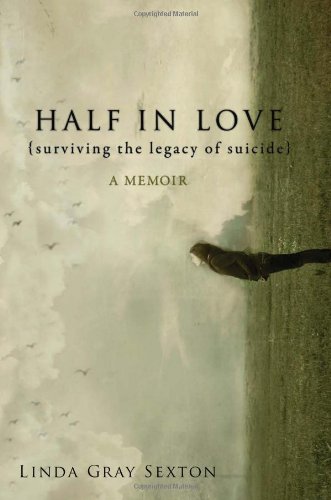
Half in Love by Linda Gray Sexton

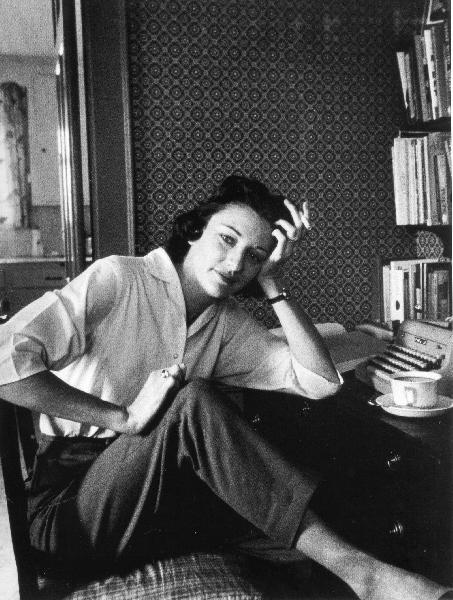
Linda Gray Sexton, an author of memoir and fiction, tackles the issues of depression, suicide, and family legacies in her latest memoir, Half in Love: Surviving the Legacy of Suicide.  In case you haven’t deduced on your own who her famous mother is, it is Anne Sexton one of the greatest American confessional poets, who successfully committed suicide in October 1974 after battling depression for years by locking herself in the garage and dying from carbon monoxide poisoning.

“The other families in our neighborhood looked nothing like my own family.  My father did not run the family, nor did my mother.  It was my mother’s illness that had seized control.  My adulation of her was not tempered by the fact that she was mentally ill.  We never used the word ‘crazy’ — though when the ambulance arrived in the driveway to take her away, the neighborhood children whispered that Mrs. Sexton was nuts again.”  (page 59)

Half in Love is far from an easy read as Linda details not only her mother’s struggles with depression and suicide, but also the violent and sometimes inappropriate relationships within the family.  The legacy of suicide is clear as Linda discusses her college years, her marriage, and the birth of her children.  The “rabbit hole” is often used to describe the downward spiral Linda and her mother descend into without necessarily being triggered by a specific event.  Some of the details about institutionalization, attempts at suicide are detailed and will make readers turn away from the page, but they are necessary to convey the depth at which these women fell away from the real world into the darkness that obscured their reasons for hope.

“Unconsciously, my mother had bequeathed to me two entirely unique legacies, and they were inextricably and mysteriously entwined:  the compulsion to create with words, as well as the compulsion to stare down into the abyss of suicide.  Both compulsions have been with me for as long as I can remember.”  (page 23)

Despite a carefully outlined plan to avoid her mother’s fate, Linda finds that she has unwittingly stepped on the same path to suicide and also has become a confessional fiction author rather than confessional poet.  When Linda becomes a mother herself and realizes just how much she inherited from her mother in terms of mental illness, she becomes concerned and wonders how much she should tell her sons about the family legacy, while her husband wishes to shield them from “prophecies” that may or may not come true.

Half in Love is about the struggle with depression and suicide, but it also is about falling “half in love” with the idea of a famous poet and her legacy in spite of the rational reasons to distance oneself from that dangerous family legacy and live a “normal” life.   Readers will be absorbed in the author’s struggles and the struggles of her mother, but in spite of these struggles there is something to “love” about these women.  In a way larger parallels between a young Linda and the greater society can be drawn about falling in love with the darker sides of life that enabled her mother, Anne Sexton, to become one of the most famous poets of her time.  But this is not just Anne’s story, but a story of a family continuously torn apart, repaired, and fragmented — possibly irreparably.

***Reading this memoir prompted me to highlight one of Anne Sexton’s poems during the Virtual Poetry Circle last week.  Please feel free to join the continued discussion.***

About the Author:

Linda Gray Sexton was born in Newton, Massachusetts in 1953 and graduated from Harvard University in 1975. She is the daughter of the Pulitzer Prize winning poet, Anne Sexton, and has edited several books of her mother’s poetry and a book of her mother’s letters, as well as writing a memoir about her life with her mother, “Searching for Mercy Street: My Journey Back To My Mother, Anne Sexton.” “Rituals,” “Mirror Images,” “Points of Light,” and “Private Acts” are her four published and widely read novels. “Points of Light” was made into a Hallmark Hall of Fame Special for television.

Check out the other stops on The TLC Book Tour.
This is my 2nd book for the 2011 New Authors Reading Challenge.

Kaleidoscope: An Asian Journey of Colors by Sweta Srivastava Vikram

Kaleidoscope:  An Asian Journey of Colors by Sweta Srivastava Vikram, who also wrote Because All Is Not Lost (check out my review), is a departure from her previous collection that deals primarily with grief.  Kaleidoscope focuses on colors and their relationship to Hindu women from birth to death including how red is worn as a bride, etc.

In this slim chapbook, Vikram tackles larger philosophical and cultural issues attached to a variety of colors prevalent in Hindu society.  She sketches out poetic memories and weaves in colors that demonstrate the emotional journey or right of passage in the moment described.

From “Innocence Comes in Pink” (page 3)

I am six today, and my limbs feel all grown up.
My tonsils are ready to be evicted from their home.
. . .
The color of my soft lungs untainted
by worldly pleasures resonates
with the wardrobe of my best friend, Barbie
and the hope of my favorite animal, Babe the pig.

Many of these poems are very vivid and pull readers into the moment.  Each line, each color, and each description is tied to a deeper familial history or tradition.  Vikram provides an in-depth examination of Hindu culture in a way that is easy to grasp and exposes the similarities between all cultures.  Further into the collection, there is a bit of defiance in her words as the color beige takes over in old age and she fights to remain red, youthful.  Overall, Kaleidoscope:  An Asian Journey of Colors is an even stronger chapbook poetry collection that Because All Is Not Lost because it deals more than with just emotion and healing.  Sweta Srivastava Vikram is a gifted poet, who has a work of fiction due out this year which I’m looking forward to, and she clearly is eager to highlight the differences in culture and the similarities between cultures at the same time — a fine line that she walks well.

About the Author:

Sweta Srivastava Vikram is an author, poet, writer, and blogger. Born in India, Sweta spent her formative years between the steel city of Rourkela, the blue waters of North Africa, and the green hills of Mussoorie before arriving in bustling New York. Growing up between three continents, six cities, and five schools, what remained constant in Sweta’s life was her relationship with words.

Please check out her interview on Page Readers.  Also, if you missed an earlier Virtual Poetry Circle in which I featured a poem from this collection, you should join the discussion.

This is my 1st book for the South Asian Reading Challenge.

This is also my 1st book for the 2011 Fearless Poetry Exploration Reading Challenge.

Stiltsville by Susanna Daniel

Stiltsville by Susanna Daniel was the December book club selection from Everyday I Write the Book, but I ran out of time in 2010 to read it.  Click here if you want to read the discussion.

Frances Ellerby is a young 20-something with her whole life ahead of her in 1969 when she heads to Miami for a wedding, meets a spontaneous young woman named Marse, and finds the love of her life, Dennis.  She makes a major decision and moves from Georgia to Miami to be with Dennis, and while she is uncertain about her life choices sometimes, for the most part she realizes she has chosen the right path.

“The pink undulated and shimmered in the sunlight, fading and brightening.  It was like nothing I’d ever imagined.  Like so much of Miami, the islands were vain, gaudy, and glorious — and in this way they belonged there, undeniably, and I hoped unrealistically that their pink skirts would stay fastened forever.”  (Page 147)

Frances is a young woman who is moored to Miami by her love of one man, but her friendships with Marse and others seem to come in and out of the storyline.  There are moments of utter joy, heartache, and humor, but there also are moments when the story line takes predictable turns as many plots about marriages over time turn to possible affairs and other heart breaks.

“‘Oh, God, I know — they botched her face-lift.’  One of Elanor’s cheeks drooped considerably, and the eyelid on the same side drooped as well, as if she’d been stuck with something and deflated.  ‘She’s going to that guy in Naples to fix it, but they can’t get her in for six months.  You’d think this would qualify as an emergency.'”  (page 194)

Although Daniel sets up the landscape of Miami as over-the-top and gaudy in many ways, readers may be unprepared for the dramatic bombshells dropped on top of one another in the last 100 pages.   Readers may find these sections unbelievable or too much to lump together near the end of a novel, especially one that up until this point had been very predictable.

Frances was too hard to connect with on many levels because she’s so unpredictable in her relationships and she second guesses her decisions at every turn.  Her deep love of Dennis is often questionable.  Overall, Stiltsville‘s setting in Miami grows with each passing decade, but the relationships between Frances and her family often seem stagnant or underdeveloped, though the introduction of Margo, her daughter, is a compelling element that should have been explored more fully.

This is my 1st book for the 2011 New Authors Reading Challenge.

The Perfect Bride for Mr. Darcy by Mary Lydon Simonsen

Mary Lydon Simonsen‘s The Perfect Bride for Mr. Darcy re-imagines Pride & Prejudice in such a way that Darcy and Elizabeth cannot get past their misunderstandings and disagreements without a little help from two matchmakers — Georgiana Darcy and Anne de Bourgh.  Anne takes the reins for much of the book after she learns her cousin Darcy has proposed marriage to Elizabeth at Rosings and failed miserably at gaining her hand and love.

The main plot points of Lizzy’s visit to Pemberley, Lydia’s downfall with Wickham, and Lady Catherine de Bourgh’s visit to Hertfordshire are all present, but Anne helps convince Lizzy to visit Pemberley and prompts her mother to visit Hertfordshire.  Georgiana is a secondary matchmaker in this novel, but she’s witty and grows into her role as mistress of Pemberley by ensuring her guests are comfortable and do not annoy one another, especially since Caroline Bingley and Elizabeth are in the same room vying for the same man’s affections.

“And, yet, Anne was saying that Mr. Darcy went with his sister to the milliner’s shop.  Lizzy could just picture him, crossing and uncrossing his legs, and drumming his fingers on top of his hat, when he was not pacing the floor.”  (page 56)

Simonsen has sketched a strong Anne and Georgiana, women who are more modern than convention dictates, but who are well aware of society’s expectations for their behavior.  Georgiana is about to come out into society when things go awry in the Bennet family, but she unselfishly tells her brother to right the wrongs and go to his love to ease her pain.  Unlike Austen’s minimal sketch of Georgiana as a beloved sister, Simonsen creates a strong young woman with romantic notions and a penchant for writing.

Not to worry because Jane and Mr. Bingley’s romance is not forgotten, but there is more than one obstacle thrown in their way after Bingley is convinced by Darcy and the Bingley sisters to cease his courtship of Jane.  Enter Mr. Nesbitt, a solicitor with a odd sense of courtship and love.  This subplot is delightful, serves to increase the suspense in the Darcy-Lizzy romance, and is full of twists and turns.

“While Mary was croaking out a lullaby, the youngster had put his hands over his cousin’s mouth and had asked her not to sing.  Everyone in the family now owed a debt of gratitude to a four-year-old boy.”  (page 161)

“‘I am not angry with either of you.  I am, however, a little disconcerted that you embarked on such an elaborate scheme after I told you I already had a plan in place.’

‘Your plan was terrible.  I have saved you weeks of anxiety about Elizabeth.  You must own to it, Will.  My plan was better than yours.”  (page 204)

The Perfect Bride for Mr. Darcy by Mary Lydon Simonsen is engaging and funny.  The interactions between Anne and Darcy are often filled with playful jabs between cousin, and the dialogue between Jane and Lizzy are not only sisterly but full of sweet teasing.  Another fun re-imagining of Pride & Prejudice that delves deeper into the secondary characters of Austen’s novel.

If you missed Mary Lydon Simonsen’s guest post and the chance to win one of two copies of The Perfect Bride for Mr. Darcy, there’s still time to check them out.

About the Author:

Mary Lydon Simonsen’s first book, Searching for Pemberley, was acclaimed by Booklist, Publishers Weekly, and RT Book Reviews. She is well loved and widely followed on all the Jane Austen fanfic sites, with tens of thousands of hits and hundreds of reviews whenever she posts. She lives in Peoria, Arizona where she is working on her next Jane Austen novel. For more information, please visit http://marysimonsenfanfiction.blogspot.com/ and http://www.austenauthors.com/, where she regularly contributes.

Sanditon by Jane Austen

Sanditon, another unfinished novel and the last that she was working on before her death, by Jane Austen begins with the Parkers in search of a surgeon to bring back to the seaside town of Sanditon from Willingden to care for the sick tourists and travelers seeking the medicinal attributes of the small town.  Unfortunately, the Parkers’ carriage runs into rough roads in a different Wilingden without a physician and it overturns.  Mr. Parker ends up with a sprained ankle and the adventure begins.

Meeting these characters initially, readers will find Mrs. Parker of few words and Mr. Parker very vocal about his town and his life.  Parker in many ways is similar to Mr. Collins in how he pontificates about Mrs. Denham, the town’s patroness.  Despite an invitation to the Heywoods to spend time in Sanditon, the Parkers had to be content to take one of the daughters, Charlotte.  On the way home, Mr. Parker tells Charlotte about Mrs. Denham and the rest of Sanditon.

“‘There is at times’ said he — ‘a little self-importance — but it is not offensive; — and there are moments, there are points, when her love of money is carried greatly too far.  But she is a goodnatured woman, a very goodnatured woman, — a very obliging, friendly neighbour; a cheerful, independent, valuable character.  — and her faults may be entirely imputed to her want of education.”  (page 166)

Parker believes the sea waters will cure all ills and make sure everyone is healthy, even those who claim to be healthy already.  The introduction describes the outrageous nature of Austen’s hypochondriacs in this novel and attributes the characterizations to her need to lighten her burdens since she had been ailing for about a year before her death.  Whether true or just speculation is hard to say, but it is clear that Austen’s experiences in Bath and with the healing waters got her thinking about her own society and its dependence on these waters to cure their ills.

As the novel progresses, readers will find that Austen has ventured into territory that she is not as familiar with, in that Charlotte Heywood becomes a narrating commentator on this new society in Sanditon.  Readers will enjoy the fresh look at society and their tendency to become ill and recover miraculously when they are needed.  Austen clearly had begun branching out beyond simply highlighting the societal hypocrisy among courtship rituals to discuss other topics like charity to those less fortunate and generating a prosperous town without commercializing it too much.

Overall, Sanditon by Jane Austen may be unfinished, but well worth reading to see how Austen’s work had grown and was about to flourish further.  It is not quite clear who the hero of the novel would have been — although it could be speculated that Uncle Sydney Parker is the hero.  It is clearly not Sir Edward, and the heroine could be Charlotte, though readers’ connection to her because of her observer status and her plight is not all that strong and could signal that Austen had another heroine in mind.  Readers will have fun visiting this seaside resort and its quirky characters, as well as fun speculating where Austen was heading with this story.

Matterhorn by Karl Marlantes

Matterhorn by Karl Marlantes is bound to be an instant classic among Vietnam War literature.  Drawing from his experiences as a Marine Lieutenant, much like many of the other authors’ novels, Marlantes’s perspective is not only of Marines on the ground in the depths of the jungle, but of a lieutenant who experienced first hand the political battles and horrifying decisions made by other officers and politicians.  Weaving in political dilemmas and screw-ups into the narrative can be burdensome for many writers — dragging down the plot and characterization — but this is not the case with Marlantes’ Matterhorn.

Mellas, the main protagonist, enters Vietnam as a lieutenant with a variety of ambitions for advancement and medals.  He’s been to Ivy League schools, he’s had a charmed life compared to the others in the bush, but he likes to feel like one of the ordinary guys in the bush, though at the same time, he wants to fit in with the officers and to prove his worth.  He’s a dichotomy in himself, displaying openly the struggle between the grunts and the officers within one man.

“Mellas was amazed and ashamed.  He realized part of him would wish anything, and maybe even do anything, if it meant getting ahead or saving his own skin.  He fought that part down.”  (page 7)

Mellas is thrown into Bravo Company and told to take hold of Matterhorn, only to abandon it when the political forces deem Cam Lo a bigger priority.  But by not having the support necessary from the base camps, his company runs out of water and other supplies, forced to hump through the jungle dehydrated and shot up.  There is more than one instance in which this company is thrown into battle with impossible odds, which will remind many readers of the movies that glorify the marines and their victories.  However, this novel shows readers the true nature of those “hollow” victories.  While these men remain dedicated to their missions and each other, without proper strategy and backing their victories become senseless in the eyes of loss and terror.  Even victories become jokes once the reports are made to the command posts and the reports of confirmed and probable dead are doctored — something that was common during the war.

“The records had to show two dead NVA.  So they did.  But at regiment it looked odd — two kills with no probables.  So a probable got added.  It was a conservative estimate.  It only made sense that if you killed two, with the way the NVA pulled out bodies, you had to have some probables.  It made the same sense to the commander of the artillery battalion:  four confirmed, two probables, which is what the staff would report to Colonel Mulvaney, the commanding officer of Twenty-Fourth Marines, at the regiment briefing.”  (page 91-2)

Mellas finds his place within the company and even becomes respected, but his continued ambition clouds much of his judgment and often forces him into situations that are more dangerous than they need to be.  Beyond Mellas, the company is hampered by continued racial tensions between the “brothers” and their white counterparts, with some elements on both sides more violent and outspoken than others.  Others are aware of the increased tension and racial hatred, but attempt to brush it under the rug or ignore it.  The tension builds within the “brothers” camp, pitting China against Henry, in such a way that it can only be released in one way.

“Jackson folded his arms. ‘You think someone’s going to understand how you feel about being in the bush? I mean even if they’re like you in every way, you really think they’re going to understand what it’s like out here? Really understand?’

‘Probably not.’

‘Well, it’s like that being black. Unless you’ve been there, ain’t no way.'” (page 429)

As for the officers back at the base camp, readers will find in Lieutenant Colonel Simpson a possible mirror image for Mellas, depending on how well he reacts to combat situations and political decisions beyond his control.  Simpson is often drunk, quick to anger, and makes rash decisions just with a few promptings from peers and underlings.

There are so many layers to Matterhorn, it is impossible to discuss them all in a review.  Mellas is a troubled hero, but in a way the hero is not any individual Marine, but the jungle that surrounds them.  It beats them down; it disguises the enemy; and it leaves them begging for mercy, but it also can provide them shelter; offer them food; and improve their chances of success.  Psychological effects of war, loss, and camaraderie in highly intense situations can be devastating and enlightening.  One of the best books I’ve read all year and easily one of the best books of the last decade.  Readers interested in drama, tension, war-related literature, and human interactions and societal contexts will be as captivated by Matterhorn as any other book that has come onto the shelves.

This is my 63rd book for this challenge.

This is my 15th book for this challenge.

My Best Reads of 2010

It’s that time of year again when I reveal what my favorite reads from the year are.  Instead of talking about the books I disliked, I’m just going to focus on those that I really enjoyed out of the more than 100 books I read this year and break them down by category.  You can click on titles for my reviews.

For those of you signing up for the Fearless Poetry Exploration Challenge in 2011, I hope my Best of Poetry 2010 helps you.  I selected three our of the 16 poetry books I read this year:

  1. The Brontes by Pamela Norris
  2. Dien Cai Dau by Yusef Komunyakaa
  3. The Wrong Miracle by Liz Gallagher

For the Best Audiobooks of 2010, I selected two of the 9 I listened to:

  1. 127 Hours:  Between a Rock and a Hard Place by Aron Ralston
  2. Ravens by George Dawes Green

For the Best Historical Fiction of 2010, I selected three out of 16:

  1. Shanghai Girls by Lisa See
  2. Watermark by Vanitha Sankaran
  3. Confessions of Catherine de Medici by C.W. Gortner

For the Best of Vietnam War Fiction 2010, out of the 15 I’ve read, I selected three:

  1. Matterhorn by Karl Marlantes (review coming at 5 p.m.)
  2. The Lotus Eaters by Tatjana Soli
  3. Paco’s Story by Larry Heinemann

For the Best Young Adult Fiction 2010, I selected three out of the 6 I read:

  1. Fallen Angels by Walter Dean Myers
  2. Undercover by Beth Kephart
  3. Saving Cee Cee Honeycutt by Beth Hoffman

For the Best Nonfiction 2010, I selected 2 out of 6 I read:

  1. A Hundred Feet Over Hell by Jim Hooper
  2. Government Girl by Stacy Parker Aab

For the Best Chicklit of 2010, I selected one out of 4 I read:

  1. Take a Chance on Me by Jill Mansell

For the Best Reference of 2010, I selected one out of 5 I read:

  1. The Nighttime Novelist by Joseph Bates

For the Best Fiction of 2010, I selected three of the 47 I read:

  1. Safe From the Sea by Peter Geye
  2. Barnacle Love by Anthony De Sa
  3. City of Refuge by Tom Piazza

None of these selections are in a particular order, but these are the ones that I enjoyed the most and that have stuck with me throughout the year.

The Watsons by Jane Austen

The Watsons by Jane Austen is an unfinished novel, but encompasses many elements from her finished novels, such as Emma and Sense & Sensibility.  Elizabeth and Emma Watson hail from a poorer family than the Osborne or the Edwards families.  Emma had been living with an aunt for many years, only to return home to a sickly father and a devoted sister, Elizabeth, who has not married despite her advanced age to care for their father.  The story begins with Elizabeth escorting herself to the Edwards’ home before the ball.

“‘I am sorry for her anxieties,’ said Emma, ‘ — but I do not like her plans or her opinions.  I shall be afraid of her.  — She must have too masculine and a bold temper.  — To be so bent on marriage — to pursue a man merely for the sake of situation — is a sort of thing that shocks me; I cannot understand it.  . . . ‘” (page 110)

Again we see Jane Austen’s insistence that marriage for wealth or improved situation are appalling, yet often done in society.  Emma is a bit more outspoken than Elizabeth Bennet, while Elizabeth has a sense of duty to the family, much like Elinore in Sense & Sensibility.  The sickly father is reminiscent of the father in Emma.  In may ways, The Watsons seems to be a starting point for many of Austen’s novels or at least an earlier work that inspired her to keep writing.

Although unfinished, readers can clearly see where the story would have gone eventually given the sickly nature of Emma and Elizabeth’s father.  One of the most interesting parts of the work are the relationship or lack there of that Emma has with her other brothers and sisters.  The love interests in the novel range from a self-indulgent, young man to an older Lord who knows his place in society and believes women should just fall for him instantly no matter how distant and self-indulgent he is.  Of course, there also is the quiet preacher who has caught the eye of a wealthy woman, but has a silent adoration for another.

The Watsons, like Austen’s other completed novels, has a depth that may be missed upon first reading, but her characters remain enduring and witty.  Gossip is prevalent in many of her novels, but the Watsons provides a great deal of snide remarks and backhanded comments.  Another enjoyable Austen read.

**Thanks to Anna for letting me borrow her copy so I could finish the Jane Austen Challenge.  I’ll probably be reading the other two novels in the new year.***

This is my 14th and final book for the Jane Austen Challenge 2010.  I’ve officially completed my 9th challenge.


This is my 10th book for the Everything Austen II Challenge.

The Cool Woman by John Aubrey Anderson

The Cool Woman by John Aubrey Anderson begins in 1970 when Lieutenant Bill Mann enters pilot training and begins to live his dream of becoming a fighter pilot.  Mann is a black man entering the military at a time when bigotry and ambition made a dangerous cocktail for his race.  He’s determined to make his mark and do his father proud, and in the process meets the love of his life, Pip.

“In the world of aviation, conventional wisdom says:  To keep an aircraft in the air, a pilot will always need at least one of three ingredients:  airspeed, altitude, or ideas. If any one or two of those ingredients is absent or in short supply, the pilot must have a proportionate abundance of whatever remains.” (page 3)

Throughout the novel, Anderson weaves in Mann’s background and hidden secrets, but he also unveils how the path to God and faith is wrought with many obstacles and trials.  Christian faith plays a large role in this novel, as it should given the combat situations and uncertainty in the lives of the families tied to Bill Mann and his friend Rusty Mattingly and every other combat pilot they encounter along the way.

The three ingredients necessary for aviation are like those necessary for faith, but readers will also note that these ingredients can be boiled down to one word — hope.  Hope is the main message of the novel despite the bullets and bigotry flying through its pages.  Anderson’s use of sparse language to tell his story makes the plight of Mann and his friends in the jungles of Vietnam immediate and harrowing at every turn, but it also helps illuminate the enduring camaraderie and bonds that were created between soldiers, nurses, administrators, and many others.

“Apparently, the sound told the gunners exactly where they were; the anti-aircraft fire intensified and became a steel curtain woven of angry red and white arcs.  Driver’s grip tested the stress tolerance of the handholds.  Within seconds the airplane was standing on its nose — the engine was threatening to come off the mounts; swarms of tracers flashed by on all sides, barely missing them.  Driver was as far down in his seat as he could get, mesmerized by one particular string of red balls that seemed frozen in space just outside the canopy.”  (page 107)

Overall, The Cool Woman is a captivating novel about Air Force pilots and the struggles they faced.  It also explores the racism in the military, the politics that gets things accomplished or screws things up, and the faith it takes to not only do what needs to be done, but get through the roughest patches.  Anderson’s cool woman is not the plane, but the inner self that must be crafted and nurtured in times of combat.

This is my 62nd book for this challenge.

This is my 14th book for this challenge.

127 Hours: Between a Rock and a Hard Place by Aron Ralston (audio)

Aron Ralston, if you are not yet familiar wit his amazing recovery from being trapped in a Utah canyon, reads this abridged edition of his memoir, 127 Hours:  Between a Rock and a Hard Place.  In only five discs, listeners will get lessons in climbing equipment and the actual stamina and skill involved in hiking treacherous terrain out west.  Ralston is a man who often likes to hike and climb alone to commune with nature, but also to be with himself in a way that allows him to just be and assess his own life.

Listeners are walking beside Ralston as he tells his tale, climbing steep canyons with him, and feeling the agony and pain of dehydration, starvation, and major blood loss.  His enthusiasm for the outdoors and climbing are infectious.

127 Hours is a gripping real life tale of a human struggle alone in the wilderness and the enduring nature of hope and humanity.  Ralston’s struggle is immediate and harrowing.  The audio, especially narrated by the actual subject of the tragic event, is mesmerizing and even disturbing in its detail.  Overall, this is one of the best audio books of the year.  It is more than just a story about a man’s struggle and courage, but about what he does following tragedy to change his life and appreciate the friends and family he has.

My husband and I listened to this audio on the commute to and from work.  My husband says the best part of the book is how the narrator describes the process through which he amputates his arm to miss his major veins and nerves until the harder parts are severed, etc.  There is a true sense of how the human spirit seeks ways to keep the body going, and how the body keeps going regardless of moments of weakness in human will.  Ralston explains his plight really well.  Very profound and memorable.

***Thanks to Eco-Libris and the Green Books Campaign for sending us this wonderful prize.***

This is my 61st book for the 2010 New Authors Reading Challenge.

2011 Fearless Poetry Reading Challenge

I’ve given this a lot of thought since the BBAW awards.  I’m going to host my very first poetry reading challenge.

I’ve been a participant in a few poetry reading challenges, but it always seems as though the participants are people who already read poetry and like it.

So I’m challenging every reader and all your friends to join the year-long 2011 Fearless Poetry Reading Challenge!

My poetry reading challenge is meant to be easy and to challenge everyone to read just 1 book of poetry, whether its contemporary or classic doesn’t matter, as long as you read one.  You can even wait until midway through the challenge and join the read-a-long of a poetry book that I’ll be selecting.

It also doesn’t matter if you like all the poems or not or whether you understand every phrase or line.  This is the challenge in which you Give Poetry a Chance!

If you want to sign up, please leave a link in Mr. Linky and snag the button.

You can tell me how many books you plan to read in the comments if you like.

But remember that as long as you read 1 book, you’ve completed the challenge.  You can’t fail if you just give poetry a try.

If you need direction or suggestions, you can check out my previous reviews or leave a comment about the type of prose writing you enjoy and I can try to match you with a book or poet.

Ok, rules:

1.  2011 Fearless Poetry Reading Challenge will run from Jan. 1, 2011, through Dec. 31, 2011.

2.  Read 1+ books during the year and post a review.

3.  Leave a link to your review in the Mr. Linky.

***Don’t forget to grab the button.***


The Brontës by Pamela Norris

The Brontës by Pamela Norris is a collection of selected poems from not only the Bronte sisters, but also certain poems from their brother Patrick Branwell Brontë.  According to the introduction, Patrick Bronte was a good poet, but did not reach the level of sophistication of his sisters.  Emily Brontë, according to Norris, is the most accomplished of the poets in terms of grasping meter and other components of poetry.  Anne Brontë is the most accessible, and readers often find it easier to emotionally connect with the poet.  Charlotte Brontë‘s poems often resemble her novels with their passionate women and abrasive men, but Norris says her narrative style can often overwhelm the poem and obscure its meaning.

The collection begins with a selection of poems from Charlotte, and many of these poems are bogged down in narrative, poetic prose, but the meaning of the poems are not completely obscured.  In fact, the selection of poems offer a sense of longing and despair topped with a current of optimism and rays of hope.  In “Mementos,”  Charlotte alludes to the precious nature of material objects, which even though tied to loved ones, are now moldy and dusty — long forgotten.

“Once, doubtless, deemed such precious things;
Keepsakes bestowed by Love on Faith,
And worn till the receiver’s death,
Now stored with cameos, china, shells,
In this old closet’s dusty cells.

I scarcely think.  for ten long years.
A hand has touched these relics old;
And, coating each, slow-formed, appears,
The growth of green and antique mould.”  (page 7, “Mementos”)

However, while Charlotte tells a unique story in each poem there is an emotional detachment even though the images and story tackle harsh topics and delve into questions of mortality and loss.  Charlotte’s poems about her deceased sisters, Anne and Emily, are more emotionally present, though the loss of Anne seems more substantial to her.

The next set of poems are from Patrick Brontë.  His poems weave a sense of loneliness, and not just a passing sadness and solitude, but a loneliness that weighs down the narrator.  From “Memory,” “Winds have blown, but all unknown;/ Nothing could arouse a tone/ In that heart which like a stone/ Senselessly has lain.” to “Oh, All Our Cares,” “But here this lonely little spot,/ Retires among its trees,/ By all unknown and noticed not,/” there is an emptiness in Patrick’s poems that is deeper than that in expressed by his sisters.  Camaraderie between the sisters must have been tough for a brother to penetrate, and to seek help from his sisters with his writing may have been a bridge he was unwilling to cross.  Regardless, his poems are no more poignant and enlightening about the human condition than those of his sisters.

Emily Brontë’s poetry is possibly the most well known of the siblings work, and her poems tend to be well crafted, adhering to style elements known for the forms she has chosen.  Her rhyme schemes are cleaner than her siblings, but her style is often dense and fantastical.  She blurs the lines between reality and a fantasy world she creates.  In some ways, readers may find that her poems are hard to decipher if they get too bogged down in the details she throws into each line.

“Will the day be bright or cloudy?” (page 39)

Will the day be bright or cloudy?
Sweetly has its dawn begun,
But the heaven may shake with thunder
Ere the setting of the sun.

Lady, watch Apollo’s journey,
Thus thy firstborn’s course shall be —
If his beams through summer vapours
Warm the earth all placidly,
Her days shall pass like a pleasant dream in sweet tranquility.

If it darken, if a shadow
Quench his rays and summon rain,
Flowers may open, buds may blossom,
Bud and flower alike are vain;
Her days shall pass like a mournful story in care and tears and pain.

If the wind be fresh and free,
The wide skies clear and cloudless blue,
The woods and fields and golden flowers
Sparkling in sunshine and in dew,
Her days shall pass in Glory’s light the world’s drear desert through.

Anne Brontë’s poetry is more childlike in its reverie with nature and the memories and emotions those things can arouse in the narrator.  Her poems are immediate and easy to comprehend; readers can connect with her more easily than her siblings’ poems.  However, her poems do not differ from theirs in subject matter; she tackles not only loneliness, longing, and emptiness, but also happy moments encapsulated in time and memories.  From “The Bluebell,” “Yet I recall, not long ago,/ A bright and sunny day:/ ‘Twas when I led a toilsome life/ So many leagues away.”  (page 74), and from “The Captive Dove,” “Poor restless dove, I pity thee;/ And when I hear thy plaintive moan,/ I mourn for thy captivity,/ And in thy woes I forget mine own.”  (page 80).

Overall, The Brontës by Pamela Norris is an excellent selection of poems that displays the diversity of the Brontës and their similarities.  Norris’ introduction can help readers understand the dynamics of the family, but the poems often speak for themselves about the depths of their loneliness and desolation.  However, some members of the family were more desolate than others and others coped by relying on fantasy and memories of happier times.

This is my 1st, and probably, only book for the 2010 All About the Brontës Challenge.

This is my 60th book for the 2010 New Authors Reading Challenge.

This is my 15th book for the Clover Bee & Reverie Poetry Challenge.