Quantcast

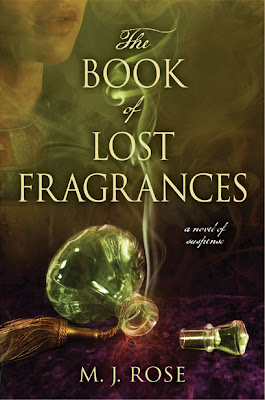
The Book of Lost Fragrances by M.J. Rose

The Book of Lost Fragrances by M.J. Rose continues the search for the 12 memory tools that Malachai Samuels continues to search for as part of his research and obsession with reincarnation.  The novel focuses not on Samuels per se, but on the history of the L’Etoile family and their development of perfumes and fragrances.  Jac has given up the family business, even though the family has insisted that she has the more discerning nose for scent, but her brother Robbie continues to believe that their family business can be saved from the brink of bankruptcy through the development of a new line of scents rather than from the sale of their trademark scents.

Rose weaves Napoleonic history with that of China and the oppression of Tibet and then brings those ties even further back into history to Egypt and Cleopatra.  In addition to archeology, her characters delve into mythology, history, and hieroglyphics translation and more, creating an even denser and more mysterious novel than expected.  How these moving pieces come together is unexpected and absorbing.

“The corpse on the left didn’t have his arms crossed on his chest, as was the custom.  Instead his right hand was extended and holding the hand of a woman with whom he’d been mummified.  Her left hand was knotted with his.  The two lovers were so lifelike, their bodies so uncorrupted, it appeared they had been buried months ago, not centuries.”  (Page 5 of ARC)

Through shifting time periods and places, readers travel with Rose’s characters to the deep recesses of their past lives, their memories, and their discoveries, while at the same time feeling the time pressure build as the House of L’Etoile draws nearer to demise and Jac’s brother Robbie disappears following a murder.  Jac must confront the loss of her mother and the expectations of her family as she strives to find her brother, find the perfume that people would kill for, and stay alive and grounded.  Jac must learn that forgetting or ignoring the past will not help her move into the future; she must accept what has happened, take it into herself, and move forward with those memories as a part of her.

“His family’s maison in Paris dated back to the mid-eighteenth century.  One shouldn’t tear down the past to make way for the future.  That’s how lessons were lost.  The art of keeping a civilization alive, like the art of making perfume, was in the blending.”  (page 46)

Meanwhile, Xie, a young calligrapher and artist in China, is living a secret life as a subversive.  Outwardly, he is the model citizen never saying too much but always thankful for opportunities presented to him by his teachers and the government.  He’s eventually chosen along with other artists to leave China on a European tour with their artwork, which makes him incredibly nervous given his communications with outsiders through his paintings.  He strives to free Tibetans from Chinese rule.  Although he is friends with others who are more outwardly subversive than he is, he tries desperately to rein in their tendencies, which could get him in trouble as well as ruin all of his plans.

The Book of Lost Fragrances by M.J. Rose blends history and mystery in an intellectual game of espionage and mythology surrounding a lost book of fragrances from the time of Cleopatra and a perfume that can help those who smell it relive their past lives.  But the novel also is about finding one’s soul mate, rekindling lost faith, and persevering against all odds.  Another winner from Rose in her series of books that will keep readers guessing adn second-guessing themselves until the memory tolls are discovered.

Also Reviewed:

The Hypnotist by M.J. Rose
The Memorist by M.J. Rose
About the Author:

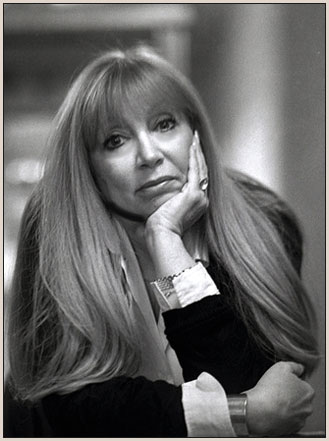
M.J. Rose is the international best selling author of eleven novels and two non-fiction books on marketing. Her next novel THE BOOK OF LOST FRAGRANCES (Atria/S&S) will be published in March 2012.  Her fiction and non-fiction has appeared in many magazines and reviews including Oprah Magazine. She has been featured in the New York Times, Newsweek, Time, USA Today and on the Today Show, and NPR radio.  Rose graduated from Syracuse University, spent the ’80s in advertising, has a commercial in the Museum of Modern Art in NYC and since 2005 has run the first marketing company for authors – Authorbuzz.com.  The television series PAST LIFE, was based on Rose’s novels in the Renincarnationist series. She is one of the founding board members of International Thriller Writers and runs the blog- Buzz, Balls & Hype.  She is also the co-founder of Peroozal.com and BookTrib.com.

Rose lives in CT with her husband the musician and composer, Doug Scofield, and their very spoiled and often photographed dog, Winka.

For more information on M.J. Rose and her novels, please visit her WEBSITE. You can also find her on Facebook.

Click for the rest of the tour


Please follow the discussion on Twitter: With Hashtag: #LostFragrancesVirtualBookTour
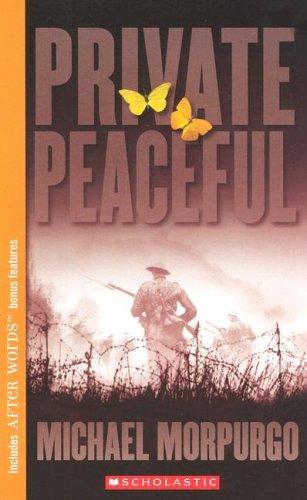
Private Peaceful by Michael Morpurgo

Private Peaceful by Michael Morpurgo is a coming-of-age novel (grades 7 and older) that sets readers up for the dreary and devastating life of a young boy, Tommy Peaceful, whose father dies unexpectedly at work as a forester.  Tommy and his brother Charlie are inseparable, and their other brother Big Joe has special needs and is often protected by the family whether it is in the school yard or at home from their Great Aunt.  Tommo tells the story in a series of flashbacks about his father’s death, his regret about how it happened, his friendship and kinship with his brother Charlie and their schoolmate Molly, and The Great War that invades their lives.  Readers will not immediately grow close to Tommo in the beginning, but as he opens up about his past and present situation overseas, it is revealed that things have changed far more and far too quickly for him.  He’s fallen in love, rushed to become an adult, and headed off on an adventure that was far less exciting and far more harrowing than he expected.  Each chapter begins with a little snippet of his present situation before Tommo relives his past happinesses, until the two moments meet in time.

“I want to try to remember everything, just as it was, just as it happened.  I’ve had nearly eighteen years of yesterdays and tomorrows, and tonight I must remember as many of them as I can.  I want tonight to be long, as long as my life, not filled with fleeting dreams that rush me on towards dawn.”  (page 1)

Morpurgo is at his best here with the subtle foreshadowing at the beginning with the crows caught in the fence, like the cavalry caught in the barbed wire of the battle fields and throughout in how Tommo relates his story.  He was 15 when he enlisted in the British military, but only after Charlie agreed to lie for him and say that they were twins of the same age.  These devoted brothers have shared everything — the sorrow of losing a father, the sorrow of losing a dog, the joy of finding Big Joe alive, and the love of Molly — but sharing everything also can breed secrets and resentment, which Tommo brings to the forefront when he speaks of Molly.  From the beginning, readers are given a clear picture of Tommo’s devotion and love for Molly, but it is clear that she treats him more as a sibling and he refuses to see it.

“Every uniform and every helmet was like our own.  Then, as we came down the gangplank into the fresh morning air, we saw them, the lines of walking wounded shuffling along the quay toward us, some with their eyes bandaged, holding on to the shoulder of the one in front.  Others lay on stretchers.  One of them, puffing on a cigarette between pale parched lips, looked up at me out of sunken yellow eyes.  ‘G’luck lads,’ he cried as we passed.  ‘Give ’em what for.’  The rest stayed silent and their staring silence spoke to each of us as we formed up and marched out of town.”  (page 115)

Morpurgo’s prose is clear and concise to ensure the mood is vivid and the experience of first person has the full impact, particularly during training and in the trenches.  A bit more for maturer audiences with its focus on the war and soldiering, but there are lighter moments of ribbing between the soldiers and talk of girls and even romance.  However, Private Peaceful by Michael Morpurgo is more about a young man coming into his own and dealing with the decisions he’s made and the events he’s witnessed.  Tommo has not only a colored past of poaching and death, but also a soldiering present that has tested his courage and devotion.  An excellent introduction to The Great War.


This is my 2nd book for the WWI Reading Challenge.

War Horse by Michael Morpurgo

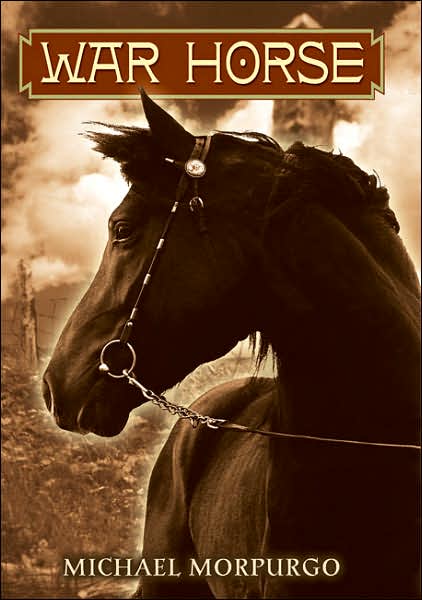
War Horse by Michael Morpurgo is told from the point of view of the horse, who is sold at auction to a drunken farmer and is written for a younger audience, grades 5-8.  In this coming of age story, the young boy Albert Narracott and his Red Bay Joey grow up together and the bond they create lasts through a number of obstacles.  Joey is sold and is off to war — The Great War — to work as a cavalry horse.  Like soldiers in war, Joey must learn maneuvers and be conditioned to fight, which really translates into unlearning farm work and learning how to get his rider safely through the enemy lines.  Morpurgo takes Joey and his readers on a harrowing journey through France where much of the battles take place, and like soldiers, horses were captured as prisoners of war.

“All around me, men cried and fell to the ground, and horses reared and screamed in an agony of fear and pain.  The ground erupted on either side of me, throwing horses and riders clear into the air.  The shells whined and roared overhead, and every explosion soon seemed like an earthquake to us.  But the squadron galloped on inexorably through it all toward the wire at the top of the hill, and I went with them.”  (page 59)

The anthropomorphism of Joey is stunning in this novel.  Morpurgo really understands how to create an animal character who seems more like a human being.  Joey struggles with war fatigue, fear, loss, and a whole set of other emotions, but while away from Albert, he holds onto the love and comfort of his farm life.  Along the way he is treated well and mistreated.

“I found Topthorn was always by me and would breathe his courage into me to support me.  It was a slow baptism of fire for me, but without Topthorn I think I should never have become accustomed to the guns, for the fury and the violence of the thunder as we came ever nearer to the front line seemed to sap my strength as well as my spirits.” (page 44)

What more could readers ask for in a young readers novel about WWI?  A champion horse who earns an Iron Cross and saves his riders from certain death, but who fears and loves just as the young boy he knew did, just as everyone does.  Joey is a hero in more ways than one, and his courage is something that all young readers could learn from, especially how Joey overcomes his fear of strange lands and people.  Additionally, he strives to do his best even when he doesn’t want to do what the humans have him doing and even though it is painful to go on without food and shelter.  Survival is paramount, and Joey not only looks out for himself and his riders, but he befriends and cares for other horses in the regiments.

War Horse by Michael Morpurgo is stunning and engages readers early on in the struggles of a young horse who is taken from his home and thrust into WWI in 1914.  There are images of war, but there is nothing too gruesome that parents should worry about young readers.  On more than one occasion, readers will be moved, and chests will be full of emotion and tears will well in their eyes as Joey relates his story.  A great way to learn about the harrows of war without delving too deeply into the politics or military strategy, while at the same time demonstrating its far reaching impacts on non-military personnel, soldiers, and horses.

This is my 1st book for the 2012 New Authors Challenge.


This is my 1st book for the WWI Reading Challenge.


Jarrettsville by Cornelia Nixon

Jarrettsville by Cornelia Nixon begins in 1869, four years after the Confederate surrender and the assassination of President Abraham Lincoln, in Jarrettsville, Md., just below the Mason-Dixon line.  Tensions continue to run high in this town with former Confederate and Union soldiers continue to hold their prejudices and wear them on their faces and express them in their venomous words.

With tensions running high, the only possible outcome for a young love between Martha Jane Cairnes, the daughter of a Southern and loyal Confederate family, and Nick McComas, a former Union soldier and advocate of Black rights, is heartache and murder.

Nixon rips pages from events in her family history to create a novel that breaths life into the tensions following the U.S. Civil War.  Despite the reunification of our nation, both sides are unwilling to let go and reconcile.

“‘We’ve got to get the Black Code back, by God.  Negroes roaming around free, reeling drunk, menacing descent women? We can’t have that here!’

‘And the women are worse than the fellows.  They’re degenerates, full of disease, corrupting our youth.  Even the little girls, I swear.’

‘That’s right, Negro girls can’t help themselves.  They’re overheated by nature, worse than the fellows, I swear.'”  (page 106 of ARC)

Martha is a strong-willed woman who sets her sights on what she wants and goes after it, while Nick is more deliberate and cautious in his approach to decisions.  However, when love takes them over, passions get out of control, leading them into compromising situations.  Then the rumors begin among the former Confederates about Nick and Martha, equally untrue and equally damaging to their reputations.  Unfortunately, these rumors are what slices and dices their relationship, particularly since it is so new and untested and both sides are tragically unable to confide in one another with the depth that friends would do.

The novel is broken into four parts, plus an epilogue, and those readers looking for integrated points of view throughout the story will find Nixon took a different approach, instead breaking up the narrative into parts dominated by one point of view or by several witness’ points of views in the final section.  The format is a bit disconcerting when the first sections end in the same place, but are told from different points of view.  However, although the events are similar, there are moments where more is revealed by one point of view than another, which helps explain more of the characters’ motivations.  Although not an ideal format for this historical fiction novel, it is easy to understand Nixon’s decision for choosing it.

Overall, Jarrettsville by Cornelia Nixon provides an inside look at the tensions that still plagued the south following the resolution of the civil war and how it tore apart families, friends, and neighbors.  Additionally, it depicts the struggles that the families in the south faced in light of scarce resources and finances.  Nixon is a talented writer who can deftly translate a portion of her ancestral history into a compelling tale of fiction.

About the Author:

Cornelia Nixon is the author of two novels, Now You See It and Angels Go Naked, as well as a study of D. H. Lawrence. She won first prize in the 1995 O. Henry Awards. She teaches in the M.F.A. program at Mills College, near San Francisco.

I hope you enjoyed this latest Literary Road Trip in Jarrettsville, Md., following the U.S. Civil War and assassination of President Abraham Lincoln.

This is my 1st book for the U.S. Civil War Reading Challenge 2011.

This is my 6th book for the 2011 New Authors Reading Challenge.

Confession time, I’ve wanted to read this book since I picked up an ARC at the 2009 Book Expo America.  This is my 4th book for the 2011 Wish I’d Read That Challenge.

Matterhorn by Karl Marlantes

Matterhorn by Karl Marlantes is bound to be an instant classic among Vietnam War literature.  Drawing from his experiences as a Marine Lieutenant, much like many of the other authors’ novels, Marlantes’s perspective is not only of Marines on the ground in the depths of the jungle, but of a lieutenant who experienced first hand the political battles and horrifying decisions made by other officers and politicians.  Weaving in political dilemmas and screw-ups into the narrative can be burdensome for many writers — dragging down the plot and characterization — but this is not the case with Marlantes’ Matterhorn.

Mellas, the main protagonist, enters Vietnam as a lieutenant with a variety of ambitions for advancement and medals.  He’s been to Ivy League schools, he’s had a charmed life compared to the others in the bush, but he likes to feel like one of the ordinary guys in the bush, though at the same time, he wants to fit in with the officers and to prove his worth.  He’s a dichotomy in himself, displaying openly the struggle between the grunts and the officers within one man.

“Mellas was amazed and ashamed.  He realized part of him would wish anything, and maybe even do anything, if it meant getting ahead or saving his own skin.  He fought that part down.”  (page 7)

Mellas is thrown into Bravo Company and told to take hold of Matterhorn, only to abandon it when the political forces deem Cam Lo a bigger priority.  But by not having the support necessary from the base camps, his company runs out of water and other supplies, forced to hump through the jungle dehydrated and shot up.  There is more than one instance in which this company is thrown into battle with impossible odds, which will remind many readers of the movies that glorify the marines and their victories.  However, this novel shows readers the true nature of those “hollow” victories.  While these men remain dedicated to their missions and each other, without proper strategy and backing their victories become senseless in the eyes of loss and terror.  Even victories become jokes once the reports are made to the command posts and the reports of confirmed and probable dead are doctored — something that was common during the war.

“The records had to show two dead NVA.  So they did.  But at regiment it looked odd — two kills with no probables.  So a probable got added.  It was a conservative estimate.  It only made sense that if you killed two, with the way the NVA pulled out bodies, you had to have some probables.  It made the same sense to the commander of the artillery battalion:  four confirmed, two probables, which is what the staff would report to Colonel Mulvaney, the commanding officer of Twenty-Fourth Marines, at the regiment briefing.”  (page 91-2)

Mellas finds his place within the company and even becomes respected, but his continued ambition clouds much of his judgment and often forces him into situations that are more dangerous than they need to be.  Beyond Mellas, the company is hampered by continued racial tensions between the “brothers” and their white counterparts, with some elements on both sides more violent and outspoken than others.  Others are aware of the increased tension and racial hatred, but attempt to brush it under the rug or ignore it.  The tension builds within the “brothers” camp, pitting China against Henry, in such a way that it can only be released in one way.

“Jackson folded his arms. ‘You think someone’s going to understand how you feel about being in the bush? I mean even if they’re like you in every way, you really think they’re going to understand what it’s like out here? Really understand?’

‘Probably not.’

‘Well, it’s like that being black. Unless you’ve been there, ain’t no way.'” (page 429)

As for the officers back at the base camp, readers will find in Lieutenant Colonel Simpson a possible mirror image for Mellas, depending on how well he reacts to combat situations and political decisions beyond his control.  Simpson is often drunk, quick to anger, and makes rash decisions just with a few promptings from peers and underlings.

There are so many layers to Matterhorn, it is impossible to discuss them all in a review.  Mellas is a troubled hero, but in a way the hero is not any individual Marine, but the jungle that surrounds them.  It beats them down; it disguises the enemy; and it leaves them begging for mercy, but it also can provide them shelter; offer them food; and improve their chances of success.  Psychological effects of war, loss, and camaraderie in highly intense situations can be devastating and enlightening.  One of the best books I’ve read all year and easily one of the best books of the last decade.  Readers interested in drama, tension, war-related literature, and human interactions and societal contexts will be as captivated by Matterhorn as any other book that has come onto the shelves.

This is my 63rd book for this challenge.

This is my 15th book for this challenge.

The Cool Woman by John Aubrey Anderson

The Cool Woman by John Aubrey Anderson begins in 1970 when Lieutenant Bill Mann enters pilot training and begins to live his dream of becoming a fighter pilot.  Mann is a black man entering the military at a time when bigotry and ambition made a dangerous cocktail for his race.  He’s determined to make his mark and do his father proud, and in the process meets the love of his life, Pip.

“In the world of aviation, conventional wisdom says:  To keep an aircraft in the air, a pilot will always need at least one of three ingredients:  airspeed, altitude, or ideas. If any one or two of those ingredients is absent or in short supply, the pilot must have a proportionate abundance of whatever remains.” (page 3)

Throughout the novel, Anderson weaves in Mann’s background and hidden secrets, but he also unveils how the path to God and faith is wrought with many obstacles and trials.  Christian faith plays a large role in this novel, as it should given the combat situations and uncertainty in the lives of the families tied to Bill Mann and his friend Rusty Mattingly and every other combat pilot they encounter along the way.

The three ingredients necessary for aviation are like those necessary for faith, but readers will also note that these ingredients can be boiled down to one word — hope.  Hope is the main message of the novel despite the bullets and bigotry flying through its pages.  Anderson’s use of sparse language to tell his story makes the plight of Mann and his friends in the jungles of Vietnam immediate and harrowing at every turn, but it also helps illuminate the enduring camaraderie and bonds that were created between soldiers, nurses, administrators, and many others.

“Apparently, the sound told the gunners exactly where they were; the anti-aircraft fire intensified and became a steel curtain woven of angry red and white arcs.  Driver’s grip tested the stress tolerance of the handholds.  Within seconds the airplane was standing on its nose — the engine was threatening to come off the mounts; swarms of tracers flashed by on all sides, barely missing them.  Driver was as far down in his seat as he could get, mesmerized by one particular string of red balls that seemed frozen in space just outside the canopy.”  (page 107)

Overall, The Cool Woman is a captivating novel about Air Force pilots and the struggles they faced.  It also explores the racism in the military, the politics that gets things accomplished or screws things up, and the faith it takes to not only do what needs to be done, but get through the roughest patches.  Anderson’s cool woman is not the plane, but the inner self that must be crafted and nurtured in times of combat.

This is my 62nd book for this challenge.

This is my 14th book for this challenge.

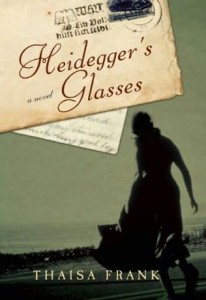
Heidegger’s Glasses by Thaisa Frank

Thaisa Frank’s WWII novel, Heidegger’s Glasses, combines philosophy, mystery, war, and more, woven with crisp, no-nonsense dialogue and just enough detailed description to tantalize the reader to continue the journey.  The story centers on Operation Mail, Briefaktion, a Nazi program to entice Jews to volunteer for relocation by sending letters from their taken relatives.  The letters are actually written by a group of Scribes pulled from the lines of people being relocated, who have special language skills.  A special set of orders, possibly from Goebbels, are sent to the Compound for a philosopher to answer Heidigger‘s letter to his Jewish optometrist Asher Englehardt, who was sent to Auschwitz and is probably dead.

“Hans Ewigkeit had originally planned to line the mine with thick brick walls.  But even before losing Stalingrad, the Reich was pinched for money.  So instead of brick walls, the Compound had thin pine walls covered with a single layer of plaster.  Workers had added five coats of paint.  But the Compound was a flimsy shell:  Scribes put their hands on their ears when they wanted to think.  Mueller had worn earmuffs.”  (page 81)

Enter Elie Schacten, a woman with two lives and names.  She writes some of the letters, but most importantly has permission to be outside after curfew and uses that to her advantage to save those she can from the oppressive Nazi regime.  She is caught between her lies and the ambitious Stumpf who considers himself in charge of the Compound as well as her affection for Lodenstein, the leader of the Compound.  Will the orders to write a response to Hiedigger’s letter expose the Compound for its lackadaisical work and Elie’s operations to rescue Jews, or will the orders be another means of saving helpless souls?

“Light snow began to fall — swirls of white on grey.  The streets widened, narrowed, widened again, expanding and contracting, as though they were breathing.  Nothing felt quite real to Elie — not the sky, or the air, or a coffeehouse where customers drank from incongruously large cups of ersatz coffee.  People hurried by, surrounded by pale grey air — the only thing that seemed to hold them together.  Elie passed a muddy street with a chain-link fence followed by a row of prosperous houses.  The town was breaking up, and she felt she was breaking up with it.  It began to snow thickly, surrounding everyone in white.  We’re bound by veils, Elie thought, fragile accidents of cohesion.” (page 95)

Heidigger’s Glasses is more than a philosophical journey, it takes a look at how the ordinary can become extraordinary.  Each object can have a hidden meaning or take on the life of a memory that will have to serve as a lifeline in the most dire of moments.  Like Hiedigger’s glasses help the philosopher “fall out of the world,” each character must find that moment in time when they fall out of the reality they fear and into the reality that they create.  Frank has taken the time to weave a complex story during a tumultuous time in history, and her novel accomplishes that goal and more.  Her characterizations are unique and dynamic, and the plot is unraveled slowly by the reader who takes an unexpected journey to discover the mettle of even the most ordinary individual.

About the Author:

Photo by Chris Hardy; www.chrishardyphoto.com

Thaisa Frank has written three books of fiction, including A Brief History of Camouflage and Sleeping in Velvet (both with Black Sparrow Press, now acquired by David Godine). She has co-authored a work of nonfiction, Finding Your Writers Voice: A Guide to Creative Fiction, which is used in MFA programs.  Her forthcoming novel, Heidegger’s Glasses, is coming out this fall with Counterpoint Press.  Foreign rights have already been sold to ten countries.

***Thanks to the author, TLC Book Tours, and Counterpoint for sending me a review copy. ***

Please check out the other stops on the tour.

Giveaway information:  1 Copy for 1 lucky reader in the U.S. or Canada

1.  Leave a comment about what historical period you love to read about most.

2.  Blog, Tweet, Facebook, etc., for a second entry and leave a link in the comments.

Deadline Dec. 3, 2010, 11:59PM EST.

This is my 57th book for the 2010 New Authors Reading Challenge.

Fatal Light by Richard Currey

Richard Currey‘s Fatal Light is an unusual novel in which an unnamed narrator provides readers with an inside view of what it is like to be a draftee before, during, and after the war.  Beyond the bullets, the Viet Cong, the mines, and the brutality of war, soldiers had to navigate a culture they didn’t understand, malaria, injury, and unexpected relationships.  The prose is sparse and the chapters are small, but each line, each chapter can knock readers over or back into their seats after putting them on the edge.

The unnamed narrator’s family is dispersed between West Virginia, Maryland, and Ohio, and the tranquility of the Ohio River and its surrounding landscape acts as the backdrop for the later contrasts of Vietnam’s jungles and the war.

“The festival queen and her court rode into view on a float garlanded with tissue flowers, gliding across the horizon of Main Street like a mirage, small-town madonnas sliding past waving their downy arms dreamily, their eyes the eyes of soft animals turned heavenward from thrones of blossoms and crepe, their faces all a magnificent promise, the romance at the end of the world passing so slowly in those long moments of perfect quiet, like the air over the river, the light and stillness inside the world at daybreak, like a held breath.”  (page 12)

There is a deep sadness in Currey’s prose as the narrator spirals further into the darkness of the jungle and of his memories as he recovers from injury and malaria.  But beyond the sadness and memory, the soldier lives on in grief, denial, and anger.  His anger rises at the military establishment, but his connection to his grandfather and those war stories still grounds him in reality.

“Mist filtered, smoke and constant drip. In the distance, the hoarse choke of approaching helicopters.

‘Choppers coming,’ I said. ‘We’re on the way.’

‘Gonna bleed the rest of my life,’ he hissed. ‘Gonna be coming right out of my bones all the rest of my life. You hear what I’m saying?’

I looked at him and the sound of the helicopters grew closer. ‘I hear what you’re saying,’ I whispered.” (page 80)

Unlike other war novels, Fatal Light is less graphic in describing wounds, battle, and recovery but the emotional connection between the narrator’s feelings and the readers are intertwined as they are drawn into each immediate, vivid observation.  While the observations are descriptive, they are not journalistic or clinical.  Currey’s prose is captivating, but realistic and gritty.  Overall, Currey’s slim novel is a memorable, twisted tale of a Vietnam soldier.

***If you missed my earlier recap of Currey’s reading in Bethesda, Md., check it out.  I purchased my copy of the book at the reading.***

Photo by Vivian Ronay

About the Author:

Richard Currey was born in West Virginia in 1949, was raised there and in Ohio, Virginia, Washington, D.C., and Canada. Drafted in 1968, he enlisted in the U.S. Navy and was detached to the Marine Corps, trained as a combat medic, and assigned to various infantry and reconnaissance units. He began publishing poetry after his discharge in 1972, and he drew upon his military experiences in Crossing Over: The Vietnam Stories. His first novel, Fatal Light, became an international bestseller published in 11 languages. Fatal Light received the Special Citation of the Hemingway Foundation as well as the Vietnam Veterans of America’s Excellence in the Arts Award. Currey’s second novel, Lost Highway, looks at the impact of the Vietnam War on an American family and was called “a rich, incisive American fable” by the Boston Globe. Currey’s short stories have received O. Henry and Pushcart Prizes and have been widely anthologized. A former military book reviewer for Newsday, he is now a contributing editor for The Veteran. A recipient of National Endowment for the Arts Fellowships in both poetry and fiction, Currey has also received the D. H. Lawrence Fellowship in Literature and the State of West Virginia’s Daugherty Award in the Humanities.

This is my 11th book for the 2010 Vietnam War Reading Challenge.


This is my 56th book for the 2010 New Authors Reading Challenge.


I hope you enjoyed this latest Literary Road Trip with Washington, D.C., author Richard Currey.

Fallen Angels by Walter Dean Myers

Fallen Angels by Walter Dean Myers is a young adult novel for ages 9-12 or ages 12 and older depending upon maturity.  It touches upon the role and racism encountered by young African-American draftees and volunteers in the Vietnam War.  The coming-of-age novel was banned by certain school districts for its use of profanity, violence, sexual language, and vulgarity, and continually challenged by parents and teachers for the last decade.  Myers pulls no punches in this young adult novel, painting a picture of war as teens drafted in the 1960s would have experienced it and been impacted by it.

Harlem, New York’s Richie Perry volunteers to join the army at age 17 after he realizes its the best option to provide for his alcoholic mother and younger brother and that college is a dream that is too far out of reach since his father abandoned them.  He joins Alpha Company once in Vietnam and meets a cast of characters from a soldier who preaches faith to Peewee who acts as tough as he does on the Chicago streets and sees racism in every comment.

“Hot.  Muggy.  Bright, Muggy.  That was the airport at Tan Son Nhut.  We deplaned, followed Lieutenant Wilson across the field into an area in front of some Quonset huts, and started forming ranks.  It took a while.  The sergeant with the clipboard came along and tried to encourage us as best he could.

‘You faggots can’t even line up straight, how you gonna fight?’ he shouted.” (page 7)

Perry thinks a lot about what to write to his mother and his brother, Kenny, and he details every moment of his time in Vietnam as if he’s keeping a journal.  His relationship with Peewee continues to grow even though their outlooks on getting back to the World differ and their reactions to tragic events are opposite.  Death touches these men in many ways, but mostly they try to forget despite the visions that flit in front of their minds out in the field as they fight the Viet Cong.

“‘How about people in the hamlet?’ Brew asked.

‘We got to show them that we can be peaceful if they peaceful with us, or we can mess them up,’ Sergeant Simpson said.

‘Pacify them to death!’ Peewee said.”  (page 120)

Fallen Angels tackles very adult themes, but from the point of view of young teenagers thrown into a war they do not understand, are unable to describe to their loved ones, and have a hard time dealing with on a day-to-day basis.  How do you define courage? Can killing the enemy and seeing fellow soldiers die be forgotten and should they?  From the spider holes used by the Viet Cong in their guerrilla warfare against the Americans to the miscommunications and changed orders for each unit, Fallen Angels provides an inside look at this confusing war, and sheds light on how inexperienced soldiers react when facing death and superiors they do not understand.  Walter Dean Myers tackles not only morality, but also racism, courage, forgiveness, and finding oneself amidst terrifying circumstances.  The anniversary edition includes information about the author and some book club discussion questions with answers from the author.

About the Author:

Walter Dean Myers is a writer of children’s and young adult literature. Walter Dean Myers was born in West Virginia in 1937 but spent most of his childhood and young adult life in Harlem. He was raised by foster parents and remembers a happy but tumultuous life while going through his own teen years. Suffering with a speech impediment, he cultivated a habit of writing poetry and short stories and acquired an early love of reading.


This is my 53rd book for the 2010 New Authors Reading Challenge.


This is my 10th book for the 2010 Vietnam War Reading Challenge.

Paco’s Story by Larry Heinemann

Paco’s Story by Larry Heinemann chronicles the war experiences of Paco, the only surviving soldier of the Fire Base Harriette massacre from Alpha Company.  The narrative is unusual in that Paco does not tell his own story of his survival or his recovery and ultimate return to the United States from the Vietnam War.  Though readers get to know Paco through the eyes of others and his nightmares, Paco is a vivid and lost character in search of peace.

“Paco is in constant motion, trying to get settled and comfortable with that nagging, warm tingling in his legs and hips.”  (Page 35)

Heinemann’s language is raw, scraping down to the guts and bones in his readers, making them cringe, turn away, and stand agape.  A number of readers may find the graphic scenes in this novel to be too much, but what makes them uncomfortable are the realities of war and the breakdown of humanity.  Paco struggles not only with why he was the only survivor, but how to assimilate himself back into a society he no longer recognizes once stateside.

“(A body never gets used to humping, James.  When the word comes, you saddle your rucksack on your back, take a deep breath and set your jaw good and tight, then lean a little forward, as though you’re walking into a stiff and blunt nor’easter, and begin by putting one foot in front of the other.  . . .”  (Page 9)

Paco is an enigma, which is typical of most returning soldiers from the Vietnam War.  “The intricate ironwork–the tension beams and torsion beams and, overhead, trellis-looking crossbeams–is delicate and well made” (Page 66-7) is an image that will stick with readers as they wonder about Paco and his ability to return from the land of ghosts and emerge from the memories that haunt him.

“And he’s just a man like the rest of us, James, who wants to fuck away all that pain and redeem his body.”  (Page 173)

Heinemann is a brilliant writer, meshing the surreal with the reality of Paco’s life as a dishwasher in the Texas Lunch of Boone, Texas.  Ghosts that push Paco to remember, veterans that tell their own stories, and the looks of townsfolk as he hobbles to and from work all serve to keep Paco entrenched in the jungle with the events that took his innocence and his life.  Paco’s Story is an every soldier story in the way it depicts the horrors of war and the impact of those events on the psyche of those soldiers.

If you’ve missed the read-a-long discussion, please check out my answers to the discussion questions for sections 1, 2, and 3.

This is my 8th book for the 2010 Vietnam War Reading Challenge.

Paco’s Story Readalong Week 2

This is week 2 of the Paco’s Story read-a-long, and the second set of  discussion questions were posted on Wednesday, July 14 for Chapters 3 and 4.

If you missed the first round of questions, check them out.  You also can check out my previous post for section 1.

Like the other chapters, readers only see Paco through the eyes of other characters or the unknown/ghost narrator.  We learn that Paco is on medication to keep the pain away, but how much medication would it take to keep the images of war out of your mind?

One of the most memorable passages for me is in Chapter 3:  “He [Paco] is not really asleep, hunched as awkwardly as he is, but mighty groggy from the several additional doses of medication — muscle relaxers and anti-depressants — to the point of a near-helpless stupor.  . . . Paco is in constant motion . . . ” (Page 35)

As readers move through these next two chapters we see Paco move from location to location — from the bar to the diner to the antique store to the barbershop –but in a way, he’s motionless as he sits and listens to each person or people he meets — silent.  Paco is a dichotomy in this way, and it makes him an enigma.

The narrator continues to demonstrate the reactions to Paco the war veteran and we learn a bit more about his recovery, but do we get to know Paco?  Should this story be told by Paco?  Readers may like to understand his inner thoughts, but I wonder if he thinks much beyond the moment.  He seems focused on finding a job and a place to stay, but not much else.

Even if you aren’t participating in the Vietnam War Reading Challenge, we hope that you will join us for the Paco’s Story read-a-long.  Until next week.

Paco’s Story Readalong Week 1

This is week 1 of the Paco’s Story read-a-long, and the first discussion questions were posted on Wednesday, July 7 for Chapters 1 and 2.

Paco’s Story is about the soul survivor of the Fire Base Harriette massacre where Alpha Company was obliterated.  Heinemann’s writing is raw and honest, and in the first Chapters we’re introduced to Paco through an unnamed narrator, who could be the ghost of a soldier killed in action during the massacre.  Readers learn that Paco is the soul survivor from Alpha Company, and his survival had a serious impact on a medic who until he met Paco had failed to save many soldiers injured in the Vietnam War.

The unnamed narrator is brutal in his honesty about Paco’s injuries and the devastation suffered by soldiers in the field.  He wants to tell his story, Paco’s story, even if people are unprepared to hear it or don’t want to hear it at all.  This is a story that must be told.  I wonder if that is how Heinemann felt while he was writing this novel — did he believe that this story was his calling, something he had to tell.

Even if you aren’t participating in the Vietnam War Reading Challenge, we hope that you will join us for the Paco’s Story read-a-long.  Until next week.