Quantcast

Guest Post: The Home of Visual Imagination by Amanda Grange

Amanda Grange is one of the most well-known writers of Austenesque retellings from Mr. Darcy’s Diary to her latest Henry Tilney’s Diary.  Henry Tilney is one of the main characters in Jane Austen’s Northanger Abbey, which is the novelist’s sarcastic take on the Gothic novel and its frivolity.

Grange’s diary series of books focus on the heroes of Austen’s novels, though there is one about a villain Wickham.  In all of these diary books, Grange gives readers an inside look into the thoughts and pasts of Austen’s male characters, and she does it all while keeping with Austen’s vision and wit.

Today, I’ve got an inside peek into Grange’s writing space and habits.  Please give her a warm welcome and stay tuned for a giveaway.

I do a lot of my writing in my head before I commit anything to paper. When I’m writing my Jane Austen retellings, I start by rereading the original novel. If it’s a nice day, I do this outside, often going to a nearby stately home or formal garden so that I can soak up the elegant, leisurely atmosphere of days gone by. As I read, I let my mind wander over all the questions that occur to me. What was Henry like as a child and young man? What kind of relationship did he have with his parents and siblings? What was life like for him when his mother died? When did he discover a love for Gothic novels? Where did he read them?

I have a very visual imagination, and as I ask the questions, I build pictures in my mind. This is easier if I’m somewhere spacious and elegant, as I can look around and imagine the characters walking round a corner or sitting in an arbour.

Sometimes I will start writing longhand, on a large notepad, and I often do this out of doors if the weather is good. I’ve written quite a few scenes sitting on the bench in the photo, which is at a nearby stately home. Then, once I’m in full flow I move onto the computer. My study is very plain, because once I get down to the actual business of writing, I don’t like distractions. The walls are a neutral colour without any pictures and there is no furniture apart from essential office furniture. My desk is large because I’m an untidy worker and I need space for all my notes, as well as my research books. I start off in an organised fashion, making neat notes in a word document, but I soon resort to scribbling things down on any piece of paper that comes to hand – an envelope, a copy of the Radio Times, anything. If I’m out, I make notes in a notebook I keep in my handbag, except when I forget it, which is often. Then I will scribble ideas down on an old receipt, train ticket or in fact anything that can be written on. I end up with a jumble of papers on my desk and I daren’t throw anything away in case it turns out to be vital.

Once the book is finished, I throw everything away with a great sense of freedom and tidy my study, which remains pristine until I start the next book. I always say I will take a break before starting the next book, but in fact I get itchy fingers and it’s usually only a week or so before I’m raring to go again.

Thanks for sharing your writing space with us. To enter for 1 copy of Henry Tilney’s Diary by Amanda Grange:

1. Leave a comment on this post about what Austen villain you’d like to see write a diary.

2. Blog, Tweet (@SavvyVerseWit), or Facebook the giveaway for up to 3 more entries.

3. Follow this blog and let me know for another entry.

Deadline Dec. 20, 2011, at 11:59PM EST. US/Canada only

The Unexpected Miss Bennet by Patrice Sarath

The Unexpected Miss Bennet by Patrice Sarath tackles the enigmatic figure of Mary Bennet, the third oldest of the Bennet sisters.  She’s the one considered unremarkable and religious in the original novel, Pride & Prejudice.  Here readers will see the struggles of Mary as she finds that she is often ignored or laughed at on almost every occasion.  She turns to sermons and music for solace, though she notes that despite the many hours she spends practicing, she is unable to improve her musical talents.

“It is a comforting belief among much of society, that a plain girl with a small fortune must have no more interest in matrimony than matrimony has in her.”  (page 1)

Sarath’s Mary has grown from the quiet girl, who was content to remain in the background.  Although she’s not sure what she wants out of life, she certainly realizes that her life is not where she wants it to be and that she wants to find a man who is her equal and to be more than her mother’s keeper or a possible governess to her sister Jane’s unborn children.  Jane and Lizzy have bigger plans for their sisters, Kitty and Mary, and plan to expose them to a greater society.  They hope that through their stay the younger sisters can find happiness, but this is Mary’s story.

Sarath has expanded upon Austen’s Mary, and readers can watch her grow into a more confident woman.  Her happiness begins to shine and it rubs off on those around her.  Rather than weave a story about Mary’s pious nature and place her in the path of a clergyman, Sarath guides Mary with deft prose to become more independent from her family and her sisters.  However, there are those moments when Mary doubts her own decisions and resolve, but so too would any woman of her societal standing who is often overlooked by men of her acquaintance as a suitable match and who is considered to be plain.

Readers favorites from Mr. Darcy and Lizzy to Lady Catherine and Anne de Bourgh round out the cast, but the colorful and rambunctious Mr. Aikens captures some of the spotlight as he shows up at inopportune moments and disrupts the decorum of Regency society with his amiable nature and constant rambling about horses.  Sarath’s characterization of Aikens helps offset the quirkiness of Mary in a way that will endear her to readers, who will see her faults as charming foibles of a well-meaning woman.

The Unexpected Miss Bennet by Patrice Sarath is less a commentary on how the wall flower blooms, but rather how as we grow into the adults we’re meant to be, we can surprise even ourselves.  Sarath has a talent for keeping the language modern, the characters vivid and evolving, and the story engaging.  Another Austenesque novel that should be read by those who love Austen and her characters.  Hopefully, Sarath has another novel planned for Kitty Bennet.

To enter the giveaway for 1 copy (US/Canada):

1.  Leave a comment about what has surprised you about your adult self when you look back on how you viewed yourself as a younger person.

2.  Spread the word on Twitter (@SavvyVerseWit), Facebook, or a blog, and leave a link for up to three more entries.

3.  Leave a comment on the guest post for another entry and let me know on this post.

Deadline Dec. 14, 2011, at 11:59PM EST.

Mailbox Monday #152 & Some Winners

Before I get to the mailbox, I wanted to congratulate some winners.  The winner of Jane Austen Made Me Do It edited by Laurel Ann Nattress (my review) was Eva.  The winner of The September Queen by Gillian Bagwell (guest post) was Gwendolyn.  Congrats to you both.

Mailbox Mondays (click the icon to check out the new blog) has gone on tour since Marcia at A Girl and Her Books, formerly The Printed Page passed the torch. This month’s host is the Mailbox Monday tour blog.

Kristi of The Story Siren continues to sponsor her In My Mailbox meme.

Both of these memes allow bloggers to share what books they receive in the mail or through other means over the past week.

Just be warned that these posts can increase your TBR piles and wish lists.

Here’s what I received this week:

1.  Astride a Pink Horse by Robert Greer, which came unexpectedly in the mail.

2.  The Iguana Tree by Michel Stone, which also came unexpectedly in the mail, which I gave to a friend.

3.  The Uncommon Reader by Alan Bennett, which I picked up from the library sale and had to add to my own personal library after reading a copy from the library at Dewey’s urging.

4.  Blue Shoe by Anne Lamott, which I picked up from the library sale since I want to give her fiction a try after reading Bird by Bird.

5.  Puppy Love, a snuggle book, which I picked up at the library sale for “Wiggles.” She’ll love it because the outside of the book is fuzzy and the back has a fuzzy tail.

6.  Little Miss Giggles Has a Giggle by Roger Hargreaves, which I picked up at the library sale for “Wiggles.”

7. Natasha’s Daddy came from her visiting “auntie” who went to the library sale too.

8. Elmo’s Delicious Christmas came with the visiting “auntie” on the plane!

What did you receive?

Interview With Beth Kephart

Earlier today, I posted my review of You Are My Only by Beth Kephart, which I thoroughly enjoyed, and later on in the interview, I’ll let you know how you can win a copy of your own.

I’ve read Beth’s work for the last few years, and I’ve enjoyed her books very much, and I’ve come to understand her writing process through her blog posts and her email conversations.  I just adore her spirit and she’s very motivating even if she doesn’t realize she’s being so.  I was so happy when she agreed to be interviewed about her stellar novel about child abduction, a tough topic for adult and young adult readers alike.

Many of you may have read enough reviews of this book, and some of you may be avoiding the book for one reason or another.  I hope that this interview will help those on the fence about the book to jump off and give Kephart’s work a try.  Without further ado, please welcome Beth.

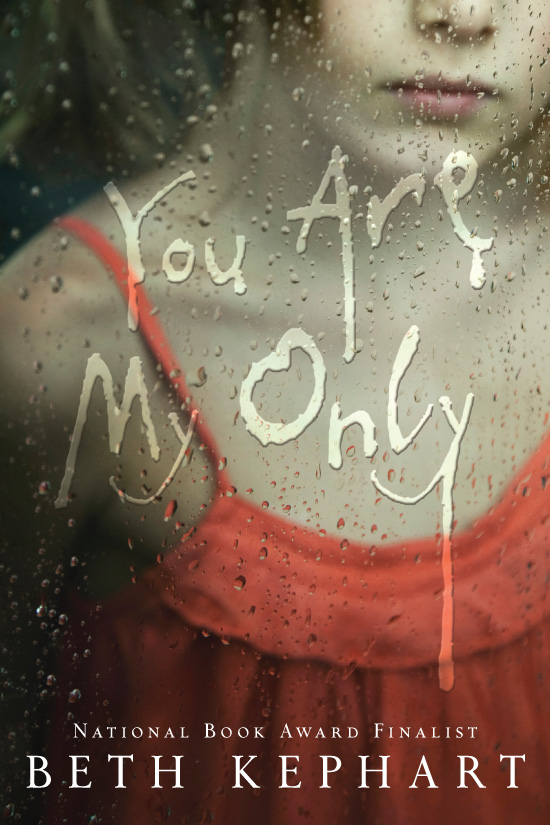
1. You Are My Only is a haunting title with an equally haunting cover. Was it your intention to create a story that would haunt its readers and get them thinking more in depth about child abduction?

Thank you, Serena, for asking such a great first question. First, the cover credit belongs entirely to Neil Swaab, whose work is exquisite. He reads the books he illustrates and that makes all the difference. Second, this book was evolved over such a long period of time that I cannot say that I set out, from the start, to get people thinking more about child abduction. I was thinking about heartbreak—the loss of a child—and how one manages to survive it. I was thinking about the compassion we must have for people whose hearts have been broken.

2. Some readers have said that Sophie’s voice is stronger and the most engaging in the novel. Do you see one voice as stronger than the other? Why or why not?

I am delighted that readers are distinguishing between the voices, for that, I think, is one of the hardest things to do—to make certain the characters sound just precisely like themselves. Sophie is 14 and while she lives an unusual life, she has not been crushed; she is also gaining an education, however unorthodox. Emmy is not nearly as educated, but she has her own poetic intelligence, and she is heartbroken. I love the characters equally. I typically hear a greater preference for Emmy from adult readers and a greater preference for Sophie from teen readers. It never occurred to me that readers would choose one voice over the other; the two voices are necessary to complete the story.

3. Of the scenes that your wrote in the novel, the soaked feet of Emmy swimming like fish in the pond of her Keds has stayed with me longest, in effect symbolizing the disembodiment of her from the life she knew before her child was abducted. Is there a particular scene that woke you from sleep or came to surprise you as you were writing?

Thank you, Serena. This entire book kept me awake for a very long time. The truth is that, while You Are My Only is a novel, some women do live the terribly bereft life of a lost child, and some children are growing up inside airless homes. I felt a great desire to get this right, a great urgency to keep reworking the stories until they honored the emotions (if not the precise storylines) of what real people have endured. I hardly ever sleep when I am working, which is to say: I sport some pretty dark circles under my eyes.

4. Your work often has a poetic feel and I know that you’ve written poetry before. Did/do you have plans for a poetry collection in the future? If not, have you read any great poetry collections that you’d recommend?

I do not have a poetry collection pending, though years ago I thought (for a brief moment) about trying to package a book of poetry and art. It still sits on my computer. I love Neruda, Stern, Gilbert, Ondaatje, Kunitz.

5. Poetry is often considered elitist or inaccessible by mainstream readers. Do poets have an obligation to dispel that myth with their writing styles? Or what other solutions do you see to get more mainstream readers interested in poetry?

Oh, my goodness. This is a great question, but I am not sure I have a good answer for it. Poets have an obligation to be rigorous with language, to imagine deeply, to feel deeply, to know. The rest of us are impoverished souls if we can not find our way to the work of these poets. (And please know that I am not counting myself among these poets; real poets do more than I can do or have done.)

6. Finally, your blog often covers writing struggles, shares photography, and some of your recent reading. How do you find time to balance the blog, writing, and your job teaching? Are there particular habits, routines, or obsessions that help you accomplish that balance?

Oh, Serena, I have no balance. I am grabbing at time, getting up very early, despairing that I will never finish or sell another book. The only thing I know for sure right now is that I cannot work on the computer when I am writing a novel. I have to go to another room and find a slice of sun and some silence. The vast majority of my time is spent running a business—a boutique marketing communications firm called Fusion. The next big chunk of time is spent making sure the house is in order—the bills paid, the floors swept, the meals on the table, and (when my beautiful son is home from college, I try to spend as much time as I can with him, of course). During spring semesters at the University of Pennsylvania, I spend about twenty-five hours each week teaching, preparing for class, working with new students and former students. Finally, to relieve the pressure of things, I dance. And so I write far more slowly than anyone realizes. Weeks will go by without a novelistic or memoiristic word. The blog is my outreach, my way of writing at least some one thing each day.

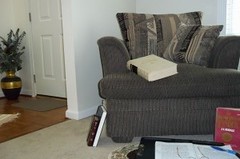
Thanks, Beth, for answering my questions; it has been a pleasure conversing with you in last year or so. As a bonus to my readers, Beth agreed to share a picture of her writing space; isn’t it gorgeous!

Beth Kephart's Office

To Enter to win 1 of 2 copies of You Are My Only by Beth Kephart, leave a comment on this post.

For a second entry, let me know that you commented on my review.

For up to 3 more entries, share this giveaway with people on Facebook, Twitter, and/or your blog and leave a link.

Deadline Nov. 18, 2011, at 11:59 PM EST. Perfect holiday gift.

You Are My Only by Beth Kephart

You Are My Only by Beth Kephart tackles the tough topic of child abduction from two perspectives — that of the young victim, Sophie, and that of a mother, Emmy, whose child is stolen.  In this powerful, yet quiet novel, Kephart explores how one unexpected event can devastate entire worlds.

While the topic is ripped from the headlines, there is no sensationalism here.  Through carefully selected words in her poetic prose, Kephart builds tension and suspense, like the quiet vibration growing louder on the railroad tracks as the train approaches.  It also provides a quiet space — like the air between the branches of a tall tree — for readers to contemplate what each voice is saying, what each voice is struggling to address, what pain is closed inside of them and just clawing to get out.

“My feet are two pale fish inside the tight ponds of my Keds.  I leave the street for the train station.  I leave the station and cross onto the tracks, slick-backed and shiny as snail glisten.  The black gauze of the clouds flap at the moon, and from the tracks I can see into the backs of people’s houses, the private places where the lamps have not gone off.  It’s like looking through snow globes, worlds behind glass.”  (page 21)

Kephart’s prose is very lyrical and imagistic, and readers need to pay careful attention to her lines.  For instance, the above passage perfectly demonstrates Emmy’s frame of mind after losing her child.  She is lost, drowning, unmoored.  She has become separate from those who have “normal” lives because that’s what she believed she had with her child and husband, no matter how imperfect the marriage.

Emmy and Sophie have strong voices, both with stories to tell, and having one without the other here would have left too much unsaid.  Kephart is a masterful storyteller, building characters from the inside out, ensuring readers receive well-rounded men and women with strengths and weaknesses.  But there is always a mystical element to her novels, something in the background that is left unexplained.  She trusts the reader to uncover the truth of these relationships she’s building and the mysteries of what motivates them to keep moving forward even when things are at their most dark and uncertain.

“But my voice skids away, rides the slippery tracks.  Far away, at the bend in the rails, the night is lamped.  It is yellow and growing brighter, and now I understand:  the train has big yellow eyes.  Lovely ocher liquid eyes.  They put the shimmer down on the tracks and splatter the dark.”  (Page 22)

Beyond the main story, there are Helen and Cloris a devoted couple of aunts to a young boy, Joey, who is as normal as can be to Sophie.  Like Joey who supports Sophie, quirky Arlen and fantastical Autumn support Emmy in ways that are unexpected.  Although Emmy’s scenes, which are told from her point of view, limit readers’ knowledge of how she becomes institutionalized, it is not how she got there that is important to the story.  What is important is what happens there and how it transforms her.  Some of the hospital scenes are reminiscent of One Flew Over the Cuckoo’s Nest — minus the booze, floozies,and Nurse Ratched — in that she is there against her will and wants to escape, but for a while she merely is.  The relationship Emmy builds with Autumn helps her repair her broken psyche, and in this way, Kephart’s hospital is the antithesis of what happens in One Flew Over the Cuckoo’s Nest.

You Are My Only is an emotional powerhouse drawing redemption out of the shattered pieces of lives rendered asunder by a single event.  Through faith and love these characters can begin the heal, rebuild, and flourish.  What more could readers ask for?  Stunning, precious, and captivating from beginning to end.

About the Author:

Beth Kephart is the author of 10 books, including the National Book Award finalist A Slant of Sun; the Book Sense pick Ghosts in the Garden; the autobiography of Philadelphia’s Schuylkill River, Flow; the acclaimed business fable Zenobia; and the critically acclaimed novels for young adults, Undercover and House of Dance. A third YA novel, Nothing but Ghosts, is due out in June 2009. And a fourth young adult novel, The Heart Is Not a Size, will be released in March 2010. “The Longest Distance,” a short story, appears in the May 2009 HarperTeen anthology, No Such Thing as the Real World.

Kephart is a winner of the Pennsylvania Council on the Arts fiction grant, a National Endowment for the Arts grant, a Leeway grant, a Pew Fellowships in the Arts grant, and the Speakeasy Poetry Prize, among other honors. Kephart’s essays are frequently anthologized, she has judged numerous competitions, and she has taught workshops at many institutions, to all ages. Kephart teaches the advanced nonfiction workshop at the University of Pennsylvania. You can visit her blog.  Also check out this chat.

My other Beth Kephart reviews:

Please come back this afternoon for my interview with Beth Kephart about You Are My Only and for a giveaway.

Guest Post: Regina Jeffers’ Writing Space

With an influx of new Jane Austen inspired short stories and novels hitting the market, authors are looking for the best way to get readers’ attentions.  Regina Jeffers has written Christmas at Pemberley, in which Georgiana Darcy must embrace the challenges of her hostess duties while her brother and his wife, Elizabeth, are stranded in a small town on the way to Pemberley by a blizzard.  Jeffers uses the Christmas season to bring the Darcy, Bennet, and Bingley families under one roof, and you can imagine what kinds of rivalries and misunderstandings will occur.

Today, Regina will give us a sneak peek into her writing space and habits.  It also seems that we share a certain Mr. Darcy obsession, and my husband would definitely love her selection of NFL Quarterback since he loves the Miami Dolphins.

Finally, one lucky reader will receive a copy of her book by entering the giveaway below.  Without further ado, please welcome Regina:

For writing my novels, I prefer to have everything within my reach. Purposely, I separate where I actually compose my books from where I word process and edit my novels. I need the “disconnect” in order to separate the steps. I write my novels in spiral notebooks, usually wide ruled because I write large. I know from experience that 30 pages of my handwritten story equals ten pages of typed text (Times New Roman, 12 point font). I, personally, hate to read chapters that are longer than ten pages so I have trained myself to work toward that goal. If you read my novels, you’ll note the consistency in the length of my chapters.

Regina's Favorite Chair!

I love the reflected sunlight of this room. In the Regency period, this would have been a small sitting room used for waiting guests to be announced to the master. Note the lap desk, encyclopedic dictionary, and synonym finder beside my favorite chair. Some day, I will have to have this chair reupholstered. I fear my “inspiration” lies in the lumpy cushions. Normally, there is a cup of tea sitting on the nearby table. I brew my own – no American tea bags for me. One can also see my journal sitting at the side, along with my Bible. This is where the creative process comes about.

Once I have written the book, I retreat to my “office” space to do the hard work. My office is the smallest of the three bedrooms in my North Carolina home. From the window, I overlook the curve of the cul de sac upon which I live. Not much happens in this small incorporated village, something I appreciate. It is quiet and relatively crime free. When I first moved here in 2003, “Miss Kitty,” my neighbor, brought me over a chocolate cake. (I didn’t tell her that I prefer white cake to chocolate. It would be rude.) I love the South!!!

Matthew Macfayden Photos

The office reflects my eclectic tastes. I love oversized furniture. The walls hold my “interests.” Of course, there are multiple pictures of Matthew Macfadyen. I enjoy Colin Firth’s work (am a big fan), but I really LOVE Matthew. All the pictures are signed. Yes, I realize this is an obsession, but daily I remind myself that the word “fan” comes from “fanatic.” (BTW, I have seen “The Three Musketeers” six times to date.) I use post it notes of different colors to keep track of appearances, guest blogs, etc.

Miami Dolphins Quarterback Chad Pennington

I also am a big fan of Chad Pennington, the NFL quarterback. He attended Marshall University, where I went to school, but my respect for Pennington comes from his kindness to my son during the difficult period when my mother was dying. He showed himself to be a true gentleman. In Darcy’s Temptation, Chadwick Harrison is so called because of Pennington.

Although I do not write much outside, I often take a cup a tea and a bit of research of which I want to peruse and sit in one of the two “cozy” spaces I have created. The first is a sheltered area at the front of my house. I bricked it all in and set up the potted plants and benches. I loved my hybrid roses and the hibiscus, but mums and pansies surround the area also. In North Carolina, the vegetation lasts well into late November. Behind my house, there is another bench draped by a weeping willow. It serves the purpose well.

So, this is where I have managed to write twelve novels (Darcy’s Passions, Darcy’s Temptation (a 2009 Booksellers’ Best Award finalist), Vampire Darcy’s Desire, Captain Wentworth’s Persuasion, The Phantom of Pemberley (took 3rd in romantic suspense for the SOLA Awards), Christmas at Pemberley, The Scandal of Lady Eleanor, Honor and Hope, A Touch of Velvet, A Touch of Cashémere, First Wives’ Club, and Second Chances), in addition to two novellas (His Irish Eve and His American Heartsong) and one short story (“The Pemberley Ball”) in a little over four years.

Christmas at Pemberley is my newest release and is currently available. I have a December 1 deadline for The Disappearance of Georgiana Darcy, which will take up where Christmas at Pemberley leaves off, but it will be a cozy mystery, rather than an inspirational romance. I am working on two others (one Austen, one non-Austen) at the same time. This is my Writing World. Quite simple. Quite plain. All me.

Thanks, Regina for sharing your writing space with us.Please also check out the slide show of the remaining photos from her writing space.

For those readers interested in reading about the Darcys, Bennets, and Bingleys during the holidays, enter the giveaway below.

1. Leave a comment about what you found most interesting about Regina’s writing space.

2. For up to 3 more entries, share the giveaway on your blog, Facebook, and Twitter, and leave a link for each in the comments.

3. Follow Savvy Verse & Wit for another entry.

Deadline is Nov. 18, 2011, at 11:59PM EST (US/Canada only)

Some Lucky Winners….

Today, I want to congratulate some winners of some spectacular books.

The two winners of You Are My Only by Beth Kephart:

Jill of Rhapsody in Books
Janel of Janel’s Jumble

The winner of The Taker by Alma Katsu:

Johannah from A Book and a Bite

Congrats ladies!

Guest Post: The Next Best Thing to Being There by Gillian Bagwell

Gillian Bagwell‘s The September Queen was released on Nov. 1, and I was thrilled to host her again.  Today, she’s going to share with us her journey and give us a sneak peek into her opportunity to write the first fictional account of Jane Lane, an ordinary Staffordshire girl who risked her life to help the young Charles escape after the Battle of Worcester on September 3, 1651.

Jane Lane was a heroic figure, and I just adore historical fiction with such high drama.  Besides, isn’t the cover of this novel just gorgeous?

Please give Gillian a warm welcome.

I was thrilled that when my agent sold my first novel, The Darling Strumpet, she also sold my second book, as yet unwritten, and was very excited to have the opportunity to write the first fictional account of Jane Lane, an ordinary Staffordshire girl who risked her life to help the young Charles escape after the Battle of Worcester on September 3, 1651.

I wanted to retrace the path Jane had taken in her travels with Charles II, and as some of the places associated with my story would be shortly closing for the winter, and traveling around England wouldn’t get any easier as it got colder, wetter, and darker, I immediately planned a research trip. My friend Alice Northgreaves and I set out from London on October 26, 2009, making our way to Worcester, the site of the battle, from which Charles had fled to Staffordshire, where Jane became involved in his desperate flight.

Charles’s six-week odyssey covered more than 600 miles before he was finally able to sail from Shoreham near Brighton on October 15. After he was restored to the throne in 1660, the story of his escape became known as the Royal Miracle, because of the numerous times he narrowly eluded capture. He told the story to Samuel Pepys, and others also recorded their parts in it, so that the route of his travels is well known. The Monarch’s Way footpath can still be followed.

Some of the sites associated with Charles’s adventures are well preserved. It was thrilling to visit Boscobel House and Moseley Hall and to see the actual priest holes into which the fugitive king curled his six-foot-two-inch frame when hiding from Cromwell’s cavalry patrols. These lovely houses are beautifully maintained by English Heritage and the National Trust respectively, and we enjoyed very informative tours. Whiteladies, where Charles arrived and was hidden at about three a.m. on the morning after the battle, is now a ruin, but is only a short walk from Boscobel, and easily found. Jane’s home, Bentley Hall, is unfortunately no longer standing, but thanks to directions from the staff at Moseley, we were able to get pretty close to the site.

Following the path of Charles’s travels with Jane Lane, and in particular finding the sites of the some of the places where events on the journey had taken place – the inn and the smithy where Charles had to have a horse re-shod, for instance – was a little more complicated. Contemporary accounts provided their general route, through Bromsgrove, where Charles’s horse threw a shoe; to Stratford-Upon-Avon, where they had to ride among enemy soldiers crowding the street; and down to Long Marston, where they stayed at the home of Jane’s cousins John and Amy Tomes. They spent the next night in Cirencester, and reached Abbots Leigh near Bristol the following evening.

Finding that no ship would leave Bristol for France or Spain in less than a month, Charles and Jane then made their way southward to Castle Cary and then to Trent, in Dorset, where they stayed at the home of the Royalist Wyndham family.

When Alice and I weren’t sure about the location of some of we had very good success by popping into a pub to ask the locals, and in this way we were helped by the staff and patrons of the Red Lion in Bromsgrove, the Crown in Cirencester, and the George in Castle Cary.

Jane left Charles at Trent and returned home when it appeared that he would shortly be able to find passage on a boat from the southern coast of England. As it turned out, Charles spent another month in England before he was able to make his way to France, traveling to Charmouth, back to Trent in Dorset, then spending several days near Salisbury before sailing from Shoreham. But that part of his ordeal takes place offstage in The September Queen, which tells Jane’s story. Very little is known about what happened to her after she parted from Charles.

From the preliminary research I had done before embarking on my trip to England, I learned that when Jane’s part in helping Charles escape was discovered, she had fled with her brother and walked to Yarmouth, hoping to reunite with Charles in France. As one book identified Yarmouth as a small town on the south coast near the Isle of Wight, I believed that her travels took her through much the same country through which she had journeyed with Charles.

It was only when I got home to California that I learned to my dismay that there was another Yarmouth – on the east coast of England, and so in a completely different direction and through vastly different country than where I thought she had walked. This part of her story was very important, and I needed to know what she had experienced. But it just wasn’t possible for me to go back to England for a second trip.

I would have to reconstruct Jane’s journey some other way. From a book on historical maps, I learned that in 1686 John Ogilby had published a book of road maps of England – 35 years past Jane’s date, but close enough that not much would have changed. I was overjoyed to find online and be able to buy a 1939 facsimile of the book, which shows the routes between major cities, laid out on parallel strips across the page. It’s a little hard to get used to looking at a map like that, but it gave me an idea of much of the route that Jane would likely have traveled to get from Staffordshire to Yarmouth, and just as wonderfully, depicted the roads and the country surrounding them in great detail, showing the kind of terrain, and features such as villages, bridges, and even large houses and windmills.

But the book didn’t provide guidance for some of the way that Jane must have walked. Another difficulty to surmount. Fortunately, a writer today is blessed with the vast resources of the internet, and I was able to accomplish forensic travel research in a way that wouldn’t have been possible even a few years ago. Google Maps and Google Earth to the rescue! I used Google Maps to ask for directions from one major town on Jane’s route to the next, and then zoomed in close enough to discover the names of the roads, which provided major clues. Unlike many roads in the U.S., which are named somewhat haphazardly or fancifully, old roads in England are frequently still called simply by where they led. So, for instance, finding a road labeled Norwich Road let me know that it was likely that was the path Jane would have followed to reach Norwich. Then I could soar along above the road to see what the landscape was like – and again fortunately for me, even now much of England is rural, and the countryside hasn’t changed substantially from what it had been like in 1651.

So miraculously, I was able to write the long sequence in which Jane and her brother walk from Bentley to Yarmouth accurately describing what they would have seen.

I was able to use up-to-the-minute technology to help me with this very old story in another way, too. When Alice and I were where we thought should be the site of Jane’s home Bentley Hall, just off the Wolverhampton Road near Walsall, we weren’t sure we had found it. There was a muddy building site that we thought might be where the house had stood, but the area is sadly very run down and not at all like what it would have been in Jane’s time. We asked in a shop if anyone knew about Bentley Hall, and were directed to the home of a local lady, Pauline Gibson, who we were told knew a lot about the area’s history. But she wasn’t home, and the neighbor with whom we left a note didn’t know when she’d be back.

We had to press on in order to get to our appointment to tour Packington, where Jane lived in later life. But having come so close, I was reluctant to leave without knowing we were in the right place. On an inspiration, I pulled out my iPhone and Googled “Bentley Hall Staffordshire.” Bingo! Up popped Michael Shaw and Danny McAree’s article “The Rediscovery of Bentley Hall, Walsall,” originally published in West Midlands Archaeology Vol. 50 (2007), pages 2-5. It told me that we were very near the site of Jane’s home. We still couldn’t find the cairn that was supposed to mark its location, and it wasn’t until I spoke by phone with Pauline Gibson later that I learned we should have continued another hundred yards or so south, but still, I had been able to find the place that Jane had lived, to see the horizon at which she would have gazed, and to feel the cool October breeze she would have known in that spot.

Still other parts of Jane’s story took place in Paris and The Hague, and to a lesser extent in Breda, Spa, Aix-la-Chapelle, Dusseldorf, and Cologne. It was just as impossible for me to visit those place in person as it had been for me to return to England. But once more I was fortunate in being able to find online old images and descriptions of these places, which, with modern images and descriptions, and help from my friend Kirsten Shepard, who was fortuitously in Paris at the time, I could conjure the backdrops for scenes from my book without ever leaving home.

Not as much fun as traveling for research, but as Jane might have said, “Needs must when the devil drives!”

Thanks, Gillian! Sounds like you really enjoyed your research, and we look forward to more novels.  Please check out the slide show below:

Gillian Bagwell Copyright Brendan Elms

About the Author:

Gillian Bagwell grew up in Berkeley, California, and began her professional life as an actress, studying at the University of California Berkeley and the Drama Studio London at Berkeley before relocating to Los Angeles to pursue a career in film and television. She moved into directing and producing theatre, founding The Pasadena Shakespeare Company, where she served as artistic director for nine years, producing thirty-seven critically acclaimed productions.

She united her life-long love of books, British history, and theatre in writing her first novel, The Darling Strumpet, based on the life of Nell Gwynn. Her second novel, The September Queen, is the first fictional account of the perilous and romantic odyssey of Jane Lane, an ordinary English girl who risked her life to help the young Charles II escape after the disastrous Battle of Worcester in 1651 by disguising him as her servant. Gillian recently returned to Berkeley and is at work on her third novel, about the formidable four-times widowed Tudor dynast Bess of Hardwick.

Please visit her Website, her blog, on Twitter, and on Facebook.

To enter to win 1 copy of The September Queen by Gillian Bagwell (US only):

1.  Leave a comment about why you’d like to read the novel.

2.  Follow Gillian on Twitter and Facebook for 2 more entries, leave your Twitter/Facebook names.

3.  Blog, Tweet, or Facebook the giveaway for up to 3 more entries and leave a link to the posts.

Deadline is Nov. 9, 2011, at 11:59PM EST.

Guest Post: Trick or Treating with Jane Austen Made Me Do It by Laurel Ann Nattress

Earlier this week I reviewed Jane Austen Made Me Do It edited by Laurel Ann Nattress of Austenprose fame.  This collection provides readers with a wide breath of Jane Austen inspired short stories that range from love and romance to witty humor and mystery.

Today, Laurel has graced us with her presence (and a giveaway) to talk about the more spooky stories in the collection in honor of Halloween, which is tomorrow.  Get your candles burning and your costumes on; it’s time to trick or treat . . . or at least have a costume party with a little Jane Austen.

Without further ado, here’s Laurel.  Please give her a warm welcome and stay tuned for the giveaway.

Hi Serena, I am so honored to be here today at Savvy Verse & Wit during my Grand Tour of the blogosphere in celebration of the release of my new Austen-inspired anthology, Jane Austen Made Me Do It.

Halloween is tomorrow and I am all anticipation of a favorite holiday. One of the things I loved about it as a child was that I could be anyone, or anything, I wanted to be for one night of the year. I used to get very creative with my costumes! Being a child of the “television generation,” my costume choices were strongly influenced by what I had recently seen on T.V. I remember trick or treating in a hoop skirt one year as Scarlet O’Hara after seeing the movie Gone with the Wind! One wonders out loud what I would be influenced to be now? Jane Austen? Oh, I wouldn’t dare. I think I could be one of her characters, but never the Incomparable One. 😉

We don’t know if the Austen family celebrated All-Hallows Eve in Hampshire when Austen was a girl, but since they were very fond of family theatricals, I could imagine them reading out loud from the popular Gothic fiction novels of the day like, The Mysteries of Udolpho or The Monk, and scaring each other with horrid tales. Jane would later be so influenced by the Gothic genre that in 1798-99 she would write a parody of it. First entitled Susan, and later renamed as Northanger Abbey, the novel was published posthumously after her death in 1817. One of Austen’s lesser known works, I consider Northanger a hidden jewel, full of tongue-in cheek humor, allusions to Gothic fiction and more importantly, containing one of her most charming and endearing heroes, the teasingly witty Henry Tilney.

Because of its Gothic elements, I always gravitate to Northanger Abbey during this time of year. It never fails to charm, delight and make me laugh out loud at Austen’s audacity at having fun with her characters and the genre. My new Austen-inspired short story anthology, Jane Austen Made Me Do It, contains twenty-two original stories, five of which are perfect for a Gothic reading on the Halloween holiday. Interestingly, they all are contemporary tales. The first two are heavily inspired by Austen’s Northanger Abbey: “A Night at Northanger” and “The Mysterious Closet,” the third, “The Ghostwriter” features Jane Austen as a advice giving ghost, the fourth transports Austen’s most iconic romantic hero, Mr. Darcy, into the twenty-first century in “Me and Mr. Darcy, Again,” and the fifth, “Intolerable Stupidity,” is a high burlesque comedy involving Mr. Darcy in a law suit against those responsible for modern adaptations and spinoff’s. Here is a description of each:

“A Night at Northanger,” by Lauren Willig

Our heroine, Cate Cartwright, is part of the cast of “Ghost Trekkers”, currently filming at one of England’s most haunted homes, Northanger Abbey. Naturally, Cate knows there’s no such thing as ghosts. It’s all smoke and mirrors for the credulous who watch late night TV. At least, that’s what she thinks… until she meets the shade of one Miss Jane Austen during one fateful night at Northanger.

“The Mysterious Closet: A Tale,” by Myretta Robens

In the wake of her most recent failed relationship, Cathy Fullerton takes an extended vacation in a converted Abbey in Gloucestershire, England. Ensconced in the Radcliffe Suite, a jet-lagged Cathy mistakes a walk-in closet for a Vaulted Chamber, a clothing rack for an Instrument of Torture and an accumulation of cobwebs for her True Love.

“The Ghostwriter,” by Elizabeth Aston

Sara, obsessed with Pride and Prejudice, is jilted by Charles, who can’t compete with Mr. Darcy. His parting gift is a lock of Jane Austen’s hair. Sara wakes the next morning to find a strange woman sitting on the end of her bed. A figment of her imagination? No, it’s the astringent ghost of Jane Austen. On a mission to restore the reputation of forgotten Gothic author Clarissa Curstable, Jane Austen saves Sara’s career and brings Charles back before taking herself off into the ether, but there’s a price to pay, as the couple discover when they wake up to find another ghostly visitor at the end of the bed. It’s Jane’s friend, Clarissa – and she plans to stay.

“Me and Mr. Darcy, Again…,” by Alexandra Potter

Mr. Darcy is every woman’s fantasy. But what happens when he becomes one woman’s reality? In 2007 Emily traveled from New York to England to go on a Jane Austen-inspired literary tour. There she met and fell in love with Spike, an English journalist.

She also met Mr. Darcy… Or did she? She can never be sure if it really happened, or it was her over-active imagination. Now, four years later, she’s had a huge row with Spike and is back in London nursing a broken heart. And there’s only one person who can mend it. Mr. Darcy….

“Intolerable Stupidity,” by Laurie Viera Rigler

Well hidden from the ordinary world, in a little-known corner of jurisprudential hell known as the Court of Intolerable Stupidity, a legal drama of literary proportions unfolds. The plaintiff is none other than the most famous romantic hero of all time, Mr. Darcy. The defendants are the authors who dared write sequels, adaptations, and inspired-by’s of his Creator’s most beloved work, Pride and Prejudice. One of those works, whose author was tried and convicted in absentia, is so popular that its salacious swimming-in-the-lake scene has resulted in Darcy’s being forced to endure a perpetual state of shivering wetness in a transparent white shirt. For when Darcy’s adoring public isn’t throwing water on him, his umbrella breaks in the midst of a downpour. And now, between the zombies and the vampires, Darcy and his wife Elizabeth are at their wit’s end. So is defense attorney Fritz Williams, who not only fights a losing battle in a kangaroo court ruled by Darcy’s tyrannical aunt, the Honorable Lady Catherine de Bourgh, but also his secret infatuation with prosecuting attorney Tawny Wolfson. Who has her own secret: a hopeless addiction to the illegal miniseries that she is supposed to abhor.

I hope that readers find Austen’s creative spirit and witty Gothic humor this Halloween by indulging in a bit of trick or treating with Jane Austen Made Me Do It. Please enjoy one of my favorite passages between Austen’s hero and heroine of Northanger Abbey to set the mood.

“You have formed a very favourable idea of the abbey.”

“To be sure, I have. Is not it a fine old place, just like what one reads about?”

“And are you prepared to encounter all the horrors that a building such as ‘what one reads about’ may produce? Have you a stout heart? Nerves fit for sliding panels and tapestry?”

– Henry Tilney and Catherine Morland, Chapter 20


Thanks so much, Laurel; it was great hosting you!

About the Editor:

A life-long acolyte of Jane Austen, Laurel Ann Nattress is the author/editor of Austenprose.com a blog devoted to the oeuvre of her favorite author and the many books and movies that she has inspired. She is a life member of the Jane Austen Society of North America, a regular contributor to the PBS blog Remotely Connected and the Jane Austen Centre online magazine. An expatriate of southern California, Laurel Ann lives in a country cottage near Snohomish, Washington.  Visit Laurel Ann at her blogs Austenprose.com and JaneAustenMadeMeDoIt.com, on Twitter as @Austenprose, and on Facebook as Laurel Ann Nattress.

To Enter the Giveaway for 1 copy of Jane Austen Made Me Do It edited by Laurel Ann Nattress (US/Canada only):

1.  Leave a comment about your favorite Halloween story or what intrigues you about reading an Austen-inspired short story anthology.

2.  Follow Laurel Ann Nattress on Facebook and Twitter, leaving a comment here that you did with your Facebook and Twitter names for 2 more entries.

3.  Leave a comment on my review for another entry.

4.  Blog, Tweet, Facebook the giveaway and leave a link here for up to 3 more entries.

Deadline is Nov. 7, 2011, at 11:59PM EST.

Winners to be drawn at random! Good luck to all!

I’m Hosting Mailbox Monday #149

First, I would like to congratulate (Vicki) on winning Waking by Ron Rash from the last Mailbox Monday giveaway.

Stay tuned for the next giveaway later on in the post, but for now, let’s get to this week’s post.

Mailbox Mondays (click the icon to check out the new blog) has gone on tour since Marcia at A Girl and Her Books, formerly The Printed Page passed the torch. Thanks to Amused by Books for hosting last month.

As host for this month, I have a couple giveaways planned, but mostly its about sharing books and the love of reading, so I hope in addition to leaving your post links in Mr. Linky that you’ll peek around Savvy Verse & Wit.

Kristi of The Story Siren continues to sponsor her In My Mailbox meme.

Both of these memes allow bloggers to share what books they receive in the mail or through other means over the past week.

Just be warned that these posts can increase your TBR piles and wish lists.

I didn’t receive anything this week, but please share what you received and enter the giveaway below:

Please leave your link below to your mailbox.

Now, for the giveaway for the week.  I’m holding an U.S. resident giveaway for Lost Edens by Jamie Patterson.  Deadline to enter is Oct. 29, 2011.

About the Book:

For Jamie Patterson, the end of her marriage is signaled by betrayal and abandonment. When estranged husband Ben asks to live with Jamie again, she ignores her instincts, her family’s concern, and her friends’ doubts and sets about making a perfect home in a California beach town.

What follows in 33-year-old Patterson’s debut reads more like a mystery (or a horror story) than an account of a relationship ruptured by infidelity. As Jamie’s carefully titrated efforts walk a tightrope between wishful fantasy and cruel reality, we watch: enraptured, enraged, and endeared by this fearless yet fragile young woman who must end one way of life to forge a new one.

Please leave a comment if you are interested in this book.

Her Sister’s Shadow by Katharine Britton

Her Sister’s Shadow by Katharine Britton is aptly titled given that Lilli Niles has always felt like she is living in the shadow of her “perfect” sister Bea.  Bea takes on a guardianship role when Lilli is about 15 after their father dies and their mother loses touch with reality.  Lilli resents her “perfect” sister’s hold over the family and is even more angry about how Bea lords it over her when she wins crew races and is considered perfect by her mother.  Couple all of that resentment with hormones of adolescence and you can imagine the volatility.

Told in alternating chapters between the past and the present when Lilli returns to White Head, Mass., after 30 years when her sister Bea calls and needs her, Her Sister’s Shadow vividly tells a story of healing after a significant rift between sisters.  Readers will feel the angst of a young Lilli who has just discovered boys and wants to grow up more quickly and the awkwardness of Lilli and Bea who attempt to reconnect after 30 years.

“When she was a girl, after the accident, she would go down onto the rocks, pick her way carefully along their slick surface, and shout her grief and guilt into the deep bass notes of that foghorn.  Her kitchen, all stillness in pools of white light, offered no such camouflage.”  (page 4)

Britton creates characters that are real, flawed, and seeking redemption through their actions even if they are unaware of it.  While Lilli’s relationship with Bea is strained, her relationship with Dori, her younger sister, is sweet and unbreakable.  Lilli’s relationship with Charlotte is more like a mother-daughter dynamic in which Charlotte is a caretaker and empathetic.  There is a great deal at work in these female relationships; their complexity is stunning and palpable.  Each sister is drawn realistically, causing readers to become attached to each one.  It is through this relationship with the reader, that Britton tugs tears out and causes wistful smiles to curl.

Bea’s shadow is not the only one looming over this book.  Britton has crafted a devastating novel through which readers and characters must journey to reach out of the fog and into the light.  Her Sister’s Shadow has a gorgeous setting steeped in coastal imagery that mirrors the churning ocean waves of these relationships which every so often smooth out to reflect the stars and beauty of calm.

About the Author:

Katharine Britton has a Master’s degree in Creative Writing from Dartmouth College. Her screenplay, Goodbye Don’t Mean Gone, was a Moondance Film Festival winner and a finalist in the New England Women in Film and Television contest. Katharine is a member of the League of Vermont Writers and PEN New England. She teaches writing at Colby-Sawyer College, and is an instructor at The Writer’s Center.

When not at her desk, Katharine can often be found in her Norwich garden, waging a non-toxic war against the slugs, snails, deer, woodchucks, chipmunks, moles, voles, and beetles with whom she shares her yard. Katharine’s defense consists mainly of hand-wringing, after-the-fact.

Please follow her blog and Facebook.

To Enter for 1 copy of Her Sister’s Shadow by Katharine Britton: (US/Canada only):

1.  Leave a comment about what kind of relationship you have with your sister or whether you would enjoy having a sister if you don’t have one.

2.  Follow Katharine Britton on Facebook and leave a comment for another entry telling me you did so.

3.  Facebook, Tweet, or Blog about the giveaway and leave a comment with each for up to three more entries.

Deadline Oct. 28, 2011, at 11:59PM EST


To visit the other stops on the TLC Book Tour, click on the icon at the right.


This is my 62nd book for the 2011 New Authors Reading Challenge.

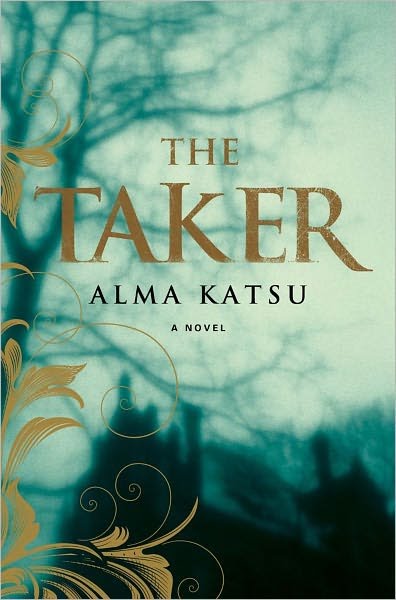
The Taker by Alma Katsu

Alma Katsu’s The Taker has received a number of rave reviews and some unfavorable reviews, and it was recently listed in BookList’s Top 10 Debut books.

Lanore, “Lanny,” shows up in her northern Maine hometown covered in blood, and the police say that she has confessed to killing a man and leaving him in the frozen woods.  ER doctor, Luke Findley, becomes the recipient of a Gothic fairy tale that is more dark and sinister than full of fairy dust, unless that fairy is an evil alchemist and sodomite.

“The stranger had appeared suddenly, at the edge of the gathering that evening.  The first thing Adair noticed about him was that he was very old, practically a shrunken corpse leaning on his walking stick, and as he got closer, he looked older still.  His skin was papery and wrinkled, and dotted with age spots.  His eyes were coated with a milky film but nevertheless had a strange sharpness to them.  He had a thick head of snow white hair, so long that it trailed down his back in a plait.  But most notable were his clothes, which were of Romanian cut and made of costly fabrics.  Whoever he was, he was wealthy and, even though an old man, had no fear of stepping into a gypsy camp alone at night.”  (page 162)

The Taker is a story within a story, within a story, spanning from the dark ages through the present day, and Lanny claims to be immortal, but do not be mistaken into thinking she’s a vampire or werewolf.  She is neither.  Her unrequited love for the town pretty boy, Jonathan St. Andrew, is the main crux of the story and how it brings about her downfall that leads to her life as an immortal.  Katsu spoke recently at Novel Places about the book and revealed that the story of Pinocchio is the backbone of her novel, which is clear in how the desire to grow up and become a woman with her own life separate from her family propels Lanny to be easily led astray.  However, that is where the similarity ends.  Katsu’s novel is ripe with sodomy, rape, kidnapping, murder, and more, which is why it would be a perfectly dark book to read this season as Halloween approaches and is what would once have been considered horror (rather than the popular category of paranormal, which has a “lighter” tone to it).

Lanny tells her story to Luke in the present day, but a more effective approach would have been to have her merely tell her story to the reader.  As many know story framing or using one character as a plot device for another character to tell his/her story is bothersome if the character/plot device is not well developed.  While Luke does have a back story here, it fails to round out the character enough, leaving him flat and boring compared to the characters of Lanny and Adair.  Even Jonathan is little more than a caricature of the pretty boy of the town’s founders, and it would have served to have more of him and Lanny’s interactions in the book at the beginning of their “romance” to demonstrate their affection for one another.  However, being told from Lanny’s point of view, it is incredibly difficult to demonstrate Jonathan’s perspective on their relationship and oftentimes he comes off as a callous womanizer who is incapable of love.

With that said, however, Katsu is adept at time shifts within the story that keep the pace of the novel moving quickly.  Moreover, she creates a deeply atmospheric novel where readers are combing through the mist to grasp the truth of Lanny’s story and to unravel the mystery of her immortality.  Some have said this is a romance; it is not.  Most will debate who is “The Taker,” but there is certainly more than one, and it will depend on your personal perspective as to which you believe is the taker.  They all are takers in their own way — taking what love and affirmation they can, taking the loyalty of others by forcing their hands, and taking pleasure in the act of taking.  Readers who shun violence in books, particularly against women should steer clear.  Katsu’s The Taker is dark and decadent; an excellent debut novel for those looking to tantalize their darker senses with interminable consequences.

Stay tuned for the next two books in this series; I know I will be waiting on the edge of my seat. I’m always on the lookout for horror books, as I’ve grown tired of EMO vamps and werewolves.

For a chance to win my gently used ARC (which has a signed bookplate), please visit this post about Alma Katsu’s reading near me.  If you’re looking for another bonus entry, leave a comment on this review.

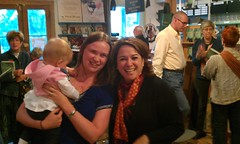
Alma Katsu (right) Me & Wiggles

About the Author:

Alma Katsu is a 30-year DC veteran who lives in two worlds: on one hand, she’s a novelist and author of The Taker (Simon & Schuster/Gallery Books). On the other hand, she was a senior intelligence analyst for CIA and NSA, and former expert in multilateral affairs.  Watch the book trailer or this one.


This is a stop on The Literary Road Trip since Katsu has worked in Washington, D.C., and now resides in Virginia.


This is my 61st book for the 2011 New Authors Reading Challenge.