

Winner Kathy at Bermudaonion

Winner Beth Hoffman
Congrats to both winners!
In other news, I’ve been interviewed by poet and fiction writer Emma Eden Ramos on her blog. Check it out!
Literature and Poetry Reviews, Home of the Virtual Poetry Circle
Winner Kathy at Bermudaonion
Winner Beth Hoffman
Congrats to both winners!
In other news, I’ve been interviewed by poet and fiction writer Emma Eden Ramos on her blog. Check it out!
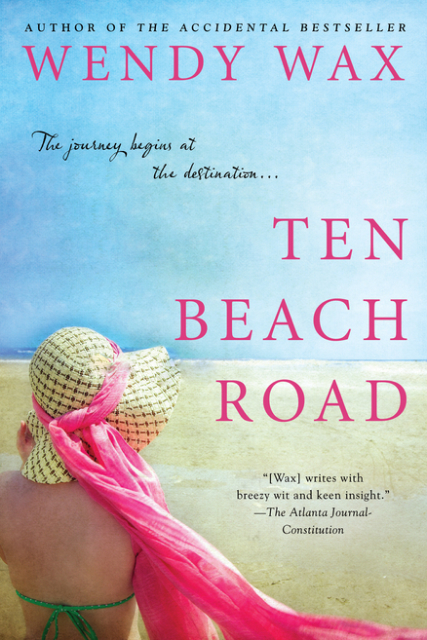 Wendy Wax‘s Ten Beach Road (my review) is out in mass-market paperback, so for those of you who have missed out on reading this book and have a book-buying budget, now is the time to grab a copy.
I absolutely adored this book and its characters, strong women –Madeline, Nicole, and Avery — who face a financial crisis and rub one another the wrong way but manage to pull it together to restore their only remaining, shared asset, a house. I loved this book so much for its summer feel, humor, and strong characters that I just had to share it with my mother, who normally reads action thrillers. She loved it.
I even loved this book so much that it was one of my picks when asked by Women’s World Magazine which summer, feel good books I’d recommend for mother’s day. (My recommendation made it into their May 14th issue on page 45, if you’re curious).
Here’s an excerpt from Ten Beach Road:
An eternity later, they hobbled out to the backyard just as the sky was beginning to pinken. Bedraggled, they dropped into the beach chairs with a scrape of aluminum against concrete.
“I don’t think I’ve ever been this dirty in my entire life.” Madeline plopped a family-sized container of hummus and triangles of pita bread on the upside down packing box that their Sam’s purchases had been carried in.
“Me, neither.” Avery dropped a bag of Cheez Doodles beside it and swiped the back of her forearm across her forehead, managing to add another streak of dirt to her face.
Nicole set an unopened bottle of Chardonnay on the pool deck next to her bare feet and handed a plastic cup to each of them. “If there was an inch of water in this pool, I’d be in it.” Nicole slumped in her chair. “I think we should make it a top priority.”
“We barely have a working bathroom,” Avery pointed out. “It took me forever to clean the shower and tub up in the hall. There’s pretty much no water pressure. I’d rather have a shower than a swim in a pool.”
“I want both,” Nicole said, lifting the cup to her lips. “It’s not an either/or sort of thing.”
“Well, it is here.” Avery took a long sip of wine as the sun slipped farther toward the Gulf. “Everything’s not going to get done at once, but I will talk to Chase about the schedule and how things should be prioritized.”
Madeline looked ruefully down at herself. Together they could have posed for the illustration of “something the cat dragged in” – even Nicole in her high-end running clothes and her hair pulled back in a glittery clasp. This was only day one; she could hardly imagine what they’d look like after the long, hot summer that lay ahead.
Her arms were so tired that it took real effort to lift even the small plastic cup, but she nonetheless touched it to the others. “Cheers!” she said, and they nodded and repeated the toast. “Will you be able to run your business from here?” she asked Nicole as they contemplated the sinking sun.
Nicole’s cup stopped midway to her lips. In the pass, a boat planed off and gathered speed as it entered the Gulf. “Sure,” she finally said. “Have laptop and cell phone, will match make.” She turned her gaze from the boat that was now disappearing from view to focus on Madeline. “How about you?” Nicole asked. “Can you really leave home for the whole summer?”
Madeline finished the last drops of wine and set her glass on the makeshift cocktail table. “You make it sound like going to camp,” she said in what could only be described as a wistful tone. “I was hoping my husband, Steve, would come down and help for a while.”
“Oh, is he retired?” Avery asked.
Madeline felt her cheeks flush. Nicole raised an eyebrow and poured them all another glassful.
“Not exactly,” Madeline admitted. “He was a financial planner who made the mistake of putting all his clients’ money in Malcolm Dyer’s fund. Along with his family’s.”
Her teeth worried at her bottom lip. She hadn’t meant to say so much. Or sound quite so pathetic.
“He stole my father’s entire estate,” Avery said. “Everything he’d built over a lifetime of hard work went into that thief’s pocket.” She grimaced and shoved her sunglasses back up on top of her head. “I still can’t believe it. Anything short of being drawn and quartered would be far too good for him.”
Madeline saw Nicole shiver slightly. “Are you cold?” The sun had not yet set, but its warmth had diminished.
“No.” Nicole turned her attention to the boat traffic in the pass. A Jet Ski swooped close to the seawall, its plume of seawater peacocking behind it. The rider was big shouldered and solid with jet black hair and heavily muscled arms. Nicole watched idly at first, presumably because he was male and attractive, but straightened in surprise as the rider locked gazes and offered a mock salute before revving his engine and zooming away.
“Do you know that guy?” Madeline asked Nicole, surprised. “He waved at you.”
“No,” Nicole said. “I don’t think he was actually waving at me. He …”
“Yes, he was,” Madeline insisted. “He acted like he knew you.”
“That guy was definitely hunky,” Avery said. “And he was definitely eyeing Nicole.”
“He must have thought I was someone else,” Nicole took a sliver of pita and chewed it intently before changing the topic. “So, how many kids do you have?” she asked Madeline.
“Two,” Madeline said, unsure how much information to share. “My son’s struggling a bit at school; he’s in his freshman year at Vanderbilt,” she said. “And my daughter, well, right before I left she lost her job-she’s a filmmaker- and she came home unexpectedly to live.” She cleared her throat as if that might somehow stop this bad news dump. “That was right after my mother-in-law moved in.”
“Good Lord,” Nicole said. She lifted the bottle, eyed the little that was left, and poured the remaining drops into Madeline’s glass. “No wonder you want to go away to camp.” She smiled with what looked like real sympathy. “Drink up. Girl; I’d run away from home, too, if I had to deal with all that.”
They sat in silence for a few minutes, sipping their wine, as the sun grew larger and brighter. A warm breeze blew gently off the Gulf, stirring the palms and riffling their hair.
“Maybe you should get your daughter to come down and shoot some ‘before’ video for us,” Avery suggested. “That’s actually what led to Hammer and Nail.” She furrowed her brow. “I had no idea what was coming down the pike when I shot that first ten minutes.”
Madeline considered the small blonde. “My mother-in-law seemed to think it was your husband’s show, that he got you on it.”
“A lot of people came to believe that,” Avery said, her tone wry. “Including my ex-husband. But the idea was mine. I’m the one who sold it, and us, to the network.”
They fell silent as the sun burned with a new intensity, shimmering almost white, then turning golden red that tinged the Gulf as it sank smoothly beneath it.
“God, that was beautiful,” Madeline breathed as they all continued to stare out over the Gulf, unable to tear their gazes from the sky and the last painted remnants of daylight. “It makes me feel like anything is possible.”
No one responded, and she supposed she should be grateful that no one trampled on her flight of fancy. The show was over, but Madeline could still feel its power. It moved her in a way her fear and even her resolution and Little Red Henness had not. She raised her now-empty glass to Avery and Nicole. “I propose that we all make a sunset toast. That we each name one good thing that happened today.”
“Good grief,” Nicole said. “Look around you.” She motioned with her empty plastic glass at the neglected house that hunkered behind them, the cracked and empty pool, the detached garage with its broken windows and listing door. “Is your middle name Pollyanna?”
Madeline flushed at the comment, but she didn’t retract her suggestion. “I’m not saying we should pretend everything’s perfect,” she said. “I’m just saying that no matter how bad it is it would be better to dwell on the even slightly positive than the overwhelming negative.”
“You’re serious, aren’t you?” Avery asked. They all still held their empty glasses aloft. “How good a thing does it have to be?”
“That’s up to you.” Madeline said. “I’m not interested in judging; there will be no ‘good enough’ police.”
“Well, that’s a good thing,” Nicole snorted.
“All right, hold on a sec,” Madeline said. She went into the kitchen and retrieved a second bottle of wine from the fridge, grateful that John Franklin had had the power turned on. As she refilled their glasses, she searched for a positive. Nicole was right, it wasn’t an easy task.
“Okay.” She raised her now-full glass and waited for the others to do the same. “I think it’s good that three complete strangers were able to reach an agreement and commit to a course of action.”
They touched glasses and took a sip. Madeline nodded at Avery. “Your turn.”
“Hmmmm, let me think.” She looked out over the seawall at the gathering darkness as the three of them sat in a spill of light from the loggia. A few moments later she raised her glass. “I think it’s good that this house is not going to be torn down. It deserves a facelift and a new life.”
They clinked and drank and turned their gazes to Nicole. Madeline could hardly wait to hear what she would say.
Nicole looked back at the house, then at them. A small smile played around her lips, and Madeline wondered if she was going to tell them to stuff the happy crap or simply refuse to participate. But she raised her glass in their directions and with only a small sigh of resignation said, “It’s a good thing no one saw me in that minivan. I can’t imagine how I’d ever live it down.”
The mass-market paperback release of Ten Beach Road is in advance of the June 26 release of the sequel, Ocean Beach, in which the three lead women — Madeline, Nicole, and Avery — from the previous book are back. I just knew Wendy Wax was not finished with these characters!
About Ocean Beach:
Unlikely friends Madeline, Avery and Nicole have hit some speed bumps in their lives, but when they arrive in Miami’s South Beach neighborhood, they are all hoping for a do-over. Literally. They’ve been hired to bring a once-grand historic house back to its former glory on a new television show called Do-Over. If they can just get this show off the ground, Nikki would get back on her feet financially, Avery could restart her ruined career, and Maddie would have a shot at keeping her family together.
At least, that’s the plan – until the women realize that having their work broadcast is one thing, having their personal lives play out on TV is another thing entirely. Soon they are struggling to hold themselves, and the project, together. With a decades-old mystery—and the hurricane season—looming, the women are forced to figure out just how they’ll weather life’s storms…
Yes, you’ll want both books. Don’t forget to follow Wendy on Twitter and Facebook.
To enter to win 1 copy of Ten Beach Road by Wendy Wax you must be a U.S. or Canadian resident. Leave a comment below by June 1, 2012, at 11:59PM EST to be entered.
If you’ve already read Ten Beach Road, leave a comment telling me why you want to read Ocean Beach to be entered by June 1, 2012 at 11:59PM EST.
When you fiercely believe in a poet’s talent and their collection, you want to do everything you can to promote it and him/her to a wider audience. You stick their book into strangers’ and friends’ hands and say, “Read this.” Sometimes, that works and sometimes it doesn’t, but if you truly believe in a collection, you press onward.
Today, I’ve got a deeply moving guest post from poet Erica Goss, who I featured during the 2012 National Poetry Month Blog Tour with a review of her book, Wild Place. She will talk about the joy of publishing her collection, but also the deep sadness that came with it when her father’s body was discovered in the wilderness.
Following the guest post, I hope that you will enter for 1 of 2 copies I am going to giveaway to 2 lucky readers anywhere in the world. Without further ado, please welcome Erica Goss.
On March 29, 2011, I checked my email late in the afternoon. The subject line “Chapbook Acceptance: Wild Place” caught my eye immediately. I opened the message and read, “Thank you for submitting to us. Your manuscript has been accepted for publication.” Blue capitals announced the sender as Finishing Line Press in Kentucky.
Finishing Line. I loved that name and its connotations: making it to the end and winning. But on March 29, 2011, “finishing line” meant something else. Three weeks earlier, some teenagers out hiking had discovered my father’s body in a remote part of Western Washington State. That was his finishing line: death from exposure, hunger, and thirst, brought on by dementia.
Over the following months, I struggled with grief and depression. Some days were simply too hard to bear. My friends congratulated me about the book, but I felt compelled to qualify their enthusiasm with reminders that I was grieving my father. As much as I wanted to shout with joy over the book’s imminent publication, I was unable to feel much happiness at such a time.
The book did give me some welcome distraction from dealing with my father’s death and trying to put his affairs in order. Choosing cover art, formatting the book, deciding which poems to keep and which to delete, absorbed many hours. At the back of my preparations, however, my father’s death lurked, a persistent ache in the pit of my stomach.
It took me some time to realize that I was living in one of those ironic situations that make good poems. The best poetry is tinged with its opposite emotion; to quote Chase Twitchell, “remember death.” As Linda Pastan writes in her poem “The Death of a Parent,”
Move to the front
of the line
a voice says, and suddenly
there is nobody
left standing between you
and the world, to take
the first blows
on their shoulders.
How often I wanted to share the news of my book’s publication with my father. In phone conversations, I’d told him about sending the book to various contests and small presses. The dementia that had been taking his brain away would lift for a little while, and he seemed genuinely interested. Then, abruptly, he would say, “Well, thank you for calling!” and hang up. When he did that, I knew that he had probably forgotten who I was, and ended the conversation to cover his embarrassment.
My father was never more attentive than when I read poetry to him. A former professor of German, he would fix his hazel eyes on me with the look he must have given his students when they mispronounced something, and listen intently. At the end, he would usually say, “Huh! Too bad he was such an ass,” or some other insulting remark about the poet. That’s when I knew my real father was back, at least for a moment. “Even jerks can write good poetry,” I would respond, hoping for his sudden laugh or the way he would smack the table, making us all jump. But more and more often, he would just look at me, puzzled, and turn back to the television.
My father loved run-down, decaying, decrepit places. This explains why he spent the last few years of his life, before his dementia worsened and he moved to Washington to live with his sister, in a tiny village in Northern California called Locke. Locke sits in the San Joaquin-Sacramento Delta, where two of California’s largest rivers meet. Eleven hundred miles of poorly maintained levees protect Locke, the other small towns of the Delta, and its surrounding orchards and farmland.
The Sacramento and San Joaquin rivers, unruly by nature, seep under the levees, giving Locke and the whole area a lumpy, moldering appearance. Artists love Locke’s tilted buildings and its atmosphere of benign neglect (Locke is the setting for “My Father at Seventy,” one of the poems in Wild Place). The first few years my father spent in Locke were happy ones; he loved the small town vibe, the artists and writers who lived in ramshackle houses where the river bubbled up through the basements, and being so close to Nature. That was before he stopped calling, stopped paying his bills, stopped cleaning his house.
Wild Place’s cover photograph, taken by San Jose artist and architect Howard Partridge, shows a view of the Sutro Baths on the coast of San Francisco. It’s clear from the photograph that the Pacific Ocean is reclaiming that piece of land, wearing down the seawall and the surrounding cliffs. Here’s another place that water will eventually take back, just like in the Delta a few miles east.
Is this a metaphor for death? Maybe. But I’d rather think of it as a demonstration of Nature’s obdurate personality. As the French poet Saint-John Perse (Alexis Leger) writes: “In vain the surrounding land traces for us its narrow confines. One same wave throughout the world, one same wave since Troy rolls its haunch toward us.”
One same wave. “The Death of a Parent” gives us this image:
The slate is wiped
not clean but like a canvas
painted over in white
so that a whole new landscape
must be started,
bits of the old
still showing through.
It’s been over a year since that bipolar month of March, 2011. I’m learning what it means to grieve. Some days I feel my father’s loss as an acute pain; other times it’s heavy and dull, like an overcast, humid day. I have gotten better at allowing myself to feel unqualified joy at the publication of Wild Place. And I look for those places where the old bits show through.
Thanks, Erica, for sharing your story with us. I know that your father would be proud of you, no matter what. Also, please check out this poem she wrote in response to a prompt about what she would tell her 16-year-old self.
For those of you interested in this stunning collection, please leave a comment here about your own father. Deadline to enter will be May 31, 2012.
Perla by Carolina De Robertis (giveaway following the review) is captivating and intoxicating in its setting, mystery, and the psychological unraveling of the main protagonist, Perla. She’s growing into a young woman, but her cloistered existence threatens to explode until she begins to release herself in books and in her relationship with Gabriel.
The past haunts everything around her, though she does not know it at first. She is proud of her family and her father’s naval career and her mother’s quirky penchant for picking up new hobbies and discarding them. But her pride is suddenly shaken when she learns of the Disappeared, Argentinians who were silently taken from their workplaces and homes in the 1970s and 1980s by the government for allegedly being subversives. In school she writes a short story that wins a prize and is published in the newspaper, but her story has other unintended consequences. It opens up hidden fissures in her family, and forces her to rebel and question the father she’s loved with blind devotion.
“He was uninvited moisture. He had leaked into this house. I had every reason to find his presence an affront, to be enraged at his invasion, or at least to eject him in calm tones. Certainly he made me feel combustible, unsafe in my own skin. But though I didn’t know why, though the feeling shocked me, I did not want him to leave.” (page 28)
The fluidity with which De Robertis tells the tale is much like the Dali painting, “The Persistence of Memory,” hung in Perla’s childhood home, weaving in and out of reality and shaping a psyche that is struggling with secrets that are too devastating to hold inside. Perla is a novel about identity and how it is created or comes into being and whether it is alive within us before we are even born. In accordance with this look at identity, the novel examines the harsh treatment society places on new generations for the transgressions of the past. Struggling with the truth of her father’s job and how it may have contributed to the disappearance of many Argentinians is enough for Perla to deal with as a young adult, but she also must confront the sneer and the unspoken disgust in the eyes of her classmates and friends when her father’s occupation is revealed.
Retreating into herself and her books, Perla finds a way to cope and becomes strong in a way that even she is unaware of, and when she meets Gabriel, her strength is tested once again. Can she love her father and still love this man who writes articles condemning the actions of former military and government leaders who now have immunity? Can she reconcile the two worlds of her life into one and live with herself? And how can she explain her love for her father amidst the knowledge of what his actions before she was born did to the country and to other families?
De Robertis takes readers on a psychological journey through Perla’s mind as she processes the revelations of her family life and the nation she was born into. Legacy plays an important role and it is clear that Perla must uncover what that legacy should be as she grows into a woman and leads her own life. The prose is so enchanting and intoxicating, hours of reading fly by as streets in Buenos Aires become crowded with footfall percussion beats and musical laughter countered with the closed off rooms of Perla’s childhood home and the dark, swirling violet waves of her aunt’s painting. Water also is a significant image throughout the book as it gives life and sustains it in the womb and in the soil, but it also connects everyone and everything in the story, running underground and supplying the sustenance to the tale.
“Flowers lurked at every turn. You could not rest your gaze without encountering a geranium, two geraniums, hundreds of geraniums, and you could not walk without the feeling that geraniums were following you close at heel, bright mobs of them, crowding the air at your back. You could not help feeling vastly outnumbered.” (page 90)
In a few sections when Perla’s mother has taken up gardening as a hobby and begins overpopulating the house with geraniums, it is clear that these flowers are like the bodies of the disappeared blossoming despite the cover up and lurking around every corner, haunting those that took part. These bodies even when the blossoms fade from lack of care, continue to haunt the house and its inhabitants, prodding Perla’s family to look about them, to question, to uncover the truth beneath the well-manicured soil.
Perla by Carolina De Robertis melds the supernatural with reality in a way that it becomes a testament to all of the disappeared and the children of the disappeared who were restored and not. It is an examination of an ugly part of Argentinian history in which women, children, and men were taken from their families and homes without warning, tortured, and released from planes above the Atlantic Ocean — erased from existence. De Robertis does not dwell on the horrors of those times, but on the consequences of those actions and the reverberations felt for generations following the political upheaval that caused them. She does so with aplomb and breath-taking imagery that transports readers to a South American nation ripe with beauty and dark secrets to explore what it means to have an identity and to be an individual in spite of what your family may have done in the past. One last note, get the tissues ready! Another for the 2012 best of list.

Author Carolina De Robertis
About the Author:
Carolina De Robertis is the author of Perla and The Invisible Mountain, which was an international bestseller translated into fifteen languages, the recipient of Italy’s Rhegium Julii Prize, and a Best Book of 2009 according to the San Francisco Chronicle, O, The Oprah Magazine, and BookList. Her writings and literary translations have appeared in Zoetrope: Allstory, Granta, The Virginia Quarterly Review, and elsewhere. She is the translator of Alejandro Zambra’s Bonsai, which was just made into a film, and Roberto Ampuero’s internationally bestselling The Neruda Case, which will be published for the first time in English in July 2012. De Robertis has been awarded a 2012 fellowship from the National Endowment for the Arts.
De Robertis grew up in a Uruguayan family that immigrated to England, Switzerland, and California. Prior to completing her first book, she worked in women’s rights organizations for ten years, on issues ranging from rape to immigration. She lives in Oakland, California, where she is currently elbow-deep in writing her third novel, which explores migration, sexual frontiers, and the tango’s Old Guard in early twentieth century South America. Connect with her on Facebook, Twitter, and through her Website.

 This is my 37th book for the 2012 New Authors Challenge.
To enter for 1 copy of Perla by Carolina De Robertis (US/Canada), leave a comment about what you’d like to learn about the disappeared of Argentina.
Deadline is May 17, 2012, at 11:59PM EST
Prosper in Love by Deborah Michel is a book that takes misunderstandings and unexpected circumstances to a new level, but it certainly sounds like the book will provide humorous moments and joy. Check out this synopsis from Amazon:
A good marriage lasts forever . . . until it doesn’t.
From the start, Lynn and Jamie Prosper were one of those couples who seem meant to be—so content with each other that they barely notice the rest of the world nodding approvingly at their wedded bliss. But sometimes, even in the very best of marriages, all it takes is a mischievous outsider to bring the perfect couple toppling off the top of the wedding cake. . .
True, Jamie has been working so hard and traveling so much as a young lawyer that he hardly has enough energy to show his devotion. Not that Lynn, a junior museum curator, has any reason to question it. But when Lynn’s old college friend turns up at a cocktail party, chinks in their marriage’s previously unassailable armor start to show.
Suddenly, without meaning to, Lynn and Jamie have both acquired divorce lawyers. And those benevolent onlookers—meddling in-laws and competitive friends alike—eagerly bear witness to each new misstep. Is love really enough to make a marriage last?
Doesn’t this sound like a fun book about the intricacies and follies of marriage? Today, Deborah Michel is going to share her writing space with us — with photos — and of course, there’s a chance for a U.S. resident to win a copy of her book.
Without further ado, please give Deborah a warm welcome.

First Abandoned Writing Space
I have three separate desks in my house, each of which I have, over the years it took me to write my first novel, Prosper in Love, intended—with the best intentions—to make my writing space. The first desk came with the house—a cozy built-in in the family room. It has heavy paneled file cabinets, matching cupboards perfect for writing and computer supplies, and pre-drilled holes to hide phone and computer cords. It even has what could be a charming reading nook if only I’d get around to having cushions made. When we first moved in I paid bills there. I don’t even do that there anymore. Never once did I sit down to write anything more than an email.
Glass Table Desk in Bedroom
Instead, I found my dream desk, a pretty, airy, glass-and-wood modernist table for my bedroom. As a former shelter-magazine writer and senior design editor, aesthetics were important to me. I know, you’re not supposed to put your workspace in your bedroom. But it was such a pretty space! I had a wall of glass looking out on verdant greenery, soaring ceilings, a place for ideas to fly. As it turned out, I didn’t need to worry about somehow sabotaging my bedroom as a place of relaxation. I barely worked at that desk for a season before my constant wandering into the kitchen for a snack or more tea ended with me moving my laptop there altogether, to a high stool at a butcher block island. Which isn’t to say the glass desk didn’t prove handy. It makes a lovely, translucent dumping ground for books, unfiled insurance papers, and the endless stacks of revisions. (Editing and re-editing the old is always so much easier than creating the new.)
Mudroom Desk
The kitchen counter wasn’t ideal. Never mind the chronic back and neck pain. (Did I mention the expensive ergonomic chair that went with my lovely glass desk?) My kids hated my working there! They hated coming home to see me bent over my laptop in work mode, too distracted to ask how their day was. And to prepare so much as a snack, everything had to be cleared away. So when we decided to add a mudroom off the kitchen, I included the perfect desk in the plan, carefully measuring for everything from the printer down to the shelf where the pencil sharpener would sit (I still write first drafts longhand). You guessed it. Never worked a day there. But it’s the perfect recharging center for everyone’s phones and gizmos—and even for my laptop on those nights when I’m forced to move it from my current writing spot.
Current Writing Space -- Dining Room Table
That would be the dining room table, where I agonized over the proofreading of my galleys and sat with a deep sigh of satisfaction to looks at my first author copy when it arrived. I still have to move everything on the nights when I cook dinner, but let’s face it, that doesn’t happen as often as it should. I’m like my protagonist, Lynn Prosper, that way. And it’s a beautiful table: a long, narrow stretch of shiny red glass in an airy room with walls of windows to the outside on three sides. So which direction do I face when writing? The only one with no view, of course.
Thanks, Deborah, for sharing all of your writing spaces with us. It can be difficult to find the perfect one.

Author Deborah Michel; Photo Credit: Shreya Ramachandran
About the Author:
Deborah Michel, a former magazine editor and freelance writer, has worked on a long list of publications that includes House Beautiful, Premiere, Los Angeles, and the Los Angeles Times Magazine. She worked as an editor and nightlife columnist for Avenue Magazine, was the west coast correspondent for Spy, and served as a contributing editor at Buzz.
To enter to win 1 copy of Prosper in Love, you must have a U.S. address and leave a comment on this post about your own marriage advice or funny stories.
Deadline to enter will be May 15, 2012, 11:59 PM EST

Click for all the posts from the 2012 tour, including those from Savvy Verse & Wit
Even though National Poetry Month is over and the blog tour has ended, I’ve still got a couple poetry items to wrap up.
First, thanks to everyone who participated this year, and I hope to see you all again in 2013. I’d like to recruit more poets, academics, and poetry readers to provide guest posts to other tour stops and to offer up their own blog stops on the tour. So if you’re interested, feel free to email me at any time.
We had some great guest posts and reviews, and you can visit any of the posts or tour stops by clicking on the tour button. All of the links have been added to the Mr. Linky. If I missed a post from you, please feel free to add it.
Second, I want to congratulate the winners of the National Poetry Month Blog Tour giveaway.

Congrats to Liviania from In Bed With Books and Lilian of Circus Toybox

Congrats to Lilian from Circus Toybox
Congrats to the five winners of the Trembling Pillow Press Journals: Elizabeth, Gerry, and Parrish Lantern.
Congrats to the nine winners of Real Courage by Michael Meyerhofer: Leslie from Under My Apple Tree, Anna from Diary of an Eccentric, Kathy of Bermudaonion, Diane, and Chris.
There are some winners I still have not received an address from, please send it along so I can mail out your prizes.

Read how to enter below.
Excerpt
Sunday brunch; the table overflowing with food and drink, the fine china and silverware laid out, the clock ticking away painfully slow minutes before father finally speaks. “Well son,” he says, “isn’t it about time you got yourself a job?”
John looks up from his plate. “Dad,” he says, “I have a job.”
Father nods thoughtfully, chewing his medium rare steak. “I guess it’s about time you moved out then. Found a place of your own. Planted some roots.”
John is baffled. “But dad, I moved out five years ago. In fact, this is the first time I’ve been back.” He looks over at mother, who shrugs and says, “You know dear, your brother has his own business. He set up an accountancy firm.”
John rolls his eyes. “That’s me, mom. I set up an accountancy firm. John Williams and Associates.”
“That’s good to hear,” father says. “Always said you should run your own business. You have a keen business sense. You always had.”
“I just wish he’d find himself a girlfriend,” mother complains.
“What do you mean?” John smiles apologetically at Annabel. “I have a girlfriend, mother, she’s sitting next to you. She gave you flowers at the door, remember?” He points at the vase. “You put them in water.”
Mother waves it away with a warm smile. “Sorry dear, I meant a proper girlfriend.” She squeezes Annabel’s hand. “You know what I mean, don’t you dear?”
Annabel opens her mouth, but can’t think of anything to say.
“Didn’t you used to have dark hair,” father says suddenly, “and not quite so many arms?” He looks John over carefully. “Yes, yes,” he says, “you definitely look different. Did you get shorter?”
“That’s enough!” John gets up. He gestures at Annabel to do the same. “If you cannot behave like civilized human beings, then we’re going! I can’t believe you’d treat Annabel and myself this way. It’s appalling!”
Father throws down his napkin and stands as well. “Serves you right, young man,” he says. “Serves you right for not going home for five years and then ending up in the wrong house!”
… continued in Unspent Time
How to enter:
For the launch of the new novel I decided to discount it to $0.99 for the month of May (PC and eBook), give away some exclusive content, and raffle off two Kindles. All entrants will get:
(Prizes can be traded for Amazon gift certificates if you already own them.)
Just email your receipt to [email protected] to enter.
Each purchase counts, so stock up on birthday presents (for people you don’t like that much, for instance) The discount ends May 31, but be sure to send the receipts no later than June 1st.


(Or order the books from any bookstore.)
Coupon code for the month: ZB77D
And then get  by tweeting about your purchase:Tweet
Sound bites from Unspent Time:
“I’m looking into my past lives. I’m convinced some of them still owe me money.”
“I’m very polite by nature, even the voices in my head let each other finish their sentences.”
“I didn’t actually want to do it,” Kiala told the boy. “The universe just kind of conspired to force me to make a fool of myself. It does that quite a lot, actually.”
“Sadly, my socks are like snowflakes, no two are exactly alike.”
Here’s what reviewers had to say:
“A veritable page turner of nonstop laughs!” — Reader Views
“An unputdownable read. a Coens Brothers’ film in book form.” — BookReview.com
“Extremely witty and clever writing.” — California Chronicle
“A Party for your Brain!” — Warren Baxter
Bio:
 Congrats to all of you.
And there is still time to enter the National Poetry Month giveaways through the end of TODAY!

Winner is Anna of Diary of an Eccentric

Winner is Heather of The Maiden's Court

Winner of Dr. Seuss Giveaway is The Girl from Diary of an Eccentric; check out that hat.
The Day the World Ends by Ethan Coen, one half of the Coen Brothers film making team with great films under their belt like Brother, Where Art Thou? and No Country for Old Men, is a twisted and unexpectedly thoughtful collection in places. The limericks are bawdy and remind me of Christopher Moore’s humorous prose, but less in the smart and sassy humor and more in the low-class bathroom humor sense. Necromancy Never Pays stated that the poetry in the volume is geared toward a male audience, and in most cases, that is true — particularly with the dirty limericks.
"Stone-age man, thawed from glacier, aghast:
'Was some snowman in my recent past?
And if so, who fucked who?
My dick's numb and quite blue
And there's freezer burn all up my ass.'" (Page 28)
Additionally, Coen appears to love rhyme, no matter how trite or over-stretched it might be. Readers could find this collection amateur at best in how Coen chooses his rhymes, even when they have a tongue-in-cheek quality. Like the “bathroom” humor, these rhymes can get tiresome. Take for instance the rhymes in “Vine-Covered Verse” (page 53), “Lord, keep this farmer’s soul in peace,/For, though he dallied with his niece,/And cow, and nephew, none can claim/He, during, failed to praise Your name;/And how commit a lesser sin/When neighbors are but kine and kin?//” However, even in this poem, there are moments of deeper thought in which the narrator is asking what sins are worse and should they all be forgiven or all be condemned. It also questions how well we know our partners or other humans in general and what secrets they will take to their graves.
Coen’s poetry in this collection seems built for laughs among men mostly, though there are moments in which the poems are not trying so hard to be humorous. There are some with an anachronistic quality to them, while others like “My Father’s Briefcase” are more serious and reflective. “Therapy” uses humor and disdain to point out the inane struggle we have against aging and the depression that accompanies the process of aging, as the narrator talks of his depression to a less-than-helpful therapist.
The Day the World Ends by Ethan Coen is not for everyone and could be trying if read from cover to cover, but for those looking for a humorous romp on the underside of humanity, take a dip into these pages.
Poet Ethan Coen
About the Poet:
Ethan Jesse Coen is one half of the American film making duo the Coen brothers. Their films include Blood Simple, Fargo, The Big Lebowski, O Brother, Where Art Thou?, No Country for Old Men, and True Grit. The brothers write, direct and produce their films jointly, although until recently Joel received sole credit for directing and Ethan for producing. They often alternate top billing for their screenplays while sharing film credits for editor under the alias Roderick Jaynes.
To enter to win one of 2 copies for US/Canada readers:
Leave a comment about what tour stop on the National Poetry Month Blog Tour you’ve enjoyed most, either here or on one of the participants’ blogs.
Blog, Tweet, or share the link on Facebook for up to 3 additional entries.
Deadline is April 30, 2012.
***Today’s tour stop is at Arisa White, so check it out!***

This is the 11th book for my 2012 Fearless Poetry Exploration Reading Challenge.
This is my 29th book for the 2012 New Authors Challenge.
Sarah Pekkanen is a best-selling author, whose work is very popular in the book blogging community and she’ll be attending the Gaithersburg Book Festival (I hope I get to see her there).
Her latest novel, These Girls, is about three women — Cate, Renee, and Abby — who come to New York City for very different reasons and end up as roommates struggling with their careers and life. Check out some early reviews from S. Krishna’s Books, Devourer of Books, Life in the Thumb, and Raging Bibliomania.
Today, as part of her online tour and for the 2012 National Poetry Month Blog Tour, Sarah Pekkanen will share one of her favorite poets, her father John Pekkanen.
Without further ado, please give Sarah and her dad a warm welcome.
The poet who wrote this isn’t rich or famous. You never studied his work in a class textbook, or saw it inscribed on a greeting card. In fact, he just began writing poetry a couple of years ago. The reason this particular poem speaks to me? It’s one my Dad wrote for my mother. He gave me permission to reprint it here, so it’s the first time it’s being published.
When you ask my father how long he has been married to my Mother, he’ll say, “For forty-five wonderful years. And three so-so years. And two really horrible years!” So if you’ve done the math, you know my parents recently celebrated their 50th wedding anniversary. They dealt with a lot during their marriage: parents who didn’t support them, my father’s risky open-heart surgery, my mother’s complicated siblings. And sometimes I wonder if their golden years are sweeter now because of all they’ve been through. Sure, they fight – in fact, their fights remind me of the squabbles teenagers have. And their life isn’t perfect, by any means. But they say they’ve never been happier, and when I see them together, I know it’s true.
Early Awakenings by John Pekkanen

Red numbers blink to 3:25.
The hard bite of winter drifts
through an open bedroom window.
I sleep best in cold rooms, blankets
tucked tight under my chin.

Early morning awakenings lay open
what lies darkest in me, reopening
old wounds to replay a familiar narrative
of my fears and failures,
thoughts of my lost brother.

In grainy half-light I watch her move,
listen to her cat-like murmurs.
I turn on my side to touch this woman
I’ve loved and desired
more than forty years, who centers me,
gave us children, makes me laugh.

I stroke the smooth arc of her back,
place my hand on her thigh’s warm skin,
her soft, sensual terrain more familiar than my own.
I fold my knees into her’s and our bodies
intertwine as if by muscle memory,
and I feel whole again.
Thanks, Sarah, for sharing your dad’s work with us.
If you’d like to win a copy of Pekkanen’s latest book, These Girls, please leave a comment here about what favorite non-famous poet you know.
Deadline for U.S. residents only is April 22, 2012.
About the Author:
Sarah Pekkanen is the internationally-bestselling author of the novels The Opposite of Me and Skipping a Beat and the upcoming These Girls, as well as the linked short stories available for e-readers titled “All Is Bright” and “Love, Accidentally.”
She has worked in journalism for Bethesda Magazine, Baltimore Sun, and Gannett New Service/USAToday.
Please follow her on Twitter, Facebook, and check out her Website.

Today’s National Poetry Month Blog Tour Stop is at Book Chatter; check it out!
The Song Remains the Same by Allison Winn Scotch will be published on April 12, and she’s become a favorite author of some wonderful bloggers I know. Don’t you just love this vibrant cover!
While I’d already dedicated the entire month of April on the blog to poetry, I had to decline reviewing her prose, which is raved about.
However, I was happy to hear that she would love to write a guest post about her favorite poet. And we have a giveaway for my U.S. readers.
First let’s check out a little bit of The Song Remains the Same:
One of only two survivors of a plane crash, Nell Slattery wakes in the hospital with no memory of the horrific experience-or who she is, or was. Now she must piece together both body and mind, with the help of family and friends, who have their own agendas. She filters through photos, art, music, and stories, hoping something will jog her memory, and soon, in tiny bits and pieces, Nell starts remembering.
It isn’t long before she learns to question the stories presented by her mother, her sister and business partner, and her husband. In the end, she will discover that forgiving betrayals small and large will be the only true path to healing herself-and to finding happiness.
Without further ado, please give Allison a warm welcome.
When I’m asked to cite my favorite poet, I know that I should cite a heavyweight, a Whitman, a Frost, an E.E. Cummings. But here’s the truth, I can honestly say that I think that my favorite poet might actually be Shel Silverstein. Why? Because as a child, I fell in love with Silverstein’s words and books, and I’d like to think that he played a part in my love of writing and my love of reading.
I think I was first introduced to Silverstein at around the age of seven or eight. I was obsessed – obsessed! – with Where the Sidewalk Ends. From the very opening poem – “The Dreamer”, a poem which, I should note, was the inspiration for the arc of a screenplay that I recently completed – to “Ickle Me, Pickle Me, Tickle Me Too” – to “Lazy Jane”– to “The Gypsies are Coming”, I was hooked. I read, and reread, and reread again, such that now, when I recently purchased the book for my own seven year-old, I could still cite many of these poems by heart, like an old friend, like an old comfort.
Poet Shel Silverstein from Culture Vulture.net
Poetry can, at times, feel daunting to me. It can feel almost exclusive, but Silverstein’s writing was the opposite of exclusive – it was welcoming, warm, relatable, and for a child who is just getting her literary footing, it was everything to me. The kids (and the parents) in the poems were gawky and silly and flawed and normal . . . and often hilarious. And yet there was, obviously, a real art, a total genius to his writing: it is no easy feat to become a beloved literary hero among both children and adults, and Silverstein is, to this day, just that. When A Light In the Attic was published after Where The Sidewalk Ends, I gobbled that one up too, along the rest of his works. (The Giving Tree is still wonderful after all of these years.)
Honestly, there are few things that remind me of the total innocence of childhood more than Shel Silverstein. If you haven’t picked up one of his books recently, I highly recommend that you do so again. You can be eight or thirty-eight or fifty-eight, and I bet you’ll love them just as much as ever.
Thanks, Allison. Shel Silverstein is one of my favorites as well, and “Wiggles” is going to get to know the joys of his books as well.
Now, I wonder how she feels about Dr. Seuss.

Author Allison Winn Scotch
About Allison Winn Scotch:
She is the bestselling author of The One That I Want, Time of My Life, and The Department of Lost and Found. Her fourth novel, The Song Remains the Same, will be released in early 2012. Prior to delving into fiction, she was a frequent contributor to numerous magazines and websites including Cooking Light, Men’s Health, Fitness, Glamour, and Redbook, and now focuses on celebrity profiles for a variety of magazines. She lives in New York with her family. For more about her and her books, go to allisonwinn.com or follow her on Twitter at @aswinn.
***For Today’s National Poetry Month Blog Tour post, hop over to Trouble With Hammers and My Friend Amy.***
To enter for 1 copy of The Song Remains the Same (US Residents only):
1. Leave a comment naming your favorite poet.
2. Spread the word via Twitter, Facebook, and/or your blog and leave links for up to three more entries.
Deadline is April 15, 2012.
Welcome to the 2012 National Poetry Month Blog Tour.
This will be a sticky post through the end of the month of April, so please scroll further down for today’s post.
If you’ve decided to hop on the blog tour, please grab the button above and link back to the tour. Here’s the current schedule for the tour.
Please place your full post links in the Mr. Linky below so that others can celebrate poetry with you and Billy Collins.
Also, if you’re interested in trying a book of poetry, leave a comment and you’ll be entered to win one copy from a donated stash of poetry from poets and publishers.
1. Three Women: A Poetic Triptych and Selected Poems by Emma Eden Ramos
2. Real Courage by Michael Meyerhofer (9 copies)
3. The Auroras (ARC) by David St. John
4. Trembling Pillow Press Journals
Don’t forget to add your permalink.