Quantcast

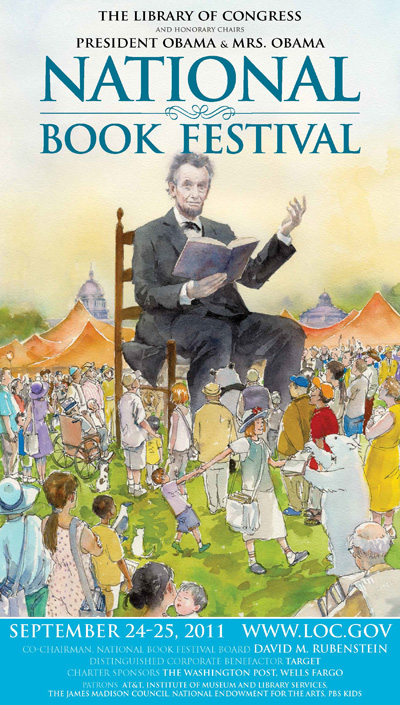
11th Annual National Book Festival

For the first time ever, the National Book Festival will be over TWO days!

Yes, you heard me right; TWO DAYS!  This Saturday and Sunday, the National Mall in Washington, D.C., will be buzzing with book lovers, authors, and more.

Did you know that the Library of Congress has its own YouTube channel?  You should check out some of these great videos with authors and musicians.

If you are going to be in town early for the festivities, please check out the other special events book-ending the festival, here.  There will be a combination outdoor and reading event with former NFL linebacker Chris Draft on Sunday, Sept. 25.  I love events where books are read aloud.

I was getting excited about the festival because it will be the longest amount of time I’ve been out of the house with “Wiggles,” our daughter.  Rhapsody in Books will be there, and she’ll get to meet “Wiggles” in person, so that should be fun.  I have plans to go again on Sunday, which may be a solo trip since football is on, to meet one of my favorite poets, Yusef Komunyakaa, in person — whom I’ve missed out on meeting several times and I consider on the level with rock stars.  Yes, you heard that right, and I’ll probably be tongue tied when I see him.

The festival theme this year is the joy of reading books aloud, and I’d like to take that a step further by having you read this poem aloud.

Facing It
by Yusef Komunyakaa

My black face fades,
hiding inside the black granite.
I said I wouldn't,
dammit: No tears.
I'm stone. I'm flesh.
My clouded reflection eyes me
like a bird of prey, the profile of night
slanted against morning. I turn
this way--the stone lets me go.
I turn that way--I'm inside
the Vietnam Veterans Memorial
again, depending on the light
to make a difference.
I go down the 58,022 names,
half-expecting to find
my own in letters like smoke.
I touch the name Andrew Johnson;
I see the booby trap's white flash.
Names shimmer on a woman's blouse
but when she walks away
the names stay on the wall.
Brushstrokes flash, a red bird's
wings cutting across my stare.
The sky. A plane in the sky.
A white vet's image floats
closer to me, then his pale eyes
look through mine. I'm a window.
He's lost his right arm
inside the stone. In the black mirror
a woman's trying to erase names:
No, she's brushing a boy's hair.

In honor of this poem, I’ll likely head down to the Vietnam War Wall at some point to take photos since I promised myself to do it this year and get some bookmark material for our War Through the Generations participants.  I had also hoped to go with my uncle, who to my knowledge has never been, for the first time, but that’s not going to happen this year…maybe some time in the near future.

If you’d like to get together, while I’m there, I’ll likely be in the poetry/prose tent more often than not.  But I could be at the wall.  We might just run into each other, don’t hesitate to say hi.  I’d love to hear about your experiences at the festival.

Also, if you want to learn more about what’s going on with the festival and more, check out my DC Literature Examiner article.

BBAW Community Connections & Giveaway

Building community connections among book bloggers takes time, no matter if you are a blogger whose been on the Internet for one minute or three years.  From commenting on other blogs to participating in memes or in reading challenges, book blogging is time consuming, exhausting, and daunting, especially when you first start out.

Imagine being a reader, writer, and lover of poetry and wondering where to find all the poetry bloggers? That can be difficult, just as its difficult finding readers in the “real world” who read poetry.

I would love to provide other poetry lovers with a space they can use to share their poetry recommendations, reviews, and questions.  Wouldn’t that be fun?  I’ve met a few wonderful readers of poetry, but there are certainly more out there.

So if anyone has some tips they’d like to share to bring this part of the community closer together, feel free to leave it in the comments.  I’m all ears.

Beyond finding your own like-minded readers, its also good to participate in community events like BBAW and the Indie Lit Awards.  The Indie Lit Awards are particularly important because readers and book bloggers are gaining a voice, and in an effort to make that voice more powerful, the awards will be given to those books that WE feel are worthy of recognition.

I’m chairing the Poetry committee this year, and love getting the word out about awesome poetry books.  We’re looking for some great 2011 nominations, and hope that you’ll stop by between now and the end of the year to nominate your favorite poetry books published this year.

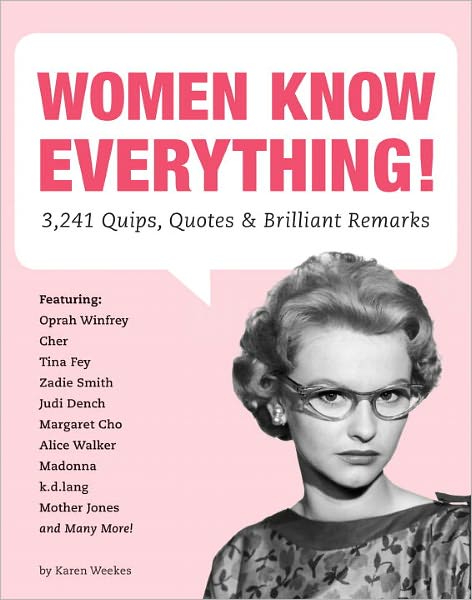
Now, for today’s giveaway.  I have 1 copy of Women Know Everything! by Karen Weekes, which I received from Quirk Books and want to pass along to someone else to enjoy. 

You must be a blogger to enter and leave your blog link in the comments.  Deadline is Sept. 16, 2011, at 11:59PM EST and is open internationally.

Nominations Are Open!

***This is a Sticky Post***

Today is the first day of nominations for the Indie Lit Awards. What are the Indie Lit Awards? 

The Independent Literary Awards are book awards given by literary bloggers. Lit bloggers write about books and literary related items. They are the fastest growing form of publicity in the literary world, though most are still independently run and do not receive compensation for their reviews or recommendations. All directors and voting members for theses awards are completely independent and do not receive compensation for reviews nor their work on the award board.

The categories seeking nominations include:

Several of these are new categories for the 2011 year, including Poetry.

In order to nominate please refer to the following:

  • Books nominated must have a 2011 release date.
  • You may nominate a book that has already been listed (the books with the most nominations will be what we add to the Long List).
  • You may nominate books in more than one genre, up to 5 per genre.
  • Nominations are open to all readers who do not make their income through the sales of books (i.e. not authors, publishers, or publicists) — hence “independent” from the publishing industry.
  • Nominations are open midnight PST September 1, 2011 – 11:59 PST December 31, 2011.

If you haven’t read any poetry or want some suggestions, I’ve got a running list up and ready for you to visit.

I’d like to make the Poetry category a success this year with a wide range of nominations beyond the popular titles, like Caroline Kennedy’s She Walks in Beauty

I know that there are many of you out there who can make that happen, especially since each of you has the opportunity to nominate up to 5 poetry titles from 2011.

***Please scroll down for today’s review one of the best pieces of fiction I’ve read in a long while.

Month 1: Stephen King’s IT Read-a-Long

Welcome to the first discussion post for Stephen King’s IT Read-a-Long.  I hope you’ve had time to read the first part whether it be in broad daylight or under the covers in the dark with a book light.

Today we’re (Anna and myself, plus anyone else who plans on joining) going to talk about the first part of the book, plus the first interlude.

I’ve read IT before, but at a younger age and the book scared me silly.  However, it didn’t stop me from enjoying the horror genre or reading Stephen King books.  I was excited when Anna agreed to a read-a-long of the book, because honestly I don’t think she would have tackled it on her own…simply because of the clown!  I could be wrong though.  Anyway, I started reading part one and it all flooded back to me and I was right there with old acquaintances in Derry, Maine.  What is striking to me is how well King uses third-person omniscient POV.  You get to see everything these characters are, have been, and wish to have been, and the fear they have of Derry and the promise they made is powerful.

IT is described as a clown, but there is something darker and sinister about Pennywise — his yellow eyes and sharp teeth — and it seems as though he’s a metaphor for other things in the town, especially when you read about the homosexual bias and other hate that pervades the small town.  Is he just a manifestation of the dark undercurrent of the town, or is he a real demon clown bent on killing children?  Only time will tell.

For some reason, beyond Stuttering Bill (Georgie’s older brother), Eddie has always been memorable.  I think part of it has to do with his wife and how much she resembles his over-protective mother.  But at the same time, his wife, Marty, is so dependent upon him.  You feel him being pulled in two directions, between his childhood promise and his wife.

One thing I notice now that I probably didn’t notice as a kid is the similarities between Bill Denbrough and Stephen King in terms of writing horror stories.  It also made me wonder about whether King had similar thoughts to Denbrough about a teacher,  or maybe an agent or publisher, who didn’t appreciate his writing.

Book cover of the edition I read as a kid

These are my initial thoughts, what about you?  But first, here are some questions that I’d like to pose:

1.  Is this your first time reading Stephen King?  If so, what have you enjoyed about the reading so far?  How’s the writing?  If this is not your first time, what’s brought you back to reading Stephen King?

2.  What are your first impressions of the characters you’ve been introduced to so far?

3.  Pennywise the Clown lives in dark places like the sewer, do you think he’s real?  Scary?

4.  How do you feel about the use of an Interlude between the parts?  what purpose do you think it serves?

Please feel free to pose your own questions in the comments.

If you’d like to link up to the discussion, please do so in the Mr. Linky below:

In September, on Sept. 28, we’ll be discussing Part 2, plus the interlude on Diary of an Eccentric.  For the rest of the schedule, go here.

Interview: Harrison Demchick on Changes in Publishing

Harrison Demchick of Bancroft Press in Baltimore, Md., agreed to be interviewed about publishing and editing, his current job and his new adventures.

His new Really Good Editing business is up and running for writers looking for a personal touch from an editor — the Website will be up soon.  Until then, you can check out his work through the icon and link to his Facebook page.  Also, feel free to email (reallygoodediting AT gmail DOT com) him if you are interested in his editorial services.

Without further ado, here’s our interview:

1.  Tell us a little bit about your publishing work and how you got started with the small press, Bancroft Press.

I started out at Bancroft Press as an intern in the summer of 2005. I was heading into my senior semester at Oberlin College and looking to get some editorial experience, and I couldn’t have found a better place. By the end of the summer, I was working on book-to-film adaptation and editing novels, and when I graduated in December, I knew Bancroft Press, and more broadly the publishing industry, was where I wanted to be.

I am extraordinarily proud of the work I’ve done at Bancroft. I’ve been lucky enough to edit all sorts of novels for all sorts of readers, most of which have been well-received, and I’ve had opportunity after opportunity to hone my skills as an editor. I can’t forget that I’m one of the lucky ones—I’ve been in a position to do what I love since the day I graduated. And I’ve learned a lot in the process.

2.  How has the publishing industry changed and what fears/concerns has it raised for you on a personal and professional level?

It’s difficult to tell sometimes where the publishing industry has changed and where it’s only my perspective that’s changed. Other times, there’s no doubt. My time in the industry has happened to correlate with the rise of the eBook, which has had a drastic effect on the industry. Every publishing house is struggling to adapt, and Bancroft Press is no different.

The way I see it is this: There have never been more ways for a writer to get his work out there. eBooks make self-publishing incredibly easy, and for a very select few, incredibly profitable. And the simultaneous rise of social media means there have also never been more ways to generate free publicity. But on the flip side, that means the industry has never been so crowded. The majority of eBooks, which don’t require the filter of publisher or editor, are inevitably going to be terrible. The new status quo doesn’t make things easier. It makes them harder.

I am very nervous about an industry that seems increasingly focused on marketing over quality. To create a hit book, more than a great product, you need a great campaign that makes optimal use of social media, and the right combination of print books and eBooks. As someone who has edited a number of books that have been genuinely terrific, it’s extremely frustrating to fight that marketing battle. Authors are told now that they need to spend two years building up their audience before their book ever comes out. That shouldn’t be. Authors should simply be able to write great books and have them succeed because they’re great.

But that’s not the way it works anymore. Maybe it never worked that way. But I’ve seen marketing become a greater and greater part of my job, and it’s not what I want to do. I don’t want to see the publishing industry reward popularity over creativity. Perhaps more than any other business, this is supposed to be a meritocracy.

Naïve? Definitely. But that’s how I feel.

3.  Rather than begin a freelance editing business, why not transition the publishing house to e-books?  Or is that also a consideration; if so, what challenges have you found in that transition process?

I don’t think going eBook-exclusive is the way to go. Understanding of the print book market is one of the critical advantages traditional publishers still have, and for all the upheaval and transformation, I don’t believe print books are dying. They’re just reaching a new equilibrium. That said, I’ve certainly been working hard these last couple years to help Bancroft Press adjust to the new reality. Figuring out new media has been a major challenge, especially seeing as we’re not natural marketers here at Bancroft. We’re book people.

Launching Really Good Editing simultaneously is far more of a personal decision. The part of this job I truly love is editing, and working with writers to make their work as wonderful as it can possibly be. Marketing is nothing but stress for me, but editing? Editing is pure meditation.

I wanted a job that would remove me from the parts of the job and the industry I don’t care for and zero in on what I really want to be doing. And that’s not to say starting a new business doesn’t also require marketing. Why, I’m marketing right now! And that’s also not to say that I don’t help my clients think about how to market their books. But primarily, I’m focused on the editing in a way I can’t be at Bancroft.

4.  What makes your freelance business, Really Good Editing, different from your competitors?  Is it lower rates, personal attention, something more?

I like to say that I write the longest and most detailed editorial letters known to man. Actually, this is probably true, but it also points to the distinction, which is that I’m a complete developmental editor. I don’t fix spelling and grammar and add the right punctuation—or, well, I do, but that’s not the main thing I do. I examine character, logic, and story. I diagnose what isn’t working in a manuscript, determine why it isn’t working, and explain to the author how it can work.

My goal is to teach an author how to make her work better. I don’t think most editors do that. I don’t think most editors know how. One of the most common responses I get from the authors I work with is that I haven’t just made their manuscripts better. I’ve made them better writers.

So, definitely, personal attention is a part of it. But I think the primary distinction is that I’m really, really good at this. I’m different because I’m the best. That sounds really egotistical. But it’s true.

5.  Has the decision to provide editing services been influenced by what some have noted as a lack of editing for some of the books coming out of the larger publishing houses?

It has not, but it’s definitely true that the major publishers no longer engage in real, in-depth editing. Some indie publishers like Bancroft Press still edit, but you go to Penguin and it’s probably not the case. They want the manuscripts they receive to be pretty much ready to go before they take them on.

So while it’s not a motivation for me that the big publishers behave this way, the fact that they do certainly suggests that writers need to invest in editors like me before they submit their manuscripts for publication.

6.  Do you think publishing books has become too much like a business and less about the art of writing and creating memorable tales and poignant stories about the human condition and society?

Absolutely. One hundred percent. I don’t know that stories need to be poignant and focused on the human condition necessarily—I’m not of the opinion that all fiction should be “literary fiction,” versus entertainment or genre fiction—but they should absolutely be stories that come from the author.

I hear about certain publishing houses where ideas come from the marketing department and are bandied about by editors before a writer is assigned to the job. That scares the hell out of me. And these books end up being insanely popular, yet they could not be more artificial.

Writing—fiction especially—is an art. And if the publishing houses that actually have the money and marketing might would use their strength for great books, and not just obviously popular books, I think we’d have a far healthier publishing industry.

7.  What are some of your personal obsessions or favorite reads from this year?

I’m rarely reading something new and popular. My bookshelf is filled with various books from various eras I haven’t gotten around to yet, and because so much of my job is reading, I so rarely do. I’ve just gotten back from vacation, during which I finally got some reading done. I read about half of Thomas Harris’s Red Dragon before losing it (darn it), then read Eoin Colfer’s continuation of Douglas Adams’s Hitchhiker’s Guide to the Galaxy series, And Another Thing . . ., and finally started Stephen King’s The Shining, which I’ve always been curious about. (So far, it’s fantastic.)

As for personal obsessions, I’ve just spent Saturday at the Baltimore Comic-Con digging through thousands of comics searching for Spider-Man guest appearances. Does that count?

Thanks, Harrison, for answering my questions and for sharing your experiences.

This is a stop on The Literary Road Trip since Harrison works for a local publisher.

The Snow Whale by John Minichillo

The Snow Whale by John Minichillo, which is published by local Maryland publisher Atticus Books, is a satire of Moby Dick by Herman Melville to a certain extent.  The debut novel centers on the life-changing decision of John Jacobs, a zombified office worker selling desk doodles to corporations via telephone, to find out his ancestry through a cheek-swab DNA test.  The results come back and find him more than one-third Eskimo/Inuit, and its enough for John to quit his job, take a vacation from his marriage, and head to Alaska to claim his birthright and go whale hunting.

“And why couldn’t a mild-mannered desk doodle salesman like Mike be the recipient of the Genghis Khan gene?” (page 9 of ARC)

His wife, Jessica, is equally in a rut, but still enjoys her job as a ballroom dance instructor.  She wishes that her marriage was more passionate and spontaneous, but the spontaneity she gets from John is not exactly what she’s looking for.  However, she agrees that he should go to Alaska given the passionate gleam in his eyes.  While some of the actions John takes are irrational and a bit nutty, readers will enjoy the shear witty prose and dialogue that accompanies the surreal situations presented.

“Q continued to walk with half steps, arms folded.
‘Stop shivering,’ Jacobs said.
‘I’m fucking freezing.’
‘Act Eskimo.’
‘What does that even mean?’
‘This is the thaw.  This should be warm for you.'”  (page 88 of ARC)

John is on a journey to find himself and to shake up the mundane, but in the midst of his journey he comes to realize that his life was already full before he left for Alaska.  Meanwhile, the chief of the Inuit tribe, Akmaaq, is looking for an end to his suffering as the leader being slowly shunned and cast aside following a dreadful whale hunt the year before.  He is like Ahab more than John because he is seeking to meet the white whale — his fate and death.  Although Akmaaq is native, like Queequeg in the original Melville novel, Akmaaq is neither a cannibal nor seeking adventure in the wide world beyond his isolated tribe, but he has established a friendship with John to ensure his safety — at least partially — and is aware that death awaits.  Ishmael is John, here in Minichillo’s novel, because he is seeking adventure and change — he is on the journey.

The Snow Whale by John Minichillo is an excellent debut novel that will likely be on the best of 2011 list.  It incorporates classic literature, though knowledge of Melville’s novel is not necessary to enjoy the wit and captivating story Minichillo creates.  John is a quirky character that readers will sympathize with, and his journey may be a bit surreal, but probably mirrors some of the fantasies readers have had about escaping their boring lives behind a cubicle wall.  Book clubs would find a great deal to discuss from the modernization of tribal people to the misconceptions “white” people have about different cultures and peoples, and themselves.

About the Author:

John Minichillo lives in Nashville with his wife and son.  This is his first novel.  Please do check out the interview with John at Atticus Books.  Here’s a sneak peak of the book.


This is my 39th book for the 2011 New Authors Reading Challenge.


This is a stop on The Literary Road Trip since this book is published by Maryland house Atticus Books.

Stephen King’s IT Read-a-Long

Created by Monniblog

Bring in the dark, the creepy, and the clowns!  Yes, you heard me right.  It’s time to begin the Stephen King’s IT Read-a-Long!

Today marks the start of my read-a-long with Anna from Diary of an Eccentric, who is afraid of clowns.  Anna and I will be discussing this book on our blogs for alternating months.

This month on Aug. 24, we’ll be posting our discussion on my blog for part 1, which includes: Part 1:  The Shadow Before and Derry:  The First Interlude

And next month, on Sept. 28, we’ll be discussing part 2 on her blog.  For the rest of the schedule, go here.

How will you be reading IT?  In broad daylight? At the beach? In the dark? Under the covers?  Won’t you join us?

Big Thank You . . .

I wanted to take a moment to thank everyone who participated and commented during National Poetry Month. The blog tour was not as well organized this year given I’ve had a few life changes in recent months, but overall, everyone who participated did a great job and made me smile with each comment and contribution.

As a thank you, I’ve extended two poetry-related giveaways until mid-May. One is US/Canada only, the other is international.

Please feel free to check out the giveaways and spread the word:

******L.A. and Dog Years and I Can Be the One EP by Luke Rathborne; Deadline May 14 (US/Canada)

******Choose 1 of 5 poetry books to win; Deadline May 14 (Global)

You must enter through the links provided, NOT on this post.

The Poets Laureate Anthology Edited by Elizabeth Hun Schmidt

The Library of Congress recently collaborated with Elizabeth Hun Schmidt to collect a select group of poems from the 43 U.S. Poets Laureate in The Poets Laureate Anthology, which lays out the poems in reverse chronological order (click for a list of the poets laureate) from the current laureate W.S. Merwin through the first poet laureate Joseph Auslander.  The table of contents also points out that poems in brackets listed for each laureate are considered their signature poems.  The collection contains a foreword by former poet laureate Billy Collins and an introduction by the editor, Elizabeth Hun Schmidt.

In the foreword, Billy Collins reveals the ceremony or lack thereof that comes with the office of U.S. Poet Laureate, noting that there is no formal naming ceremony, simply a phone call from the Librarian of Congress who selects the latest laureate.  The post does come with an office in the Jefferson Building, but each laureate approaches the appointment differently, though former laureate Howard Nemerov explained that the laureate spends more time explaining the duties he or she performs than actually accomplishing much.

Elizabeth Hun Schmidt’s introduction discusses the placement of the poet laureate’s office in a remote wing of the Library of Congress near the rooms used by U.S. House teenage pages, “You might think our country wants to both flaunt and to hide the fact that the only official job in the arts in the United States is for a poet” (page xiv of The Poets Laureate Anthology, published by W.W. Norton in association with the Library of Congress).  The office of Poet Laureate actually receives mail, and appointed laureates often travel the country exposing new people and communities to poetry, but only Robert Frost was asked to read at a presidential inauguration.

It is clear that some laureates were more active than others, engaging the community either through “brown-bag lunches,” educational projects, or through Websites and lectures.  Billy Collins is the most well-known for his work on Poetry 180, but Ted Kooser also began a project to garner a wider audience for poetry — American Life in Poetry.  Readers will applaud these poets for their commitment to a wider audience, including students, to erase the wall between readers and poetry.  Other laureates focused more on helping amateur poets hone their craft.  But each approached the office as differently as they tackle their verses, and it is this variety that makes the anthology unique, resembling a history of U.S. poetry.

Collins, like many readers, approached this anthology as a way to familiarize themselves with poetry piece-by-piece, dipping back into it over the course of their lives.  Anthologies are often created with this purpose in mind, and many are crafted to provide a reference for the best selections of a certain genre.  In this case, it’s poetry.  Each anecdotal comment from the laureates and their biographical snippets provide a backdrop for the poems that follow, but which, if any, of these poems were written while the laureates were in office is unclear.  Readers may have found it interesting to see which laureates wrote poems during their tenure and to read those poems for themselves.

Overall, The Poets Laureate Anthology edited by Elizabeth Hun Schmidt is a collection worth adding to anyone’s library shelves.  Whether looking for poems by a particular laureate or searching for a particular poem, the anthology provides a broad look at each poet’s efforts to define their moments, their lives, and humanity.  Reaching into history or dealing in the present, these laureates earned the title and executed the office with aplomb, and this anthology celebrates their accomplishments.  Readers looking to dip into poetry will enjoy this volume as much as those who dive deep into verse on a regular basis because it offers something for everyone.


This is my 9th book for the Fearless Poetry Exploration Reading Challenge.


This is my 15th book for the 2011 New Authors Reading Challenge.


***This is a part of the National Poetry Month 2011 Blog Tour.

This Just In . . . One Time Only . . .

This just in from The Writer’s Center in Bethesda, Maryland:

April 28 and April 29 a free Webcast of the Poetry Out Loud competition will be held live between 9 am and 8pm and 7 pm and 9 pm, respectively.  On April 28, the semifinals with all 53 competitors will be held, with the finals held on April 29.

This is a one-time only event for National Poetry Month and the Webcast cannot be viewed after the events are held.

Please check the events out at this link:  http://www.ustream.tv/channel/poetry-out-loud-finals

If you do listen to some of the poetry, please stop by and let me know what you thought.

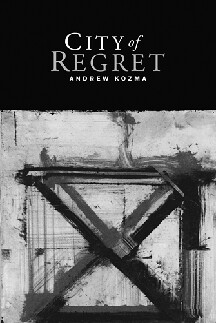
City of Regret by Andrew Kozma

City of Regret by Andrew Kozma is broken into five parts and each section is named for some element of the city — entrances, walls, living spaces, alleys, and exits.  (You can check out my 32 Poems Magazine interview with the poet, here. And please visit Saturday’s Virtual Poetry Circle –link will be live April 30 — for a look at one of his poems).

As a prologue to the collection, Kozma begins with the poem “Dis” (page 1), which is a fictional city in Dante’s The Divine Comedy containing the lower circles of hell.  Like Dante, Kozma goes on a journey through hell, but the poet is traveling through these circles to find his father who has died and with whom he has unfinished business as he says in the final lines:  “When a ravine splits the sky, Earth’s muddy light/unearths my father.  We have much to talk about.//”  This poem sets the tone for the remainder of the collection with its melancholy and mournful tone.

In the first section — entrances — Kozma uses individual poems to explore the various ways people and other beings meet, greet, avoid, and rush toward death.  In “That We May Find Ourselves at Death” (page 8), he echoes the lines of Emily Dickinson, who could not stop for death, when he asks where you go when you are late for death?  He questions how death is confronted when it has already happened and there is no way to turn back the clock.  But in other poems — such as “Night Meeting” (page 6) — the poet evokes violent images of a dead squirrel’s body pulsating with ants to demonstrate not only the sudden impact and violence of death, but the messy aftermath that often follows.  However, death need not always be violent and unexpected, it can come silently . . . gradually like in ” Your Sketch of the Church in Mourning” (page 13):  ” . . . You step with silence,/walking out, and walk slowly.  Navigate the marble floor/softly, or you will not hear the dead/call after you.//”

The poems in the second section — walls — all seem to personify the denial that comes with the stages of grief.  In “Blood Perimeter” (page 25), the narrator speaks of embracing the grief like one would embrace rust, an illustration of how tough it is to come to terms with grief.  In many cases, the poems speak of vanishing moments and people, events that are baffling yet make sense when impermanence of relationships and life are examined and understood.  Kozma uses rhyme and repetition in these poems to ensure the narrator’s meaning is not lost among the vivid images like that of the Acropolis or the hunting dogs.

In the third section — living spaces — the stage of acceptance is discovered beyond the walls of denial, but acceptance is not as tame as the word suggests.  Accepting death means letting go of the person you lose to death and in a way the narrator suggests that you have to rip free from the notion that they are still present by figuratively setting it afire, like in “Quarantine” (page 31).  These living memories and moments of joy and anger with loved ones often resurface during the grieving process, and it is these fragments that will ease the pain of acceptance, but they also become painful.  In “The Butcher” (page 38), accepting the loss and remembering the lost one is like slitting the wrist and letting the blood flow — tortuous but necessary to purge the immediate pain of grief.  Kozma’s images in this section are both violent and jarring, but effective.

In the final sections of the collection — alleys and exits — Kozma’s poems become darker, more melancholy as the loss sets in and becomes consuming.  Whether the darkness in these poems is tied to the narrator’s lack of faith in an afterlife or merely the deep emotional scarring of grief is unclear.  However, there are tinges of hope that death brings about a renewal as the ashes of a cremated body are returned to nature.

Overall, City of Regret by Andrew Kozma is a deeply moving homage to a deceased father and acts as a guide through the journey of grief.  While a different journey than the one taken by Dante in The Divine Comedy, Kozma’s journey does take the poems’ narrator through hell and more.  This collection is deeply evocative and will stay with readers long after the last page is turned.


This is my 8th book for the Fearless Poetry Exploration Reading Challenge.


This is my 14th book for the 2011 New Authors Reading Challenge.


***This is a part of the National Poetry Month 2011 Blog Tour.

Bone Key Elegies by Danielle Sellers

Danielle Sellers’ Bone Key Elegies is a collection of poems published by Main Street Rag Publishing as part of its Editor’s Select Poetry Series.  (You can check out my previous 32 Poems Magazine interview with the poet, here, and one of her poems in the 81st Virtual Poetry Circle).  Unlike eulogies that praise someone upon his or her death, elegies are a lament for the dead and are often mournful.  In this vein, Sellers excels at creating memorable elegies for her sister, a lost family, and happier memories.  However, many of these poems will deceive the reader at first, beginning with scenery or a happy moment in time before turning melancholy.  Sellers’ style echoes the turn of line expected in haiku or the final couplet of Shakespearean sonnets.

However, some poems, like “The Bridge Fishers” (page 16), are less full of despair than the other beginning poems in the collection and more mischievous, especially as the narrator drives away in a boat beneath a bridge where fisherman are waiting for their first bite from the fish, only to have the engine of the boat scare the fish away.  Sellers’ poems are filled with surprises:  some shocking, some full of dark humor, and some violent.  In “Welcome to my Father’s Showroom” (page 26), readers are given a quirky picture of the showroom as a sort of maze through which the father navigates or hides to peer at customers secretly, but in the final lines, ” . . . He watches them.  In case one should step out of/line, a shotgun leans against the metal filing cabinet.  On its shaft,/his hand-print is outlined in dust.” (please check out some sample poems).

What’s surprising is that each poem has its own depth of despair and melancholy, like an elegy is supposed to have, but the depth of that sorrow generally corresponds well to the connection the narrator has with each subject.  Losing a father can be very devastating to a daughter, but is it more or less devastating to a daughter who has seen her father cheat on her mother or leave her mother?  Losing a sister at a very young age can be tragic and life changing, but is it more or less life changing than if you were to lose a sister after having lived half your life with her by your side?  These are just some of the emotional questions tackled by Sellers’ poems, and Bone Key Elegies is an excellent examination of the various levels of melancholy and despair that individuals can experience at different intervals in their lives. It is clear that the poem about the death of a sister sets the tone for the entire collection, a tone that deepens and thins out in a see-saw of emotion.

Through rich language and vivid imagery from the Florida Keys, Sellers’ illustrates not only the brackish nature of woe, but also the desperate fight against that emotion — leaving readers breathless.


This is my 7th book for the Fearless Poetry Exploration Reading Challenge.


This is my 13th book for the 2011 New Authors Reading Challenge.


***This is a part of the National Poetry Month 2011 Blog Tour.