Quantcast

Tribute to Adrienne Rich

When an influential poet passes out of this world and into the next, all plans are set aside to pay tribute. In this case, Adrienne Rich — one of the most influential feminists and poets of her time — died on March 27 at the age of 82.

She has been compared to Betty Friedan, who wrote The Feminine Mystique, by the New York Times and others. Beth Kephart has even been touched by Rich’s poetry, including one of my favorites in her post honoring her. She has been decried and praised for her brash poetry against war and the political world, and she once famously said that she could not accept the National Medal of Arts from the Clinton Administration because “I could not accept such an award from President Clinton or this White House because the very meaning of art, as I understand it, is incompatible with the cynical politics of this administration. [Art] means nothing if it simply decorates the dinner table of the power which holds it hostage.”

Tonight No Poetry Will Serve from Poets.org

Saw you walking barefoot
taking a long look
at the new moon's eyelid

later spread
sleep-fallen, naked in your dark hair
asleep but not oblivious
of the unslept unsleeping
elsewhere

Tonight I think
no poetry
will serve

Syntax of rendition:

verb pilots the plane
adverb modifies action

verb force-feeds noun
submerges the subject
noun is choking
verb    disgraced    goes on doing

now diagram the sentence
Poet Adrienne Rich

From her hometown in Baltimore, Md., Rich created an unconventional life for herself as a mother, wife, poet, and activist, who often focused her energy on “outing” the oppression of women and lesbians and who modified the traditional cadence of free verse poetry. Whether she was a lesbian or not is irrelevant to her contributions to the antiwar and feminist movements as well as her poetic contributions that often were confessional and shocking. She strove to change the world through poetry and the power of the written word, even if she acknowledged herself that poetry could not do it alone. Though what some would consider a well-decorated poet from awards and fellowships, etc., I would almost say that she never felt she deserved them alone, but wanted to share them with all women and those that strive to make deep-rooted change in our society.

I’ll leave you with a portion of one of her poems from The Penguin Anthology of 20th Century American Poetry edited by Rita Dove.

A Valediction Forbidding Morning (page 296)

My swirling wants.  Your frozen lips.
The grammar turned and attacked me.
Themes, written under duress.
Emptiness of the notations.

They gave me a drug that slowed the healing of wounds.

Please take a moment to reflect on the power of poetry and seek out Adrienne Rich’s words to celebrate change and passion.

Perfect Gifts for Readers Supports a Cause & 25 Percent Off for You

Gone Reading recently contacted me and offered a coupon code for my readers who are looking for just the right gift for their reader friends and family.

The organization, which is based near Washington, D.C., seeks to spread the love of reading to countries across the globe where libraries are few or even non-existent.  Even in the United States, libraries are struggling to stay afloat as state budgets are reduced and some states find themselves running a deficit and in dire need of balancing, which means spending on libraries and other public services are reduced.    As part of their effort to spread the love of reading and literary discussion, Gone Reading offers a number of products for book lovers, and the group “donates 100% of our after-tax profits to provide new funding for libraries and reading-centered non-profits.”

For those interested in helping libraries in the United States, Canada, United Kingdom, and Australia, Gone Reading has an excellent, pilot fundraising program in the works.  If you work with libraries or are a librarian, please feel to contact the group about the effort.

I’ve checked out the products they offer, and there are some great Jane Austen items available for my fellow Janeites, like Anna and those at Austen Blog and Austenprose.  There are games centered on reading, book journals, gorgeous bookplates, posters, and more.  They even sent me my own sample T-shirt:

I hope you’ll all take advantage of an exclusive coupon code for Gone Reading this month for 25% off any item in the Gone Reading store, except for book ends:

SAVVYVERSE25

The code expires on April 21, so get your orders in, and feel free to spread the love to other readers you know.

2011 Indie Lit Awards Revealed

2011 Indie Lit Awards Plain PoetryAs many of you already know, I’ve been working with the Indie Lit Awards for 2011 on as director of the Poetry panel.  This was the first year for an award in the poetry category, and I think the team picked the right two collections for the winner and runner-up slots.

This year’s winner is:

Laurie Soriano for Catalina (also available for Kindle), which was published by Lummox Press.  Please check out these videos of her reading from the collection.  Stay tuned to the Indie Lit Awards for our interview with Laurie.

The runner up in the poetry category was Edward Nudelman‘s collection, What Looks Like an Elephant, also from Lummox Press.

For the list of Fiction, Bio/Memoir, GLBTQ, Mystery, Nonfiction, and Speculative Fiction, please click on the Indie Lit Awards button in this post.

Congrats to all the winners, including Aine Greaney for Dance Lessons, which I reviewed here and who offered a look at her writing process after the novel is published, in the fiction category.

Seuss and More

I’ve dropped all reading today

because today is Dr. Seuss’ birthday

or so they tell me

those bloggers I see.

Let’s celebrate

his wit and fate

to entertain children and adults

with whimsical words to exult.

He’ll be 108

isn’t that great.

Come share your rhymes

on Twitter; we’ll have good times.

Hashtag #SeussDay

Come and Play.

For the LOVE of Seuss

In all Seussiness, please join us and share your Seussian memories, favorite books, favorite rhymes, politics, and more today.  I’ll tell you that my love of poetry started with Seuss’ Cat in the Hat, which he didn’t have published until 1958!  If you have no idea why Seuss (Theodor Seuss Geisel) is so fun, you should check out Seussville where you can learn about the author, his life, his politics, and just have fun creating your own Whoville character!

In a twist on Necromancy Never Pays‘ weekly trivia game, I’ve crafted a set of Seussian lines for you to check out and tell me which book they came from.  A Seussian prize will be given to the winner who will be drawn at random from those who get all the answers right.

1.  “UNLESS someone like you cares a whole awful lot, nothing is going to get better.  It’s not.”

2.  “They kept paying money.  They kept running through until neither the Plain not the Star-Bellies knew whether this one was that one . . . or that one was this one or which one was what one . . . or what one was who.”

3.  “‘I will not let you fall.  I will hold you up high as I stand on a ball.  With a book on one hand! And a cup on my hat!  But that is not ALL I can do!'”

4.  “I hate this game, sir.  This game makes my tongue quite lame, sir.”

5.  “I’m sorry to say so but, sadly, it’s true that Bang-ups and Hang-ups can happen to you.  You can get all hung up in a prickle-ly perch.  And your gang will fly on.”

My daughter’s room is homage to Seuss in his books, his famous quotes, his color palette, and his characters.  I wanted her to be secure in her imagination, and I think that room will help her see that imagination can be

instrumental in success and happiness.  What I always loved about Seuss — besides his poetic rhymes — was the limitlessness of his imagination in the worlds and characters he created.  Worlds I just wanted to jump into and lose

myself in as a kid.  He showed me that life was full of possibilities as long as I was willing to grab onto opportunity or create it where there was none.

For some fun with kids older than mine, you should check out the Seuss crafts on CoffeeCupandCrayons (Mulberry Street, One Fish Two Fish Red Fish Blue Fish, Oobleck)!

***Also today, I wanted to let everyone know that the judging process is still going for the Indie Lit Awards, and that the winners will be announced this month.***

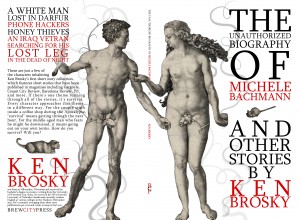
The Unauthorized Biography of Michele Bachmann and Other Stories by Ken Brosky

The Unauthorized Biography of Michele Bachmann and Other Stories by Ken Brosky is a collection of short stories prefaced by a bit of background about each story in the collection, including his trio of “Dodge County” stories.  While this kind of preface can be enlightening or amusing, this one just seems unnecessary given the powerful stories beyond this “prologue.”  From surviving a car accident that takes the life of your best friend to surviving the loss of a new friend in Darfur, these stories are poignant and threatening.  They serve to demonstrate that loss can happen unexpectedly and can tear at you emotionally and physically.

“When you see your best friend’s neck snap back with all the force of three thousand pounds behind it before everything goes black, there are other bruises, too.  They hide under the skin, just out of sight, and they take longer to heal.” (“The Third Pile,” page 50)

Some of these tales of survival border on the surreal, such as the arrival of the horseman of the apocalypse or a man deciding his future based on how many virtual deer are killed in a video game.  Beyond the theme of survival, the collection also touches upon the theme of carpe diem — to stop waiting for something to happen or your fortunes to change — and take a risk.  Each story is narrated by the first person, but the narrators are not the same, though they are similar in humor.  Some narrators are harsh in their machismo, while others are self-deprecating about their accomplishments and talents.  Brosky offers a variety of insecure male perspectives in these stories, which demonstrate how men cope with their insecurities. However, there are perspectives that are determined and secure in their convictions, no matter how unorthodox.  Another interesting aspect of these survival stories is the settings chosen from rural areas to urban Washington, D.C., and with a range of characters from artists to war veterans.

The Unauthorized Biography of Michele Bachmann and Other Stories by Ken Brosky brings to the fore the power of indecision and chaos in a way that forces each narrator to struggle and survive even when circumstances are not as they expect them to be nor as they want them to be.  Brosky’s prose is clipped at times, weaving stories in very few pages that leave a lasting impression.  In some cases the characters are not as well developed and appear to be mouthpieces talking to the reader, although there is one essay with a satiric bent in which that is to be expected.  Some stories leave their marks better than others, but overall, it is a satisfying look at survival in a number of different situations.

About the Author:

Ken Brosky was born in Milwaukee, Wisconsin and received his bachelor’s degree in creative writing from the University of Wisconsin-Eau Claire. He received his MFA from the University of Nebraska-Omaha and currently teaches English at various colleges in the Madison-Milwaukee area. He’s currently averaging 3 short story publications per year and wants to keep it that way.


Additionally, this is a stop on The Literary Road Trip since some of these stories take place in/near Washington, D.C.


This is my 14th book for the 2012 New Authors Challenge.

Reading with Sarah McCoy, Author of The Baker’s Daughter, at Novel Places

The Baker’s Daughter by Sarah McCoy was published in January 2012 and already has received a number of praising reviews and even one blogger, Anna of Diary of an Eccentric, says that the book will be on her best of 2012 list.  With all of this praise, I’m looking forward to my TLC Book Tour stop in March, but I also wanted to see the author in person.  Who is this woman who has generated so much buzz in the blogosphere with her sophomore book?  (Her first book for those interested was The Time it Snowed in Puerto Rico)  Lucky for me, Novel Places in Clarksburg, Md., was hosting a reading with this author and I could make it with some finagling by me to have the hubby watch “Wiggles.”

I’ve loved the few readings I’ve been to at Novel Places because the store is cozy and the readings are intimate — more like a conversation with a book club and author than a formal reading.  People arrived early to get copies of the book and chat with the author before 7 p.m., and I just sat and listened.  What I learned from the event was that most authors have the same type of personality in that they love listening to their characters in their heads and garnering inspiration from the people and things around them.

The Baker’s Daughter is actually inspired by a German woman whom Sarah met at a farmer’s market once and who told her how she married an American soldier at the end of WWII before coming to the United States.  That was all that was said, and while Sarah has not seen the woman since, it was enough to send her off on a journey of history, relationships, and more, which is all housed in her second book.  Although she says that she will never hand the woman a copy of the book and tell her that she was the inspiration, I think the woman would be happy to know that she touched the author in that way.

Author Sarah McCoy at Novel Places

I love that Sarah brought the red hat from the cover and although she’s too young to be in the Red Hat Society, she agreed to become a Pink Lady.  She was asked about her writing and revision process, which she says is long with journaling about her characters at the start, rather than plot outlines, and about 10-12 rounds of revisions once the first draft is written. Her research process is narrowed by the characters she is inspired to write about, limiting research to a particular year in a particular region or city in Germany for example for The Baker’s Daughter.  She says that otherwise, she would just research too much, get overwhelmed or after 10 years still not have written a book.

Her younger brother also was in attendance and was apparently not only chauffeuring her around to each event while she’s in the area, but also taking photos.  It was obvious from the way she interacted and talked about him and her family that they are all close.  It’s wonderful to see those family connections in person, especially given that her novel touches upon family connections and interactions during some difficult periods in history.

Answering Questions at Novel Places

She talked about her MFA program and her teaching stints in Texas where she now lives with her husband, though she is a former Virginia resident (her parents still live in Fairfax County).  Overall, it was an engaging and conversational event.  She’s affable, delightful, and vivacious, and obviously very outgoing; I think I was in awe of her — too in awe to actually ask any questions, though there were many buzzing in my head.  Perhaps, I’ll get the chance to interview her once I’ve had the chance to read the book and review it here for the blog tour.

Hopefully, I didn’t miss much in the conversation, but that sickness is going around and I think it has finally reached me because my head was feeling awfully foggy.  I’m lucky I remembered my book and Anna’s for Sarah to sign and to talk to her about how much Anna loved the book — by the way, she remembered Anna from that blue cat tattoo icon she uses. . .how cute is that?!

Thanks to Patrick for hosting another AWESOME event!


Additionally, this is a stop on The Literary Road Trip since Sarah McCoy is a former resident of the area and her family still lives here.

Call for Poetry Book Donations & Looking for Tour Hosts

National Poetry Month 2012 is nearly upon us, with less than two months to go.  I’ve got a few great bloggers willing to talk about poetry and to host reviews and guest posts in April, but I’ve still got some open spots on the schedule.  Won’t you help me fill them in?

I’ve got a few guest posts coming in from poets that need blog tour hosts for them.  Just drop me an email if you want one and what day you want to host.

Also, if you’re a poet or a publisher of poetry, I’m looking for short guest posts from you about poetry for some fellow bloggers who want to join the tour but don’t feel they want to review a book.  I’m looking to help them out with a guest post form you.  Please email me with your ideas at savvyverseandwit AT gmail

Finally, anyone who would love to share the love of poetry through some giveaways in April, please sign up to donate books, poetry workshop classes, poetry journals, literary magazines, and any other poetry-related items.  Send me an email to savvyverseandwit AT gmail with your donations and if you prefer I run the giveaway or you’d like to run it yourself.

OK, that’s it.  I hope everyone can help out.  See you for the big tour in April.

Interview with Eric D. Goodman, Author of Tracks

Tracks by Eric D. Goodman (my review) is one of the best novel in stories I’ve read in a long time, and it will likely end up on my best of the year list. It not only reads like separate short stories, if you just want to read something satisfying in a short slot of time, but also is a connected story by the train, the conductor, and the mystery/action storyline.  In many ways, I’ve thought about how it reminds me of Agatha Christie’s Murder on the Orient Express, but the reader is the detective.  However, there also are deeper themes at work of feeling stuck and unable to move on or wanting to change, but unable to accomplish that goal because of an inability to take a risk or the inability to let go of the past.  I digress, just go read the review, you’ll see what I mean.

I’ve got a great treat for my readers today, as Eric agreed to an interview about his book and his writing experiences. Please give him a warm welcome.

1. Since Tracks takes place on a train traveling between Baltimore
and Chicago, it is clear that trains are important to you. When did
you first realize that you loved trains and what do they mean to you?

As a child, I think I had a love of trains that many children share:
toy train sets, a need to watch trains as they passed by, an urge to
place coins along the tracks to be warped and smashed by the
locomotives. And there was always a spirit of adventure involved with
coming across a line of tracks and walking along it.

I was probably about six when I took my first trip on Amtrak. It was
exciting, an adventure, and much more fun than the usual cross-country
driving trips my family took. But then there was a long period of no
trains. Unfortunately, trains seem to be underfunded in our country
and, therefore, are sometimes more expensive than planes and certainly
cars and busses.

It was when I was a college student traveling in Russia that I
rekindled my interest in trains. Trains were a popular and
inexpensive way to get around. I took sleeper cars on overnight trips
often while in Russia. Sometimes, that was the most fun part of a
trip.

2. Baltimore is almost like its own character in the book, looming
ominously over some of the characters while anchoring others to a
sense of home. Was it hard to show both the darker and lighter sides
of Baltimore given its reputation as a high-crime city? And how do
you view Baltimore, as a resident and a writer?

Baltimore is a wonderful place to live if you’re a writer or an
artist. The literary community is tight knit and most of the writers
I know are very supportive of their fellow authors. As far as the
crime goes, I think Baltimore is a lot like any other large city:
there are areas with high crime, areas with virtually no crime, and
much of the violent crime exists in its own little sub-culture. I’ve
lived in Ohio, California, Rhode Island and lots of places in between.
I won’t pretend they’re the same, but I will say that I’ve personally
encountered no more crime here than in the other places I’ve lived. In
other words, it exists, but it’s easy to avoid.

Baltimore has a lot of character; it was easy to set certain scenes
from Tracks in rich locations with exciting backdrops.

3. When writing Tracks did you find that one scene or character
surprised you? If so, which one and how so?

My writing tends to be inspired by an idea or theme or some nugget of
conversation that I found interesting. It doesn’t begin with plot;
the idea comes first, then the character, then the plot. So my
characters surprise me often. I know what I want the theme or idea to
be, when I begin writing, but not always exactly what they’re going to
do.

The Conductor, Franklin, sort of surprised me. His two stories were
actually the last two I wrote. In the original manuscript, he didn’t
even have his own stories. He appears in everyone else’s story and
always seems like such a nice, chipper, friendly guy. And he is. But
when I began to dig deeper and write about him in his own stories, I
discovered that he had another side.

4. The conductor and the Amtrak train tie the stories together, but
the stories also could stand on their own. Was there any point in the
process where you thought that 
Tracks should just be a short story
collection and not be a novel in stories? What convinced you to stay
with the novel in stories format?

I had written three stories individually before I decided that I
should make this a collection. Then, as I continued to weave the
stories closer together, I thought it would be nice to create a sort
of hybrid—to write a novel and a set of stories at once. Part of it
was with the goal of both working on a novel and having stories to
submit to journals at the same time. But part of it was just out of
curiosity—could I pull off a “novel in stories?”

Coincidentally, by the time this went to print, there seemed to be a
revival in the format: A Visit from the Goon Squad, Olive Kitteridge,
Later at the Bar, The Civilized World. But I wasn’t riding a wave; I
was doing my first draft before it started!

5. From first draft to publication, how long did it take to complete
Tracksand find it a home on bookstore shelves? Have you had any
champions behind the book that spurred you to get it published and who
have helped hand-sell (I use this term lightly — noting that social
media and the Internet could help spread the word) copies?

It’s been a long line of track. I think it was back in 2006 when I
wrote the first draft. I tend to write a manuscript, then put it away
for a year or longer, then rewrite it. So although I didn’t spend
time each year working on the manuscript, about five years passed from
first draft to bookshelf. During that time I wrote a couple other
book drafts (one of which is with my agent now) and did a lot of
tinkering and polishing. I had it ready to submit to agents in 2009,
got an agent in 2010, and secured a publisher later that same year.
Then it was released in 2011.

I’ve been overwhelmed by the kind reception Tracks has received from
other writers. Some of the biggest include Madison Smartt Bell,
Thomas Steinbeck, Bathsheba Monk, Jessica Anya Blau, Rebecca Barry,
and Victoria Patterson. I even got notes of congratulations (but not
official blurbs) from Jonathan Franzen, Jennifer Egan, T.C. Boyle, and
Junot Diaz! It’s felt good to be noticed, even if sometimes only as
an insect.

Thanks, Eric for answering my questions. If you are in the Washington, D.C., area and interested in reading Goodman’s book, he’ll be reading at the Open Door Series at the Writer’s Center in Bethesda, Md., on Feb. 12 at 2 p.m. Register for the event.


Additionally, this is a stop on The Literary Road Trip since Eric is a local author in Baltimore, Md.

Poetry Readers and Writers

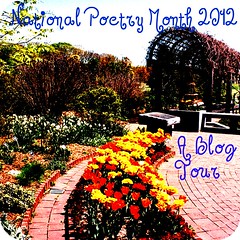
National Poetry Month 2012National Poetry Month 2012 is in April and I’m looking for guest posts from poetry readers and tour hosts for these guest posts. I want to fill out all of April early and be able to direct readers across the blogosphere for some great poetry discussion and celebration.

Not only will you be part of a tour involving poetry collections, poet interviews, guest posts from poetry readers, and maybe even just some great poems and discussion, you also get my new snazzy button — and I can’t believe I made it myself from a photo my hubby took at the National Arboretum.   OK, that’s a lame reason to join the blog tour.

I’m hoping to put together some great giveaways for everyone who participates either as a commenter or as a blog tour host/guest blogger.

I hope that even if you don’t want to participate you’ll spread the word.  I want to fill up every day in April.  Dates will be a first come, first serve basis, and I’ll be posting the participating blogs on the schedule below as I hear from people.

Won’t you join me in celebrating poetry?

Sunday, April 1 — Savvy Verse & Wit’s Kickoff of the blog tour
Monday, April 2 — Sara from Wordy Evidence of the Fact
Tuesday, April 3 — Jill from Rhapsody in Books will talk about Cole Porter
Wednesday, April 4 — Anna from Diary of an Eccentric, WWI Poetry Anthology
Thursday, April 5 — Audra from Unabridged Chick
Friday, April 6 — Michael Meyerhofer from Trouble With Hammers
and My Friend Amy hosts Sweta Vikram’s Guest Post

Saturday, April 7 — Dar from Peeking Between the Pages
Sunday, April 8 — Patty from Books, Thoughts and A Few Adventures…
Monday, April 9 — Naida from the Bookworm
Tuesday, April 10 — Kathy from Bermudaonion, tentatively THE WATCH THAT ENDS THE NIGHT by Allan Wolf
Wednesday, April 11 — Jeanne from Necromancy Never Pays, who will discuss litany poems and then show and discuss Richard Siken’s “Litany in Which Certain Things Are Crossed Out”
Thursday, April 12 — Julie from Read Handed will talk about 2010 Cider Press Book Award winning collection Play Button by Liz Robbins
Friday, April 13 — Melanie from The Indextrious Reader on superstitions and poetry
Saturday, April 14 — Cecelia from Adventures of Cecelia Bedelia
Sunday, April 15 — Ana from Things Mean a Lot
Monday, April 16 — Cassandra from Indie Reader Houston
Tuesday, April 17 — Ti from Book Chatter
Wednesday, April 18 — The Girl from Diary of an Eccentric will focus on Robert Frost
Thursday, April 19 — Pam from Bookalicious
Friday, April 20 — Tabatha of Tabatha Yeatts: The Opposite of Indifference
Saturday, April 21 — Megan from Solid Quarter
Sunday, April 22 — Nicole Luongo from Bare Your Naked Truth at Peeking Between the Pages.
Monday, April 23 —  Adrienne Odasso from Seer of Ghosts and Weaver of Stories
Tuesday, April 24 — Arisa White from Arisa White
Wednesday, April 25 — Craig from Mr. Watson
Thursday, April 26 — Wallace from Unputdownables will focus on Edna St. Vincent Millay and Dorothy Parker
Friday, April 27 — Wendy from Caribousmom will host Poet Michael Meyerhofer and his guest post on self-publishing
Saturday, April 28 — David from Wordcoaster who will showcase bird poetry.
Sunday, April 29 — Sidne from Sidne, The Reading Socialite who will discuss Love and/or Life
Monday, April 30 — Travis Laurence Naught on how Jack Kerouac and Jim Morrison (maybe even Allen Ginsberg) formed his writing style

Thanks, everyone.

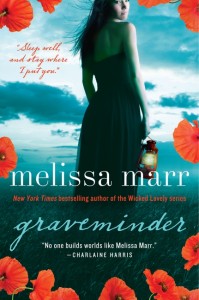
Graveminder by Melissa Marr

Graveminder by Melissa Marr is creepy and mysterious.  Claysville is a town in which its residents are protected, and there is a peculiar bond between the undertakers and the graveminders.  Not sure what a graveminder is? Readers quickly get an inkling of what they do and how they take care of the dead in the town.  Supernatural beings — both good and bad — are afoot in Claysville, and those that leave the town who were born there are often drawn back by an unnatural force.

“Absently, Rebekkah ran her fingertips over the wood of the desk.  Maylene had refused to let any one refinish it, arguing that the pattern of the scratches and wear marks from years of use made it uniquely hers.  Years leave stories written on every surface, she’d said.  The room, Maylene’s bedroom, was filled with stories.”  (page 112)

Rebekkah Barrow is called back home when her grandmother, Maylene, is murdered, and her on-again, off-again love Byron is there by her side as she buries the only family she has left.  Although Rebekkah is not a blood relative, she’s got a bigger job to do now that she’s returned, and Byron has to help her.  Blood relatives are beside themselves with jealousy, like Cissy, or are indifferent to the situation, like Liz.  And the town is full of people who know a lot more than they are willing to speak about aloud.

Marr has an excellent sense of how to create atmosphere; her novel reads like those dark movies where the fog machines are making everything misty and the characters are left bumbling around in the dark, trying to hold onto some sense of normalcy.  Byron and Rebekkah are surrounded by their pasts with one another and their histories with those in the town, but they must set their troubles aside for the good of the town.  Marr is clearly using an allusion to the Faust and his deal with the devil, but in Graveminder, the town has made a pact with the dead.  The body count gets larger and larger as the Undertaker and his Graveminder learn their craft, but the question is, will the pact be broken or will they find themselves broken by the pact that gave them no choice about who they were to become?

Graveminder by Melissa Marr has an interesting set of characters, though Cissy is a bit too much of a caricature and a little too outrageous in her outbursts.  Readers would almost prefer her to be less but more sinister.  Quick paced, and action packed, but the drama between Byron and Rebekkah could have been more subtle.  Readers searching for a book to curl up with and looking for a bit of paranoia with their late night reading should consider a Graveminder for a companion in the wee hours of the morning.

About the Author:

Melissa Marr grew up believing in faeries, ghosts, and various other creatures. After teaching college literature for a decade, she applied her fascination with folklore to writing. Wicked Lovely was her first novel. Currently, Marr lives in the Washington, D.C., area, writes full-time, and still believes in faeries and ghosts.  Check her out on Twitter, the Web, Facebook, and “like” Graveminder.


To see the other stops on the TLC Book Tour, click the TLC Tour Button.


This is my 7th book for the 2012 New Authors Challenge.


Additionally, this is a stop on The Literary Road Trip since Melissa Marr is a Washington, D.C., resident and author.

The Gauntlet Has Been Dropped: Monthly Poetry Event

Lu, Kelly, and Eva have talked about reading more poetry in 2012, and they want us all to join in.  Stuck for a list of enjoyable poetry books, check out the Indie Lit Awards 2011 list and Lu’s list.

This challenge is open to everyone — from those who love poetry already to those just starting out or returning to poetry — and you don’t even have to read poetry, but post about poetry.  You could post about your favorite poet, why you hate poetry, why you want to read poetry, different poetic forms, something you remember about poetry from school, and anything else you can think of as long as it is about poetry.

This is the schedule for posting ONCE per month:

Poetry: Read More/Blog More – A Monthly Event!

January 31st
February 28th
March 27th
April 23rd
May 29th
June 26th
July 31st
August 28th
September 25th
October 30th
November 27th
December 18th

Once you’ve posted, visit Lu and Kelly’s blogs to put your link in the Mr. Linky!  Once you have your sign up post ready, link up here.

I’ve picked up the gauntlet, will you?!

Tracks by Eric D. Goodman

Tracks by Eric D. Goodman is a expressive and reflective novel told in stories or what some would call a short story collection published by Maryland-based publisher Atticus Books, and unlike other short story collections, there are very few weak stories, if any.  Each protagonist in the story is on the train headed somewhere and each of their lives is in transition, from a young woman on the verge of promotion who must decide between lover and career to a man and woman at the end of their years who must face their fears.  Goodman is adept at ensuring readers care about his characters in just a few pages, and even though the end of each story comes quickly, there is rarely a sense that there was more to the story that was not told.

“The train has a way of transforming a person.  Sometimes passengers become aware of things they didn’t know before boarding.  Something about the stillness on a moving train, being around people and alone at the same time.  They’re neither here not there — in transition.  That frees them up to do things or say things they might not ordinarily do or say.” (from the preface)

The Cardinal that rides between Baltimore, Md., and Chicago, Ill., carries all of these passengers on their way, and some of these passengers have been on the train in both directions, while others have traveled the rails between Chicago and Washington, D.C., and more than once.  It does not matter where these characters come from; what matters is that the rails provide them with hope and a time out from their hustle of their daily lives.  The train and the rails are an escape, a quiet place to contemplate their lives as the undulating sway of the cars lulls them into deep meditation.  Paralleling their actual lives, the trip on the train has each member making contact with strangers, and like the conscience that guides their decision making, the conductor on the train whispers advice and nuggets of observation/wisdom to those with whom he speaks.  Beyond the characters, the city of Baltimore and the rail line itself loom large in the story, almost becoming characters themselves, with the city representing an anchor weighing down certain characters and the rail a symbol of liberation.

“one station, joy; the next, grief
the soul pulled along
by the hope for peace
at the next junction.” (page 198)

Each story is tied together by the people the characters meet on the train, the conductor, and the railway itself.  The rails come to symbolize the journey life takes us on, with some of the moments in our lives speeding by us too quickly for us to pause and reflect, while others gently impress upon us the gravity of their meaning.  Readers spend time with each character, getting to know their reasons for being on the train, the events that have hammered them recently, and how they view their fellow passengers, but Goodman also sprinkles in a bit of mystery and mayhem into the narration with the introduction of Gene Silverman in “Reset” and Charlie in “One Last Hit.”  Several stories also delve into the detrimental effect of war on not only the victims who survive, but also the soldiers called to action.

Tracks by Eric D. Goodman demonstrates how we are all traveling the same line and how we have similar fears and failings, but also similar hopes and dreams.  In spite of that, we all end up in different places.  Even with the characters who seem unsavory or hard to like, they offer a lesson to readers — seize the moment because in the next, it could be gone.  Opportunity arises and disappears just as quickly, and life on the train ride of life is quick and unrelenting.  There’s not much time for reflection and a deeper examination of pros and cons when living life at full tilt, but stepping back for a few hours on a train ride can be enough to reassess and rejoin life’s journey with a new purpose.  Excellent novel in stories with a common theme, setting, and interacting characters tying them together.

About the Author:

Eric D. Goodman has been writing fiction since he was in the third grade, when a story assignment turned him on to the craft more than a quarter century ago. He regularly reads his fiction on Baltimore’s NPR station, WYPR, and at book festivals and literary events. His work has appeared in a number of publications, including The Baltimore Review, The Pedestal Magazine, Writers Weekly, The Potomac, Grub Street, Scribble Magazine, The Arabesques Review, and New Lines from the Old Line State: An Anthology of Maryland Writers. Eric is the author of Flightless Goose, a storybook for children. Check out this interview with Eric at Atticus Books.


This is my 2nd book for the 2012 New Authors Challenge.


This is a stop on The Literary Road Trip since a lot of the book Tracks focuses on Baltimore, Md., the author is a regular on Baltimore’s NPR, and the publisher is based in Maryland.