Quantcast

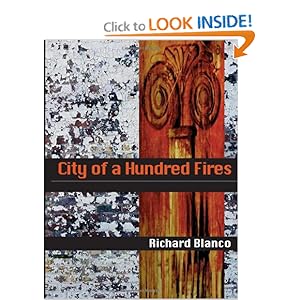
City of a Hundred Fires by Richard Blanco

Richard Blanco‘s City of a Hundred Fires is a collection published by the University of Pittsburgh Press about the Cuban-American experience, which won the 1997 Agnes Lynch Starrett Poetry Prize.  (You can check out one of his poems in the 40th Virtual Poetry Circle and my take on a reading he did at the local Writer’s Center in 2009.)  The collection is broken down into two sections and each poem contains not only English, but also Spanish phrases, which readers may or may not know offhand.  Readers who are bilingual will have little trouble, though those who have a working knowledge of Spanish or don’t will be able to gather what Blanco is getting at from context clues.  Poems are either in traditional short narrative lines or in longer, more paragraph-like lines, but each tells a story, reveals a memory, and explores a bit of the Cuban-American experience.

“Crayons for Elena” on page 13 is one of the most poignant poems in the collection as it uses the box of 64 crayons to illustrate the differences in skin tones and cultures of the people the narrator encounters and the colors that represent elements from the narrator’s own culture, including pinatas and mangoes.  “. . . All these we wore down to/stubs, peeling the paper coating further and further, peeling and sharpening/until eventually we removed the color’s name.  This is for leaving the box in/the back seat of my father’s new copper Malibu, the melted collage, the butter/”  It seems that though these differences confuse the narrator and cause discomfort, eventually, these differences are forgotten and life moves beyond those variations and instead absorbs the similarities, “melting them into a collage.”

Blanco continues to straddle the Cuban culture — kept alive in family traditions such as Quinces balls — and his new home in American culture.  In a way, his traditional family culture seems foreign to the narrator as he assimilates to American traditions of turkey at Thanksgiving and peanut butter and jelly sandwiches.  Unlike the older relatives talked about in the poems, the narrator does not kid himself that he will be returning to Cuba after the revolution; he knows that the dream of returning to the old country is just that — a dream.

At times, however, the narrator does experience moments of nostalgia, in which he remembers family events or moments.  There are other moments in which the voids left by an American culture that does not feel exactly like home are filled with reminders of a culture left behind whether those voids are filled with sake by a Japanese immigrant or by dark rum with lemon for a Cuban-immigrant.

Unlike in part one where the narrator delves into familial memories and the confusion of bridging two cultures, in the second part, the narrator has become more observant of how his home culture is mutilated and warped by the American idea of capitalism to create a caricature of Cuban life and culture, like in “El Jagua Resort” (page 43):  “where Canadians and Italians step out/drunk congas from megaphone instructions –/side-to-side, kick-then-kick, hand-to-hip;/caught in spells of tabaco, dark rum,/brown sugar, and the young mulatas/”  In a way, the little Havana created in America by the narrator’s parents’ generation is fading and being replaced, but the second part also illustrates more historical details of Cuba, the revolution, and other events.

For a slim volume of poems at 74 pages, City of a Hundred Fires by Richard Blanco will knock you on your butt with its passion, anger, and disbelief.  But it also will drag you to your feet as it clings to hope and harmony.  Overall, Blanco has crafted a diverse collection of poems on the Cuban-American experience that delves below the surface struggles of bias and loneliness to the internal struggle of one narrator and how he copes with those struggles and more.
This is my 6th book for the Fearless Poetry Exploration Reading Challenge.


This is my 12th book for the 2011 New Authors Reading Challenge.


***This is a part of the National Poetry Month 2011 Blog Tour.
 

Earth Day 2011

Happy Earth Day, everyone.  I’ve done a number of posts over the years about recycling, ebooks, and other environmental topics, but today, I wanted to provide you with more of a hodgepodge of information.

First, Eco-Libris, which hosts the Green Books Campaign annually, is hosting a contest as part of its 41 reasons to plant a tree for your book. Today is the last day to enter the giveaway.  Check out the giveaway information from Eco-Libris:

Last November you took part in our Green Books Campaign and we thought you might be interested to learn on the campaign we’re launching for the upcoming Earth Day. This year we are celebrating the 41th Earth Day with a special campaign – 41 Reasons to Plant a Tree for Your Book.

With more than 180,000 trees planted so far on behalf of readers, authors and publishers working with Eco-Libris, it’s no surprise we think planting trees to green up books is a great idea..

But we also want to hear what readers think about it and why they believe planting trees for their books is a good idea, and so for 41 days, beginning on March 13 and continuing through April 22 (Earth Day) we’ll publish on our blog 41 of the best replies we’ll get, one reply every day!

We have great prizes to all the readers whose replies we’ll publish, including a $25 gift card for Strand Bookstore, audiobooks from Simon & Schuster Audio (such as The Half Life by Jennifer Weiner, American Assassin by Vince Flynn and Essence of Happiness by the Dalai Lama) and great green books, like Planet Home by Jeffrey Hollender, Little Green Books,  Spit That Out! by Paige Wolf, The Story of Stuff by Annie Leonard and many more! You can see the full list of the prizes on the campaign’s page.

If you would like to share the information on the this campaign with your readers and invite them to take part and send us their replies that would be great! Our email is [email protected] and the campaign’s page address is http://www.ecolibris.net/41reasons.asp

Yours,
Raz @ Eco-Libris

Today, I’m striving to reduce energy use in my new home by installing eco-friendly light bulbs, ensuring that I recycle as much plastic and paper as I can, and reducing water consumption through my dishwashers “water miser” setting.  I’ve also heard some great things about rain barrels, and hope to comparison shop for one which we can use in our backyard.  Since giving birth to my daughter, I’ve reduce my energy consumption by working from home, but naturally, that’s a perk that will end sooner than I’d like.  What plans do you have to reduce your carbon footprint (take the quiz to see what your footprint is) or to conserve?

If you are interested in signing a petition to foster a “greener” economy here in the United States, please sign it here.

You also can go to the Earth Day Network and find events happening in your local area.  Please check out those events for the Washington, D.C., region.

But even if you don’t have the time or there are no Earth Day events near you, take the time to spend a moment or two outside cleaning up your own yard or  your local neighborhood, which can be as easy as picking up stray litter or dog poop.  You can even take time to visit a local park and clean up there or simply sit and enjoy the pleasures of nature.

Enjoy Earth Day and spread the word!

***Please also stop by the next National Poetry Month Blog Tour stop at Diary of an Eccentric and Read Handed.

White Egrets by Derek Walcott

White Egrets by Derek Walcott is a collection of deeply suggestive and blatant poems about the natural cycle of birth, life, and death and coming to terms with the later as friends, lovers, and others pass away leaving the narrator behind on the journey of life.  Each poem uses nature imagery to paint a canvas of emotion as the narrator grapples with grief, joy, and memory.

Walcott’s poems are long and narrative in many cases, which is not a form or style that calls to every reader, but even the most picky reader can easily pick out the cues that will carry them throughout the multiple part poems.

For instance, in the title poem “White Egrets” section one, readers will notice the lines “in the drumming world that dampens your tired eyes/behind two clouding lenses, sunrise, sunset,/” that signal a decline in health.  In the second section, the theme carries on in the lines “into a green thicket of oblivion,/with the rising and setting of a hundred suns/” until it culminates through a series of images and narrations in section four with the lines “and of clouds.  Some friends, the few I have left,/are dying, but the egrets stalk through the rain/as if nothing mortal can affect them, or they lift/”  and finally in section eight, “the egrets soar together in noiseless flight/or tack, like a regatta, the sea-green grass,/they are seraphic souls, as Joseph was.//”  While the poem is dreary in theme, the subject of losing ones friends slowly over time to death, it also carries along elements of immortality and being left behind as a testament to those who have passed before us.

Many of Walcott’s poems are in memory of friends, family, and others as he dedicates poems or portions of poems to them, and each takes on a meditative and reflective state as he explores their relationship and his memories of their time together.  More than just mundane relationships to our friends and family, Walcott paints a picture of humanity’s infinite connections to the past, present, and future in an effort to demonstrate how deeply we are all interconnected.  In poem 46, “catalogue of a vicious talent that severs/itself from every attachment, a bitterness whose/poison is praised for its virulence.  This verse/” Walcott harshly discusses the consequences of severing attachments, which some may actually believe is a preferable way to live.

White Egrets is a collection readers would probably tackle on a poem-by-poem basis, rather than read at once — not because they are too hard to interpret but because they tackle themes and emotions that are heavy and can weigh down the reader or provide him or her with fodder for reflection on his or her own life.  From moments in history such as the debts owed because of the Holocaust to the election of President Obama, the poet reviews moments in history and how they impact individuals.  Overall, White Egrets is a emotional roller coaster ride of longer poems that are meditative, disruptive, and thought-provoking.

This is my 5th book for the Fearless Poetry Exploration Reading Challenge.


This is my 11th book for the 2011 New Authors Reading Challenge.


This review is part of my celebration for National Poetry Month!

Guest Post: The Passion for Poetry: the Writer and the Reader

Today, we have an excellent guest post from Lu at Regular Rumination about generating a passion for poetry among readers from her perspective as a reader and writer of poetry.  I can’t wait for all of us to share our methods for reading and/or writing poetry.  Without further ado, here’s Lu:

“You can’t be a good reader if you don’t have the experience of writing,” is the essential philosophy of one of my literature professors. He has said on a few occasions now that he prefers reading and discussing poetry only with poets. Keep in mind he said this to a classroom full of students who are decidedly not poets, but rather Spanish-language literature students. Now, I’m not always the most attentive student, but this made me stop and really pay attention to what he was saying. This is exactly the kind of alienating idea that I try to work against, constantly. Poetry should be for everyone, not just those who are devoted to studying or writing it. Poetry is a sensual, literary experience for the masses, not for the few.

But what if he has a point? As someone who has studied writing poetry, not just reading it, do I have an advantage or some kind of insight that those who are “just” readers do not?

Don’t worry, I don’t actually think I am better at reading poetry than you are, but I do think there are some differences. I think the best metaphor to describe it is that reading poetry as a poet is like listening to music as a musician. I am no musician, even though I’m currently taking piano lessons again after 10 years, so when I listen to a complex piece of music (read: music with two or more instruments), I generally can’t tell the instruments apart or even what instruments are being played. I can’t tell you why I like the music. There are some things I’m more familiar with, like the piano, and that I can recognize and explain, but everything else? I just listen and enjoy.

When I am reading a poem for the first time, I am often more interested in what the poem sounds like than what it says. So, since I have been taking piano, when I first get a new piece to play, I always play my right hand first, then my left. Finally, after practicing those over and over again, I put them together and practice some more. With a poem, the first thing I “read”  is the sound. Only after I have gotten a grasp on what the author is trying to do with the rhythm, meter, rhyme and other aspects of sound in poetry can the meaning make its way through. Then I put the two together and read it again. That’s why people often say you can’t read a poem only once.

When I write poetry, what I pay more attention to really depends on the poem. Sometimes form comes first, others meaning. But for me, when I am reading and when I am writing, the two often begin as separate things and then come together to form the complete poem. However, I hope that when someone reads the poetry I have written, the two work together seamlessly. My poetry mentor once said to me, “We do all of this hard work as poets just so our readers won’t notice it.”

So how can we apply this to our daily poetry lives? How about getting people passionate about reading and writing poetry? If you are reading this post, you probably already are. I believe that the way we teach poetry makes it seem hard. I don’t think poetry should be hard. It should make you think, it should make you passionate, it should make you happy. Of course, not every poem can do all of those things for you, but introducing people to the wonders of poetry at an early age could get people passionate about poetry again.

Maybe you saw this coming, but I think the best way to get kids passionate about poetry is to get them writing it. There were plenty of things that I didn’t understand about poetry until I actually spent time writing it. Meter, for instance. I have a horrible ear, to this day I still have trouble hearing the meter in poetry. But writing in form, something I never thought I’d be able to do (and trust me, the first time, I did it kicking and screaming), really helped clarify what I was supposed to be hearing and writing.

Of course I disagree with my professor. Not everyone has to be a poet to understand, love or talk about poetry. Not everyone has to have a talent for poetry or writing to enjoy reading it. But there are advantages to studying the process of writing poetry when it comes to reading it, at least there were for me. In the end though, all that really matters, is that people are reading poetry and falling in love with it.

I don’t think everyone has the same reading or writing process that I do, so here’s my parting question to you: what is your poetry reading process like? If you write poetry, how do you incorporate form and meaning? Do you focus on one and then the other? I’m fascinated by both the reading and the writing process, so please, answer away!

Thanks, Lu, for participating in the National Poetry Month Blog Tour! I can’t wait to see what everyone has to say about their reading process.

***Also, don’t forget to check out today’s tour stop at Haiku Love Songs and Read Handed.

Guest Post: Novelists Who Are Poets Too

When setting up the National Poetry Month Blog Tour, a number of bloggers were eager to participate, including Valerie from Life Is a Patchwork Quilt. Today, I’m turning over the blog to her as she discusses some novelists that she recently discovered also wrote poetry. I hope you’ll share with her and me some of the novelists you know that also write poetry.

It is not a great surprise to us that many past and present authors in the literary world have have written both poetry and prose. A writer throughout his or her literary career prefers, often times, one or the other form. Sometimes a writer chooses one path because of personal preference. Sometimes it is for good reason — they are better writers than poets, or vice-versa. Or, sometimes success in one field or the other is simply due to a matter of timing or circumstances.

Today, let’s look at a few people of whom we are probably more familiar with as writers, but also published poetry. I’ll present them in chronological order.

There’s the Brontë Sisters: Charlotte (1816-1855); Emily (1818-1848); and Anne (1820-1849). In 1846, and under pseudonyms, the sisters published Poems by Currer, Ellis, and Acton Bell. After only two copies sold, the Brontës then concentrated on writing novels, with more successful results. Unfortunately, all three sisters died young, so they produced only a few novels and their poetry for us to persue.

The Brontës lived during the Romantic Era, the same time period of the works of Lord Byron, John Keats, and others. Death and yearning are a common theme in most of the Brontë poems — therefore, their poetry may not be everyone’s cup of tea. What follows is a typical example of Brontë poetry.

The Old Stoic by Emily Brontë

Riches I hold in light esteem;

And Love I laugh to scorn;

And lust of fame was but a dream

That vanished with the morn:

And if I pray, the only prayer

That moves my lips for me

Is, ” Leave the heart that now I bear,

And give me liberty !”

Yes, as my swift days near their goal,

‘Tis all that I implore;

In life and death, a chainless soul,

With courage to endure.

Some sources available for Brontë poetry: Project Gutenberg has Poems by Ellis, Currer and Acton Bell ; a PDF format , by Pennsylvania State University. In print: Best Poems of the Brontë Sisters, Dover Thrift Editions (not all poems from the original 1848 publication are included).

When I was recently reading Ernest Hemingway (1899-1961), I was intrigued that he had some poetry published in addition to his novels. Hemingway was known for his minimalist writing style in his novels, and I feel that it did not transfer as well in his poetry. Yet, during his lifetime, his poetry was published in Poetry Magazine and other publications, and in his Three Stories and Ten Poems. A modern source of Hemingway poems is Complete Poems: Ernest Hemingway by editor Nicholas Gerogiannis (University of Nebraska Press, revised edition 1992).

As follows is one of Hemingway’s better poems, published in Poetry Magazine in January 1923. In that issue, Hemingway was introduced as a young Chicago poet who was at the time abroad in Paris.

Chapter Heading

By Ernest M. Hemingway 1899–1961

For we have thought the longer thoughts

And gone the shorter way.

And we have danced to devils’ tunes,

Shivering home to pray;

To serve one master in the night,

Another in the day.

(formatting source: Poetry Foundation)

Your browser may not support display of this image.

John Updike (1932-2009) wrote many novels (including the Rabbit Angstrom series and Witches of Eastwick) during his productive career, and regularly published volumes of poetry. Collected Poems 1953-1993 includes all his poetry volumes published up to that point; and his later poetry volumes were Americana and Other Poems (2001), and Endpoint and Other Poems (2009).

As with his books, Updike’s poetic subjects were wide-ranging. He could shift from writing about sports to poems of place (Spain, Brazil) to poems with more traditional topics (such as nature). If one is in the mood for light verse –but with more depth — then Updike’s poetry might be appreciated. Many of Updike’s poems are laced with humor (but be warned: a few are quite earthy; such as “The Beautiful Bowel Movement”; some refer to sex).

Here is one poem by Updike:

Painted Wives, by John Updike (Collected Poems 1953-1993)

Soot, house-dust, and tar didn’t go far

With implacably bathing Madame Bonnard;

Her yellowish skin has immortally been

Turned mauve by the tints she was seen floating in.

Prim, pensive, and wan, Madame Cezanne

Posed with her purple-ish clothes oddly on;

Tipped slightly askew, and outlined in blue,

She seems to be hearing, “Stop moving, damn you!”

All lilac and cream and pink self-esteem,

Young Madame Renoir made the sheer daylight dream;

In boas of air, without underwear,

She smiles through the brushstrokes at someone still there.

Some online sources for more poetry by Updike: Updike poems at The Poetry Foundation , Requiem (at NYT) , poets.org.

Finally, I present a living poet and novelist: Laura Kasischke. I was first introduced to Laura Kasischke’s works when I lived in Michigan — in fact, her son and my older son were in the same cub-scout den. Our local library carried all of her works, and eventually I acquired some of her novels and poetry for myself. At that time, I had the feeling that Laura Kasischke was primarily known as a poet rather than as a novelist. But, over the past couple years, as I started following book blogs, I noticed that blog reviews focused on Kasischke’s more recent novels (In a Perfect World, 2009; and The Raising, 2011), rather than her poetry.

Kasischke has written several volumes of poetry; her most recent (Space, In Chains, March 2011) was published this year. Based on what I’ve read of Kasischke’s recent poetry, my impression is that she may be evolving into using shorter, sparer verse today than her earlier works that includes Gardening in the Dark (2004). Following is a short excerpt from “Speeding Ticket”, from Gardening in the Dark.

Excerpt from “Speeding Ticket” by Laura Kasischke; Gardening in the Dark

Truly, I wanted only

to appear to obtain such grace, and then

through the years somehow I became

a high brick wall fully expecting

the little blue flowers to thrive in my shade.

Kasischke is currently in the April 2011 issue of Poetry Magazine, and some of these poems (and earlier poems by her) are at their website (Poetry Foundation). Other online sources of Kasischke poetry are here: Poetry Daily and Poetry Daily 3/8/2011.

In conclusion, I have covered only a few novelists-as-poets here. They all range in style, and possibly, talent. Please share with us any novelists-as-poets that you know about!

Thanks to Serena for allowing me to write a guest post for Savvy Verse and Wit during National Poetry Month 2011. It was a pleasure to write on the topic of novelists as poets (or vice versa).

Thanks, Valerie, for exposing us to more poetry. I do want to add that the Brontë sisters also had a poetic brother, and you can learn more about his poetry and theirs in my review of The Brontës by Pamela Norris.

So, we’re wondering which novelists you know write poetry or which poets do you know that write novels?

Interview With Poet Halli Lilburn

Welcome to today’s interview with poet Halli Lilburn for the National Poetry Month Blog Tour.  Please welcome her.

1. How would you introduce yourself to a crowded room eager to hang on your every word? Are you just a poet, what else should people know about you?

I’m boring!  My mind doesn’t come out my mouth.  I think the first thing I would do is sing.  Poetry put to music conveys emotion faster and lasts longer in people’s memories.  Then I would follow with this introduction; My name is Halli – it is a form of Hallelujah which in Hebrew means praise to Jehovah.  My middle name is Dee, which is Hebrew for delicate, weak, languishing and is a form of Delilah who was a false and treacherous woman.  So I love God, it’s true, but I’m not very good at it.

2.  Do you see spoken word, performance, or written poetry as more powerful or powerful in different ways and why?

Spoken word is a social convenience for sharing art. It takes a certain type of poem where the sound of the words is an important feature, as well as the meaning.  Some poets, like myself, are not very good actors. The poem is lost in a bad performance.  The written word is not gone in a flash.  It is to be mulled over, reread, and pondered upon.  There is time for the reader to find hidden symbols and messages.  So unless I get a thespian friend of mine to recite my poetry for me, I would way rather have someone read it.  Even then, it’s disappointing to me if they only read it once.

3.  Do you have any obsessions that you would like to share?

I can’t stand open drawers and doors.  It’s super anal I know, but if there is a cupboard or drawer left open it drives me crazy.  Even metaphoric ones.  I can’t keep secrets.  It eats me up inside.  If there is an unresolved issue I have to “close it” right away.  I don’t want to see the clutter inside.

4.  Most writers will read inspirational/how-to manuals, take workshops, or belong to writing groups. Did you subscribe to any of these aids and if so which did you find most helpful? Please feel free to name any “writing” books you enjoyed most (i.e. Bird by Bird by Anne Lamott).

Studying the craft of writing is essential.  No writer is so good that her art couldn’t use a little help.  Some of my favorites are continuing education classes on-line from ed2go.com.  Easy art journaling or creative writing class can give me a million new ideas.  I also rely heavily on NaNoWriMo or I’d never get anything finished.  Getting a personal e-mail from Lemony Snicket telling me I would never complete a 50,000 word novel so why bother, was the most amazing boost of motivational reverse psychology I’ve ever received.  Critique groups are always essential.

5.  Poetry is often considered elitist or inaccessible by mainstream readers. Do poets have an obligation to dispel that myth and how do you think it could be accomplished?

Art is made of two motivating components; therapy and impact.  There are hard times in my life when I used art for the sole purpose of therapy, but I don’t show it to anybody.  It will only make sense to me.  Readers think you’re an art snob, if your work is too cryptic.  If you create art solely for impact, then it ends up too extreme, fluffy or entertaining.  You’ll gather the wrong crowd.

6.  When writing poetry, prose, essays, and other works do you listen to music, do you have a particular playlist for each genre you work in or does the playlist stay the same? What are the top 5 songs on that playlist? If you don’t listen to music while writing, do you have any other routines or habits?

Music and I have a complicated relationship.  I definitely have a soundtrack in mind when I replay scenes in my mind.  I’ll list the music in the back of my books as a suggestion to my readers.  But when I’m struggling to put the long form down on paper I have to have quiet so I can get inside the mind of my characters.  Luckily for me all my kids are in public school this year.

Here are five songs that keeping coming back to me:

So Heavy by Florence and the Machine
Kingdom Come by Cold Play
Hallelujah done by Jeff Buckley
Anything by Heidi Happy
Reasons Why by Nickle Creek
Blue Lips by Regina Spektor
Oops that’s six.

7.  Do you have any favorite foods or foods that you find keep you inspired? What are the ways in which you pump yourself up to keep writing and overcome writer’s block?

I reward myself periodically while writing as soon as I start to despise sitting for too long.  I love baking, especially cinnamon buns or butter tarts.  Yum.  I have hobbies like, gardening, painting, scrapbooking that I try to throw in once in a while.  I have to leave time to disconnect myself from a writing project so I can go back with fresh eyes.  When writer’s block hits it’s usually because I’m trying too hard.  If writing doesn’t make me emotionally drained, then I’m not doing it right.  I keep several projects on the go and I’ll switch back and forth. A writer can’t create constantly, they need to refine, edit, work on submissions and social networking.  That takes up a lot of time.

8.  What poetry books published in 2011 are you looking forward to reading or would recommend to readers?  Or which poetry books you’ve read have you recommended?

There are some journals that I am fiercely loyal to: The Malahat Review and the Antigonish Review, both Canadian publications.  When it comes to authors I must reveal my complete bias towards Tim Lilburn since he’s my uncle-in-law.

Here are some places where my work is available:

poetryquartery.com has accepted ‘First Kiss’ for their spring issue.
Seedingthesnow.net has accepted ‘Mother Tree’ for their spring issue.
Redfez.net has accepted ‘Messed Up’ for their spring issue.

Thanks to Halli for letting me interview her. I hope you are enjoying the National Poetry Month Blog Tour.

More Poetry Events . . .

As promised, I’ve been posting about poetry-related events on the Savvy Verse & Wit Facebook page, but I’m also posting information here on the blog about similar or the same events.  I hope that if you get out to see any of these events that you’ll stop by the blog and tell me about them or share them with your own readers if you have a blog.

John Amen, a poet who has appeared on this blog before and whose poetry I’ve reviewed before (At the Threshold of Alchemy and More of Me Disappears — click for my reviews), will be touring parts of the eastern United States and reading his poetry in honor of National Poetry Month.  Check out the schedule below:

04/07/2011: Reading and Workshop at Coker College: Hartsville, SC
Workshop at 3:30PM (in-school/closed event); Reading at 7:30PM (open to public)
Reading to be held in the C.W. Coker Auditorium in Davidson Hall; 300 East College Ave; Hartsville, SC 29550

04/12/2011: Reading in Wallingford, PA
7PM
Stage One; 101 Plush Mills Road (Route 252 & Plush Mills Road); Wallingford, PA.

04/14/2011: Reading in Lake Katrine, NY
7PM
Bohemian Book Bin; 85 Carle Terrace; Lake Katrine, NY 12449.

04/17/2011: Reading in New York, NY
4PM
Bowery Poetry Club; 308 Bowery; New York, NY.

04/19/2011: Reading in Fanwood, NJ
8PM
The Carriage House/Kuran Arts Center Series; 75 N Martine Ave; Fanwood, NJ 07023.

04/22/2011: Reading at Towson University in Towson, Maryland
More information available soon. For more info, email [email protected].

Also, he’s got a special going for his books:

I’m still running the special, until April 15. My first two collections (Christening the Dancer and More of Me Disappears) and my two CDs (All I’ll Never Need and Ridiculous Empire) are on sale for $5 each. My latest collection, At the Threshold of Alchemy, is marked down to $10. All purchases can be made easily and securely through Paypal via my website (www.johnamen.com). It is also possible to make purchases via check.

The Bethesda, Md., based Writer’s Center also is holding a series of great poetry events this month.

Open Door Reading with Erika Meitner and Candace Katz
Sunday, April 10, 2:00 P.M.

Erika Meitner reads poems from her latest collection, Ideal Cities. She is joined by novelist Candace Katz, author of Schaeffer Brown’s Detective Observations. Register here.

Poet Lore Vol. 106, No. 1/2 Launch Party
Sunday, April 17, 2:00 P.M.

Celebrate the launch of Poet Lore’s spring/summer issue! The nation’s oldest continuously published poetry journal, at 122 years old, hosts readings by local poets Janice Lynch Schuster, Melanie Figg, and R. Dwayne Betts. Register here.

Here are some other local Maryland and Washington, D.C., events:

Annapolis Book Festival
Saturday, April 9, 10:00 A.M.-4:00 P.M.

The ninth annual Annapolis Book Festival will feature nationally renowned authors from a variety of fiction and non-fiction categories. This Festival is free and open to the public, and will be held on the campus of The Key School at 534 Hillsmere Drive in Annapolis, Maryland. Check the schedule for TWC-sponsored events on writing and publishing. For more details, visit their Web site.

Bethesda Literary Festival
April 15th-17th

Celebrate literature at Bethesda’s weekend-long festival. Highlights include the Poet Lore Launch Party on Sunday (see above).

Just for Kids
Saturday, 1:00 P.M.
Bethesda Library

See award-winning children’s book author, poet, playwright and songwriter, Mary Amato (TWC workshop leader), as she reads from her most recent book, Edgar Allen’s Official Crime Investigation Notebook. Children ages 6-12.

Poetry Readings and Awards
Saturday, 8:00 P.M.
Hilton Garden Inn

Hear from award-winning poets David Keplinger and Michele Wolf (TWC workshop leaders), and the winners of the Bethesda Poetry Contest.

See the festival Web site for more details.

Also, please check out the latest Shelf Awareness article on poetry, which I really enjoyed because it is about the casual reader of poetry.

Poetry Books 2011: Indie Lit Award Suggestions

Although official nominations for the 2011 Indie Lit Awards will not be accepted until September, I wanted to start collecting recently published poetry titles for consideration.  I’m borrowing this idea from Eclectic/Eccentric, who created a running list for her category, speculative fiction.

Also, if you want a handy tutorial on how to search for the latest poetry books, please visit Regular Rumination.  I couldn’t have explained it better.

To access this list at any time, please click on this icon in the right sidebar.

So, here’s a ever-growing list of poetry books published in 2011; please feel free to leave titles in the comments and I will see that they are included:

Cormorant Beyond the Compost by Elisavietta Ritchie (published January 2011)

Something’s Wrong With the Cornfields by Margaret Randall (January 2011)

Imagining the Self by Laverne Frith (published January 2011)

After the Ark by Luke Johnson (published January 2011)

The Book of Men by Dorianne Laux (published February 2011)

The Book of Ten by Susan Woods (published February 2011)

Money Shot by Rae Armantrout (published February 2011)

The Little Office of the Immaculate Conception: Poems by Martha Silano (published February 2011)

Head Off & Split by Nikky Finney  (Published February 2011)

The Broken Word by Adam Foulds (published March 2011)

Culture of One by Alice Notley (published March 2011)

Together:  Stories and Poems by Julius Chingono and John Eppel (published March 2011)

Crack Willow: Poems of Transformation by Shelby Allen (published March 2011)

Ethics of Sleep by Bernadette Mayer (published March 2011)

Space, In Chains by Laura Kasischke (published in March 2011)

The Chameleon Couch by Yusef Komunyakaa (published March 2011)

Invisible Strings by Jim Moore (published March 2011)

In A Beautiful Country by Kevin Prufer (published March 2011)

Illinois, My Apologies by Justin Hamm (published April 2011 )

Horoscopes for the Dead by Billy Collins (published April 2011)

The Art of Angling:  Poems About Fishing by Henry Hughes (published April 2011)

She Walks in Beauty by Caroline Kennedy, Jane Alexander, John Bedford Lloyd, and Hope Davis (published April 2011)

Leavings by Wendell Berry (published April 2011)

Good Poems, American Places edited by Garrison, Keillor (published April 2011)

Sightseer by Cynthia Marie Hoffman (published April 2011)

A Black Girl’s Poetry for the World by Kimberly LaRocca (published April 2011)

Curses and Wishes by Carl Adamshick (published April 2011)

Words for You by Various Artists (published April 2011 — Audio CD)

purrrrrrr by Abraham Uravic (published April 2011)

Three Hours to Burn a Body by Suzanne Roberts (published May 2011)

Somewhere Over the Pachyderm Rainbow by Jennifer C. Wolfe (published May 2011)

Flies by Michael Dickman (published May 2011)

Spare Parts and Dismemberment by Josh Fernandez (published May 2011)

Life on Mars by Tracy K. Smith (published May 2011)

This Strange Land by Shara McCallum (published May 2011)

Soul Clothes by Regina D. Jemison (published May 2011)

Dhaka Dust by Dilruba Ahmed (published June 2011)

Of Gentle Wolves: An Anthology of Romanian Poetry translated by Martin Woodside (published July 2011)

FFing by Meg Frances (published July 2011)

Broetry by McGackin, Brian (published July 2011)

Come, Thief by Jane Hirshfield (published August 2011)

Clean by Kate Northrop (published August 2011)

Listen With Your Eyes by Strainj (published August 2011)

Transfer by Naomi Shihab Nye (published September 2011)

Three Women:  A Poetic Triptych and Selected Poems by Emma Eden Ramos (published September 2011)

Beyond the Scent of Sorrow by Sweta Srivastava Vikram (published September 2011)

Apologetic for Joy by Jessica Hiemstra-Van Der Horst (published October 2011)

Waking by Ron Rash (published October 2011)

The Glossary of Tania Aebi by Carolyne Whelan (published 2011)

Richard Hugo House’s National Poetry Month Celebration

Seattle, Wash., based Richard Hugo House is celebrating National Poetry Month.  For every day this month, local poets are being filmed in odd places throughout the area reading their favorite poems.  Those videos will be published on the publisher’s blog, so check them out.

Here’s an example from the project; Peter Pereira reads Frank O’Hara’s “Lana Turner Has Collapsed!”

For those in the Seattle area, please check out the other events and activities the publisher is hosting:

A Good Line: Artists on Poems

April 1-30; reception on April 12, 6-9 p.m.

Local artists Gala Bent, Sharon Arnold, Troy Gua, Counsel Langley, Ryan Molenkamp, Amanda Manitach, Erin Shafkind, Nola Avienne, David Lasky, Liz Tran, Shaun Kardinal and Jed Dunkerley create new work based on poems they love. These paintings are on display throughout the month of April at the House. Gallery opening and happy hour on Tuesday, April 12, 6-9 p.m.

Recto Verso: A Small Press Expo

April 9, 2-6 p.m.

Meet local and visiting publishers and gain exposure to the independent publishing industry, featuring Copper Canyon Press, Wave Books, Future Tense Books, Chin Music Press and many other local and visiting presses and publishers. There will be readings by Aaron Kunin (Fence), Kevin Sampsell (Future Tense), Ed Skoog (Copper Canyon Press), Michael Riley Parker (Wonderlust) and others; informal talks; and drinks throughout the afternoon. Admission is $5-15 sliding scale (Includes gifts and a nifty book bag with price of entry). Presented in partnership with Pilot Books.

A Reading with Melissa Kwasny and Christopher Howell

April 18, 7 p.m.

Melissa Kwasny, former Seattleite and student of Richard Hugo’s at the University of Montana, visits Hugo House for a reading from her new collection of prose poems, “Nine Senses.” Kwasny is joined by Spokane poet Christopher Howell. A former journalist for the US Navy in the Vietnam War, Howell is the author of eight collections of poetry, including “The Crime of Luck” and “Light’s Ladder,” winner of the Washington State Book Award in 2005. The reading is free.

What’s So Funny About Peace, Love and Understanding?

April 20, 7 p.m.

Peter Pereira, Kathleen Flenniken, Judith Roche and Bob Redmond talk and read poems about the destruction and healing of our natural world. The reading is free.

Poetry Rocks!

April 21, 7:30 p.m.

Jose Bold, Sara Edwards, Goldfinch and Jason Dodson of the Maldives are taking their favorite poems to the natural next step: turning them into songs. Expect to hear poems from Wallace Stevens, Dean Young, Walt Whitman, Yeats, Keats, Dorothy Parker, Theodore Roethke and more translated into musical beauty. (There are rumors that Jose Bold may riff on Jewel’s “A Night Without Armor” to keep irony alive.) Each musician, great lyricists in their own right, performs original work, too. Come for the music and stay for the poetry. Tickets are $10 and available by calling (206) 322-7030.

Write Out: A Happy Hour for Writers

April 26, 6-8 p.m.

Hugo House’s new, popular happy hour for writers is bards-only this month. Guests Carol Guess, John Burgess and David Nixon of “Awesome” offer writing prompts to get you started and then hunker down and write. If their prompts don’t do it for you, a grab-bag of writing prompts and exercises and a small library of books on writing are available to inspire you. And to further inspire you, happy hour specials are available at the bar.

4 Courses

April 27, 6:30 p.m.

Joyce Carol Oates once wrote, “If food is poetry, is not poetry also food?” At 4 Courses, featuring four pairings of writers—Langdon Cook, Kevin Craft, Kate Lebo and Martha Silano—with food from Tom Douglas Restaurants and pie from High 5 Pie , Oates’ question is answered with a resounding “Yes!” Tickets are $15/$10 for students and seniors and available by calling (206) 322-7030.

“Cheap Wine and Poetry”

April 28, 7-10 p.m.

Hugo House closes out the month with its popular reading series, featuring poets Roberto Ascalon, Elizabeth Austen, Paul Nelson and Katharine Ogle. Plus, cheap wine! The reading, as always, is free. Open mic follows the featured readers.

Details at www.hugohouse.org or call (206) 322-7030.

***Please stop by Reading Frenzy for today’s National Poetry Month Blog Tour stop on Dylan Thomas.

National Poetry Month at 32 Poems Magazine Blog

Have you wondered what other Websites are doing to celebrate National Poetry Month?  Well, you’ve learned that Poetic Asides is doing a poem-a-day prompt, and today we’re going to take a look at the events on the 32 Poems Magazine Blog.

Not only are there interviews with poets by yours truly, but also poetry book recommendations from poets themselves.  Those recommendations will surely come in handy for those taking part in the National Poetry Month Blog Tour and my 2011 Fearless Poetry Reading Challenge.  I hope you’ll check out the books being recommended and give some of them a try this month.

Deborah Ager, owner of the blog and publisher of 32 Poems magazine, also is participating in NaPoWriMo.  You can check out the prompts and her poems on the blog as well.

Finally, there’s a big poetry giveaway for those interested in reading more poetry this month or this year.  Please go on over and enter.

***Don’t forget to visit the tour stops and check out the poetry events near you that I’m posting on Facebook.***

Poetry Activity From Poetic Asides

Every day this month, one of my favorite poetry blogs, Poetic Asides, is hosting the activity of writing one poem per day, aka the PAD Challenge.

Today’s challenge prompt is to write a poem about a person; Check out the details.  I’d love to see what everyone comes up with.  Here is the first draft of my poem:

Mystery Writer

Cyanide poisoning, stabbing, or bullet
so many ways to die, but choosing just one
is it enough?

In a dark alley, a bright studio, or in bed
everyone dies alone
but only murderers know their last words.

Twists and turns in plot
encumbered in pretzels
never too salty.

Can’t say it’s the best poem I’ve ever wrote, but at least I gave it a shot.  What about you?

Also, please check out the Poetic Asides interview with 2010 Poetic Asides Poet Laureate Walt Wojtanik.

Welcome to National Poetry Month 2011

***This Post Is Sticky for the Month of April and the Poetry Celebration***

Today is the start of National Poetry Month; please do check out Poets.org and their frequently asked questions about the celebration.  One of my favorite features on the site is the map in which you can find out information about your state’s poets.  Keep this in mind for later in the month when I unveil some interactive activities.

You’re probably wondering what is going on here at Savvy Verse & Wit for the month.  I’ve got some great poet interviews posting this month at 32 Poems Blog and I’ve already gotten some other bloggers planning posts celebrating poetry.  Anyone can participate, all you have to do is write up a post about poetry, review poetry, or interview a poet; don’t for get to grab a button and add your permanent URL for the post to the Mr. Linky below.

If you have events in your area that are promoting poetry or poets, please send the information along to me at savvyverseandwit AT gmail, and the information will be made available through my Facebook Fan Page for everyone.

Also, those interested in being interviewed about poetry or providing a guest post or guest review for the celebration, please don’t hesitate to send in a request.

When you need to catch up on the month’s post, just visit the events tab and click on National Poetry Month to see the latest news.